
Imperialism and the Moral Decay of the West
IN FOCUS, 20 Jul 2026
Atilio Boron | Resumen - TRANSCEND Media Service
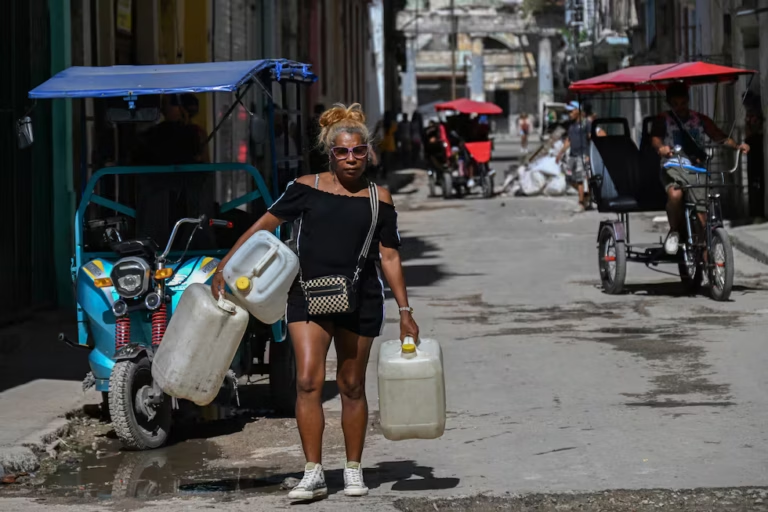
The oil embargo has made daily life for Cubans harder in every way. Foto: AFP
15 Jul 2026 – The irreversible decline of the U.S. empire’s global hegemony is not merely an economic or technological issue. Such an reductionist approach would prevent us from grasping the full scope and the many dimensions of this slow but inexorable decline. It is also a military issue: the inability to win wars, continually highlighted by analysts in that country and confirmed in recent days by the setback suffered by Washington (and its cronies in Tel Aviv) in the war against Iran.
It is also political, because one of the consequences of the dictatorship of capital that underlies the logic of the empire has been the growing dissatisfaction with bourgeois democracy, the practice of which has only served to make the rich exponentially wealthier and keep the vast majority of the U.S. population in poverty: that is, without universal access to quality public health care and education, decent housing, and a wide range of labor and social rights. This is one of the reasons why some sections of the American poor are increasingly inclined to seek and vote progressive or left-wing alternatives—alternatives that were denounced as “communist” by Donald Trump in his speech of the recent Fourth of July
And it is also a moral issue because societies—not only the United States but Western societies in general—seem to have been numbed into feeling no compassion whatsoever for the victims of the brutality unleashed by the genocide, ethnic cleansing, and theft of foreign territories carried out by the Israeli neo-fascist regime, with its indiscriminate attacks against defenseless civilian populations; or by the ruthless attacks that the United States and Israel launched against the Iranian population and the selective annihilation of Iran’s religious and political leadership; or by the U.S. bombing of a defenseless Caracas and the subsequent abduction of Nicolás Maduro, president of the Bolivarian Republic of Venezuela, and his wife, Congresswoman Cilia Flores. Outrageous acts, typical of monstrous characters like Adolf Hitler, which in their time drew near-universal condemnation today are “normalized” and accepted with indifference by the public—all thanks to the media scoundrels, the reign of algorithms, and the instruments of cognitive and volitional control that the ruling classes have at their disposal to subjugate the people and consolidate their supremacy.
Yet, the forms of genocide have evolved over time. The Nazi barbarism that led to the Holocaust of the Jews in Europe, or the ongoing massacre of the Palestinian people—especially women and children—coexist today with a more covert but no less criminal form of genocide: the policy of “sanctions” imposed by the United States and its unworthy European pawns against countless countries. Recently, a lecture by University of Chicago professor John Mearsheimer cited a study published in the prestigious British journal The Lancet, which reported the findings of a research on the medical and social consequences of “unilateral coercive measures” imposed on 152 countries between 1971 and 2021. The authors of the aforementioned study—Francisco Rodríguez, Silvio Rendón, and Mark Weisbrot—summarized their findings by stating that “unilateral sanctions are associated with an annual death toll of 564,258 people.” In other words, some 28 million people died as a result of the economic “sanctions” imposed by Washington over the course of half a century—just over a third of the casualties caused by World War II !. Consequently, we are witnessing a slow, invisible, and relentless genocide that provokes condemnation from only a small fraction of the global public. That is why the Chicago scholar speaks of “mass murder” caused by these policies.
Among the many countries that have suffered from them are Venezuela—especially since 2015—and Cuba, continuously since 1960, when the Eisenhower administration began imposing the first sanctions against the Cuban Revolution. The criminal intensification of the blockade decreed by Donald Trump and his Secretary of State, Marco Rubio, has taken things to an unprecedented extreme. In vain, the overwhelming majority of UN member states have been calling on the U.S. government for decades to end the blockade (which the empire’s spin doctors try to sugarcoat by referring to it as an “embargo” rather than a blockade).
The empire, whose brutality grows as its decline gains momentum, has ignored these demands and has continued to inflict “collective punishment” on the Cuban people, causing deaths and terrible suffering, especially among those in need of medical care. This is in addition to the punishment imposed by the blockade regarding oil supplies for the daily lives of the entire population: extremely long power outages, obstacles to mobility, shortages of essential goods, and the paralysis of institutions, from schools and universities to public hospitals.
From a strictly medical standpoint, it is important to note that Cuba—which had been among the countries with the lowest infant mortality rates in the world—saw a 148% increase between 2018 and 2025, rising from 4.0 per 1,000 live births to 9.9, according to a study released by the Center for Economic and Policy Research based in Washington. This surge means that approximately 1,800 Cuban children have died as a result of the blockade—a figure that pales in comparison when you add the deaths of patients who cannot access their cancer medications or drugs for the treatment of diabetes and many other chronic diseases.
In short, Washington’s policy is a war crime, and those responsible should be brought to trial, just as the regime’s leaders responsible for the genocide of the Jews were at the Nuremberg trials following the defeat of Nazism. Today we have another one underway—in Gaza, the West Bank, and southern Lebanon—which, however, does not provoke the outrage and condemnation that arose at the mid forties of the past century. To make matters worse, we find ourselves facing a society that has been numbed in its ability to think critically and react against the true mass murder caused by U.S. sanctions policies against Cuba, Venezuela, and numerous countries around the world.
This tacit acceptance of the blockade is one of the great accomplishments of the imperial “soft power.” Hence the urgency of waging the “war of ideas,” as Martí put it, urging us to win it “through the power of thought.” This means fighting with all our might against the dominant conventional wisdom and those who, like Pontius Pilate, wash their hands of this tragedy and turn a blind eye to it; also against the apathetic and those who worship depoliticization and retreat into selfish interests. In its decay, the empire has debased the societies of the collective West, fostering selfishness and rendering them insensitive to the suffering of their fellow human beings. The words that a young Gramsci used in his article titled “I Hate the Indifferent” are particularly relevant here. There he said, among other things, that “indifference is the dead weight of history. But indifference exerts a powerful influence on history. It operates passively, but it operates nonetheless. It is fate; that which cannot be told.” Or, we might add, that which can be told but is not told because the media landscape is dominated by the enemy, determined to cover up the crimes of the system. And Gramsci went on to say that “to live means to take sides. Whoever truly lives cannot fail to be a citizen and a partisan. Indifference and apathy are parasitism; they are cowardice; they are not life. That is why I hate the indifferent.” In that short article, Gramsci draws on the humanist legacy that Dante Alighieri imprinted in *The Divine Comedy* when he declared that “God had reserved the most horrendous circle of hell for those who, in times of moral crisis, had opted for neutrality.”
_________________________________________________
Atilio Boron is an Argentine sociologist, political scientist, professor and writer. He holds a PH.D. in Political Science from Harvard University.
Go to Original – resumen-english.org
Tags: Anti-hegemony, Anti-imperialism, Morality, West
DISCLAIMER: The statements, views and opinions expressed in pieces republished here are solely those of the authors and do not necessarily represent those of TMS. In accordance with title 17 U.S.C. section 107, this material is distributed without profit to those who have expressed a prior interest in receiving the included information for research and educational purposes. TMS has no affiliation whatsoever with the originator of this article nor is TMS endorsed or sponsored by the originator. “GO TO ORIGINAL” links are provided as a convenience to our readers and allow for verification of authenticity. However, as originating pages are often updated by their originating host sites, the versions posted may not match the versions our readers view when clicking the “GO TO ORIGINAL” links. This site contains copyrighted material the use of which has not always been specifically authorized by the copyright owner. We are making such material available in our efforts to advance understanding of environmental, political, human rights, economic, democracy, scientific, and social justice issues, etc. We believe this constitutes a ‘fair use’ of any such copyrighted material as provided for in section 107 of the US Copyright Law. In accordance with Title 17 U.S.C. Section 107, the material on this site is distributed without profit to those who have expressed a prior interest in receiving the included information for research and educational purposes. For more information go to: http://www.law.cornell.edu/uscode/17/107.shtml. If you wish to use copyrighted material from this site for purposes of your own that go beyond ‘fair use’, you must obtain permission from the copyright owner.
Join the discussion!
We welcome debate and dissent, but personal — ad hominem — attacks (on authors, other users or any individual), abuse and defamatory language will not be tolerated. Nor will we tolerate attempts to deliberately disrupt discussions. We aim to maintain an inviting space to focus on intelligent interactions and debates.