
I Was Part of the Protest March in Delhi–>Democratic Politics Took a New Turn
BRICS, 27 Jul 2026
Yogendra Yadav | The Indian Express - TRANSCEND Media Service
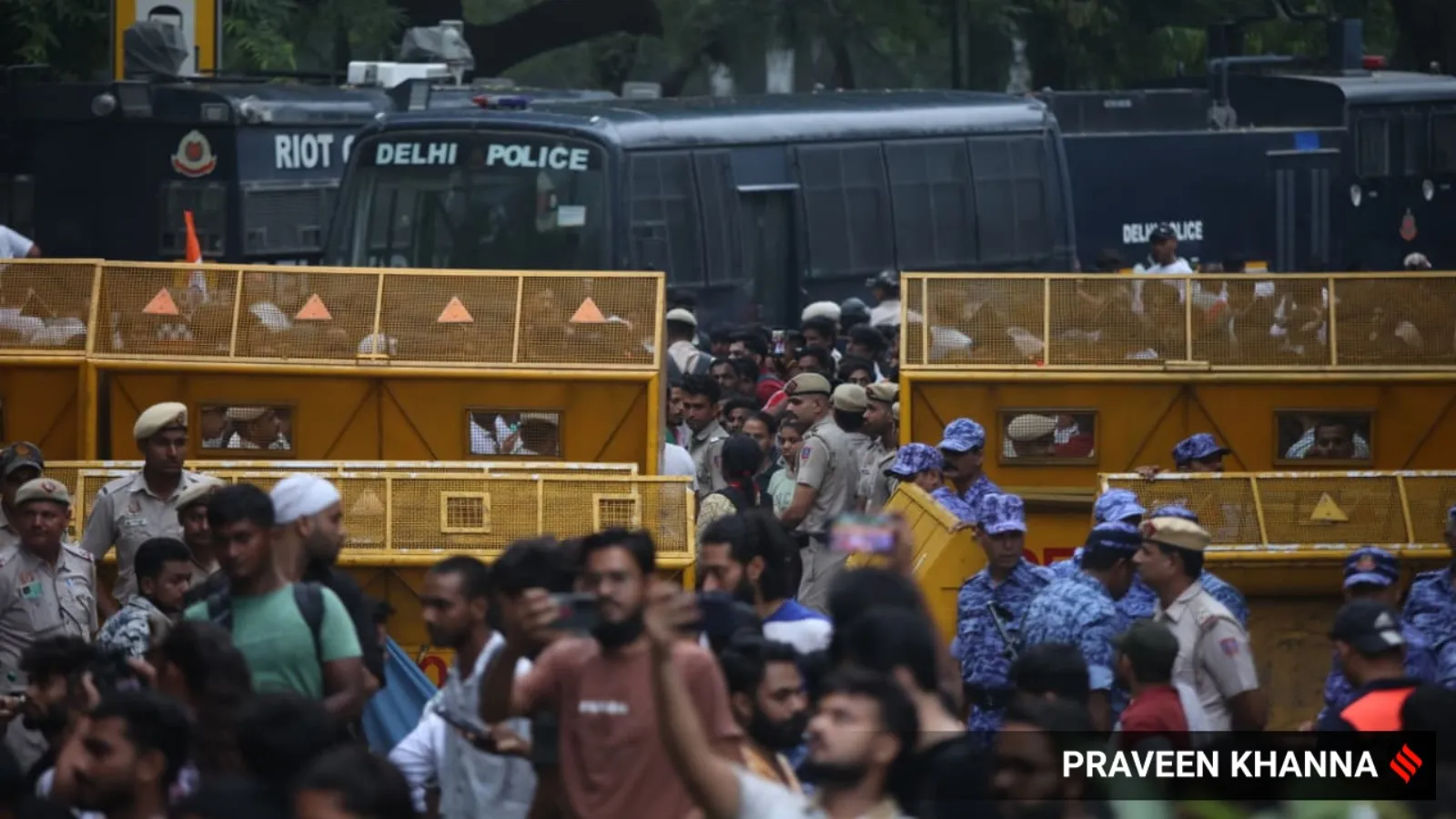
The lawyer told a three-judge bench presided over by Chief Justice of India Surya Kant, “the protest is already going on in Jantar Mantar”. (Express Photo by Praveen Khanna)
More than direct sufferers, the protesters were primarily potential sufferers, those who know that it could be their turn tomorrow, those who realise that the education-employment system has broken down.
22 Jul 2026 – The regime — and the silence — often made me wonder whether I’m completely crazy for coming back… But today — to see this democratic spirit which has been silenced for so long come back alive again — I feel whole again. Even if temporarily”.
I read these lines well past 3 am, still trying to process all that I had witnessed on the streets of Delhi this Monday. These lines, posted on X by Vanya Vaidehi Bhargav, herself a fine political theorist, captured why July 20 may be remembered in the history of Indian democracy.
This column has argued that as we slip from competitive authoritarianism to electoral autocracy, the focus of the Opposition must switch from electoral politics to a politics of resistance. Here are six reasons why the Jantar Mantar protest was a perfect illustration of what the politics of resistance may look like.
Firstly, the numbers. No one has a good estimate. But it was undoubtedly many times more than the 15,000-20,000 the organisers had hoped and planned for. Drone images suggest that well over a lakh joined this protest. Originally planned as a march, it turned into a rally, then a raila — a mass flow. By the afternoon, every road leading to Parliament and much of Lutyens’ Delhi was packed with the protesters. It was India’s “Occupy” moment.
Second, What made the numbers stand out even more is that this was an organic mobilisation. Far from the culture of rent-a-crowd political rallies or spectacles of organisational prowess, the Jantar Mantar protest comprised almost entirely self-mobilised youth responding to a social media call, arranging for their travel and walking long distances. The last time I witnessed this spontaneous synchronisation was the famous Republic Day tractor march organised by the farmers’ movement in 2021.
Third, notice their “utterly absurd diversity”, as a friend called it. I met a person who travelled from Arunachal Pradesh, a group of adults from Dharamshala in Himachal Pradesh, a wheel-chair bound student of Spanish, a group of girls from Dehradun, scores of boys and girls from all over UP, Bihar and MP, students from elite private universities, national public universities as well as time-pass colleges, and of course a large chunk of “aspirants” from Mukherjee Nagar and similar hotspots. The proportion of women was striking and exhilarating. These were not your usual suspects. An overwhelming majority were first-time participants in any protest. Their families mostly supported the BJP. So did they, till yesterday. That must worry the regime.
Fourth, the issue that brought them together was much larger and more enduring than just the recent paper leaks. There were, of course, students who suffered the NEET cancellation and the CBSE scam, parents who lost their children due to this fiasco, aspirants waiting indefinitely for jobs, and victims of recruitment scams. But more than direct sufferers, the protesters were primarily potential sufferers, those who know that it could be their turn tomorrow, those who realise that the education-employment system has broken down.
Anger against Minister Dharmendra Pradhan is only the tip of the iceberg. The underlying urge is for an equitable, meaningful and quality education and for a universal right to employment. It is after half a century — since the JP movement in Bihar in 1974 — that a youth protest has placed education and employment at the centre of the national agenda.
Fifth, the spirit of resistance goes beyond names and labels. Sonam Wangchuk is clearly their hero, but the hero-worship quotient is much more muted than during the Anna movement. The youth related to the CJP and its leadership, but were not shy to offer healthy criticism. They heard and cheered political leaders and activists from the podium, but were not swayed by any one personality. This democratic spirit augurs well for the future.
Sixth, the repeated chants of “Godi media, go back” were a reminder that the youth have found a way past the narratives of mainstream media. For the last one month, the Noida channels and the notional press more or less erased the protest at Jantar Mantar, when not mocking or demonising it. Yet every calculation of the regime and every narrative of its spin doctors was defied. Just as in the farmers’ movement, media black-outs actually spurred the participants into developing their parallel information channels through social media, word of mouth and WhatsApp. Their posters were punchy: “The true test of a democracy isn’t the protest. It’s how the state responds to it”. Their slogans were innovative. I heard this one for the first time: “Jab jab Modi darta hai, Hindu-Muslim karta hai”. The authoritarian narrative is being punctured.
Seventh, and above all, July 20 shows a fracturing of the spell of fear. Today’s youth understand the risks of surveillance and profiling under the present regime, something absent during the Ramlila Maidan mobilisation of the anti-corruption movement. That deterred many of them from coming to Jantar Mantar for the first two weeks. But somehow, something shattered it on Monday. Perhaps the safety of the crowd. Perhaps the adrenaline of hopelessness. Or maybe a faint hope. But these young people were not afraid of being heard, photographed or even tear-gassed.
Finally, in a way almost unnoticed, the movement could mark a new phase in the politics of social justice. The youth of India have come together in a movement led by a Dalit, Abhijeet Dipke, and inspired by an Adivasi, Sonam Wangchuk, one not limited to the stereotypical “SC/ST issues”. Instead of demanding its share in the nation, bahujan politics can now define what the nation is.
For many months now, I have been repeating a dialogue to anyone who asks me about the future of India: “Sawal ye nahin hai ki janata tanashahi ke khilaaf khari hogi ya nahin. Sawal sirf itna hai ki jab janata khari hogi tab tak kahin ham toh nahin baith jayenge”. Yesterday, I saw it unfold before my eyes. Janata was standing. And so was I.
______________________________________________
The writer is member of Swaraj India and national convenor for Bharat Jodo Abhiyaan.
Tags: Activism, BRICS, Civil Resistance, Corruption, Demonstrations, Gen Z, India, Police brutality, Protest movements, Youth
DISCLAIMER: The statements, views and opinions expressed in pieces republished here are solely those of the authors and do not necessarily represent those of TMS. In accordance with title 17 U.S.C. section 107, this material is distributed without profit to those who have expressed a prior interest in receiving the included information for research and educational purposes. TMS has no affiliation whatsoever with the originator of this article nor is TMS endorsed or sponsored by the originator. “GO TO ORIGINAL” links are provided as a convenience to our readers and allow for verification of authenticity. However, as originating pages are often updated by their originating host sites, the versions posted may not match the versions our readers view when clicking the “GO TO ORIGINAL” links. This site contains copyrighted material the use of which has not always been specifically authorized by the copyright owner. We are making such material available in our efforts to advance understanding of environmental, political, human rights, economic, democracy, scientific, and social justice issues, etc. We believe this constitutes a ‘fair use’ of any such copyrighted material as provided for in section 107 of the US Copyright Law. In accordance with Title 17 U.S.C. Section 107, the material on this site is distributed without profit to those who have expressed a prior interest in receiving the included information for research and educational purposes. For more information go to: http://www.law.cornell.edu/uscode/17/107.shtml. If you wish to use copyrighted material from this site for purposes of your own that go beyond ‘fair use’, you must obtain permission from the copyright owner.
Join the discussion!
We welcome debate and dissent, but personal — ad hominem — attacks (on authors, other users or any individual), abuse and defamatory language will not be tolerated. Nor will we tolerate attempts to deliberately disrupt discussions. We aim to maintain an inviting space to focus on intelligent interactions and debates.