


India: Teaching a Lesson
EDUCATION, 3 Aug 2026
Eram Agha | The Caravan/After the Truth-Shower - TRANSCEND Media Service
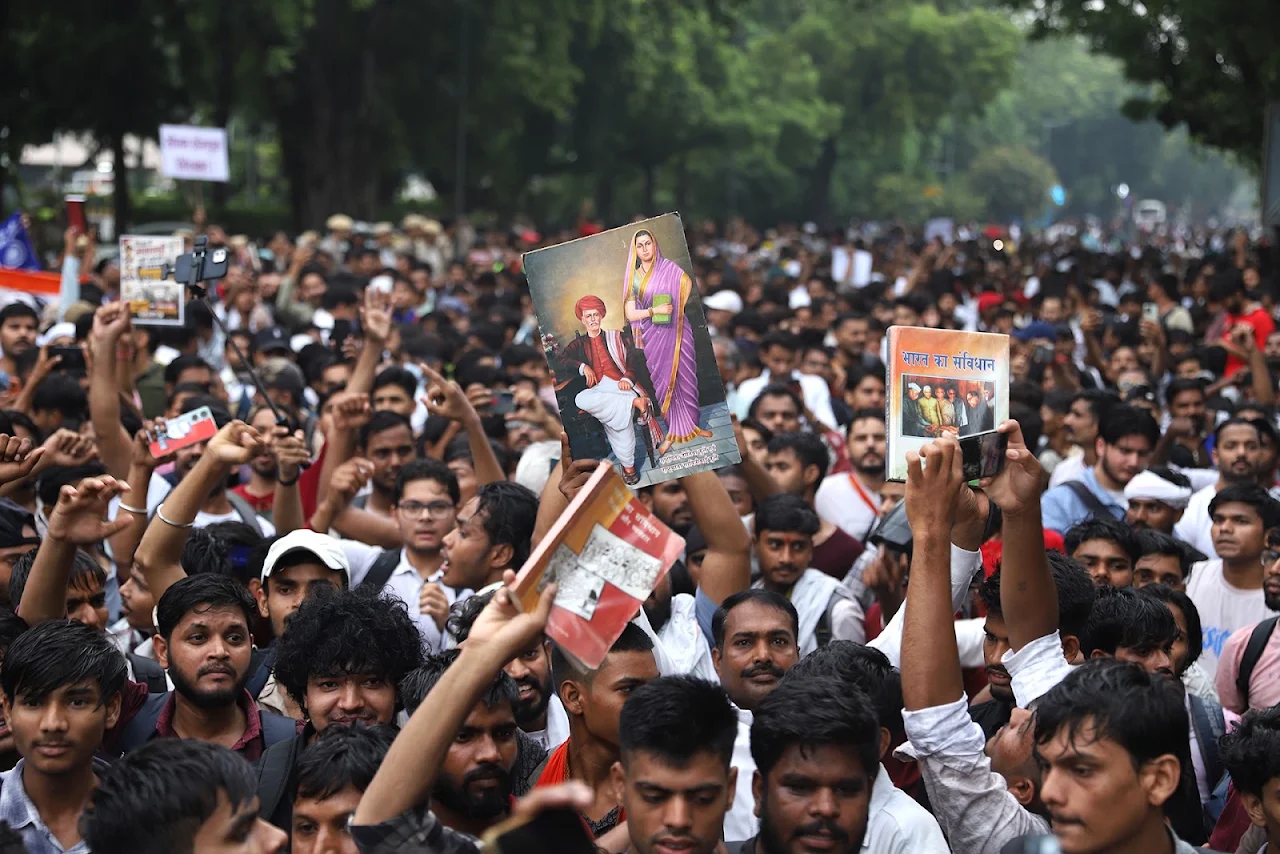
Student protesters carry a portrait of Jotirao and Savitribai Phule as they march towards parliament, on 20 July 2026. Nearly every student had some story of an ugly clash with India’s costly, bureaucratic and ultimately crumbling higher education system in the last five years.
Shahid Tantray for The Caravan
31 Jul 2026 – How the NEP’s killing of the public university brought Gen Z out on the streets.
(ONE}
GROWING UP IN THE 2000s, I hated the prospect of sitting for competitive entrance examinations. I only ever sat for two, and the entire process—studying for days under a cloud of anxiety, the nervous energy of those exam halls—made me want to bypass the process and enter the workforce early. Unlike my two sisters, I was not a very bright student. Luckily, getting into a government college in Lucknow was not a problem. We were admitted based on our twelfth-standard marks, and I just had to fill a form. Avadh Girls Degree College was only seven kilometres from my home. Later, my undergraduate marks were enough to get me into a master’s degree in political science in the same university. When I became a journalist, working in several of the city’s newspapers, one of my main beats was covering education. I had a chance to report from university towns such as Aligarh, before seeing how it worked in Delhi.
Things have changed drastically since my student days. With nearly every student interview I conducted over the past six months for this story, I found that the landscape had become so challenging that I feel certain, had I been dealt the same institutional cards, I would simply not have made it through the hoops the youth of today have to jump through.
Nearly forty percent of India’s 1.4 billion population is under the age of 25. To serve them, the higher-education department counts 52,397 colleges managed by 1,422 universities. The bulk of these are state-level public and private universities. State governments still account for about ninety percent of budget expenditure on education. This makes sense, because states whose demography and literacy levels are as starkly different as Kerala and Bihar need different education solutions.
Entrance systems have typically always been highly competitive. But for the majority of state colleges—for the humanities, sciences, commerce, engineering or medicine—your final twelfth-standard marks were enough to secure a seat. When institutions of national importance, such as the Indian Institutes of Technology and All India Institutes of Medical Sciences, popped up, they developed their own entrance exams. Some central universities, including the University of Hyderabad and Jawaharlal Nehru University, had their own exams too, along with affirmative action for those from marginalised backgrounds.
Over the past decade, the Narendra Modi government has attempted to centralise these multiple doors into higher education. Singular national examinations, organised by the National Testing Agency—an autonomous body under the department of higher education—were established in 2017. The official reason was vague. “If you are entering into any undergraduation, or any such phase, you will have to identify what competencies that student has to have,” MK Shridhar, a professor of management who co-authored the National Education Policy, 2020, told me. “If you leave it to each institution, their own assessment will be done in a completely different way. Therefore, we need to have some kind of a benchmarking for assessment of competencies. That’s how a centralised system like this has come.” But centralising examinations for a mammoth schooling system, which works across different syllabi, different languages and, crucially, vastly different quality from school to school, produces grave structural issues.
Medical entrances, among the first to be centralised, under the National Eligibility cum Entrance Test, were a portend of the effects this would have. The national exam had its syllabus determined by the Central Board of Secondary Education, completely alien to the nearly ninety percent of the population whose school education is run through different state syllabi. For those on social margins, the poor and the rural, coaching classes for the NEET are out of reach. Repeating the examination a year or two later—as only five percent ever get through and chances for a majority of students remain poor—is a hard thing for any student to justify to themselves and their families. Harder yet for the poor.
This year, the NEET for undergraduate entrances took place on 3 May for nearly 2.3 million aspirants but was cancelled ten days later, after it was found out the question paper had been leaked. After the examination was cancelled, at least a dozen students took their lives. According to the National Crime Records Bureau, student suicides have jumped eighty percent in the last decade—more than a hundred and twenty thousand over ten years—and over two thousand students die annually due to exam failures. Education has, for centuries, been understood as the only real path for upward mobility in India, emphasised across class, creed or region. Millions of families are willing to go deep into debt if it means ensuring their children get the right private tuitions, online classes and study material needed for them to get into a prestigious university and a well-paying profession. When question papers leak, or examinations are cancelled arbitrarily, or the machines on which students take them malfunction, the entire weight of pulling their families out of poverty comes crashing down on the candidates’ shoulders.
But, this time, the leak, and the subsequent suicides, unleashed something no one could have predicted. It became one of the triggers of widescale student protests in the national capital and across the country.
ON 20 JULY, tens of thousands of protesters, most of them students, thronged through the maze-like streets of central Delhi. The first day of parliament’s monsoon session was beginning with questions about leaked question papers. Two days earlier, Sonam Wangchuk, a 59-year-old education reformer and activist who had been on hunger strike since 28 June demanding the resignation of the union education minister, Dharmendra Pradhan, was picked up by the Delhi Police and forcefully transferred to hospital. The fast was on the stage of the Cockroach Janata Party, a meme-turned-protest movement that had camped at Jantar Mantar alongside various leftist and Ambedkarite student organisations. Over that month, the footfall at Jantar Mantar had been moderate, in the hundreds. After Wangchuk’s arrest, numbers began to swell. And nobody, not the Delhi Police, not the protesters, not the government, expected the numbers that showed up for the march to parliament.
Mobile internet services were suspended in the area. Officers of the Delhi Police, its special cell and from various paramilitary forces—many with their name badges removed, and others in plain clothes—repeatedly tear-gassed and beat the crowd with lathis. Rapid Action Force personnel shot protesters with pellet guns and used stun batons. Protesters noted that some lathis had been studded with nails. The thuggish violence did not seem to discriminate between young and old, with schoolchildren and the elderly all facing severe blows to their heads and limbs. More than a hundred people were hospitalised with various injuries, and around seventy were detained. Some detainees were beaten at the Parliament Street police station.
Despite the violence, the protesters did not retreat. I watched people pouring out of the New Delhi railway station, where thousands of young men and women had made their journeys in jam-packed train carriages. I met those that had travelled by train that night from Ranchi, Aligarh and Sikar. Some had, after the journey and scuffles with the police, fallen asleep in bus stops, their college bag their pillow. They hung like grapes from Lutyens Delhi’s garden walls, from the roofs of buses the Delhi Police had arranged as barricades and from atop Palika Bazar, the commercial heart of the city. A student I met had skipped a flight home, to Arunachal Pradesh, to join the protests. After the Delhi Police’s brutal crackdown, protests started in places as far away as Itanagar, Villupuram and Nagpur.
Nearly everyone I spoke to had some story of an ugly clash with India’s costly, bureaucratic and ultimately crumbling higher education system in the last five years.
Some parents sat by the roadside with their schoolchildren and tiffin boxes. Other children had hidden away their uniforms in their bags and joined in hordes. Equally truant office-goers asked not to be photographed because they had slipped out of their workplaces. A retired but far-from-frail schoolteacher, placard in hand, told me, “We’re old cockroaches, we’ve been here since Safdar Hashmi”—a street theatre activist from the 1970s. A teenager who had just written their final school exams said they had to hide and join the protests, because their family, which supported the ruling Bharatiya Janata Party, would beat them if they found out. Those adults who had arrived told reporters they had come for the future of their children, or a younger sibling. In a news debate show that evening, a former special director of the Intelligence Bureau exasperatedly admitted that his daughter had joined the protest too.
Nearly everyone I spoke to had some story of an ugly clash with India’s costly, bureaucratic and ultimately crumbling higher education system in the last five years. Two years ago, Shruthi Zode had travelled two hundred kilometres from her hometown to Nagpur, to sit for the Common University Entrance Test, which determines entrances to most colleges. The computer systems at the testing centre lagged, then switched off. She had to wait another year to enter college, a struggle for most young women for whom pressures to study locally or get married are never too far. Nandini Das, from Arunachal Pradesh and studying at Delhi University, complained that, in class, lessons on the Mahabharata had replaced her core subjects. Swagat Milin, studying in Mumbai, protested that his annual fees had risen to Rs 1.5 lakh for a single semester.
Tanvi, from Sikar in Rajasthan, was smarting from a muscle tear in her arm after being chased by police into the Life Insurance Corporation building and brutally beaten. “I saw at least ten people suffering severe head injuries right in front of my eyes,” she told me. “People’s faces were completely covered in blood. I also saw women being knocked to the ground in the street and beaten with shocking brutality. In the chaos, people’s clothes were torn, and slippers were scattered everywhere. They were screaming for help.” I had to help tie her hair before she spoke to me. She said she had joined the protest because her college’s principal had used casteist slurs to denigrate a fellow student.
Dipti, studying astrophysics, came because her university did not have sufficient laboratories or teachers to train her well and, instead of addressing these concerns, had rolled out absurd courses such as “The Art of Being Happy.” Shijjan Rehan, now a research assistant, had found that barely any of his classmates from four years of his Bachelor of Science course had joined a master’s programme. The university had thirty thousand students graduating but announced only eleven hundred postgraduate seats. The NEET paper leak was only a symptom, most students told me. A disease had hollowed out Indian higher education.
Nearly every one of the changes the students described to me was the direct result of a single document, the National Education Policy of 2020—the Modi government’s attempt to reshape all of education in its image. The florid, 66-page vision for a deregulated, private-led education system had been implemented by universities and administrative bodies into a confusing and fruitless set of challenges for India’s youth. Over the past six months, I reported from universities across the country, speaking to nearly a hundred students, professors, education ministry officials and policymakers about the monumental changes the NEP had brought in, riding roughshod over an already underfunded and poorly managed system, and somehow making it more opaque and unmanageable than before. What I found made it clear that a reckoning of the kind we saw on 20 July would have come regardless of the hunger strike or the march to parliament.
India’s universities had been teetering for years, starved of funds, their administrations replaced by poorly trained apparatchiks of the Sangh Parivar, and their academics essentially pushed out of designing curricula. Students had to face a different reality each year as the NEP made additional changes to entrance systems and course structures, while courses in core disciplines—such as history, physics or mathematics—were crowded out by poorly thought out “value addition courses” or by propagandistic classes about India’s imagined past glories. The degradation had pushed many towards private colleges and deemed-to-be-universities mushrooming across the country. The NEP allowed for multiple exits from the undergraduate system, which, alongside the sharp rise in education costs, had led to students leaving higher education at an unprecedented rate. Those affected most are the poor, marginalised communities and women. According to the education ministry’s All India Survey on Higher Education, undergraduate enrolment has fallen for the first time ever.
Once students made it out of this poorly organised system, the jobs were few and far between. Unemployment rates in India are at an all-time high. The NEP’s changes had made it easier for a miniscule minority to make it to US universities for postgraduate degrees or research roles. But the overwhelming result of its changes was visible in the other class of people spread across the protest site, who have precarious livelihoods and turn towards informal work or the gig economy. From the day after the violence, hundreds of Indians had placed orders, anonymously, on Zomato and Swiggy for food to be delivered to anyone at Jantar Mantar. Young men, also of the NEP generation, in red or orange delivery uniforms, milled about, offering burgers or biryanis to whoever would take them.
I remembered what Abha Dev Habib, a physics professor at Delhi University’s Miranda House college, had told me: “They want to make their own children global scholars, and make these children RSS pracharaks”—propagandists of the Rashtriya Swayamsevak Sangh, the BJP’s ideological fountainhead. “That’s what they want. You have human resources. If this human capital is not invested or cannot join knowledge production, then you are a market for cheap labour. You will produce gig workers for the global need. That is your loss.”
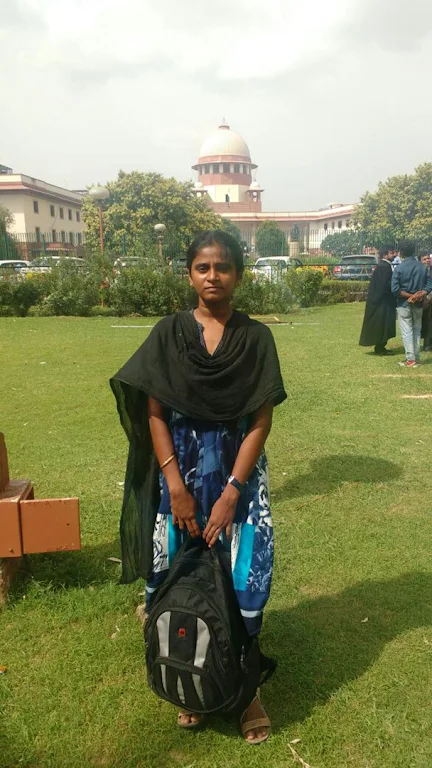
S Anitha on the Supreme Court lawns. The 17-year-old daughter of a daily-wage labourer was not able to get a medical seat because of NEET. She would go on to take her own life, after the Supreme Court made NEET binding, the first of many suicides linked to the exam.
Wikimedia Commons
{TWO}
THE STATISTICS ARE CLEAR that the centralisation of the examination system hurts the poor. The AK Rajan committee, set up to study the effects of NEET in Tamil Nadu, noted in its report that before NEET, 19.8 percent of those who got medical seats were from Tamil-medium schools. That fell to just 1.6 percent after the examination was introduced, in 2016. First-generation graduates dropped from 24.6 percent to 14.5 percent, while the representation of Dalits in undergraduate medical courses fell from a high of 5.24 percent to a low of 1.1 percent.
On 1 September 2017, Shanmugam Anitha, the 17-year-old daughter of a daily-wage labourer from Tamil Nadu, died by suicide. Despite living in abject poverty and lacking even a toilet in her house, she had done extremely well in the state’s twelfth-standard board examination, scoring 1,176 out of 1,200 marks. In the alien syllabus of NEET, however, she scored a mere 86 out of 700. When the state government challenged the exam in the Supreme Court, Anitha impleaded herself. When the court decided that only NEET would apply for the state’s medical colleges, she took her own life. Every year since, more teenagers have followed in her footsteps. The Common University Entrance Test took the problems that the NEET offered for the country’s 823 medical colleges and applied it to tens of thousands of arts, commerce and science colleges.
Elaiyakumar R, a research scholar at Delhi’s Jamia Millia Islamia who led the Students Federation of Dravidians, told me that the CUET had placed an inconceivable number of hurdles for those wanting to enter higher education. He said he had made it to Delhi only because a professor in Chennai had guided and mentored him through the process. “She helped me to fill the form, showed me how to prepare for the entrance exam and supported me to get the books,” he said. To apply, Elaiyakumar had to file his Aadhaar card, on which his name was misspelt, as it is for so many in the country. He nearly missed the application as he had lost the SIM card linked to his Aadhaar number. But he made it through. Kaliya, another SFD member at the university, found that among his Tamil classmates, nearly all were the children of “central government families, IAS, IPS officers” or others from the urban rich. Along with a handful of members from SFD, he now helps rural Bahujan youth get through the CUET gauntlet.
Elaiyakumar told me the first struggle was that few in rural India have even heard of the examination or knew enough to seriously prepare for it. Some state governments give coaching classes for exams such as the NEET, IITJEE and UPSC but not for the CUET. GK Yazhmozhi, one of the students the SFD mentored, told me that only three in her large school batch had even applied for the exam. “The CUET is also based on the CBSE syllabus,” Elaiyakumar told me. “Besides our state syllabus, an additional forty percent from another syllabus needs to be learnt. That’s an extra burden for the students. The question paper is now available in Tamil, but how about study material in Tamil? NCERT”—the National Council for Educational Research and Training, which publishes CBSE textbooks and sets the curriculum—“doesn’t give books in Tamil.”
To take the CUET, you have to spend Rs 1,000 for the three core papers, and Rs 400 more for each paper after that, with slight discounts for marginalised communities. The costs rise every year. “Each university has different eligibility criteria among the CUET papers for each course,” Kaliya told me. “If I want to apply for a BCom in Pondicherry University, which is also a central university, I have to only appear in one CUET exam, the one for commerce. But for the exact same course in Delhi University, I needed to have passed CUET in five different papers: commerce, math and the core papers.” He said that Delhi University and many others had released their admission guidelines, marking which CUET papers were required, after the exam results were already out. For many students, that meant another year wasted, just because the universities had been late in their communication.
Elaiyakumar began checking off on his hand the number of hurdles students faced in the application process. They needed to have an ABC ID—a bank of course credits that the NEP makes a core part of all higher education. In the latest application, a live photograph is mandatory, taken from your laptop or phone’s camera. Few students understand why, and many got rejected because the official photo they had already submitted was found by the system to look different. If you faced such issues, there was not much you could do. “If there is a technical issue like this, there is a toll-free number where they never pick up,” Elaiyakumar said. “And if they do, they’ll tell us to write an email with all of the complaints.” That was a task most of his Tamil-medium mentees struggled with, as the entire system was designed in Hindi and English alone. Of the many students the team mentored, only about twenty made it to the examination.
On exam day, the centres many students were assigned were far away, in neighbouring states or further afield. A Nagpur-based NEET applicant was assigned a centre in Abu Dhabi. Biometric sign-ins before the exam have been glitchy, having led to postponements just this year. The examination itself is made up of computerised multiple-choice questions. “Most are not familiar with computerised testing,” Nandita Narain, a retired mathematics professor from St Stephens College, told me. “We teach them these things in college, but, before that, they are coming from rural areas and somehow managing pen-and-paper Class 12 exams. Even the urban poor. So, you apply for this, but you go away saying ‘I can’t do this.’ Forty percent of the students who applied didn’t actually appear for the exam one year.” Kaliya told me the Tamil question papers did not even make sense, with many questions having been inaccurate Google translations of the English questions.
Students I had met at the protest had had their systems hang, not work until halfway through the exam, or blink off without reason, compelling them to study another year to get in. This is inconceivably harder for several young women, whose parents are already reticent to send them to study far from home and pressure them to marry instead. Sakshi Bhatia, from Haryana, whose examination had been cancelled because of glitches, told me, “For one year, my parents kept saying, ‘Why don’t you just study from some local college here?’” Some state colleges are still admitting based on twelfth-standard marks, a window that will likely close soon too. “We are also young women, no?” Bhatia said. “We have to get out of here. And then marriage tantrums they throw at us, if we are home.” The results of this are evident. Narain told me, “Professors from so many colleges have told me we are just not getting as many women.” In 2021, 54,818 women were admitted into Delhi University. The year following the introduction of the CUET, it fell to 34,120. That number has grown every year since, but is still nowhere near pre-CUET numbers.
AFTER THE CUET RESULTS ARRIVE, students still need to apply to each university individually. “Anna University has more than four hundred colleges. You fill one application form and you can choose any course from any of the colleges, and the counselling fees is the same—one application fee,” Elaiyakumar told me. “There are 49 central universities under CUET UG, and you have to fill 49 different forms. Again, each course has a separate fee.” The paperwork alone is enough to push many unfamiliar with computers, or those whose parents are themselves poorly literate, out of the system.
Narain had noticed the kind of students the CUET had brought her. Most had rote-learnt through what she described as a “coaching mafia” that had mushroomed across the country. “The quality of the testing was also such that it really didn’t test your analytical and verbal skills,” she said. “That is partly because they may have gone through COVID at the time of school education, but it’s not just that. It’s subsequent batches too. Their fundamentals are very weak, by and large.”
She also saw that the exam had clear regional biases. Apart from the Christian students, as hers was a minority institution, she said, “we got students in my college from only three states in the first year of the CUET: Haryana, UP and Rajasthan. Not a single Bengali, not a single south Indian.” Those south Indians that made it, she said, were brought up in Delhi. Narain told me it was likely a result of students from state boards getting sidelined in the examination, with coaching centres being prolific in these states.
“Even if they get it done via the university, there’s an order that comes from above, and the vice-chancellor, using his brute majority in the statutory bodies, sets up a committee not involving any teachers and then pushes it through. So, even if CUET on paper was not mandatory, every university followed it because the vice-chancellors are coming with a certain agenda.”
It was these regional divides that brought the CUET to Delhi University admissions. “The vice-chancellor had set up a committee of select principals and said that, because the different regional boards have different standards of marking, it’s not fair,” Narain told me. “Sometimes too many from one state—basically, people from Kerala—are doing well.” But there had been a normalisation process to adjust for how well different state boards scored their students. She also said students had come from everywhere, and those from Kerala were bright “because their state focuses on good school education.” With school marks now not being considered, she said, “They basically trash your school education completely, where people learn over a period of time, slowly, they develop writing skills, analytical skills. It’s not perfect, but it’s the best we have in the absence of anything else, and it recognises the class divide better.”
The NEP is a policy, and nothing it suggests is binding. This was a defence that Anurag Behar, the CEO of the Azim Premji Foundation and the founding vice-chancellor of Azim Premji University, who sat on the committee that authored it, gave me. “Where in the policy does it say CUET is compulsory?” he asked. It is up to the university to adopt the CUET. By the time I spoke to him, the students’ protests were in full swing, and many criticisms of the examination were being publicly aired. Behar said that the primary idea of the policy was to hand complete autonomy to the university and all of the prescribed changes—the four-year undergraduate course, the CUET, the multiple entries and exits, the reduction of postgraduate courses to a single year and the cancellation of MPhil degrees—were all mere suggestions. “Do you want students to write a hundred different entrance exams?” However, for the vast majority of undergraduate seats, entrance examinations had not really ever been required.
The way policymakers shrug off the results of their policy betrays the callous disregard for how any policy works in Modi’s India. “Even if they get it done via the university, there’s an order that comes from above, and the vice-chancellor, using his brute majority in the statutory bodies, sets up a committee not involving any teachers and then pushes it through,” Narain said. “So, even if CUET on paper was not mandatory, every university followed it because the vice-chancellors are coming with a certain agenda.”
The Modi government’s appointment of pliant, unqualified and ideologically aligned vice-chancellors to most of the country’s public universities is a widely reported fact. Many come from the Sangh Parivar, while others are unscrupulous bureaucrats who gained the trust of the regime in the past decade. A member of the NEP’s drafting committee, who wished to remain anonymous, told me how this played out. “It’s the silliness of these universities,” they said. “It’s like what they say about Emergency: ‘We asked them to bend and they started crawling.’ Many universities want to be in the good book of the ruling regime. And so, they implement something blindly, without thinking, and then they say, ‘Look, we were the first to implement it. We are your biggest followers.’”
As a result, the delays in the new admission processes were inordinate, poorly planned and confusing for students. Vainavi Vadnere, from Madhya Pradesh, had written the CUET in July, but there was no certainty about when the results would come out or when admissions would open in Delhi University. She joined Christ, a deemed university in Bengaluru, instead, which was costlier and further from where she wanted to be. The CUET results came out in September, and Delhi University opened its admission process even later. “Towards the last seven or ten days, the university found that they don’t have enough applications,” Mithuraaj Dhusiya, an English professor at Delhi University’s Hansraj College who also served on the university’s academic council, told me. “Then they came up with this new thing called the jhadu-pocha”—mop-up—“round, where CUET marks were not taken into consideration, only twelfth-grade marks were. Just imagine, same course, same college, same university, there are different criteria for admissions.”
Narain described how late October looked in her college. Usually buzzing with debates, overconfident musicians and excited romances at that time of year, it was quiet. The university was half empty. That NEP batch joined in December, she said, and would have to write their semester’s final exams two months later.
{THREE}
SABIHA JAVED DID NOT THINK she needed to prepare much for her second-year examinations. She had travelled from Shillong to study Arabic at Delhi’s prestigious Jawaharlal Nehru University. But, by her second year, language papers in their syllabus began being replaced by courses under the NEP’s new Indian Knowledge Systems programme. The programme’s goal was to preserve and promote Indian traditions of philosophy, science and arts by ruling that a certain number of credits each student required to get their degrees had to be from IKS courses. At JNU, the designing of these courses was handed over to a Chennai-based institution called Siddhanta Knowledge Foundation.
The foundation had no teachers in Delhi. They merely sent the students a link to their website on which a new video would be uploaded every other week. Sabiha was in their Bharatiya Knowledge Ecosystem course. “You just need to click on the video and it records your attendance,” she told me. “These are not even online classes. You can’t ask questions, do anything. We didn’t have to be in a classroom either. So, in hostel, we’ll just leave the video on and do whatever we want.”
She still watched all the videos before their final examination and felt reasonably prepared. They were asked to bring their laptops to the classroom where the examination would be conducted online. Once it started, she was distracted and looked to the side. A warning popped up. It had scanned the movement of her retinas and gave her a warning: if she looked away from the screen four more times, she would fail. Then the machine abruptly started reading even small gestures, a tilting of the neck, a straightening of the back, as looking away. After four more such warnings, she was barred from writing the exam.
Given the NEP changes, a lot more students would have to come to campuses. Every undergraduate college will now have four batches, not three. The post-NEP syllabus that universities hand out now include many more courses too—called Value Addition Courses and Skill Enhancement Courses, whose credits are required to get a degree. But, rather than strengthen and expand colleges to deal with this heavier burden, the education ministry has only tightened its purse. This stretches the university’s infrastructure, its teaching staff, classrooms, laboratories, libraries, toilets and public spaces to their limits.
Abha Dev Habib, the physics professor, pointed out the last few times the student body had increased in size, universities were aided in increasing their teaching capability too. “When 27-percent OBC reservation was brought in, they said they would increase the size of each university by 50 percent,” she told me. “They understood that inclusion shouldn’t mean exclusion, so universities were expanded and the Moily committee was set up to look into the needs of higher-education institutions. It recognised there should be a per-student grant, so every university got grants to increase their teaching staff and non-teaching staff and improve infrastructure. They were all hired around 2007.” She pointed out that the Modi government had also forced all colleges to admit students reserved under the new Economically Weaker Sections category—for upper-caste families with annual incomes less than Rs 8 lakh. “This resulted in a 25-percent expansion in the university, but no extra grant has been given. Similarly, now, in every college, you have about five hundred more people staying back for the fourth year, but no extra space or funds or teachers.”
With limited classrooms and more courses than before, professors are severely overstretched, with classes in some colleges going from 8 am to 8 pm. “Internally, if you speak to both teachers and students, you’ll realise that everyone is bloody tired,” Debaditya Bhattacharya, an assistant professor of English at Jamia, told me. “Nine courses for the student in a semester means 18 internal assessments that we have to do. You have increased everyone’s workload. If you go and speak to DU teachers, they say that we have to take a viva with every examination. For one examination to be taken by all students, you have to anyway repeat the examination four times, because you can’t fit them all in one schedule.” He said the result was that most professors simply gave up. “The unsaid policy across universities is to not fail students,” he said. “DU even made it official, announcing no first-year master’s students will be failed, to transition into the NEP model. I mean, you’ve made the entire university system a sham.”
The education ministry’s technique to deal with its overstretched universities has been a consistent push for online classes. Under the NEP’s advice, all scholars have to create an Academic Bank of Credits that is recognised by all universities. Then students from any university can take courses—called Massive Open Online Courses—taught in any other university in the country, by viewing videos of those classes on the education ministry’s SWAYAM portal. They write an online examination and get the same credits. Shridhar, the NEP co-author, spelt it out in as many words. “Whatever small universities we have, they have only so much resources,” he told me. “The number of students getting benefited are limited. So, why not upscale that? Our present regulations have made it that 40 percent of all courses can be online.” According to him, this “scale-up of the economy” would not only reduce costs but create vibrant spaces where universities can encourage students towards research and creating start-ups on the campus. “All of these are ways for the institution to earn revenue,” Shridhar said.
Far from incubating start-ups or expanding learning, students told me, online courses had actively hampered their education. Bishnu Jyoti, an Adivasi postgraduate in media studies, told me that his peers struggled with online courses. Many of his classmates at the University of Hyderabad, from marginalised backgrounds, did not have their own laptops. There were limited, but compulsory, online courses, which meant classmates had to borrow laptops from one another or miss the compulsory classes. “Even when we attended, we learnt nothing from it,” he told me. He said that one other Adivasi classmate had nearly left because of online learning. “That guy told me, ‘It’s not the COVID era anymore. Why the hell have I paid high fees and travelled so far to a prestigious university, if I just have to do online classes?’”
Now at JNU, Motghare saw postgraduate classes where the NEP model had not yet been introduced. He said the difference between the two was “classes in which you were not using your brains and classes in which you were using your brains.”
Rahul Motghare, a history postgraduate, told me that in his undergraduate programme, both his English and gender studies courses were online. “The lectures were merely recorded and uploaded,” he said. “It is not an interactive session at all. You can’t ask any questions. These are hard concepts, but you can’t understand. So most of my friends would just switch on the video and get on with their other work. There was no learning.” He said that when online examinations were introduced, most would have another device nearby on which they would find the answers for all the questions on ChatGPT.
This practice of switching on the videos, scrolling all the way to the end of the video to mark completion and then dealing with the examinations through ChatGPT on a second device was something scores of students from different universities across the country told me about. Now at JNU, Motghare saw postgraduate classes where the NEP model had not yet been introduced. He said the difference between the two was “classes in which you were not using your brains and classes in which you were using your brains.” Seeing what occurred to the JNU undergraduate language student, whose exam programme’s broken retina-scan system had failed her, it is an acute fear that any cracking down on cheating in online classes will only follow more punitive means, instead of recognising the pedagogical faults with the format itself.
Abha told me that online learning also weakened the sense of engagement students had with the university. “Engagement is precisely what keeps institutions accountable and intellectually rigorous,” she told me. “When students raise questions, institutions are compelled to reflect, respond and correct themselves. Now that process also disappears. It is like going somewhere simply to use a restroom. Even if it is dirty, you do what you need to do and leave. But imagine if you had to go there every day, and that place is meant to be your environment for seven years. Then your relationship to it would be entirely different. Then you will fight, no?”
Narain called massive online open courses “the most international discredited form of learning,” saying the government supported it simply to show that India had high enrolment numbers “while there is an actual decline in learning.” She said the move was only part of a much larger push to force private higher education onto Indian citizens. “The government doesn’t want to fund education,” she said. “They want to wash their hands off it. Teachers are where you spend—ninety-five percent of a university’s expenditure is on salaries. So what do you do when you want to reduce teachers? You go online. Online teaching allows you to reduce the number of teachers drastically.”
THE PUSH TOWARDS privatising higher education started in the 1990s. In 1994, India signed an agreement that created the World Trade Organization and the General Agreement on Trade in Services, which marked higher education as a tradable service, open to private profit-making. “The United Front government had started saying, in the ’90s, that higher education should pay for itself. It started then,” Narain said. But, then, the institutions guarding higher education had fought back. Narain recalled that Armaity Desai, the chairperson of the University Grants Commission at the time, had fought actively against it. Upendra Baxi had resigned as vice-chancellor of Delhi University to protest funding cuts. “They argued that education is a public good, it is the best way to alleviate poverty,” Narain said. “In all other poverty alleviation programs, money doesn’t reach the purpose for which it is supposed to reach. Education guarantees that alleviation. So, you encourage teachers, encourage talent to come in, fund it properly, and that is how you empower the people of the country.”
For the past 72 years, universities have gotten their funds from grants given by the University Grants Commission. Under the aegis of the NEP, the government hopes to end the UGC’s role as the regulator and grantee of universities, and replace it with a body called the Viksit Bharat Shiksha Adhishthan, whose primarily role is only to regulate universities and recognise degrees. It attempted to do this through the Viksit Bharat Shiksha Adhishthan Bill, which unifies the functions of the UGC, the National Council for Technical Education and the All India Council for Teachers Education under a single body. Introduced by Pradhan, in December 2025, it was forwarded to a joint parliamentary committee, where opposition leaders have criticised it for its over-centralisation, undermining of state autonomy and unclear financing provisions. The bill remains unpassed. “As an interim agent, the UGC is sending us absurd regulations but not releasing any funds,” Narain told me. “Now when we go to them, they say, ‘You approach the ministry directly for grants for payment of salaries.’” She said that, in some Delhi University colleges, teachers had not received their salaries for three months, with pensions to retirees also unpaid.
The NEP calls for all institutions to become self-financing and autonomous. It requires every university to create its own Institutional Development Plan, which, in its characteristically flowery but under-detailed words, is where “institutions will develop initiatives, assess their own progress, and reach the goals set therein.” Sridhar told me that grants to universities will be based on these IDPs. But no clarity has been given on how much or how little, or what is required in IDPs to demand extra funding. “The NEP says, ‘You are free from us, free from regulation, you can open new courses, you can have incubation centres, you can do this, you can do that,’” Abha told me. “However, for all of this, they haven’t spoken of any grant being given, and you will have to generate your own resources. This is basically pushing central universities towards a collapse.”
Given that grants are not currently being offered, universities have to find other sources of funds. This is most commonly achieved through raising fees. Bishnu, the media studies student, told me that, while his course only cost Rs 25,000 per semester, other public universities charged as much as Rs 85,000 per semester for the same course. “They increase it like this every year, and you find, as an obvious result, that every year more and more SC and ST seats lie vacant,” he told me. India’s education inflation is between ten and twelve percent, about double the rise in the consumer price index. “You have to look at the total expenses towards education,” Abha told me. “Students who don’t get hostels, stay in PGs—a small room shared by two will cost Rs 15,000 per student. So, apart from fees, a student ends up spending over Rs 2 lakh every year in an expensive city like Delhi.” Given that the NEP allows for students to drop out after their first or second year, rising fees make colleges an increasingly exclusive space.
Starved of funds, some universities seemed to even be trying to make up for the shortfall through fines. JNU, for example, had seen a sudden rise in the frequency with which it fined students and the cost of each fine, students had told me. K Gopika Babu, the vice-president of the student union, told me that she and some others had been protesting near the library. “Four of us, five of us were rusticated, but the rest of those students there have gotten a fine of Rs 19,000 each,” she said. “What is written in their office order is very funny to read. It says that ‘they were seen clapping.’ Clapping has cost them Rs 19,000 in fines.”
Gopika said that the university used to take disciplinary action through university statutes. But the current vice-chancellor, Santishree Dhulipudi Pandit, introduced a chief proctor’s office manual that allowed her to impose fines as she saw fit. “A simple quarrel between two students, both of them get fines of Rs 5,000. Others were fined Rs 5,000 each for pasting a flag of Palestine. If you look at the media reports, it suggests that how many lakhs the administration has extracted only on the basis of fines.” Sunil Yadav, the general secretary of the student union, told me that, following a protest, Pandit had humiliated students for paying such little in fees. “She told students, ‘You are beggars that you are studying for such less fees,’” he said. “She said there is a lot of pressure on her to increase the fees of JNU.” Neither JNU nor DU’s vice-chancellors responded to a detailed questionnaire from The Caravan. The ministry of education did not either.
Shridhar, the NEP co-author, told me the policy’s answer to the penury of universities was through loans from the Higher Education Financing Agency. The HEFA, using the funds of the education ministry and banks, would offer low-interest loans to colleges. Shridhar saw this as only natural. “Now the number of people taking loans for education has increased like anything,” he told me. But nearly every professor I spoke to saw HEFA loans as a non-answer to the crisis their colleges were facing. “Now it looks all good. The vice-chancellor is taking the loan, the principal is taking the loan,” Mithuraaj told me. “But when the time for repayment comes, none of these people will be there. They’ll be happily retired. It’ll be the students still there, and the teaching and non-teaching staff. Can any VC give it to us in writing that because of HEFA loans the fees of students won’t increase, that our future salaries will not be impacted? They won’t be able to.” He said that supporters of the government tell him that only a ten-percent interest must be paid. “The point is ten percent of crores of rupees can only be made by raising fees,” he said.
“For many students, once they take an exit from their studies, re-entering becomes extremely difficult. Even if they do return, they often fall behind academically. We are often unable to pick up from where we left off.”
“I don’t know much about the education policy and all, ma’am, but I can tell you what happened to me,” Devendra Suna, a zoology student from Maa Manikeshwari University in Odisha, told me. He was working at the pharmacy department of a hospital in Kerala. Days after his final twelfth-standard exams, the COVID-19 pandemic hit. His father, a daily-wage labourer, was getting old and could not work easily. “The situation became so difficult that everyone in the family was staying at home, and we even faced problems arranging basic necessities such as food and rations,” he told me. “Pursuing a graduation degree involves many expenses, including hostel fees, food costs, admission charges and semester-wise payments. We couldn’t manage that, so I went to work during the pandemic.”
After a year of work, he enrolled at a college. The pandemic batch of school graduates had received unusually high marks as correctors went light on them because they all had trouble with online learning. Thus Devendra, who faced harsher marking, got what he described as a “bad” college. “I find studying through online classes challenging, and many students struggle with this mode of learning,” he said. “After all, who can effectively study only through online classes? Because of this, I lost an entire academic year.”
Following his first fruitless year of a degree, with the situation growing worse at home, Devendra had to leave again. “My family depends on me financially,” he said. “They look to me for support, believing that if I earn, the family will be able to manage its daily needs. For many students, once they take an exit from their studies, re-entering becomes extremely difficult. Even if they do return, they often fall behind academically. They lose interest in studying, and it becomes hard to regain the mental preparation and momentum needed to continue. We are often unable to pick up from where we left off.” He still has not finished his four-year undergraduate programme. He described how many Scheduled Caste students like him depended on scholarships to re-enroll every year. But the scholarships never arrived, or arrived too late to fill in the next year’s forms. He wanted to pursue a master’s degree in zoology but did not know when an opportunity would come. As the government retreats from education—from 4.6 percent of the budget under the Manmohan Singh government falling consistently to 2.5 percent now—its effects, Devendra made clear, were felt farthest away from Delhi.
{FOUR}
“YOU TELL ME WHY I shouldn’t laugh at the Indian education system, ma’am,” Bhavyanshu Vashishth Pandey, an undergraduate at Delhi’s Ramjas College, told me. “We are in our first year, I am doing Hindi honours, and I am being taught diary-writing? We are taught this in Class 8, and they are teaching us this in UG. It’s a total waste of time.” The offending course had been part of one of his Value Addition Courses, a certain number of which are required to get a degree. “The teacher comes in, says, ‘This is how you write a diary. You write the date, you write some of your thoughts, then put a signature. The diary is done!’”
One of the NEP’s core goals is multidisciplinarity. “By 2040, all higher education institutions (HEIs) shall aim to become multidisciplinary institutions and shall aim to have larger student enrolments preferably in the thousands, for optimal use of infrastructure and resources, and for the creation of vibrant multidisciplinary communities,” it notes. “Since this process will take time, all HEIs will firstly plan to become multidisciplinary by 2030, and then gradually increase student strength to the desired levels.”
Both students and teachers I spoke to said that the effect of this push had been disastrous in two ways. It overburdened students with a lot of poorly thought-out courses. But, more dangerously, it critically reduced the amount of time that students would devote to their core subjects, meaning every new graduate in the country would know their subject significantly less than their predecessors. At Delhi University, for example, Abha told me that, under the old system, “148 credits in three years were there, out of which 108 credits came from the main discipline. Whereas, now, if you look at three years, then out of 132 credits only eighty to eighty-eight are core. So, you see the dilution there. The dilution is in the basic structure itself.”
Saikat Ghosh, an assistant professor at Sri Tegh Bahadur Khalsa College, told me that to attempt to compensate for this, the university had increased the number of discipline-specific courses in the fourth year. “What is the university’s estimate of retention in the fourth year?” he asked. “It is around thirty percent, isn’t it? Only about thirty percent of students are continuing into the fourth year, while the remaining seventy percent are exiting after three years.” Even for those who stay, the total number of hours taught in the core subjects is less than in the previous three-year programme.
Monami Basu, an associate professor of economics at Delhi University’s Kamala Nehru College, described the process through which these courses are established. “Every department’s committee of courses is asked to formulate the syllabus for a SEC and VAC,” she told me. This is then sent to a standing committee, she said, where “it can get rejected for reasons like overlap with other courses, readings which are dated, et cetera.” After that, it goes to the university’s academic council. “However, courses can be sent back to the COC or the department can be asked to drop the entire course, or topics within the course, or readings, for political and ideological reasons as well.”
“Actually, the problem is that any student can take any SEC or VAC from any other department,” Basu said. “And students are already so overburdened with seven courses in a year, so what happens is the students go for the easiest VAC and SEC—‘Art of Being Happy’ or whatever?” The course was likely offered by the psychology department for its own students, she said, “but now fifteen hundred students have applied for it. And now they are divided into batches of 60 and every teacher, even those from other departments, have to teach it. So, finally, what happens is people who have trained for several years in economics or physics or other disciplines, are now expected to spend several hours in the week teaching subjects completely unrelated to their core discipline. Courses like ‘Art of Being Happy,’ or ‘Fit India’ or ‘Emotional Intelligence.’”
Mahika S, from Gargi College’s commerce department, was one of the unfortunate students to have taken the course and have it be taught by a commerce teacher. “Like, even the professors were teaching for the sake of it,” she said. “She barely taught anything that was related to the art of being happy. They mostly just made us draw one thing that made us happy, one person we really liked—kindergarten assignments.”
SEC and VAC courses were also offered across the university without any understanding of whether it had the required infrastructure. Colleges offered apiculture courses without any bees. A student studying zoology at Miranda House, who wished to remain anonymous, told me she had excitedly jumped at a SEC about culturing zebrafish. “It’s a model organism used for genetic studies, specifically for embryological development,” she said. Soon after, she found that the college had no lab with zebrafish. She had just finished an entire semester of visual communication and photography as a SEC because it had been her long-time interest. “I thought I would learn the basics, shutter-speed, ISO, aperture and all,” she told me. “But the entire course was just talking and screening documentaries. It was only in the very last class that the teacher even brought a camera to the class.” She ended with the same phrase I had heard from plenty of other students: “Sab majboor hain”—Everyone is helpless.
THE MOST SUSPECT ELEMENT in the university’s pledge toward multidisciplinarity has been a range of SEC and VAC courses about Modi’s flagship policies. Both Swachh Bharat and Fit India—campaigns promoting cleanliness and fitness, respectively—are VAC courses at Delhi University. Ananya, a political-science student who had just taken the former course, told me it was inane propaganda. “In the class, the lady just read out of the aims and objective of Swachh Bharat, very generic stuff. It seemed like a Wikipedia class,” she told me. “If there was a course on public policy, and one class we did on Swachh Bharat, and others on something else, that would make sense. But an entire course of just PPTs? Nobody was listening to her. Nobody gave a damn about it. Everybody was just doing their assignments from other courses.” She said what she missed was a critical lens. “If you have a professor who is critical, who looks at whether the toilets were delivered or not, whether open defecation ended or not, the ground realities, then you can learn something.” Without that, it merely seemed like you were learning the same praise for the prime minister that any primetime television segment could have told you.
Basu said that Delhi University did have skill enhancement courses before this, but they were department specific. “Earlier, we would have research methodology courses, or economic data courses, which would help them,” she said. Mithuraaj told me, “SEC was earlier attached to departments. Now they are choosing SEC and VAC of non-sciences so that they don’t have to do labs. Ultimately, it’s impacting science in a very negative way.” Pandey, the Hindi undergraduate, said that everyone just chose those SECs and VACs where no assessments were done. The courses without an exam meant they could simply ignore the course for the whole year.
Narain told me that the slow destruction of the university’s syllabus was a result of academics being pushed out of designing them. The determination of syllabi was historically a complex but democratic process. The UGC would offer broad guidelines, but “the university had complete autonomy about how to frame its courses within that framework,” she said. “The committee of courses is a statutory body in which you have representation from every college, with college teachers by rotation. You have the departmental representatives, and they all put together a syllabus. You know there was lot of consultation that used to happen, and we always try to make it better by demanding greater democratisation. Some departments were better at that than others, of course.”
“Now what is happening is that some syllabi are made from somewhere and sent and just forced on us,” she said. “The structure is sent from there and you cannot say no. And then, even within that structure, the details, the vice-chancellor has his political henchman who will push through deletions and additions to suit a particular right-wing agenda. This has been an absolute disaster.” It still formally works under the old structure that established the university in law. “Departments would earlier make the course and then peer reviews were done,” Abha told me. “The best of the people in the country would review whether the syllabus was holistic or not. That was important. Now what is happening is BJP people are sitting in the standing committee or in academic council, and they are hounding.”
After the department, the course heads up to the academic council, which has officers of the university, heads of departments and eight principals by rotation. Of a body of 160, only 26 are elected directly by teachers. “One would hope that when you have raised a question there, logic will prevail to decide what to do,” Abha said. “But often it is like a policy assault. Whether CUET, four-year undergraduate programme, semesterisation earlier, we see that when the VC brings an agenda, the people are well aware of that this is coming from the government, it is coming from the VC. I mean they should actually represent their own subjects and the views of the teachers of their discipline, but they surrender that autonomy.”
At the department level itself, courses were trimmed of anything that may offend the ideology of the BJP. Abha said, “Heads of the department are shouted at and asked, ‘Yeh gender nahin padhwana hai, yeh aap caste ko kyon padha rahe hain?’”—Don’t teach about gender, why are you teaching about caste? She said they also pushed against the inclusion of readings by any academic seen as left-leaning. “They ask, ‘Why are you making a reference to Nandini Sundar here? Why have you included Nivedita Menon’s piece?’ Earlier this kind of scrutiny was not there.”
“We get calls from the ministry too, to change syllabus. And it is no longer the education ministry of a secular country.”
As a result of the NEP, “the university wants the syllabus to be reframed overnight or want everything to be done quickly,” Abha said. “Then the participation at the department level has also gone down.” The substantial changes required have essentially empowered the VC to rule by diktat, to a large extent. “Norms are generally not being followed,” she said. “You see the minutes of the Academic Council meeting. You will see the first thing written is that this AC empowers the vice chancellor to change the syllabus. How can a body give up its role and assign that to the VC? What is happening is the BJP and RSS’s people will come and ask, ‘Why are they teaching this topic?’ And the VC calls the head of the department and tells them to remove it. ‘Remove Allama Iqbal from the syllabus.’” Iqbal, a Muslim scholar and national poet of Pakistan, is bound to be a no-go zone in a Hindu-nationalist education system. Abha said it was not even academics from the National Democratic Teachers’ Front—an RSS affiliate—that determined the courses they taught anymore; it was anybody from the RSS or its student body, the Akhil Bharatiya Vidyarti Parishad, that could twist arms. “We get calls from the ministry too, to change syllabus,” she told me. “And it is no longer the education ministry of a secular country.”
Students across universities told me about the speed at which their syllabi had been rid of anything that irked conservative Hindu sensibilities and replaced by the valorisation of Hindu figures from the past. Ananya, the political-science student, said she was surprised when she saw that an entire core course was added to her sixth semester, called “Understanding Savarkar.” VD Savarkar is a demagogue who first framed Hindutva as a political tool. “It was an embarrassing paper to read,” she told me. It just had six units with broad headlines like ‘Savarkar and Indian Historiography,’ ‘Savarkar and Language Questions in India,’ with no material about it.
Ananya said, “But I had a good professor, who was critical, and she said, ‘Let us look into it, what this Savarkar guy actually has to say.’” The professor helped them plumb into Savarkar’s imagination and see when his ideas were worryingly violent. “But then she said, ‘When you write your exams, be very careful. You do not know who will check your answer. If you say the same thing that I am saying, there will be people in the department who will straight away deduct your marks,’” Ananya told me. “I straight up just wrote some of his quotes. I did not write anything critical. It was a pretty spineless move, but I could not do anything.”
The new NEP-prescribed syllabus also severely weakened English as a subject, attempting to replace them with Hindi. One of the NEP’s core goals is the creation of “more HEIs across India that offer medium of instruction or programmes in local/Indian languages.” Ajay Gudavarthy, a professor of political science at JNU, told me that both those on the “Lohia Left” and the Right had kept pushing for a switch to Hindi, away from English. “Amit Shah says, ‘I will create a situation where people speaking in English will feel ashamed,’” he told me. “Obviously they are pushing this whole anti-English thing as if it’s anti-imperial—the optics of it looks like that. But is vernacular not linked to caste? There are power dynamics, caste dynamics are embedded in vernacular.” He said Dalit communities wanted “to escape by learning English. They feel they will have better cultural capital by learning English. It has become a mass language. It’s a mass aspiration, maybe it is more of an economic infrastructure than colonial legacy.”
But the anti-English push has already begun. “Ability Enhancement Courses in English are not being taught in Delhi University, unlike in every other central and state university,” Mithuraaj told me. “It was there, but it was taken away by people with vested interests. See, there is no problem with vernacular languages or Hindi language. Teach them, but why at the cost of English? Earlier, when they could choose any language, English, Hindi or Sanskrit, ninety-five percent of them opted for English. But they want to stop that.” He felt it had done a great disservice to the job prospects of his students and had brought it up in the university’s academic council, only to be shouted down. “Somehow, those in power feel that English is corrupting,” he told me. “You know there is this dichotomy deliberately built between Western civilisation and Indian civilisation. Now somebody should ask, ‘Brother, is what you eat Indian, are your clothes Indian? Is the mobile you use Indian? Its software is Western.’ But that they want to ignore. It feels like they want to take us back a hundred years.”
THE ADDITION of SEC and VAC courses, as well as the more politically driven new offerings, had pushed academically rigorous core courses to the side. Nearly every teacher I spoke to warned about the effect of this. They felt that while students paid more now in fees, they got back much less expertise in their subjects than ever before. “The credits of core courses have gone down,” Mithuraaj told me. “Earlier they used to study five units—that is, five hours [a week] in their core courses. Now they study just three hours in those subjects.”
Narain told me that while core subjects were about eighty percent of the degree in the past, they now made up only about fifty percent. She said she had expected that the government would be able to severely compromise the syllabi of history or sociology, subjects laden heavier with Hindutva grouses, but was surprised that even something as unoffending as the mathematics syllabus was severely weakened. “Mathematics was revolutionised in the world in the twentieth century and it filtered down to India by the middle of that century,” she told me. “So, when we came as students, the bulk of our papers were modern pure mathematics, analysis, modern algebra and so on. Mathematics in the world is basically now resting on two pillars of modern pure mathematics, analysis and algebra. From the ’60s, DU also modernised, making 11 out of 14 papers analysis and algebra. So, all old papers like mechanics, hydrostatics, coordinate geometry and differential equations were eased out all over the world. Now classical mathematics is where you do calculations and all, but now these things can be done by computers. You don’t need the human mind so much for that.”
Narain said that, in the post-NEP syllabus, “modern pure maths has been reduced almost to zero.” From 11 courses between analysis and algebra, it has reached a state where analysis appears only in one paper in the seventh semester. Instead, “They have mostly either classical stuff or Indian Knowledge System stuff. How Bharatiyas did sequences and series. So, our students are going to be illiterate. They are teaching things we have abandoned sixty or seventy years ago. Because the people making the syllabus, nobody knows who they are. There must be some RSS fellows who never studied modern maths.”
Mithuraaj told me that the undermining of core subjects had starved students of their appetite for research. They simply lacked the competence to enter research, though the fourth year was added specifically to allow for undergraduates to publish research papers. As in the past, teachers like him often spoke to industry leaders about what they wanted from graduates, what forms of training. “I mean, even the corporate people, the ones who give jobs, ask ‘what is your specialisation?’” he told me. “And in this system, you can’t have a core or a specialisation in these four years. Job creation under NEP is a mirage, it’s a dream. In the earlier system too it was not easy to get a job, but at least their core subjects were strong. Now the basics have totally gone.”
I asked every teacher who told me about weakening cores why they thought the government was pursuing this policy. There were only a few hazarded guesses—some about cost, the others about a lack of expertise at the top. Narain had another explanation. “You may think this is me being a conspiracy theorist, but I think there is a method in the madness here,” she told me. “The thing is, all these papers of modern pure mathematics are the ones that teach you to think. The whole thing is about reasoning, logic, being able to point out flawed logic and so on. It’s these courses which will make students think independently, develop their cognitive abilities. That’s what is being removed all together. The students are just left as calculating machines.” An ideal student for a regime that found dissent to be anathema.
{FIVE}
“WE RENOUNCE INTERNATIONAL SCIENCE,” one of the most famous speeches of the Gleichschaltung—Nazi Germany’s attempt to re-order society in its image—regarding education goes.
We renounce research for its own sake. We teach and learn medicine not to increase the number of known microbes but to keep the German people strong and healthy. We teach and learn history not to say how things actually happened but to instruct the German people from the past. We teach and learn the sciences not to discover abstract laws but to sharpen the implements of the German people in their competition with other peoples.
The speech was given by the historian Ulrich Kahrstedt in 1934, a year after the Nazis came to power, with universities being among the first spaces they cracked down on. The University of Berlin lost a third of its academic staff and the rest of the academic community, by and large, submitted without protest to the new dispensation. The core goal of academia was no longer knowledge that was useful, or that would better oneself. It was knowledge with the right level of Germanness.
Similarly, the Indianness of education is at the heart of the NEP. “The rich heritage of ancient and eternal Indian knowledge and thought has been a guiding light for this Policy,” it notes. After listing 18 prehistoric sages, it adds that India’s knowledge, its “rich legacies to world heritage must not only be nurtured and preserved for posterity but also researched, enhanced, and put to new uses through our education system.” Created to handle this goal was the education ministry’s Indian Knowledge Systems Division.
Ganti Suryanarayana Murthy, a professor at IIT Indore who is the division’s national coordinator, told me the goal was essentially to have every student leaving college with at least a minor degree in how India understood a certain topic in the past. “So, let’s say a student is studying BA or BCom in economics,” he said. “Then that student can actually take one additional course per semester and at the end of their degrees they can get an IKS minor in economics. That is to understand how was economics was looked at in India. How did we look at the financing? How did we do the accounting? Let them understand that.”
Murthy said his division had a budget of about Rs 80 crore, which was spent on creating courses, training teachers and running some five hundred research projects. He kept insisting his division “cannot force anybody to take any course that we develop.” Murthy said the main problem was that teachers did not meet the IKS mark. “It’s not the fault of the teachers or faculty or anything like that. See, we are all trained in the Western methodology and things like that, then you ask somebody to teach about IKS. What will they do?”
The division found early suitors in a handful of IITs where they had IKS Faculty Development Programmes. “There are four hundred hours of videos that we have put together, high quality videos, 18-day FDPs that we have conducted in IIT Kharagpur, available online,” Murthy said. Following this, in 2023, the division held six such FDPs in different regions, including Chennai, Lucknow, Guwahati and Srinagar. “Then we told the UGC, ‘You have many universities that are going to be the teaching the IKS, so collaborate with us. We can train teachers and you can send them.’” But the UGC had a big ask, the training of ten thousand teachers, something out of the division’s bandwidth.
Shikha Srivastava, a botany teacher at Bhaskarachaya College of Applied Science, was an enthusiastic member of this first batch. In October 2023, she joined a WhatsApp channel the UGC. “In the group, the then chairman of UGC, Mamidala Jagadesh Kumar, posted saying that IKS-related training is set to start for the first time,” she told me. Her principal immediately gave her leave to go.
“All our IKS master trainers were top-class, Grade A. And all of them understand this main point: whatever our future as a developed India will be, it will only come by following dharma.”
“In that basic training, there were teachers from all the streams and all other places,” Srivastava told me. “For those ten days, Sanskrit, literatures, linguistics, and everything chemistry, physics, people from every stream you can imagine—senior, juniors—were there.” Murthy told me the first batch had about two hundred people. After six days of the course, where bits of lost Indian knowledge were presented, they were given a quick test and handed an IKS certificate. Srivastava, a devout reader of the Vedas who mourned that curricula did not cover them, was delighted. “After that, whatever instinct within me, whatever push I needed, I got it,” she said.
In three months, Srivastava was invited to Bhopal for “master level training in IKS.” That was a one-week course, which, too, had a mix of disciplines. They were then divided into discipline-specific trainings, for just three days. Srivastava was very interested in the bits of Ayurveda they taught—having researched plants with medicinal properties all her life—but she was sorted into a group with agriculture, botany and water management teachers.
Her training, at IIT Indore, was by academics the IKS division brought. Ganti Murthy taught her briefly, as did an “expert on ancient water management,” from Gujarat. “All our IKS master trainers were top-class, Grade A,” Srivastava told me. “And all of them understand this main point: whatever our future as a developed India will be, it will only come by following dharma. But to explain this simple idea, we still need to make a lot of effort. You need to understand what dharma truly is, and what adharma is. And adharma will inevitably lead you toward destruction.” Murthy said that, after the three-day course, “we gave them materials, videos, all of those things and then said, ‘You please now try to teach.’ Then we said to UGC, ‘These are your two hundred master trainers from all parts of the country, and now you take care. You train your ten thousand people.’” The training was conducted under the education ministry’s Pandit Malaviya Mission Teacher Training Programme which aims to “transform higher education by integrating Indian values and ethos into teaching, research, publications, patents, and institutional development.”
But when Srivastava had to teach other trainers, she was given very little space. “We were first-level master trainers, and we were simply given a predefined set of slides,” she told me. “We objected, saying that we should be allowed to create our own slides, but they responded that their challenge is: who will sit and review so many slides to check where the mistakes are? But even beyond the slides, they included a video and said it should be played, and we stopped it and interacted, so participants got bored and participants gave bad feedback.” She also said that training sessions happen when the semester is in session, making it hard for trainers like her.
Srivastava was deeply suspicious of some other IKS trainers. “In the name of IKS, a lot of people have come in and, honestly, it often feels like their delivery isn’t strong,” she told me. “I’ve observed this during our presentations. The thing is, you can’t just pass on WhatsApp-level information anywhere to anyone.” She was not wrong. Another master-level IKS trainer, with a straight face, had told me that the Pythagorean theorem was an Indian invention, while another told me that humans had a third eye they could open if you did yoga, and a third assured me that a sugarcane harvest would be more bountiful after a Hindu prayer.
Srivastava’s own claims though were not much more rigorous. She had soon started an IKS club, which holds regular seminars on days of religious importance to Hindus. Some keynote lectures included “The Neuroscience of Mantra Chanting,” “The Importance of Inner Silence,” “Karma Yoga in the Bhagwat Gita” and “Natya Sastra, the Oldest Form of Performing Art.”
Most accomplished teachers I spoke to told me that there was knowledge that could be gained from India’s vast diversity of cultures and histories. “As a historian, I know that, for centuries, the Indian subcontinent has nurtured not one kind of system, tradition, practices or custom, but a multitude of them,” Maya John, an assistant professor at Delhi University’s Jesus and Mary College, told me. “But the focus is on just Brahminical traditions, which is something that the RSS peddles in contestation with the heterodox traditions such as Buddhism, Jainism, the more materialistic philosophies and, you know, traditions of the Charvaka, et cetera. This paradigm that has a singular notion of Indian culture—this is India’s past—that is what the RSS wants to ensure is being taught in our classes and is driving the research agenda.”
Murthy told me that the goal of his division was to “neither glorify, nor dismiss” Indian traditions. But, in its implementation, an absolutely uncritical appreciation for all things mythically ancient was so patently visible. He also said his department looks at India’s many heterodox traditions, pointing me to the video courses present on their website. But among the courses on offer on their website were the likes of “Bhagavad Gita-A Guide for Holistic Wellbeing” and “Comprehending India Through Ramayana.”
Course-making itself had largely been subcontracted out, with the IKS division recognising 91 IKS centres that could make material for them. This includes a clutch of Sanskrit universities but also plenty of private foundations such as the Siddhanta Knowledge Foundation, which manages JNU’s IKS curriculum. Murthy told me the Shiksha Prashikshan Kendra—a wing of his department—had sanctioned almost Rs 30 lakh to Siddhantha for the project. Siddhanta Foundation is the social and educational arm of the Jhaver Group, a conglomerate with interests in pharmaceuticals and agrochemicals. The manufacturing company had seemingly shifted its focus to Indic philosophy, positioning itself as a curriculum- and content-provider for the integration of IKS and Vedic philosophy directly into college syllabi.
Sujoy Bhadra, a student at JNU’s School of Languages, told me that when he saw an IKS course was compulsory, he opted for “Yoga and Wellness” because, unlike Siddhantha’s courses, it was not online. “But they forced me into a Siddhantha course,” he said. He was given an ID on Siddhantha’s website where they uploaded a few videos, which he did not have access to after the course ended. “I don’t think they are teaching,” he added. “Nobody really watches the videos.”
“The lectures were mainly about Nyaya Shastra and emphasised how great our civilisation was,” Awant Patel, a first-year student of Chinese, told me. “And, in those online Siddhanta courses, they would sometimes justify the caste system as well. For example, they would argue that caste divisions were originally based on duties and occupations, and that caste discrimination did not arise from the system itself.” Bhadra and others had protested after their experience, asking for Siddhantha courses to be removed. “They are still there,” he said. “Instead, they said they would add some new courses. One course is titled ‘Ideal State and Governance in the Ramayana.’ Essentially, it is about Ram Rajya. These are conducted offline. One of my friends had taken a course called ‘Governance and Public Wealth in the Mahabharata.’”
Anil Sahasrabudhe, who chairs the National Educational Technology Forum, told me that students would be encouraged to follow up on their IKS courses after leaving university too. Many of the IKS trainers “are knowledgeable, and students can choose to go for internships with them,” he said. “We give them even stipend for doing internship in a university college or even with some of the people who may not be formally associated with academic institutions but have knowledge. You know people who run some gurukuls”—modelled on ancient Indian schools under the mentorship of a guru—“we have more than five thousand students. They are not IIT alone. IIT may be few. We have hundreds of colleges, you know, engineering colleges. Those students are going. Even science college students are going.”
INTERNSHIPS HAVE BEEN the largest promise the government has to offer students who make it through the dilapidated college system. After facing a setback in the 2024 general election, Modi’s flagship announcement was the Prime Minister Internship Scheme, with the finance minister announcing that, over the next five years, 10 million youth would get internships in five hundred companies. The government never made it explicit, but those internships were supposed to convert into jobs. Two years later, only sixteen thousand youth have been enrolled under the scheme, with many dropping out midway, in a country where between seven and ten million enter the labour market every year.
It was no wonder that the CJP protests saw such scorn and abuse targeting Modi in its placards and slogans. This indignant humour is something that came up in a seminar Srivastava’s IKS club had organised, titled “Is Sanskrit Still Relevant in Modern Times.” The seminar argued that it absolutely is but that people simply were not showing enough interest. “Everyone is restless, everyone is in a state of chaos,” a participant said. “People do not have the words to express themselves, so they end up using whatever words they can.” The answer prescribed was learning Sanskrit. “A person who regularly recites and practises Sanskrit naturally develops a sense of tolerance,” Srivastava replied. “In all my years of life, I have never come across someone deeply engaged in Sanskrit recitation who was violent by nature.” Another participant knew just what would solve the problem. She said that we have to “create incentives around Sanskrit in such a way that knowing Sanskrit enhances one’s prestige and social standing within one’s peer group.”
I remembered Elaiyakumar telling me about a time Sanskrit had enhanced one’s prestige and social standing. “In 1920, even though medical courses were taught in English, you had to pass a Sanskrit exam to get into medicine,” he told me. “But the Justice Party in the 1920s removed this. Then, subsequent governments in Tamil Nadu removed more and more of these bottlenecks. They removed entrance exams that were too hard, regulations that made it harder for us. Remember, we were denied education not just for decades but for centuries. To break that system, you have to break these bottlenecks.” He told me all he had seen in the past five years were the addition of more bottlenecks, the restriction of quality education from the most marginalised.
For those pushed out of the system, the starkness of the opportunities India’s education provided was clear. The ministers of Modi’s own government had left it to fester while arranging foreign degrees for their children. Dharmendra Pradhan’s daughter attended the Fletcher School at Tufts University. Finance Minister Nirmala Sitharaman’s daughter studied at Northwestern University. External Affairs Minister S Jaishankar’s son studied at Georgetown University. In that sense, it was not just the IKS course—the NEP had brought all of education closer to India’s ancient heritage, with a handful escaping into the joyous world of well-funded knowledge production, while the vast majority are resigned to semi-skilled labour in a very devout land.
The youth, for their part, learnt that when a system was as broken as this, them marching in the thousands could bring down a minister, even in the famously uncompromising Modi regime. They went back with a lesson, rare as those are today. But has the government learnt from the protest just how many systemic fixes higher education needs? Without that lesson, it would take only another hunger strike, or another paper leak, for the thousands to return.
_____________________________________________
Eram Agha is a staff writer at The Caravan.
Source: CARAVAN
Tags: Activism, BRICS, Civil Resistance, Cockroach Janta Party- CJP, Corruption, Democracy, Demonstrations, Gen Z, India, Narendra Modi, Police brutality, Protest movements, Protests, Youth
DISCLAIMER: The statements, views and opinions expressed in pieces republished here are solely those of the authors and do not necessarily represent those of TMS. In accordance with title 17 U.S.C. section 107, this material is distributed without profit to those who have expressed a prior interest in receiving the included information for research and educational purposes. TMS has no affiliation whatsoever with the originator of this article nor is TMS endorsed or sponsored by the originator. “GO TO ORIGINAL” links are provided as a convenience to our readers and allow for verification of authenticity. However, as originating pages are often updated by their originating host sites, the versions posted may not match the versions our readers view when clicking the “GO TO ORIGINAL” links. This site contains copyrighted material the use of which has not always been specifically authorized by the copyright owner. We are making such material available in our efforts to advance understanding of environmental, political, human rights, economic, democracy, scientific, and social justice issues, etc. We believe this constitutes a ‘fair use’ of any such copyrighted material as provided for in section 107 of the US Copyright Law. In accordance with Title 17 U.S.C. Section 107, the material on this site is distributed without profit to those who have expressed a prior interest in receiving the included information for research and educational purposes. For more information go to: http://www.law.cornell.edu/uscode/17/107.shtml. If you wish to use copyrighted material from this site for purposes of your own that go beyond ‘fair use’, you must obtain permission from the copyright owner.
Join the discussion!
We welcome debate and dissent, but personal — ad hominem — attacks (on authors, other users or any individual), abuse and defamatory language will not be tolerated. Nor will we tolerate attempts to deliberately disrupt discussions. We aim to maintain an inviting space to focus on intelligent interactions and debates.