



Forging a Righteous Future: A Five-Year Strategic Plan for Peace, Stability and Integrity in Post Liberation South Africa
TRANSCEND MEMBERS, 26 Jan 2026
Prof Hoosen Vawda – TRANSCEND Media Service
“A Lesson in the Anatomy of Decline: The Interlinked Systems of Crime, Corruption, and Institutional Decay in Contemporary South Africa” [1]
“State Capture and Societal Capture: The Multifaceted Crisis of Law and Order in South Africa [2]
This publication is suitable for general readership. Parental guidance is recommended for minors who may use this research paper as a resource material, for projects.
The author, as a third generation South African, person of Indian origins, by birth, has survived the brutality of the apartheid government under White Nationalism and is ideally positioned to discuss the multifaceted crisis of law and order in the democratic South Africa. He highlights “The Betrayed Mandela Covenant”: Corruption, Crime, and the Crisis of Ethical Governance in South Africa, in the 21st century.
The author invites and welcomes any comments and discussions, by the readership.
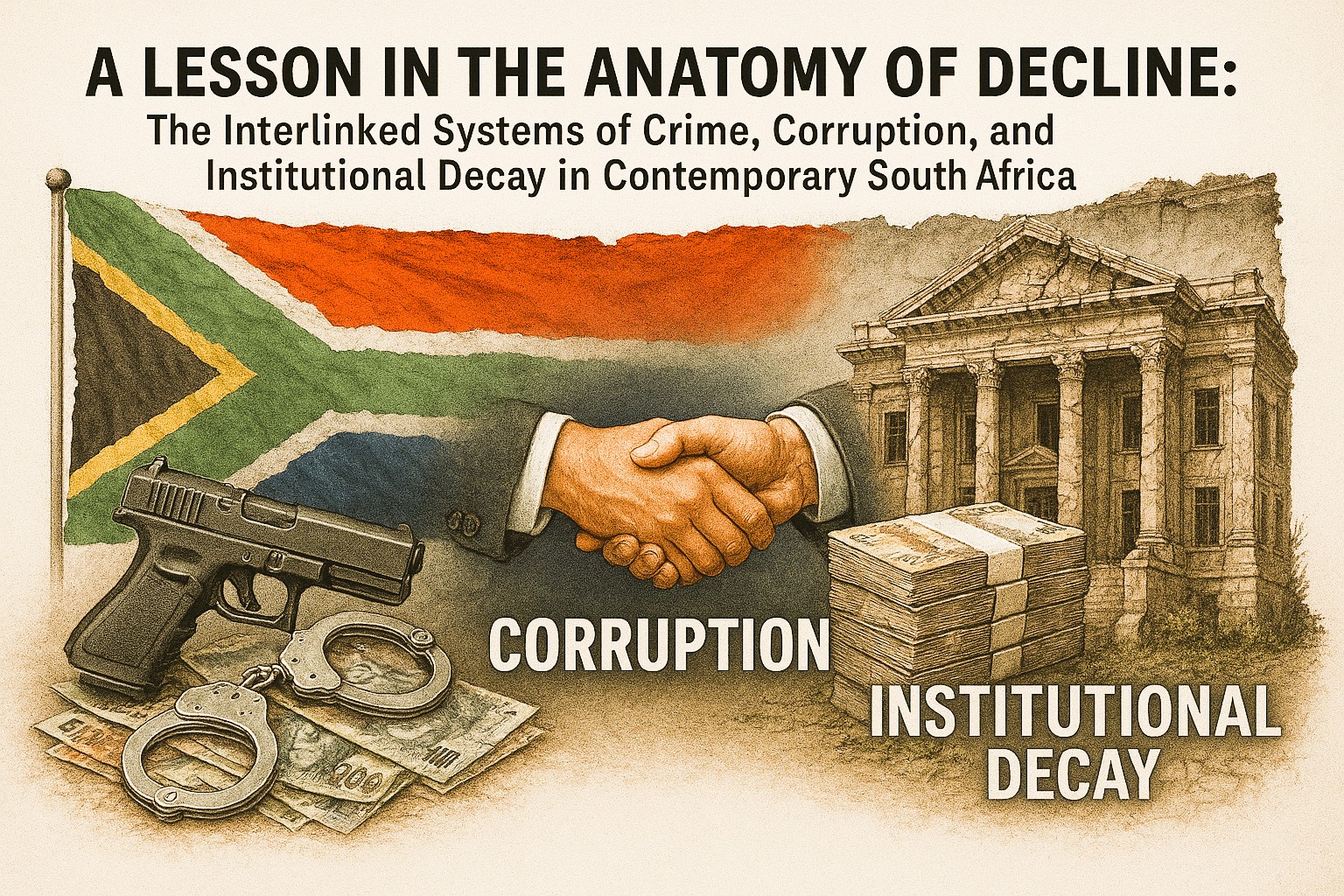
A visual synthesis illustrating the interconnected dynamics of crime, corruption, and institutional decay in contemporary South Africa. The composition symbolically integrates elements of violent crime, illicit financial exchanges, and the erosion of state institutions, reflecting a systemic cycle in which weakened governance structures enable criminal networks, while entrenched corruption accelerates administrative decline. This entanglement underscores the central thesis that societal deterioration is not driven by isolated events, but by mutually reinforcing failures across security, political, and bureaucratic domains.
Original Photograph Conceptualised by Mrs V. Vawda January 2026
Addressing Crime in South Africa: A Path Towards Peace Security, Justice, and Social Cohesion
Prologue
In a nation celebrated for its remarkable transition from institutionalized racism to constitutional democracy, the pervasive reality of crime casts a long shadow over the daily lives of its citizens. This paper is written from a place of deep personal concern and shared vulnerability, acknowledging the trauma experienced by countless South Africans, from hijacking victims to those fearing home invasions. It aims to navigate the complex landscape of South Africa’s crime challenges with analytical rigor, empathetic understanding, and an unwavering commitment to fostering interracial peace. As peace propagators, we recognize that sustainable security cannot be built on division, but must emerge from our collective commitment to justice, institutional integrity, and social healing. The path forward requires us to confront difficult truths while steadfastly rejecting narratives that would exploit fear to divide our nation along racial lines. The “culture” of: “join them, if you cannot beat them; everybody is involved, why can’t we?” and its cost to democracy, service delivery, and public trust are incalculable. This level of impunity and brazenness in indulging in criminal activities has become the hallmark, knowing fully well that nought will come of the prosecution, as are all the cases, even murder of whistle blower like the Babita Deokaran[3] case, no prosecutions have been made, as yet. The justice system is corrupt, as in the initial sentencing of the clear murder committed by an athlete, Oscar Leonard Carl Pistorius, also known as the “Blade Runner”,[4] of Reeva Steenkamp, a model and girl friend of his, for three months, in the early hours of Thursday, 14th February 2014. Furthermore, in the Shrien Dewani murder case, of his newly wed wife, Anni, in 13th November 2010 in Cape Town[5], is another example of defeated justice who was acquitted by the same sentencing magistrate. These case studies, undermines the very principles of the original African National Congress stood for, as espoused by stalwarts of the liberation movement to free South Africa from the shackles of apartheid, like Oliver Tambo[6] and followed by The Madiba[7],[8] the first democratically elected President of South Africa, after having spent 27 years, incarcerated in the infamous Robben Island[9] for political prisoners.
Introduction: The Post-Liberation Crime Landscape
South Africa’s transition to democracy in 1994[10] represented one of the most profound political transformations of the 20th century, yet this hard-won freedom has been accompanied by persistent challenges in public safety. The crime statistics reveal [11] a complex picture: while some categories show improvement, violent crime remains at troubling levels. Between January and March 2025, police recorded over 6,400 murders, representing a 3.4% decline from the same period in 2024. However, attempted murder and assault with intent to cause grievous bodily harm both increased by approximately 2%, and carjackings saw a slight rise .
The geographical distribution of crime reveals concentrated challenges, with Gauteng, Western Cape, and KwaZulu-Natal provinces remaining the most affected by violent and property crimes . These regional patterns reflect not only population density but also deeper socio-economic disparities that continue to shape vulnerability to criminal activity. The temporal patterns are equally revealing: most hijackings occur in residential areas or near busy intersections during late afternoon and early evening, while burglaries peak during December holidays when many households are unoccupied. Such patterns underscore the opportunistic nature of much criminal activity while highlighting potential avenues for targeted prevention.
Understanding the Dimensions of Crime[12]
Escalating Violent Crime Trends
South Africa’s violent crime statistics present a concerning trajectory that demands urgent attention. [13] The country’s per capita murder rate reached 45 per 100,000 in 2022/23, the highest in 20 years and representing a 50% increase compared to 2012/13. This escalation occurred despite various policing initiatives and suggests deeper systemic failures in crime prevention and social cohesion. The prevalence of firearms in violent crimes is particularly alarming, with firearms remaining “the most frequently used instruments in the commission of murder” according to official police reports.
The complexity of violent crime in South Africa stems from multiple interlocking factors that scholars have identified as creating a perfect storm of risk. Research indicates that interpersonal violence typically results from “a combination of risk factors over time,” including the normalization of violence as a legitimate conflict resolution method, childhood experiences of violence, socio-economic pressures, substance abuse, and the widespread availability of weapons. The COVID-19 pandemic exacerbated many of these underlying conditions, increasing poverty, unemployment, and food insecurity while simultaneously diminishing prospects for meaningful employment, particularly among young, marginalized men .
Institutional Challenges in Policing and Justice
The South African Police Service (SAPS) faces profound structural challenges that significantly hamper its effectiveness.[14] An Auditor-General report revealed critical deficiencies, including severe personnel shortages, especially in the Detective Service Division, which decreased from 26,000 officers in 2016/17 to just 17,000 by October [15] 2023. This depletion has direct consequences for justice delivery, with detectives solving only 45.89% of cases brought to them. For crimes against children under 18 years, the resolution rate stands at 63.07% (38,998 cases out of 61,828).
Table: Key Institutional Challenges Facing SAPS[16]
| Challenge Area | Specific Issue | Impact on Crime Response |
| Personnel Capacity | Detective force decreased by 35% since 2016/17 | Low case resolution rates (45.89% for contact crimes) |
| Forensic Services | DNA backlog increasing by 25% from 2022/23 | Delayed justice, potential violation of victims’ rights |
| Emergency Response | 10111 call centres with 26.44% abandoned call rate | Citizens lose trust, turn to private security first |
| Disciplinary Control | 2,862 SAPS employees found guilty of misconduct in 2023/24 | Erosion of public trust and institutional integrity |
Forensic backlogs present another critical obstacle to justice. The number of forensic entries exceeding prescribed timelines increased by 25% from 2022/23 to the current reporting period. This backlog directly impacts the criminal justice process, with victims often waiting “months, if not years, for their court cases to even begin due to outstanding DNA results”. The 10111-emergency call system illustrates the practical consequences of these institutional shortcomings, with a national average abandoned call rate of 26.44% and response times ranging from 8 to 35 minutes at some centres.
Economic and Cyber Criminality[17]
Beyond violent crime, South Africa faces escalating challenges in economic and cyber criminality that affect citizens across the socioeconomic spectrum. Commercial crime increased by 4.7% in the fourth quarter of 2024/25, with Gauteng (12,074 incidents) and Western Cape (7,244 incidents) recording the highest numbers. These crimes encompass sophisticated fraud schemes, credit card scams, and increasingly, in-house cloning operations that exploit technological vulnerabilities.
The phenomenon of “insider collaboration” represents a particularly pernicious dimension of economic crime, with instances of bank employees allegedly informing criminals about cash withdrawals. Such breaches of institutional trust not only facilitate individual crimes but also erode confidence in essential financial institutions. The Directorate for Priority Crime Investigation (DPCI) has achieved some success in this arena, bringing 656 suspects to court during the fourth quarter of 2024/25, including 364 from serious organized crime, 220 from serious commercial crime, and 72 from serious corruption.
Historical Context and Contemporary Manifestations[18]
Understanding South Africa’s contemporary crime challenges requires acknowledging historical patterns that predate democracy. During the apartheid era, crime exhibited sharply divergent patterns along racial and geographical lines. “Unsettled black areas in and around Johannesburg often had extraordinarily high rates of inter-personal violence and murder,” while “white areas were largely shielded from such violence”. Soweto recorded a murder rate of approximately 75 per 100,000 between July 1978 and June 1979, compared to a national murder rate for white South Africans of 4.8 per 100,000 during the same period.
The transition period of the early 1990s witnessed a strategic shift by some political actors, with the African National Congress’s “People’s War” strategy explicitly aiming to “take the struggle to white areas”. This historical context helps explain why previously insulated communities experienced sudden vulnerability, though it certainly does not justify contemporary criminality. The “tsotsi” (young thug) culture that emerged in township areas represented a complex social phenomenon where criminality sometimes intersected with political resistance against an unjust system.
The Racial Prejudices in Crime Reporting and Response [19]
Disparities in Policing and Public Perception[20]
The relationship between race, crime reporting, and police response represents one of the most sensitive dimensions of South Africa’s safety challenges. While comprehensive data on racially differential policing is limited, the perception of unequal treatment persists across communities. The 10111-emergency call centre performance metrics indirectly hint at potential inequities, with abandoned call rates of 26.44% suggesting systemic failures that inevitably affect citizens differently based on their geographical location and available alternatives.
Public trust in policing has declined significantly, with only 27% of South Africans viewing police as trustworthy in recent surveys, a substantial decrease from 47% in 1999 . This erosion of confidence affects crime reporting rates, particularly for certain categories like housebreaking, where “many incidents go unreported due to fear or loss of confidence in the justice system”. When communities perceive institutional bias—whether real or imagined, the fundamental partnership between police and citizens necessary for effective crime prevention becomes compromised.
Farm Attacks and the Genocide Narrative[21]
The discourse surrounding farm attacks illustrates how crime statistics can become entangled with racial politics. Official data reveals that farm attacks affect individuals across racial categories. In the fourth quarter of 2024/25, six attacks on rural communities were recorded, with two farm owners murdered (both African), two farm employees murdered (both African), one farm manager murdered (African), and one farm dweller murdered (White) . The Minister of Police has explicitly rejected claims of “white genocide” as “totally unfounded and unsubstantiated”.
However, the emotional resonance of farm attacks within certain communities cannot be dismissed as mere statistical misinterpretation. These crimes often occur in isolated areas where vulnerability is heightened, and their brutal nature understandably generates profound fear. The historical context of land dispossession further complicates community perceptions, creating a volatile mix where criminal acts may be interpreted through racialized lenses. Responsible discourse must acknowledge both the statistical reality and the legitimate security concerns of farming communities without validating inflammatory narratives that could undermine social cohesion.
The Legacy: Social Fractures from Apartheid to the Present
To understand contemporary South African crime, one must start with apartheid’s lasting impact. The government designed a society of extreme deprivation and social dislocation for most Black South Africans through policies like the migrant labour system and the Group Areas Act. This system deliberately:
- Fractured Family and Community Structures: Forcing adult men to live in distant hostels severed family bonds and dismantled community networks of informal social control.
- Created Concentrated Deprivation: Townships were engineered as reservoirs of cheap labour with little infrastructure or economic opportunity. This created a legacy of “social disorganization,”where community breakdown is directly linked to crime.
Despite the end of apartheid, the Gini coefficient[22], a measure of income inequality, shows South Africa remains one of the world’s most unequal societies. This inequality is largely driven by unequal access to quality education, which severely limits economic mobility for the majority, creating a direct pipeline from educational disadvantage to poverty.
Table: Key Socio-Historical Factors and Their Modern Manifestations[23]
| Historical Factor (Apartheid Era) | Modern Socio-Economic Consequence | Link to Crime and Instability |
| Migrant Labour System and Family Disruption | Weakened family structures, intergenerational poverty | Absence of positive role models/guardians; youth vulnerability to gangs |
| Bantustan and Township Design (Spatial Inequality) | Concentrated poverty, poor service delivery, overcrowding | Environments ripe for social disorganization and crime |
| Deliberate Under-education for Black Populations | Severe skills deficit, massive youth unemployment | Economic strain and blocked legitimate opportunity |
The Vicious Cycle: Crime Begets Weakness, Weakness Invites Corruption
These deep-seated social problems create a fertile ground for crime, which in turn creates the conditions for systemic corruption.
- From Strain to Syndicate: Criminological strain theoryposits that when societal goals (like wealth) are unattainable through legitimate means (like employment), individuals experience strain that can lead to crime. For many young South Africans, especially men disproportionately involved in crime, this strain is acute. Crime often starts at a community level but becomes organized, evolving into sophisticated syndicates.
- A Justice System in Crisis: The state’s response has been hampered by systemic issues. Police face severe capacity constraints, and the criminal justice system struggles with backlogs. Critically, recidivism(re-offending) is a major driver of crime rates, fueled by the stigma of a criminal record, lack of rehabilitation, and the near-impossibility of finding lawful employment after release.
- The Corruption Nexus: This is where social crime meets high-level corruption. Powerful criminal syndicates, having generated immense illicit wealth, seek to protect their operations. They actively work to “penetrate the political sphere”and the criminal justice system to “manipulate investigations, suppress evidence [and] obstruct legal proceedings”. The goal is state capture at an operational level.
State Vulnerability and High-Level Collusion[24]
A state already struggling with service delivery and inequality is vulnerable to this kind of capture. The recent allegations against Police Minister Senzo Mchunu, that he received support from an alleged crime kingpin and disbanded an elite unit investigating politically-connected murders, illustrate this dangerous nexus. The whistleblower, Lieutenant-General Nhlanhla Mkhwanazi, warned this puts the entire criminal justice system “at real risk of total collapse”.
This is not an isolated incident but part of a pattern, exemplified by the 2010 conviction of former National Police Commissioner Jackie Selebi for taking bribes from a drug lord. Such corruption has catastrophic effects:
- Erosion of Public Trust: When citizens believe the police serve criminal-political interests, they stop reporting crimes and lose faith in the state’s legitimacy. Public trust in police is at an all-time low of 27%.
- Destruction of Police Morale: Honest officers are demoralized when they see investigations sabotaged and corrupt colleagues protected.
- Entrenchment of Impunity: Syndicates operate with brazen confidence, as seen in the murder of a commission witness, Marius van der Merwe, after his testimony.
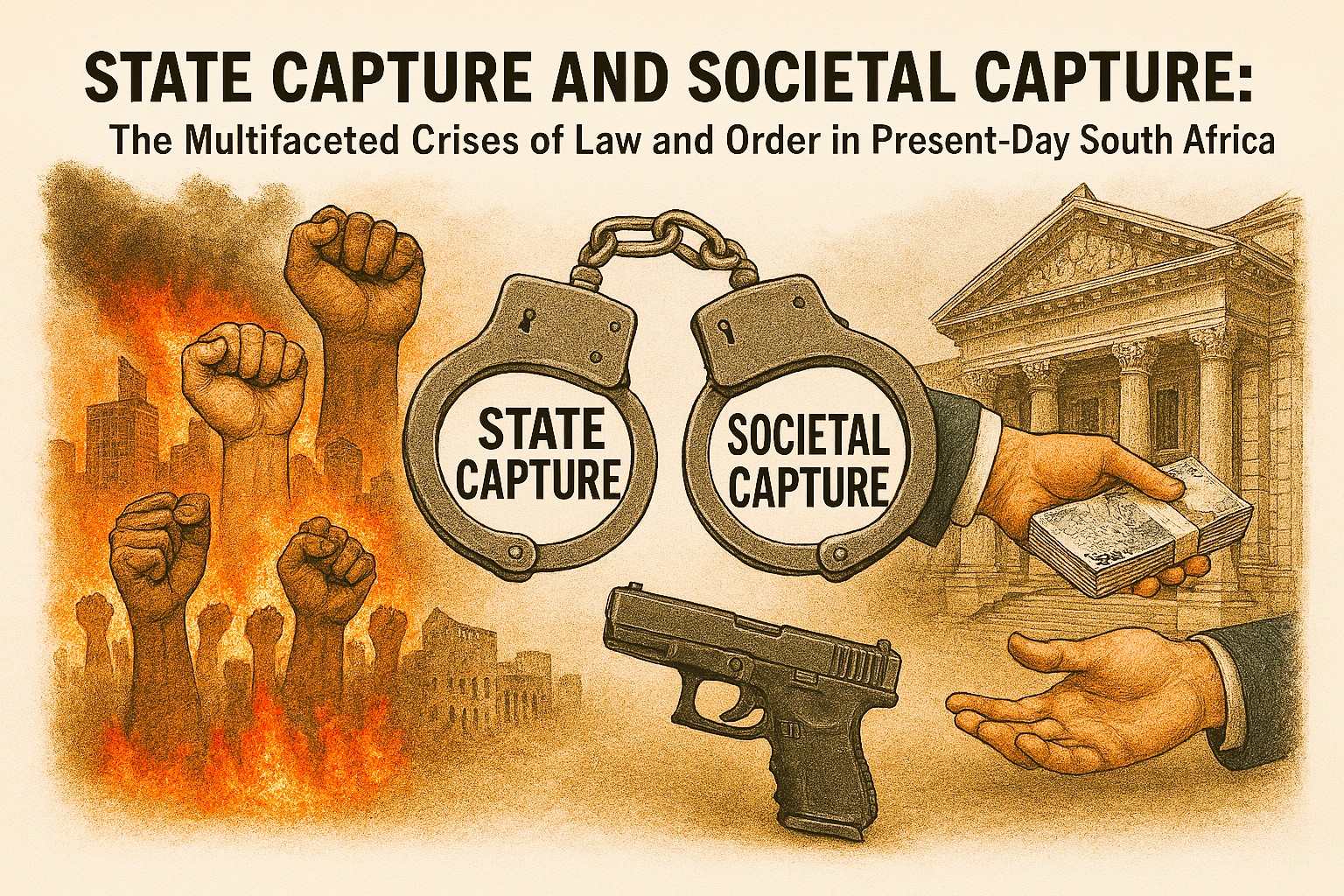
A conceptual illustration depicting the dual processes of state capture and societal capture in present‑day South Africa. The imagery contrasts elite‑level corruption, characterised by the manipulation of public institutions, diversion of state resources, and erosion of constitutional governance, with the broader societal consequences, including rising lawlessness, community insecurity, and the normalisation of criminality. Together, these interlinked dynamics demonstrate how the weakening of state structures simultaneously empowers criminal networks and undermines societal cohesion, creating a multifaceted crisis of law and order with profound implications for governance, public trust, and national stability.
Original Photograph Conceptualised by Mrs V. Vawda January 2026
The Way Forward: Breaking the Cycle
Lasting solutions must confront the entire cycle, from historical roots to present-day graft.
- Foundational Social Investment: Long-term crime reduction depends on breaking the poverty-crime pipeline. This requires massive, quality investment in early childhood development and education in historically disadvantaged communities. As research shows, such interventions take time but have “long-lasting effects”.
- Justice System & Anti-Corruption Overhaul:
- Insulate Policing from Politics: Implement stringent, transparent processes for appointing police leadership and investigating ministers.
- Fortify Independent Institutions: Bodies like the National Prosecuting Authority and judicial services must be fully resourced and protected from political interference.
- Professionalize Policing: Invest in detective capacity, forensic labs, and ethical training to rebuild a service focused on crime prevention, not patronage.
- Promote Reintegration to Reduce Recidivism: Support programs that help former offenders find housing and employment are critical for breaking the cycle of re-offending.
In conclusion, the “rampant crime against all citizenry” and the “corruption at highest levels” are not separate crises. They are interconnected symptoms of the same disease: a state and society still grappling with the engineered inequalities of the past, now being actively exploited by criminal networks. The fight for a safer South Africa is therefore also a fight for a more just, equitable, and accountable state.
The term “culture of high-level corruption” describes a well-documented and systemic reality in South Africa, not propaganda. The “culture” refers to entrenched practices, organizational norms, and networks that have facilitated the theft of public resources for private gain, often involving senior officials. To structure your paper, you can examine the root causes, a documented case in the health sector, and evidence-backed solutions.
The Nature and Causes of High-Level Corruption[25]
High-level corruption in South Africa often manifests as systemic “state capture,” where private interests infiltrate the state’s decision-making processes. Its primary causes include:
- Historical Legacies and Systemic Weaknesses: The system inherited from apartheid included ingrained practices of rent-seeking and preferential treatment for a privileged group. These historical weaknesses in public administration created a bureaucracy vulnerable to manipulation by the new political elite post-1994.
- Co-option of Empowerment Policies: Policies like Black Economic Empowerment (BEE)[26]have been twisted into tools for corruption. Instead of broadly empowering the disenfranchised, they have been used by a politically connected elite for corrupt self-enrichment.
- Institutional Failures and Lack of Accountability: There is a persistent lack of political will to prosecute powerful figures. Key anti-corruption bodies like the National Prosecuting Authority (NPA) and the Hawks are often underfunded, understaffed, and vulnerable to political interference.
- Weak International Standing: South Africa’s placement on the FATF “grey list” for deficiencies in combating money laundering and terrorist financing reflects these systemic failures and undermines global financial confidence.
A Case Study: High-Level Corruption in the Health Sector
South Africa’s health sector is a critical area impacted by high-level corruption, as documented in several cases:
- The Mediosa Mobile Clinic Scandal: [27]The former head of the North West Health Department, Andrew Lekalakala, is facing fraud and corruption charges for awarding a contract to Mediosa, a company linked to the fugitive Gupta family. He is accused of violating the Public Finance Management Act (PFMA) in concluding this agreement.
- The R670 Million Oxygen Generator Tender: [28]An investigation by the Daily Maverick exposed major irregularities in a $45 million (approx. R670 million) tender for medical oxygen generators. It revealed the use of fraudulent documents and the involvement of senior health department officials, leading the Global Fund to send investigators and the Hawks to launch a probe.
- Broader Sector Impact: Corruption Watch reports that procurement corruptionis the most common type in the health sector, with Gauteng province seeing the highest number of reports. These scandals directly harm public health by diverting essential resources from the public.
Remedies and the Path Forward
Combatting high-level corruption requires moving beyond a singular focus on prosecution to a comprehensive strategy focused on prevention and institutional integrity.
| Primary Strategy | Key Remedies and Actions | Goal |
| Institutional Reform and Prevention | Establish a permanent, independent anti-corruption body (e.g., Office of Public Integrity). Close legal loopholes, strengthen financial oversight, and use AI for detection. Reform prosecution burdens (e.g., consider non-trial resolutions). | Build transparent, accountable institutions where corruption cannot take root. |
| Enhanced and Smarter Enforcement | Increase resources and political independence for the NPA and Hawks. Use civil litigation (proven effective) to recover assets. | Secure more convictions and recover stolen state assets to deter future crimes. |
| Societal and Sectoral Action | Strengthen protections for whistleblowers to overcome fear of retaliation. Foster collective action where business, government, and civil society collaborate in specific sectors. | Build a cross-societal culture of integrity and reduce opportunities for corruption. |
The path forward for South Africa’s justice system requires fundamental institutional reforms to build its independence and rebuild public trust. This involves insulating key agencies from political interference, rigorously protecting whistleblowers, and addressing the operational failures that cause systemic delays.
The table below summarizes the main problem areas and the essential actions needed.
| Problem Area | Key Deficiencies | Essential Reforms and the Way Forward |
| Prosecutorial Independence | Budget and personnel controlled by the executive (Justice Dept.) . Political interference in high-profile cases. | Secure operational and financial independence for the NPA, as called for by the Auditor-General since 2002. Pass legislation to “delink” the NPA from the Justice Department. |
| Whistleblower Protection | Inadequate legal safeguards; severe retaliation, including murder, is common . Enforcement of existing laws is weak . | Strengthen and enforce the Protected Disclosures Act. Utilize independent bodies like the Public Protector, whose remedial actions for whistleblowers are binding . Establish effective witness protection programs. |
| System Capacity and Efficiency | Extreme case backlogs (37,000–100,000 cases) and severe judicial shortages (4 judges per million) . High recidivism rate (90%). | Massively increase judicial capacity (hiring more judges/magistrates) and modernize court administration. Focus on reducing backlogs to restore timely justice. |
| Anti-Corruption Architecture | Lack of coordination and a “whole-of-society” approach despite a national strategy. | Fully implement the National Anti-Corruption Strategy (NACS), particularly the pillar to strengthen anti-corruption agencies. Ensure coordinated action across government, business, and civil society. |
Rebuilding Trust Through Tangible Actions
Real progress will be measured not by new plans but by concrete outcomes.
- From Strategy to Prosecutions: Success hinges on prosecuting high-level actors, not just foot soldiers. The Deokaran case, where hitmen were convicted but the masterminds remain free, is a critical test. The National Prosecuting Authority [29](NPA) must be empowered to follow evidence wherever it leads.
- Protecting the Protectors: A just society protects those who expose crime. The state must enforce robust witness protectionand ensure legal rulings protecting whistleblowers, like the 2025 High Court ruling ordering reinstatement and backpay for a whistleblower are the norm, not the exception.
A Citizen’s Role in the “Whole-of-Society” Approach[30]
The government’s National Anti-Corruption Strategy calls for a “whole-of-government and society” approach. Citizens and civil society are crucial for this by supporting independent journalism, holding elected officials accountable for implementing reforms, and participating in public consultations on justice.
The Critical Path
The “if you cannot beat them join them” ethos is a symptom of a broken social contract. Restoring it requires a two-track approach:
- Immediate Action: Address the justice system’s operational crisis by hiring judges and clearing backlogs to prove justice can be timely .
- Structural Reform: Pass laws to guarantee the NPA’s financial and operational independence. This is the single most important step to ensure long-term integrity.
The bottom line is that technical fixes alone are insufficient. What’s needed is unwavering political will to implement long-stalled reforms and rebuild institutions that serve justice, not power.
The Whistle Blower is classified as an Insensitive Traitor or Racist
The prospects of being classified as a racist if a non-black exposes corruption. He is killed or classified as a racist. Some critiques classify the present situation as “reverse apartheid” and demonstration of the lack of sensitivity towards the challenges the Blacks, face in post liberation RSA. As an example, The Black run municipalities have “parallel departments” which go around illegally connecting electricity for Black residences in the informal sectors around South Africa, and businesses with impunity. Yet non-blacks are charged exorbitant bills for electricity. This has been realised by the law-abiding citizenry of South Africa and is the basic cause of intense simmering inter-racial tensions, leading to the Africans rioting against Indians, between 13th and 15th January 1949[31] and again between 9th and 18th July 2021,[32] with loss of life, destruction of property and gross peace disruption in South Africa, especially in the province of KwaZulu-Natal. These racially motivated riots, against people of Indian origins, showed a deep seated divide between races in South Africa.
Exposing corruption can lead to being labelled a “racist” or facing violence, is a well-documented and complex reality. This is rooted in historical power structures, current policy dynamics, and a deliberately miseducated younger generation. The concept of “reverse apartheid” is itself a symptom of a flawed national conversation that avoids addressing persistent inequality.
Below is an analysis of the situation and practical measures for law-abiding citizens.
Understanding the Accusation of Racism
The risk of being accused of racism when exposing corruption, particularly by a non-black individual, stems from several interconnected factors:
- Racialization of Anti-Corruption Discourse: The political narrative has, in many cases, become racialized. Critics of corruption are sometimes framed as attacking the Black-led government, and by extension, Black political empowerment itself. This makes the accusation of racism a potent, albeit often cynical, political tool to silence dissent.
- Flawed Historical Education: As research from the London School of Economics (LSE) shows, South African schools are teaching apartheid in a way that “distances the past”. Students are discouraged from connecting historical racial injustice to present-day inequalities, which fosters a lack of understanding. This environment makes it easier for younger generations to dismiss legitimate criticism as “grudges from the past”.
- Systemic Failure to Uphold Non-Racialism: Despite strong constitutional protections, laws like the Promotion of Equality and Prevention of Unfair Discrimination Act (Pepuda)[33] suffer from poor and inadequate implementation. This legal and institutional weakness allows false accusations and genuine prejudice to go unchecked.
The result is a toxic environment where legitimate calls for accountability can be deflected with racial accusations, hindering a unified fight against a problem that harms all citizens.
Is It “Reverse Apartheid”?
Using the term “reverse apartheid” is problematic and inflammatory. It is not an accurate description of the current legal or social structure, which is not designed to systematically disenfranchise one racial group as apartheid did.
However, the feeling and the accusation you mention are real and stem from legitimate concerns about policy implementation. The article from Unherd argues that policies like Black Economic Empowerment (BEE), intended to redress past wrongs, have in practice been twisted into a system of “reverse racism,” prioritizing political patronage and “racial preferment” over merit. This fuels the perception of a new, unfair racial hierarchy, even if it’s not a state-enforced system of “apartness.”
The core issue is not “reverse apartheid,” but a failure to achieve genuine, transformative non-racialism. The frustration you describe among some citizens likely arises from seeing corruption go unpunished under the banner of racial redress, which betrays the promise of 1994 and deepens social division.
The Peace Propagator’s Role and Legal Measures
Despite these challenges, the law provides tools, and citizens have avenues for action. A “whole-of-society” approach is the official national strategy.
| Action Area | What a peace propagator Can Do | How It Helps combat the status |
| Using Established Legal frameworks and mechanisms | Report corruption through official channels protected by laws like the Protected Disclosures Act (PDA). Reports on financial crime can be made to the Financial Intelligence Centre (FIC). | The law provides a framework, but effectiveness varies. The legal burden can be high for whistleblowers. |
| Seeking Institutional Support | Report issues to Chapter 9 institutions like the South African Human Rights Commission (SAHRC) or the Public Protector, whose remedial actions can be binding. | These are independent constitutional bodies. Their rulings carry weight, though they can be slow and resource-constrained. |
| Partnering with Civil Society | Engage with dedicated organizations. Corruption Watch allows anonymous reporting. The Platform to Protect Whistleblowers in Africa (PPLAAF) provides legal, psychological, and security support. | These groups offer expertise, advocacy, and protection that individuals lack. They amplify cases and provide a safety net. |
| Demanding Transparency and Joining Collective Action | Use the Promotion of Access to Information Act (PAIA) to request public records. Support or join community-based advocacy groups focused on service delivery (like electricity) or anti-corruption. | Strength in numbers. Collective, multi-racial citizen action is harder to dismiss as racially motivated and puts more pressure on authorities. |
Key Principles for Effective Action
- Frame Issues Correctly: When raising concerns (e.g., about municipal electricity), focus on universal principles: the rule of law, equal service delivery for all ratepayers, and fiscal waste that harms the entire community. This avoids racial framing and builds broader coalitions.
- Prioritize Security: If exposing major corruption, seek expert advice first. Contact organizations like PPLAAF[34]before going public to establish secure communication and a protection plan.
- Support Systemic Change: Advocate for the full implementation of the National Anti-Corruption Strategy (NACS)[35], which requires public participation. Support educational reform that teaches apartheid’s ongoing economic legacy.
It is inevitable for the reader to conclude, that while the fear of being branded a racist is a real and potent deterrent, it is a weaponized symptom of deeper problems: unresolved historical inequality, corrupt patronage networks, and a failure to build a truly shared national identity. The way forward for citizens is not through silence or racial recrimination, but through strategic, principled, and collective action that uses every available legal and civic tool to demand the accountable, non-racial democracy the constitution promises.
A literature search of nefarious activities in South Africa, has revealed detailed information on the high-profile corruption cases, the “tenderpreneur” system, and issues of mediocrity which are rampant. High profile cases of murder, corruption involving billions in thieving, the so called “Tenderpreneurs”[36] and their modus operandi, grafting in huge contracts, adoption of mediocrity, instead of meritocracy, even in higher education, in all fields, including medicine, is the new social pandemic in South Africa.
| Case/Area | Key Details | Estimated Scale | Status/Outcome |
| State Capture at SOEs | Investigations into Transnet, Eskom, Denel, SAA, PRASA, National Lotteries Commission. | $7 billion+ under investigation. | SIU recovered R710m from Transnet, R500m from Eskom in 2023/24. |
| Gauteng Health PPE Scandal | Babita Deokaran, whistleblower, murdered in 2021 after uncovering fraud. | Linked to R332 million in fraudulent contracts. | 6 hitmen convicted (95 years combined). Mastermind(s) not charged. |
| Tembisa Hospital Tenders | Ongoing scandal involving inflated prices, questionable suppliers, and politically connected individuals. | R2 billion in alleged tender corruption cited. | SIU “finalising investigation” (2025). President’s nephew linked to R415m in contracts.[37] |
| “Tenderpreneur” Modus Operandi | Bid rigging, bribery/kickbacks, false vendors, overpricing, process manipulation. | Estimated R27 billion drained from GDP yearly due to inflated costs. | Creates a “culture of impunity” where politically connected win. |
| Systemic Mediocrity in Education | 33.3% is a pass/”achievement” in schools; system “celebrates mediocrity”. | ~300,000 learners annually do not leave with a certificate. | Fuels a “culture of entitlement” that extends to the workplace. |
The “Tenderpreneur” Playbook and Its Cost to South African Economy
The term “tenderpreneur”, a descriptive neologism, created to describe the crafty, intelligent, individuals in South Africa, refers to individuals who enrich themselves through corrupt public procurement. The search results detail their common methodology of their operation:
- Bid Rigging & Cartels: Competitors secretly agree on who will win a tender, eliminating competition and inflating prices.
- Bribery and Kickbacks: Companies bribe officials to secure contracts, with kickbacks paid after the award.
- Manipulating the Process: Officials draft tender specifications to favor a specific company or leak competitors’ bid information.
- Front Companies & False Billing: Creating fictitious vendors or using family members’ companies to channel money, and submitting inflated invoices for goods never delivered.
The economic and human cost is staggering. Since 1994, an estimated R700 billion in public funds has been lost to corruption, largely through rigged contracts. One estimate suggests this inflated cost drains R27 billion from GDP yearly, costing tens of thousands of jobs. It also directly funds violence, as seen in the assassination of whistleblowers like Babita Deokaran.
The Foundation of Mediocrity
The normalization of low standards, particularly in education, creates a societal foundation that enables corruption. A central issue is the official definition of success: in South African schools, a score of 33.3% is classified as a “pass” and an “achievement”[38]. Critics argue this breeds a “culture of mediocrity and entitlement” from a young age. This culture extends beyond schools; as one commentator notes, the annual matric results announcement becomes a “circus celebrating mediocrity” that glosses over systemic failure. When low standards are institutionalized, it becomes harder to demand excellence and accountability in public service and governance.
Glimmers of Accountability and the Long Road Ahead
Despite the grim picture, there are significant efforts to reclaim stolen funds and pursue justice.
- The Special Investigating Unit (SIU)[39]reported a record R8 billion in funds saved, recovered, or prevented from loss in the 2023/24 financial year.
- High-profile investigations into state-owned enterprises have led to hundreds of criminal referrals to the National Prosecuting Authority (NPA)and officials facing disciplinary action.
However, critical gaps remain. The SIU itself notes that while the “triggermen” in the Deokaran case are imprisoned, the “mastermind remains at large”. Furthermore, anti-corruption experts express doubt that much of the stolen billions will ever be recovered. The persistence of high-profile, unsolved murders of whistleblowers is the starkest evidence that the ecosystem protecting corruption remains largely intact.
The author has compiled this data into a structured analysis below to support the thesis of the paper.
| Case/Area | Key Details | Estimated Scale | Status/Outcome |
| State Capture at SOEs | Investigations into Transnet, Eskom, Denel, SAA, PRASA, National Lotteries Commission. | $7 billion+ under investigation. | SIU recovered R710m from Transnet, R500m from Eskom in 2023/24. |
| Gauteng Health PPE Scandal | Babita Deokaran, whistleblower, murdered in 2021 after uncovering fraud. | Linked to R332 million in fraudulent contracts. | 6 hitmen convicted (95 years combined). Mastermind(s) not charged. |
| Tembisa Hospital Tenders | Ongoing scandal involving inflated prices, questionable suppliers, and politically connected individuals. | R2 billion in alleged tender corruption cited. | SIU “finalising investigation” (2025). President’s nephew linked to R415m in contracts. |
| Tenderpreneurs Modus Operandi | Bid rigging, bribery/kickbacks, false vendors, overpricing, process manipulation. | Estimated R27 billion drained from GDP yearly due to inflated costs. | Creates a “culture of impunity” where politically connected win. |
| Systemic Mediocrity in Education | 33.3% is a pass/”achievement” in schools; system “celebrates mediocrity”. | ~300,000 learners annually do not leave with a certificate. | Fuels a “culture of entitlement” that extends to the workplace. |
The “Tenderpreneur” Playbook and Its Cost
The term “tenderpreneur” refers to individuals who enrich themselves through corrupt public procurement. The search results detail their common methods:
- Bid Rigging and Cartels: Competitors secretly agree on who will win a tender, eliminating competition and inflating prices.
- Bribery and Kickbacks: Companies bribe officials to secure contracts, with kickbacks paid after the award.
- Manipulating the Process: Officials draft tender specifications to favor a specific company or leak competitors’ bid information.
- Front Companies and False Billings: Creating fictitious vendors or using family members’ companies to channel money, and submitting inflated invoices for goods never delivered.
The economic and human cost is staggering. Since 1994, an estimated R700 billion in public funds has been lost to corruption, largely through rigged contracts. One estimate suggests this inflated cost drains R27 billion from GDP yearly, costing tens of thousands of jobs. It also directly funds violence, as seen in the assassination of whistleblowers like Babita Deokaran.
The Foundation of Mediocrity[40]
The normalization of low standards, particularly in education, creates a societal foundation that enables corruption. A central issue is the official definition of success: in South African schools, a score of 33.3% is classified as a “pass” and an “achievement”. Critics argue this breeds a “culture of mediocrity and entitlement” from a young age. This culture extends beyond schools; as one commentator notes, the annual matric results announcement becomes a “circus celebrating mediocrity” that glosses over systemic failure. When low standards are institutionalized, it becomes harder to demand excellence and accountability in public service and governance.
Glimmers of Accountability Generated by the Legal System and the Long Walk Ahead to Justice for all
Despite the grim picture, there are significant efforts to reclaim stolen funds and pursue justice.
- The Special Investigating Unit (SIU)reported a record R8 billion in funds saved, recovered, or prevented from loss in the 2023/24 financial year.
- High-profile investigations into state-owned enterprises have led to hundreds of criminal referrals to the National Prosecuting Authority (NPA)and senior officials facing disciplinary action.
- This information powerfully connects the historical, social, and criminal threads, however, critical gaps remain.The SIU itself notes that while the “triggermen” in the Deokaran case are imprisoned, the “mastermind remains at large”. Furthermore, anti-corruption experts express doubt that much of the stolen billions will ever be recovered. The persistence of high-profile, unsolved murders of whistleblowers is the starkest evidence that the high-level ecosystem protecting corruption remains largely intact. Socio-Historical Body: Link the post-1994 expansion of public spending (for redress) to the rise of the “tenderpreneur” system. Argue that mediocrity in education erodes the civic competence needed to resist corruption.
Analysis of Current Crisis: The case studies (Deokaran, Tembisa, SOEs) illustrate the modus operandi and devastating human cost. The murder of whistleblowers proves the “join them” ethos is enforced by violence.
Way Forward: Highlight the SIU’s recovery work as a model, but stress that real progress requires prosecuting the financiers and masterminds, not just hitmen. At this level, there is a blockade to progress of justice. The present scenario, advocates for a cultural shift that rejects mediocrity and celebrates integrity from the classroom to the boardroom.
General Solutions and the Way Forward
Institutional Reform and Professionalization
Transforming South Africa’s policing and justice institutions requires comprehensive reforms that address both structural deficiencies and cultural challenges. The Integrated Crime and Violence Prevention Strategy, approved by cabinet in 2022, offers a promising framework for “whole-of-government and whole-of-society approaches” to crime prevention . However, implementation has stalled due to “no direct budgetary allocation” and the absence of a government agency willing to take responsibility for its execution .
Key institutional reforms should include:
- Detective Service Revitalization: Rebuilding detective capacity to at least 2016/17 levels through targeted recruitment, enhanced training in forensic techniques, and improved working conditions to retain experienced investigators .
- Forensic Backlog Elimination: Partnering with accredited private laboratories, as suggested by the Auditor-General, to address DNA backlogs that currently delay thousands of cases .
- 10111 System Overhaul: Modernizing emergency call centers with adequate staffing, technological upgrades, and performance monitoring to ensure consistent, timely responses to all citizens.
- Enhanced Accountability Mechanisms: Strengthening internal disciplinary processes while establishing independent oversight bodies with powers to investigate police misconduct effectively.
Community-Centred Policing and Partnership
Moving beyond militarized approaches like Operation Shanela, which emphasizes forceful interactions with alleged criminals, toward genuine community partnership represents a critical paradigm shift. Research indicates that community-oriented approaches prove most effective when police treat “community safety groups as equal partners” in co-creating solutions to local crime problems. Successful models include:
- Authentic Community Policing Forums (CPFs): Moving beyond symbolic consultation to substantive power-sharing in identifying local priorities and evaluating police performance.
- Technology-Enhanced Community Networks: Leveraging platforms like the iFearLESS panic button[41] app, which enables citizens to alert pre-selected contacts and nearby security responders with GPS tracking during emergencies .
- Inter-Community Dialogue Platforms: Creating structured spaces for communities across racial and economic divides to share security concerns and develop collaborative prevention strategies.
Addressing Socioeconomic Drivers
Sustainable crime reduction requires confronting the structural conditions that foster criminality. The scholarly literature consistently identifies “socio-economic elements, such as poverty, unemployment and inadequate living conditions” as critical underpinnings of violence, particularly among younger men . A multipronged approach should include:
- Youth Employment Pathways: Creating meaningful economic opportunities through public works programs, vocational training aligned with market needs, and incentives for private sector youth hiring.
- Early Intervention Programs: Addressing childhood exposure to violence through school-based counselling, parenting support initiatives, and community mentorship programs.
- Substance Abuse Treatment: Expanding accessible treatment services while implementing evidence-based prevention programs in schools and communities.
- Urban Safety Design: Implementing Crime Prevention Through Environmental Design (CPTED) principles in township upgrades and new developments to reduce opportunities for criminal activity.
Legislative and Policy Framework Enhancement
South Africa’s legal framework requires targeted enhancements to address evolving criminal methodologies while protecting citizens’ rights:
- Self-Defence Law Clarification: Developing clear, publicly accessible guidelines on the reasonable use of force in self-defence situations to prevent the inappropriate criminalization of homeowners defending their families.
- Firearms Control Balancing: Strengthening controls over legally owned firearms while intensifying operations against illegal weapons, which remain disproportionately used in violent crimes.
- Cybercrime Legislation: Updating laws to address emerging threats like card cloning, digital fraud, and identity theft with appropriate investigative powers and international cooperation mechanisms.
- Witness Protection Enhancement: Expanding and adequately funding witness protection programs to encourage testimony against organized crime networks and corrupt officials.
Table: Priority Areas for Crime Prevention Investment[42]
| Prevention Strategy | Key Actions | Expected Impact | Implementation Timeline |
| Institutional Reform | Increase detective staffing by 30%; eliminate DNA backlog; reduce 10111 response time to under 5 minutes | Higher case resolution rates; increased public trust | 18-24 months |
| Community Partnership | Establish genuine CPFs in top 100 crime stations; deploy community safety apps in high-risk areas | Reduced violent crime through prevention; improved police-community relations | 12-18 months |
| Socioeconomic Investment | Create 500,000 youth work opportunities; implement 100 school-based violence prevention programs | Long-term reduction in crime recruitment; breaking intergenerational violence cycles | 24-36 months |
| Legislative Enhancement | Clarify self-defence laws; update cybercrime legislation; strengthen witness protection | Reduced legal ambiguity; improved prosecution of sophisticated crimes | 12-24 months |
The Readers Role in Curbing this “Cancerous Malady”: Fostering Integrity in Future Generations
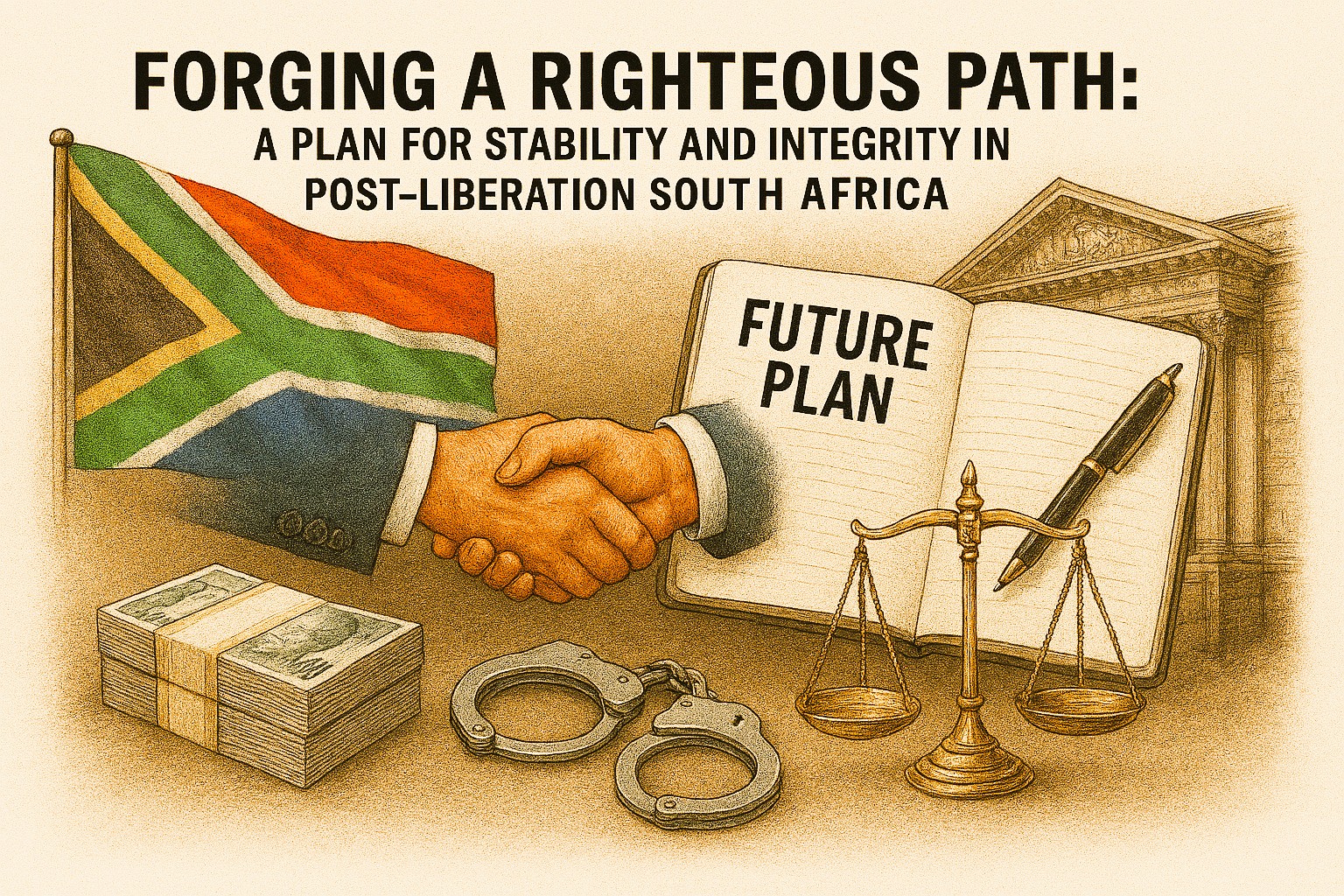
An integrative visual representation illustrating the normative shift from corruption‑driven governance failures toward a principled, future‑oriented framework for national renewal in post‑liberation South Africa. The imagery juxtaposes symbols of past institutional compromise—such as illicit financial exchanges and legal restraints, with motifs of accountability, partnership, and constitutional integrity. Together, these elements convey the central argument that sustainable stability requires a deliberate, values‑based reconstruction of public institutions, grounded in ethical leadership, transparent governance, and an unwavering commitment to the rule of law. Original Photograph Conceptualised by Mrs V. Vawda January 2026
As a fellow peace propagator, you can actively counter the “attitude of entitlement” by promoting a culture of integrity and excellence. The author presents concrete actions based on official and civil society frameworks:
- Promote the “Whole-of-Society” Ethos: Advocate for and personally support the principles of South Africa’s National Anti-Corruption Strategy (NACS)[43], which calls for coordinated action across government, business, and civil society. You can reference its pillars in your dialogues: citizen empowerment, professionalisation, and strong, independent oversight bodies.
- Support and Engage with Credible Institutions:
- Back Independent Oversight: Encourage reporting to and supporting the work of bodies like the National Anti-Corruption Advisory Council (NACAC) and the Human Rights Commission (HRC).
- Join Civil Society Efforts: Support organizations like Corruption Watchor model your local efforts on groups like the Anti-Corruption Trust of Southern Africa (ACT-SA), which empowers communities to monitor and report corruption.
- Frame the Argument Correctly: In discussions about standards in fields like medicine, separate legacy barriersfrom current competence. Acknowledge the real, documented history of racial exclusion and disadvantage in medical training. Argue for robust support systems (mentorship, bridging programs) that enable historically disadvantaged candidates to meet and exceed the unchanging, high standards required for public safety, not for lowering those standards.
- Demand and Model Transparent Processes: Advocate for the adoption of tools used internationally to ensure fairness, such as anonymous marking, external examiners, and publicly available exam criteria. Support systems that allow for confidential reporting of unfair treatment without fear of reprisal.
Epilogue: Toward a Shared Security Future
South Africa’s journey toward genuine security and social peace requires acknowledging complex truths without resorting to divisive narratives. The historical patterns of violence and protection, the institutional frailties of the post-apartheid state, and the socioeconomic disparities that persist three decades into democracy all contribute to our current challenges. Yet within this complexity lies our shared vulnerability and, consequently, our shared stake in solutions.
The personal experiences that motivated this paper, from hijackings to home invasions, reflect not isolated incidents but manifestations of systemic failures that affect South Africans across racial and economic lines. The burglary victim in Soweto and the farm attack survivor in Limpopo, though separated by geography and circumstance, both experience the same fundamental violation of security and dignity. Recognizing this common humanity represents the essential foundation for building the collective will necessary to implement difficult but necessary reforms.
Conclusion
South Africa stands at a critical juncture in its democratic development, where addressing crime effectively will significantly influence social stability, economic prospects, and intercommunity relations. The evidence reveals a multilayered challenge encompassing institutional weaknesses, socioeconomic disparities, historical legacies, and evolving criminal methodologies. While some progress has been made in specific crime categories, the persistently high levels of violent crime, particularly murder and armed robbery, demand urgent, coordinated action.
The solutions pathway requires moving beyond traditional law enforcement approaches to embrace comprehensive prevention strategies that address root causes while strengthening justice institutions. This includes professionalizing policing, rebuilding detective capacity, eliminating forensic backlogs, and fostering genuine community partnerships. Equally important is confronting socioeconomic drivers through youth employment initiatives, early violence prevention programs, and urban safety improvements.
Perhaps most crucially, advancing security requires resisting the racialization of crime discourse while acknowledging differential impacts and historical contexts. Sustainable safety cannot be achieved through fortress mentalities or zero-sum security approaches but only through recognizing our interconnected vulnerability and shared interest in effective, equitable justice institutions.
Take Home Message
- Crime affects all communities, though experiences and perceptions may differ based on historical and geographical factors. Building bridges across these differences strengthens our collective security.
- Institutional reform is non-negotiable, professional, adequately resourced, and accountable policing and justice systems serve every citizen’s interests.
- Prevention requires partnership, effective crime reduction emerges from collaboration between government, communities, and the private sector, not from militarized policing alone.
- Address root causes strategically, while immediate security measures are essential, sustainable safety requires investing in youth opportunities, substance abuse treatment, and violence interruption programs.
- Reject divisive narratives, exploiting crime fears to foster racial division ultimately undermines the social cohesion necessary for effective crime prevention.
The hope for South Africa lies in this duality: relentlessly pursuing institutional reform and economic growth to remove the soil in which crime and corruption flourish, while simultaneously cultivating a new public ethic that celebrates earned merit, integrity, and service. As an individual, your most powerful tool is to consistently champion this dual approach in your sphere of influence. The future is not predetermined; it will be built by the choices and values propagated today.
A five-year strategic plan for a “Stable and Righteous South Africa
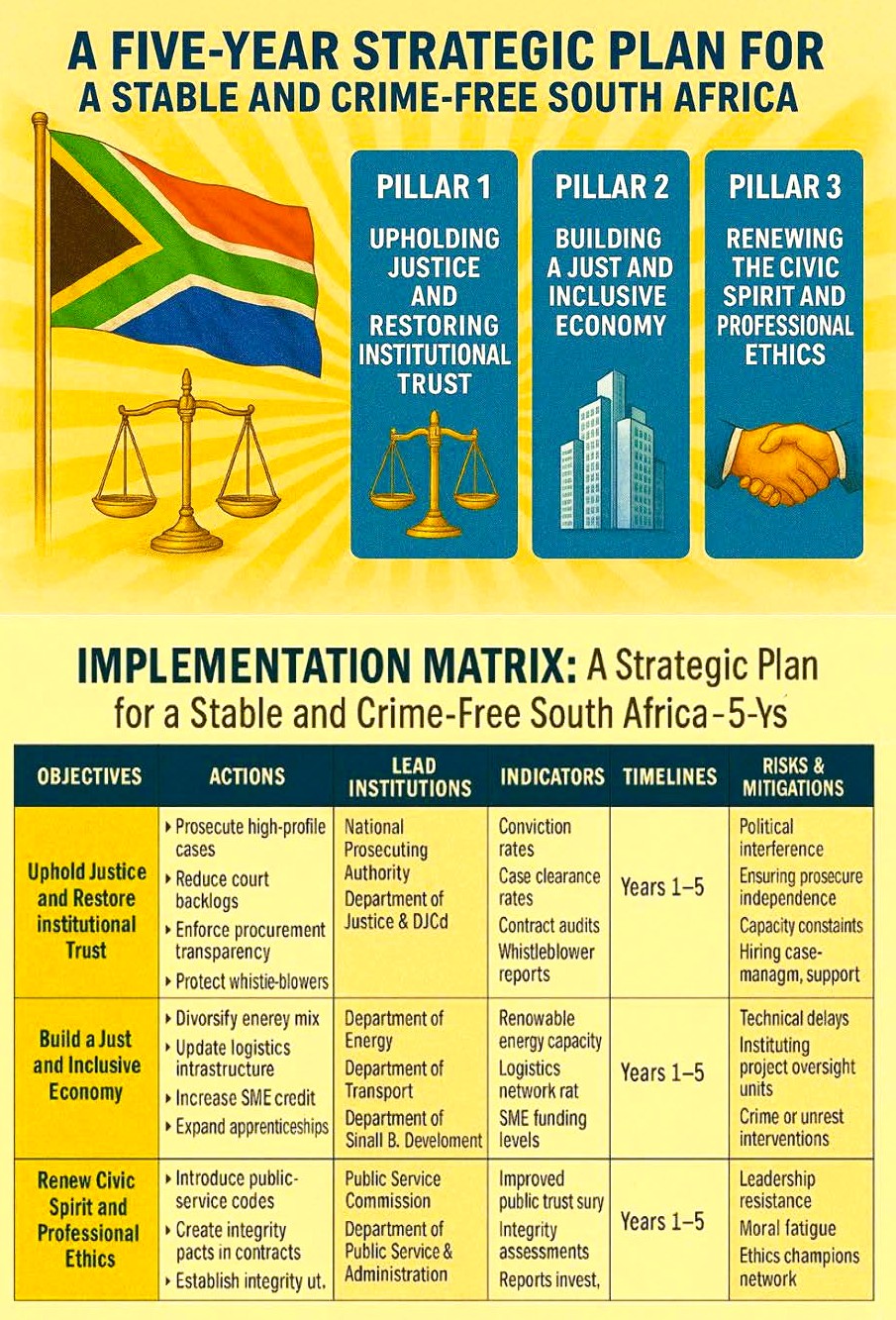
The Implementation Matrix (Five Years)
Pillar 1 Upholding Justice & Restoring Institutional Trust
Objectives:
Independent investigations & prosecutions; clean procurement; community‑centred policing & forensic turnaround.
Lead institutions:
DoJ & CD, NPA, DPCI (Hawks), SIU, SAPS, OCJ, IPID, National Treasury, AGSA, SARS, CIPC, municipalities.
Core indicators:
Priority‑crime conviction rates; backlog reduction; asset recovery (R); e‑procurement coverage; debarments; FSL turnaround; GBVF prosecutions.
Risks & mitigations:
Political interference → statutory safeguards & transparent appointments; capacity gaps → specialist training; collusion & IT sabotage → independent security audits; morale issues → performance contracts & station audits.
Pillar 2 Building a Just & Inclusive Economy
Objectives:
Reliable energy/logistics; SME growth & decent jobs; municipal service recovery & urban safety.
Lead institutions:
DMRE, Eskom, Transnet, DoT, SAPS, DSBD, DTIC, SARS, SETAs, COGTA, municipalities, Water Boards.
Core indicators:
Load‑shedding hours ↓; port dwell time ↓; rail ton‑km ↑; cargo theft ↓; SME formalisation; apprenticeship placements; audit outcomes; non‑revenue water & electricity losses ↓.
Risks & mitigations:
Sabotage/theft → security hardening & corridor protection; financing constraints → PPPs/blended finance; contractor failure → framework contracts; vandalism → community stewardship & rapid‑repair teams.
Pillar 3 Renewing the Civic & Professional Ethos
Objectives:
Professionalise public service; civic education & youth pathways to service; radical transparency & social accountability.
Lead institutions:
DPSA, PSC, NSG, DBE, DHET, NYDA, DPME, National Treasury, metros, universities, NGOs.
Core indicators:
PSC case resolution times; disciplinary turnaround; ethics CPD completion; participation in civic programmes; dashboard usage; public‑trust indices; remedial action completion.
Risks & mitigations:
Leadership resistance → legislated criteria & independent panels; participation drop‑off → stipends/mentorships; data‑quality issues → standards and third‑party verification.
Time cadence across all pillars
Year 1: Stabilise & signal (fast wins; clear accountability).
Years 2–3: Rebuild & professionalise (institutional capacity; scaling).
Years 4–5: Consolidate & entrench (codify gains; dashboards; audits; civic norms).
Original Photographs Conceptualised by Mrs V. Vawda January 2026
Based on the author’s vision for a “Stable and Righteous South Africa” and the challenges discussed above, I have mapped out a comprehensive five-year strategic plan. This framework is designed to address the deep-seated issues of crime, corruption, socio-economic inequality, and a weakening professional ethic through systemic action and civic renewal.
The plan is structured around three pillars, which are visualized below for clarity:
Pillar 1: Upholding Justice and Restoring Institutional Trust[44]
This pillar focuses on professionalizing the state and ensuring the rule of law is applied fairly and effectively.
- Year 1-2: Professionalize Core Institutions
- Justice & Policing: Implement a mandatory, standardized training curriculum for all police officers and new magistrates, focused on ethics, constitutional rights, and forensic investigation. Fully implement the National White Paper on Safety and Securityto close coordination gaps between government levels.
- Economic Governance: Cement the exit from the FATF “grey list” by making the new anti-money laundering protocols permanent, establishing a dedicated Financial Crimes Court, and publishing transparent asset declarations for all senior officials.
- Year 3-5: Deepen Reform and Civic Partnership
- Community Justice: Expand programs that build trust, like youth volunteer programs at police stations and community safety forums. Legislate stronger protections for whistleblowers.
- National Ethics Foundation: Launch nationwide civic education programs in schools and communities, teaching the tangible economic and social costs of corruption and entitlement.
Pillar 2: Building a Just and Inclusive Economy[45]
This pillar aims to create dignified work at scale, addressing the root causes of crime and desperation.
- Year 1-2: Unleash Job-Creating Reforms
- Infrastructure & Trade: Fast-track the African Continental Free Trade Area (AfCFTA)implementation and focus on “corridor-led industrialization” to connect regions and create “good jobs zones”. Accelerate private-sector participation in energy and logistics to unlock an estimated R200 billion in investment.
- Sectoral Growth: Launch public-private partnerships in agro-processingand digital services (e.g., BPO, software), bundling investment with job-relevant skills training.
- Year 3-5: Scale Inclusive Growth
- Formalize and Elevate Work: Use “digital rails” (e-ID, e-payments) to help small, informal firms build credit histories and access growth services, moving them from survival to productivity. Enforce a “Decent Work Standard” across all public and large private contracts.
Pillar 3: Renewing the Civic and Professional Ethos[46]
This pillar directly counters the “attitude of entitlement” and rebuilds a culture of merit and service.
- Year 1-2: Mandate Merit and Transparency
- Professional Standards: For critical fields like medicine, engineering, and law, require all accredited bodies to publish standardized, competency-based exam criteria and implement double-blind marking. Establish an independent ombuds office to review grading appeals, insulating examiners from unfair accusations.
- National Integrity Campaign: A government-led campaign celebrating everyday integrity, coupled with a mandatory “Ethics in Public Service” module for all state employees and university students.
- Year 3-5: Empower a New Generation
- Youth as Community Guardians: Scale up proven programs that position youth as positive change agents, like the Youth for Safer Communitiesprogram and initiatives that expose youth to the justice system to understand consequences.
- Charter for a Righteous Society: Facilitate a national dialogue across all sectors to draft and adopt a public charter that defines the mutual responsibilities of citizens, professionals, and the state.
Proposed Implementation Roadmap
| Year | Pillar 1: Justice and Trust | Pillar 2: Inclusive Economy | Pillar 3: Civic Ethos |
| Year 1 | Train police/magistrates; FATF protocols permanent. | Launch first two “good jobs zones”; fast-track energy/logistics reforms. | Publish merit standards for key professions; launch integrity campaign. |
| Year 2 | Roll out community safety forums nationally. | Scale agro-processing clusters; begin SME formalization drive. | Establish independent exam ombuds; ethics module in universities. |
| Year 3 | Legislate whistleblower protection; establish Financial Crimes Court. | Enforce “Decent Work Standard” in public contracts. | Scale “Youth Guardians” programs to all provinces. |
| Year 4-5 | Annual public scorecard on institutional trust metrics. | Target: significant reduction in youth unemployment. | National dialogue and adoption of “Charter for a Righteous Society.” |
The Path Forward
The greatest resource for this plan is not in the treasury, but in the populace. The “whole-of-society” approach called for in national strategies must be activated. This means moving from isolated projects to a unified national mission where business investment, community action, and state reform are aligned.
The plan is ambitious but built on existing, proven foundations. Its success depends on consistent political will and relentless civic pressure to ensure each milestone is met. As a peace propagator, your role is to champion this holistic vision, advocating that true stability cannot be enforced but must be built through righteous institutions, shared prosperity, and a reclaimed ethic of excellence.
The Bottom Line
The fundamental reality confronting South Africa is that our safety as individuals is inextricably linked to our collective commitment to justice, institutional integrity, and social healing. While current crime levels and institutional challenges present formidable obstacles, evidence-based strategies exist that could significantly improve security if implemented with sufficient resources and political will. The choice before us is whether to allow fear and difference to further fragment our society or to harness our shared vulnerability as motivation to build the effective, equitable institutions that all South Africans deserve. Our history demonstrates our capacity for extraordinary transformation; that same resilience and vision must now be applied to creating a safer, more just society for every citizen. The author presents and forcefully argues that dismantling this national culture is essential for justice, economic stability, and fulfilling the promise of democracy for all of the citizenry of the Rainbow Nation as described by the Honourable, Late, Emeritus Bishop Tutu[47], [48]: May His Souls Rests in Eternal Peace.
Closing Epigraph: Ubuntu[49],[50] Vedic[51], Sufi Cosmic Descent[52]
“And now, as this reflection comes to rest,
may we return to the simple truth that underlies all worlds,
that the same Light which spins the galaxies
also dwells quietly in the chambers of the human heart.
If we guard that Light with justice,
nurture it with compassion,
and share it with courage,
then even in uncertain times
a nation may walk unafraid.
For Ubuntu teaches that no soul travels alone,
the Vedas remind us that Dharma steadies every path,
and the Sufis whisper that Love is the bridge
between what we are
and what we may yet become.
So let us step forward,
with humility, with clarity, with grace,
knowing that the destiny of South Africa
will shine in proportion to the goodness
its people choose to embody.
And when our work is done,
may future generations look back and say:
they kept the flame alight.”
Original Epigraph Conceptualised by Mrs V. Vawda January 2026
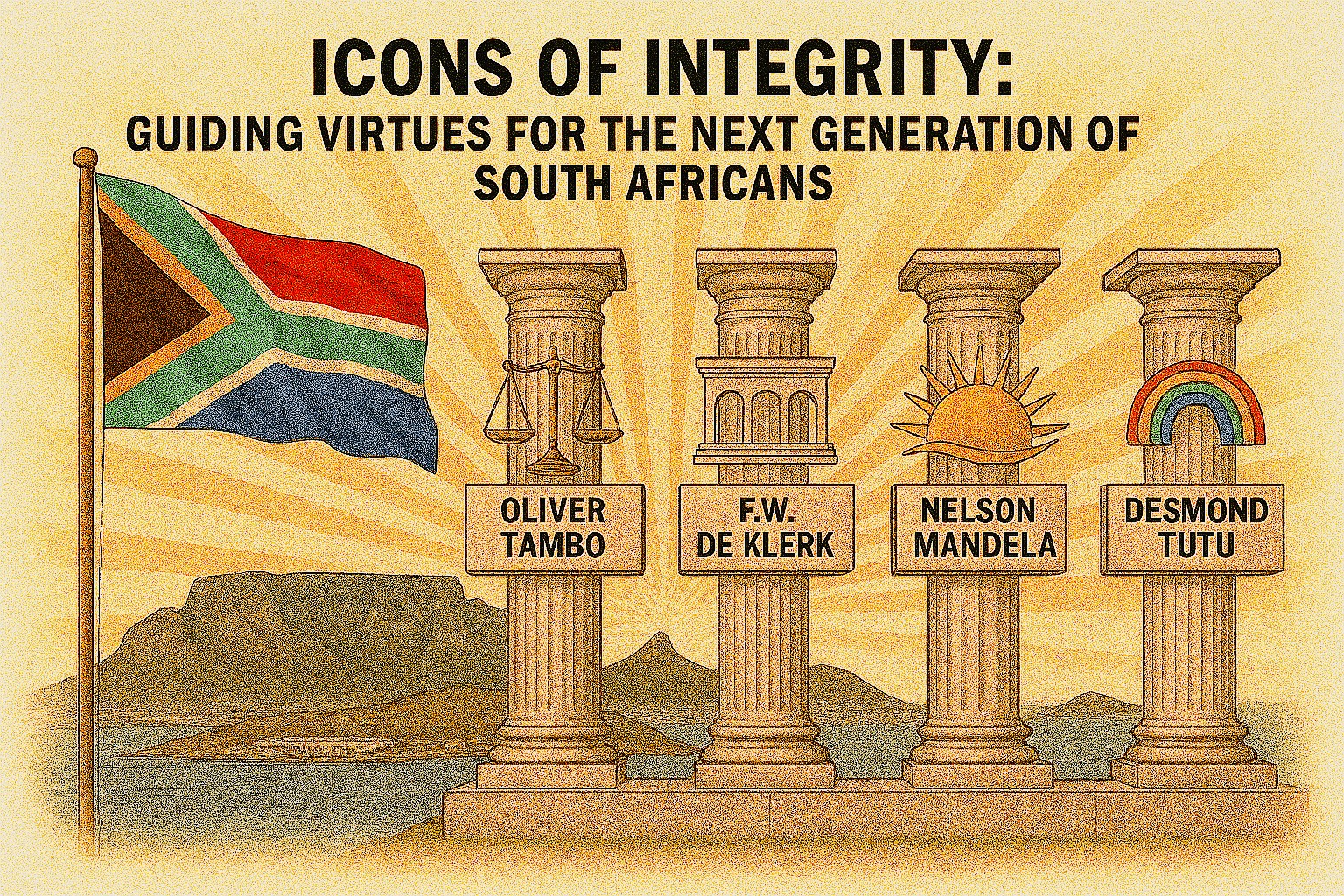
A symbolic tableau presenting four cardinal virtues, Justice and Steadfastness; Transition and Bridge‑Building; Reconciliation and Courage; Moral Clarity and Compassion, cast as classical pillars set before the iconic panorama of Table Mountain, with Robben Island solemnly occupying the foreground. In refraining from depicting individuals, the composition emphasises values rather than personalities, inviting the viewer to contemplate the ethical architecture upon which the post‑apartheid nation was rebuilt. The landscape itself becomes a moral geography: Robben Island embodies the crucible of suffering, Table Mountain rises as a metaphor for resilience, and the South African flag anchors the vision in shared nationhood.
The tableau also gestures toward South Africa’s unparalleled achievement, its transition from the engineered brutality of Grand Apartheid to the expansive moral vision of Grand Democracy without descending into civil war. This peaceful passage was not an accident of history but the cumulative expression of Ubuntu: the ancestral African ethic that affirms human dignity, mutual care, and the indivisibility of destiny. It was further strengthened by interfaith solidarity, churches, mosques, temples, synagogues, and African spiritual traditions converging upon a collective yearning for justice without vengeance, and transformation without hatred. Politicians and statesmen like Mandela and F.W. de Klerk[53] need to be commended for this peaceful, bloodless transition.
In this way, the pillars serve as an allegory for peace‑propagation: the disciplined cultivation of virtues that transcend creed, ethnicity, or class. The radiating background, suggestive of dawn, evokes the moral luminosity that guided South Africa through its most tumultuous decades. For young South Africans, the artwork offers a call to ethical remembrance: that a just society is not inherited but consciously built, and that the nation’s future stability rests upon embracing these interfaith, Ubuntu‑infused values as sources of moral courage, civic responsibility, and shared human upliftment.
Original Photographs Conceptualised by Mrs V. Vawda January 2026
Global: + 27 82 291 4546
References:
[1] Personal Quote by author, January 2026
[2] Personal Quote by author, January 2026
[3] https://www.bing.com/ck/a?!&&p=b03722f5356e897037a5047a7f63ae79f2b5d3ec7339f8d97235589f4c84a3baJmltdHM9MTc2OTIxMjgwMA&ptn=3&ver=2&hsh=4&fclid=37940f5c-820f-62a2-14ab-19c283916323&psq=whistle+blower+deneonarin+&u=a1aHR0cHM6Ly93d3cudGhlcG9zdC5jby56YS9uZXdzLzIwMjUtMDctMTgtZmFtaWx5LWhvcGVzLWZvci1icmVha3Rocm91Z2gtaW4tZmluZGluZy1tYXN0ZXJtaW5kLWJlaGluZC13aGlzdGxlLWJsb3dlcnMtbXVyZGVyLw
[4] https://www.bing.com/ck/a?!&&p=be3d42864e48ac2baecddb3ab1d553cd73923df555fac5a342f28069cc0abc3aJmltdHM9MTc2OTIxMjgwMA&ptn=3&ver=2&hsh=4&fclid=37940f5c-820f-62a2-14ab-19c283916323&psq=Blade+Runner+oscar+pistorius&u=a1aHR0cHM6Ly9lbi53aWtpcGVkaWEub3JnL3dpa2kvT3NjYXJfUGlzdG9yaXVz
[5] https://www.bing.com/ck/a?!&&p=fda28c6ec588479a506541f1f1dbc6ba294447c1ed6d7d55bc15c4c5d8e1fa2aJmltdHM9MTc2OTIxMjgwMA&ptn=3&ver=2&hsh=4&fclid=37940f5c-820f-62a2-14ab-19c283916323&psq=Diwani+case+some+years+ago&u=a1aHR0cHM6Ly93d3cuc2FmbGlpLm9yZy96YS9jYXNlcy9aQVdDSEMvMjAxNC8xODguaHRtbA
[6] https://www.bing.com/ck/a?!&&p=bfc176feb9c7f70a4fc254940d3bd2358886e0e1fd2a5ec6111969091f71ce41JmltdHM9MTc2OTIxMjgwMA&ptn=3&ver=2&hsh=4&fclid=37940f5c-820f-62a2-14ab-19c283916323&psq=Oliver+Tambo&u=a1aHR0cHM6Ly9lbi53aWtpcGVkaWEub3JnL3dpa2kvT2xpdmVyX1RhbWJv
[7] https://www.transcend.org/tms/2021/07/south-africa-is-burning-the-legacy-of-mandela-is-dead-for-a-nation-of-thieves/
[8] https://www.transcend.org/tms/2025/11/the-johannesburg-g20-summit-gambit-ubuntus-challenge-to-a-fragmenting-world-order/
[9] https://www.bing.com/ck/a?!&&p=69132126a13922bb30ebc821895915100ad2d3279c1f26e72ab1955158181d3fJmltdHM9MTc2OTIxMjgwMA&ptn=3&ver=2&hsh=4&fclid=37940f5c-820f-62a2-14ab-19c283916323&psq=robben+island+history&u=a1aHR0cHM6Ly9lbi53aWtpcGVkaWEub3JnL3dpa2kvUm9iYmVuX0lzbGFuZA
[10] https://www.bing.com/ck/a?!&&p=544abc04332cd50f17f051f9f26119a2867ec24450ee82f240b96c61a690ffe5JmltdHM9MTc2OTIxMjgwMA&ptn=3&ver=2&hsh=4&fclid=37940f5c-820f-62a2-14ab-19c283916323&psq=South+Africa%27s+transition+to+democracy+in+1994&u=a1aHR0cHM6Ly93d3cuc2FoaXN0b3J5Lm9yZy56YS9hcnRpY2xlL3NvdXRoLWFmcmljYW4tZ2VuZXJhbC1lbGVjdGlvbnMtMTk5NA
[11] https://www.bing.com/ck/a?!&&p=e2d18213e6ec8e9fd1526dc7db1eb098f3b0c6cdc969b8059a37baf79d9dbd7eJmltdHM9MTc2OTIxMjgwMA&ptn=3&ver=2&hsh=4&fclid=37940f5c-820f-62a2-14ab-19c283916323&u=a1aHR0cHM6Ly93d3cuc3RhdHNzYS5nb3YuemEvP2NhdD0yNiZxdW90&ntb=1
[12] https://www.bing.com/ck/a?!&&p=4277028b15e0a92aa34aeedf6e1fcba21e9ce0c862986c4dc04304fbce3ac2d8JmltdHM9MTc2OTIxMjgwMA&ptn=3&ver=2&hsh=4&fclid=37940f5c-820f-62a2-14ab-19c283916323&psq=Understanding+the+Dimensions+of+Crime&u=a1aHR0cHM6Ly93d3cuY3JpbXBzeS5jb20vYnJvYWQtY29uY2VwdC1vZi1jcmltZS8
[13] https://www.bing.com/ck/a?!&&p=607044dbb685820d86f69c839671b0ce8c3444f02cf6500c0a7b367d8a348e14JmltdHM9MTc2OTIxMjgwMA&ptn=3&ver=2&hsh=4&fclid=37940f5c-820f-62a2-14ab-19c283916323&psq=South+Africa%27s+violent+crime+statistics+present+a+concerning+trajectory+that+demands+urgent+attention.&u=a1aHR0cHM6Ly93d3cuc3RhdGlzdGEuY29tL3RvcGljcy8xMTQwNC92aW9sZW50LWNyaW1lLWluLXNvdXRoLWFmcmljYS8
[14] https://www.bing.com/ck/a?!&&p=37b81a30232fbaf0d7dce8dcfd69b8b5e2eaf33f8a8de41b6636c7a7cfeaaa10JmltdHM9MTc2OTIxMjgwMA&ptn=3&ver=2&hsh=4&fclid=37940f5c-820f-62a2-14ab-19c283916323&psq=The+South+African+Police+Service+(SAPS)+faces+profound+structural+challenges+that+significantly+hamper+its+effectiveness.+&u=a1aHR0cHM6Ly93d3cucmVzZWFyY2hnYXRlLm5ldC9wcm9maWxlL1Byb2Zlc3Nvci1Nb2Rpc2UvcHVibGljYXRpb24vMzg5MTY0NzQxX0FuX0V4YW1pbmF0aW9uX29mX3RoZV9Tb3V0aF9BZnJpY2FuX1BvbGljZV9TZXJ2aWNlX1NBUFNfU2VydmljZV9EZWxpdmVyeV9PYmplY3RpdmVzX3RoZV9DaGFsbGVuZ2VzX0VuY291bnRlcmVkX2J5X1N0YXRpb25fQ29tbWFuZGVyc19hbmRfdGhlX0ltcGxpY2F0aW9uc19mb3JfT3BlcmF0aW9uYWxfRWZmZWN0aXZlbmVzc19hbmRfUHVibGljX1RydXN0L2xpbmtzLzY3YjcxNTkwODMxMWNlNjgwYzZiMmMzNi9Bbi1FeGFtaW5hdGlvbi1vZi10aGUtU291dGgtQWZyaWNhbi1Qb2xpY2UtU2VydmljZS1TQVBTLVNlcnZpY2UtRGVsaXZlcnktT2JqZWN0aXZlcy10aGUtQ2hhbGxlbmdlcy1FbmNvdW50ZXJlZC1ieS1TdGF0aW9uLUNvbW1hbmRlcnMtYW5kLXRoZS1JbXBsaWNhdGlvbnMtZm9yLU9wZXJhdGlvbmFsLUVmZmVjdGl2ZW5lc3MtYW5kLVB1YmxpYy1UcnUucGRm
[15] https://www.bing.com/ck/a?!&&p=79f6c4eada2c0f78d5c7701a56176f2fb32041d18135f90a345102160db67a89JmltdHM9MTc2OTIxMjgwMA&ptn=3&ver=2&hsh=4&fclid=37940f5c-820f-62a2-14ab-19c283916323&u=a1aHR0cHM6Ly9jYXBldG93bi50b2RheS9uZXdzL2NoYWxsZW5nZXMtYW5kLXVyZ2VuY3ktYS1jcml0aWNhbC1leGFtaW5hdGlvbi1vZi1zYXBzLWluLTIwMjMtMjQ&ntb=1
[16] https://www.bing.com/ck/a?!&&p=c55aa22e638f6357546d1719a65bf4f0e533c05ab97ce849f7268b137a00a840JmltdHM9MTc2OTIxMjgwMA&ptn=3&ver=2&hsh=4&fclid=37940f5c-820f-62a2-14ab-19c283916323&psq=+Key+Institutional+Challenges+Facing+SAPS&u=a1aHR0cHM6Ly9jYXBldG93bi50b2RheS9uZXdzL2NoYWxsZW5nZXMtYW5kLXVyZ2VuY3ktYS1jcml0aWNhbC1leGFtaW5hdGlvbi1vZi1zYXBzLWluLTIwMjMtMjQ
[17] https://www.bing.com/ck/a?!&&p=27293137a726926c8a8d7a54df73fafe9bcd0e220b09b6da40feeac5f6359dcbJmltdHM9MTc2OTIxMjgwMA&ptn=3&ver=2&hsh=4&fclid=37940f5c-820f-62a2-14ab-19c283916323&u=a1aHR0cHM6Ly9saW5rLnNwcmluZ2VyLmNvbS9hcnRpY2xlLzEwLjEzNjUvczQzNDM5LTAyMy0wMDA4OS04&ntb=1
[18] https://www.bing.com/ck/a?!&&p=f5ed652d8b82253de4d6df031999448083e540bae4ac1e24e03136783d35990fJmltdHM9MTc2OTIxMjgwMA&ptn=3&ver=2&hsh=4&fclid=37940f5c-820f-62a2-14ab-19c283916323&u=a1aHR0cHM6Ly9tcnNwdWJsaXNoZXIuY29tL2Fzc2V0cy9hcnRpY2xlcy8xNzU5OTEzNDUyLnBkZg&ntb=1
[19] https://www.bing.com/ck/a?!&&p=8e291107fe5f8d1c1fb6d6a6d9db7488923abb1de6987280284ba974bf85c059JmltdHM9MTc2OTIxMjgwMA&ptn=3&ver=2&hsh=4&fclid=37940f5c-820f-62a2-14ab-19c283916323&psq=Racial+prejudices+in+crime+reporting+in++SA&u=a1aHR0cHM6Ly93d3cudGFuZGZvbmxpbmUuY29tL2RvaS9mdWxsLzEwLjEwODAvMjMzMTE4ODYuMjAyMS4yMDAyNTQy
[20] https://www.bing.com/ck/a?!&&p=1953aaeea20fe8cc26dcb7025919a41607ac378f24b64d14ece20bf1582572caJmltdHM9MTc2OTIxMjgwMA&ptn=3&ver=2&hsh=4&fclid=37940f5c-820f-62a2-14ab-19c283916323&u=a1aHR0cHM6Ly9saW5rLnNwcmluZ2VyLmNvbS9hcnRpY2xlLzEwLjEwNTcvczQxMjg0LTAyNS0wMDUwMi0z&ntb=1
[21] https://www.bing.com/ck/a?!&&p=04440066f312319326f69aa3db817f9c9cbae7a7b6e54c663841e1456c4d3bcdJmltdHM9MTc2OTIxMjgwMA&ptn=3&ver=2&hsh=4&fclid=37940f5c-820f-62a2-14ab-19c283916323&psq=Farm+Attacks+and+the+Genocide+Narrative&u=a1aHR0cHM6Ly9lbi53aWtpcGVkaWEub3JnL3dpa2kvU291dGhfQWZyaWNhbl9mYXJtX2F0dGFja3M
[22] https://www.bing.com/ck/a?!&&p=81b7f19b643357a5e8c1bb8a91f519420eb7ae889c492890ec2c1ba7d621e9ebJmltdHM9MTc2OTIxMjgwMA&ptn=3&ver=2&hsh=4&fclid=37940f5c-820f-62a2-14ab-19c283916323&psq=Gini+coefficient&u=a1aHR0cHM6Ly9lbi53aWtpcGVkaWEub3JnL3dpa2kvR2luaV9jb2VmZmljaWVudA
[23] https://www.bing.com/ck/a?!&&p=cfaf04d08f370917fe3942334112ee54c5e2a687f9df5cd32b440423b63b2957JmltdHM9MTc2OTIxMjgwMA&ptn=3&ver=2&hsh=4&fclid=37940f5c-820f-62a2-14ab-19c283916323&psq=key+socio-historical+factors+and+their+modern+manifestations+in+s+africa&u=a1aHR0cHM6Ly93d3cuc3R1ZG9jdS5jb20vZW4temEvbWVzc2FnZXMvcXVlc3Rpb24vMTAyMjQ5NDgva2V5LWhpc3RvcmljYWwtc29jaW8tZWNvbm9taWMtZmFjdG9ycy10aGF0LWluZmx1ZW5jZS1zdXN0YWluYWJsZS1kZXZlbG9wbWVudC1pbi1zb3V0aC1hZnJpY2E
[24] https://www.bing.com/ck/a?!&&p=539d9378df7f7394e25ca1fec692fd9ce8813ff0bb50fceb819a287f90b7dcadJmltdHM9MTc2OTIxMjgwMA&ptn=3&ver=2&hsh=4&fclid=37940f5c-820f-62a2-14ab-19c283916323&u=a1aHR0cHM6Ly93d3cudWZzLmFjLnphL2RvY3MvZGVmYXVsdC1zb3VyY2UvbmV3cy1kb2N1bWVudHMvb3Bpbmlvbl9wb2xpdGljc2FuZGNvcnJ1cHRpb25fZ2IxLnBkZj9zZnZyc249M2NkMDZjMjBfMA&ntb=1
[25] https://www.bing.com/ck/a?!&&p=2966728e914ef01063884df81f7994b226401d7e95f997e96603f62eff28dc88JmltdHM9MTc2OTIxMjgwMA&ptn=3&ver=2&hsh=4&fclid=37940f5c-820f-62a2-14ab-19c283916323&psq=The+Nature+and+Causes+of+High-Level+Corruption+in+S+A&u=a1aHR0cHM6Ly93d3cucmVzZWFyY2hnYXRlLm5ldC9wdWJsaWNhdGlvbi8zNzg0NjEwNTZfQV9jcml0aWNhbF9leGFtaW5hdGlvbl9vZl90aGVfY2F1c2VzX29mX0NvcnJ1cHRpb25faW5fU291dGhfQWZyaWNhJ3NfU3RhdGUtT3duZWQtRW50aXRpZXNfU09Fc19CYWNoZWxvcl9vZl9BcnRzX0hvbm91cnNfaW5fUG9saXRpY2FsX1NjaWVuY2Vz
[26] https://www.bing.com/ck/a?!&&p=9bc6ae3c4f52274d7e9246b8582550a3e49addf86246ba8ffe4a21308dd9fc38JmltdHM9MTc2OTIxMjgwMA&ptn=3&ver=2&hsh=4&fclid=37940f5c-820f-62a2-14ab-19c283916323&psq=Black+Economic+Empowerment+(BEE)&u=a1aHR0cHM6Ly9lbi53aWtpcGVkaWEub3JnL3dpa2kvQmxhY2tfRWNvbm9taWNfRW1wb3dlcm1lbnQ
[27] https://www.bing.com/ck/a?!&&p=ed1c4e03a87b3c7955c5fb7d5886618e58d1c5006f2aa870d785cedfbcef27edJmltdHM9MTc2OTIxMjgwMA&ptn=3&ver=2&hsh=4&fclid=37940f5c-820f-62a2-14ab-19c283916323&psq=%e2%80%a2%09the+mediosa+mobile+clinic+scandal%3a+wikipedia&u=a1aHR0cHM6Ly93d3cuaW9sLmNvLnphL25ld3MvcG9saXRpY3Mvbm9ydGgtd2VzdC1oZWFsdGgtaGFzLXRlcm1pbmF0ZWQtbWVkaW9zYS1jb250cmFjdC1tb3Rzb2FsZWRpLTE0NjYxMjU4Lw
[28] https://www.bing.com/ck/a?!&&p=1e09aaa1dc0a64b3f6ea29cbac0cc586e4ba5e361ec77885656e4009d0c736bdJmltdHM9MTc2OTIxMjgwMA&ptn=3&ver=2&hsh=4&fclid=37940f5c-820f-62a2-14ab-19c283916323&u=a1aHR0cHM6Ly93d3cubWVkaWNhbGJyaWVmLmNvLnphL2ZvcmVuc2ljLXJlcG9ydC1leHBvc2VzLWV4dGVudC1vZi1zdGF0ZS1ob3NwaXRhbC1veHlnZW4tdGVuZGVyLWZyYXVkLw&ntb=1
[29] https://www.bing.com/ck/a?!&&p=3df26f54fca26ef5b77292982fa618d6ab9b591184ff795773f7144f49938ec2JmltdHM9MTc2OTIxMjgwMA&ptn=3&ver=2&hsh=4&fclid=37940f5c-820f-62a2-14ab-19c283916323&psq=national+prosecuting+authority+south+africa&u=a1aHR0cHM6Ly93d3cubnBhLmdvdi56YS8
[30] https://www.bing.com/ck/a?!&&p=1789842a8df71ca42af03ecb2d5d7070a2679cdff0e208ce1970dc1f65e64857JmltdHM9MTc2OTIxMjgwMA&ptn=3&ver=2&hsh=4&fclid=37940f5c-820f-62a2-14ab-19c283916323&u=a1aHR0cHM6Ly9jcmlzLnVudS5lZHUvZ292ZXJuYW5jZS0lRTIlODAlOTh3aG9sZS1zb2NpZXR5JUUyJTgwJTk5LWFwcHJvYWNo&ntb=1
[31] https://www.bing.com/ck/a?!&&p=447d684c24831aad7da2579e3bdf77934eebb2eaee76a0038bbc87d68d847b9fJmltdHM9MTc2OTIxMjgwMA&ptn=3&ver=2&hsh=4&fclid=37940f5c-820f-62a2-14ab-19c283916323&psq=Africans+rioting+against+Indians+in+1949&u=a1aHR0cHM6Ly9lbi53aWtpcGVkaWEub3JnL3dpa2kvRHVyYmFuX3Jpb3RzIzp-OnRleHQ9VGhlJTIwRHVyYmFuJTIwcmlvdHMlMjB3ZXJlJTIwYW4lMjBhbnRpLUluZGlhbiUyMHJpb3QlMjB0aGF0LHdhcyUyMHRoZSUyMHNlY29uZCUyMGRlYWRsaWVzdCUyMG1hc3NhY3JlJTIwZHVyaW5nJTIwYXBhcnRoZWlkLiUyMCU1QjIlNUQ
[32] https://www.bing.com/ck/a?!&&p=740e5372be7f589803cf4a33ec4914b2b902389bed9b336ab0ca632264881178JmltdHM9MTc2OTIxMjgwMA&ptn=3&ver=2&hsh=4&fclid=37940f5c-820f-62a2-14ab-19c283916323&psq=Africans+rioting+against+Indians+in+2021&u=a1aHR0cHM6Ly93d3cuc293ZXRhbi5jby56YS9uZXdzL3NvdXRoLWFmcmljYS8yMDI0LTAxLTMwLWRlZXAtc2VhdGVkLXJhY2lzbS1hbmQtbWlzdHJ1c3Qtc3BhcmtlZC1qdWx5LTIwMjEtdW5yZXN0LWNybC1yZXBvcnQv
[33] https://www.bing.com/ck/a?!&&p=13a222410787c56299bd15c520841562a94c41a09ad0e122b97171a862496299JmltdHM9MTc2OTIxMjgwMA&ptn=3&ver=2&hsh=4&fclid=37940f5c-820f-62a2-14ab-19c283916323&psq=pepuda+act+4+of+2000&u=a1aHR0cHM6Ly9qdXN0aWNlLmdvdi56YS9sZWdpc2xhdGlvbi9hY3RzLzIwMDAtMDA0LnBkZg
[34] https://www.bing.com/ck/a?!&&p=8ea4c737d9a0d51adfc6b4a715d6d0c0750f07f58a6fb0b3eb7070b46dd8765cJmltdHM9MTc2OTIxMjgwMA&ptn=3&ver=2&hsh=4&fclid=37940f5c-820f-62a2-14ab-19c283916323&psq=pplaaf+south+africa&u=a1aHR0cHM6Ly93d3cucHBsYWFmLm9yZy8
[35] https://www.bing.com/ck/a?!&&p=519c9e97bbd8d37fe044cff1d8b4118696ad4c198a45f39c99c0bc76a64536d5JmltdHM9MTc2OTIxMjgwMA&ptn=3&ver=2&hsh=4&fclid=37940f5c-820f-62a2-14ab-19c283916323&psq=National+Anti-Corruption+Strategy+(NACS)&u=a1aHR0cHM6Ly93d3cubnN0LmNvbS5teS9uZXdzL25hdGlvbi8yMDI0LzA1LzEwNDczMjEvdXBkYXRlZC1wbS1sYXVuY2hlcy1uYXRpb25hbC1hbnRpLWNvcnJ1cHRpb24tc3RyYXRlZ2llcy0yMDI0LTIwMjg
[36] https://www.bing.com/ck/a?!&&p=59a7be045d9746dab6d284da5fb728f76857a2056fc8712eb0d6514aed87a8d9JmltdHM9MTc2OTIxMjgwMA&ptn=3&ver=2&hsh=4&fclid=37940f5c-820f-62a2-14ab-19c283916323&psq=tenderpreneur+south+africa&u=a1aHR0cHM6Ly9lbi53aWtpcGVkaWEub3JnL3dpa2kvVGVuZGVycHJlbmV1cg
[37] https://www.bing.com/ck/a?!&&p=206af466d2d9fbb91fffe869891bf4ba18ac4614dc85f2d10282b6f68fa61f0aJmltdHM9MTc2OTIxMjgwMA&ptn=3&ver=2&hsh=4&fclid=37940f5c-820f-62a2-14ab-19c283916323&u=a1aHR0cHM6Ly9zdW5kYXlpbmRlcGVuZGVudC5jby56YS9uZXdzLzIwMjUtMDktMTQtaW52ZXN0aWdhdGlvbi1pbnRvLXRlbWJpc2EtaG9zcGl0YWwtZnJhdWQtaW1wbGljYXRlcy1zeW5kaWNhdGUtcmVwb3J0ZWRseS1saW5rZWQtdG8tcHJlc2lkZW50LXJhbWFwaG9zYXMtbmVwaGV3Lw&ntb=1
[38] https://www.bing.com/ck/a?!&&p=45b13503a93dbfa29dc23c9a38e0ee39db901f6926128bd725adfda6fe2e493cJmltdHM9MTc2OTIxMjgwMA&ptn=3&ver=2&hsh=4&fclid=37940f5c-820f-62a2-14ab-19c283916323&psq=33.3%25+is+classified+as+a+%22pass%22+and+an+%22achievement%22+south++africa&u=a1aHR0cHM6Ly9lbi53aWtpcGVkaWEub3JnL3dpa2kvQnJpdGlzaF91bmRlcmdyYWR1YXRlX2RlZ3JlZV9jbGFzc2lmaWNhdGlvbiNJbnRlcm5hdGlvbmFsX2NvbXBhcmlzb25z
[39] https://www.bing.com/ck/a?!&&p=206d78e2a557ac6106a7019268d399ad9df90b20520170e7377578a71b1e580bJmltdHM9MTc2OTIxMjgwMA&ptn=3&ver=2&hsh=4&fclid=37940f5c-820f-62a2-14ab-19c283916323&psq=Special+Investigating+Unit+(SIU)++s+a&u=a1aHR0cHM6Ly9lbi53aWtpcGVkaWEub3JnL3dpa2kvU3BlY2lhbF9JbnZlc3RpZ2F0aW5nX1VuaXQ
[40] https://www.bing.com/ck/a?!&&p=65f6e393ced5e1d5e29dcfc3249c68a1cb759f270f0caf0c476f5a83c6a39e25JmltdHM9MTc2OTIxMjgwMA&ptn=3&ver=2&hsh=4&fclid=37940f5c-820f-62a2-14ab-19c283916323&psq=The+Foundation+of+Mediocrity+in+academia+in+S+Africa&u=a1aHR0cHM6Ly9zY2llbG8ub3JnLnphL3NjaWVsby5waHA_c2NyaXB0PXNjaV9hcnR0ZXh0JnBpZD1TMjUyMC05ODY4MjAyNDAwMDEwMDAwOA
[41] https://www.bing.com/ck/a?!&&p=78338144f6eee826ffdba2e252d47598f8fa28e9c86e51d939d5abd68876b1c3JmltdHM9MTc2OTIxMjgwMA&ptn=3&ver=2&hsh=4&fclid=37940f5c-820f-62a2-14ab-19c283916323&psq=iFearLESS+panic+button&u=a1aHR0cHM6Ly9pZmVhcmxlc3MuY28uemEv
[42] https://www.bing.com/ck/a?!&&p=daafb27b5701693c91ca1b9ccf152809bf13a5b64fe09b71e48ab54208cf0e0cJmltdHM9MTc2OTIxMjgwMA&ptn=3&ver=2&hsh=4&fclid=37940f5c-820f-62a2-14ab-19c283916323&psq=priority+areas+for+crime+prevention+investment+s+african+context&u=a1aHR0cHM6Ly93d3cuZ292LnphL2RvY3VtZW50cy9vdGhlci9uYXRpb25hbC1jcmltZS1wcmV2ZW50aW9uLXN0cmF0ZWd5LXN1bW1hcnktMDEtbWF5LTE5OTY
[44] https://www.bing.com/ck/a?!&&p=69593121fe9961f18de8e9fd00b328d3763727d8cb953affd76c60eb94b5be4fJmltdHM9MTc2OTIxMjgwMA&ptn=3&ver=2&hsh=4&fclid=37940f5c-820f-62a2-14ab-19c283916323&psq=upholding+justice+and+restoring+institutional+trust+s+african+context&u=a1aHR0cHM6Ly93d3cuaWpyLm9yZy56YS9wb3J0Zm9saW8taXRlbXMvY2l0aXplbnMtcGVyY2VwdGlvbnMtb2YtdHJ1c3QtYW5kLWNvcnJ1cHRpb24taW4tZ292ZXJubWVudC1pbnN0aXR1dGlvbnMtaW4tc291dGgtYWZyaWNhLw
[45] https://www.bing.com/ck/a?!&&p=22412692c72bca7fb95fb563c5d7382503d1e4e2c21474e8a1586379b3acf90aJmltdHM9MTc2OTIxMjgwMA&ptn=3&ver=2&hsh=4&fclid=37940f5c-820f-62a2-14ab-19c283916323&u=a1aHR0cHM6Ly93d3cud29ybGRiYW5rLm9yZy9lbi9jb3VudHJ5L3NvdXRoYWZyaWNhL3B1YmxpY2F0aW9uL2RyaXZpbmctaW5jbHVzaXZlLWdyb3d0aC1pbi1zb3V0aC1hZnJpY2EtcXVpY2std2lucy13aXRoLWNvbXBldGl0aXZlLW1hcmtldHMtYW5kLWVmZmljaWVudC1pbnN0aXR1dGlvbnM&ntb=1
[46] https://www.bing.com/ck/a?!&&p=5df67da79ea8c5595e18746c25b94b9e502ad07b2cab0ec92f0ae73fc87f96f4JmltdHM9MTc2OTIxMjgwMA&ptn=3&ver=2&hsh=4&fclid=37940f5c-820f-62a2-14ab-19c283916323&psq=renewing+the+civic+and+professional+ethos+meaning&u=a1aHR0cHM6Ly9jaXRpemVuLW5ldHdvcmsub3JnL2xpYnJhcnkvY2l2aWMtZXRob3MuaHRtbA
[47] https://www.bing.com/ck/a?!&&p=b060cd725b91feb996a4cdbaae5ef0da7d2e702f30c6822610fa13c5619c8204JmltdHM9MTc2OTIxMjgwMA&ptn=3&ver=2&hsh=4&fclid=37940f5c-820f-62a2-14ab-19c283916323&psq=Emeritus+Bishop+Tutu+by+vawda&u=a1aHR0cHM6Ly93d3cuZ292LnphL0Rlc21vbmRUdXR1LXRyaWJ1dGVz
[48] https://www.transcend.org/tms/2022/01/the-death-of-the-father-of-the-rainbow-nation/
[49] https://www.transcend.org/tms/2026/01/ubuntu-rising-a-peace-force-against-global-belligerism/
[50] https://www.transcend.org/tms/2025/11/the-johannesburg-g20-summit-gambit-ubuntus-challenge-to-a-fragmenting-world-order/
[51] https://www.transcend.org/tms/2023/03/peace-propagators-part-1-the-sufi-spiritual-masters/
[52] https://www.bing.com/ck/a?!&&p=ea784fee89fad284bd3f53fefdc7e41de13f52f8b97cd7fa70cd7e8e4f252fa3JmltdHM9MTc2OTIxMjgwMA&ptn=3&ver=2&hsh=4&fclid=37940f5c-820f-62a2-14ab-19c283916323&psq=sufi+cosmic+descent+meaning&u=a1aHR0cHM6Ly9lbi53aWtpcGVkaWEub3JnL3dpa2kvU3VmaV9jb3Ntb2xvZ3k
[53] https://www.bing.com/ck/a?!&&p=23796cbae5cb6fd58bc632592dc235cb6499d899fbb7461108389a288e8ec19eJmltdHM9MTc2OTIxMjgwMA&ptn=3&ver=2&hsh=4&fclid=37940f5c-820f-62a2-14ab-19c283916323&psq=f.+w.+de+klerk&u=a1aHR0cHM6Ly9lbi53aWtpcGVkaWEub3JnL3dpa2kvRi5fVy5fZGVfS2xlcms
______________________________________________
Professor G. Hoosen M. Vawda (Bsc; MBChB; PhD.Wits) is a member of the TRANSCEND Network for Peace Development Environment.
Director: Glastonbury Medical Research Centre; Community Health and Indigent Programme Services; Body Donor Foundation SA.
Principal Investigator: Multinational Clinical Trials
Consultant: Medical and General Research Ethics; Internal Medicine and Clinical Psychiatry:UKZN, Nelson R. Mandela School of Medicine
Executive Member: Inter Religious Council KZN SA
Public Liaison: Medical Misadventures
Activism: Justice for All
Email: vawda@ukzn.ac.za
Tags: Academic Mediocrity, Anni Dewani, Attitude of entitlement, Babita Deokaran, Bishop Tutu, Grafting, Madiba, NPA, National Anti-Corruption Strategy (NACS), Oliver Tambo, Oscar Pistorius, Race Riots 1949 and 2021, Robben Island, SIU, Shrien Dewani, South Africa, Sufi, Tenderpreneur, Ubuntu, Vedic, Whistle Blower
This article originally appeared on Transcend Media Service (TMS) on 26 Jan 2026.
Anticopyright: Editorials and articles originated on TMS may be freely reprinted, disseminated, translated and used as background material, provided an acknowledgement and link to the source, TMS: Forging a Righteous Future: A Five-Year Strategic Plan for Peace, Stability and Integrity in Post Liberation South Africa, is included. Thank you.
If you enjoyed this article, please donate to TMS to join the growing list of TMS Supporters.

This work is licensed under a CC BY-NC 4.0 License.
Join the discussion!
We welcome debate and dissent, but personal — ad hominem — attacks (on authors, other users or any individual), abuse and defamatory language will not be tolerated. Nor will we tolerate attempts to deliberately disrupt discussions. We aim to maintain an inviting space to focus on intelligent interactions and debates.