


The Courage to Be: Adapting to Unknowability in a Dangerous World
EDITORIAL, 16 Feb 2026
#938 | Richard Falk – TRANSCEND Media Service
As human beings we share deep emotional impulses to foretell the future, whether to foresee action on the basis of dread as to what the future will bring or to offer oneself and others reassurance that the future will deliver us from an ominous catastrophe or bring us the gifts of life that we most covet. From pre-modern times humans have sought this reassurance, resorting to magicians or religious seers and texts as necessary.
Diverse civilizations throughout history have thirsted after knowledge of their future as individuals or in relation to diverse collective identities as members of tribes, nations, states, religions, ethnicities, and gender identities, and more recently as a species. Fortune telling, astrology, and divining rods have all tried to foretell the future, without waiting for it to unfold. This kind of epistemological denialism has been somewhat disguised in modern sensibilities by recourse to experts, futurists, and forecasters who translate data into policy preferences and predictions that earns respect as ‘knowledge.’ It is also us bound up with gambling and extreme sports, as if we can defy the fog clouding the future and subjugate the future to our appetites.
This passion to know the future has even penetrated sophisticated scientific circles. A prominent example is the Doomsday Clock administered since 1947 by the Bulletin of Atomic Scientists that select a group of scientists, weapons specialists, nuclear experts, and public figures to assess how close the world is to the midnight omega point of nuclear war. This year it was a major news item when the clock was moved four seconds closer to midnight, from 89 seconds to 85, a pseudo-precise way of anticipating the risks of an apocalyptic future for humanity. As with pre-scientific ways of relieving persons and communities of the anxieties and impatience associated with the core uncertainties of life, as bearing upon prospects feared or desired. In modernity this demand for something as definite as possible about the future tends to be more comfortable relying on statistics, graphs, and data, still functioning as ways to cover up the unknowability of the future , and ultimately performs a disservice to humanity by encouraging fatalism, passivity, or sedation on one side and cynicism and complacency on the other.
Why act or struggle for the future if we know what lies ahead? Thereby arises a ‘false consciousness.’ This is what the philosopher, Alfred North Whitehead, famously warned us about calling it ‘the fallacy of misplaced concreteness.’ He considered that this widespread fallacy induced a false consciousness about the real. My purpose is more modest. It is to criticize the impact of negativity to the extent that it flourishes even among solutions-oriented peace activists in the tradition of Johan Galtung, and to energize progressive activism without the palliative of false consciousness.
Unknowability about the future, starting with the precariousness of our own mortality, is never comfortable, yet it is real. It should not diminish efforts to reduce dangers or risks, but motivate us to adjust behavior on the basis of present knowledge. The Titanic would not have struck an iceberg if it had not ventured so close to Arctic waters. I would feel safer and more secure if denuclearizing initiatives were embraced by the nuclear weapons states such as by entering into a nuclear disarmament treaty process with a resolve to make it work. Even so, I would be overreaching by claiming 100% certainty that my line of advocacy was assured of being best course for humanity to take? Claiming to know the future is a mixture of dogmatism and hubris, leading in worst case scenarios to extremism of a destructive kind.
These dangers disfigure behavior in potentially destructive ways. Zionist ideology roots its justifications for apartheid, genocide, and ecocide in the biblical promise of ‘the promised land,’ taking no account of the well-being and attachments of the majority population in modern day Palestine. Israel’s first Prime Minister, David Ben Gurion, a confirmed secularist, opportunistically invoked this sacrosanct method of foretelling of the future by saying ‘let the Bible be our weapon,’ and further evaluating any choice by the simple question, ‘is it good for the Jews?’ Not only is the future assured and hence knowable, but its inevitability tends to relieve those so falsely enlightened of all moral constraints. This kind of manipulative futurism corrupts as exemplified by Christian Zionists who read the Book of Revelations that comes at the end of the New Testament as validating unconditional support of Israel joined with a mission to induce Jews to emigrate to Israel as the necessary prelude to the Second Coming of Jesus Christ. And then, when the initial forecast is fulfilled, Jews are to be given the choice of conversion or eternal damnation.
The most notable substitution of hope for knowledge when it comes to the future derives its strongest affirmation from the great late 18th century German philosopher of rationality, Immanuel Kant (1724-1805), who put articulated in solemn inspirational language that has cheered the best of activists for more than two centuries: “The moral arc of the universe is long but bends toward justice.” Martin Luther King, Jr, famously invoked this sentiment, although he tied it to struggle more than treated it as a foolproof prediction of the future. A reading of the present can be interpreted as vindicating Kant’s confidence in the future of humanity, as in his essay Perpetual Peace: A Philosophical Sketch (1795) or an expression of premature optimism or even as a selective blindness toward the human condition as it is currently being exhibited. The evidence is equivocal and premature, at best, and if I had to pronounce upon it, I would prefer to regard such a predisposition as an ultra-humanistic version of false consciousness about the human future.
From these perspectives, I want to encourage peace activism of all kinds, to accept the challenges associated with a refusal to indulge delusions about ‘knowable futures’ in favor of rooting their beliefs in the unknowability of the future, and to ground their activism in an ethos of humanistic struggle based on visions of desirable futures without depending on false claims about the certainties of doom or of a guarantee that their dedicated responses to such assaults on humanity as arise from warfare, climate change, poverty, racism, and imperialism will with certainty overcome such shortcomings in the human condition.
As a species we must abandon a worldview based on parts rather than the whole. As long as we speak only or primarily from the present particularities of nationality, gender, ethnicity, civilizational, and religious identity we should awaken in the present that this is not a path to a peaceful, just, and resilient path to the future. With urgency we must learn to think and act as engaged citizens of the planetary ecosystemic whole, and more expansively of the cosmos as our unavoidable shared foundation of life and spirituality.
Overall, this involves an acceptance of unknowability when it comes to the future and to struggle on behalf of our beliefs in the present, with a posture of prudence toward perceived dangers and wrongdoing. Such a reorientation of outlook and engagement entails profound changes in education, citizenship, and notions of the public good. I try to remain engaged with the help of my former mentor/teacher, Paul Tillich, and especially his book Courage to Be (1952), whose message counsels rootedness in the deep soil of present reality.
__________________________________________
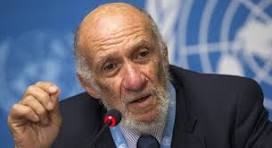 Prof. Richard Falk is a member of the TRANSCEND Network, of the TRANSCEND Media Service Editorial Committee, Albert G. Milbank Professor Emeritus of International Law at Princeton University, Chair of Global Law, Faculty of Law, at Queen Mary University London, Research Associate the Orfalea Center of Global Studies at the University of California, Santa Barbara, and Fellow of the Tellus Institute. He directed the project on Global Climate Change, Human Security, and Democracy at UCSB and formerly served as director the North American group in the World Order Models Project. He also is a member of the editorial board of the magazine The Nation. Between 2008 and 2014, Falk served as UN Special Rapporteur on Human Rights in Occupied Palestine. His book, (Re)Imagining Humane Global Governance (2014), proposes a value-oriented assessment of world order and future trends. His most recent books are Power Shift (2016); Revisiting the Vietnam War (2017); On Nuclear Weapons: Denuclearization, Demilitarization and Disarmament (2019); and On Public Imagination: A Political & Ethical Imperative, ed. with Victor Faessel & Michael Curtin (2019). He is the author or coauthor of other books, including Religion and Humane Global Governance (2001), Explorations at the Edge of Time (1993), Revolutionaries and Functionaries (1988), The Promise of World Order (1988), Indefensible Weapons (with Robert Jay Lifton, 1983), A Study of Future Worlds (1975), and This Endangered Planet (1972). His memoir, Public Intellectual: The Life of a Citizen Pilgrim was published in March 2021 and received an award from Global Policy Institute at Loyala Marymount University as ‘the best book of 2021.’ He has been nominated frequently for the Nobel Peace Prize since 2009.
Tags: Apocalypse, Bible, Bulletin Atomic Scientists, Doomsday Clock, Future, Israel, Jews, Johan Galtung, Knowledge, Nuclear war, Palestine, Predictions, Realism, Reality, Religion, Spirituality, Superstition
This article originally appeared on Transcend Media Service (TMS) on 16 Feb 2026.
Anticopyright: Editorials and articles originated on TMS may be freely reprinted, disseminated, translated and used as background material, provided an acknowledgement and link to the source, TMS: The Courage to Be: Adapting to Unknowability in a Dangerous World, is included. Thank you.
If you enjoyed this article, please donate to TMS to join the growing list of TMS Supporters.

This work is licensed under a CC BY-NC 4.0 License.
2 Responses to “The Courage to Be: Adapting to Unknowability in a Dangerous World”
Join the discussion!
We welcome debate and dissent, but personal — ad hominem — attacks (on authors, other users or any individual), abuse and defamatory language will not be tolerated. Nor will we tolerate attempts to deliberately disrupt discussions. We aim to maintain an inviting space to focus on intelligent interactions and debates.
[…] The following article was authored by Prof. Richard Falk and originally published in Transcend Media… […]
[…] The Courage to Be: Adapting to Unknowability in a Dangerous World […]