
FIFA World Cup 2026: The World Awaits the Largest Spectacle in History
SPORTS, 8 Jun 2026
Maksuda Lisa | Pressenza - TRANSCEND Media Service
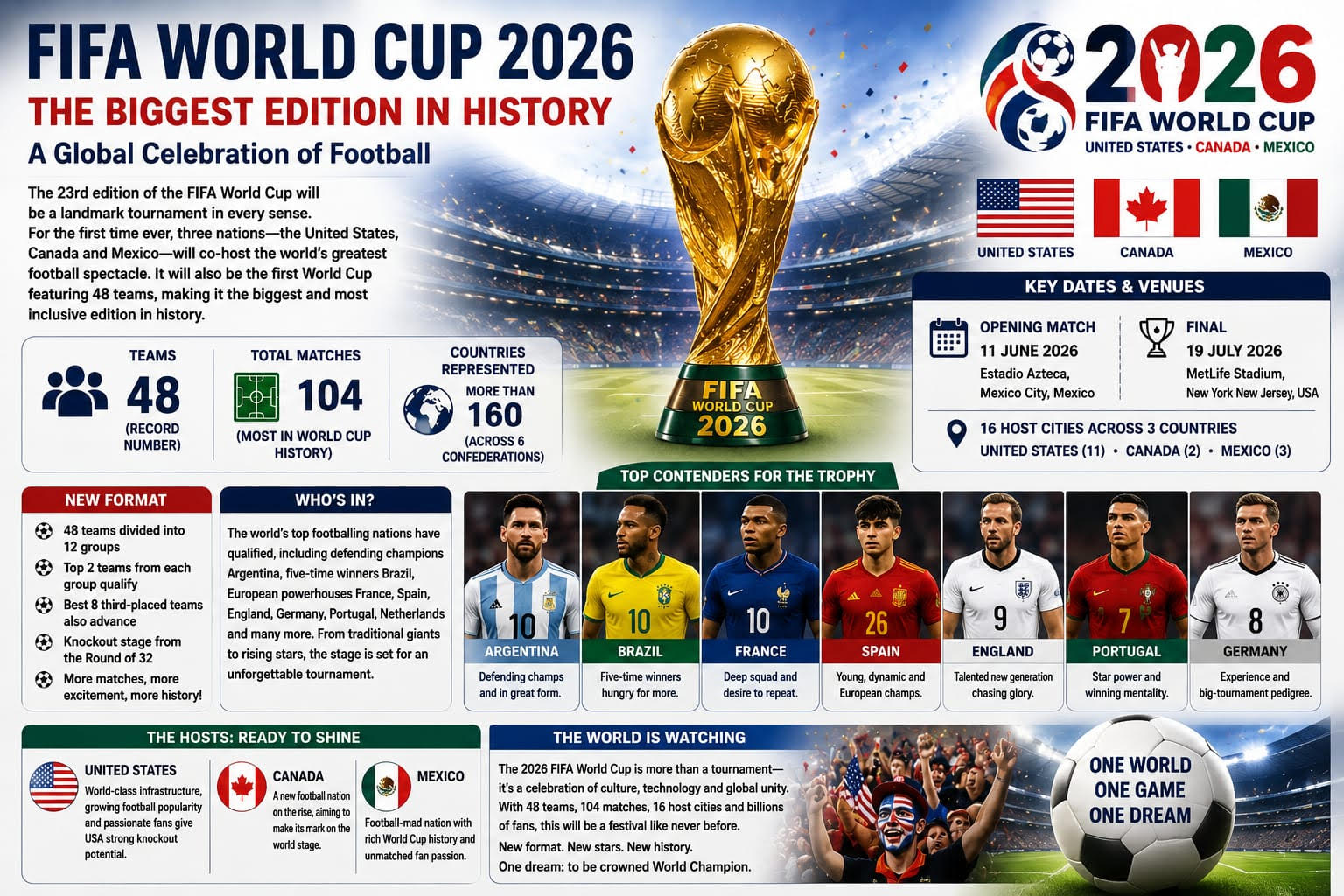
Participation of 48 teams, 104 matches, and joint hosting by three nations. The dawn of a new era in soccer is set to begin in North America.
2 Jun 2026 – Football is the most popular sport in the world. And the ultimate stage for that football is the FIFA World Cup. The emotions that build up around this tournament, held every four years, create new history and give birth to new legends. The FIFA World Cup to be held in 2026 is no exception. Rather, in many aspects, it is going to be the largest, most expensive, and most extensive arrangement in the history of the World Cup.
For the first time, three countries- the United States, Canada, and Mexico- are jointly hosting this grand spectacle of football. At the same time, a record number of 48 teams will participate in the World Cup for the very first time. As a result, the scope, competition, and global engagement of the World Cup will all reach an unprecedented new height. According to football analysts, the 2026 World Cup is not just a sports competition; it is going to be the dawn of a new era in modern football.
2026 World Cup Statistics at a Glance:
- Participating Teams: 48
- Total Matches: 104
- Joint Host Countries: 3 (United States, Mexico, Canada)
A New Chapter in World Cup History
The journey of football’s most prestigious tournament began with the hosting of the first World Cup in Uruguay in 1930. Over its long 96-year history, the World Cup has witnessed numerous changes. However, the 2026 edition is being seen as the ultimate symbol of major transformation. Prior to this, from 1998 to the 2022 World Cup, the number of participating teams was 32. Now, that number has been leaped to 48.
As a result of the expansion in team numbers, more countries from Asia, Africa, North America, and Oceania are getting the opportunity to represent themselves on the main stage of the World Cup. FIFA President Gianni Infantino had long stood in favor of expanding the World Cup. According to him, this historic change has been introduced with the goal of making the World Cup more global, meaningful, and inclusive.
Three-Nation Joint Hosting and Venue Allocation
Another major feature of the 2026 World Cup is its massive hosting framework. For the first time, three powerful nations are organizing the World Cup together. The matches of the World Cup will be held across 16 modern cities in the United States, Canada, and Mexico. Among these, 11 venues are located in the United States, 3 in Mexico, and 2 in Canada.
Country-wise Venues and Cities:
* United States (11 Venues): New York-New Jersey, Los Angeles, Dallas, Houston, Atlanta, Miami, Seattle, Boston, Philadelphia, Kansas City, and the San Francisco Bay Area.
* Mexico (3 Venues): Mexico City, Guadalajara, and Monterrey.
* Canada (2 Venues): Toronto and Vancouver.
From a historical perspective, Mexico has previously hosted the World Cup individually in 1970 and 1986. The United States successfully hosted the World Cup in 1994. On the other hand, for Canada, this will be the historic first experience of hosting a men’s FIFA World Cup.
From Azteca to MetLife: The Opener and the Final
The opening match will be held on June 11, 2026, at the legendary Estadio Azteca in Mexico City. With this, Estadio Azteca will set a unique record in the history of world football. It will be the first stadium in the world to earn the glory of hosting the opening matches of three different World Cups.
On the other hand, the ultimate final match to determine the supremacy of world football will be held on July 19. The famous MetLife Stadium in New York-New Jersey has been finalized as the venue, where approximately 82,000 spectators can enjoy the game live.
New Format and Abundance of Matches:
According to the new structure of the World Cup, the 48 teams will be divided into 12 groups. Each group will consist of four teams. Following the group stage, the top two teams from each group, along with the eight best third-placed teams, will secure their spots in the knockout stage. Afterward, the main knockout round of 32 teams will commence. Due to this new format, the total number of matches in the tournament will stand at 104, which is the highest in World Cup history. In comparison, there were only 64 matches in the Qatar 2022 World Cup.
Who are the Top Contenders in the Title Race?
As the countdown to the World Cup draws closer, intense analysis regarding the potential title contenders is heating up in the sports arena:
* Argentina: As the reigning world champions, the Albiceleste are naturally one of the top favorites. In 2022, they clinched their third title under the leadership of Lionel Messi, ending a long 36-year wait in Qatar. Although the era of Messi is nearing its conclusion, Argentina’s current team structure, Scaloni’s coaching blueprints, and consistent performances have once again made them strong contenders.
* Brazil: Brazil is the most successful team in World Cup history with five championship titles. However, they have been deprived of the title for more than two decades since 2002. This time, the Seleção will take the field with a flock of new-generation stars on a mission to reclaim the crown of the world’s best.
* France: The 2018 champions and 2022 runners-up, France is currently one of the most consistent and dominant teams in world football. Their deep squad, pace, power, and experience in playing big matches make them, as always, one of the primary contenders for the title.
* Spain and England: In recent times, Spain, built with young and talented footballers, has been playing highly aggressive and fast-paced football. On the other hand, England, a perennial contender in every major tournament, is dreaming big of winning their elusive trophy this time. Additionally, Germany, Portugal, and the Netherlands are also ready to shift the momentum of the tournament at any given moment.
Economy, Technology, and Global Impact
According to economic analysts at Pressenza, the 2026 World Cup is not just about football on the pitch; it is set to become one of the world’s largest economic and cultural gatherings. Centering this mega event, economic activities worth several billion dollars will be generated in tourism, broadcasting rights, sponsorships, and global commercial sectors. FIFA expects this World Cup to break all previous records and script a new history in terms of stadium attendance, television ratings, and digital engagement.
Waiting for a New History
As hosts, the United States, Canada, and Mexico will want to leverage the added advantage of playing on home soil. Particularly in the United States, the popularity of football has grown by a record margin over the past decade. Modern stadiums, immense spectator support, and strong infrastructure will provide them with great inspiration.
Altogether, with the blend of a new format, a record number of teams, and modern technology, the 2026 FIFA World Cup is set to give birth to a unique thrill. Now, the global football community eagerly awaits the answer to just one question- under the sky of MetLife Stadium on July 19, whose hands will lift the golden World Cup trophy? Will Argentina retain its title, or will world football witness the rise of a new king?
________________________________________________

Maksuda Lisa: Senior journalist and contributor, Dhaka Bureau.
Go to Original – pressenza.com
Tags: 2026, Canada, Competition, FIFA, Futebol, Mexico, North America, Soccer World Cup, Sports, USA
DISCLAIMER: The statements, views and opinions expressed in pieces republished here are solely those of the authors and do not necessarily represent those of TMS. In accordance with title 17 U.S.C. section 107, this material is distributed without profit to those who have expressed a prior interest in receiving the included information for research and educational purposes. TMS has no affiliation whatsoever with the originator of this article nor is TMS endorsed or sponsored by the originator. “GO TO ORIGINAL” links are provided as a convenience to our readers and allow for verification of authenticity. However, as originating pages are often updated by their originating host sites, the versions posted may not match the versions our readers view when clicking the “GO TO ORIGINAL” links. This site contains copyrighted material the use of which has not always been specifically authorized by the copyright owner. We are making such material available in our efforts to advance understanding of environmental, political, human rights, economic, democracy, scientific, and social justice issues, etc. We believe this constitutes a ‘fair use’ of any such copyrighted material as provided for in section 107 of the US Copyright Law. In accordance with Title 17 U.S.C. Section 107, the material on this site is distributed without profit to those who have expressed a prior interest in receiving the included information for research and educational purposes. For more information go to: http://www.law.cornell.edu/uscode/17/107.shtml. If you wish to use copyrighted material from this site for purposes of your own that go beyond ‘fair use’, you must obtain permission from the copyright owner.
Join the discussion!
We welcome debate and dissent, but personal — ad hominem — attacks (on authors, other users or any individual), abuse and defamatory language will not be tolerated. Nor will we tolerate attempts to deliberately disrupt discussions. We aim to maintain an inviting space to focus on intelligent interactions and debates.