
Processed, Stamped and Denied Entry: The World Cup Meets the US Border
SPORTS, 22 Jun 2026
Raïs Neza Boneza – TRANSCEND Media Service
16 Jun 2026 – Once upon time the World Cup arrived like a secular Pentecost: flags, drums, beer, bad defending, tears, and at least one uncle discovering nationalism after three decades of political silence.
Now it arrives on US soil like a badly managed airport transfer: overpriced, over-policed, under-attended, and somehow still convinced it is doing humanity a favor.
The biggest sporting event in the world has landed in the United States, and the first sound we hear is not the roar of the crowd. It is the quiet, humiliating beep of an unsold ticket scanner.
Figures are now circulating about 180,000 unsold tickets on resale markets. Hotels in some host cities are reportedly facing mass cancellations. Transport to stadiums has become less of a public service than a hostage negotiation with wheels. A family wanting to watch football must now choose between one match ticket and a minor surgical procedure.
And then comes the masterpiece: thousands of tickets still available for the United States versus Paraguay.
In the US.
For the US team.
This is not a slow start. This is a national sport discovering that patriotism has a price ceiling.
But of course, no modern World Cup is complete without a border incident dressed as security theatre. Omar Abdulkadir Artan, Somalia’s top referee and Africa’s 2025 Referee of the Year, arrived in the United States to officiate at the tournament. He had FIFA credentials. He had a visa. He had done what world football asked of him.
The border said no.
No detailed public explanation. No transparent process. Just the familiar smell of “trust us,” which in politics is usually what people say when the file is either empty, embarrassing, or both.
Andrew Giuliani, son of Rudy Giuliani and now a key White House figure in World Cup operations, defended the decision by saying the authorities wanted to avoid “bad actors.” A phrase so wonderfully elastic it can cover terrorists, referees, journalists, poets, midfielders, and anyone whose passport looks inconvenient under fluorescent light.
Artan was not treated like a professional invited to the World Cup. He was treated like a plot twist.
FIFA, that brave guardian of universal football brotherhood, responded with the moral courage of a wet napkin: immigration is the government’s problem. Which is a fascinating position from an organization that can tell entire nations how to build stadiums, tax hotels, price tickets, police fan zones, and redesign their cities — but apparently cannot ask why one of its own referees has been swallowed by airport security.
Then there is Iran.
Several Iranian football officials and support staff were denied visas. Iran had to move its training base from Arizona to Tijuana. Imagine preparing for the greatest football tournament on earth and discovering that your tactical plan now includes geopolitics, border control, and emergency relocation.
This is the beautiful game, we are told.
Beautiful, perhaps, if you enjoy watching diplomacy perform a sliding tackle from behind.
The hypocrisy is almost nostalgic. In Qatar 2022 the world cup was politics in an air-conditioned stadium, the world was flooded with lectures about human rights. When in Russia 2018 it was politics in a tracksuit. we were told that sport could not be separated from politics. Editorial boards, NGOs, television panels, politicians, celebrities, and think-tank experts suddenly became defenders of universal values. Saudi Arabia 2034 is already warming up on the touchline with a smile, a construction crane, and a public relations budget large enough to qualify for the knockout rounds.
But now? The world supporters struggle to obtain visas. Fans from parts of the Global South face barriers that many Western travelers never have to think about. Families who saved for years to attend major tournaments are left wondering whether they will even be allowed through the door. And suddenly the silence is deafening.
Where are the human rights organizations? Where are the emergency statements? Where are the press conferences? Where are the outraged editorials explaining that access, mobility, fairness, and equal treatment are human rights issues? Perhaps they are busy. Or perhaps human rights, like wireless internet, seem to have stronger coverage in some countries than others.
This is not about defending Qatar. This is not about defending Russia. This is about consistency. If freedom of movement, discrimination, and equal treatment matter, then they matter regardless of who is hosting the tournament. If restrictive policies are a scandal in Doha, they should be a scandal in Miami. If exclusion is wrong in Moscow, it should be wrong in Los Angeles. Universal principles are called universal for a reason. Otherwise, they are not principles. They are branding.
The uncomfortable question is not whether the US has the right to secure its borders. Every state claim that right. The question is why some countries are subjected to endless moral audits while others receive diplomatic exemptions. For years, the world was told that sporting events must reflect human rights values. Fine. Then apply the same standard to everyone. Because a principle that only works against your rivals is not a principle. It’s a geopolitical preference wearing a human rights T-shirt.
USA 2026 has brought something new: the World Cup as a luxury panic room. Here, football is not merely commercialized. It is securitized, privatized, monetized, litigated, and then sold back to the fan in installments.
You want a ticket? Dynamic pricing.
You want a train? That will be ninety-eight dollars, please.
You want your federation staff to enter the country? National security.
You want transparency? Please enjoy this commemorative silence.
Meanwhile, FIFA has reportedly been leasing office space on the 17th floor of Trump Tower in New York, space that some football officials say has sat mostly idle. The rent, naturally, flows to the Trump family business.
This is where satire begins to suffer from workplace burnout. What can a writer add? The joke has already signed the lease.
Gianni Infantino, the high priest of football’s global marketplace, appears to have understood the ancient rule of imperial sport: when in Rome, rent in Trump Tower, visit Mar-a-Lago, bring trophies, smile in the Oval Office, and call it “building relationships.”
Football was once criticized for betraying its values for money — “selling its soul.” Now the soul has been rebranded, franchised, regionally activated, and sold back to the public as an exclusive hospitality package.
And let us not forget the public health subplot, because every collapsing system deserves a bonus round. The same political class that pulled the United States away from the World Health Organization now finds itself complaining about global health coordination when disease-control questions emerge around the tournament.
First you burn the bridge. Then you blame the river.
This is the new operating system of power: defund the institution, sabotage the cooperation, dismantle the safety net, then appear on television asking why nobody caught you when you fell.
The World Cup has always been political. Anyone who says otherwise has never watched a national anthem played before twenty-two millionaires and a referee under surveillance. Football is soft power with shin guards. It is empire with sponsorship boards. It is war without artillery, although FIFA is doing its best to close the gap.
Russia understood this. Qatar understood this. Saudi Arabia understands this so well it has practically laminated the manual.
But the USA was supposed to be different, we were told. More open. More professional. More “world-class.”
Instead, the tournament is beginning to look like a shopping mall built on top of a border checkpoint, with a football pitch somewhere in the basement.
Fans are priced out. Cities absorb costs. Officials enjoy access. Private interests collect rent. Nations are humiliated. Referees are deported. And FIFA stands in the middle wearing a lanyard, whispering its favorite prayer:
Not our problem.
But it is their problem.
Because if a World Cup cannot welcome the world, then it is not a World Cup. It is a gated community with corner kicks.
If a referee cleared by football’s own institutions can be publicly reduced to a security suspicion without evidence shown, then this is not safety. It is spectacle.
If fans from certain nations are treated as suspicious before they even sing, then this is not hosting. It is profiling with fireworks.
If the tournament enriches private power while public cities count losses, then this is not a festival. It is extraction with mascots.
And if football’s governing body can survive Russia, bow through Qatar, bless Saudi Arabia, and then rent space in Trump Tower while preaching unity, then perhaps the real trophy was never gold.
Perhaps it was impunity.
The World Cup used to ask one simple question: who is the best team in the world?
Now it asks something darker: How much humiliation can be packaged as celebration before the crowd stops clapping?
The USA may still fill the stadiums. The cameras may still find the children with painted faces. The commentators may still speak of magic. Someone will score a beautiful goal, and for ninety seconds we will remember why we came.
That is football’s curse. It keeps producing beauty inside systems that deserve contempt.
But outside the white lines, the message is clear.
The game is no longer just being played.
It is being processed.
Stamped.
Priced.
Denied entry.
And resold.
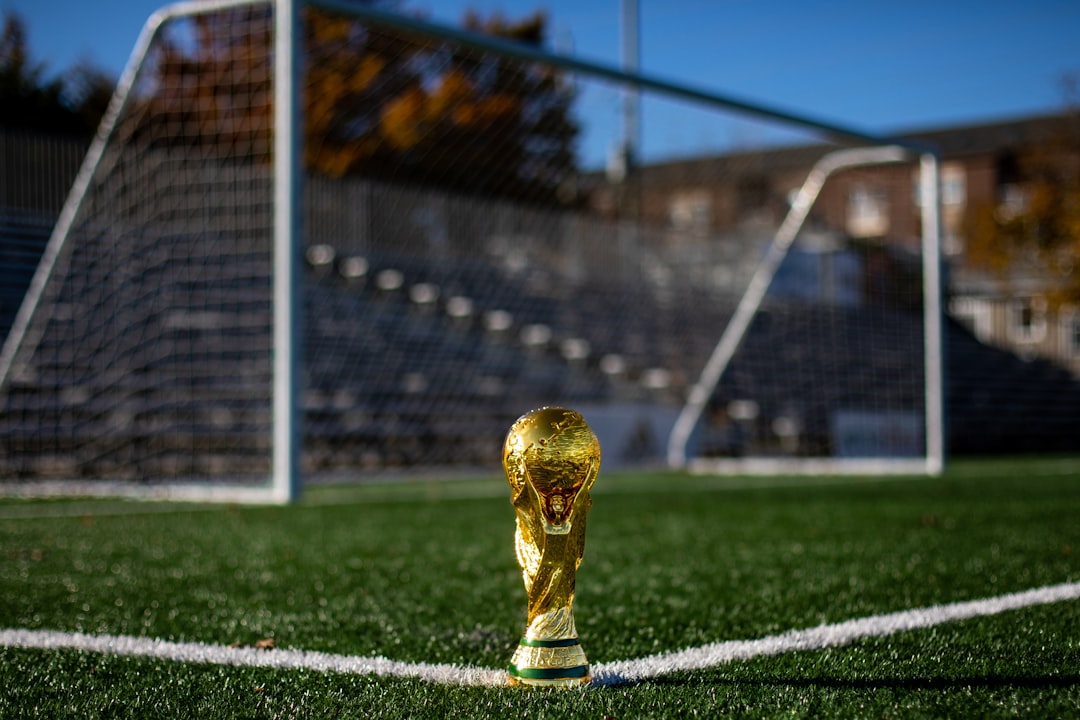
Photo by My Profit Tutor on Unsplash
____________________________________________
 Raïs Neza Boneza is the author of fiction as well as non-fiction, poetry books and articles. He was born in the Katanga province of the Democratic Republic of Congo (Former Zaïre). He is also an activist and peace practitioner. Raïs is a member of the TRANSCEND Media Service Editorial Committee and a convener of the TRANSCEND Network for Peace Development Environment for Central and African Great Lakes. He uses his work to promote artistic expressions as a means to deal with conflicts and maintaining mental wellbeing, spiritual growth and healing. Raïs has travelled extensively in Africa and around the world as a lecturer, educator and consultant for various NGOs and institutions. His work is premised on art, healing, solidarity, peace, conflict transformation and human dignity issues and works also as freelance journalist. You can reach him at rais.boneza@gmail.com – http://www.raisnezaboneza.no
Go to Original – rboneza.substack.com
Tags: 2026, Anti-immigration, FIFA, ICE, Soccer World Cup, Trump, USA
DISCLAIMER: The statements, views and opinions expressed in pieces republished here are solely those of the authors and do not necessarily represent those of TMS. In accordance with title 17 U.S.C. section 107, this material is distributed without profit to those who have expressed a prior interest in receiving the included information for research and educational purposes. TMS has no affiliation whatsoever with the originator of this article nor is TMS endorsed or sponsored by the originator. “GO TO ORIGINAL” links are provided as a convenience to our readers and allow for verification of authenticity. However, as originating pages are often updated by their originating host sites, the versions posted may not match the versions our readers view when clicking the “GO TO ORIGINAL” links. This site contains copyrighted material the use of which has not always been specifically authorized by the copyright owner. We are making such material available in our efforts to advance understanding of environmental, political, human rights, economic, democracy, scientific, and social justice issues, etc. We believe this constitutes a ‘fair use’ of any such copyrighted material as provided for in section 107 of the US Copyright Law. In accordance with Title 17 U.S.C. Section 107, the material on this site is distributed without profit to those who have expressed a prior interest in receiving the included information for research and educational purposes. For more information go to: http://www.law.cornell.edu/uscode/17/107.shtml. If you wish to use copyrighted material from this site for purposes of your own that go beyond ‘fair use’, you must obtain permission from the copyright owner.
Join the discussion!
We welcome debate and dissent, but personal — ad hominem — attacks (on authors, other users or any individual), abuse and defamatory language will not be tolerated. Nor will we tolerate attempts to deliberately disrupt discussions. We aim to maintain an inviting space to focus on intelligent interactions and debates.