
Ending the War on Iran Depends on Ending Iran’s Vulnerability to Future U.S./Israel Aggression
EDITORIAL, 27 Jul 2026
#961 | Richard Falk – TRANSCEND Media Service
Pushing Iran Toward Nuclearism
In the writing about how to restore hopes for the avoidance of further bloodshed, devastation, and suffering arising from reescalating the confrontation between the US/Israel and Iran it is crucially relevant to take account of the current situation as stemming from an unprovoked war of aggression started by the United States on February 28 and soon joined by Israel, and resumed from time to time since. The original pretexts for initiating the war concerned Iran’s continuing nuclear program and alleged stockpiles of enriched uranium relevant to the production of a nuclear weapon. In the early days of the war Trump arrogantly ordered the Iranian people ‘to take back their country’ and have a new leadership in Tehran acknowledging its defeat and admit the total U.S. military victory with a show of gratitude for liberating its people from the ruling theocracy. Israel somewhat in the background had additional strategic goals that included a radical regime change in Tehran, a commitment to end proxy relations with regional Islamic movements (Hezbollah, Houthis, Hamas), and destruction of Iran’s remaining missile capabilities including launchers. While the U.S. was negotiating bilaterally it tried with minimum results to separate itself from Israel’s continuing regional warmongering especially in southern Lebanon.
The highpoint was the disclosure of a Memorandum of Understanding on June 17 that set forth a plan generated by high profile negotiations that seemed to be a formula for a permanent ceasefire and the gradual normalization of Iran as a state among states, with assurance of Iran’s future security. The MOU left the regulation of Iran’s nuclear program and enriched uranium to further negotiations in a 60-day period. Israel’s extreme displeasure with the MOU was not hidden, and its continued attacks on Lebanon violated Iran’s quite reasonable expectations that the MOU applied to Israel. Such behavior doomed diplomacy and revived an atmosphere of acute mistrust repeated bloodthirsty threats by Trump accompanied military strikes against civilian infrastructure and warnings of further and worse to attacks if Iran refuses to given in to U.S. demands, which have yet to be clearly articulated beyond a commitment to prevent Iran from ever acquiring a nuclear weapon.
The Iran War can be divided into five distinct phases:
- U.S. launch of a war of aggression;
- joint U.S./Israeli aggression;
- effective countermeasures by Iran within the scope of self-defense, including attacking military bases in the Gulf reason used by the U.S. to carry out its military operations and the closing of the Strait of Hormuz to commercial shipping that disrupted energy and fertilizer supply chains;
- bilateral U.S./Iran negotiations climaxing with the mutual acceptance of an apparent war-ending MOU;
- breakdown of the MOU envisioned process and resumption of threats and military attacks by the two aggressor countries.
This is not the Iran War that has been portrayed in the West, especially by the voices of the Western governments and even the United Nations since its initiation on February 28, 2026.
The evidence and the intention of applicable law is to brand the failure to use peaceful means to resolve international disputes and to refrain from recourse to international force as an international crime since 1928 when the Pact of Paris was signed into law, a status confirmed at the Nuremberg and Tokyo war crimes tribunals as belonging to the ultimate category of international crimes, Crimes Against the Peace. The aggression against Iran was aggravated by the fact that the country was subject to the so-called Twelve Day War initiated by the same aggressors less than on June13, 2025, less than a year earlier. It was also aggravated in the midst of ongoing negotiations in Oman that the mediating official described as being on the verge of success thus amounting to a rebuff of the legal imperative of peaceful settlement of disputes. Beyond this, was the shocking events on the first day of the Iran War that included the deliberate targeting for assassination of the Supreme Leader of Iran, Ayatollah Ali Khomeini who as well as being the political leader was revered as a sacred religious figure among Shi’ite Muslims throughout the region. On the same day, an elementary school in Minab was struck that killed at least 165 underage children. U.S. officialdom discounted without an apology the attack as an accident of war resulting from relying on obsolete targeting information, but even if true it hardly eliminates the symbolic impact of such a tragedy of innocence.
Against this background, even the UNSC could not mobilize the political will to condemn the aggression, but outrageously blamed Iran for spreading the war by its attacks on the military bases on the territory of Gulf countries. [S/RES/2817 92026) by a vote 0f 13-0, with China, Russia abstaining] Mainstream Western media did little better confining its coverage to which side was winning the war as if both sides were equally culpable for the the chaotic conditions brought about. The NY Times and other liberal media platforms characterized the war from a Western perspective as ‘a war of choice,’ implicitly admitting that it was not initiated or waged because of a credible security threat, much less in response to an armed attack. It did by and large counter U.S. governmental contentions that it was victorious and running out of patience with Iran’s refusal to admit as much. It even gave respectful attention to the views of militarist hawks such as John Bolton who called upon Washington ‘to finish the job’ as if crimes of the aggressor were a legitimate international undertaking. It gave no attention to dovish views that peace must be restored by taking account of the identity of the aggressor and not through a false symmetry. As with the Gaza Genocide Trump’s ‘peacemaking’ in the Iran setting rewards the perpetrators of crimes and further punishes the victims.
More good willed diplomatic initiatives are also non-judgmental as to the two sides when setting forth to put in place measures to end the Iran War coupled with arrangements that will establish a more stable future for the region. Such proposals focus on assurances of future freedom of navigation through the Strait of Hormuz by some sort of joint management of this waterway that is a choke point of globally vital supply chains. Such proposals that fail to take account of Iranian vulnerability to future aggression or to impose punitive accountability of the aggressors for the devastation and the betrayals of trust seem unworthy of consideration.. It is impossible to expect Iran to accept an arrangement for Hormuz that doesn’t include some reliable alternative means of deterrent and self-defense. At present, there is no foundation or justification to rely on the U.S.’s, much less Israel’s, professions of peaceful intention without assured access to reliable deterrent capabilities or retaliatory countermeasures. Without such features a peace agreement would almost certainly a death trap for Iran. At present, the only plausible way of achieving Iran’s future security would be to authorize managerial access to Hormuz in times of national security emergency, which would be helpfully reinforced by the demilitarization of the U.S. regional presence by way of military bases and security guarantees. If such an alternative proves to be impossible it is likely that Iran will ironically be tempted to seek security by sheltering beneath a nuclear umbrella of a nuclear weapons state or by somehow acquiring, like Israel, its own nuclear arsenal. Such an outcome of a peace process is almost too surrealistic—a war seeking to avoid proliferation instead becomes stimulus of proliferation.
For those who seek genuine peace in the world, the plight of Iran has many lessons that need to be learned by liberal democracies that continue to voice rhetorical praise for an international rule of law while repudiating its relevance whenever compliance becomes strategically inconvenient.
__________________________________________
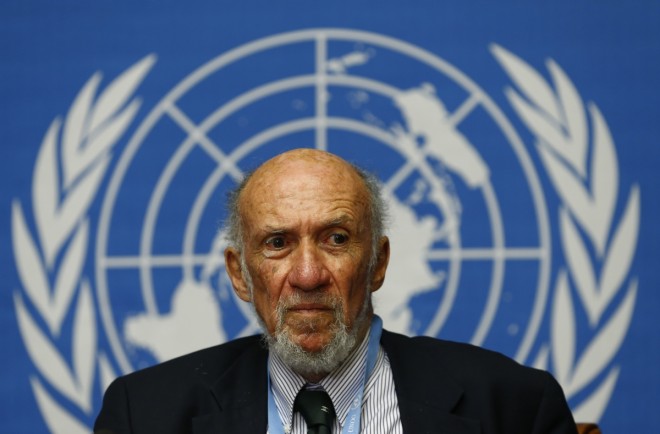 Prof. Richard Falk is a member of the TRANSCEND Network, of the TRANSCEND Media Service Editorial Committee, Albert G. Milbank Professor Emeritus of International Law at Princeton University, Chair of Global Law, Faculty of Law, at Queen Mary University London, Research Associate the Orfalea Center of Global Studies at the University of California, Santa Barbara, and Fellow of the Tellus Institute. He directed the project on Global Climate Change, Human Security, and Democracy at UCSB and formerly served as director the North American group in the World Order Models Project. He also is a member of the editorial board of the magazine The Nation. Between 2008 and 2014, Falk served as UN Special Rapporteur on Human Rights in Occupied Palestine. His book, (Re)Imagining Humane Global Governance (2014), proposes a value-oriented assessment of world order and future trends. His most recent books are Power Shift (2016); Revisiting the Vietnam War (2017); On Nuclear Weapons: Denuclearization, Demilitarization and Disarmament (2019); and On Public Imagination: A Political & Ethical Imperative, ed. with Victor Faessel & Michael Curtin (2019). He is the author or coauthor of other books, including Religion and Humane Global Governance (2001), Explorations at the Edge of Time (1993), Revolutionaries and Functionaries (1988), The Promise of World Order (1988), Indefensible Weapons (with Robert Jay Lifton, 1983), A Study of Future Words (1975), and This Endangered Planet (1972). His memoir, Public Intellectual: The Life of a Citizen Pilgrim was published in March 2021 and received an award from Global Policy Institute at Loyala Marymount University as ‘the best book of 2021.’ He has been nominated frequently for the Nobel Peace Prize since 2009.
Tags: Arabs, Crimes against Humanity, Evil empire, Iran, Israel, Jews, Middle East, Netanyahu, Nuclear Free Middle East, Persia, Trump, USA, War crimes, War of Aggression
This article originally appeared on Transcend Media Service (TMS) on 27 Jul 2026.
Anticopyright: Editorials and articles originated on TMS may be freely reprinted, disseminated, translated and used as background material, provided an acknowledgement and link to the source, TMS: Ending the War on Iran Depends on Ending Iran’s Vulnerability to Future U.S./Israel Aggression, is included. Thank you.
If you enjoyed this article, please donate to TMS to join the growing list of TMS Supporters.

This work is licensed under a CC BY-NC 4.0 License.
2 Responses to “Ending the War on Iran Depends on Ending Iran’s Vulnerability to Future U.S./Israel Aggression”
Join the discussion!
We welcome debate and dissent, but personal — ad hominem — attacks (on authors, other users or any individual), abuse and defamatory language will not be tolerated. Nor will we tolerate attempts to deliberately disrupt discussions. We aim to maintain an inviting space to focus on intelligent interactions and debates.
[…] Ending the War on Iran Depends on Ending Iran’s Vulnerability to Future U.S./Israel Aggression […]
Thank you, Professor Falk, for this clear and erudite summary of the prospects for peace. They are decidedly gloomy.
Sad to say, the only way I see the aggressors changing tack from their obsession with bombing, is if a significant number of American coffins return to the U.S.A., creating political pressure from citizens and politicians who suddenly have to bear the cost of war through their own American war dead. Fifteen coffins so far (by my count from press reporting) is not a sufficient burden to move American public opinion. Fifteen families in mourning, but no impact on the general public. The thousands of dead Palestinians, Lebanese, Iranian and other Middle Eastern victims, and the tens of thousands who are maimed, traumatized, homeless and reduced to poverty, all this misery does not seem to register with Americans. Do they even notice? Do they even care?
The Christianity that once infused America, has forgotten or excluded God’s Commandments Thou Shalt Not Kill, and Love they Neighbor As Thyself. What is left in the Soul of America, apart from the U.S. dollar ?