


New Forms of Political Criminalization in Latin America
LATIN AMERICA AND THE CARIBBEAN, 3 Aug 2026
Alejandra Garcia Elizalde | Resumen - TRANSCEND Media Service
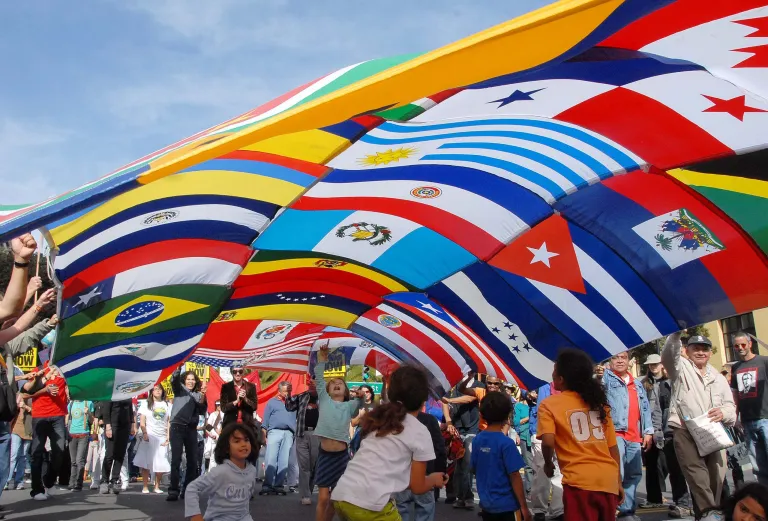
Foto: Bill Hackwell
27 Jul 2026 – The recent meeting convened by U.S. Secretary of State Marco Rubio to coordinate international action against what has been labeled “left-wing extremism” has reignited a long-standing debate in Latin America over the limits of security policies and the construction of the so-called “internal enemy.” According to analysts and social organizations, the initiative reflects the continuation of a logic that, although adapted to the technological and political realities of the 21st century, bears similarities to doctrines implemented during the Cold War.
The meeting, held on July 16 in Washington and attended by representatives from 66 countries across the Americas, Europe, and Asia, was presented as a mechanism for international cooperation to address threats to democratic order. According to the U.S. Department of State, its objective is to strengthen coordination among governments to identify organizations and activists considered “extremists.”
However, the scope of concepts such as “left-wing extremism,” “radical activism,” and “hybrid threats” has raised concerns among human rights experts and political analysts, who warn that these categories may be broad enough to encompass social movements, grassroots organizations, or groups that challenge certain public policies.
The debate inevitably recalls the National Security Doctrine promoted by the United States during the Cold War. During that period, the primary threat was no longer seen as an external enemy but rather as internal actors considered potentially destabilizing.
Under that doctrine, labor unions, peasant organizations, student movements, religious groups involved in social struggles, intellectuals, and revolutionary organizations were labeled as enemies. This perspective provided the ideological foundation for Operation Condor, the coordinated system of repression carried out by the military dictatorships of the Southern Cone during the 1970s and 1980s. The operation involved joint intelligence efforts, political persecution, kidnappings, torture, and enforced disappearances.
Five decades later, the regional landscape has changed. Military dictatorships are no longer the primary mechanism of political control, but many researchers argue that the tendency to construct new internal enemies through national security narratives persists.
From Military Control to Technological Surveillance
For Argentine analyst Alejandra Rizzo, one of the key differences between past and present lies in the tools being used. In her article From Operation Condor to the New Architecture of Political Criminalization, she explains that “while Operation Condor relied primarily on intelligence services and the armed forces, technological developments have significantly expanded the capacity for state and transnational surveillance.”
Artificial intelligence, biometric recognition, digital surveillance, information sharing among security agencies, migration restrictions, financial sanctions, and the widespread use of digital platforms have become part of a new ecosystem of control capable of monitoring the political and social activities of millions of people.
These developments are accompanied by mechanisms such as the judicial prosecution of social leaders, the practice known as lawfare, the criminalization of protest, and disinformation campaigns, which, according to various experts, can weaken the organizational capacity of certain social sectors without necessarily resorting to direct military repression.
Social Movements at the Center of the Debate
Social organizations warn that this new security architecture disproportionately affects movements that challenge prevailing economic, environmental, or political models. Among those most frequently mentioned are labor unions, peasant organizations, Indigenous movements, student groups, environmental organizations, and human rights institutions, many of which have reported cases of stigmatization or judicial persecution in different countries.
“The debate is not only about the right to protest,” Rizzo explains. “It is also about who defines what constitutes a threat to democracy and what criteria are used to distinguish political activism from extremism.”
Beyond the ideological dispute, numerous organizations have denounced the closure of government ministries dedicated to gender equality, reductions in funding for equality policies, the elimination of programs aimed at preventing gender-based violence, and the weakening of community networks that provide assistance to women in vulnerable situations.
Critics argue that these measures represent an institutional setback. Their supporters, however, contend that they reflect efforts to reorganize public spending or redefine the role of the state.
What is clear is that feminist movements have broadened their agenda beyond gender equality to include issues such as economic inequality, care work, extractivism, militarization, racism, and social rights. This broader platform has transformed them into political actors with increasing capacity for mobilization and public influence.
An Increasingly Coordinated Regional Landscape
The international dimension of the recent summit also reflects a growing trend toward transnational coordination of security policies.
In response, many social movements argue that resistance must likewise be organized at the regional level through alliances among organizations across national borders.
Latin America’s experience demonstrates that processes of political criminalization have historically been met with solidarity networks built by human rights organizations, labor unions, and grassroots movements.
Today, the arena of political struggle extends beyond traditional public spaces into the digital sphere. Social media platforms and digital technologies have simultaneously become tools for organization, spaces of surveillance, and battlegrounds where political narratives are constructed and contested.
In this context, the debate sparked by the Washington meeting extends well beyond the immediate political moment. It raises fundamental questions about the balance between security and civil liberties, the expanding role of surveillance technologies, and the protection of fundamental rights in increasingly digital societies.
“The challenge for Latin America,” Rizzo concludes, “will be to strike a balance between responding to genuine security threats and preserving the freedoms that form the foundation of any democratic system.”
_______________________________________________
Alejandra Garcia Elizalde is a Cuban journalist who is a correspondent for teleSUR and the lead Latin American correspondent for Resumen Latinoamericano in English.
Go to Original – resumen-english.org
Tags: Anglo America, Anti-hegemony, Anti-imperialism, Evil empire, Latin America Caribbean, Marco Rubio, North America, South America, Trump
DISCLAIMER: The statements, views and opinions expressed in pieces republished here are solely those of the authors and do not necessarily represent those of TMS. In accordance with title 17 U.S.C. section 107, this material is distributed without profit to those who have expressed a prior interest in receiving the included information for research and educational purposes. TMS has no affiliation whatsoever with the originator of this article nor is TMS endorsed or sponsored by the originator. “GO TO ORIGINAL” links are provided as a convenience to our readers and allow for verification of authenticity. However, as originating pages are often updated by their originating host sites, the versions posted may not match the versions our readers view when clicking the “GO TO ORIGINAL” links. This site contains copyrighted material the use of which has not always been specifically authorized by the copyright owner. We are making such material available in our efforts to advance understanding of environmental, political, human rights, economic, democracy, scientific, and social justice issues, etc. We believe this constitutes a ‘fair use’ of any such copyrighted material as provided for in section 107 of the US Copyright Law. In accordance with Title 17 U.S.C. Section 107, the material on this site is distributed without profit to those who have expressed a prior interest in receiving the included information for research and educational purposes. For more information go to: http://www.law.cornell.edu/uscode/17/107.shtml. If you wish to use copyrighted material from this site for purposes of your own that go beyond ‘fair use’, you must obtain permission from the copyright owner.
Join the discussion!
We welcome debate and dissent, but personal — ad hominem — attacks (on authors, other users or any individual), abuse and defamatory language will not be tolerated. Nor will we tolerate attempts to deliberately disrupt discussions. We aim to maintain an inviting space to focus on intelligent interactions and debates.
Read more
Click here to go to the current weekly digest or pick another article:
LATIN AMERICA AND THE CARIBBEAN: