


Golden Lines: The UAE, Sudan’s Blood Gold, and China’s Quiet Facilitation
TRANSCEND MEMBERS, 1 Dec 2025
Vanessa Beeley – TRANSCEND Media Service
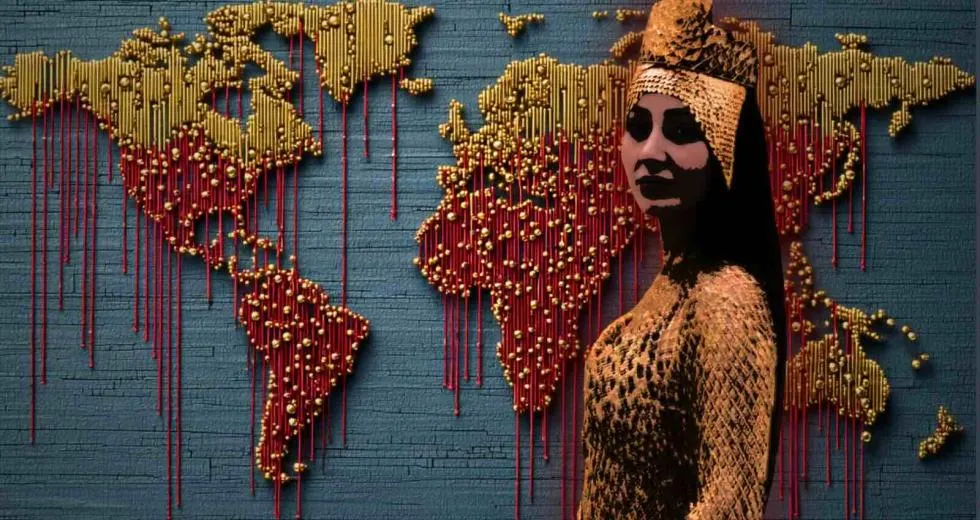
25 Nov 2025 – Beneath Dubai’s glittering skyline lies a darker treasure; gold mined in Sudan’s war zones, traded through UAE vaults and polished by a global system that profits from human suffering.
The following article was written by Marwa Osman for UK Column
Gold has been a sign of wealth and safety for hundreds of years. That shine hides a much darker truth: a global market that can and does hide where metal comes from in places where there is violence, exploitation, and state collapse. This investigation follows one such chain: the flow of Sudanese gold into the United Arab Emirates, the human and political cost of that trade inside Sudan, and the role of third parties, such as China, in a regional ecosystem that has made it possible for illegal and wartime gold to be turned into cash, legitimised, and moved into global markets.
The UAE promotes itself as a modern financial centre. Its gold vaults and trading floors in Dubai and Abu Dhabi have become key points in a world market where hundreds of tonnes of gold move every year. The UAE does not, however, have a gold mining industry that is big enough for that market. Most of the metal that goes to its refineries and exchanges comes from other countries. Some of it is legally declared, but there are also unregulated flows that international investigators and analysts say include gold mined under armed control or taken from workers who are forced to work in conflict zones, especially Sudan.
The outcome is a moral and geopolitical contradiction: a small Gulf state with few natural gold resources is one of the world’s biggest arbitragers and holders of gold reserves. Its vaults are filling up with metal whose upstream chain of custody is unclear. Sudan, on the other hand, is losing money that can and has been used to pay for fighters on both sides of its civil war. This is because the artisanal and industrial gold sector grew rapidly after South Sudan became independent. The story of how modern markets can make violence worse includes the trafficking routes, the people who use them, and the outside buyers who make money off them.
A Brief Overview of Numbers and Structure
The magnitude of the relationship is hard to overlook due to trade statistics gathered by global customs databases and trade analysts. The United Arab Emirates (UAE) was listed as the primary destination for a significant portion of Sudan’s $1.03 billion in gold exports in 2023, which were the country’s top export line item. According to estimates from independent trade trackers, significant amounts of Sudanese gold either passed through or arrived in the United Arab Emirates between 2019 and 2023 through direct exports and neighbouring transit states. According to trade data platforms and researchers at Chatham House, a significant portion of Sudan’s gold production, sometimes estimated at almost half, is smuggled, resulting in a grey economy that favours private middlemen and armed actors.
The UAE’s declared gold reserves and trade volumes have increased concurrently. Dubai continues to be one of the busiest gold hubs in the world; assessments typically place it in the top two or three global centres for gold trading, along with Switzerland and London. The Central Bank of the UAE has reported a sharp increase in the value of the country’s official gold holdings in 2024-2025. However, the UAE only acts as a trader, refiner, and registrar in the market; it has no substantial domestic gold reserves. Understanding the origins of the metal is crucial because of this asymmetry, which contrasts small domestic production with excessive trading activity and growing reserves.

A woman examines gold jewellery at a shop in Dubai. Image credit: Giuseppe Cacace.
According to independent investigations, a significant amount of Sudan’s gold wealth completely eludes state oversight, supporting a covert economy that keeps the war going. According to an analysis by Global Witness, networks associated with Sudan’s Rapid Support Forces (RSF) run smuggling routes that transport unregistered gold through Chad and Darfur on their way to Dubai, where it is refined and reexported under the guise of lawful trade. Once in the UAE’s refineries, these shipments frequently conceal their origins by combining legally mined metal with gold from conflict sources. Despite UN sanctions and international monitoring efforts, RSF-controlled companies have continued to maintain trading links with Emirati intermediaries, according to Reuters reporting from late 2023.
The UAE’s lax regulatory framework, which permits substantial amounts of unconfirmed gold to enter Dubai’s markets, supports this illegal system. Researchers from Chatham House point out that the UAE is a popular destination for conflict-linked gold from all over Africa because of its ‘door-open’ import policy and lax customs procedures. Investigations by Al Jazeera in 2023 revealed how Sudanese middlemen and traders effectively turn war profits into legal capital by using front companies registered in the United Arab Emirates to launder the proceeds from smuggled bullion. The outcome is a self-sustaining cycle: Dubai’s refineries and vaults provide the international legitimacy that keeps the system afloat, while Sudan’s battlefields produce gold that fuels the fighting.
Researchers at Chatham House also reported that the United Arab Emirates has emerged as the hub of Africa’s conflict-gold economy, importing from at least 16 African nations, many of which are impacted by armed conflict or poor governance, in addition to Sudan. According to the study, because of the UAE’s “door-open import policy” and lax scrutiny of origin documentation, “the majority of Africa’s artisanal and small-scale gold production is channeled through the UAE”. Ahmed Soliman and Suliman Baldo, the authors of the report, point out that this system makes it possible for gold from conflict areas like Darfur to enter international markets indistinguishable from lawful trade, thereby ‘laundering’ war profits through Dubai’s exchange houses and refineries.
These conclusions are supported by an Al Jazeera Investigative Unit exposé published in mid-2023, which shows that RSF-affiliated businessmen and Sudanese middlemen have legalized profits from smuggled bullion by using front companies registered in the Emirates. Operating from Dubai’s free-trade zones, these shell companies take advantage of legal loopholes that let them buy unconfirmed gold, melt it into new bars, and then resell it with Emirati certification. Investigators linked a number of these companies to people who had been sanctioned by the EU and the US for funding armed groups. Profit and geopolitics collide at the expense of accountability in this arrangement, which turns Dubai from a neutral trading hub into a financial conduit for Sudan’s war economy.
The Sudanese Context: Gold, War, and Exploitation
After 2011, when the majority of oil revenues were lost, Sudan’s gold industry grew quickly, creating a void and encouraging the growth of other extractive industries. Nowadays, the majority of Sudan’s metal comes from Artisanal and Small-scale Gold Mining (ASGM). Because miners operate in isolated camps, supply chains are disjointed, and armed groups and local powerbrokers frequently exercise control, that industry is infamously difficult to regulate.
Gold immediately regained strategic significance in April 2023 when fighting between the Rapid Support Forces (RSF) and the Sudan Armed Forces (SAF) resumed. In order to purchase weapons, pay fighters, and finance territorial control, it was necessary to control mines, transit routes, and export pipelines. Both official and informal networks syphoned gold from mining areas into export routes, frequently eluding state oversight and institutions, as investigations and reporting have shown. Rights organisations have documented abuses ranging from forced labour and child labour in mining operations to the vicious targeting of civilians by armed actors. Miners and local communities have also experienced displacement, violence, and coercion in this wartime economy.

Satellite imagery shows blood-stained streets shortly after the RSF militia took over Al Fashir. Image from X.
According to independent analysts, a significant amount of Sudan’s output is never included in official statistics because smuggling generates funding for armed actors in addition to lost state revenue. Independent verification is extremely challenging due to the secrecy surrounding operations, the remote location of mining fields, especially in Darfur and Kordofan, and the existence of private companies with unclear ownership structures.
The extraction zones in places like Jebel Amer (North Darfur) and the border regions of South Kordofan became battlegrounds for economic dominance when the fighting resumed in April 2023. The warring parties acted swiftly to secure mining operations and export pipelines, according to a thorough analysis by Chatham House: “All players in Sudan’s civil war have sought to maintain and expand their control of gold production and trade”. According to the study, the change in the mining geography, RSF in Darfur and West Kordofan, SAF in the Red Sea and Northern states, was a calculated move to control revenue sources rather than a coincidental one.
As the formal economy collapsed, smuggling networks and artisanal mining flourished. According to a UN report, “over 50% of the gold mined in Sudan was smuggled out of the country rather than traded through the official channels.” Workers in many isolated mining camps complain about a lack of supervision, inadequate safety gear, and sporadic militia checkpoints. “The area is no longer safe, and anything you obtain can be stolen in minutes, putting your life at risk,” a sector expert stated during a Sudan transparency briefing.
This war motivated by gold has a significant humanitarian cost. Local communities have experienced environmental destruction, forced relocation, and coercion as mining operations have grown under the control of armed groups. According to a recent report by Darfur 24, workers in isolated mining areas were subjected to mercury and cyanide leaching, and their families experienced contaminated water and lost farmland. Gold is not only fuelling the conflict, but also widening the social divide throughout Sudan due to the combination of financial exploitation and violent dominance.
The Middleman: How Gold Gets from Sudan to the Gulf
In general, the practical mechanics are straightforward. Local businesses or middlemen consolidate artisanal gold from mines before transporting it overland to ports or border crossings. Consignments are then shipped, frequently declared in value but not in origin, or moved across nearby borders where smuggling is made easier by gaps in documentation. The United Arab Emirates receives both declared and undeclared shipments due to its world-class refining capacity and its position as a major re-export hub. Financially speaking, Dubai’s trading desks and refineries turn small, opaque consignments into certified bars or products that can be sold on the international market as fungible assets, eliminating any obvious evidence of their place of origin in the process.
Dubai’s role in transforming African gold into marketable forms has been highlighted by numerous investigations. A study by SWISSAID and partners quantified similarly large flows and cautioned that inadequate oversight in transit hubs facilitates the laundering of illicit gold. A 2024 Reuters analysis revealed that hundreds of tonnes of undeclared African gold entered UAE markets annually. The numerous routes that erode traceability, direct exports to the United Arab Emirates, shipments via Egypt and Chad, and unofficial overland flows, are highlighted in Chatham House’s mapping of Sudan’s wartime gold trade.
‘Slave Labour’ in Mines and Construction
The misuse of migrant and local labour, as well as the known existence of coercion in mining contexts, are two more pillars upon which the ethical criticism of the UAE’s connection to Sudan is based, in addition to the direct monetisation of mineral wealth. Numerous instances of exploitative labour practices, such as wage withholding, passport confiscation, excessively long work hours, and degrading accommodations under the Kafala (sponsorship) system, have been documented by independent human rights organizations. These practices are prevalent in many Gulf construction and services sectors. Migrant workers, mostly from South Asia and Africa, have contributed significantly to the construction of the UAE’s contemporary skylines and have reported widespread abuses. Although these working conditions are distinct from the processes that transport Sudanese gold to Gulf markets, they are ethically connected to them.
Rights groups and journalists have documented instances of coercion in mining zones within Sudan, including forced contributions from villagers, armed groups conscripting labour, and, in some cases, the use of slave-like conditions. Eyewitness accounts and reporting describe patterns of extreme exploitation that amount to forced labour or conditions that, in certain places, amount to enslavement.
Parts of this chain of labour exploitation have been directly linked by human rights investigations to the unofficial economies that surround the extraction and export of gold. In North Darfur and the Blue Nile, villagers, including children, were forced to labour in militia-controlled mines under armed supervision, frequently for no pay and in hazardous conditions, according to a 2024 Amnesty International field report. Private traders with established ties to Dubai’s markets and networks connected to the RSF then sell the gold extracted in these situations. These results are consistent with Human Rights Watch’s 2023 warning that forced labour in Sudan’s mining areas was “systemic and tied to the country’s wider conflict economy” rather than isolated.
The UAE’s Political Economy: Interests, Investments, and Influence
Why would the United Arab Emirates deliberately foster an excessive interest in gold? The solution lies at the nexus of geopolitical strategy and economic diversification. Finance, tourism, aviation, logistics, and commodity trading are all essential components of the Emirates’ long-term goal to lessen their dependency on oil and develop alternate sources of income and power. Possessing a leading position in the world’s gold market offers financial leverage, liquidity, and geopolitical clout.
A deeper geopolitical project unfolding on the African continent is revealed by the UAE’s increasing dominance in the world gold trade, which goes beyond simple economic ambition. Abu Dhabi has incorporated itself into Sudan’s precarious economy by investing in ports, mining, and logistics, turning business endeavours into tools of influence. These connections, which are presented as partnerships and development, have come to resemble the workings of a contemporary colonial enterprise.
The UAE’s role has come under scrutiny as the conflict in Sudan has intensified. Abu Dhabi has reportedly supported the Rapid Support Forces (RSF), directing material and financial assistance that subtly feeds the conflict. Through Emirati networks, gold taken from Sudanese territory has been used to fund armed groups and strengthen economic reliance. Sudan’s instability is now a tool for influence rather than a problem to be solved, as the UAE’s pursuit of regional dominance and resource control has effectively contributed to the continuation of one of Africa’s most catastrophic conflicts.
According to a recent Amnesty International investigation, the RSF is using 155 mm AH-4 howitzers and sophisticated guided bombs made in China, which the group claims were most likely re-exported by the UAE, on the battlefields of Sudan. By directing these heavy weapons into the conflict area, the UAE appears to have broken the UN arms embargo on Darfur, according to another report by Al Jazeera. This means that what could be portrayed as the arms or commodity trade is actually directly arming one of the warring factions.
Logistics and transit networks connected to the United Arab Emirates supplement this arms flow. The Straits Times reported that cargo planes connected to UAE networks have moved weapons and equipment to RSF-controlled areas via regional airports, shifting the balance of power and extending the conflict in Sudan. In the meantime, the UAE’s role in providing equipment is described as a “tangible fact“ in direct statements from Sudan’s military and UN sanctions monitors. Instead of being a domestic issue that needs to be resolved, such interventions transform the war in Sudan into a strategic advantage for external parties.
The diplomatic fallout is getting worse. Citing the UAE’s backing of the RSF as a breach of Sudanese sovereignty, the Sudanese Government declared in May 2025 that it would cut diplomatic ties with the country. The UAE retaliated by refusing to provide weapons, but the regularity of independent investigations by Amnesty International, UN monitors, and human rights organizations indicates that the UAE’s involvement is more extensive and profound than its public denials acknowledge. This implies that a state with ties to international finance and the commodity trade is materially complicit in the continuation of one of the biggest humanitarian catastrophes in history.
China’s Role: Buyer, Investor, and Systemic Enabler
The situation is made more complex by China’s involvement. Beijing and Sudan have a long history of strategic and commercial ties that go beyond infrastructure and oil agreements to include mining and building. Chinese businesses have long operated in Sudan’s extractive industries, and Beijing’s voracious appetite for commodities contributes to the structural demand for gold. Through trading hubs, gold is imported by buyers from around the world, including Chinese companies and state-affiliated buyers. There is evidence that some of the metal that reaches UAE markets is then sold to buyers in Asia, including China.
The UAE-China partnership is also significant. The Emirates are a desirable middleman for metal headed for Chinese markets because of their financial and trade ties, which include agreements that permit gold trading in yuan on Dubai exchanges. In summary, the chain becomes less transparent at each stage as a piece of Sudanese gold moves from an artisanal mine to a middleman, a refinery in Dubai, and finally an Asian buyer. The UAE’s ability to refine and trade, along with Chinese demand, creates a bilateral dynamic that makes it possible to monetize supplies that are not properly regulated.
Evidence suggests that China is indirectly escalating the conflict by providing weapons and munitions that wind up in the hands of both sides, even though the Sudanese Armed Forces (SAF) and the Rapid Support Forces (RSF) are the parties to the official conflict. Newly produced Chinese small arms, mortars, and ammunition have been reported on battlefields in Darfur and wider Sudan, according to a 2024 briefing by Amnesty International. For instance, the report states that “recent Chinese small arms are widely present in other parts of Darfur and wider Sudan” and that Chinese-made 82 mm PP87 mortar bombs were observed in East Darfur.
More sophisticated Chinese-made weapons, like guided bombs (GB50A) and AH-4 howitzers, which are produced by the Chinese state-owned enterprise Norinco Group, have been discovered in RSF possession through re-export channels. China’s arms transfers are contributing to the continuation of fighting on both fronts, not just one, which complicates any chances for de-escalation and links commercial interests to the conflict’s extension.
Blood Gold and Blind Eyes
Sudan is the most heinous example of how the global gold market has turned into a conduit for funding conflicts. The nation’s gold rush, which was fuelled by Chinese demand and Emirati money, is a moral as well as an economic tale. There is a history of burned villages, mass evictions, and covert profiteering behind each shipment of bullion that departs Port Sudan or refineries in Dubai.
The Rapid Support Forces (RSF) are able to turn Sudanese blood gold into hard currency and weapons because the UAE’s gold trading hubs have become laundering facilities for war profits. The demand and the means are provided by China, which is one of the biggest buyers of gold in the world and a supplier of dual-use weapons that end up in Sudanese hands. Together, they create a vicious cycle of violence and exploitation, with one side arming the conflict and the other generating revenue for it.
The silence around the world adds to the gloom. Commodity exchanges, financial institutions, and Western regulators have mostly turned a blind eye, not wanting to risk damaging lucrative relationships with Beijing or Abu Dhabi. The end effect is a moral void where corporate and governmental interests take precedence over humanitarian needs. A market that values gold but not human lives is driving Sudan’s decline toward potential genocide in real time.
Token compliance is not enough to break this chain. It calls on international organizations to treat commodities linked to conflicts as facilitators of atrocities, to hold trading hubs like Dubai to real transparency standards, and to scrutinize Chinese importers. Until then, the tragedy in Sudan will continue to serve as a reminder of how international finance turns violence into a commodity and how, while people are dying, the world continues to count profits because it is so enamoured with gold.
_______________________________________________
 Vanessa Beeley is a member of the TRANSCEND Network for Peace Development Environment. “The pursuit of peace and progress, with its trials and its errors, its successes and its setbacks, can never be relaxed and never abandoned.”
Go to Original – beeley.substack.com
Tags: China, Dubai, Gold mining, Sudan, UAE, Warfare
DISCLAIMER: The statements, views and opinions expressed in pieces republished here are solely those of the authors and do not necessarily represent those of TMS. In accordance with title 17 U.S.C. section 107, this material is distributed without profit to those who have expressed a prior interest in receiving the included information for research and educational purposes. TMS has no affiliation whatsoever with the originator of this article nor is TMS endorsed or sponsored by the originator. “GO TO ORIGINAL” links are provided as a convenience to our readers and allow for verification of authenticity. However, as originating pages are often updated by their originating host sites, the versions posted may not match the versions our readers view when clicking the “GO TO ORIGINAL” links. This site contains copyrighted material the use of which has not always been specifically authorized by the copyright owner. We are making such material available in our efforts to advance understanding of environmental, political, human rights, economic, democracy, scientific, and social justice issues, etc. We believe this constitutes a ‘fair use’ of any such copyrighted material as provided for in section 107 of the US Copyright Law. In accordance with Title 17 U.S.C. Section 107, the material on this site is distributed without profit to those who have expressed a prior interest in receiving the included information for research and educational purposes. For more information go to: http://www.law.cornell.edu/uscode/17/107.shtml. If you wish to use copyrighted material from this site for purposes of your own that go beyond ‘fair use’, you must obtain permission from the copyright owner.
Join the discussion!
We welcome debate and dissent, but personal — ad hominem — attacks (on authors, other users or any individual), abuse and defamatory language will not be tolerated. Nor will we tolerate attempts to deliberately disrupt discussions. We aim to maintain an inviting space to focus on intelligent interactions and debates.