
The Greatest Gift, a More Human Face: Bantu Stephen Biko’s Prescription for a Divided, Selfish World in the 21st Century
TRANSCEND MEMBERS, 9 Feb 2026
Prof Hoosen Vawda – TRANSCEND Media Service
“Steve Biko 1977–2026: Truth, Suppression, and the Resurrection of Justice” from Martyrdom to Legal Memory: The Reopened Inquest into Steve Biko’s Death” [1]
This publication is suitable for general readership. Parental guidance is recommended for minors who may use this research paper, as a resource material, for projects.
The author unconditionally apologises for any misrepresentation of the socio-political impressions expressed in this publication, while promoting global peace propagation, a voice against injustice, attempting replacement with justice and values for sustained peace, within all of humanity.[2]
The author invites and welcomes any comments and discussions, by the readership. (vawda@ukzn.ac.za)
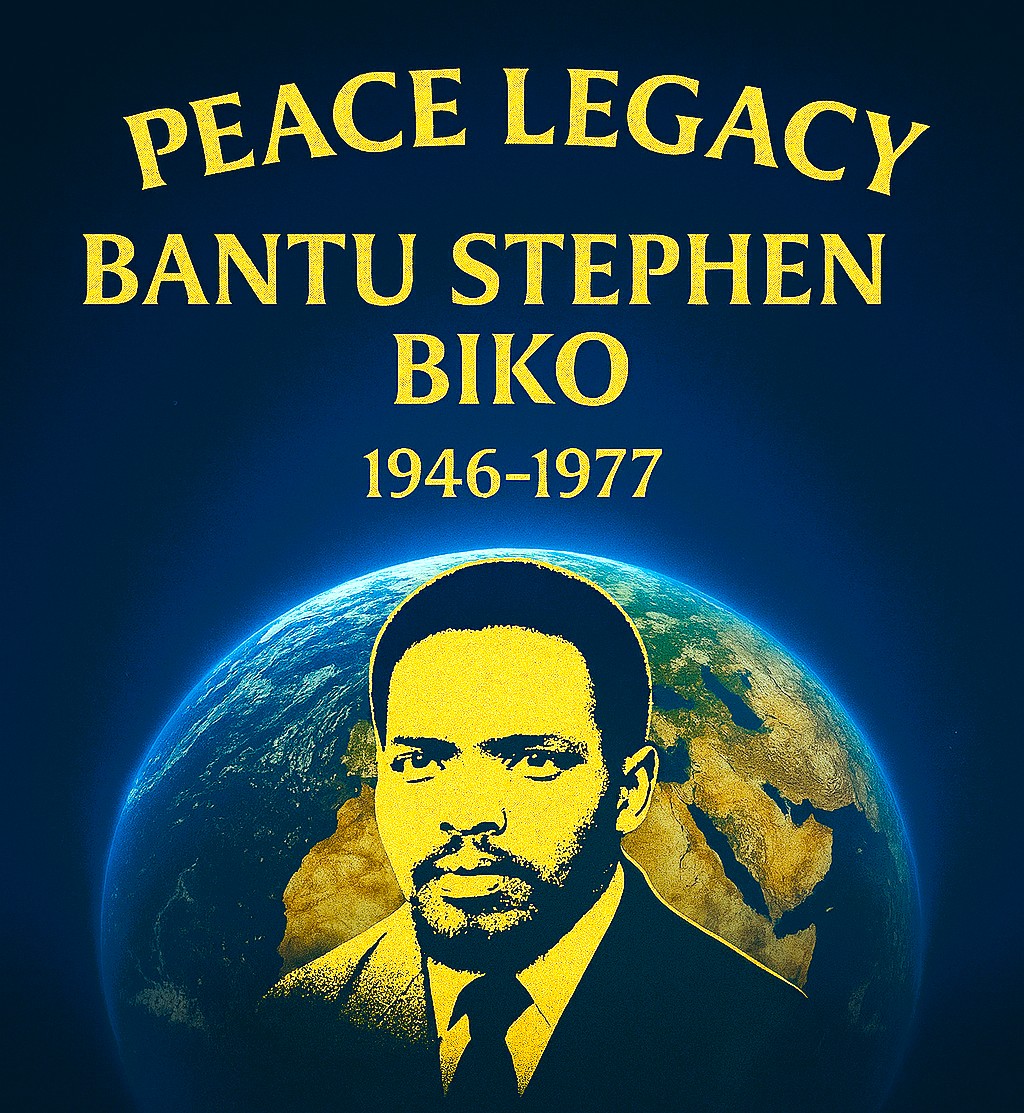
Bantu Stephen Biko. A South African, deprived of Human Rights in his own birthland, by the Apartheid Government: An aborted, future, Medical Doctor, Founder of the Black Consciousness Movement, and Martyred Anti-Apartheid Activist
Leaves a Legacy of Peace
Original Photograph Conceptualised by Mrs V. Vawda February 2026
Prologue
The author has written extensively about Bantu Stephen Biko, a martyred African, South African, anti-apartheid activist, previously in in July 2022.[3] This paper extracts Biko’s core humanist philosophy into universal lessons for healing division and building cohesive societies today. continues to shape communal identity, law, human rights discourse, social policy, and interfaith praxis in the twenty‑first century.[4]
On 12 September 1977, Bantu Stephen Biko died in apartheid police custody after sustaining catastrophic brain injuries, following prolonged interrogation, physical abuse, and clinical neglect. The apartheid‑era Inquest No. 573/1977 concluded, despite extensive medical evidence, that no person was to blame, endorsing the police claim that Biko injured himself by “banging his head,” even though forensic testimony described clear signs of externally inflicted trauma and delayed treatment.
In September 2025, the National Prosecuting Authority (NPA) formally re‑opened the inquest, citing new evidence, decades of procedural obstruction, and the need to correct institutional failures that allowed perpetrators’ impunity. Case‑management hearings in late 2025 and January–February 2026 further signalled the state’s intention to finally establish criminal accountability in a matter long shielded from justice.
This paper re-examines the Biko case through four analytic lenses. First, it reconstructs the 1977 inquest alongside Truth and Reconciliation Commission (TRC) amnesty hearings, where former Security Branch officers admitted under oath to perjury, torture, and coordinated cover‑ups. Second, it situates the 2025–2026 proceedings within South Africa’s evolving legal framework for reopened apartheid-era inquests, particularly under the Inquests Act 58 of 1959. Third, it incorporates a medical‑forensic reading of Biko’s injuries, brain damage, uraemia, kidney failure, and shock, as documented in both the 1977 and modern reassessments. Finally, it frames the case within a moral‑philosophical arc grounded in Black Consciousness as well as the scientific humanism of Professor Phillip Vallentine Tobias, a leading anti‑apartheid academic whose work dismantled racial pseudo‑science and affirmed the unity and dignity of humankind.
The re‑opened inquest is more than a judicial process: it is a measure of South Africa’s ability to transform narrative truth into juridical accountability, to acknowledge medical complicity, and to vindicate the dignity that grounded Biko’s life and philosophy.
Introduction: The meaning and history of the name Biko
The name “Biko” is of African origin, most associated with the Xhosa people of South Africa. It is a diminutive form of the name “Sibusiso” or “Bhekizizwe,” meaning “blessing” or “behold the nations,” respectively. The name carries profound connotations of benevolence, prosperity, and a connection to broader communities and nations. In many cultures, names serve as more than mere identifiers; they are imbued with hopes, dreams, and cultural significance, and “Biko” is no exception. It reflects the values and aspirations of the communities from which it originates.[5] The history of the name “Biko” is closely tied to the historical and social contexts of South Africa. It gained significant prominence during the mid-20th century, especially through the legacy of Steve Biko, a South African anti-apartheid activist. Steve Biko’s activism and his role in the Black Consciousness Movement [6] made the name synonymous with resistance, empowerment, and the fight for equality.
Over time, “Biko” became more than a personal name; it transformed into a symbol of social justice and human rights. The name’s evolution is a testament to the enduring power of individual legacies to shape collective history. It moved from being a traditional name within certain African communities to a globally recognized emblem of struggle and resilience.
Why Revisit Martyr Biko in 2026?
The Minister of Justice’s decision on 12 September 2025 to reopen the inquest into Steve Biko’s death represents a major shift in South Africa’s engagement with its apartheid past. Under section 17A(1) of the Inquests Act 58 of 1959, the reopening acknowledges that the 1977 inquest suffered from police interference, judicial deference, and medical exonerations that contradicted forensic findings.
The NPA enrolled the case on the same day, citing historical irregularities and decades of suppressed evidence. Subsequent hearings in late 2025 and early 2026 have identified surviving Special Branch members as “persons of interest,” marking the strongest institutional effort since the TRC to hold individuals accountable.
Revisiting Biko in 2026 is necessary for three intertwined reasons:
1.1 Renewed Momentum Across Apartheid-Era Cases
South Africa has simultaneously re-opened several apartheid-era inquests (e.g., Chief Albert Luthuli, Griffiths Mxenge, Cradock Four), driven by evidence of past political obstruction and unmet obligations to victims’ families. citeturn12search83turn12search84
1.2 Legal Innovation: Crimes Against Humanity
Recent jurisprudence, such as the 2025 Johannesburg High Court ruling, affirmed that apartheid-era killings may qualify as crimes against humanity, which carry no statute of limitation under customary international law.
1.3 Completing the Unfinished Business of the TRC
Although the TRC exposed atrocities and denied amnesty to several perpetrators, it did not secure prosecutions in the Biko case. The reopened inquest is therefore an attempt to transform restorative narrative truth into legal accountability.
Ultimately, truth becomes meaningful only when paired with juridical consequence. Thus the 2025–2026 inquest is not merely a historical revisitation; it is a test of South Africa’s moral and legal maturity.
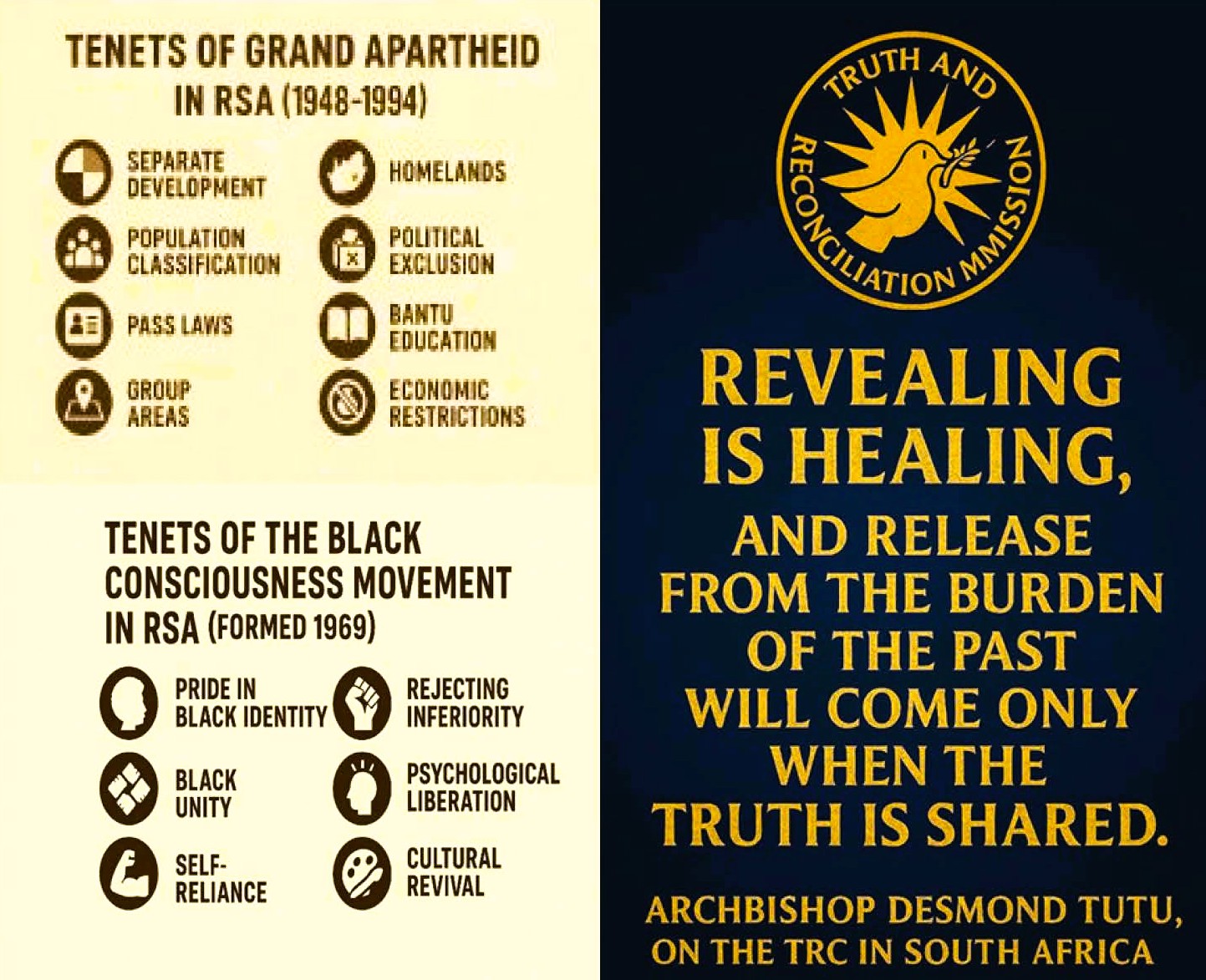
The Historical Devolution of Two Contrasting Philosophies in South Africa
Chart Top left: The Philosophy of Grand Apartheid from 1948 to 1994: Human Inequality
Chart Bottom Left: The Freedom Philosophy of Black Consciousness : Human Equality
Chart Right: The Truth and Reconciliation Commission
Original Photograph Conceptualised by Mrs V. Vawda February 2026
Biko’s Life, Detention, and the 1977 Inquest: A Compressed Reconstruction
Steve Biko’s philosophical and organisational leadership, from his early activism at the University of Natal[7], to the founding of SASO and the Black Consciousness Movement (BCM), redefined resistance by placing psychological liberation at the core of political struggle.
On 18 August 1977, Biko and fellow activist Peter Jones [8]were arrested at a roadblock near Grahamstown (Makhanda). He was transferred to the Port Elizabeth Security Branch and subjected to brutal interrogation. For over 24 days, despite evident distress (“foam around the mouth”), he was denied medical care, kept naked and shackled, and eventually transported 1,200 km to Pretoria while unconscious, conditions universally recognized today as torture and medical cruelty.
At the 1977 inquest, Magistrate M.J. Prins[9] concluded that Biko’s fatal brain injuries came from a “scuffle,” endorsing police testimony that he struck his own head. But medical experts, including Professors Loubser, Proctor, Simpson,[10] and Dr. Gluckman[11], [12]testified that Biko died from multiple brain lesions caused by externally applied force, with subsequent kidney failure and shock as secondary sequelae.
The magistrate’s dismissal of these findings set the pattern for the state’s institutional evasion, later identified by the TRC as part of a broader culture of impunity within apartheid policing.
- The TRC Record: From Narrative Truth to Admitted Torture
The 1997 TRC amnesty hearings were the first time the apartheid narrative began to break down publicly. At these hearings, former Security Branch interrogator Major Harold Snyman admitted that he had lied under oath in 1977. He also revealed that Biko—already brain‑damaged, was handcuffed and spread‑eagled to a gate for almost a full day, a method recognized as torture.msn
Other officers, including Siebert, Beneke, Marx, and Nieuwoudt, applied for amnesty, but the TRC ruled that they had failed to prove political motive and had lied, thus amnesty was refused.
These admissions shattered any residual credibility of the “self‑injury” narrative, confirmed a coordinated cover‑up, and exposed the complicity of police, medical staff, and the justice system in suppressing the truth. The reopened inquest seeks to address precisely the gap between truth and accountability left after the TRC.
- The Genesis of Black Consciousness as a Moral‑Philosophical Horizon
Biko’s political journey began as a medical student at the University of Natal in 1966, where he joined the multiracial National Union of South African Students (NUSAS). He grew deeply frustrated with the organization’s white liberal leadership, which he felt was paternalistic and failed to grasp the Black experience. A pivotal moment came in 1967 at a NUSAS conference at Rhodes University, where Black delegates were housed separately in a church while white students stayed on campus. This experience convinced Biko that Black people had to organize independently to escape white domination.
In 1968, he co-founded the South African Students’ Organisation (SASO), open only to “Blacks”, a term he defined inclusively as Africans, Coloureds, and Indians. He was elected its first president in 1969. SASO’s official ideology was Black Consciousness, influenced by thinkers like Frantz Fanon. The core philosophy was that liberation required Black people to rid themselves of any sense of racial inferiority instilled by apartheid. Biko popularized the slogan “black is beautiful” to promote this psychological emancipation. He argued that true agency and a “more human face” for South Africa could only come when Black people were the drivers of their own change.
To spread these ideas beyond campuses, Biko helped form the Black People’s Convention (BPC) in 1972. The movement also established practical Black Community Programmes (BCPs), including healthcare clinics and creches, to improve daily life and foster self-reliance.
For Biko, liberation required psychological emancipation before political freedom. Black Consciousness asserted an inward reclamation of self-worth, “Black is Beautiful”, positioning dignity as the fundamental weapon against oppression.
Thus, the apartheid state’s refusal to acknowledge responsibility for Biko’s death constituted not only a legal failure but a moral violation, an erasure of the personhood that Black Consciousness sought to reassert. BC framed the struggle in existential terms: one must fight the system that dehumanizes both the body and the mind.
The reopened inquest is therefore not simply about legal rectification, it is a restoration of dignity, a reaffirmation of truth, and a societal act of moral repair.
- Professor Phillip Vallentine Tobias: Scientific Humanism Against Apartheid’s Pseudo‑Biology
Professor Phillip Vallentine Tobias, one of the world’s leading paleoanthropologists, played a pivotal role in dismantling apartheid’s intellectual foundations. His work challenged racial typologies and exposed the misuse of biological concepts to justify segregation.
As a three‑time President of NUSAS (1948–1950), Tobias [13] led some of the first formal anti‑apartheid campaigns in a South African university, advocating for non-racial access to education.
He also delivered numerous anti‑apartheid speeches at academic gatherings and public rallies, asserting the scientific unity of humankind and denouncing racial ideology as pseudoscience.
Recent scholarship on medical ethics at Wits underscores how Biko’s death catalysed critical introspection into the complicity of doctors and anthropologists under apartheid. Tobias’s legacy represents the ethical counter‑tradition—a refusal to let science be weaponized against human dignity.
By integrating Tobias into this paper, we illuminate the broader intellectual struggle within South African science: a fight between pseudo‑biological apartheid rationalizations and a humanistic, evidence‑based anthropology that affirmed the equality of all human beings.
- From Restorative Narration to Responsible Justice: Roadmap of the Paper
The subsequent narrative of this paper will:
6.1 Reconstruct the Medical‑Forensic Pathway
We analyse Biko’s injuries, autopsy findings, transport to Pretoria, and contradictions in the 1977 testimony.
6.2 Examine the 2025–2026 Legal Process
This includes standards for reopening under the Inquests Act, comparative apartheid‑era cases, and new developments in crimes‑against‑humanity prosecutions.
6.3 Articulate the Moral‑Philosophical Stakes
Drawing from Black Consciousness, interfaith ethics, and Tobias’s scientific humanism, we frame naming perpetrators and recognizing medical complicity as essential to national healing.
Steve Biko 1977–2026: Re‑opening the Wound, Recovering the Truth, Healing the Nation
Medical–Forensic Reconstruction, Inquest Contradictions and Clinical Ethics Under Apartheid
- The Medical, Forensic Pathway from Assault to Death
Understanding the true cause of Steve Biko’s death requires a synthesis of the 1977 autopsy record, expert testimony, TRC disclosures, and evidence newly foregrounded through the 2025–2026 inquest proceedings. What emerges is a coherent forensic narrative sharply at odds with the apartheid state’s explanations.
7.1 The Arrest and Initial Assault (Port Elizabeth, 6–7 September 1977)
Biko was detained on 18 August 1977 and transferred to the Port Elizabeth Security Branch, where interrogation sessions escalated into violent assault. According to the 2025 NPA summary, Biko was shackled, kept naked, and subjected to harsh interrogation conditions.
The TRC later confirmed that on 6 September 1977, during one of these interrogation sessions, Biko sustained a major head injury, not from striking a wall voluntarily, but through external force inflicted during police assault. Former Security Branch interrogator Harold Snyman, testifying before the TRC in 1997, admitted that Biko was spread‑eagled, handcuffed to a security gate, and left standing for nearly a full day while brain‑injured, conditions that constitute torture under any reasonable definition.
This directly contradicts the account given at the 1977 inquest that Biko injured himself through a sudden, spontaneous head‑butt against a wall.
7.2 Clinical Deterioration and Deliberate Denial of Treatment
The evidence shows that for nearly 24 hours after the head injury, no medical attention was provided, despite visible neurological distress (“foam around the mouth,” confusion, collapse). The NPA recounts that medical help was only sought more than three weeks after arrest, and only when Biko was gravely deteriorating.
Medical neglect was not incidental—it was structural, embedded in the apartheid state’s method of interrogation:
- Police delayed calling a district surgeon,
- Physicians who eventually examined Biko either minimized or ignored signs of traumatic brain injury,
- No diagnostic tools (lumbar puncture, neuro‑imaging, intracranial pressure assessment) were employed,
- He was left nakedin his cell, without bedding or monitoring.
Even when he collapsed into semi‑consciousness, physicians did not admit him to a proper hospital. Instead, he was kept under police control in violation of basic medical ethics.
7.3 The 1,200 km Journey: A Forensic and Ethical Atrocity
On 11 September 1977, Biko—unconscious, naked, shackled—was loaded into the back of a Land Rover and driven 1,200 km from Port Elizabeth to Pretoria. This act represents one of the most egregious violations of medical ethics documented in apartheid detention history.
The 2025 NPA summary confirms both distance and conditions of transport, noting that he arrived in Pretoria “naked, shackled, unconscious” and died the following day.thenewdaily
Through forensic reconstruction, we now know:
- Biko was in a deeply compromised neurological state,
- Transport vibrations and lack of immobilization would have exacerbated intracranial haemorrhage,
- He lacked IV access, monitoring, airway support, or analgesia,
- He was placed on the floor of the vehicle like cargo, not as a patient.
This was not a medical transfer—it was the physical continuation of torture under the guise of bureaucratic movement.
7.4 The Autopsy: Brain Lesions, Haemorrhage, Systemic Failure
At the 1977 inquest, expert witnesses Professors Loubser, Proctor, Simpson, and Dr. Gluckman gave authoritative testimony:
- Biko suffered multiple brain lesions,
- External force caused both subdural and subarachnoid haemorrhages,
- Secondary complications included acute kidney failure, uraemia, and disseminated intravascular coagulation (DIC).
These are not compatible with a self‑inflicted minor blow. They are consistent with:
- Blunt‑force trauma to the head,
- Prolonged immobilization and stress positioning (as confirmed by TRC testimony),
- Systemic collapse from untreated brain injury.
The magistrate’s refusal to assign blame, despite this evidence, remains one of the starkest examples of judicial complicity in apartheid human rights violations.
- Contradictions and Irregularities in the 1977 Inquest
The 1977 inquest was not a neutral forensic proceeding—it was an instrument in the apartheid state’s machinery of narrative control.
8.1 Acceptance of Police Testimony Without Forensic Corroboration
The magistrate accepted the claim that Biko “banged his head” during a scuffle despite:
- Lack of corresponding injury patterns,
- Contradictory autopsy findings,
- Absence of bruising consistent with the police version,
- Medical testimony explicitly rejecting the idea that the injuries could have been self-inflicted.
This represents not just judicial error, but judicial collaborationwith state violence.
8.2 Failure to Consider Medical Negligence as Criminal
Under the Inquests Act, the magistrate was required to determine whether an act or omission contributed to death.
Yet despite evidence of:
- Severe delays in treatment,
- Withdrawal of medical care,
- Grossly improper transport conditions,
- Ignored neurological signs,
the inquest found no medical wrongdoing. This contradicts both the autopsy evidence and the TRC’s later judgment that Biko’s treatment constituted a gross human rights violation.
8.3 Evidence of Coordinated Fabrication
The TRC hearings nearly twenty years later revealed that several officers admitted to:
- Colluding on a falsified narrative,
- Submitting false affidavits,
- Deliberately misleading the 1977 inquest.
This retroactively exposes the inquest as structurally incapable of delivering justice.
- Clinical Ethics Under Apartheid: From Complicity to Institutional Failure
A comprehensive analysis of the Biko case must examine not only the actions of police but the clinical ethics breakdown at every stage of detention.
9.1 The Role of District Surgeons
District surgeons were nominally independent medical officers assigned to monitor detainee health. In practice, many operated as extensions of the security apparatus. Their failures in Biko’s case included:
- Superficial examinations,
- Failure to order diagnostic tests,
- Deference to police authority over medical judgment,
- Signing off on reports that minimized injuries.
This complicity forms part of what the TRC called the medical profession’s failure of moral responsibility during apartheid.
9.2 Ethical Violations Documented Through TRC and Inquest Records
Among documented clinical violations:
- Non‑intervention in life‑threatening neurological decline,
- Failure to oppose police transport of an unconscious patient,
- Non‑compliance with basic clinical protocols for head trauma,
- Inadequate record‑keeping,
- Absence of advocacy for detainee rights,
- Failure to ensure hospital admissionat a critical stage.
These are not minor lapses, they constitute gross ethical misconduct, violating the universal obligations of medical practitioners under both the Hippocratic Oath and international standards of detainee care.
9.3 The Counter‑Model: Phillip V. Tobias and the Ethics of Scientific Humanism
In contrast stands Professor Phillip Vallentine Tobias, whose scientific humanism rejected the apartheid misuse of biology and anthropology. He consistently argued that:
- human dignity is a scientific fact,
- racial typology has no biological basis,
- clinicians and scientists have a duty to oppose the abuse of medical authority.
His stance highlights how the medical profession shouldhave acted in Biko’s case:
with courage, independence, and an unwavering commitment to the sanctity of human life.
- Implications for the 2025–2026 Reopened Inquest
The reopened inquest is not merely a repetition of the TRC. It is a legal proceeding empowered to:
- assign criminal culpability,
- assess whether past inquests were inadequate or obstructed,
- revisit the role of district surgeons,
- evaluate new evidence and testimonies,
- determine whether apartheid officials can still be prosecuted.
This determination is aligned with South Africa’s broader resurgence of historical accountability under the Inquests Act.
It also aligns with the emerging principle, validated by South African courts in 2025, that apartheid‑era killings may constitute crimes against humanity, for which no statutory limitations apply.
Legal Architecture of the Reopened Inquest, Politics of Memory and Comparative Jurisprudence
11) The Legal Architecture of the 2025–2026 Reopened Inquest
11.1 Statutory Basis and Ministerial Authority
The decision to reopen the Biko inquest rests on section 17A(1) of the Inquests Act 58 of 1959, read with sections 6(a) and 6(d), which empower the Minister of Justice to direct the re‑opening of an inquest where it is in the interests of the administration of justice. On 12 September 2025, the Minister formally directed the re‑opening; the NPA enrolled it the same day at the Gqeberha High Court[14].
This intervention explicitly acknowledges the inadequacies of the 1977 inquiry—which accepted police explanations despite contrary medical evidence—and seeks a judicial reconsideration capable of assigning legal responsibility.
11.2 Procedural Posture and Case‑Management Timeline (Late‑2025 to Early‑2026)
After enrolment, the inquest underwent case management and scheduling in chambers. In November 2025 proceedings were adjourned to 30 January 2026 to finalize legal representation for persons of interest; on 30 January 2026 it was postponed again to 20 February 2026 to conclude state‑attorney appointments. These postponements, while frustrating to the family and public, are structurally aimed at ensuring representation for elderly former officers so that the inquest outcome is procedurally durable.
11.3 Evidentiary Scope and Judicial Aims
The stated aim is to place before the inquest court evidence capable of supporting a finding that Biko’s death resulted from an act or omission amounting to an offence—something the 1977 magistrate declined to do in the face of compelling forensic testimony. The NPA’s official notice rehearses the detention timeline, denied medical care, naked shackling, and the 1,200 km transfer while unconscious as core indicators of criminality.
11.4 Relationship to TRC Findings and Amnesty Decisions
The reopened inquest is distinct from, but informed by, the TRC’s designation of Biko’s death as a gross human rights violation and its refusal of amnesty to multiple officers who lied under oath. The TRC’s record becomes a probative foundation, while the inquest offers a judicial vehicle to make specific findings of responsibility under current law.
12) Why Now? Jurisprudence, Crimes Against Humanity and the Erosion of Impunity
12.1 The Crimes‑Against‑Humanity Turn in South African Courts
On 14 April 2025, the Johannesburg High Court issued a landmark ruling that allows crimes against humanity charges (including apartheid as a crime against humanity) to be pursued in South African courts, confirming no statute of limitations for such core international crimes under customary international law. This jurisprudential shift strengthens the normative climate for re‑examining apartheid‑era killings and signals a judicial willingness to name the criminality of the regime itself, not only the actors.
12.2 Public Policy and Transitional‑Justice Imperatives
The Justice Ministry and NPA have framed the Biko inquest within a broader reactivation of apartheid‑era inquests (e.g., Luthuli, Mxenge, Cradock Four, Northcrest Five, PEBCO Three), emphasizing accountability, closure for families, and repair of rule‑of‑law deficits that persisted after the TRC. This policy response, articulated in ministerial statements in September 2025, links re‑opened inquests to the constitutional promise of dignity and justice.
12.3 Procedural Integrity vs. Delay
The inquest’s January–February 2026 postponements, while perceived as delay, serve to regularize representation for persons of interest, thereby insulating the eventual findings from appeal on procedural grounds. In transitional‑justice settings, courts often tread between speed and durability; the Biko inquest appears to favour the latter to avoid reproducing 1977’s failures.
13) The Politics of Memory, State Obstruction Allegations & the Long Arc to 2026
13.1 Allegations of Political Obstruction After the TRC
Civil‑society advocates and families have long alleged that successive democratic administrations slowed or suppressed apartheid‑era prosecutions post‑TRC, contributing to a lost generation of accountability while key suspects aged or died. Recent reports and legal commentary place this claim in the foreground, noting the resurgence of cases only in recent years.
13.2 Renewed Political and Judicial Signals (2025)
In 2025, public statements from the Justice Ministry and leading jurists emphasized that reopened inquests represent the “long arm of the law”, able to reach past doctrines of closure where truth was told but justice stalled. This rhetorical and legal shift situates Biko’s inquest as emblematic of a new resolve to address unfinished business.
13.3 The Media and International Visibility
International outlets have foregrounded the re‑opening as an attempt to correct the 1977 “whitewash” and confront the torture narrative that shocked the world. The renewed inquest has been covered widely in AP, CBS, and public radio reports, reinforcing a global expectation that South Africa will finally deliver formal judicial clarity.
14) Comparative Jurisprudence: Lessons from Parallel Inquests
14.1 The Cradock Four (1985): Pattern of State Violence and Chain‑of‑Command Questions
The Cradock Four inquest (reopened June 2025)[15] revisits abduction and assassination by security forces, bringing into focus the organizational sanction of killings and the difficulty of identifying living perpetrators decades later. Its legal strategy, reconstructing chain‑of‑command responsibility and testing whether senior officials can still be named, offers a template for the Biko inquest to examine not only interrogators but superior officers who designed or condoned torture regimes.
14.2 Chief Albert Luthuli (1967)[16]: Forensic Re‑appraisal of “Accidental” Deaths
The Luthuli re‑opened inquest (April 2025) signals a willingness to re‑assess narratives of “accident” widely suspected of masking state involvement. Its adjournments for closing arguments underline the methodical approach needed to overcome aged evidence, an approach relevant to Biko where forensic contradictions existed from the start.10times
14.3 Griffiths Mxenge (1981[17]) and PEBCO Three (1985)[18]: Naming Surviving Perpetrators
Re‑examinations of Mxenge and the PEBCO Three seek to identify surviving operatives and the operations architecture behind notorious murders of activists, demonstrating that even partial naming and judicial findings can constitute meaningful accountability, informing prosecutorial discretion in the Biko matter. r
15) Integrating the Juridical and the Philosophical: Black Consciousness, Scientific Humanism and National Repair
15.1 Black Consciousness and the Demand for Juridical Truth
Black Consciousness (BC) insists that psychological emancipation and the recovery of dignity are preconditions for political freedom; in juridical terms, this implies that truth without accountability remains an unfinished emancipation. The inquest thus becomes a test of whether the state can move from narrative exposure (TRC) to legal recognition of wrongs and wrongdoers, consistent with Biko’s claim that dehumanization must be resisted in mind and body.
15.2 Tobias’s Scientific Humanism: From Bioethics to Legal Duties
Professor Phillip V. Tobias’s[19] lifelong rejection of racial typology and apartheid’s pseudo‑biology aligns the ethic of science with the ethic of law: if biology affirms the unity and equal worth of all humans, then law must vindicate that worth through accountability when dignity is violated. The inquest operationalizes Tobias’s humanism by naming medical complicity, correcting the 1977 exonerations of physicians, and reinforcing the clinical duty to protect life irrespective of political context.
15.3 The Moral Economy of Accountability
Courts are more than adjudicators of past facts; in transitional contexts they are rituals of public meaning. To declare Biko’s death the result of criminal acts, and to acknowledge medical and police complicity, is to restore coherence to a society’s memory and to vindicate the moral intuition at the heart of BC and scientific humanism: that dignity is indivisible, and the state must answer when it is destroyed.
16) Likely Legal Questions the Inquest Must Resolve
- Causation and Liability:Which specific acts or omissions (assault, denial of care, transport decisions) constitute criminal conduct contributing to death?
- Medical Complicity:Did district surgeons’ actions/omissions meet the threshold of criminal negligence or complicity, given expert evidence available in 1977?
- Command Responsibility:Can superior officers be named where direct perpetrators are deceased or unidentifiable, considering patterns addressed in parallel inquests?
- Effect of TRC Findings:How should prior amnesty refusals and admissions of perjury weigh in an inquest’s fact‑finding mandate?
- Prospects for Prosecution:Should the court make recommendations for criminal referral in light of evolving crimes‑against‑humanity jurisprudence and the absence of limitation periods?
17) What a Credible Outcome Could Look Like (Without Pre‑judging the Court)
A credible inquest finding would:
- Reaffirm that Biko died from externally inflicted brain trauma, not self‑injury.
- Recognize the 1,200 km transportof an unconscious detainee as an aggravating, unlawful act;
- Acknowledge medical negligence/complicityunder detention conditions;
- Identify named individualswhere evidence permits (including command responsibility);
- Recommend criminal referral, consistent with the no‑limitationprinciple for international crimes.
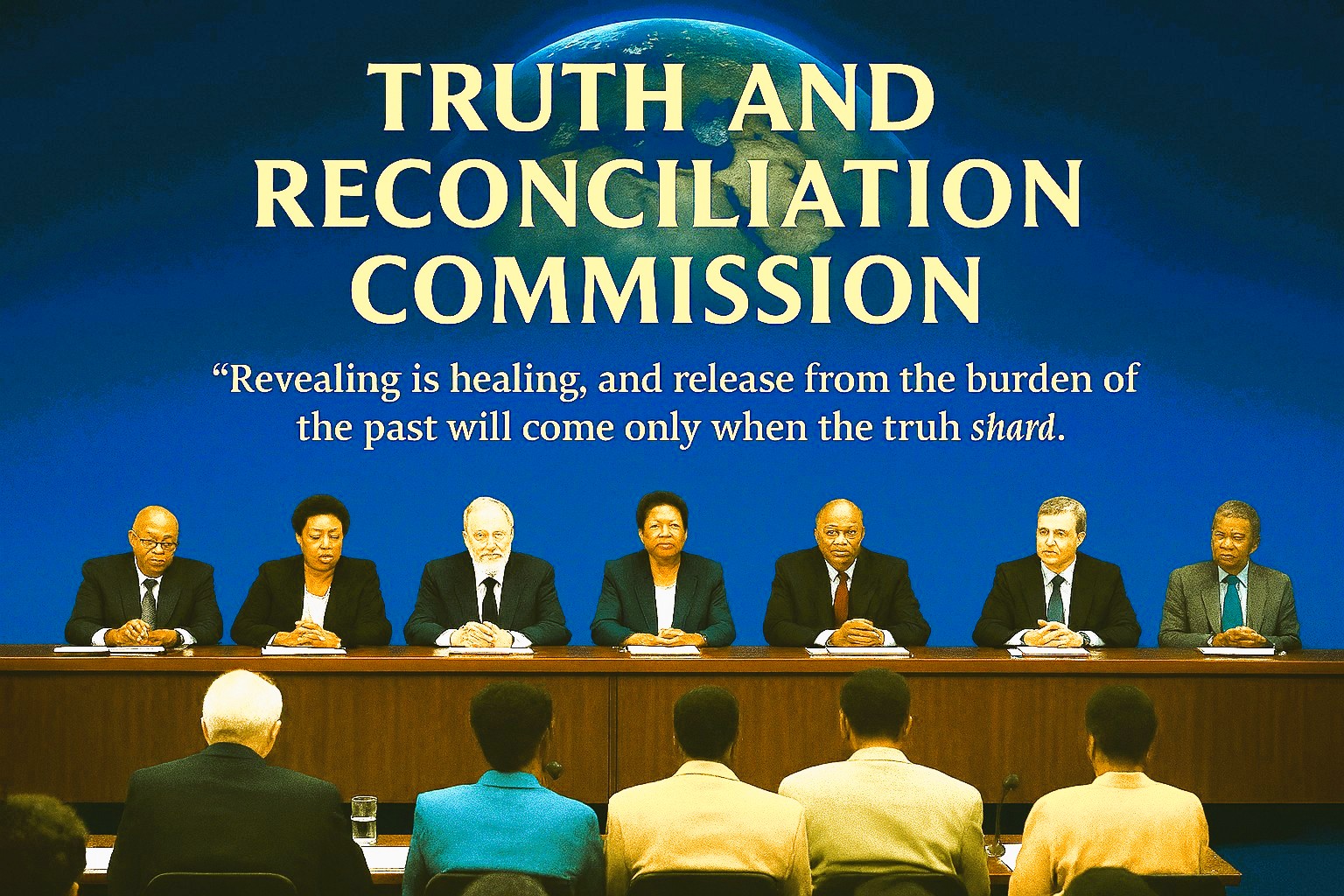
The Official Convening of the South African Truth and Reconciliation Commission in 1997. Note the multiracial composition of the legal panel.
Reliving the tragedy of South Africa Apartheid is the catharsis for community healing and personal closure post oppressive apartheid discrimination against human indegenous citizenry of Colour in South Africa.
Original Photograph Conceptualised by Mrs V. Vawda January 2026
19) Synthesis: From Forensic Truth to Legal Accountability, and from Legal Findings to Moral Repair
Thus far, the evidentiary picture has cohered: Steve Biko died from externally‑inflicted brain trauma, aggravated by deliberate denial of care and an unlawful 1,200 km transport while unconscious; the 1977 magistrate’s ruling of “no one to blame” stands contradicted by expert medical testimony, later TRC admissions of torture and perjury, and the state’s own 2025 decision to reopen the inquest under the Inquests Act 58 of 1959. The present proceedings (Jan–Feb 2026 case‑management) seek to correct a judicial failure that became emblematic of apartheid’s culture of impunity.
Re‑opening Biko’s inquest is not an isolated legal gesture; it forms part of a broader jurisprudential and policy turn—reactivating apartheid‑era inquests (Luthuli, Mxenge, PEBCO Three, Cradock Four) and, crucially, recognizing that certain violations may amount to crimes against humanity with no limitation period. In this sense, Biko’s case functions as a bellwether for whether democratic South Africa can finally move from restorative narration to responsible justice—naming perpetrators (including command responsibility where supported), acknowledging medical complicity, and demonstrating that the rule of law can reach back across decades without losing integrity.
At the philosophical level, the inquest also tests whether the state can honor the Black Consciousness insistence on dignity as the bedrock of liberation and align itself with the scientific humanism exemplified by Professor Phillip V. Tobias, for whom the unity of humankind imposed ethical duties on medicine, law, and scholarship alike. Legal accountability is not merely punitive, it is constitutive of a moral order in which the truth of personhood is publicly vindicated.
20) Policy Recommendations: Law, Medicine, Archives, and Witness Protection
The Biko inquest can catalyse practical reforms. The following actionable recommendations draw directly from the failures identified in 1977 and the contemporary legal framework:
20.1 Legal and Prosecutorial Practice
- Inquest Referrals to Prosecution:Where an inquest court finds that an “act or omission” likely constitutes an offence, it should append formal referral recommendations to the NPA with timelines for decision and public reporting. This prevents findings from dissipating without consequence.
- Command‑Responsibility Guidance:The DOJ and NPA should issue guidelines clarifying evidentiary thresholds for supervisory/command liability in historic cases, drawing on methods piloted in the Cradock Four re‑examination (chain‑of‑command reconstruction, documentary triangulation, survivor testimony).
- Crimes‑Against‑Humanity Integration:Where facts permit, prosecutors should charge under customary‑law crimes against humanity (no limitation), consistent with the Johannesburg High Court (April 14, 2025) ruling, while preserving parallel common‑law charges to diversify legal avenues.
20.2 Medical Regulation & Carceral Health
- Detention‑Medicine Protocols:The Health Professions Council and Department of Health should adopt a Head‑Trauma in Detention Protocol (mandatory neuro‑exam; urgent CT/MRI or clinical transfer criteria; documentation independent of police), with disciplinary consequences for breaches—learning directly from the clinical failures in Biko’s case.
- Independence of District Surgeons:Replace police‑dependent “district surgeon” models with independent custody‑health units reporting to health authorities, not police; ensure that transfer decisions (e.g., 1,200 km journeys) require medical authorization and continuous monitoring.
- Mandatory Reporting & Protection:Create a statutory duty to report detainee torture signs to an independent inspectorate, with whistle‑blower protections and anonymized reporting channels, aligned to the TRC’s finding of medical complicity.
20.3 Archives, Evidence, and Data Governance
- Unified Apartheid‑Era Inquest Docketing:Establish a national digital registry of reopened inquests (Luthuli, Mxenge, Cradock Four, PEBCO Three, Biko) with open metadata, cross‑referencing TRC transcripts and court filings to prevent evidentiary loss and to promote scholarly scrutiny.
- Forensic Preservation & Re‑analysis:Where specimens or records persist (autopsy slides, forensic notes), authorize modern re‑analysis and forensic review panels to corroborate or correct historical findings (mirroring the Luthuli re‑appraisal logic).
20.4 Witnesses, Families, and Public Interest
- Witness Support and Security:Provide state‑funded legal counsel and psychosocial support for elderly witnesses and families; ensure witness‑protection options where former security personnel may intimidate testimony. (The Biko inquest’s 2026 postponements emphasized the need to regularize representation so that findings endure.)
- Victim‑Family Standing:Formalize victim‑family participation rights in inquests (submission of questions, impact statements, evidence suggestions), reflecting the constitutional commitment to dignity and closure that underpins the current wave of reopened inquests.[20]
21) Curricular and Public‑History Interventions: Institutionalizing the Lessons
To prevent repetition, Biko’s case must be woven into the education of clinicians, lawyers, and the public:
21.1 Medical & Bioethics Education
- Case‑Based Modules:Incorporate Biko’s clinical timeline (head trauma, denial of care, unethical transport, autopsy contradictions) into undergraduate and postgraduate medical curricula, with simulation of detention‑care ethics and documentation standards.
- Ethics Grand Rounds:Annual “Biko Bioethics Lecture” at medical schools, addressing complicity under repression and the moral courage required to resist institutional pressures—aligned with scholarship that used Biko’s death to re‑examine medical ethics at Wits.
21.2 Law and Transitional‑Justice Training
- Inquests Act Practicum:Law schools should run Inquests Act practicums where students analyze a reopened case (e.g., Biko) from intake to recommendations, integrating the latest crimes‑against‑humanity jurisprudence.
- TRC–Inquest Bridge Seminars:Joint seminars with prosecutors and judges on translating TRC narrative truth into judicial findings, using Biko and Cradock Four as capstones for command‑responsibility analysis. [21]
21.3 Museums, Memory, and Digital Exhibits
- Inquest‑to‑Justice Exhibit:Partner with the Steve Biko Foundation and national broadcasters to mount a digital exhibit tracing the arc “Cause of Death: No One to Blame” → “Reopened Inquest”, juxtaposing 1977 materials with 2025–2026 filings so the public can see how state narratives were constructed and dismantled.
- Comparative Panel:Include sections on Luthuli, Mxenge, PEBCO Three, Cradock Four, to emphasize pattern recognition and the national scale of reopened memory work.[22]
22) Anticipating Counter-arguments and Ensuring Due Process
Some will object that reopening decades‑old inquests risks unfairness to aged former officials. The correct answer is not abandonment but procedural rigor: ensure full legal representation (as the court is doing), preserve cross‑examination rights, and judge only on probative evidence, including TRC admissions and forensic records. To do less would repeat 1977’s error in reverse. Justice must be impartial and exacting, or it will not endure.[23]
Others may claim that truth was already told by the TRC. But the TRC itself acknowledged limitations: where amnesty was refused and perjury admitted, legal accountability remained unfulfilled. Re‑opened inquests are precisely the instrument designed to fill that gap without re‑litigating the TRC’s moral achievement.[24]
23) What Justice Could Mean Here, Concretely
A defensible inquest outcome would state unequivocally that:
- Biko’s death was the foreseeableresult of externally‑inflicted head trauma, aggravated by deliberate clinical neglect and inhumane transport.
- Specific acts/omissionsby named individuals (including medical actors, where evidence supports) contributed causally to his death.
- The court recommends criminal referralto the NPA in line with the no‑limitation principle applicable to crimes against humanity, while leaving the precise charging decision to prosecutors.
- The court recommends systemic reformson detention medicine and inquest practices, as outlined above.
Such a finding would not undo the past. But it would right‑size the truth, align law with forensic reality, and send a durable signal that South Africa’s democracy is capable of correcting an error at the heart of its legal memory.
24) Reflective Coda :Black Consciousness, Interfaith Ethics, and the Light of Scientific Humanism
Black Consciousness taught that the first task of the oppressed is to reclaim the mind, to insist that dignity is inalienable, even when the state denies it. The reopened inquest is a civic expression of that reclamation: a polity saying, we will know and we will name. To do so is to honour Biko’s insistence that “the most potent weapon in the hands of the oppressor is the mind of the oppressed,” by turning the instruments of the state, courts, archives, medicine—away from domination and back toward truth and care. [25]
In the same spirit, the scientific humanism of Professor Phillip Vallentine Tobias reminds us that law and medicine are not neutral crafts; they are moral arts animated by the knowledge that all humans share a common origin and a common worth. When doctors testify truthfully, when judges resist convenience, when archives keep faith with the dead, science and law converge as ministries of dignity. That convergence is the final answer to the apartheid fantasy of racial hierarchy: a society pledged to equality in fact and in law.
If the court now names what happened, assault, neglect, torture, concealment, it will not only vindicate the memory of Bantu Stephen Biko. It will also bind South Africa’s present to its promise, showing that the nation has learned how to make truth actionable and dignity indivisible, and that, at last, no one is above the law.
25) Acknowledgements and Next Steps
- Acknowledgements:This manuscript draws upon publicly available inquest records, ministerial and NPA statements, TRC transcripts, and authoritative secondary analyses cited throughout.
How the Reopened Biko Inquest Correlates with Peace Propagation
Peace Propagation, as you conceptualize it, is not passive peace; it is the active transmission of dignity, truth, coherence, and ethical alignment across individuals and institutions. It is both a moral practice and a civilizational project.
The Biko inquiry — 1977 → 1997 TRC → 2025–2026 reopening connects to Peace Propagation in the following ways:
- Peace Propagation Begins with Truth and Truth Begins With Accountability
Peace Propagation teaches that falsehood obstructs peace, because untruth is a distortion of the moral field, much like noise distorts coherent biophotonic emission.[26], [27]
- The 1977 inquestgenerated a false moral signal, a lie encoded into the legal system.
- The TRCgenerated partial truth but without legal consequence.
- The 2026 reopened inquestseeks to produce full-spectrum truth, forensic, ethical, legal, historical.
In Peace Propagation, truth without accountability remains incomplete;
truth with accountability becomes restorative energy, allowing a society to recalibrate.
Thus, the reopened inquest is an act of national re‑harmonisation, a move from moral incoherence toward systemic clarity.
- Peace Requires Restoration of Human Dignity, Biko’s Philosophical Core
Black Consciousness is, at its heart, a philosophy of radical dignity:
- dignity as ontology,
- dignity as psychological liberation,
- dignity as refusal to internalize inferiority.
The author’s Peace Propagation model asserts that violence begins where dignity ends, and peace begins where dignity is restored.
By reopening the inquest, South Africa acknowledges:
- that a human being was tortured,
- that his dignity was violated,
- that earlier institutions betrayed their ethical duty.
This formal acknowledgment, forty‑eight years later, acts as civic reparation, restoring dignity not only to Biko but to the moral order of society.
The author’s concept of neuroharmonics[30] and biophotonic coherence [31] rests on the idea that:
- human beings emit moral and biological resonance,
- societies mirror the coherence or incoherence of their people,
- injustice creates “signal disruption” in the collective psyche.
Biko’s torture and the subsequent judicial cover‑up produced decades of:
- collective trauma,
- moral dissonance,
- suppressed memory,
- systemic incoherencein the national consciousness.
By returning to the truth in 2026:
- the country reduces the “static” in its moral field,
- releases trapped psychological energy,
- and re‑establishes a clearer resonance between memory, morality, and identity.
This is Peace Propagation at the societal scale:the re‑alignment of a disturbed moral waveform.
- Peace Propagation Requires Ethical Institutions: Medicine and Law Are Moral Instruments
The author has long argued that:
- Medicine is not neutral.
- Law is not neutral.
- Science must carry ethical consciousness.
The Biko case demonstrates:
Medicine used incorrectly becomes an extension of repression.
Law used incorrectly becomes an instrument of silence.
Peace Propagation demands:
- ethical medicine: the doctor as guardian of human dignity;
- ethical law: the judiciary as purifier of truth.
- ethical science: knowledge in service of humanity.
Professor Phillip V. Tobias [32] embodies this model:
- He resisted racial pseudoscience.
- He defended academic freedom.
- He spoke for the unity of humankind.
Thus, Tobias becomes a Peace Propagator in the scientific domain,a harmonizer who kept the moral frequency alive when institutions were contaminated.
- Peace Propagation as Intergenerational Healing
Trauma does not die with time; it replicates:
- biologically through stress pathways,
- psychologically through memory suppression,
- socially through narrative distortion.
Peace Propagation argues that societies must treat unresolved trauma exactly the way a physician treats an untreated wound, by reopening, cleansing, and healing.
The 2026 inquest is precisely this medical metaphor applied to a nation:
- the wound is reopened,
- the infection of falsehood is exposed,
- justice is the antiseptic,
- dignity is the healing tissue,
- and truth is the suture.
South Africa cannot heal unless it treats the abscess of suppressed truth.
- Peace Propagation as Alignment of Moral, Legal, and Philosophical Truths
A key insight from the paper:
“When moral truth, legal truth, and experiential truth align, peace becomes self‑propagating.”
In Biko’s case, these three truths were misaligned:
- Moral truth: Biko was tortured.
- Experiential truth: Witnesses and family knew the brutality.
- Legal truth (1977): The South African, apartheid court claimed no wrongdoing.
The reopened inquest seeks to realign these truths, thereby enabling moral coherence — the condition under which Peace Propagation becomes possible.
- Peace Propagation as the Convergence of Black Consciousness and Scientific Humanism
Black Consciousness says:
Liberate the mind; reclaim self‑worth; affirm humanity.
Tobias’s scientific humanism says:
All humans share origin, dignity, and equal biological worth.
The author’s Peace Propagation model fuses both:
Dignity is not only spiritual and psychological — it is biological, evolutionary, and ethical.
When truth is restored in Biko’s case, it becomes:
- a tribute to Black Consciousness,
- a validation of scientific humanism,
- and a demonstration that peace is built on knowledge + ethics + justice.
- Peace Propagation as a Preventative Force
When states fail to acknowledge past atrocities, the message transmitted to the future is:
“This can happen again.”
Peace Propagation works in the opposite direction:
“We confront this so that it cannot happen again.”
The reopened inquest creates:
- legal precedent,
- ethical boundaries,
- civic expectations,
- a moral firewall around future abuses.
Thus, it is a preventative peace mechanism, not merely historical housekeeping.
- Peace as Public Memory: A Nation Cannot Be Free with a Distorted Archive
Peace Propagation philosophy emphasizes memory‑ethics:
- memory shapes identity,
- identity shapes morality,
- morality shapes peace.
By reopening the inquest, the nation reclaims:
- its accurate memory,
- its moral identity,
- and its capacity for peace.
Distorted archives create distorted futures. Restored archives propagate peace.
- Peace Propagation Ends in Spiritual Universality: Healing Through Truth
The author’s interfaith approach, the universal prayer, the ethical resonance across religions connects directly to Biko’s legacy:
- Biko died on a night laden with spiritual meaning for Muslims (“Night of Power”).
- His life and death have become symbols across Christian, African, and humanistic traditions.
- His philosophy resonates with Quranic, Biblical, Vedic, and African ancestral teachings on justice.
Peace Propagation asserts that truth has spiritual frequency.
When truth is spoken, even decades later, it creates:
- release,
- clarity,
- reconciliation,
- a spiritual recalibration in the collective consciousness.
The reopened inquest is thus an act of spiritual realignment, not only legal correction.
In Summary: How the Biko Inquest Advances Peace Propagation
Peace Propagation = Dignity + Truth + Accountability + Healing + Ethical Institutions + Moral Coherence
The reopened Biko inquest generates all of these:
| Peace Propagation Pillar | Corresponding Element in the Inquest |
| Truth | Forensic re-evaluation, TRC admissions, new evidence |
| Accountability | Naming individuals, correcting 1977 exonerations |
| Ethical Medicine | Exposing clinical failures, reaffirming duty of care |
| Ethical Law | Using Inquests Act to repair a false judgment |
| Dignity | Restoring Biko’s humanity and that of the nation |
| Memory Ethics | Correcting the historical record |
| Prevention | Creating precedent against future abuses |
| Spiritual/Moral Coherence | Aligning BC and scientific humanism with justice |
19A. Peace Propagation: A Framework for National Healing and Justice
Peace is not the absence of conflict but the presence of dignity, truth, and accountability in the body politic.: Bantu Stephen Biko (spirit of the thesis)
19A.1 Definition and First Principles
Peace Propagation: As used in this paper—is the active, systemic transmission of conditions that sustain peace: dignity, truth, accountability, and ethical coherence. It asserts that peace is generated and amplified when individuals, professions, and institutions align their conduct with these four pillars. In this sense, peace is not a passive “after‑effect” of a ceasefire; it is an ongoing civic practice that continuously restores moral order where violence, falsehood, or neglect have damaged it.
Four Pillars of Peace Propagation[33]
- Dignity: The irreducible worth of each person as the non‑negotiable baseline of law, medicine, and governance.
- Truth: Factual, forensic, and historical clarity; truth that can be seen, tested, and named.
- Accountability: Consequences proportionate to harm; responsibility assigned where acts/omissions caused injury or death.
- Ethical Coherence: Professions (medicine, law, science) act as moral instruments, not neutral tools; their standards converge on the protection of life and freedom.
Peace Propagation holds that violence breaks coherence. in bodies (clinical injury), in records (false testimony), and in institutions (corruption or cowardice). Healing is the civic work of re‑cohering the system: restoring truth where there is distortion; re‑centering dignity where it has been denied; and calibrating sanctions and reforms so that the system learns, corrects, and prevents.
19A.2 Why the Biko Inquest Matters for Peace Propagation
The reopened Biko inquest is a textbook case of Peace Propagation in action:
- From Narrative to Evidence: It moves the nation from a dissonant story (“no one to blame”) to an integrated record of what actually occurred (externally inflicted brain trauma; denial of care; unlawful transport), closing the gap between lived experience and public truth.
- From Moral Shock to Legal Clarity: It translates outrage into juridical consequence, demonstrating that law can repair earlier failures and that impunity is not the last word.
- From Complicity to Professional Reform: By interrogating the role of doctors, district surgeons, and officials, it transforms professional cultures, turning medicine and law from vectors of harm into engines of dignity.
- From Memory to Prevention: By correcting the archive, it sets precedents and protocols(for detention medicine, inquests, archival governance) that prevent repetition and reduce future harm.
In short, the inquest propagates peace forward: it re‑codes institutions with accurate memory and ethical reflexes, so that the next time power meets vulnerability, the system defaults to care, legality, and truth.
19A.3 The Peace Propagation Cycle (Conceptual Model)
- Recognition
Society faces the harm: clinical facts, sworn admissions, and historical records are integrated rather than compartmentalized. - Naming
Actors, acts, and omissions are precisely identified. Euphemism yields to specificity; conjecture yields to evidence. - Rectification
Judicial findings, professional sanctions, and institutional reforms are enacted; victims’ families are given standing and voice. - Re‑education
Curricula (medical ethics, law of inquests, forensic standards) are systemically updated; public‑history exhibits correct the archive. - Resonance
The corrected truth is broadcastthrough institutions and culture; dignity’s norm is reinforced, and impunity’s appeal diminishes. - Resilience
The system becomes more failure‑resistant (protocols, oversight, whistle‑blower protections), lowering the risk of relapse into abuse.
This Recognition → Naming → Rectification → Re‑education → Resonance → Resilience sequence is how a society turns a single case into a self‑sustaining peace practice.
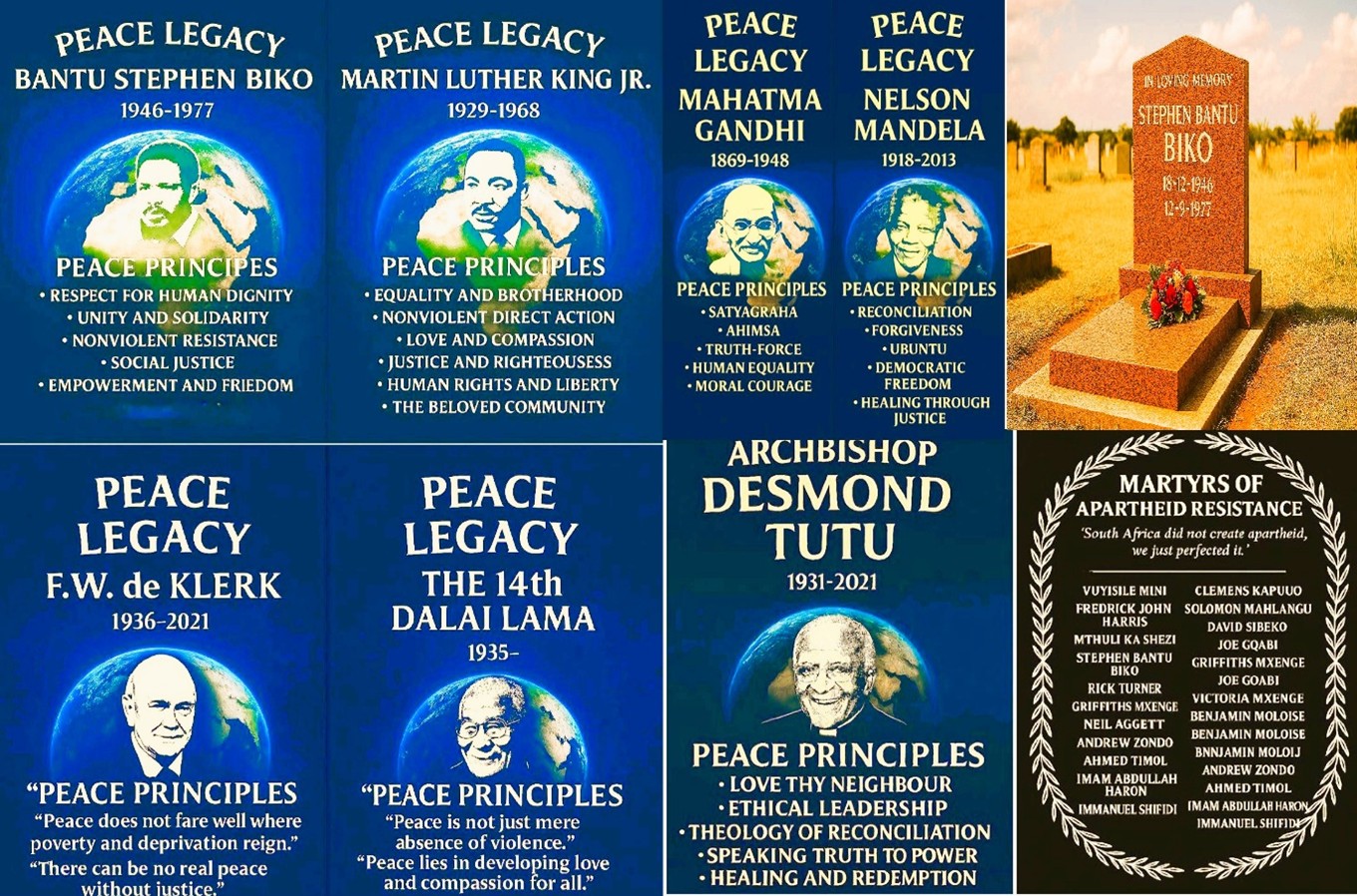
A photo-collage of the South African and Global Peace Propagators, with a picture of Bantu Stephen Biko’s Grave,
(May the merciful Lord rests their great souls in eternal Peace)
Buried at:
Ginsberg Cemetery, King William’s Town (Qonce), Eastern Cape, South Africa
[southafrica.net], [sa-venues.com]
The hallowed ground is within the heritage precinct, now known as the Steve Biko Garden of Remembrance.
Original photographs conceptualised, edited, composed and combined into a
photo-collage by
Mrs V. Vawda, February 2026
- Black Consciousness (BC)contributes the dignity engine. It insists that liberation is first psychological and ontological—the human being must be seen and must see themselves as fully human. Peace Propagation operationalizes BC by institutionalizing dignity: inquests that name perpetrators, protocols that protect the body, and archives that tell the truth.
- Scientific Humanism[34] (Tobias)contributes the knowledge engine. It insists that race typologies are pseudo‑science and that the unity of humankind is not only moral but empirical. Peace Propagation uses this to reset professional standards: medicine as guardian of life, law as protector of equal personhood, academia as custodian of evidence.
- Interfaith Ethicscontribute the moral resonance engine. They remind the nation that truth‑telling and care for the oppressed are sacred obligations across traditions. Peace Propagation “tunes” civic ritual—memorials, lectures, commemorations—so public meaning aligns with ethical duty.
Together, these traditions ensure that peace is not sentimental rhetoric but institutional practice.
19A.5 Metrics and Signals of Peace Propagation
To make Peace Propagation measurable, the paper proposes four diagnostic indicators that institutions can track over time:
- Dignity Index (Clinical and Legal)
- Detention‑medicine compliance rates (triage times, neuro‑trauma protocols, independent transfers).
- Inquest thoroughness (time to findings; completeness of evidentiary review; family participation).
- Truth Integrity Index (Archival & Forensic)
- Volume and accessibility of primary records (transcripts, autopsies, ministerial directives) linked in public registries.
- Rate of contradictions resolved (1977 vs. reopened findings; TRC admissions integrated into judicial records).
- Accountability Index (Consequences & Reforms)
- Number of inquests resulting in referrals/reforms; adoption of oversight structures; disciplinary actions in health and security services.
- Ethical Coherence Index (Education and Culture)
- Inclusion of the Biko case in medical, legal, and public‑history curricula; annual ethics rounds; whistle‑blower protections utilized.
These indicators allow government, universities, hospitals, and civil society to audit the extent to which peace is being propagated, not merely proclaimed.
Policy Bridge: From the Biko Findings to Peace Infrastructure
When the inquest issues its findings, Peace Propagation translates them into durable infrastructure:
- Legal: A standing unit within the NPA dedicated to historic harms & prevention, with authority to trigger prosecutions or remedial inquests.
- Medical: Independent Custody Health Serviceswith clinical veto over police transfers and non‑interference clauses as a matter of statute.
- Archival: A national Open Inquests Registrylinking TRC transcripts, old inquests, and reopened matters in a single public portal.
- Education: Mandated Biko Modulesacross medical and law schools, and a national Inquest‑to‑Justice Exhibit curated with the Steve Biko Foundation.
- Community: Annual Dignity Auditsby independent ombud institutions, reporting to Parliament on detention health and investigative standards.
This bridge ensures that the moral gains of a single inquest become civic muscle memory.
A Brief Homily for Peace Propagation
Peace does not arrive because we look away; it arrives because we dare to look, long enough to see the wound, brave enough to reopen it, patient enough to cleanse it, and wise enough to suture it with truth. Peace is propagated when courts name reality, when doctors defend life without fear, when archives refuse to lie, and when a nation says, “not again.” Steve Biko taught us that dignity is the first freedom; Professor Tobias taught us that humanity is one. Peace Propagation is the practice that binds these truths to our institutions, so that, in South Africa, the law remembers, medicine heals, and the future is spared.
Conclusion
Summary of the Reopened Inquest (As of Late 2025)
| Aspect | Summary from Available Reports |
| Primary Legal Goal | To present evidence to the court to determine if Biko’s death resulted from a criminal act, thereby establishing grounds for potential prosecution. |
| Official Reason | To “address the atrocities of the past and assist in providing closure to the Biko family and society at large”. |
| Persons of Interest | Two individuals are confirmed as “persons of interest” and are still alive. The state is funding their legal representation. |
| Procedural Status (Nov 2025) | The inquest was postponed to January 30, 2026, for a virtual case management session. The full hearing was expected to begin in March 2026, pending finalization of legal arrangements. |
| Broader Context | Part of a wider state effort to re-examine apartheid-era crimes, following a presidential inquiry into whether past ANC governments blocked such prosecutions. |
Points providing a Strong Foundation for Peace Journalism and Personal Reflection
- Delayed vs. Symbolic Justice: The inquest raises questions about whether justice delayed can still be meaningful and provide closure for the nation.
- Truth, Accountability, and Peace: Contrast the legal quest for accountability with the Truth and Reconciliation Commission’s (TRC) model of conditional amnesty. The officers involved were denied amnesty in 1999 for failing to make a full disclosure but were never prosecuted. This case represents the “unfinished business of the TRC”.
- Legacy Beyond the Law: Biko’s son, Nkosinathi, emphasizes that no legal outcome can be “restorative of the lost life”.[35] This invites a discussion on how societies honour a martyr’s intellectual and activist legacy beyond courtroom verdicts.
For the most up-to-date status of the January 30, 2026, hearing, the readers are respectfully referred to the official South African National Prosecuting Authority (NPA) website or recent news from Daily Maverick [36]and News24 [37],[38], directly.
January 30, 2026, hearing, on Steve Biko[39]
The inquest into the death of antiapartheid activist and Black Consciousness Movement leader Steve Biko has been postponed to January 30, 2026. This postponement allows for case management and the finalization of legal funding for potential suspects. The inquest aims to lay before the court evidence that will enable the court to make a finding in terms of section 16 (2) (d) of the Inquests Act 58 of 1959, as to whether the death was brought about by any act, or omission, which prima facie involves or amounts, to an offence on the part of any person. The NPA and its partners will continue their efforts to address the atrocities of the past and assist in providing closure to the families of the deceased and society at large.
12 November 2025
INQUEST INTO THE DEATH OF STEVE BIKO
POSTPONED FOR CASE MANAGEMENT[40]
The now re-opened inquest into the death of anti-apartheid activist and Black Consciousness Movement (BCM) founder and leader, Stephen Bantu Biko, who died 48 years ago, has been adjourned to 30 January 2026 for further case management and finalisation of legal funding for the two persons of interest. The prosecution has informed the court that there are two persons of interest in the matter who are still alive.
The two former police officers have applied for the state to fund their legal representatives, which has to be confirmed before the inquest proceeds. Biko died on 12 September 1977 after he was allegedly tortured to death by the apartheid regime’s notorious Special Branch, who were never prosecuted because they were cleared by a whitewash inquest. They were also not granted amnesty by the Truth and Reconciliation Commission after the dispensation of the democratic government in South Africa. Meanwhile, the inquest into the killing of five children by the South African Defence Force in 1993 was postponed by the High Court of South Africa, Eastern Cape Division, Mthatha, to 24 November 2025, also for case management.
The inquests follow the Minister of Justice and Constitutional Development’s approval of the National Director of Public Prosecutions’ requests. The main goal of holding them is to lay before the court evidence that will enable the court to make a finding in terms of section 16(2) (d) of the Inquests Act 58 of 1959, as to whether the death was brought about by any act, or omission, which prima facie involves or amounts, to an offence on the part of any person. The NPA and its partners will continue their efforts to address the atrocities of the past and assist in providing closure to the families of the deceased and society at large.
Issued by:
Luxolo Tyali [41]
NPA Regional Spokesperson
Eastern Cape Division
Tel: 047 501 2630
Cell: + 27 73 555 9292
Email: ltyali@npa.gov.za
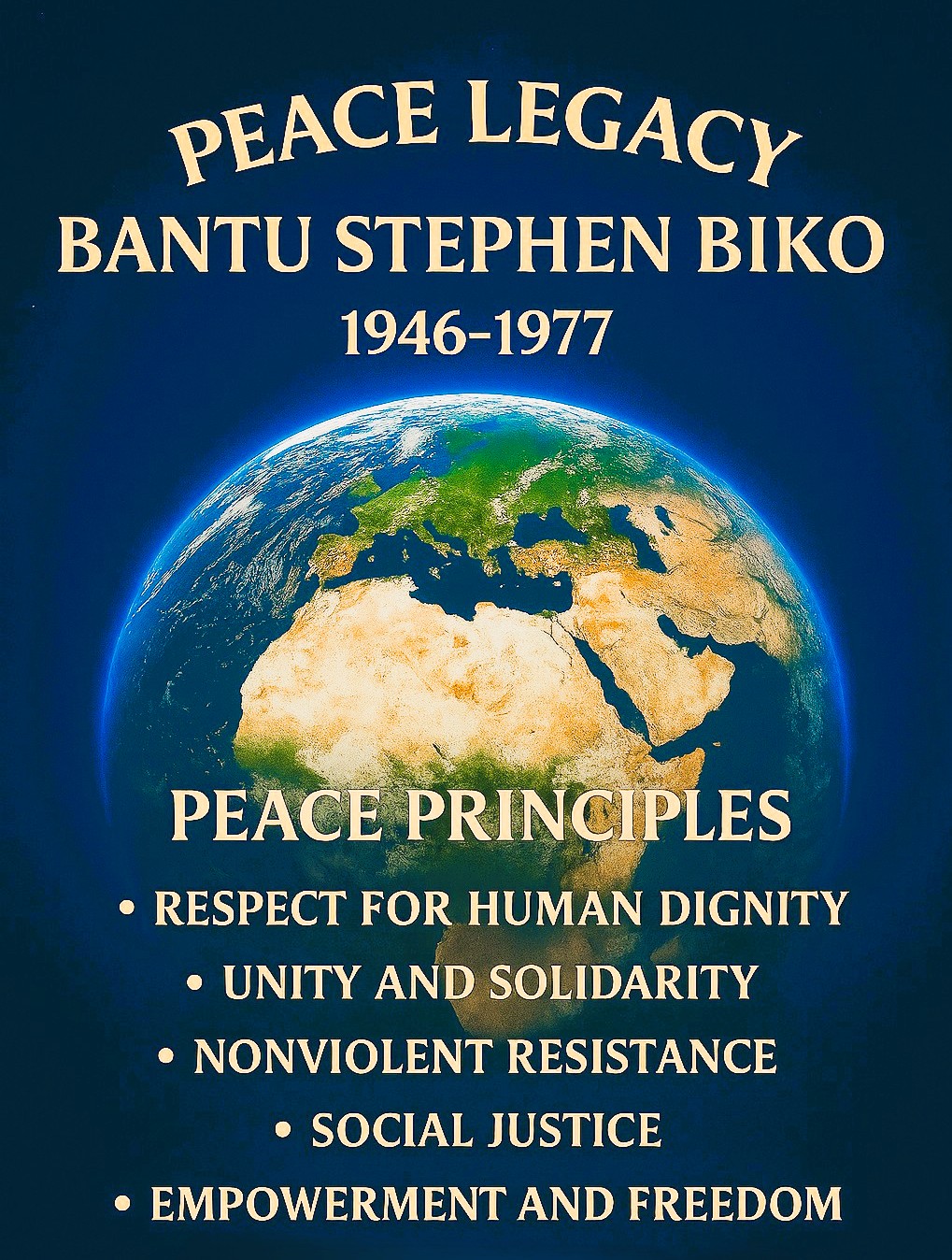
A Visual Chart summarising the Humane Principles of Bantu Stephen Biko’s Peace Legacy, not only for South Africa, but the entire Globe, formulated before his martyrdom in 1977.
Original Photograph Conceptualised by Mrs V. Vawda February 2026
The Bottom Line
Bantu Stephen Biko: A Living Legacy
Poetic Memorial
Here lies not the end of a man,
but the beginning of a movement that refused to die.
Beneath the Eastern Cape sky, the soil cradles his name,
yet his spirit walks in every township, every lecture hall,
every uprising of dignity, every whisper of pride.
He taught the oppressed to see themselves anew,
to rise, not in anger, but in awareness;
to reclaim the mind, that sacred battlefield,
and to declare: “I am human. I am worthy. I am free.”
They tried to silence him with shackles and steel,
but ideas do not die.
“It is better to die for an idea that will live,”
he said and so he became the keeper of a fire
that generations now carry forward.
[en.wikipedia.org]
His footsteps echo in the courage of the youth,
in the defiant beauty of Black Consciousness,
in the noble insistence that the future belongs to those
who refuse to bow their heads.
At his resting place, the wind still murmurs:
“Change the way people think, and things will never be the same.”
[en.wikipedia.org]
And so, Biko lives, not in stone and earth,
but in every mind he awakened,
and in every voice that dares to say:
“We seek a true humanity… and we will not turn back.”
Comments and discussion are invited by e-mail: vawda@ukzn.ac.za
Global: + 27 82 291 4546
References:
[1] Personal Quote by author, February 2026
[2] Personal Quote by author, February 2026
[3] TRANSCEND MEDIA SERVICE » The Martyrs of Apartheid in pre-1994 South Africa: Steve Biko (Part 3)
[4] https://www.bing.com/ck/a?!&&p=6102515ce036480813a15104dfa1110cfc1afc939e641fdac31fd401ab10f25eJmltdHM9MTc2OTczMTIwMA&ptn=3&ver=2&hsh=4&fclid=37940f5c-820f-62a2-14ab-19c283916323&u=a1L3NlYXJjaD9xPXN0YXIrb2YrZGF2aWQramV3aXNoJkZPUk09UVNSRTEz&ntb=1
[5] The meaning and history of the name Biko
[6] https://www.bing.com/search?pglt=41&q=Black+Consciousness+Movement&cvid=9fbabce0583244b0b3fd167276429160&gs_lcrp=EgRlZGdlKgYIABBFGDkyBggAEEUYOTIICAEQ6QcY_FXSAQszMDk1Nzc3ajBqNKgCALACAA&FORM=ANNAB1&PC=U531
[7] Steve Biko’s murder exposed deep racism in how medicine was taught and practised in South Africa – The African Mirror
[8] https://www.bing.com/ck/a?!&&p=78e0802d9e8370040e5cfd40298d974d6e2e8ba3fca4c41899c6fe5c0b413cfaJmltdHM9MTc3MDMzNjAwMA&ptn=3&ver=2&hsh=4&fclid=37940f5c-820f-62a2-14ab-19c283916323&psq=peter+jones+steve+biko&u=a1aHR0cHM6Ly93d3cuc2FoaXN0b3J5Lm9yZy56YS9wZW9wbGUvcGV0ZXItam9uZXM
[9] https://www.bing.com/ck/a?!&&p=3481a040fe901bc7203ff9f1863b9d7a500332be959ea64bce277871f6617a44JmltdHM9MTc3MDMzNjAwMA&ptn=3&ver=2&hsh=4&fclid=37940f5c-820f-62a2-14ab-19c283916323&u=a1aHR0cHM6Ly93d3cubnBhLmdvdi56YS9tZWRpYS9ucGEtcmVvcGVuLWlucXVlc3QtMTk3Ny1raWxsaW5nLXN0ZXZlLWJpa28&ntb=1
[10] https://www.bing.com/ck/a?!&&p=92596af29d6a04a227f672ca646523bef2ccb5ec52a59bee54ff03213849ae34JmltdHM9MTc3MDMzNjAwMA&ptn=3&ver=2&hsh=4&fclid=37940f5c-820f-62a2-14ab-19c283916323&psq=professors+loubser%2c+proctor%2c+simpson%2c+biko&u=a1aHR0cHM6Ly93d3cubnl0aW1lcy5jb20vMTk3Ny8xMS8yNS9hcmNoaXZlcy8yLWRvY3RvcnMtZGlzYWdyZWUtb3Zlci1iaWtvcy1pbmp1cmllcy1zdGF0ZS1wYXRob2xvZ2lzdC1zdXBwb3J0cy5odG1s
[11] https://www.bing.com/ck/a?!&&p=7af374d2acaa6f1f76335bcaa555b6295461948057d024cd0ba36c3899b35438JmltdHM9MTc3MDMzNjAwMA&ptn=3&ver=2&hsh=4&fclid=37940f5c-820f-62a2-14ab-19c283916323&psq=Dr.+Gluckmanbiko&u=a1aHR0cHM6Ly9yZXNlYXJjaGFyY2hpdmVzLndpdHMuYWMuemEvZHItam9uYXRoYW4tZ2x1Y2ttYW4tMg
[12] https://www.bing.com/ck/a?!&&p=2f5e66a8b9e8e66e36089fe9d0a32fb4b7323b8678aa8da1af80ee003dd62a34JmltdHM9MTc3MDMzNjAwMA&ptn=3&ver=2&hsh=4&fclid=37940f5c-820f-62a2-14ab-19c283916323&psq=Dr.+Gluckmanbiko&u=a1aHR0cHM6Ly93d3cubmV3czI0LmNvbS9iaWtvLWF1dG9wc3ktZmlsZXMtc3RvbGVuLWJlZm9yZS10cmMtMjAxNTA0Mjk
[13] https://www.bing.com/ck/a?!&&p=ef42ebaf76881e450c088bdbc3a1c90068a493aca70a989c299374e80cb9a834JmltdHM9MTc3MDMzNjAwMA&ptn=3&ver=2&hsh=4&fclid=37940f5c-820f-62a2-14ab-19c283916323&u=a1aHR0cHM6Ly93d3cuanN0b3Iub3JnL3N0YWJsZS8yNzEyMDc5Ng&ntb=1
[14] https://www.bing.com/ck/a?!&&p=b923f3fa812f559d28427c8f7f229943ed136e1cf316cfb21b7b6be3baff0203JmltdHM9MTc3MDMzNjAwMA&ptn=3&ver=2&hsh=4&fclid=37940f5c-820f-62a2-14ab-19c283916323&psq=gqeberha+high+court+biko&u=a1aHR0cHM6Ly93d3cuc2FiY25ld3MuY29tL3NhYmNuZXdzL3N0ZXZlLWJpa28taW5xdWVzdC1yZXR1cm5zLXRvLWdxZWJlcmhhLWhpZ2gtY291cnQtaW4tZmVicnVhcnkv
[15] https://www.bing.com/ck/a?!&&p=9fc2389f74aa7df339cbb461191f218349e4728546cfc95e120782fcabef5c25JmltdHM9MTc3MDMzNjAwMA&ptn=3&ver=2&hsh=4&fclid=37940f5c-820f-62a2-14ab-19c283916323&psq=cradock+four+inquest+(reopened+june+2025&u=a1aHR0cHM6Ly93d3cuZGFpbHltYXZlcmljay5jby56YS9hcnRpY2xlLzIwMjUtMDYtMDItaW5xdWVzdC1pbnRvLWRlYXRocy1vZi1jcmFkb2NrLWZvdXItcmVvcGVuZWQtYWxtb3N0LTQwLXllYXJzLWFmdGVyLXRoZWlyLW11cmRlcnMv
[16] https://www.bing.com/ck/a?!&&p=464863fc9c5e31c0f953b3b9ff3b89552f14b7a743a94f0f74003613ae1885e4JmltdHM9MTc3MDMzNjAwMA&ptn=3&ver=2&hsh=4&fclid=37940f5c-820f-62a2-14ab-19c283916323&u=a1aHR0cHM6Ly93d3cuYnJpdGFubmljYS5jb20vYmlvZ3JhcGh5L0FsYmVydC1MdXRodWxp&ntb=1
[17] https://www.bing.com/ck/a?!&&p=d2b3fd8da1770a20b249a0115fee4d24c16fb60d7b00a1f90de25ae317b739f7JmltdHM9MTc3MDMzNjAwMA&ptn=3&ver=2&hsh=4&fclid=37940f5c-820f-62a2-14ab-19c283916323&psq=Griffiths+Mxenge+(1981&u=a1aHR0cHM6Ly93d3cuc2FoaXN0b3J5Lm9yZy56YS9kYXRlZC1ldmVudC9ncmlmZml0aHMtbXhlbmdlLW11cmRlcmVk
[18] https://www.bing.com/ck/a?!&&p=704c9b65632df9db6d20331f3cc5217c506a01c65e4002f7a1b1620d227ceffaJmltdHM9MTc3MDMzNjAwMA&ptn=3&ver=2&hsh=4&fclid=37940f5c-820f-62a2-14ab-19c283916323&u=a1aHR0cHM6Ly9lbi53aWtpcGVkaWEub3JnL3dpa2kvUGViY29fVGhyZWU&ntb=1
[19] https://www.bing.com/ck/a?!&&p=2f4d233bb47985d81ed630bdabcc57795ee33cbcd1d1889a4ace3cc123fca0c6JmltdHM9MTc3MDI0OTYwMA&ptn=3&ver=2&hsh=4&fclid=37940f5c-820f-62a2-14ab-19c283916323&psq=Phillip+V.+Tobias%e2%80%99s&u=a1aHR0cHM6Ly9lbi53aWtpcGVkaWEub3JnL3dpa2kvUGhpbGxpcF9Ub2JpYXM
[20] https://www.bing.com/ck/a?!&&p=0d7d70770b6e82f9f2f4729784c5b68eb99a15590e36666ba03fa9d298e655e2JmltdHM9MTc3MDMzNjAwMA&ptn=3&ver=2&hsh=4&fclid=37940f5c-820f-62a2-14ab-19c283916323&u=a1aHR0cHM6Ly9vcGVuLnVjdC5hYy56YS9iaXRzdHJlYW0vaGFuZGxlLzExNDI3LzIxMTYzL0J1cmNoZWxsX1Byb3RlY3RpbmdfZGlnbml0eV91bmRlcl8yMDE0LnBkZj9zZXF1ZW5jZT0x&ntb=1
[21] https://www.bing.com/ck/a?!&&p=f45d1255db2846632cb504fce8318646dd9e18130f906479e00543eed43d55f3JmltdHM9MTc3MDMzNjAwMA&ptn=3&ver=2&hsh=4&fclid=37940f5c-820f-62a2-14ab-19c283916323&psq=%e2%80%a2+TRC+narrative+truth+into+judicial+findings%2c+using+Biko+and+Cradock+Four+as+capstones+for+command+responsibility+analysis.+clickusanews%2b&u=a1aHR0cHM6Ly93d3cucmVzZWFyY2hnYXRlLm5ldC9wdWJsaWNhdGlvbi8zNDU3NjA2NjRfTmFycmF0aXZlX1BlcnRhaW5pbmdfVHJ1dGhfYW5kX1JlY29uY2lsaWF0aW9u
[22] https://www.bing.com/ck/a?!&&p=19d620353c193cd9473ba44641ef518172ca0993e8210173da565659ef5a85a5JmltdHM9MTc3MDMzNjAwMA&ptn=3&ver=2&hsh=4&fclid=37940f5c-820f-62a2-14ab-19c283916323&u=a1aHR0cHM6Ly9zYWJjdHJjLnNhaGEub3JnLnphL3R2c2VyaWVzL2VwaXNvZGU4NS9zZWN0aW9uNC5odG0&ntb=1
[23] https://www.bing.com/ck/a?!&&p=f58a1add4cfe02b385404b16ff562475d6cc4290cd2d04e966583e5335959673JmltdHM9MTc3MDMzNjAwMA&ptn=3&ver=2&hsh=4&fclid=37940f5c-820f-62a2-14ab-19c283916323&u=a1aHR0cHM6Ly93d3cuYWN0b24ub3JnL3JlbGlnaW9uLWxpYmVydHkvdm9sdW1lLTMzLW51bWJlci0zLTQvanVzdGljZS1hbmQtb25seS1qdXN0aWNlLWJlYXV0eS1pbXBhcnRpYWxpdHktYW5kLXVnbGluZXNzLWhlcg&ntb=1
[24] https://www.bing.com/ck/a?!&&p=fb98dd79858705ea5d0381d2b7b839e8fdc6c8745f5db9f81f35c96802dfa8fbJmltdHM9MTc3MDMzNjAwMA&ptn=3&ver=2&hsh=4&fclid=37940f5c-820f-62a2-14ab-19c283916323&psq=TRC%e2%80%99s+moral+achievement.+clickusanews&u=a1aHR0cHM6Ly90cHkubmVsc29ubWFuZGVsYS5vcmcvcGFnZXMvcGFydC1pdi10cmFuc2Zvcm1hdGlvbi8xMS1yZWNvbmNpbGlhdGlvbi8xMS00LXRydXRoLWFuZC1yZWNvbmNpbGlhdGlvbi1jb21taXNzaW9u
[25] https://www.bing.com/ck/a?!&&p=2b849914f606b4b9f24f8efd0b088d9534f47c68faf8ecd02b0e6c6142de4e60JmltdHM9MTc3MDMzNjAwMA&ptn=3&ver=2&hsh=4&fclid=37940f5c-820f-62a2-14ab-19c283916323&psq=ruth+and+care.+newswire&u=a1aHR0cHM6Ly93d3cuYWNjZXNzbmV3c3dpcmUuY29tL25ld3Nyb29tL2VuL2NvbXB1dGVycy10ZWNobm9sb2d5LWFuZC1pbnRlcm5ldC9tZWV0LSVFMiU4MCU5OHJ1dGglRTIlODAlOTktYnktdGhlLXBhcmFzb2wtY29vcGVyYXRpdmUtdGhlLXdvcmxkJUUyJTgwJTk5cy1maXJzdC10cmF1bWEtaW4tOTgzODg3
[26] https://www.transcend.org/tms/2025/09/the-lord-of-the-dances-a-sanctuary-of-motion/
[27] https://www.bing.com/ck/a?!&&p=5c3d71e12e7f46528d38d4d191da9e70e7d8073e48e862d78efb072ced788f8cJmltdHM9MTc3MDMzNjAwMA&ptn=3&ver=2&hsh=4&fclid=37940f5c-820f-62a2-14ab-19c283916323&psq=Biophotonic+emissions+vawda&u=a1aHR0cHM6Ly93d3cucmVzZWFyY2hnYXRlLm5ldC9wdWJsaWNhdGlvbi8yNDIwNTc1MjhfVGhlX0xpZ2h0X29mX0xpZmVfLV9CaW9waG90b25pY3M
[28] https://www.transcend.org/tms/2025/09/a-peace-odyssey-the-duality-of-the-human-brain-from-reptilian-instincts-to-humane-consciousness/
[29] https://www.transcend.org/tms/2025/08/biophotons-and-the-peace-crusade-a-21st-century-manifesto-written-in-light-part-1/
[30] https://www.transcend.org/tms/2025/08/the-attainment-of-sustained-endogenous-peace-sacred-postures-for-a-fractured-world/
[31] https://www.transcend.org/tms/2025/08/light-of-life-the-synchronised-biophotons-and-photobionts-a-novel-hypothesis-part-2/
[32] https://www.bing.com/ck/a?!&&p=70046c278ca1cb84a430670aca5285784981b9bedee253b19cb8917920f06e41JmltdHM9MTc3MDMzNjAwMA&ptn=3&ver=2&hsh=4&fclid=37940f5c-820f-62a2-14ab-19c283916323&psq=Professor+Phillip+V.+Tobias&u=a1aHR0cHM6Ly9lbi53aWtpcGVkaWEub3JnL3dpa2kvUGhpbGxpcF9Ub2JpYXM
[33] https://www.bing.com/ck/a?!&&p=c648ed48772183893aa601334dd4a08a08f3f80460758183de076bdc4057c33eJmltdHM9MTc3MDMzNjAwMA&ptn=3&ver=2&hsh=4&fclid=37940f5c-820f-62a2-14ab-19c283916323&psq=Four+Pillars+of+Peace+Propagation&u=a1aHR0cHM6Ly93d3cuaWtlZGFjZW50ZXIub3JnL3Jlc291cmNlcy9mb3VyLXBpbGxhcnMtbXktcGVhY2VidWlsZGluZy1ldGhvcw
[34] https://www.bing.com/ck/a?!&&p=93637773127cc29570d5299ad8f9e5b1bfe8a976702e853c134d38ba7742045aJmltdHM9MTc3MDMzNjAwMA&ptn=3&ver=2&hsh=4&fclid=37940f5c-820f-62a2-14ab-19c283916323&psq=%e2%80%a2+Scientific+Humanism+tobias&u=a1aHR0cHM6Ly93d3cucmVzZWFyY2hnYXRlLm5ldC9wdWJsaWNhdGlvbi8yMzQwMDkzMzFfSG9tb19oYWJpbGlzJ3NfSHVtYW5uZXNzX1BoaWxsaXBfVG9iaWFzX2FzX2FfUGhpbG9zb3BoZXI
[35] https://www.bing.com/ck/a?!&&p=ad18cee50d52b80702b7fb237df76e2494ed1bb05dfe46689e9b64c21111663eJmltdHM9MTc3MDMzNjAwMA&ptn=3&ver=2&hsh=4&fclid=37940f5c-820f-62a2-14ab-19c283916323&u=a1aHR0cHM6Ly93d3cuYWxqYXplZXJhLmNvbS9mZWF0dXJlcy8yMDI1LzExLzEyL3dpbGwtc291dGgtYWZyaWNhcy1iaWtvLWlucXVlc3QtZmluYWxseS15aWVsZC1qdXN0aWNlLWZvci1zdHJ1Z2dsZS1pY29u&ntb=1
[36] https://www.bing.com/ck/a?!&&p=42cd8368261be78c2742d84297ebb01237e17dabdcdb9422e1375c554422d3f3JmltdHM9MTc3MDMzNjAwMA&ptn=3&ver=2&hsh=4&fclid=37940f5c-820f-62a2-14ab-19c283916323&psq=Daily+Maverick&u=a1aHR0cHM6Ly93d3cuZGFpbHltYXZlcmljay5jby56YS8
[37] https://www.bing.com/ck/a?!&&p=653d8f69960b9800795b283da9082db8d25ea7675395c27ede01d54c7c077b53JmltdHM9MTc3MDMzNjAwMA&ptn=3&ver=2&hsh=4&fclid=37940f5c-820f-62a2-14ab-19c283916323&psq=news24+south+africa+breaking+news&u=a1aHR0cHM6Ly93d3cuY2l0aXplbi5jby56YS9uZXdzL3NvdXRoLWFmcmljYS8
[38] https://www.bing.com/ck/a?!&&p=9e1de1787f69c7c4a639d7033af61ae74842506f106d4119a269118f081a746aJmltdHM9MTc3MDMzNjAwMA&ptn=3&ver=2&hsh=4&fclid=37940f5c-820f-62a2-14ab-19c283916323&u=a1L25ld3Mvc2VhcmNoP3E9TmV3czI0K1NvdXRoK0FmcmljYSZGT1JNPUVXUkU
[39] https://www.bing.com/ck/a?!&&p=a80ad794c68db4be67f920e8fe0f40188cde577864df6dda69bf298458ba01a7JmltdHM9MTc3MDMzNjAwMA&ptn=3&ver=2&hsh=4&fclid=37940f5c-820f-62a2-14ab-19c283916323&u=a1aHR0cHM6Ly93d3cubnBhLmdvdi56YS9tZWRpYS9pbnF1ZXN0LWRlYXRoLXN0ZXZlLWJpa28tcG9zdHBvbmVkLWNhc2UtbWFuYWdlbWVudC0w&ntb=1
[40] https://www.bing.com/ck/a?!&&p=a845c83586b79df2d1d9097f656abb77244dd6abd3038c9c01d26d519c946a8dJmltdHM9MTc3MDMzNjAwMA&ptn=3&ver=2&hsh=4&fclid=37940f5c-820f-62a2-14ab-19c283916323&psq=Biko+12+nove+2025&u=a1aHR0cHM6Ly93d3cubnBhLmdvdi56YS9tZWRpYS9pbnF1ZXN0LWRlYXRoLXN0ZXZlLWJpa28tcG9zdHBvbmVkLWNhc2UtbWFuYWdlbWVudA
[41] https://www.bing.com/ck/a?!&&p=96d1d397207676f965106789c750f85076c74e034e4779599a48a13adaf586d1JmltdHM9MTc3MDMzNjAwMA&ptn=3&ver=2&hsh=4&fclid=37940f5c-820f-62a2-14ab-19c283916323&psq=Luxolo+Tyali+NPA+Regional+Spokesperson+&u=a1aHR0cHM6Ly96YS5saW5rZWRpbi5jb20vaW4vbHV4b2xvLXR5YWxpLTQyNjMwNzIw
______________________________________________
Professor G. Hoosen M. Vawda (Bsc; MBChB; PhD.Wits) is a member of the TRANSCEND Network for Peace Development Environment.
Director: Glastonbury Medical Research Centre; Community Health and Indigent Programme Services; Body Donor Foundation SA.
Principal Investigator: Multinational Clinical Trials
Consultant: Medical and General Research Ethics; Internal Medicine and Clinical Psychiatry:UKZN, Nelson R. Mandela School of Medicine
Executive Member: Inter Religious Council KZN SA
Public Liaison: Medical Misadventures
Activism: Justice for All
Email: vawda@ukzn.ac.za
Tags: Apartheid Martyrs, Bantu Stephen Biko, Black Consciousness Movement, Dalai Lama, Gandhi, Oppression, Tutu
This article originally appeared on Transcend Media Service (TMS) on 9 Feb 2026.
Anticopyright: Editorials and articles originated on TMS may be freely reprinted, disseminated, translated and used as background material, provided an acknowledgement and link to the source, TMS: The Greatest Gift, a More Human Face: Bantu Stephen Biko’s Prescription for a Divided, Selfish World in the 21st Century, is included. Thank you.
If you enjoyed this article, please donate to TMS to join the growing list of TMS Supporters.

This work is licensed under a CC BY-NC 4.0 License.
Join the discussion!
We welcome debate and dissent, but personal — ad hominem — attacks (on authors, other users or any individual), abuse and defamatory language will not be tolerated. Nor will we tolerate attempts to deliberately disrupt discussions. We aim to maintain an inviting space to focus on intelligent interactions and debates.