
After Greenland, Antarctica?
ANGLO AMERICA, 2 Mar 2026
Jun Ohashi and Takashi Yamaguchi | TBS News Dig (Japan) – TRANSCEND Media Service
The U.S. ‘Diplomacy’ Heads for Southern-Edge of Argentina, Ushuaia City, the “Gateway to Antarctica”
24 Feb 2026 – Ushuaia, the southernmost city in Argentina, South America, has a population of approximately 80,000 and is also known as the “end of the world.” This small port city, a dream destination for tourists heading to Antarctica, is now attracting attention as the “frontline” of great power competition.
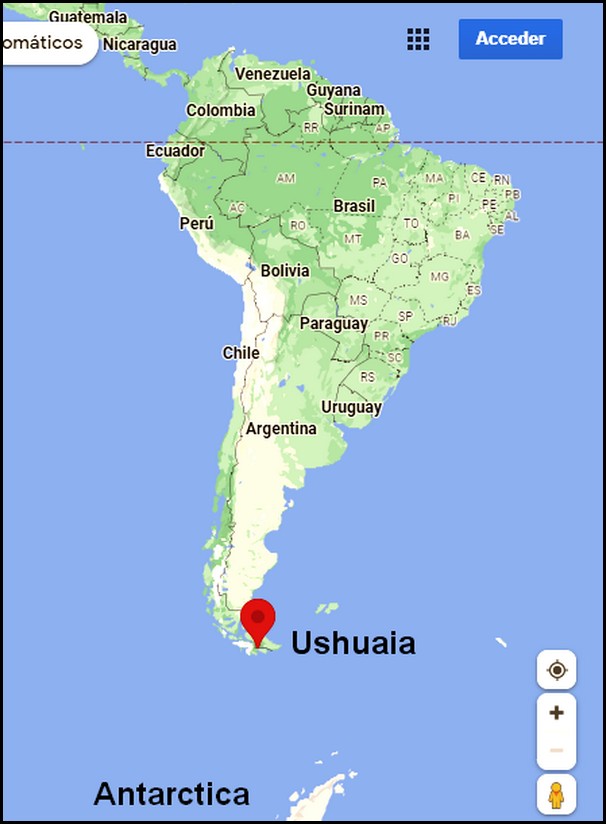 Source of the map image above: https://lashworldtour.com/wp-content/uploads/2023/05/Ushuaia-map-1.jpg
In January of this year 2026, members of the ruling party in the U.S. Congress made a surprise visit to the city. Plans for the construction of a “naval base” in Ushuaia have raised suspicions among the local residents that the plan is “preparing the ground for the U.S. military base [in Ushuaia].”
- [South Atlantic Stakes: U.S. Counters China at Argentina’s Ushuaia]
- [Argentina: Government’s Administrative Takeover of Southernmost Port Indicates Strong Alignment With Washington]
The Trump administration is strengthening its influence in Latin America and accelerating its “Western Hemisphere Strategy,” including claiming sovereignty over Greenland. Why is it now turning its attention to the “Gateway to Antarctica“? We explore its strategic importance through expert interviews.
Antarctic Resources and Vital Shipping Routes Are Drawing Global Attention
Ushuaia, located at the southern tip of South America, is considered one of the major ports closest to Antarctica. It serves as the departure point for the Antarctic research vessels and supply ships, and has attracted attention from various countries as a base for resource development and research activities.
Professor Garrett Martin of the American University, an expert on the U.S. national security and maritime policy, points out that its geographical importance is increasing.
- [Exploring the Viability of Mining in Antarctica]
- [The threat to Antarctica from mining and exploiting oil and gas]
- [New Mining Frontiers: Arctic and Antarctic Rare Earth Prospects]
“There is a possibility that vast resources lie beneath the Antarctic ice sheet. Considering climate change and improvements in icebreaking technology, Ushuaia is a crucial location for the future. The Argentine government believes it is lagging behind neighboring Chile in terms of infrastructure development for Antarctic development, and is eager to expedite the development of a base there.”
Furthermore, Ushuaia is close to the Strait of Magellan, a key maritime transportation hub. Known as an alternative route for large ships unable to navigate the Panama Canal, its value has been reassessed in recent years. As conflicts around the world destabilize major shipping routes, the route to the southern tip of South America is said to be gaining strategic importance.
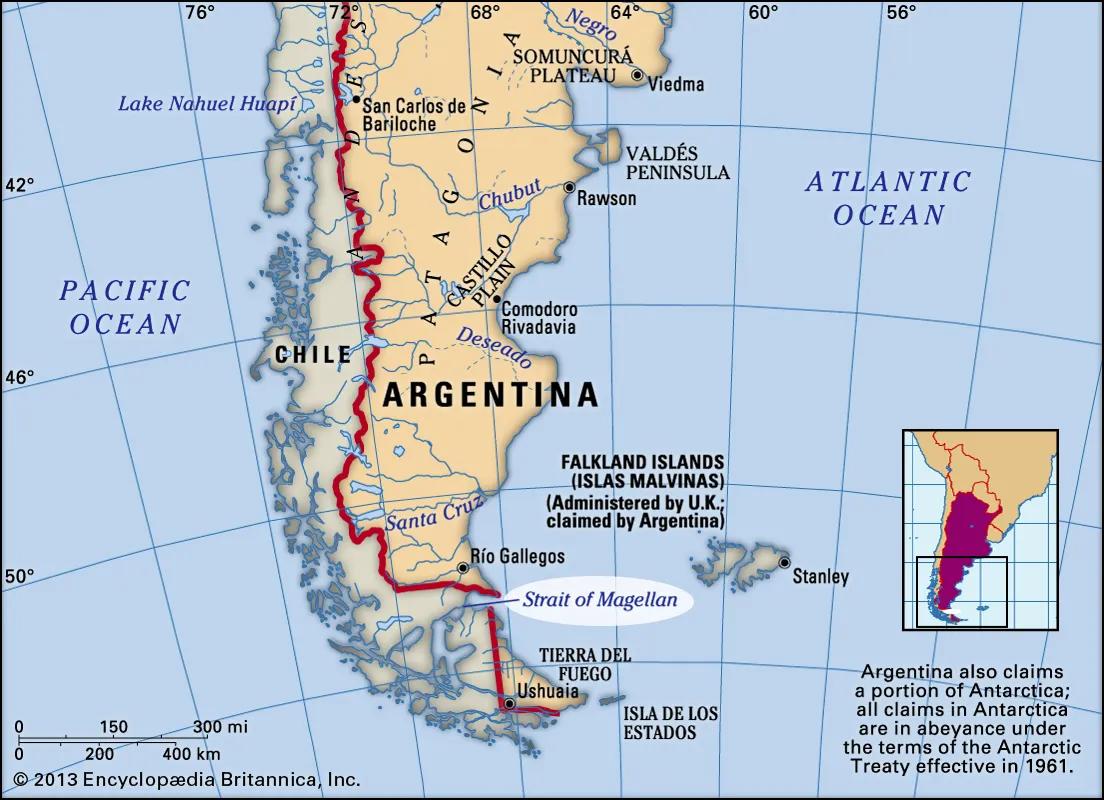 Source of the map image above: https://cdn.britannica.com/16/166916-050-3F2F1814/Strait-of-Magellan.jpg
A Close Relationship Between the United States and Argentina
These geographical conditions coincide with a political shift in Argentina.
President Javier Milei, who took office in 2023, made a major shift in foreign policy. He distanced himself from the previous administration’s efforts to strengthen ties with China and the BRICS, and instead placed cooperation with the United States at the center of his diplomacy.
China is an important factor for Argentina. Argentina is a key economic partner, with a particularly strong presence in infrastructure investment. However, the Milley administration has expressed caution about Chinese companies’ involvement in critical infrastructure and has shown a cooperative stance with the United States in the defense and resource sectors.
Meanwhile, President Trump’s second administration has emphasized the strategic importance of the Western Hemisphere. He is strengthening his involvement in the region not only in terms of immigration and drug issues, but also in terms of security and resource supply.
Professor Martin points out as follows:
“The United States places great importance on countries like Argentina remaining close to Washington, not Beijing. As seen in the move to exclude Chinese companies from Panama, strengthening ties with Argentina also has an element of regional hegemony. At the very least, expanding cooperation with the Argentine Navy is considered a given, so it’s not surprising that they’re showing interest in the Ushuaia base.”
The visit by the congressional delegation, led by a senator from the ruling Republican Party, was unannounced, leading Argentina’s opposition party to demand an explanation from the government.
According to some local media, the delegation arrived in Ushuaia on the U.S. military aircraft. We [i.e. TBS News Dig] have requested an interview with a Republican congressman who visited the site, but have not yet received a response. The U.S. Embassy explained the purpose of the visit as “inspecting environmental issues.”
Furthermore, a local Argentine journalist told me, “It’s no secret that the U.S. has an interest in the naval base. Fishermen fear that the U.S. military’s presence will prevent them from fishing and limit their livelihoods. There are also criticisms that President Milley is trying to hand over the base to the U.S. for his own gain.”
According to Professor Martin, the Argentine public opinion, having experienced the Falklands War, is highly wary of foreign military presence, and this naval base could become a major political issue in the future.
What Greenland and Ushuaia Have in Common
The Trump administration’s geopolitical thinking extends to the Arctic, and the “Greenland sovereignty” issue is increasing tensions with Europe. Climate change has dramatically reduced sea ice, dramatically improving access to the Arctic Ocean. The U.S. is increasingly wary of expanding Russian and Chinese activities from the perspective of resource development and securing shipping lanes.
- [How similar is Greenland to Antarctica ?]
- [Antarctica vs. Greenland – What’s the Difference?]
- [Scientists Warn About the ‘Greenlandification’ of Antarctica]
Greenland in the Arctic and Ushuaia, the gateway to Antarctica. These two seemingly unrelated regions share a commonality: they serve as strategic bases around the polar regions.
In Antarctica, the Antarctic Treaty, which came into force in 1961, freezes military activity and territorial claims. However, as the framework that underpins international order is undergoing significant disruption, there’s no guarantee that the current rules will continue to be upheld.
Professor Martin analyzes that countries are beginning to reserve their positions in preparation for “just in case.”
“Spheres of influence are not determined solely by geography. If Antarctica begins to be recognized as part of the Western Hemisphere security, its political significance will change dramatically. With the international order weakening, who can say for sure how long the current situation can be maintained? Treaties are merely ‘paper’ and only function if the countries involved are willing to abide by them.”
“The Edge of the World” Becomes a “New Frontline” of International Politics
Ushuaia has long been known as “the edge of the world.” However, the Trump administration views the town as a base for Antarctic development and a key location for sea lanes, and is seeking to strengthen its influence there.
- [Trump reveals what he wants for the world]
- [Why Argentina’s Ushuaia Is Caught in a Global Power Struggle]
“While there are real concerns about military activity from Russia and China in the Arctic, Greenland is currently a more urgent security concern,” Professor Martin said, before emphasizing:
“For China, Ushuaia is also an important base for Antarctic development. Its presence here carries symbolic significance as it views itself as a global power. This issue is not simply a regional one; it is quickly becoming a new frontline in the struggle for hegemony over the future of Antarctica and the international order itself.”
- [The US sets its sights on Antarctica in pushback against China]
- [NATO starts mission to strengthen presence in Arctic after Trump’s Greenland threats]
- [What Can the United States Do to Counter Growing Chinese and Russian Influence in Antarctica?]
Notes:
- Those hyperlinks with brackets [ ] with the italic letters and those maps under some of the paragraphs as well as those hyperlinks in some of the paragraphs were added by the translator for the convenience and references for the reader.
- The views and/or opinions in those hyperlinks added by the translator do not necessarily reflect those of his. In addition, it is either impossible or unavailable for him to verify the genuineness of the information in those links. He does not take any responsibility for the contents in those relevant links at all.
- Some sentences in the article, deemed important and/or emphasized in terms of the context, are expressed in the Italic letters, by the translator for the convenience of the reader.
- The views and/or opinions expressed in the above-mentioned article are those of Jun Ohashi and Takashi Yamaguchi (TBS NEW DIG), the original authors. Their views and/or opinions do not necessarily reflect those of the Transcend Media Service (TMS) or those of the translator. Therefore, the reader is kindly requested to understand, interpret or judge those views and/or opinions at his or her own responsibility.
- The original article in Japanese was published more than a few days or a few weeks ago. Meanwhile, the situations and/or conditions mentioned in the article might have been changed. This also means that the author’s argument expressed and/or the information provided in the article might have become inadequate or less or least adequate, obsolete, out of date or no longer valid by the time the TMS reader reads the same article in English.
Translation: Satoshi Ashikaga — Google Translate (with some corrections and/or modifications)
Tags: Antarctica, Greenland, Trump, USA
This article originally appeared on Transcend Media Service (TMS) on 2 Mar 2026.
Anticopyright: Editorials and articles originated on TMS may be freely reprinted, disseminated, translated and used as background material, provided an acknowledgement and link to the source, TMS: After Greenland, Antarctica?, is included. Thank you.
If you enjoyed this article, please donate to TMS to join the growing list of TMS Supporters.

This work is licensed under a CC BY-NC 4.0 License.
Join the discussion!
We welcome debate and dissent, but personal — ad hominem — attacks (on authors, other users or any individual), abuse and defamatory language will not be tolerated. Nor will we tolerate attempts to deliberately disrupt discussions. We aim to maintain an inviting space to focus on intelligent interactions and debates.