


Why Gandhi Matters?
PAPER OF THE WEEK, 16 Mar 2026
K. V. Raghupathi, PhD | Erothanatos - TRANSCEND Media Service
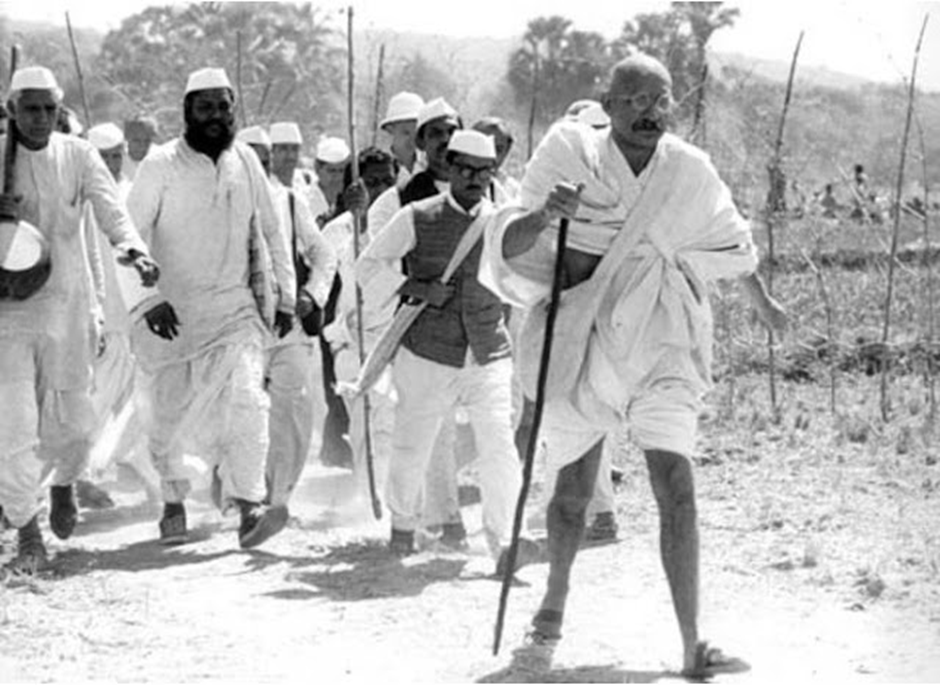
The Mahatma leading his followers and supporters of all religions including Muslims, on the Salt March that set the stage for the British exiting from India after robbing the colony of trillions of pounds over a nearly 200 year period. Photo Credit: Wikimedia Commons
Abstract
The paper dispassionately examines Gandhi’s greatness and why he matters now much more than he had been in his times while he was alive. Even seventy years after his death, Gandhi is the cynosure of everyone in the world. He has been “beloved” of historians, biographers, political thinkers and post-colonial interlocutors. He is a delight for psycho-analysts, economists and philosophers. Scores of books besides hundreds and hundreds of research articles and theses have been written on him, his philosophy and relevance.
There is not a single university in India that has not established centres on Gandhian studies. The author of this paper affirms with conviction and authority that his triple virtues, adherence to Truth, non-violence (ahimsa) and satyagraha had made him extraordinarily unique and morally and spiritually strong. It is this strength of character and his constant experimenting with Truth in his life that must warrant us to look at him as different and relevant to the changing times in the world.
*****************
Of the great tributes paid to Gandhi after his assassination, I would like to recall here the three distinguished men of letters. The first was undoubtedly Einstein, one of the greatest scientists of the twentieth century. As the twentieth century came to a close Time magazine chose great persons of the century, a once hundred years takes place, they include the scientist Albert Einstein first, Gandhi, second (jointly with Franklin Roosevelt).
Einstein himself had absolutely venerated Gandhi. As Richard Crockett records that “for Einstein it is clear Gandhi was the supreme moral compass” (19). When Einstein moved to Princeton in 1935 from Berlin, he added Gandhi to his three portraits, Newton, Faraday and Clerk Maxwell. However, while the three physicists were removed, the portrait Gandhi was retained in 1954. Upon asking him for the reason, Einstein answered that the Mahatma was the “greatest man of our age” (Clark 498, 581). Writing about Gandhi in 1944, Einstein said, “Generations to come will scarce believe that such a one as this ever in flesh and blood walked upon this earth” (Guha vii).
The second was the writer Italo Calvino from Italy observed in 1930, much earlier than Gandhi’s death: “When I think back to the personalities who dominated world news at the time, the one who stands out from all the others in terms of his visual image is without a doubt Gandhi. Although huge numbers of anecdotes about him circulated, and he was very often caricatured, his image managed to instil the idea that there was something serious and true in him, albeit very remote from us” (Newsweek, 6 January 2003).
To the verdicts of Einstein and Calvino, let me add the third, that is, Barrack Obama, the former President of the US, among the leaders who were influenced by Gandhi. As a state senator of Illinois, Obama had a photo of Gandhi in his office, alongside portraits of Nelson Mandela, Martin Luther King and Thurgood Marshall. Many years later, after he was elected President of the USA, a journalist asked him which person in history, dead or alive, he would most like to have dinner with. Obama answered Mahatma Gandhi, wittingly adding that it would have to be a frugal meal (Guha “Epilogue” 922).
Gandhi was not, however, free from criticism. Among his contemporaries Ambedkar had many a time differed with him, wrote a fascinating letter to his future wife, Dr. Sharada Kabir, “You know that I owe nothing to Mr. Gandhi and he has not contributed to my spiritual, moral and social make-up” (Guha. “Martyrdom” 893). Mohammed Ali Jinnah was another who had always differed with Gandhi for one reason or the other, but mostly and undoubtedly on personal grounds, had paid lip sympathy tribute when the latter was assassinated. Among the recent critics of Gandhi, the flamboyant writer and social activist Arundhati Roy is one, who made an astonishing charge that Gandhi was a “Saint of the Status quo”, and suggested he was a casteist in India because he had been racist in South Africa.
Some leaders influence while alive and they soon are forgotten after their death. Some leaders influence a little while alive but carry profound influence after their death. Yet some leaders influence not only while alive but after death. To this third category belongs Mahatma Gandhi. While he was alive, his magic influence was so wide and profound that even the British had to bow. His personality was so towering and imposing that no one who had by chance or political reasons come into contact had escaped from being influenced by his shadow of personality.
Even after his death, Gandhi profoundly influenced several leaders in the world. Among the African leaders, Jomo Kenyatta of Kenya, Kenneth Kaunda of Zambia, Julius Nyerere of Tanzania, Kwame Nkrumah of Ghana, Albert Luthuli, Nelson Mandela and Desmond Toto of South Africa, Martin Luther King of the US and Aung Sam Kee of Mynamar and the recent anti-corruption crusader, Anna Hazare.
Even seventy years after his death, Gandhi is the cynosure of everyone in the world. He has been “beloved” of historians, biographers, political thinkers and post-colonial interlocutors. He is a delight for psycho-analysts and economists. Philosophers have an enigmatic relationship with him, sometimes bemused at his seemingly perplexing insistence that thought and practice ought to be indistinguishable. More than this, he has become much more relevant than he had been while he was alive. No other leader has been talked about so much as Gandhi in recent times. Scores of books have been written on him, his philosophy and relevance. Hundreds and hundreds of research articles and theses have been written.
There is not a single university in India that has not established centres on Gandhian studies. Who is this Gandhi? What is his greatness? Why does he become relevant in this age of globalization? I am too small a man to assess this unusual personality that India has produced. At times in my life, I deeply repent for not having been born in his times and had at least a glimpse of his personality if not I had lived with him. I have my own apprehension in this venture of rendering my rambling thoughts on his personality; however, I make this small squirrel-like attempt in utter humility.
On the other, I fear for another reason that I myself consider nothing before this towering personality and to write about him and assess him taking the humongous writings he had made in the form of mostly letters answering numerous queries from the political leaders across as well admirers and followers. With all these serious limitations, one being the time and space at a conference like this, I would make my humble attempt and hope and trust if my assessment is wrong I would be forgiven both by his soul and the enlightened audience present here.
Let me audaciously say and admit that reading Gandhi is as good as reading the Freedom movement of India. Until his return from South Africa in 1915, the freedom movement in India was predominantly city-based and elite-dominated, and not well orchestrated. It was desperately looking for a strong leader who could take everyone with him despite differences. It was Gandhi who provided that leadership and who made freedom movement into a mass movement, taking it into villages. For Gandhi delivering India from the British was not the only task he had set.
Forging harmony of various other movements emancipating the society from evils was his preoccupation. In fact, all these sectional campaigns were conducted in parallel. All such as ending the pernicious practice of untouchability, focusing on economic self-reliance, solving the disputations of religious communities, forging communal harmony between Muslims and Hindus were of equal importance. In 1933 he wrote to a close friend C.F. Andrews that “my life is one indivisible whole… I can’t devote myself entirely to untouchability and say: ‘Neglect Hindu-Muslim unity or swaraj’.
All these things run into one another and are inter-dependent. You will find at one time in my life emphasis on one thing, at another time on another. But that is just a pianist, now emphasizing one note and now another. But they are all related to (one) another” (CWMG, IV. 198-99). Similarly, Gandhi never visited any country. Between 1915 and his death in 1948 he visited England in 1931 (Roundtable Conference). However, his ideas were keenly discussed in media, magazines and books in the US and other European countries.
A most unusual public figure, a profound and original thinker, Gandhi was. His greatness lies in his living, constantly experimenting with Truth, moment to moment. For this reason, he named his autobiography, My Experiments with Truth. A pragmatist down to earth there was no dichotomy between Gandhi the thinker and Gandhi the activist, rather in his life there was this symbolic relationship between thought and action.
He maintained a perfect balance between his thought and writings on the one hand and his thoughts and actions on the other. He read copiously and eclectically and wrote extensively although he was not primarily a writer, he wrote more than many professional writers. He had no philosophy in the usual academic sense, yet had so much to reflect upon the human living. He had no ideology, never formed and preached although, he had spoken a lot on political, social, economic, cultural and historical life. For a man who had no public office, yet, what was his greatness?
One aspect of life as I observed from a reading of his writings was that Gandhi was completely self-taught, though several influences came upon him while he was a boy and a grown-up young man. Though several influences were cited as having shaped his personality, his greatness lay in absorbing the teachings and living in them. He responded to the people he met and he learnt from them; he observed humankind in action.
With the aid of various influences that came through persons like his own pious mother, Dadabhai Naoroji, Raychand Bhai, Gokhale, Tolstoy, H.D.Thoreau, John Ruskin from the west, and readings of scriptural texts, the Bible, the Gita, the Koran, the Mahabharata, the Ramayana and scores of other texts, he built up his own philosophy not in strict academic sense, but a world view and a philosophy of action. He denied the idea that he was the founder of Gandhism as a school of thought. He was always intellectually and spiritually on the move, learning as he went along, expanding his understanding of Truth. Consequently, to understand Gandhi we have to engage in his life.
Second, he lived a life of action in virtues that he imbibed from the Gita. Towards the end of his second year in England, two Theosophist brothers invited him to read the Gita, particularly Sir Edwin Arnold’s translation, The Song Celestial. This was his first exposure to the Gita and it made a deep impression on his mind. He thus records in his Autobiography: “The impression has ever since been growing on me with the result that I regard it today as the book par excellence for the knowledge of Truth” (Chapt. XX). It was only after some years it became a book of daily reading for him.
It was from the chapter of Gita that he had learnt the gospel of Karma or work, the gospel of bhakti or devotion and the gospel of jnana or knowledge, and regarded all the three gospels as a single one, and have to be practised harmoniously. He said one must approach it through virtues which he sincerely adhered to Ahimsa (non-violence), Satya (truth), Brahmacharya (celibacy), Aparigraha (non-possession) and Asteya (non-stealing). Significantly, these five virtues constitute Yama in Patanjali’s Yoga Sutras. The Gita became his “only infallible guide, the only dictionary of reference, in which I find all the sorrows, all the troubles, all the trials arranged in the alphabetical order with exquisite solutions” (Iyer 72).
He lived a life of Truth. Truth became his sole objective in his living. He constantly experimented his life with Truth. He equated God with TRUTH. He wrote in his letter to Narandas Gandhi: “The word Satya is derived from Sat, which means that which is, Satya means a state of being. Nothing is or exists in reality except Truth. That is why sat or satya is the right name for God. In fact, it is more correct to say that Truth is God than to say God is Truth” (Iyer 231-33). “And where there is Truth, there also is knowledge which is true. Where there is no Truth, there can be no true knowledge. That is why the word chit or knowledge is associated with the name of God. And where there is true knowledge, there is always Ananda, bliss… hence we know God as Sat-Chit-Ananda” (Iyer 231-33).
Third, Gandhi practised Ahimsa (non-violence) in the pursuit of Truth. In his letter to M. Asif Ali dated 4 August 1932, he wrote, “Non-violence for me is not a mere experiment. It is part of my life and the whole of the creed of satyagraha, non-cooperation, civil disobedience, and the like are necessary deductions from the fundamental proposition that non-violence is the law of life for human beings. For me, it is both a means and an end and I am more than ever convinced than in the complex situation that faces India there is no other way of gaining real freedom” (Iyer ESMG 244). But, these values were not new to him. He derived these values from reading the Gita. He himself said, “I have nothing new to teach the world.
Truth and Non-violence are as old as the hills. All I have done is to try experiments in both on as vast a scale as I could. In doing so, I have sometimes erred and learnt by my errors. Life and its problems have thus become to me so many experiments in the practice of truth and non-violence…In fact it was in the course of my pursuit of truth that I discovered non-violence.” (Bose 13). Explaining further, he said, “Ahimsa and Truth are so intertwined that it is practically impossible to disentangle and separate them. They are the two sides of a coin, or rather a smooth unstamped metallic disc. Who can say, which is the obverse, and which the reverse? Ahimsa is the means; Truth is the end. Means to be means must always be within our reach and so Ahimsa is our supreme duty. If we take care of the means, we are bound to reach the end sooner or later” (Bose 14).
Ahimsa is not merely the absence of killing, but it demands a sincere effort to free the mind from negative feelings and emotions like anger, malice, hatred, revenge, jealousy, etc. Its positive aspect is nothing but Love, a feeling of oneness. Love, according to Gandhi, is the energy that cleanses one’s inner life and uplifts him the higher level. It comprehends such noble feelings as benevolence, compassion, forgiveness, tolerance and sympathy. To practice ahimsa, Gandhi says that one requires tremendous moral strength and hence it is not for the weak. For him, violence is essentially an expression of weakness.
The really strong wins not by brute force, but by fearless love. He wrote in Young India dated 11-08-1920, “Non-violence does not mean meek submission to the will of the evil-doer. It means pitting of one’s whole soul against the will of the tyrant. Working under this law of our being, it is possible for a single individual to defy the whole might of an unjust empire” (18). Non-violence is conceived as a gospel of action. It is not an attitude of indifference or passivity. It is a dynamic force involving continuous and persistent deliberations, efforts, strains and actions. It requires extreme patience, but it is not a sign of inactivity, it is an expression of inner consciousness and effort that will transform the enemy or opponent to see and realize his own mistake.
It is for this reason, Ahimsa involves sacrifice and suffering. Sacrifice, according to Gandhi, is indispensable for expressing love. He wrote in Young India dated 9-07-1925, “Love never claims, it ever gives. Love ever suffers, never resents, never revenges itself” (27). The test of love, according to him, is tapasya, which is self-suffering. Further, this practice of Ahimsa requires sincere faith in God. Thus, for Gandhi, the love of God would turn into a love of humanity, which alone can make possible the practice of Ahimsa. Faith in God, therefore, is the most fundamental condition for the practice of Ahimsa.
This technique was successfully used by several leaders in several countries. Martin Luther King in the US, Lech Walesa in Poland, Vaclav Havel in Czechoslovakia, Aung San Sui Kyi in Myanmar Nelson Mandela in South Africa have used the power of Non-violence to replace their apathetic governments, communist and military dictatorships. In our country, his method of Satyagraha has been employed by several movements such as Chipko movement, and leaders like the recent anti-corruption crusader, Anna Hazare.
Fourth, Gandhi was a great Satyagrahi. The technique of Ahimsa is Satyagraha, translated in English as Truth-force, or Soul-force or Love-force. It was first experimented in South Africa representing the Indian Diaspora, roughly 1, 50,000 in all in towns and cities. In his homeland, he made his idea known in every corner of the subcontinent. He used it as a weapon not only to drive the British out but against any evil. Gandhi is still relevant on account of this Satyagraha he pioneered.
The gospel of Satyagraha is the choicest gift that Gandhiji had given to the human world which will be grateful for the gift. A Satyagrahi must adhere to Truth and Love. It appears for Gandhi almost as a religious pursuit. It rests on a religious belief of oneness of God, the basis of Love, and unless one has this basic love one cannot practice the technique of Sathyagraha. Gandhi describes Satyagraha as a force against violence, tyranny and injustice. It tries to win the opponents by love and understanding and not by means of hatred and enmity. It is for this reason Satyagraha is described as a method of conversion rather than a method of coercion which implies violence. It aims at what Gandhi calls the change of heart.
For Gandhi Satyagraha is not a passive resistance; it is more active than violence. It completely forbids the use of violence. A Satyagrahi respects and obeys the higher laws – the Law of God and Truth. Indeed, the whole idea of Satyagraha is based on love, understanding, ahimsa and conscious suffering. Besides, a Satyagrahi must be basically honest and sincere, open-minded, disciplined, fearless, ready to sacrifice, simple and humble, tolerant, firm in dealings, able to learn as to how to undertake the fasting in extremely trying situations and profess his enormous faith in God.
Gandhi is relevant today on account of these virtues I have stated above and accomplishments he had made in his thirty-three years of his total involvement in the freedom struggle in India. I have no doubt that his methods have not become outdated. His triple virtues, adherence to Truth, non-violence (ahimsa) and satyagraha had made him extraordinarily unique and morally and spiritually strong. It is this strength of character and his constant experimenting with Truth in his life that must warrant us to look at him as different and relevant to the changing times in the world.
Works Cited
Bose, N.K. Studies in Gandhism. Indian Association Publishing Co., 1947.
Calvino, Italo. ‘II Duce’s Portraits’. New York Times, 6 January 2003.
Clark, Ronald W. Einstein: The Life and Times. Hodder and Stoughton, 1973.
Complete Works of Mahatma Gandhi (CWMG) LV. New Delhi: Publication Division 1958-94. Crockett, Richard. Einstein and Twentieth Century Politics. Oxford University Press, 2016.
Gandhi, M.K. An Autobiography: The Story of My Experiments with Truth. Translated by Mahadev Desai, Navajivan, 1927.
Young India. Broadway, New York: India Home Rule League of America, 1920, 1925. Guha, Ramachandra. Gandhi: The Years That Changed the World. Penguin Random House India, 2018.
Iyer, R.N., editor. The Essential Writings of Mahatma Gandhi. Oxford University Press, 1993.
_________________________________________________
Erothanatos – A Peer-Reviewed Quarterly Journal on Literature
Vol. 3 Issue 4, October 2019. URL: https://www.erothanatos.com/vol3issue4
E-ISSN 2457-0265
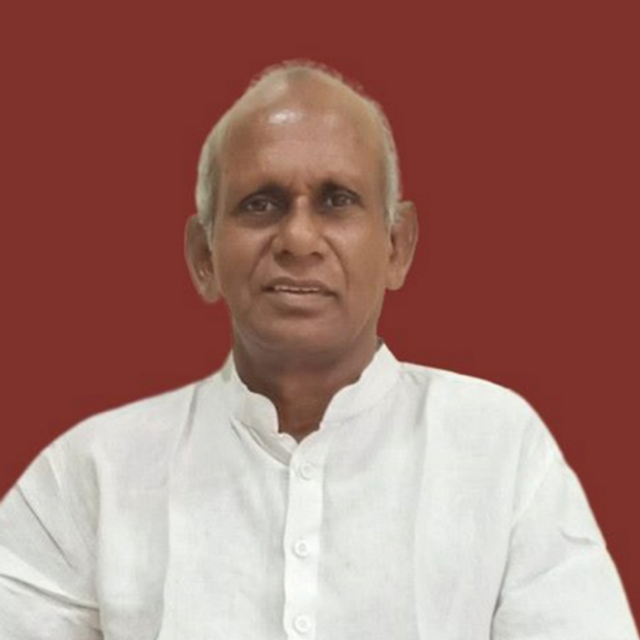 K. V. Raghupathi is a PhD holder in English Literature. He is a poet, short story writer, novelist, book reviewer and critic. He takes the readers on the spiritual exploration of radical philosophical thoughts which strongly speak through all the collections. He has taught at three different universities, S.V.University, Tirupati, Yogi Vemana University, Kadapa, and the last being Central University of Tamil Nadu, Thiruvarur before he had a quit to devote fulltime to writings. His other passions include classical Karnatic music and Yoga. He began writing seriously in 1985. Since then he has published twelve books in English Verse, two novels, two collections of short stories and four books on Yoga, besides edited seven critical works. His poems and short stories, besides scholarly papers have appeared in various newspapers like The Hindu and The Statesman. He is a recipient of several awards that include Michael Madhusudhan Dutt Award, Kolkata in 2001, H.D.Thoreau Fellowship, Dhvanyaloka, Mysore in 2000, the best chosen poet for 2003, Poetry Society of India, New Delhi Poetry Chain, Mumbai, Life Time Achievement Award, Chennai Poetry Circle, Chennai in 2010, and Rock Pebbles National Award for creativity, 2014, Bhubaneswar and Phrasal King Arbind Choudhary National Award for Poetry, Mahatama Gandhi Education and Welfare Society, Parbhani, Maharastra; and two awards in Yoga, Best Yogic Publication of the Year Award, 2018, and Lifetime Achievement Award in Yoga, 2018, New Delhi.
Download PDF file:
PAPER OF THE WEEK STAYS POSTED FOR 2 WEEKS BEFORE BEING ARCHIVED
Tags: Ahimsa, Einstein, Gandhi, God, History, India, Satyagraha, Truth
DISCLAIMER: The statements, views and opinions expressed in pieces republished here are solely those of the authors and do not necessarily represent those of TMS. In accordance with title 17 U.S.C. section 107, this material is distributed without profit to those who have expressed a prior interest in receiving the included information for research and educational purposes. TMS has no affiliation whatsoever with the originator of this article nor is TMS endorsed or sponsored by the originator. “GO TO ORIGINAL” links are provided as a convenience to our readers and allow for verification of authenticity. However, as originating pages are often updated by their originating host sites, the versions posted may not match the versions our readers view when clicking the “GO TO ORIGINAL” links. This site contains copyrighted material the use of which has not always been specifically authorized by the copyright owner. We are making such material available in our efforts to advance understanding of environmental, political, human rights, economic, democracy, scientific, and social justice issues, etc. We believe this constitutes a ‘fair use’ of any such copyrighted material as provided for in section 107 of the US Copyright Law. In accordance with Title 17 U.S.C. Section 107, the material on this site is distributed without profit to those who have expressed a prior interest in receiving the included information for research and educational purposes. For more information go to: http://www.law.cornell.edu/uscode/17/107.shtml. If you wish to use copyrighted material from this site for purposes of your own that go beyond ‘fair use’, you must obtain permission from the copyright owner.
Join the discussion!
We welcome debate and dissent, but personal — ad hominem — attacks (on authors, other users or any individual), abuse and defamatory language will not be tolerated. Nor will we tolerate attempts to deliberately disrupt discussions. We aim to maintain an inviting space to focus on intelligent interactions and debates.