
Brief, Arbitrary Abductions: A New Tool of Israeli Intimidation in Masafer Yatta
PALESTINE ISRAEL GAZA GENOCIDE, 20 Apr 2026
Basel Adra | +972 Magazine - TRANSCEND Media Service
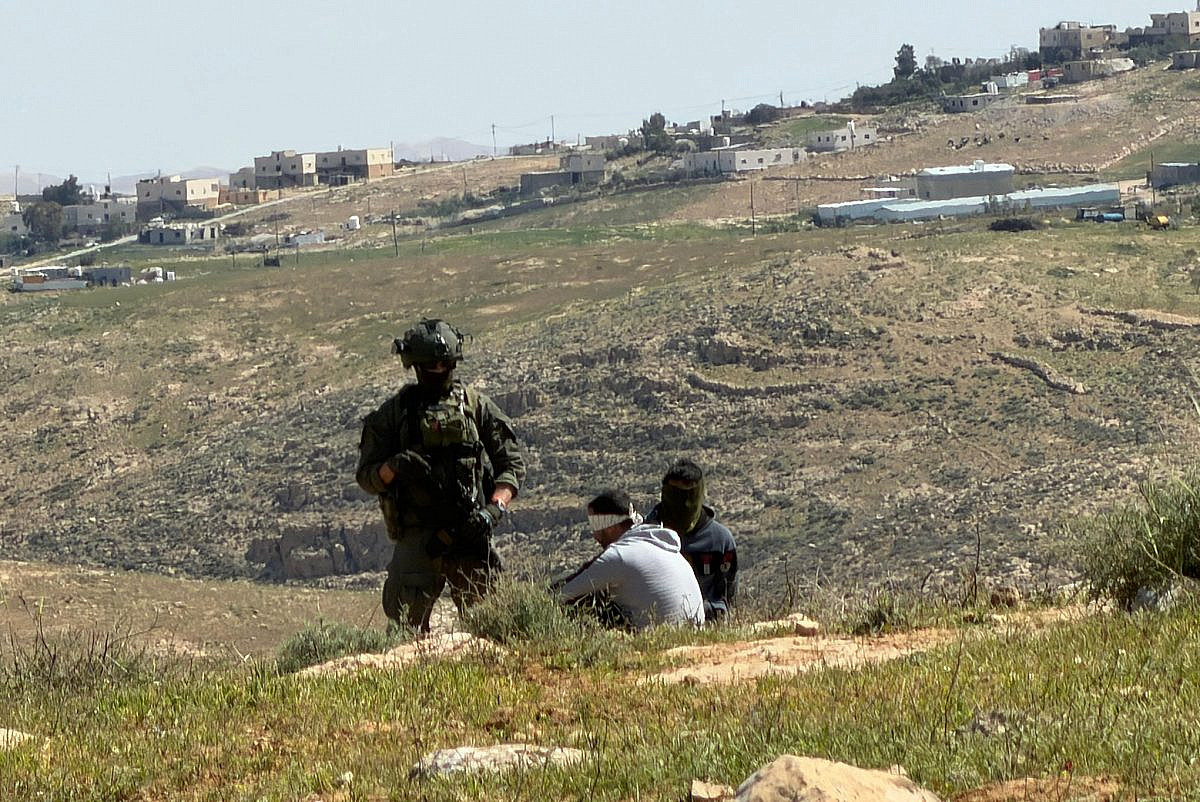
Israeli soldiers arrest Palestinian shepherds in the village of Rujum ‘Ulya, Masafer Yatta, West Bank, 25 Mar 2026. (Basel Adra)
In recent months, soldiers have arrested dozens of West Bank Palestinians — many blindfolded, beaten, and then released without explanation.
15 Apr 2026 – In the morning hours on March 25, Palestinian shepherds were grazing their flocks near their homes in Rujum ‘Ulya, a village in the Masafer Yatta region of the southern West Bank. Suddenly, a settler from Shorashim appeared — an illegal outpost three kilometers away — driving his ATV into the middle of the village.
In the occupied West Bank, this is no unfamiliar scene: settler harassment and violence against Palestinian farmers have been raging for years, and have only escalated in recent months. Many now avoid leaving their homes, let alone take their animals to graze their land. But on this day, Said Abu Aliyan and five other shepherds dared to go out with their sheep.
After the settler from Shorashim arrived, soldiers soon followed — many of whom are often settlers themselves, and enter Palestinian communities in full or partial military uniform regardless of whether they are on duty. When Abu Aliyan refused to leave the area as the soldiers demanded, an officer shoved him backwards and fired two shots into the air.
Soldiers began detonating stun grenades at the ten other shepherds and their sheep, but the Palestinians refused to retreat to their homes. The soldiers called for army and police backup, which arrived after a few minutes. Dozens of soldiers pushed the shepherds, detonating more stun grenades, firing tear gas, and marching behind every flock.
That morning, the army arrested eight shepherds, while injuring two other locals who required medical treatment. Soldiers tied the detainees’ wrists, blindfolded them, and led them to a military jeep, in full view of their families and young children.
One soldier conducted at least three arrests, then paused to photograph the crowd — images that would likely be integrated into Israel’s vast surveillance database. “The whole village came to cause trouble,” he said in Hebrew. Meanwhile, the settler watched from his nearby tractor, also taking photos of the Palestinians.
Soldiers are increasingly resorting to these arbitrary arrests, at times initiated by settlers’ presence on their land or false complaints. Even under the Israeli occupation’s discriminatory laws, there is no legal justification for these arrests; rather, they are simply a new tool to intimidate families across the West Bank.
“A particularly disturbing trend has intensified in recent months: soldiers simply taking Palestinians in what some would term abductions, which clearly constitute unlawful detentions,” The Human Rights Defenders Fund, a legal aid group, noted in a statement.
These arrests occur “without any involvement of law enforcement agencies, bypassing the legal procedures that normally require an arrest or detention to be reported to the police and the detainee brought to a police station,” the statement continued. “By taking Palestinians in this manner, soldiers and settlers can harass or abuse Palestinians without oversight.”
In the Rujum ‘Ulya area of Masafer Yatta, some 35 people have been arrested in this fashion over the past two months. The vast majority were detained by settlers wearing military-style uniforms, taken to nearby army bases rather than police stations, and held for hours — where they endured beatings and humiliation — before being released far from their homes.

After arresting the eight farmers on March 25, the army transferred them to the nearby military base on the outskirts of Susya. But it was only the first round of army abductions in Rujum ‘Ulya that day.
Around 1 p.m., Abu Aliyan, his brothers, and his son returned to graze their sheep near the area where the arrests took place. A settler from a nearby outpost soon approached on a motorcycle, determined to chase their sheep. As the shepherds stood in front of the bike to prevent the settler from advancing, the settler called an army patrol, which arrived a few minutes later to detain the shepherds, including Abu Aliyan and his son.
“I tried to explain to the soldier that this is our private land and we are allowed to be here with our sheep, but he did not respond and would not listen to anything we said,” Abu Aliyan said. “They handcuffed me and my son, blindfolded us, put us in a military jeep, and drove us to the army base in Susya.”
Abu Aliyan, his son, and the eight detainees from Rujum ‘Ulya were released that night in an unfamiliar area by the base. “They released us without our phones, so I walked back to the base to retrieve my phone,” he said. “The soldiers detained me for another two hours before returning my phone and my son Muhammad’s phone, and finally releasing us.”
This was the second time in a single month that Abu Aliyan was arbitrarily detained in this base. The previous incident occurred after he and another Palestinian farmer called the police to report that settlers in military uniform had stolen their donkey. To retaliate, the soldiers arrested them and held them in the Susya base for six hours.
‘We froze in fear’
In the afternoon of March 23, soldiers stormed the home of 61-year-old Adel Rashid in Imneizil, another village in Masafer Yatta. They claimed to be searching for Rashid’s son Omar, but only Rashid and his wife, daughter-in-law, and four grandchildren were home.
“The soldiers were throwing the household items onto the floor,” Sujood, Omar’s wife, told +972. “I gathered my four children — Layali, who is five, Wadie, three, Adel, two, and Mohammad, just five months old — and sat with them in a corner of the house.”

Offering no information about why they were looking for Omar, the soldiers eventually left the home. But just hours later, in the middle of the night, they returned. “Suddenly the door was opened, and flashlights were pointed directly at my face and my children’s faces — we froze in fear,” Sujood said. “They asked me about Omar. I told them he works in Bethlehem and stays there. One of the soldiers responded: ‘You are lying.’”
A soldier ordered Sujood to call her husband. After several failed attempts, Omar finally answered the phone. “The officer spoke to him and said: ‘You have 15 minutes. Either you come home, or we will take your wife until you do.’” Sujood was brought outside the house, while her children remained inside with her mother-in-law, crying in fear. “Wadie was crying and begging the soldiers, saying: ‘Don’t take my mother, leave her.”
Eventually, the soldiers told her in broken Arabic to get dressed, suggesting she would be arrested. “I was wearing my nightclothes, so I told him to leave the room so I could change,” she said. “They refused and stayed with me in the room. I was forced to remain in my nightclothes, and they arrested me like that — I was shivering from the cold.”
The soldiers proceeded to tie Rashid and Sujood’s hands tightly behind their back, blindfold them, and confiscate their phones. Once placed in the military car, Sujood remembers the soldiers calling them “terrorists” and “child-killers” as they headed towards a military base in Beit Yatir.
When they arrived, their phones were confiscated and they were put inside a trailer littered with cigarette butts, damp mattresses on the floor, and plastic ties used to bind detainees. “It smelled of dampness and filth. We were left there for long hours,” Sujood said.
“I was shaking from the cold because of my light clothing, and I vomited. I kept thinking about my children who were at home, afraid.” After spending more than 12 hours in the trailer, they were transferred to the police station in Kiryat Arba, a nearby settlement, where Sujood was interrogated by a female officer.
“I asked why I was there. She said I was accused of stealing sheep from a settler. I told them: “How could I steal sheep when I am a mother of four children and rarely leave my home?” The interrogation lasted for an hour, during which the officer yelled at her in Hebrew, despite the presence of an Arabic translator.
Afterward, Sujood was photographed, fingerprinted, and released at the gate of the settlement. It was getting dark, and she had no phone, money, or any way of finding a ride home. After walking through an unfamiliar area for 40 minutes, a passerby helped her contact her family, who rushed to pick her up. Adel, who was still blindfolded and handcuffed at the police station, was released about half an hour after Sujood.
Almost every Palestinian recently arrested in Masafer Yatta reports similarly distressing experiences, whether being beaten while in custody, having their phones confiscated, or being released faraway, with no means of getting home.
When he learned his father and wife were in custody, Omar went to the police station and tried to turn himself in for the unknown offense, hopeful that it would mean getting the two of them released. Yet the police officer returned his ID and told him he was not wanted, so he returned to Imneizil.
Shortly after arriving home, Omar received a phone call from a Shin Bet officer instructing him to go to the main entrance of the nearby town of Yatta. Knowing his father and wife were in danger of being re-arrested, Omar went as instructed and was arrested on the spot. To this day, he remains detained in an unknown location for allegedly “attacking a settler,” an accusation he denies.
In response to +972’s request for comment, the IDF Spokesperson stated: “The IDF’s mission in Judea and Samaria is to thwart terrorism in order to maintain the security of all residents of the region and enforce law and order in the area. When receiving a report of a clash, the role of IDF forces is to restore order in the area and, if necessary, detain the suspects involved in the clash until the arrival of the Israel Police forces. In many cases, after the detention, the suspects’ involvement in the incident and their details are examined. If there is no need to continue the detention, or transfer them for further processing by the Israel Police, the suspects are released.”
The Israeli Police did not respond to requests for comment.
________________________________________________
Basel Adra is an activist, journalist, and photographer from the village of At-Tuwani in the South Hebron Hills.
Tags: Anti Zionism, Collective Punishment, Colonialism, Colonization, Crimes against Humanity, Cultural violence, Direct violence, Ethnic Cleansing, Genocide, Israel, Israeli occupation, Palestine, Palestinian Holocaust, Sociocide, State Terrorism, Structural violence, USA, War crimes, West Bank
JOIN THE BDS-BOYCOTT, DIVESTMENT, SANCTIONS CAMPAIGN TO PROTEST THE ISRAELI BARBARIC GENOCIDE OF PALESTINIANS IN GAZA.
DON'T BUY PRODUCTS WHOSE BARCODE STARTS WITH 729, WHICH INDICATES THAT IT IS PRODUCED IN ISRAEL. DO YOUR PART! MAKE A DIFFERENCE!
7 2 9: BOYCOTT FOR JUSTICE!
DISCLAIMER: The statements, views and opinions expressed in pieces republished here are solely those of the authors and do not necessarily represent those of TMS. In accordance with title 17 U.S.C. section 107, this material is distributed without profit to those who have expressed a prior interest in receiving the included information for research and educational purposes. TMS has no affiliation whatsoever with the originator of this article nor is TMS endorsed or sponsored by the originator. “GO TO ORIGINAL” links are provided as a convenience to our readers and allow for verification of authenticity. However, as originating pages are often updated by their originating host sites, the versions posted may not match the versions our readers view when clicking the “GO TO ORIGINAL” links. This site contains copyrighted material the use of which has not always been specifically authorized by the copyright owner. We are making such material available in our efforts to advance understanding of environmental, political, human rights, economic, democracy, scientific, and social justice issues, etc. We believe this constitutes a ‘fair use’ of any such copyrighted material as provided for in section 107 of the US Copyright Law. In accordance with Title 17 U.S.C. Section 107, the material on this site is distributed without profit to those who have expressed a prior interest in receiving the included information for research and educational purposes. For more information go to: http://www.law.cornell.edu/uscode/17/107.shtml. If you wish to use copyrighted material from this site for purposes of your own that go beyond ‘fair use’, you must obtain permission from the copyright owner.
Join the discussion!
We welcome debate and dissent, but personal — ad hominem — attacks (on authors, other users or any individual), abuse and defamatory language will not be tolerated. Nor will we tolerate attempts to deliberately disrupt discussions. We aim to maintain an inviting space to focus on intelligent interactions and debates.
Read more
Click here to go to the current weekly digest or pick another article:
PALESTINE ISRAEL GAZA GENOCIDE: