
How 51 Countries Armed Israel During Gaza Genocide
EXPOSURES - EXPOSÉS, 1 Jun 2026
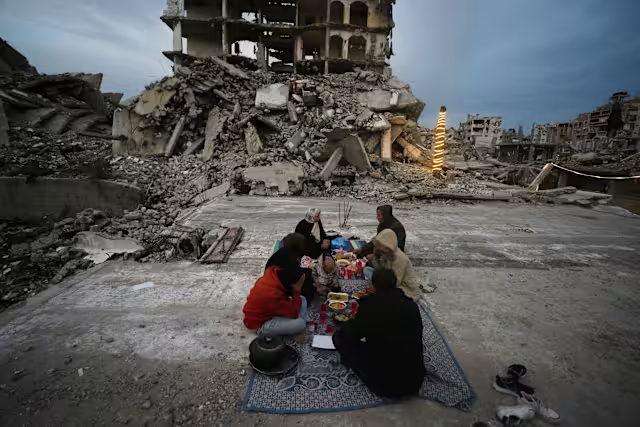
Members of the al-Najar family break their fast during the Muslim holy month of Ramadan amid the rubble of destroyed buildings in Gaza City, 13 Mar 2026. [Jehad Alshrafi/AP Photo]
Israel imported military-related goods from six European countries despite arms restrictions.
23 May 2026 – On a cold day in early January 2024, protesters gathered outside the International Court of Justice (ICJ) in The Hague to denounce Israel’s genocidal war on Gaza, then nearly 100 days old.
More than 3,000km (1,864 miles) away, some Palestinians in Gaza followed the proceedings, livestreamed on YouTube, but most were trying to survive Israel’s relentless bombardment.
In nearly eight decades of the Convention on the Prevention and Punishment of the Crime of Genocide, only a handful of cases had ever reached the court. That day, South Africa was asking the world’s highest court to consider whether Israel’s assault on Gaza constituted a genocide – the destruction, in whole or in part, of an ethnic, racial, religious or national group.
Inside the courtroom, Irish lawyer Blinne Ni Ghralaigh, who was representing South Africa, began to speak.
“The international community continues to fail the Palestinian people,” she told the judges, despite Israeli officials’ “dehumanising, genocidal rhetoric” matched by the military actions in Gaza.
“This is the first genocide in history, where its victims are broadcasting their own destruction in real time, in the desperate, so far vain, hope that the world might do something,” she said.
An average of 247 Palestinians were being killed every day, Ni Ghralaigh told the court; 48 mothers, two every hour; more than 117 children daily, five each hour.
She referred to the new acronym used among doctors and aid workers that had emerged from the devastation: WCNSF – wounded child, no surviving family. By that point, more than 7,000 Palestinians had been killed.
“These facts,” Ni Ghralaigh said, “could not present a clearer or more compelling case” for genocide.
On January 26, 2024, the ICJ ruled that there was a plausible risk of genocide in Gaza and ordered provisional measures. Crucially, it reminded all states party to the Genocide Convention, of which there are 153, of their obligations: to act to prevent genocide.
But over the next 22 months, the killing continued. By the time a ceasefire was reached in October 2025, more than 70,000 people had been killed, with some 171,000 injured.
Throughout that period, the weapons to Israel kept flowing.
Weapons exports
A months-long Al Jazeera investigation has found that military-related goods originating from at least 51 countries and self-governing territories continued entering Israel after the ICJ’s warning of a plausible risk of genocide in Gaza.
Based primarily on an analysis of Israeli Tax Authority (ITA) import data between 2022 and 2025, and supported by customs records and freedom of information requests, the investigation traced military supply chains linked to countries across Europe, Asia, North America and South America. All named countries are signatories to the Genocide Convention.
In some cases, the military-related goods originated from countries that had formally imposed arms embargoes on Israel or had partially suspended arms supplies to the country.
In fact, according to the ITA data, arms imports increased after the ICJ ruling, with the largest share falling under the category of munitions.
The five largest countries of origin for military-related goods entering Israel – the United States, India, Romania, Taiwan and the Czech Republic – all recorded increased shipments during the war.
While many countries included in this investigation do not share statistics on arms exports to Israel, the ITA data shows that 2,603 consignments of military-related goods – including imports labelled as goods related to ammunition, explosive munitions, weapons parts and armoured vehicle components – entered Israel between October 2023 and October 2025.
In total, the imports were valued at 3.22 billion shekels ($885.6m), with 91 percent of that value recorded after the ICJ’s ruling, according to the ITA data.
By comparison, in the 20 months before October 2023, military-related imports to Israel totalled 1.41 billion shekels ($388.1m). The data suggests Israel increased its dependence on foreign weapons supplies to help sustain its military offensive in Gaza.
Even after the latest ceasefire took effect on October 10, 2025, the flow of weapons did not stop. In the final two months of 2025, Israel received an additional 324.9 million shekels ($89.4m) in military-related imports, according to the ITA data.
TO READ FULL REPORT Go to Original – aljazeera.com
Tags: Collective Punishment, Crimes against Humanity, Cultural violence, Direct violence, Ethnic Cleansing, European Union, Gaza, Genocide, Hunger, Israel, Israeli occupation, Palestine, Palestinian Holocaust, Sociocide, State Terrorism, Structural violence, USA, War crimes, West Bank
DISCLAIMER: The statements, views and opinions expressed in pieces republished here are solely those of the authors and do not necessarily represent those of TMS. In accordance with title 17 U.S.C. section 107, this material is distributed without profit to those who have expressed a prior interest in receiving the included information for research and educational purposes. TMS has no affiliation whatsoever with the originator of this article nor is TMS endorsed or sponsored by the originator. “GO TO ORIGINAL” links are provided as a convenience to our readers and allow for verification of authenticity. However, as originating pages are often updated by their originating host sites, the versions posted may not match the versions our readers view when clicking the “GO TO ORIGINAL” links. This site contains copyrighted material the use of which has not always been specifically authorized by the copyright owner. We are making such material available in our efforts to advance understanding of environmental, political, human rights, economic, democracy, scientific, and social justice issues, etc. We believe this constitutes a ‘fair use’ of any such copyrighted material as provided for in section 107 of the US Copyright Law. In accordance with Title 17 U.S.C. Section 107, the material on this site is distributed without profit to those who have expressed a prior interest in receiving the included information for research and educational purposes. For more information go to: http://www.law.cornell.edu/uscode/17/107.shtml. If you wish to use copyrighted material from this site for purposes of your own that go beyond ‘fair use’, you must obtain permission from the copyright owner.
Join the discussion!
We welcome debate and dissent, but personal — ad hominem — attacks (on authors, other users or any individual), abuse and defamatory language will not be tolerated. Nor will we tolerate attempts to deliberately disrupt discussions. We aim to maintain an inviting space to focus on intelligent interactions and debates.
Read more
Click here to go to the current weekly digest or pick another article:
EXPOSURES - EXPOSÉS: