
Canada: How Louise Arbour Helped Shield Paul Kagame from Justice
AFRICA, 1 Jun 2026
Judi Rever | Canadian Dimension - TRANSCEND Media Service
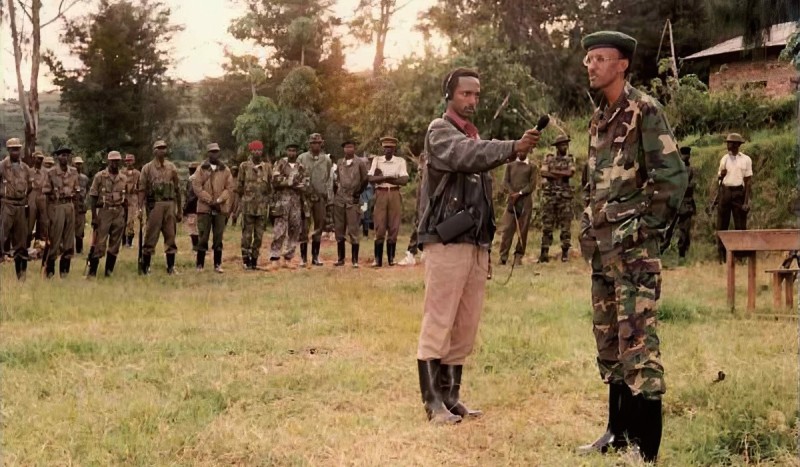
Paul Kagame with Rwandan Patriotic Front (RPF) troops in the 1990s.
Photo courtesy: Great Lakes Eye
Canada’s new governor general helped cement the impunity of Rwanda’s leader, one of the worst criminals in African history.
11 May 2026 – If power is measured by the capacity to influence outcomes, then Louise Arbour, Canada’s new choice for governor general, is one the most commanding figures in the annals of international (in)justice.
The fate of millions of people living in central Africa was directly impacted by a series of decisions that Arbour made nearly three decades ago as chief prosecutor at a United Nations tribunal that was set up to seek justice in Rwanda after the 1994 genocide.
Between 1996 and 1999, Arbour decided on how justice was carried out, who among the perpetrators of violence would be prosecuted at the International Criminal Tribunal for Rwanda (ICTR), and by extension, who would be granted judicial immunity.
Two men who were privy to Arbour’s discretionary power at the tribunal were Michael Hourigan, a former crown prosecutor from Australia, and Jim Lyons, a former FBI agent and specialist in counter terrorism. Lyons became a senior investigator at the ICTR, and worked in the same office with Hourigan for the tribunal. During Arbour’s tenure, Hourigan began collecting evidence on the event that triggered the Rwandan genocide: a missile attack on April 6, 1994 that shot down the plane carrying Rwanda’s Hutu President Juvenal Habyarimana, Burundi’s President Cyprien Ntaryamira, senior military and political officials close to the Rwandan leader, and three French crew members. All 12 people on board were killed.
By early 1997, after a year on the job, Hourigan had collected evidence about the missile attack from three former soldiers of the Rwandan Patriotic Front (RPF) who served under Paul Kagame, Rwanda’s current leader, who seized power in July 1994 amid the ashes of the genocide. Two of the soldiers said they had been part of a commando team that shot down the plane, and the third soldier said he had direct knowledge of the operation. Hourigan also obtained information from a UN peacekeeper who overheard a broadcast on the RPF’s shortwave radio, on the night of the plane attack, indicating that “the target” had been hit.
“What better way for Kagame to become a hero than to start the genocide himself by shooting down the plane and then marching into Kigali with his army and saving everybody,” Lyons told me in a lengthy interview, adding that Kagame had long been the “fair-haired boy of the US government and the Brits, trained by the CIA and MI6.”
Lyons was at the US embassy in Kigali with Hourigan when the Australian lawyer used an encrypted phone to call Judge Arbour, who was in The Hague at the time, to brief her on the investigation. Lyons heard Hourigan’s account to Arbour that day, in late February 1997. When Hourigan got off the phone, he said Arbour was very excited about the breakthrough and that she wanted Hourigan to come to The Hague to brief her in person. But when Hourigan arrived in the Netherlands, Arbour told him to shut down the investigation. He was astounded. She told him the court had no mandate to investigate the plane attack, and that it had no legal jurisdiction to proceed.
Hourigan rightly insisted that the assassination of Rwanda’s and Burundi’s presidents was a blatant act of terrorism and indeed within the UN tribunal’s mandate. Article 4 of the ICTR Statute specifically called for the court to investigate acts of terrorism.
Lyons told me that Arbour was rough with Hourigan in her exchange at The Hague and that she must have come under political pressure. “Someone gave her the order to shut down [the investigation],” Lyons said. Hourigan subsequently submitted an affidavit of his findings to the court, in addition to an internal memo for his colleagues. A few months later he resigned.
Before his death in 2013, Hourigan told Phil Taylor, the host of CIUT Radio in Toronto, that the miscarriage of justice at the ICTR left him bewildered and discouraged. “We didn’t discover the truth; we were actively thwarted and worked against. And now, years later, they’ve only prosecuted people they’ve been told to prosecute. You know, some of the main offenders for some of the biggest crimes have been left untouched. And all the while now, the European and North American powers are plundering that region’s resources, with millions still dying in Congo.”
We will likely never know why Arbour refused to investigate the catalyst that set off Rwanda’s mass killings, a catastrophe from which the region has never truly recovered. We will also likely never know whether she was pressured by a higher authority. Arbour declined my request for an interview to discuss her term at the ICTR and her exchanges with Hourigan.
But in an interview with the Globe and Mail in 2016, Arbour said she had concerns for the safety and security of ICTR witnesses, because the office of the prosecutor of the UN court was in Rwanda at the time. She said the court did not have the means or the know-how to gather evidence against the leadership in Rwanda. “That’s not, frankly, very do-able,” she lamented.
It seemed, therefore, that Arbour was admitting that she was unable to independently pursue the cause of justice, which in and of itself is a serious breach in international law and obligation.
The ICTR was legally bound to prosecute individuals responsible for serious violations of the Geneva Conventions, including heads of government or state, regardless of their official position. Their status, in other words, did not mitigate punishment under international law. Arbour knew this. In shutting down the investigation into the terrorist act that unleashed the Rwandan genocide, she granted Kagame and his senior entourage judicial immunity. The tribunal was also obliged to help restore peace and stability to Rwanda and the region. By every objective measure, it failed to do so.

Louise Arbour served as the chief prosecutor at a United Nations tribunal that was set up to seek justice in Rwanda after the 1994 genocide. Photo courtesy United Nations.
Not only did Kagame ignite genocide in Rwanda, but he continued to oversee mass killings in Rwanda during and after the genocide, before unleashing a war in neighbouring Congo that has raged for 30 years and left millions of people dead. There has been no greater source of menace on the African continent than Kagame and his imperialist sponsors in the West, namely the United States.
Not only did Arbour’s decision change the human rights landscape in central Africa, but it set the stage for legal compromise and historical erasure.
Carla Del Ponte, who succeeded Arbour as chief prosecutor of the ICTR, oversaw the Special Investigations Unit, which discreetly collected evidence of crimes committed by Kagame and his senior commanders. The unit’s investigators found prima facie evidence that Kagame’s army had brought missiles from Uganda into Rwanda prior to the genocide, had trained a commando team to fire the missiles, and was responsible for the assassinations. Tutsi soldiers who had broken with Kagame’s regime also provided evidence that Kagame’s army had committed mass atrocities against Hutu civilians and had infiltrated Hutu militias and killed Tutsi civilians, thereby potentiating the genocide against Tutsis.
Del Ponte proceeded to draw up a list of targets for indictments, including one against Kagame himself, but she was unceremoniously fired from the tribunal before the indictments were issued. In 2003, just as Del Ponte was given her marching orders, the US ambassador for war crimes, Pierre Prosper, brokered an illegal deal which transferred the jurisdiction for prosecuting RPF crimes from the UN tribunal to Rwandan courts, allowing the killers to prosecute themselves. The ICTR had therefore officially granted Kagame legal immunity from war crimes and terrorism. Prosper would later become Kagame’s personal litigator in the United States (the ICTR ultimately indicted 95 individuals and convicted 62, all of whom were linked to the former Hutu regime in Rwanda).
A senior ICTR prosecutor told me that the court’s refusal to investigate the plane attack and indict Kagame and his commanders for the crimes they committed in 1994 amounted to a “malicious conspiracy”—in other words, a cover-up.
“The RPF shot that plane down,” said the prosecutor, who asked not to be named and, like Arbour, went on to have an illustrious career in international law. “Everybody now knows that. And everybody knew it at the time. There was an abundance of evidence that should have been available under the right circumstances to prosecute the crimes committed by the RPF. The reason they were not available is because the command-and-control relationship of the RPF put Paul Kagame in direct authority over any of those acts that would have been committed. So therefore, Paul Kagame would have been the ultimate indictee,” he stated.
Similarly, because Kagame is the West’s favourite warlord, he has been shielded from prosecution at the International Criminal Court, which should have indicted him for invading Congo and committing atrocities there.
What does this say about the state of international justice if someone with so much blood on their hands has been able to dodge the law for 30 years while simultaneously jet setting and hobnobbing with the global elite?
As I argue in my latest book, Rwanda’s 30-Year Assault on Congo: The Crimes, the Criminals and the Cover-Up, judicial malfeasance has denied Kagame’s victims the dignity of telling their stories and preserving memory for a future generation. Courts do not simply interpret and apply laws; they create history. Lawyers and judges select and frame evidence and create historical narratives. The courts, in particular the ICTR, has ensured Kagame’s moral invincibility, gaslighted his victims, and allowed him to pour gallons of blood onto central Africa.
Arbour is not alone in protecting Kagame. She is among a group of powerful people who have rationalized Kagame’s violence, who have buried, denied, or dismissed the evidence against him and ultimately distorted history. In her new, ceremonial job representing Canada’s head of state, it is doubtful that Arbour will be taken to task on any of this. But for the millions of Kagame’s victims in Rwanda and Congo, her record is a deeply painful one, and will be remembered forever.
________________________________________________
Judi Rever is a journalist from Montréal and is the author of In Praise of Blood: The Crimes of the Rwandan Patriotic Front and Rwanda’ 30-Year Assault on Congo: The Crimes, the Criminals, and the Cover-Up.
Go to Original – canadiandimension.com
Tags: Africa, Canada, Justice, Paul Kagame, Rwanda
DISCLAIMER: The statements, views and opinions expressed in pieces republished here are solely those of the authors and do not necessarily represent those of TMS. In accordance with title 17 U.S.C. section 107, this material is distributed without profit to those who have expressed a prior interest in receiving the included information for research and educational purposes. TMS has no affiliation whatsoever with the originator of this article nor is TMS endorsed or sponsored by the originator. “GO TO ORIGINAL” links are provided as a convenience to our readers and allow for verification of authenticity. However, as originating pages are often updated by their originating host sites, the versions posted may not match the versions our readers view when clicking the “GO TO ORIGINAL” links. This site contains copyrighted material the use of which has not always been specifically authorized by the copyright owner. We are making such material available in our efforts to advance understanding of environmental, political, human rights, economic, democracy, scientific, and social justice issues, etc. We believe this constitutes a ‘fair use’ of any such copyrighted material as provided for in section 107 of the US Copyright Law. In accordance with Title 17 U.S.C. Section 107, the material on this site is distributed without profit to those who have expressed a prior interest in receiving the included information for research and educational purposes. For more information go to: http://www.law.cornell.edu/uscode/17/107.shtml. If you wish to use copyrighted material from this site for purposes of your own that go beyond ‘fair use’, you must obtain permission from the copyright owner.
Join the discussion!
We welcome debate and dissent, but personal — ad hominem — attacks (on authors, other users or any individual), abuse and defamatory language will not be tolerated. Nor will we tolerate attempts to deliberately disrupt discussions. We aim to maintain an inviting space to focus on intelligent interactions and debates.