
Stratagems for Change: Saving Humanity from Ourselves
CONFLICT RESOLUTION - MEDIATION, 1 Jun 2026
Ivana Nikolić Hughes, Ph.D. | Nuclear Age Peace Foundation – TRANSCEND Media Service
29 May 2026 – We are living in a challenging time with far too much suffering, stemming from a variety of ailments, including armed conflict, poverty, and ecological destruction. The symptoms of our dysfunctional world are many, the causes few, and yet complex, intricate, and hard to elucidate in simple terms. It’s easy to blame one individual, but of course the problems we face predate him and his rise to power, even if he has made so many of our problems more acute. It’s also easy to blame one state that has acted as a hegemon for far too long, but of course, others have contributed as willing and active participants, often even leading the calls for war, whether in Ukraine or West Asia or elsewhere.
Amidst all this suffering lies an existential threat to humanity – the possibility that human civilization could end as a result of nuclear war, which would not only kill hundreds of millions of people, but cause environmental changes to the planet that put the very survival of human beings and other life forms into question. Albeit operating on a different time scale, global warming also has the potential to fundamentally disrupt life as we know it on our beautiful planet. Continued greenhouse gas emissions and consequent increases in temperature will not only threaten inhabited areas with consequences of wildfires, droughts, and heightened impacts of storms, but may make entire regions uninhabitable due to sea level rise, unlivable temperatures, or collapse of ecosystems. In both cases we are quite literally playing with fire.
How did we get to such a place? How is it that we have made ourselves completely and inexplicably vulnerable to total and utter destruction? That the existence of nuclear weapons – the most monstrous weapons of mass destruction – continues to threaten the very existence of humanity is a never-ending source of incredulity for all those who understand just what is at stake in a world in which nuclear war could begin and end in mere minutes, not hours, or days, or weeks. That global warming continues apace, while the merits of the scientific evidence explaining and demonstrating the human role in the warming continue to be debated as if there were anything reasonable to debate at all, is yet another conundrum.
I’m not a historian or a policy analyst or a spiritual leader, so I will not attempt to explain the role of the empire, or the moneyed interests, or evil in how we arrived at this place. What I do want to highlight is that regardless of the root cause, the reason that we are here, living under the cloud of the existential threats of nuclear war and global warming, is that those behind denying these threats – whoever they are and for whatever reason they do this – have managed to convince even many well-meaning people, let alone the non-well-meaning ones, that nuclear weapons keep us safe and that the science of global warming is not settled. Until these notions are challenged, rejected, and eradicated broadly, comprehensively, and forcefully by the media, by so-called leaders, by academics, by ordinary people, it will not be possible to pull away from the brink. We cannot operate from alternative facts. We cannot discount science and history. Continuing on this path, we will find ourselves in a place far worse than where we are today. Or as John F. Kennedy said in October of 1962 during the Cuban Missile Crisis, “If we…do what they want us to do, none of us will be alive later to tell them that they were wrong.”
So what can be done to steer this ship around?
Consider the Pale Blue Dot, a photograph taken of the Earth in 1990, by the Voyager 1 spacecraft, from six billion kilometers away, far beyond the neighborhood of Neptune. In the words of Carl Sagan, who originally proposed that such a photograph be taken, “That’s here. That’s home. That’s us. On it, everyone you ever heard of, every human being who ever lived, lived out their lives.” Sagan went on to say, “To my mind, there is perhaps no better demonstration of the folly of human conceits than this distant image of our tiny world. To me, it underscores our responsibility to deal more kindly and compassionately with one another, and to preserve and cherish that pale blue dot, the only home we’ve ever known.”
Sagan reminds us of a responsibility to:
- (a) deal more kindly and compassionately with one another, and
- (b) to preserve and cherish our planet Earth.
I read these words as a rallying cry for three things:
- peace,
- nuclear disarmament, and
- climate action.
All three arguably fall under each of Sagan’s two calls.
In aggregate, the answer is education and far greater public awareness of both the problems and the solutions. Here are some specific thoughts on each of the three issues in turn:
(1) Regarding peace, we need a radically different kind of geopolitics and international relations. Radically different means only in practice, because of course, we don’t actually have to invent anything new here – we already have a United Nations (UN) Charter that spells out how nations are to deal with one another, how they are to solve disputes peacefully, and how they are to collaborate with one another in addressing global challenges, while also promoting human rights, social progress, and better living standards. We need not create something new, but we do have to return to the commitments that each UN Member State is already obligated to follow not just as a matter of international law, but as a matter of national laws. To give the example of the US, the UN Charter is an international treaty that the US is a part of, and as such, according to the US Constitution, it is the supreme law of the land.
(2) Regarding nuclear disarmament, the starting point needs to be widespread acceptance that nuclear weapons are a threat and not a solution; acceptance that in fact, so long as we have them, they will continue to threaten humanity’s very survival. Nuclear war today would lead to nuclear winter, ozone layer destruction, and global spread of radiation, in addition to hundreds of millions of deaths from the nuclear attacks themselves.
Dealing with this problem would also involve earnestly following existing international law in the form of the Treaty on the Non-Proliferation of Nuclear Weapons (NPT). According to this treaty, the five nuclear weapons states (NWS): the US, Russia, UK, France, and China, are obligated to negotiate in good faith towards not just nuclear disarmament, but total and complete disarmament. More than 55 years after the treaty entered into force, the NWS have demonstrably not met these obligations. Over the past month, the states parties to the treaty held the 11th Review Conference at the United Nations Headquarters in New York. But instead of agreeing to recommit to the treaty and its obligations, most particularly the disarmament obligations of Article VI, the parties failed to adopt even the most basic outcome document signaling agreement on the future of the NPT. This was a huge missed opportunity.
Previous times of crises during the Cold War in particular, led to important international and bilateral agreements between states in the case of the former, and the US and the Soviet Union in the case of the latter. The failure of the NPT to deliver a decisive response to the current challenges facing our world is a significant blow. Meanwhile, the much more recent Treaty on the Prohibition of Nuclear Weapons (TPNW), through which the states that do not possess nuclear weapons, primarily from the Global South, have decided to take matter into their own hands, remains a bright light in a very dark world. In fact, the TPNW offers a new framework for pressure on the NWS to recommit and actually meet their NPT obligations both from the international community and from inside the NWS themselves.
Another piece of good news is that nuclear disarmament is not a technical problem, but rather a political one. If states, most particularly the nine nuclear armed states, agree to eliminate their arsenals, we actually know how to achieve that goal. What we need is the political will to realize a world free of nuclear weapons. The implementation will follow.
(3) On climate, we have two things that need to be accomplished – one is the political agreement, and the second is implementation. Despite what you might read from dubious sources, reductions and elimination of greenhouse gas emissions can in fact help save the world from catastrophe on the global scale. This is not an insoluble problem. For example, solar energy reaching the Earth is more than 8000 times greater than our current total global energy use.
In April, I participated in Climate Games organized by Prof. Jeffrey Sachs at Columbia University. This was a simulation of negotiations between nine nations and regions of the world, represented by groups of students. The games demonstrated that agreement between the major players, although difficult to achieve, is possible. In the real world, China is actually showing the way forward in its planned, comprehensive, and overwhelming turn towards renewable energy and electrification.
It is worth emphasizing that peace, nuclear disarmament and climate action are not separate issues, as described here, but they are actually deeply intertwined. To state the obvious, the wars in the West Asia and Ukraine increase the risk of nuclear war and contribute to climate change simultaneously. And yet, the connections run deeper still. If progress on nuclear disarmament were achieved, it might provide a template for greater cooperation on addressing global warming, and vice versa. On the other hand, if climate issues were addressed appropriately, they could reduce the risk of more wars and even nuclear war. Greater cooperation in one domain could only help to address the others, as well as to address other important threats, including AI and pandemics.
If we go back to Sagan’s rallying cry:
“to preserve and cherish that pale blue dot, the only home we’ve ever known,”
we don’t have a choice but to do everything we can to achieve peace, nuclear disarmament, and climate action.
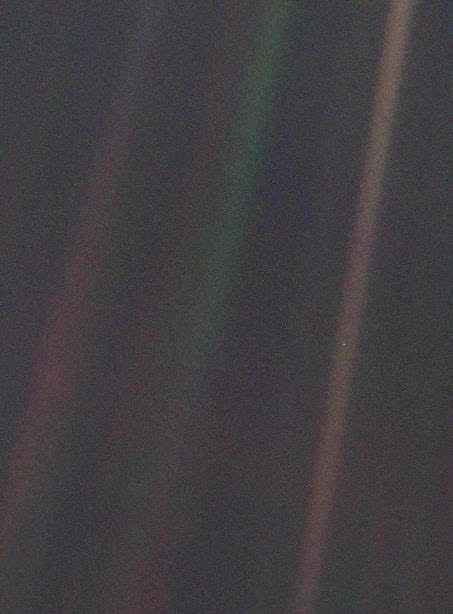
Earth, the “Pale Blue Dot.” Photograph captured by the Voyager-1 in 1990 from Saturn [right, slightly below the center]. (NASA/JPL)
 Ivana Nikolić Hughes, Ph.D. is president of the Nuclear Age Peace Foundation, a senior lecturer in Chemistry at Columbia University, and a member of the Scientific Advisory Group to the Treaty on the Prohibition of Nuclear Weapons. Her writing has appeared in TRANSCEND Media Service, The Hill, The Nation, Bulletin of the Atomic Scientists, Scientific American, Truthout, Common Dreams, The Diplomat, and elsewhere. wagingpeace.org
A version of these remarks was delivered at a webinar entitled “Stratagems for Change,” organized by Rajani Kanth, and held on April 25, 2026. The video can be found HERE.
Tags: Conflict Analysis, Crisis, Solutions, World
This article originally appeared on Transcend Media Service (TMS) on 1 Jun 2026.
Anticopyright: Editorials and articles originated on TMS may be freely reprinted, disseminated, translated and used as background material, provided an acknowledgement and link to the source, TMS: Stratagems for Change: Saving Humanity from Ourselves, is included. Thank you.
If you enjoyed this article, please donate to TMS to join the growing list of TMS Supporters.

This work is licensed under a CC BY-NC 4.0 License.
Join the discussion!
We welcome debate and dissent, but personal — ad hominem — attacks (on authors, other users or any individual), abuse and defamatory language will not be tolerated. Nor will we tolerate attempts to deliberately disrupt discussions. We aim to maintain an inviting space to focus on intelligent interactions and debates.
Read more
Click here to go to the current weekly digest or pick another article:
CONFLICT RESOLUTION - MEDIATION: