
Green Dashboard
ENVIRONMENT, 29 Jun 2026
Pang Xiao and Liu Kan | China Daily Global - TRANSCEND Media Service
WANG XIAOYING/CHINA DAILY
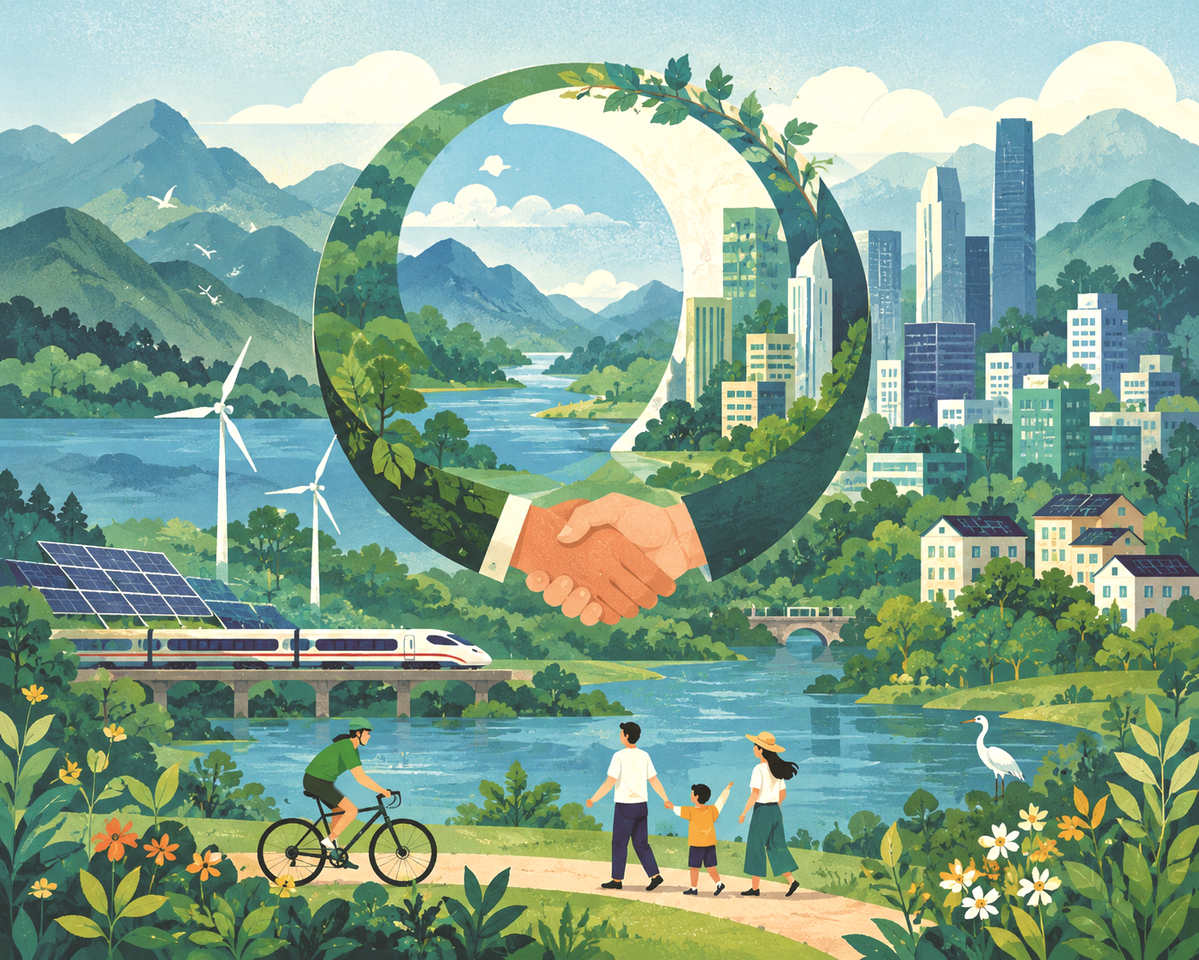
China is placing environmental conservation at the heart of its modernization drive with practical governance measures.
4 Jun 2026 – In 2013, President Xi Jinping proposed a fundamental shift in mindset: no longer judging performance solely by GDP growth rate, and placing ecological environment at the forefront of the evaluation system for economic and social development. The philosophical shift was encapsulated in the famous phrases “lucid waters and lush mountains are invaluable assets” and “green is gold”.
In the past decade, particularly the 14th Five-Year Plan (2021-2025) period, this philosophy delivered tangible results. During this period, China’s GDP grew at an average annual rate of 5.4 percent, while its carbon dioxide emissions intensity continued to decline.
Recently, the Chinese government issued two assessment measures to evaluate the performance of local governments in terms of their carbon peaking and neutrality efforts and the measures they are taking to realize a Beautiful China. These represent further progress in China’s green journey by establishing a concrete governance mechanism for green development.
Since its inception in the last century by economist Simon Kuznets, GDP has become the most widely used metric for measuring national economic development. However, Kuznets himself once stated that the welfare of a nation cannot be inferred from the measurement of national income. In recent years, the deficiencies of the GDP metric became increasingly apparent. In some countries, behind the rising GDP, public dissatisfaction has also been increasing. Efforts have been made to address GDP’s flaws with the introduction of concepts such as GEP (gross ecosystem product).
Now, the world is witnessing a megatrend to move beyond GDP. The High-Level Expert Group on Beyond GDP, launched by United Nations Secretary-General Antonio Guterres, released a landmark report in May titled “Counting What Counts: A Compass of Progress for People and Planet”. The report proposes a dashboard-style indicator system comprising four pillars — foundational principles, current well-being, equity and inclusion, and sustainability and resilience — containing 31 specific indicators, including environmental and climate metrics such as total and per capita greenhouse gas emissions, and a biodiversity intactness index.
Notably, China’s two assessment measures not only resonate with the “Beyond GDP” concept and indicators, but take them a step further by making them a governance compass for action.
The assessment of progress toward achieving the dual carbon goals uses indicators such as total carbon emissions, emissions intensity and total coal and petroleum consumption at the provincial level for the first time, which has already drawn significant international attention. The assessment on actions to realize the Beautiful China Initiative is directly linked to the annual performance evaluation, rewards, punishments and appointments of local officials, and also serves as a reference for allocating government fiscal funds related to ecological environmental protection.
While the UN’s Beyond GDP indicators act as a macro-value compass for orientation, China’s two assessment measures operate as practical policy tools.
First, both the UN’s Beyond GDP indicators and China’s two assessment measures are highly aligned. The assessment measures, as two of the latest policy tools of China’s journey toward green development, provide a robust empirical support for the UN’s latest global indicator system, offering crucial practical experience and references for future implementation of the “Beyond GDP” concept, and for shaping the post-2030 global sustainable development agenda.
Second, China is demonstrating how to achieve a “closed-loop” governance system for “Beyond GDP”. The Chinese practice shows that moving beyond GDP does not remain merely at the statistical level; it can form a policy loop with binding force and incentive mechanisms at the national level. In China’s governance practice, establishing new assessment indicators for stakeholders in related areas provides effective policy guidance for actions in a local context.
Finally, it’s noteworthy that the Environmental Kuznets Curve, named after the founder of GDP, is a highly relevant concept for those who study Chinese environmental policies closely. It suggests that as economic levels rise, some nations’ environmental quality deteriorates before improving — a pattern often referred to in Chinese context as the “Western development model of polluting first, cleaning up later”. In this context, the two measures explain the uniqueness of China’s pathway. On the one hand, China faces dual pressures from both climate change and environmental pollution in a short period, which is significantly different from the experience of the West, which was to address pollution and climate issues separately over a much longer time frame. On the other hand, it reflects China’s opposition to passively waiting for the turning point of the Environmental Kuznets Curve. Instead, China advocates synergistic advancement: cutting carbon emissions, reducing pollution, expanding green development and pursuing economic growth simultaneously. By proactively supporting green and low-carbon industries, China is attempting to seize the opportunity of the new technological revolution to spur its green development. For example, electric vehicles, lithium-ion batteries and photovoltaic products witnessed a surge in export value in 2025, which, according to China’s General Administration of Customs, approached 1.3 trillion yuan ($191.6 billion), an increase of 350 percent compared with 2020.
Overall, China is proactively advancing green technology to support its high-quality development through robust ecological and environmental protection, serving as a positive example for other countries in the Global South. And this can also be a realistic pathway to realize the philosophy of “Beyond GDP”.
_______________________________________________
Pang Xiao is an associate senior specialist at the Secretariat of the China Council for International Cooperation on Environment and Development.
Liu Kan is the director of the Secretariat of the China Council for International Cooperation on Environment and Development.
The authors contributed this article to China Watch, a think tank powered by China Daily. The views do not necessarily reflect those of China Daily.
Go to Original – chinadaily.com
Tags: China, Ecology, Environment, Green Economy
DISCLAIMER: The statements, views and opinions expressed in pieces republished here are solely those of the authors and do not necessarily represent those of TMS. In accordance with title 17 U.S.C. section 107, this material is distributed without profit to those who have expressed a prior interest in receiving the included information for research and educational purposes. TMS has no affiliation whatsoever with the originator of this article nor is TMS endorsed or sponsored by the originator. “GO TO ORIGINAL” links are provided as a convenience to our readers and allow for verification of authenticity. However, as originating pages are often updated by their originating host sites, the versions posted may not match the versions our readers view when clicking the “GO TO ORIGINAL” links. This site contains copyrighted material the use of which has not always been specifically authorized by the copyright owner. We are making such material available in our efforts to advance understanding of environmental, political, human rights, economic, democracy, scientific, and social justice issues, etc. We believe this constitutes a ‘fair use’ of any such copyrighted material as provided for in section 107 of the US Copyright Law. In accordance with Title 17 U.S.C. Section 107, the material on this site is distributed without profit to those who have expressed a prior interest in receiving the included information for research and educational purposes. For more information go to: http://www.law.cornell.edu/uscode/17/107.shtml. If you wish to use copyrighted material from this site for purposes of your own that go beyond ‘fair use’, you must obtain permission from the copyright owner.
Join the discussion!
We welcome debate and dissent, but personal — ad hominem — attacks (on authors, other users or any individual), abuse and defamatory language will not be tolerated. Nor will we tolerate attempts to deliberately disrupt discussions. We aim to maintain an inviting space to focus on intelligent interactions and debates.