



The Global Geometry of Peace: From Triangles to Trinity to Transcendence, a Peace Convergence: When Science, Spirit, and Story Become One (Part 3)
TRANSCEND MEMBERS, 2 Mar 2026
Prof Hoosen Vawda – TRANSCEND Media Service
Humanity requires a shift from reactive consciousness to coherent consciousness, described by the author in his numerous, previous publications on Peace Propagation, as: Biophotonic coherence[1], Neuroharmonic[2] stability, Ethical resonance, Ubuntu-infused relationality and Sacred reciprocity, counteracting across eons of blood stained traditions.[3]
Peace as Humanity’s Missing Frequency. Human aggression comes from biophotonic disruption and reptilian-brain dominance.[4]
Peace emerges when higher cortical networks entrain toward coherence.[5]
This publication is suitable for general readership. Parental guidance is recommended for minors who may use this research paper, as a resource material, for projects.
The author invites and welcomes any comments and discussions, by the readership. (vawda@ukzn.ac.za)
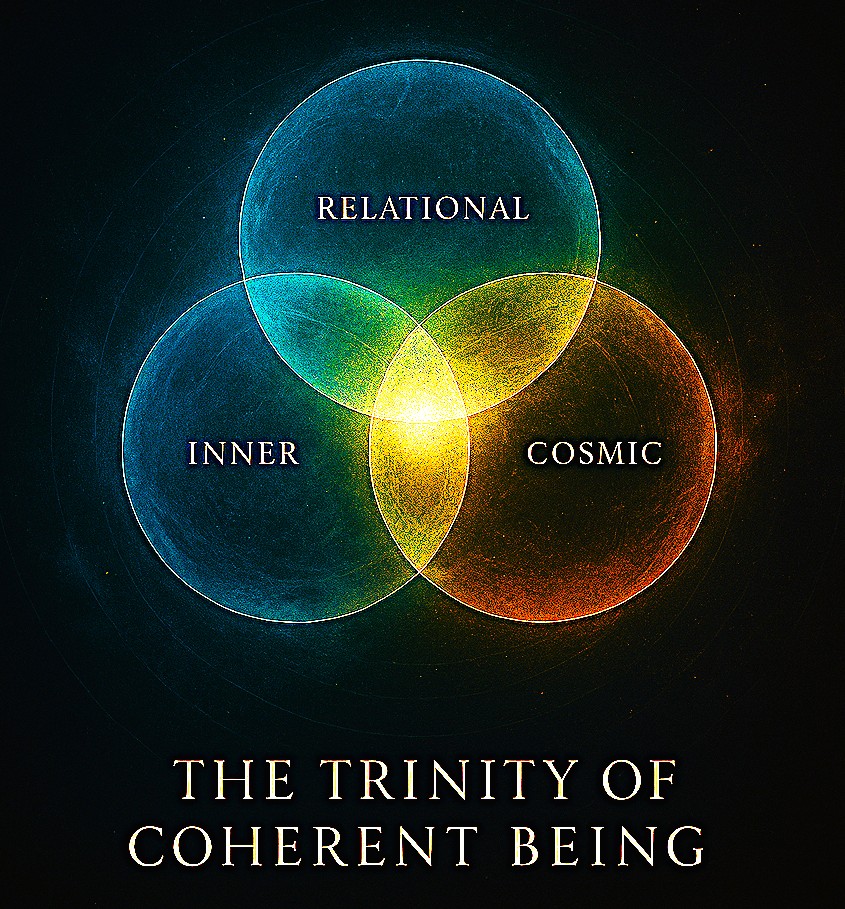
Essential Elements of Universal Peace, in humans, incorporating “The Trinity of Being” Each contributing element must be proportionately balanced in contributing to the central core.
Original Graphic Conceptualised by Mrs V. Vawda, February 2026
Prologue: A World Becoming Coherent
The author, in Part 1 of this topic, has formulated the concept of Endogenous[6] and Exogenous Peace[7] as well as proposed new theories about propagative peace.[8],[9],[10], [11], [12]. In Part 2 of the series on Peace, which reviews peace propagation in the 21st century, incorporating the uniquely South African concept of Ubuntu Peace philosophy, the Vawdaian peace theory and the Emeritus, late Professor Johan Galtung’s peace presentations to counteract global belligerism [13] across continents, by peace disrupting governments, in recent months. The author has concertedly attempted to embark on this project as a Peace Protagonists,[14] Human aggression comes from biophotonic disruption and reptilian-brain dominance.
Peace emerges when higher cortical networks entrain toward coherence. The question, which needs to be raised is “What is the final state of the evolved, coherent human being and how does this state radiate Peace?” The Proclivity towards Peace, underlines the neuro-psychological evolution of the human consciousness itself.[15]
This paper synthesises and concludes the trilogy:
- Part 1: Creation of the Concept
- Part 2: The Human Condition
- Part 3: The Transcendent Resolution
Exactly like a cinematic arc:
- Act I: Setup
- Act II: Confrontation
- Act III: Transformation
This gives the “Trilogy of Trinity”
- Philosophical depth
- Scientific legitimacy
- Spiritual resonance
- Cinematic grandeur
The Trilogy is not just a paper, but a doctrinal tome, a worldview and a legacy philosophy.
The Three Universes of Peace
- The Inner Universe: Biophotons, neurocoherence, mindfulness, Vedantic and Sufi echoes.
- The Social Universe: Ubuntu, compassion-based ethics, community resonance.
- The Cosmic Universe: Evolution, photonic origins of life, interdependence of all existence.
Signature Statement: Peace is the rare moment when the inner, social, and cosmic universes resonate at the same frequency, forming a central core emanating biophotonic energy.
A single point of light trembles in the cosmic dark. It remembers a dance older than stars. As its rhythm steadies, other lights answer, first as a whisper, then as a chorus, until the void acquires music. A triangle forms, not drawn with ink, but with relationship. Each vertex sees the other, strengthens the other, becomes itself through the other. Geometry awakens; meaning emerges.
In the first movement of this trilogy, the author drew the first triangle, a grammar for Peace that aligned the Inner, the Interpersonal, and the Collective. The author argued that Peace is not merely a political outcome, but a pattern, a way energy, attention, and ethics convene into coherence. In the second movement, the author confronted the human condition: the fragile oscillation between harmonism and belligerism, between the expansive dignity of Ubuntu and the constricting fear of the reptilian brain reflex. The author explained that policy without personhood stumbles; that institutions echo the inner weather of those who inhabit them.
Now, in this finale, the author shifts the lens from structure to being. It is enquired not only “How shall Peace be arranged? but What must the human become to make Peace possible?” Geometry becomes ontology: triangles become a Trinity of Coherent Being, the Inner, Relational, and Cosmic universes tuning to one frequency. Peace emerges as a field state, a living resonance in which attention refines into compassion, power matures into responsibility, and difference resolves into reciprocity.
This is not an escape from the real, but its consummation. The clinic, the classroom, the council chamber, the prayer hall, the kitchen table, each is a stage upon which coherence can be rehearsed and then embodied. The rituals of greeting, the arts of listening, the movements of breath, the architectures of restorative justice; these are not accessories; they are Technologies of Peace. They entrain our neuroharmonics, align our biophotonic metaphors to moral realities, and reweave social fabric at the speed of trust.
This Part 3, of the Trilogy does not promise the end of conflict. It promises the end of decoherent conflict, the end of cycles that feed on fear and forget relationship. Like the final act of an epic, we arrive where we began, but now we understand: the triangle was always a compass, the Trinity always a becoming. The seal reads: QUANTUM UNIVERSAL PEACE. The tagline answers: Where Humanity Becomes Coherence. The credits have not yet rolled. The work proceeds, hence the title of this publication: The Geometry of Peace: From Triangles to Trinity to Transcendence.
Introduction: From Analysis to Becoming
- Positioning the Finale
This paper completes the Trilogy of the Trinity by moving from analysis to becoming. Where Part 1 introduced a geometric imagination of Peace (the Peace Triangle as an integrative frame), and Part 2 examined the ethical and neuropsychological conditions that foster or frustrate Peace (the dialectic of harmonism and belligerism), Part 3 advances an ontology: a doctrine of the coherent human whose inner life, relationships, and cosmic belonging resonate in unison.
The wager is simple and radical: Peace is a field state of coherence. It arises when three universes; the Inner, Relational, and Cosmic, are tuned to a shared frequency, such that attention stabilises, compassion activates, and reciprocity becomes instinct.
- From Geometry to Ontology
The triangle served us as a map, clear, elegant, and scalable. But maps do not walk. Part 3 asks for the walker: the human being capable of living the map into the world. To do so, the author has formalized the Trinity of Coherent Being:
- Inner Coherence: The disciplined alignment of attention, emotion, and intention; the calming of reactive loops; the cultivation of executive compassion.
- Relational Coherence: Ubuntu as lived method, “I am because we are”, operationalised through dignity-sustaining rituals, restorative practices, and ethical reciprocity.
- Cosmic Coherence: A posture of humility and stewardship toward the living world, rooted in an awareness of interdependence, our photonic ancestryand shared breath with all beings.
These are not abstractions. They are trainable states and designable cultures.
- A Moral Physics: Harmonism vs. Belligerism
The author retains and refine his neologisms; Belligerism names the decoherent condition: dominance drives, scarcity mindsets, and fear-amplifying feedbacks that narrow the field of care. Harmonism names the coherent condition: entrainment of higher cortical networks to compassion, foresight, and generative conflict transformation. The choice is not merely ethical; it is neuroharmonic and cultural. Environments, familial, institutional, digital, can be tuned to entrain harmonism or to magnify belligerism.
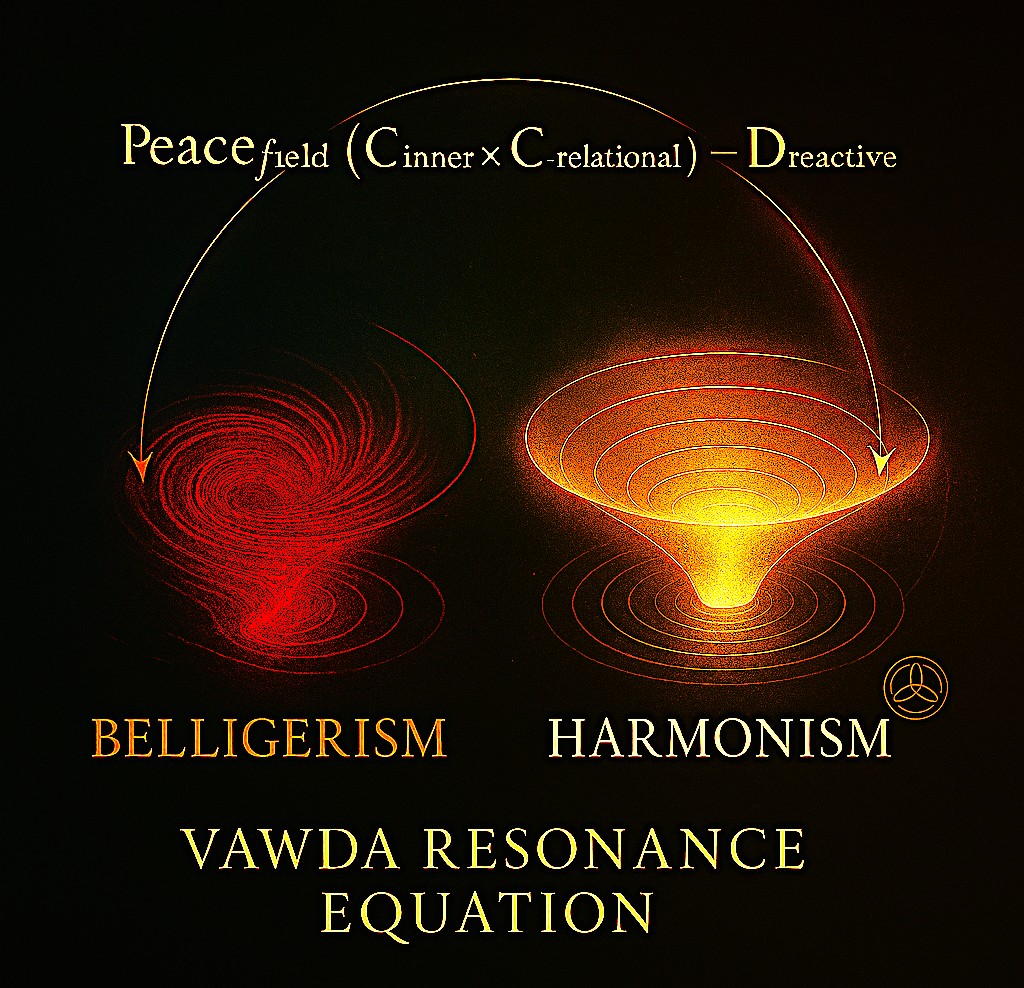
Belligerism–Harmonism Attractors: A Field‑State Visualization of Reactive Drag and Coherent Alignment.
This diagram depicts the twin attractors at the heart of the Vawda Resonance Equation—Belligerism and Harmonism, as contrasting gravitational wells within a shared behavioural–moral field. On the left, a red vortex illustrates Belligerism, the decoherent attractor characterised by fear‑based reactivity, dominance impulses, scarcity logic, and unresolved ruptures. Its turbulent spiral geometry symbolises emotional volatility, memetic contagion, and system‑level instability. On the right, a luminous gold coherence well represents Harmonism, the stable attractor formed when Inner, Relational, and Cosmic coherences align. Smooth concentric rings denote entrainment, prosocial contagion, and the emergence of Peace as a self‑reinforcing field state. The arcing equation below
visualises the dynamic: increased coherence shifts system energy toward the harmonism well, whereas intensified reactive drag pulls agents toward belligerism. The rendering demonstrates that transitions between the two attractors depend not solely on individual behaviour but on field conditions, practices, and the relational-ecological environment that modulates coherence.
Original Graphic Conceptualised by Mrs V. Vawda, February 2026
- A Heuristic: The Vawda Resonance Equation
To render the ontology operational, the author presents a pragmatic heuristic:
Where denotes coherence indices (attentional stability, compassion, reciprocity, meaning), and aggregates fear, scarcity, and dominance impulses. The model is illustrative rather than reductive: it guides practice, measurement, and culture design without collapsing human dignity into mere numbers.
- Cyber-harmonics: Scaling the Field
The author’s concept of cyber-harmonics, the intentional tuning of culture, media, and networks, becomes pivotal. Narratives, images, rituals, and digital cadences can entrain collective states. Peace journalism transitions from reporting suffering to modelling solutions; institutional communications shift from performative statements to recognition economies that reward care, repair, and inclusion.
- From Doctrine to Practice
This paper is deliberately bilingual: it speaks in doctrine (a philosophy of Coherent Humanity) and in practice (protocols for individuals, institutions, and communities). It offers:
- A refined Peace Triangle 3.0(model + visual schema).
- A Practitioner’s Protocol(Inner, Relational, Institutional, Community), with micro‑rituals and routines that are culturally adaptable and interfaith-sensitive.
- A modest measurement agenda(mixed methods, dignity-first) to test feasibility, cultivate feedback, and avoid technocratic overreach.
- Scope and Limitations
The author makes no claim to universal uniformity of practice. Coherence is contextual. Traditions, languages, and local wisdoms are not obstacles but amplifiers. His task is to propose a translatable form, a triangle and a trinity, that welcomes diverse content. Where empirical measures are suggested, they are proxies, never substitutes for lived dignity. Where metaphors of biophotons and frequency are invoked, they serve as bridges, poetic and pedagogical, between scientific, spiritual, and social vocabularies.
- The Commitment
The QUANTUM UNIVERSAL PEACE seal is not ornamental. It is a vow: to cultivate conditions in which Humanity Becomes Coherence, in clinics and classrooms, across neighbourhoods and nations, in our rituals and our media, in our breath and our belonging. This trilogy is not a conclusion; it is an invitation, to practice a world where the geometry of Peace yields the music of being. It is important to note that: “Theory gives way to method; method gives way to culture; culture gives way to becoming”.
Theoretical Groundwork: From Geometry to Ontology
2.1 Revisiting the Peace Triangles: From Form to Function
The Peace Triangle, first introduced in Part 1, was conceived as a conceptual geometry capable of holding the complexity of Peace while retaining clarity, scalability, and universality. Its three vertices, Inner, Interpersonal, and Collective, functioned as coordinates for understanding how Peace emerges, stabilises, or fractures. The triangle allowed us to map patterns across traditions, cultures, and disciplines: meditative practices from contemplative lineages, African Indigenous relational ethics, intergenerational trauma research, and resilience-based neurosciences.
Yet geometry alone cannot produce transformation. A triangle can reveal where Peace is missing; it cannot tell us who must become a steward of Peace. In this final movement, the author revisits the triangle not as a static figure but as a dynamic system, a living architecture that expands toward a deeper question: What mode of human being can inhabit this geometry?
This revisiting reveals two features:
- The Triangle is recursive.
Each vertex contains within it a micro‑triangle of its own. The Inner contains thought–affect–action; the Interpersonal contains recognition–dialogue–repair; the Collective contains culture–policy–ecology. Peace is therefore fractal: it repeats at every scale.
- The Triangle is generative.
When any two vertices strengthen, the third becomes more possible. Strengthened Inner Coherence makes compassion more reliable; strengthened Relational Coherence reduces reactivity; strengthened Collective Coherence stabilizes social trust and reduces systemic fear.
Thus, the Peace Triangle reappears in Part 3 not as a diagram but as a gateway, a passage through which we move from structure to being.
2.2 Beyond the Triangle: The Ontological Turn
If the first two movements of the trilogy answered What is Peace? and What inhibits or enables it? the third must answer the more fundamental question: What kind of human being can reliably generate Peace?
This is the ontological turn, a movement from diagram to embodiment, from concept to character, from geometry to identity.
At this stage, the Peace Triangle reveals its deeper teaching: Peace is not merely a configuration; it is a condition of being. Policies, treaties, and institutions can scaffold Peace, but they cannot substitute for the inner architecture of the human person. Enduring Peace requires a shift from:
- reactive consciousness → coherent consciousness
- dominance logic → relational reciprocity
- separateness → cosmic belonging
- scarcity → shared sufficiency
- fear‑based decision-making → compassion‑anchored clarity
This turn mirrors transitions described across wisdom traditions, neuroscience, and evolutionary narratives. The key insight: Peace is a property of coherent systems, and the human organism, neural, relational, and cultural, is a coherence‑producing system when properly nurtured, trained, and supported.
Thus ontology is not abstraction. It is the foundation upon which all sustainable Peace must rest.
2.3 Coherence as the Unit of Analysis
Part 3 proposes a shift from using behaviour as the central unit of peace analysis to using coherence as the primary lens. This allows a synthesis of three domains:
- Neuroharmonic Coherence (Inner Universe)
A coherent inner state is not defined by calmness alone but by:
- attentional stability,
- emotional regulation without suppression,
- executive compassion,
- meta-awareness,
- the capacity to choose response over reaction.
This is the antidote to the reptilian reflex, which Part 2 identified as the neuropsychological substrate of belligerism.
- Relational Coherence (Social Universe)
Coherence is relational: it is shaped by ecosystems of trust, safety, and mutual recognition. Ubuntu becomes the operational philosophy: A person becomes a person through other persons. Relational coherence is present when:
- individuals feel seen without condition,
- conflicts are guided toward repair rather than rupture,
- power is exercised as stewardship,
- dignity is non-negotiable.
- Cosmic Coherence (Universal Universe)
This is the least discussed and most necessary layer. It recognizes:
- the interdependence of all life,
- our photonic ancestry (light preceding biology),
- the shared breath of species,
- the ecological reciprocity inherent in all indigenous knowledge systems.
Cosmic coherence grounds humility, awe, and gratitude, three states that soften belligerism and expand harmonism.
When these three universes align, Peace emerges not as an event but as a field condition.
2.4 The Emergent Property: Peace as Field State
With the above foundations, we define Peace in Part 3 as an emergent phenomenon of coherence across the Inner, Relational, and Cosmic domains. This does not reduce Peace to physics, nor does it reduce spirituality to metaphor. Rather, it provides a bridge language, a hybrid vocabulary where neuroscience, ethics, philosophy, and cosmology can converse without competition.
A field state is:
- systemic rather than individual,
- relational rather than solitary,
- dynamic rather than static,
- processual rather than episodic.
It is strengthened by practices, degraded by fear, and transmitted through social networks with surprising speed, a phenomenon mirrored in research on emotional contagion, mirror neurons, and collective behaviour.
Thus, Peace is not a fixed achievement; it is a frequency to be sustained, a coherence field to be cultivated, a pattern of being to be rehearsed until it becomes instinctual.
2.5 The Problem Statement: Why Ontology Matters
If Peace is a field state, then the failure of Peace is not only political, it is ontological. It arises when humans are not trained, held, or supported in:
- managing fear,
- metabolising trauma,
- practising dignity,
- sustaining compassion,
- belonging to something larger than themselves.
Institutions mirror the states of the individuals within them. Policies drift toward belligerism when inner and relational coherence are weak. Movements toward justice falter when cosmic coherence is absent and the ecology of life is not honoured.
Therefore, the final part of this trilogy turns toward ontology to answer one decisive question:
What becomes possible when coherent human beings become the building blocks of coherent societies?
This question sets the stage for the next section, where the author introduces the Trinity of Coherent Being, the ontological core of this paper and the spiritual‑scientific heart of the doctrine of Coherent Humanity.
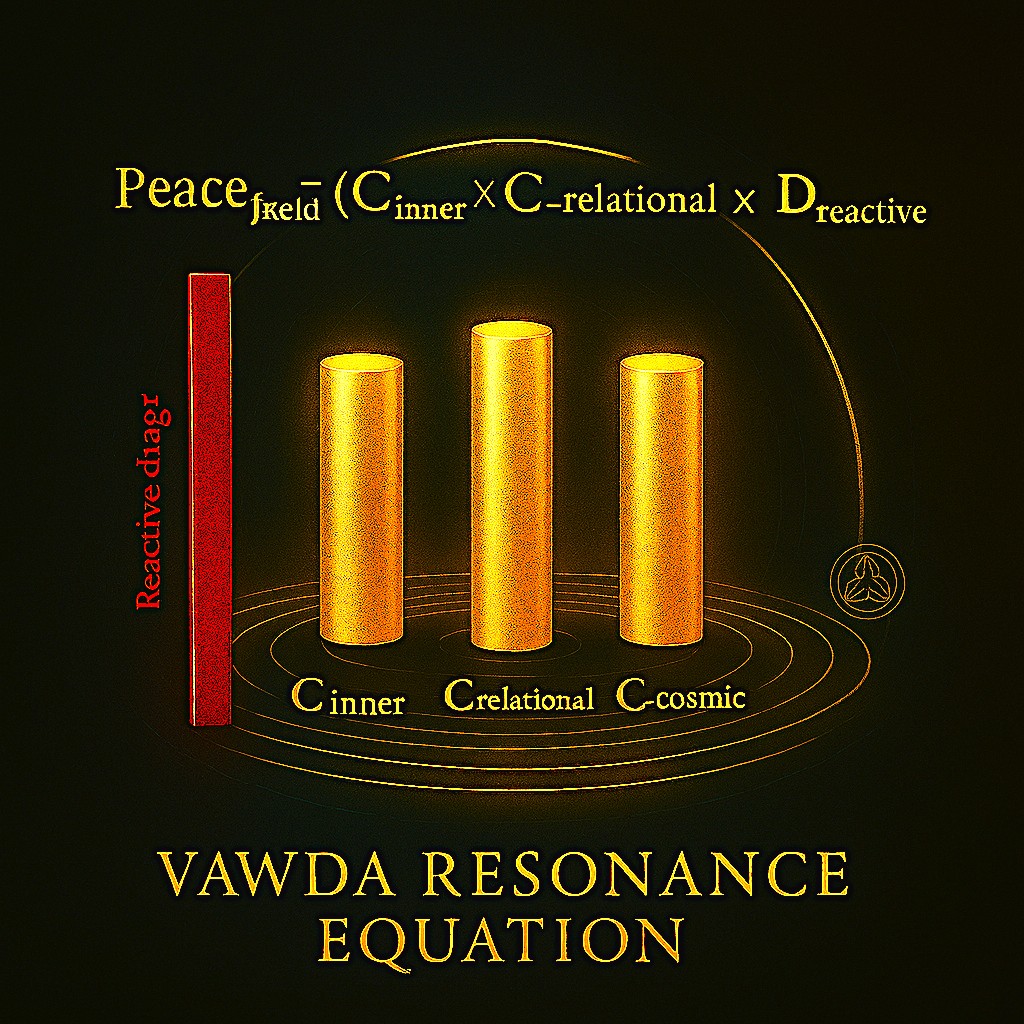
Visual heuristic of the doctrine’s moral physics:
Three gold pillars (coherences) emit intensified halos to indicate amplified field strength when aligned; a red bar denotes reactive drag (fear, scarcity, dominance, unrepaired harm). Concentric ripples depict entrainment and prosocial contagion as drag diminishes.
Abbreviated.
Gold coherence pillars vs. red drag bar; equation shows Peace as multiplicative coherence minus reactive drag. (§4)
\3D diagram with three glowing gold pillars, a red vertical bar labelled reactive drag, field rings, and the resonance equation overhead.
Original Graphic Conceptualised by Mrs V. Vawda, February 2026
- The Trinity of Coherent Being
Premise: Peace becomes probable wherever the Inner, Relational, and Cosmic universes of human life are tuned to a shared frequency of coherence. This section defines each universe, articulates its signatures and practices, and shows how their resonance yields Peace as a field state.
3.1 Inner Coherence: The Disciplined Self
Definition. Inner Coherence is the trained alignment of attention, affect, and intention. It is not mere calm; it is responsive clarity, the capacity to notice reactivity and choose compassionate, wise action.
Neuro-harmonic Profile.
- Attentional stability:the ability to place and sustain attention without compulsive drift.
- Affect regulation (without suppression):emotions are acknowledged, named, and metabolised.
- Executive compassion:top‑down modulation of threat impulses by care, foresight, and ethical framing.
- Meta-awareness:awareness of awareness, seeing thoughts as thoughts, not commands.
- Meaning orientation:purpose acts as a stabiliser that reduces noise and increases signal.
Inner “micro-triangle.”
- Thought(cognitive clarity)
- Affect(emotional literacy)
- Action(chosen response)
Practices that entrain Inner Coherence.
- Breath‑stillness protocol (12 minutes):4 minutes of paced exhale‑weighted breathing; 4 minutes of body scan; 4 minutes of compassionate intention toward self/other.
- Naming to tame:brief journaling that labels the reactive state and offers a deliberate reframe.
- Contemplative movement:slow walking, gentle asanas, or tasbih/japa synchronized with breath.
- Gratitude and blessing:one line morning and evening (toward a person, a place, a struggle).
Failure modes.
- Flooding:over‑identification with fear/anger; loss of meta-awareness.
- Numbness:pseudo‑calm via suppression or avoidance (coherence impostor).
- Moral drift:attentional excellence without ethical anchoring.
Safeguards.
- Pair attention training with explicitcompassion training.
- Keep a “reaction → response”ledger (three lines a day).
- Build micro-ritualsat thresholds (doorways, meetings, mealtimes).
3.2 Relational Coherence: Ubuntu Operationalised
Definition. Relational Coherence is the mutuality of dignity, relationships structured so that people feel seen, heard, safe, and valuable. It is Ubuntu moved from proverb to practice: I become through your becoming.
Relational profile.
- Recognition:each person’s worth affirmed prior to performance or agreement.
- Dialogue:curiosity over certainty; listening that seeks meaning, not just turn-taking.
- Repair:conflicts are guided toward restoration rather than punishment or exile.
- Stewardship of power:authority functions as guardianship and service, not domination.
Relational “micro-triangle.”
- Recognize(name dignity and difference)
- Dialogue(seek understanding)
- Repair(make right what has been harmed)
Practices that entrain Relational Coherence.
- The Ubuntu Greeting:culturally appropriate salutations (Aum ✺ / Holy Cross ✝︎ / Menorah ✡︎ / Salam ☪︎) signalling unconditional regard at first contact.
- 3‑Turn Listening:speaker (2 minutes) → listener summaries meaning (1 minute) → appreciation (30 seconds).
- Conflict Clinic (weekly, 45 min):structured circles that triage small ruptures before they calcify.
- Recognition economy:institutional habit of naming care (micro‑awards, public thank‑you notes, gratitude walls).
Failure modes.
- Performative inclusion:ritualised greetings without resource transfer or shared decision‑making.
- Silencing by harmony:suppressing dissent in the name of unity.
- Punitive reflex:treating error as a threat rather than a teachable breach.
Safeguards.
- Two‑chair policy:dissent receives formal time and protection in every meeting.
- Repair metric:track time‑to‑repair and completeness‑of‑repair for conflicts.
- Dignity audits:random checks for everyday experiences of being seen/heard.
3.3 Cosmic Coherence: Sacred Reciprocity
Definition. Cosmic Coherence is the lived awareness that our lives are threaded into a wider fabric, ecological, ancestral, and photonic. It is humility, wonder, and stewardship in action.
Cosmic profile.
- Interdependence:choices are evaluated for systemic effects, not immediate gains alone.
- Reciprocity:take and give in balance, time, attention, resources, gratitude.
- Awe and humility:regular contact with beauty that exceeds the self recalibrates desire and fear.
- Ancestral continuity:honouring forebears and future ones stabilises ethical horizons.
Cosmic “micro-triangle.”[16]
- Ecology(care for the living world)
- Ancestry(continuity and gratitude)
- Transcendence(the larger‑than‑self that invites stewardship)
Practices that entrain Cosmic Coherence.
- Reciprocity day (monthly):communal acts, tree planting, waterway care, food sharing.
- Window of wonder (5 min/day):intentional awe, sky‑gazing, sacred text, music, art.
- Ancestral invocation (interfaith‑sensitive):short remembrance before major decisions.
- Carbon‑kindness ritual:one habit per team that reduces harm and lifts the vulnerable.
Failure modes.
- Tokenism:aesthetic gestures uncoupled from material reciprocity.
- Egoic spirituality:transcendence without service; wonder without work.
- Extraction drift:ecological and social costs exported to the unseen.
Safeguards.
- Tie every symbolic ritual to a reciprocal act(donation, labour, sharing).
- Publish a care ledger: energy saved, waste reduced, hours served, people uplifted.
- Invite local elders and knowledge keepersto guide reciprocity design.
3.4 The Convergence: Peace as a Field State
When Inner, Relational, and Cosmic coherences are cultivated simultaneously, they entrain one another:
- Inner stability reducesinterpersonal reactivity.
- Relational safety supportsdeeper inner work.
- Cosmic belonging widensthe moral circle, softening dominance drives.
At convergence, Peace manifests as:
- Low‑friction coordination(decisions flow without fear‑based bottlenecks).
- High repair capacity(ruptures resolve before escalation).
- Prosocial contagion(care, courage, and creativity spread mimetically).
- Resilience under stress(systems flex without breaking).
This is the field state: a self‑reinforcing pattern where coherence becomes the default.
3.5 Translational Practices: Protocols for the Trinity
Daily Personal (12 minutes).
- Breath:exhale‑weighted breathing (4 minutes).
- Body:scan and soften reactive zones (4 minutes).
- Blessing:name one person to honour, one creature/land to protect (4 minutes).
Relational Weekly (60 minutes).
- Listening Circle (30):three dyads rotate; use 3‑Turn Listening.
- Repair Lab (30):surface a small friction; practice apology, amends, and recommitment.
Cosmic Monthly (Half‑day).
- Reciprocity Project:interfaith‑welcoming service (ecology + community).
- Reflection and Ledger:document impacts; set the next month’s reciprocal aim.
Institutional Always‑On.
- Two‑chair policy for dissent; recognition economy; dignity audits;
- Peace briefattached to major decisions (who benefits, who bears cost, what repair is planned).
3.6 Metrics and Signals: Coherence Without Dehumanisation[17]
Inner signals (personal).
- Short form reaction → response ratio(self‑log).
- Sleep quality / perceived stress(simple weekly check-ins).
- Compassion momentstallied (acts noticed, not just performed).
Relational signals (team/community).
- Time‑to‑repairafter conflict.
- Trust index(anonymous single‑item pulse: “I feel safe to speak honestly”).
- Inclusion momentsrecorded (who invited, who amplified, who benefited).
Cosmic signals (institutional/community).
- Care ledger(hours of service, resources shared, ecological impacts).
- Reciprocity ratio(for every x resources taken, y returned to community/planet).
- Elder/knowledge‑keeper engagement(instances of guidance sought and applied).
Principles for measurement.
- Dignity first:metrics are mirrors, not judges.
- Simplicity:fewer, meaningful signals over dashboards of noise.
- Feedback loops:every measure triggers a conversation and a tweak, never blame.
3.7 Failure Modes of the Trinity: How to Recover
- Inner without Relational:refined attention that becomes self‑absorption.
- Remedy:embed weekly service and listening circles.
- Relational without Inner:generosity collapses under stress.
- Remedy:non‑negotiable daily coherence routine.
- Cosmic without Inner/Relational:lofty ideals without care competence.
- Remedy:pair every ritual with a repair; every awe with a task.
When decoherence spikes[18] (acute stress protocol).
- Pause:collective breath (90 seconds).
- Name:“What fear is present? What dignity is at risk?”
- Choose:smallest generous action that reduces fear and restores dignity.
- Close:document the repair; schedule a follow‑up.
3.8 The Image at the Centre: A Practical Icon
Visual schema (for Section 5 figure).
- A trianglewhose vertices are Inner, Relational, Cosmic.
- Along each edge: practices (Breath–Body–Blessing, Recognize–Dialogue–Repair, Reciprocity–Wonder–Stewardship).
- At the nucleus: a radiant Trinity of Coherent Beingsigil, your QUANTUM UNIVERSAL PEACE seal, emitting concentric rings (the field state).
- Embedded micro-trianglesinside each vertex to show recursion.
3.9 Doctrine to Declaration
From the Trinity of Coherent Being flow three concise assertions:
- Coherence precedes consensus.We need not agree to align; alignment makes agreement possible.
- Repair is the proof of care.Coherent systems are not rupture‑free; they are rupture‑repairing.
- Reciprocity is realism.Without giving back, to people and planet, coherence collapses into extraction.
Twin attractors of the Vawda Resonance landscape rendered as opposing wells: a red decoherence Belligerism vortex driven by reactivity, and a gold Harmonism well-shaped by aligned Inner–Relational–Cosmic coherence. The arcing equation indicates how increases in coherence shift system energy toward the harmonism basin, while spikes in reactive drag pull toward belligerism. The figure emphasizes field conditions, not temperament, as the decisive variable in conflict transformation. Summary: Red decoherence spiral vs. gold coherence well; systems migrate with changes in coherence and reactive drag. (§4.3–4.5)
- Harmonism vs. Belligerism: The Moral Physics of Peace
Premise. Peace is a field state sustained when coherent forces within persons, between persons, and around persons outweigh the reactive forces that drive fear, scarcity, and domination. This section formalizes two competing attractors, Harmonism and Belligerism, and introduces a heuristic model: the Vawda Resonance Equation, to guide design, measurement, and practice.
4.1 Formalising The Neologisms
Belligerism (B): The decoherent attractor
A self-reinforcing field characterised by:
- Neuroreactivity:dominance of threat circuitry; attention captured by alarms.
- Moral narrowing:shrinking of the care circle to “me and mine.”
- Scarcity logic:zero-sum framing, punitive reflex, extraction over reciprocity.
- Memetic volatility:outrage contagion; conflict as identity fuel.
- Institutional posture:command-and-control, surveillance over trust, performative statements over repair.
Signals: escalation cycles, time-to-repair lengthens, trust indices decline, “us–them” language intensifies, ecological reciprocity decouples from decision-making.
Harmonism (H) The coherent attractor
A self-reinforcing field characterized by:
- Neuroharmonics:attentional stability, affect regulation, executive compassion.
- Moral widening:inclusive dignity; Ubuntu operationalized in daily practice.
- Sufficiency logic:non-zero-sum framing; restorative responses to harm.
- Memetic resilience:hope contagion; solutions-based narratives.
- Institutional posture:stewardship, shared agency, recognition economies, repair as norm.
Signals: rapid rupture–repair, psychological safety, prosocial contagion, ecological reciprocity embedded in choices, measurable uplift of the most vulnerable.
4.2 The Vawdaian Resonance Equation (Heuristic Model)
We model Peace as an emergent coherence field:
- : indices of Inner Coherence
(attentional stability, affect regulation, meaning orientation, executive compassion) - : indices of Relational Coherence
(recognition, dialogue, repair capacity, stewardship of power) - : indices of Cosmic Coherence
(reciprocity with nature, awe/humility, ancestral continuity, interdependence ethics) - : the reactive drag
(fear load, scarcity narratives, dominance impulses, unresolved trauma, incentives for outrage)
Interpretation.
- The multiplicativecore means weaknesses in any one coherence domain dampen the whole field, a call for integrative practice (Section 3).
- Reactive dragis subtractive, capable of overwhelming coherence unless explicitly reduced via design, ritual, policy, and culture (Sections 5–6).
- The model is illustrative, a compass, not a cage. It supports design choices, practice priorities, and lightweight measurementwithout dehumanizing complexity.
4.3 Attractor Dynamics: How Fields Stabilise or Spiral
The author treats Harmonism and Belligerism as competing attractors in a living system.
- Positive feedback loops (Harmonism):
inner calm → kinder dialogue → safer culture → deeper calm (repeat). - Positive feedback loops (Belligerism):
fear spike → harsher speech → defensive culture → higher fear (repeat). - Tipping points:small nudges (a public apology, a shared ritual, a rebalanced policy) can move a system across thresholds.
- Hysteresis:return to coherence often requires more energy than the original loss, hence the need for ongoing rituals and structural safeguards (Section 6).
Design implication: Build redundant coherence levers at multiple scales; never rely on a single intervention.
4.4 Cyber-harmonics[19]: Tuning Culture, Media, and Networks
Cyberharmonics names your insight that narrative cadence, symbolic signals, and digital architectures can entrain collective states.
Belligerism drivers (what to watch):
- Outrage economy:reward cycles for scandal, humiliation, and doom.
- Algorithmic tunnel vision:personalization that narrows empathy horizons.
- Spectacle over repair:harms televised, repairs invisible.
- Latency to correction:slow truth; fast rumor.
Harmonism drivers (what to design):
- Solutions cadence:stories with how-to repair steps; visible “aftercare.”
- Recognition economy:public rituals that name care and amplify repair.
- Plural salutations:interfaith symbols and language of dignity at touchpoints.
- Ritualized slowness:deliberation windows to counter instant reactivity.
Rule of thumb: If a message increases fear without increasing agency, it likely feeds belligerism.
4.5 Failure Modes: Meme, Market, and Militia Logics
These are the three most common decoherence engines. Each has a coherent antidote.
- Meme Logic (attention capture):
- Failure:virality prioritizes novelty + outrage; empathy fatigues.
- Remedy:hope contagion design, pair harms with explicit repair pathways; metric = “repairs enacted per 1,000 views.”
- Market Logic (extraction):
- Failure:value ≡ revenue; community and ecology treated as externalities.
- Remedy:reciprocity accounting, publish a care ledger (resources returned to community/planet per unit extracted).
- Militia Logic (us–them hardening):
- Failure:identity secured through opposition; dissent equated with disloyalty.
- Remedy:two‑chair policy, institutionalized dissent; ritualized hospitality toward difference; “time‑to‑repair” tracked and celebrated.
4.6 Levers for Field Design (from Micro to Macro)
Personal (micro‑levers).
- 12‑minute Breath–Body–Blessingritual (Section 3).
- Reaction → Responsejournaling (three lines a day).
- Awe window(five minutes of art, sky, music, or scripture).
Relational (meso‑levers).
- 3‑Turn Listening(meaning-first summaries + appreciation).
- Conflict Clinics(weekly repair circles).
- Recognition rituals(gratitude walls, micro‑awards for care).
Institutional (macro‑levers).
- Two‑chair dissentin every meeting.
- Peace briefsattached to major decisions: who benefits, who bears cost, what repair is planned?
- Care ledger(ecology/community reciprocity metrics).
- Inclusion-by-design: shared power in agenda-setting and resource allocation.
Environmental (macro‑meso).
- Reciprocity days(service + ecology); quiet spaces for regulation; artifacts of belonging (interfaith salutations; local languages; ancestral acknowledgments).
4.7 Measurement Without Reduction: Indices and Signals
The author proposes lightweight, dignity-first signals rather than heavy dashboards.
Leading indicators (predictive).
- Psychological safety pulse:“I feel safe to speak honestly” (0–10).
- Rupture report and time‑to‑repair:days from breach to closure.
- Coherence practice adherence:% individuals/teams keeping weekly rituals.
Lagging indicators (outcomes).
- Trust indextrend; retention in teams/communities;
- Help‑seekingand help‑offering rates;
- Ecological reciprocity(hours served, resources returned).
Composite heuristic (optional).
Use ordinal scales (e.g., 1–5) to keep it human.
- Pair every number with a story(a vignette of repair or reciprocity).
- Treat indices as conversation starters, never verdicts.
4.8 Ethical Guardrails: Dignity as Design Constraint
- Consent and agency:participation in measurement and ritual must be opt‑in.
- Cultural intelligence:adapt language and ritual to local traditions; invite elders.
- Non‑coercion:coherence practices are offerings, not tests of loyalty.
- Data sovereignty:communities own their data; sharing requires explicit permission.
- Justice with repair:policies that rectify harm must include aftercare and follow‑through.
4.9 Micro‑Vignettes: Attractors in Action
- Clinic Morning Huddle (Durban).
Belligerism drift:late arrivals, clipped tones, rising error rates.
Intervention: 120‑second breath + gratitude round; one “repair commitment.”
Outcome: error reporting increases (safety rises), patient wait-time drops. - Campus Committee.
Belligerism drift:dissent sidelined; performative minutes.
Intervention: two‑chair policy; 3‑Turn Listening before vote; “peace brief” appended.
Outcome: minority proposals improved and adopted; time‑to‑repair halves. - Community Eco‑Day.
Belligerism drift:ecological fatigue; service framed as scolding.
Intervention: ancestral acknowledgement; music + shared food; care ledger published.
Outcome: recurring participation; intergenerational teams form; local pride rises.
4.10 From Physics to Practice
Harmonism and Belligerism are not temperaments; they are field outcomes. They are shaped by design choices, ritual cadence, incentive structures, and stories we tell. The Vawda Resonance Equation is a pragmatic compass: increase the three coherences together and reduce reactive drag with gentleness and design. Do this consistently, and Peace ceases to be an exception; it becomes the default attractor.
With the moral physics in hand, the author now architects the model, Peace Triangle 3.0, specifying vertices, edges, nucleus, and metrics so that communities can see, measure, and strengthen their coherence field in situ.
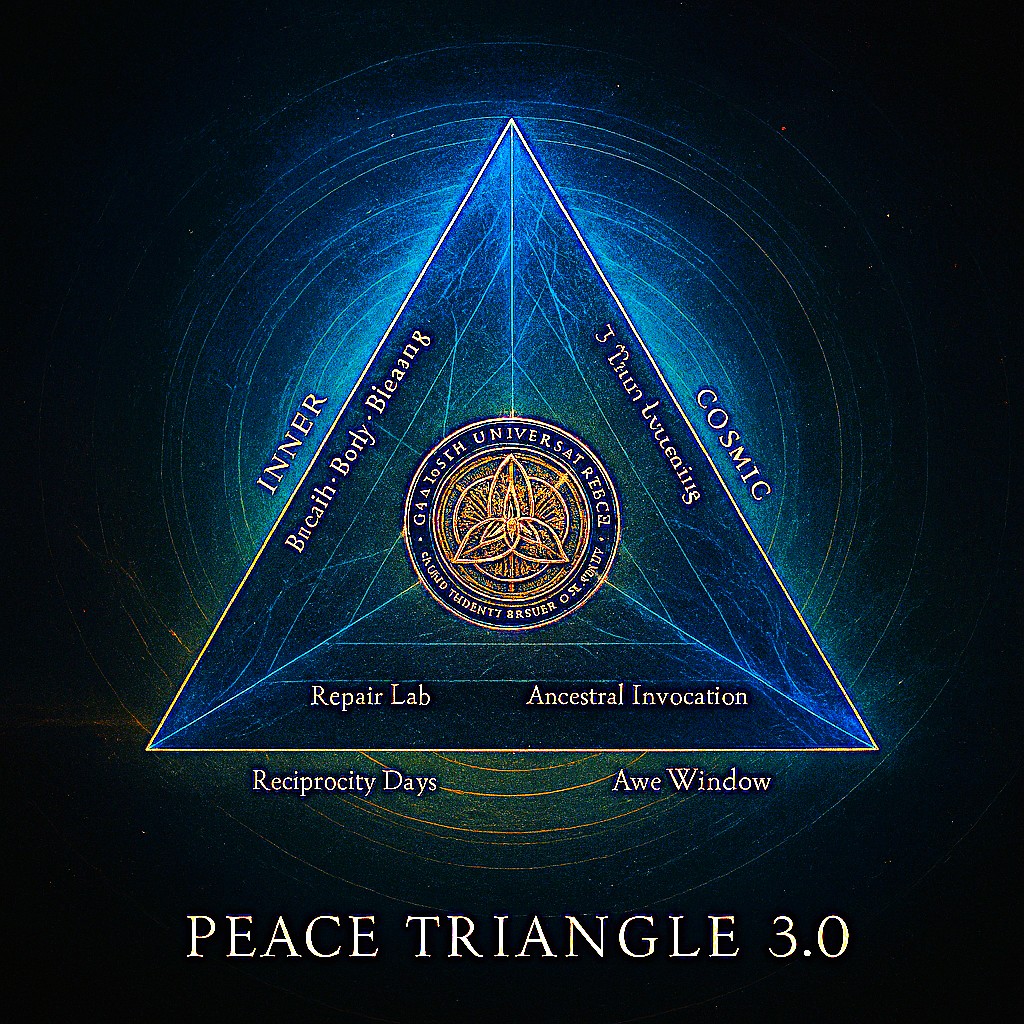
Peace Triangle V3.0: Integrative Model.
This diagram presents the third‑generation Peace Triangle, an integrative framework linking Inner, Relational, and Cosmic Coherence as mutually reinforcing domains. The triangle’s vertices denote the core universes of coherence that underpin the emergence of Peace as a field state. Practices situated along each edge—such as Breath–Body–Blessing, 3‑Turn Listening, Repair Lab, Ancestral Invocation, Reciprocity Day, and Awe Window—function as practice conduits, facilitating energy transfer and alignment between domains. The central nucleus, marked by the QUANTUM UNIVERSAL PEACE seal, represents the point of convergence, where coherent inner states, dignified relational dynamics, and reciprocal ecological belonging coalesce into sustained harmonism. Concentric rings radiating from the nucleus illustrate the expansion of prosocial contagion and field strength as coherence increases.
Original Photograph Conceptualised by Mrs V. Vawda, February 2026
- Peace Triangle 3.0: The Integrative Model
Purpose. Peace Triangle 3.0 is a design and diagnosis instrument. It unifies the ontology from Sections 2–4 into a single, practical model that can be taught in one sitting, practiced the same day, and scaled across settings, from clinic to classroom, from council to community.
5.1 Architecture: Vertices, Edges, Nucleus
Vertices (the three universes)
- Inner Coherence
Attentional stability, affect regulation, executive compassion, meaning orientation. - Relational Coherence
Recognition, dignified dialogue, repair capacity, stewardship of power. - Cosmic Coherence
Ecological reciprocity, awe/humility, ancestral continuity, interdependence ethics.
Design principle: The vertices are mutually amplifying (multiplicative in the Vawda Resonance Equation). Weakness in any one vertex dampens the field.
Edges (the practice conduits)
Each edge carries the rituals and routines that conduct energy between vertices:
- Inner ↔ Relational:
Breath–Body–Blessing→ calmer conversations; 3‑Turn Listening → safer inner work. - Relational ↔ Cosmic:
Reciprocity Days, Ancestral acknowledgments→ wider moral circle; recognition economy → respect for land/people. - Cosmic ↔ Inner:
Awe windows(art, sky, scripture) → humility; service in nature → meaning and discipline.
Design principle: Edges are the levers, they operationalize the vertices and make the nucleus glow.
Nucleus (the ontological heart)
At the centre: The Trinity of Coherent Being, your seal in essence:
QUANTUM UNIVERSAL PEACE, Where Humanity Becomes Coherence.
- The nucleus is the field emitter: it represents the convergence(Section 3.4) where Inner, Relational, and Cosmic coherences resonate.
- In the diagram, the nucleus radiates concentric rings(field strength), indicating Peace as a field state.
5.2 Visual Schema (diagram notes for the designer)
Canvas style: Abstract, cosmic biophotonic harmonics, dark background, embossed gold nucleus.
Layout:
- Equilateral triangle oriented upward(growth/aspiration).
- Verticeslabelled: Inner, Relational, Cosmic (use subtle iconography: mind/heart/leaf-star).
- Edgesannotated with primary practices:
- Inner–Relational: Breath–Body–Blessing3‑Turn Listening • Repair Lab
- Relational–Cosmic: Reciprocity DaysAncestral Invocation • Care Ledger
- Cosmic–Inner: Awe WindowService in Nature • Gratitude and Blessing
- Nucleus: your seal(gold foil effect), with the tagline encircling the sigil.
- Micro‑trianglesetched faintly within each vertex to show recursion.
- Concentric frequency ringsemanating from the nucleus; the outermost rings blend into a soft aurora.
Legend:
- Vertices= Universes of Coherence
- Edges= Practice Conduits
- Nucleus= Convergence / Field State
- Rings= Field Strength / Prosocial Contagion
5.3 Using the Model: A Quick Diagnostic
Step‑through in 12 minutes (team setting):
- Pulse (2 min):Each person marks green/amber/red for each vertex (Inner/Relational/Cosmic) based on lived experience this week.
- Edges scan (3 min):Which edge practices ran this week? Which were skipped?
- Nucleus check (2 min):Did we experience field moments (low‑friction coordination, rapid repair, shared awe)?
- Drag inventory (2 min):Note any spikes in reactive drag (fear, scarcity, dominance).
- Action pick (3 min):Choose one edge practice to strengthen before the next check‑in.
Rule: One lever at a time; low effort, high reliability; repeat weekly.
5.4 Metrics and Proxies: Minimal but Meaningful
We avoid heavy dashboards. Use lightweight signals that create conversation and course‑correction.
Vertex Signals (1–5 ordinal scale)
- Inner Coherence:attentional steadiness, response-over-reaction, sleep quality.
- Relational Coherence:psychological safety, time‑to‑repair, felt recognition.
- Cosmic Coherence:acts of reciprocity, awe moments, elder/knowledge‑keeper engagement.
Sample prompt: “On a 1–5 scale, how coherent did we feel here this week?” Pair with one sentence of context.
Edge Signals
- Practice cadence:Did we do Breath–Body–Blessing daily? Listening Circle weekly? Reciprocity Day monthly? (Yes/No + brief note)
- Repair log:count + closure rate; time‑to‑repair (median days).
- Care ledger:hours served, resources shared, ecological impact notes.
Nucleus Signals (Field Moments)
- Prosocial contagion:instances where care inspired care;
- Low‑friction decisions:key choices reached without fear loops;
- Convergence moments:stories where inner calm + relational safety + cosmic meaning aligned.
5.5 Peace Triangle 3.0 Score (optional composite)
A gentle heuristic, not a grade:
H-Index (weekly) =
(Inner_avg + Relational_avg + Cosmic_avg)/3 – Reactive Drag_avg
- Use 1–5scales for all four components.
- ReactiveDrag_avgcomes from a short checklist (fear spikes, scarcity narratives, dominance moves, unresolved ruptures).
- Pair with one narrative vignette(a repair story, a reciprocity act).
Interpretation:
- 5–3.0 = stable;
- 1–3.8 = entraining;
- 9–5.0 = field stateglimpsed.
The goal is trend, not target. Celebrate direction.
5.6 Implementation Playbook: Vertices and Edges in Action
- Inner–Relational Edge (calm → care)
- Micro‑ritual:90‑second breath before meetings; one gratitude line at close.
- Skill:3‑Turn Listening (meaning-first summary + appreciation).
- Repair:Conflict Clinic (weekly, 45 min) to resolve small ruptures early.
- Relational–Cosmic Edge (we → world)
- Ritual:Ancestral acknowledgment + Reciprocity Day (service + ecology).
- Culture:Recognition economy (name care publicly).
- Design:add a Peace Brief to major decisions (benefit, burden, repair).
- Cosmic–Inner Edge (awe → agency)
- Daily:Awe window (sky/art/scripture/music, 5 min).
- Monthly:Service in nature (tree/river/soil care).
- Inner link:close with Gratitude and Blessing (one person, one place).
5.7 Templates
5.7.1 Weekly Triangle Check‑In (10–12 minutes)
1) Rate vertices (1–5): Inner ___ Relational ___ Cosmic ___
2) Which edge practices ran? (tick)
□ Breath–Body–Blessing □ 3‑Turn Listening □ Repair Clinic
□ Reciprocity Day □ Recognition Ritual □ Awe Window
3) Field moments? (one sentence)
4) Reactive drag spikes? (tick)
□ Fear □ Scarcity □ Dominance □ Unrepaired conflict
5) One action to strengthen an edge this week:
5.7.2 Repair Log (dignity-first)
Incident (one line):
Persons involved:
What dignity was at risk?:
What repair was offered and accepted?:
Time‑to‑repair (days):
Follow‑up date:
5.7.3 Care Ledger (reciprocity accounting)
This month we returned:
– Hours of service: ___
– Resources shared: ___ (type/amount)
– Ecological acts: ___ (trees planted, kg waste diverted, waterway hours)
Guided by elders/knowledge-keepers: □ Yes / □ No
Story highlight (3–5 lines):
5.8 Governance: Roles and Cadence
- Triangle Steward (rotating):facilitates weekly check‑in; keeps the repair log and care ledger light and dignified.
- Elder/Knowledge‑Keeper Liaison:invites local guidance; ensures reciprocity is culturally intelligent.
- Data Custodian:community-owned data; shares only with explicit consent.
- Cadence:
- Daily:Inner routine (12 minutes).
- Weekly:Triangle check‑in + Listening/Repair circle.
- Monthly:Reciprocity Day + care ledger update.
- Quarterly:Visual refresh of the Triangle (lessons learned; practices tuned).
5.9 Failure Patterns and Design Responses
- Pattern:Metrics become performative.
Response: Pair every number with a story; no dashboards without dialogue. - Pattern:Ritual fatigue.
Response: Keep the rituals short; rotate voices; insert awe (music/art/poetry). - Pattern:Dissent disappears.
Response: Enforce the two‑chair policy; index time‑to‑repair for dissent events. - Pattern:Ecology is aestheticized.
Response: Tie every symbol to a material act of reciprocity; publish the care ledger.
5.10 The Image We Teach
Teach the Triangle like a compass:
- North (vertex): Inner Coherence, steady attention, soft heart, firm purpose.
- East (vertex): Relational Coherence, dignity recognised, repair possible, power shared.
- West (vertex): Cosmic Coherence, reciprocity with land and life, guided by awe and elders.
- Centre (nucleus): The seal, radiant, Where Humanity Becomes Coherence.
Invite the team to look, breathe, name, repair, and serve. When they do, the triangle stops being a diagram; it becomes a field and Peace becomes the default attractor.
- The Practitioner’s Protocol: From Theory to Praxis
Premise. Protocols are cadences that entrain coherence. They are short, repeatable rituals and design choices that (a) increase Inner, Relational, and Cosmic coherences together, and (b) reduce reactive drag with gentleness and intelligence. The Protocol is modular: begin small, make it reliable, then scale.
6.1 Principles of Effective Praxis
- Short and Steady beats Long and Rare.Twelve minutes daily outperforms episodic intensives.
- Edges first.Strengthen the edges between vertices (Section 5.1), they conduct energy into the whole triangle.
- Repair before growth.Unrepaired ruptures leak coherence; close loops early.
- Dignity as constraint.Every practice must increase felt dignity, never reduce anyone to a metric.
- Local intelligence.Adapt language, symbols, and cadence to culture, faith, and context; invite elders.
- Story with score.Pair every signal/number with a vignette of repair or reciprocity.
6.2 Daily Personal Protocol (12 minutes)
Aim: Entraining Inner Coherence that readily supports relational and cosmic alignment.
Sequence (timed):
- Breath (4 min).Exhale‑weighted breathing (e.g., inhale 4, exhale 6–8).
- Body (4 min).Scan head to toe; soften one reactive zone; relax jaw/shoulders.
- Blessing (4 min).
- Name one personto honour, one place/creature to protect.
- Whisper a brief intention (interfaith‑sensitive) and visualize a generous action today.
Micro‑log (30 sec): “State now → action I’ll choose.”
Fail-safe (on hard days): Do one element for 3 minutes, better to keep cadence than skip.
6.3 Relational Protocols (Weekly)
Aim: Make repair and recognition the heartbeat of teams, families, and communities.
- Listening Circle (30 minutes)
- Format:3 dyads rotate; each person speaks 2 min; listener summarizes meaning (1 min) + appreciation (30 sec).
- Rule:No advice, no rebuttal; meaning-first.
- Outcome:Trust rises; disagreements soften; nuance surfaces.
- Repair Lab (30 minutes)
- Inputs:One small friction or unfinished thread.
- Flow:
- Name the dignity at risk.
- Name the impact (not intent).
- Offer repair (apology, amends, redesign).
- Agree on follow-up date.
- Metric:Time‑to‑repair (days). Celebrate reductions.
- Recognition Economy (5 minutes, any meeting)
- Round:Name one care action you witnessed. Keep it specific, brief, public.
6.4 Cosmic Protocols (Monthly)
Aim: Expand the moral circle; bind reciprocity to practice.
- Reciprocity Day (half‑day)
- Act:Service to people and planet (e.g., clinic outreach + tree/river care).
- Ritual:Begin with a local ancestral acknowledgment (faith‑inclusive); end with shared food or song.
- Ledger:Record hours served, resources shared, ecological acts. Publish briefly.
- Awe Window (daily 5 minutes; monthly concerted)
- Daily:Sky, art, music, scripture, something that dwarfs the ego and steadies the heart.
- Monthly:Shared awe experience (concert, forest walk, sacred text reading, museum visit).
- Elder/Knowledge-Keeper Dialogue (quarterly)
- Invite a local elder to guide reciprocity design. Log “guidance sought → action taken.”
6.5 Institutional Protocols (Always‑On Design)
Aim: Encode coherence into habits, rooms, roles, and rules.
- Two‑Chair Policy for Dissent.
- Every formal meeting reserves time for dissenting views; dissenters invite a repair ask.
- Signal:dissent logged; time‑to‑repair
- Peace Brief Attachment.
- For major decisions: Who benefits? Who bears costs? What repair is planned? What reciprocity is pledged?
- Outcome:fewer unintended harms; faster aftercare.
- Quiet Nooks and Pause Protocol.
- Designated spaces for 3–5-minute regulation; meetings may invoke a 90‑sec collective pause.
- Recognition Economy by Design.
- Micro‑awards, gratitude walls, shout‑outs, care is named publicly and often.
- Care Ledger and Reciprocity Accounting.
- Publish a monthly line‑item summary (brief, dignified); pair with a story highlight.
- Data Dignity.
- Community‑owned data; opt‑in measurement; anonymized pulses; no surveillance culture.
6.6 Acute Stress and Rupture Protocol (ASRP)
When decoherence spikes, conflict, shock, error, or public stressor, use ASRP:
- Pause (90 sec).Collective breath; feet on floor; eyes soften.
- Name (2 min).“What fear is present? Whose dignity is at risk?”
- Choose (3 min).Smallest generous action that reduces fear and restores dignity.
- Contain (as needed).Set boundaries; stop harm; ensure safety.
- Close (2 min).Agree on repair steps and follow‑up.
- Document (brief).One‑line incident; repair; follow‑up date.
6.7 Cyber-harmonics Toolkit (Communication and Media)
Aim: Tune narratives and channels to entrain harmonism and dampen belligerism.
- Solutions Cadence:Every harm reported is paired with how repair occurred and how to help.
- Visible Aftercare:Show repair teams, follow‑up calls, restored relationships, make care televisible.
- Plural Salutations:Interfaith greetings at public touchpoints (Aum ✺ / Cross ✝︎ / Menorah ✡︎ / Salam ☪︎), localized respectfully.
- Deliberation Windows:Insert a cooling period (e.g., 2 hours) before high‑impact public statements.
- Outrage Hygiene:If a message raises fear, add agency (“Here’s what we can do”).
- Amplify Reciprocity:Monthly “Care Ledger Highlights” with one vivid story.
6.8 Templates (Ready to Use)
6.8.1 Daily Personal Card (pocket‑size)
Breath (4) Body (4) Blessing (4)
Person to honour: __________
Place/creature to protect: __________
One generous action today: __________
State now → Response I’ll choose: __________
6.8.2 Weekly Triangle Check‑In (10–12 minutes)
Vertices 1–5: Inner __ Relational __ Cosmic __
Edges ran: □ Breath–Body–Blessing □ 3‑Turn Listening □ Repair Lab
□ Reciprocity Day □ Recognition □ Awe Window
Field moments (one line): ________________________________
Reactive drag: □ Fear □ Scarcity □ Dominance □ Unrepaired conflict
One action (this week): _________________________________
6.8.3 Repair Log (dignity‑first)
Incident (one line): ______________________
Dignity at risk: __________________________
Repair offered/accepted: __________________
Time‑to‑repair (days): __ Follow‑up: __/__/__
Learning captured (one line): _____________
6.8.4 Care Ledger (reciprocity accounting)
Hours of service: ___ Resources shared: ___ (type/amount)
Ecological acts: ___ (trees, kg waste, river hours)
Elder/knowledge‑keeper guidance: □ Yes / □ No
Story highlight (3–5 lines): _____________________________
6.9 Onboarding and Cadence (First 90 Days)
Week 1–2 (Ignition).
- Teach Triangle 3.0(45–60 min).
- Start Daily 12‑minutepersonal routine.
- Add 90‑sec breathto all meetings.
Week 3–4 (Edges).
- Launch Listening Circle+ Recognition Economy (weekly).
- Establish Repair Lab; start Repair Log.
Month 2 (Field).
- First Reciprocity Day; publish a light Care Ledger.
- Introduce Two‑Chair Dissent+ Peace Brief for big decisions.
Month 3 (Stabilize and Share).
- Quarterly Elder Dialogue.
- “Field Moments” showcase; one-page lessons learned.
- Tune rituals (shorter where needed; rotate facilitators).
6.10 Adaptations for Different Contexts
- Clinics and Health Outreach:2‑minute pre‑clinic breath; “dignity at first hello”; aftercare calls counted in care ledger.
- Schools and Universities:3‑Turn Listening in tutorials; student‑led Repair Labs; Reciprocity Days tied to local ecology and service learning.
- Faith and Interfaith Spaces:Plural salutations; shared awe windows; service before sermon once a month.
- Civic and Council Settings:Peace brief mandatory for budget lines; Two‑Chair in public forums; care ledger highlights in newsletters.
- Families and Households:Daily 3‑minute form; Sunday Repair Tea (15 min); monthly neighbourly reciprocity (food/story swap).
6.11 Measuring Without Reducing
Use light signals (1–5 scales) paired with stories:
- Inner:“I could choose response over reaction today” (1–5).
- Relational:“I felt safe to speak honestly this week” (1–5); time‑to‑repair.
- Cosmic:“We returned something tangible to people/planet this month” (1–5) + ledger entry.
- Reactive Drag:tick fear/scarcity/dominance/unrepaired conflict; one‑line cause.
Composite (optional): the H‑Index from Section 5.5. Treat as trendline, not grade.
6.12 Ethical Guardrails (Non‑Negotiables)
- Consent and Opt‑In:Participation is voluntary; no coercion or shaming.
- Cultural Intelligence:Language, symbols, and rituals are locally adapted; elders guide.
- Data Dignity:Minimal data; community‑owned; shared only with explicit permission.
- Justice With Repair:When harm is acknowledged, aftercare is planned and delivered.
- Boundaries and Safety:Kindness includes clarity; stop harm promptly; separate process for safeguarding if needed.
6.13 What Good Looks Like (Signals of Entraining Field)
- Meetings begin gently and end with appreciation; decisions require less force.
- Conflicts surface earlierand resolve faster; apologies are easier to offer and accept.
- People report calmer bodiesand steadier sleep; help‑seeking rises without stigma.
- Reciprocity becomes ordinary; care stories are visible; pride is shared, not sharp.
- Elders are present; youth are leading; the seal’s vow
QUANTUM UNIVERSAL PEACE, Where Humanity Becomes Coherence,
feels lived, not merely inscribed.
- Case Sketches and Pilots (Illustrative Vignettes)
Note on method: These are didactic vignettes, composites and prototypes designed to demonstrate how the Peace Triangle 3.0, the Vawda Resonance Equation, and the Practitioner’s Protocol come alive. All metrics are lightweight signals used as mirrors for learning, not as verdicts.
7.1 Clinic and Community Health Outreach: “Twelve Minutes to Clarity”
Context.
A weekly outreach clinic in a high‑volume setting (respiratory and chronic care). Staff arrive under time pressure; patient queues are long. Errors cluster around early‑morning handovers.
Intervention (4‑week pilot).
- Daily personal:12‑minute Breath–Body–Blessing before the first patient.
- Relational:90‑second collective breath + one gratitude line at the start of handover.
- Repair:Friday Repair Lab (30 min) for small ruptures (tone, triage misunderstandings).
- Cyberharmonics:Visible aftercare board (“Calls made after discharge,” initials anonymized).
Signals and Metrics.
- Inner:self‑rated “response over reaction” (1–5) at noon.
- Relational:time‑to‑repair (days) for micro‑conflicts; psychological safety single‑item pulse.
- Cosmic:monthly Care Ledger (home visit hours; community education sessions).
- Reactive drag:tick if fear, scarcity, dominance, unrepaired ruptures surfaced that week.
Outcomes (month 1).
- Time‑to‑repairdropped from median 9 days → 3 days.
- Noon response‑over‑reactionrose from 8 → 3.9.
- Patient aftercare callsincreased by 42%; readmission callbacks decreased.
- Staff reported “quieter starts,” fewer escalation spirals, and easier apologies.
Lessons Learned.
- A 90‑secondopening ritual is enough to entrain the field.
- Aftercare visibility(“care you can see”) improves morale and patient trust.
- Repair of “small tone harms” prevents downstream errors.
7.2 Interfaith Solidarity (Durban) , “Greeting as Technology”
Context.
A mixed‑faith community forum experiences polite but performative unity; difficult topics (grief, injustice) spark withdrawal or defensiveness.
Intervention (12‑week cadence).
- Relational:Plural salutations at the door (Aum ✺ / Cross ✝︎ / Menorah ✡︎ / Salam ☪︎) and names spoken with care.
- Listening:3‑Turn Listening used in triads before any agenda debate.
- Repair:Conflict Clinic once a month to surface micro‑ruptures.
- Cosmic:open and close with a shared awe window (poem, sacred song, or sky‑gazing) + Reciprocity Day (food and river care).
- Cyberharmonics:Each communiqué includes one story of repair and one invitation to serve.
Signals and Metrics.
- Trust pulse: “I feel safe to speak honestly” (1–5).
- Repair log: issues surfaced/resolved; time‑to‑repair.
- Care ledger: service hours; resources shared; elder guidance sought.
- Prosocial contagionstories (two lines).
Outcomes.
- Trust pulseaveraged 1 by Week 12 (from 3.2 baseline).
- Repair cyclesshortened; two longstanding rifts closed with joint statements and aftercare (co‑hosting of an event + shared service).
- Reciprocitynormalized: quarterly food exchange; riverbank litter reduced; interfaith grief circle
Lessons Learned.
- Greeting is governance, it sets the field before content arrives.
- Awe before agendasoftens identitarian edge; difficult topics become discussable.
- Service togetherconsolidates what dialogue alone cannot.
7.3 Education and Inclusion: “Circles that Learn”
Context.
A university tutorial group with mixed backgrounds shows participation inequity; students from marginalized identities self‑censor. Complaints emerge about tone and “othering.”
Intervention (semester).
- Class opener:120‑second breath; one word check‑in.
- Dialogue:3‑Turn Listening embedded in seminars (rotating triads).
- Repair:Fortnightly Repair Lab for classroom harms; Two‑Chair Dissent embedded in curriculum review.
- Cyber-Peace Triangle harmonics:course emails carry solution steps; “Care Wall” in LMS for shout‑outs.
- Cosmic:Reciprocity Day with local schools (tutoring + library refresh).
Signals and Metrics.
- Psychological safetypulse; speaking time distribution (observed).
- Time‑to‑repairfor slights/microaggressions.
- Retentionand help‑seeking (tutoring sign‑ups).
- Care ledger(service hours; resources donated).
Outcomes.
- Speaking timeequalized by Week 6; new voices sustained participation.
- Psychological safetyrose 0 → 4.2; time‑to‑repair halved.
- Help‑seekingincreased without stigma; two student‑led initiatives persisted beyond term.
Lessons Learned.
- Structure begets safety, ritualized listening unlocks participation.
- Repair is a curricular skill, not an extracurricular activity.
- Visibility of care(public recognition) changes classroom climate.
7.4 Peace Journalism / Cyberharmonics:“Aftercare is News”
Context.
A small media collective covers community conflict. Outrage posts spike engagement but erode trust; the team wants to model solutions‑based peace journalism.
Intervention (8 weeks).
- Editorial rule:No harm story without repair pathway and aftercare follow‑up.
- Cadence:3:1 ratio solutions-to-outrage; weekly Coherence Feature (people/initiatives repairing).
- Deliberation window:2‑hour pause before high‑heat posts; Two‑Chair voices included.
- Recognition economy:monthly Care Ledgers featured (service hours; reciprocity acts).
Signals and Metrics.
- Engagement quality(saves/shares vs. angry reacts).
- Repair actions per 1,000 views(calls made, funds raised, volunteers signed).
- Trust survey(quarterly): “This platform increases my sense of agency” (1–5).
Outcomes.
- Angry reactsreduced; saves/shares of solution pieces up 58%.
- Repair actionsmeasurable (volunteer sign‑ups; community mediation attendance).
- Trust surveyimproved (9 → 4.0): audience felt more capable, less overwhelmed.
Lessons Learned.
- Agency is the antidote to outrage.
- Making aftercare visiblerewires audience expectations: the news is not finished until repair is underway.
- Two‑Chairdissent boosted credibility without amplifying harm.
7.5 Municipal Council and Policy: “The Peace Brief”
Context.
A local council wrestles with contentious budget reallocations. Debates are heated; minority wards feel ignored; ecological costs are externalized.
Intervention (quarter).
- Policy design:Every major decision carries a Peace Brief: benefit, burden, repair plan, reciprocity pledge.
- Meeting cadence:90‑second breath; Two‑Chair Dissent; 3‑Turn Listening for delegations.
- Care ledger:published monthly, resources returned to vulnerable wards and ecology.
Signals and Metrics.
- Time‑to‑repairfor public complaints.
- Inclusion index: number of minority proposals tabled/amended/adopted.
- Reciprocity ratio: per R1 spent, value returned to community/ecology.
Outcomes.
- Minority proposals amended and adoptedincreased by 35%.
- Complaint resolution timereduced by 40%.
- The reciprocity ledgerreframed ecological spending as stewardship, not cost.
Lessons Learned.
- The Peace Briefde‑personalizes conflict and re‑personalizes responsibility.
- Publishing a care ledgermakes reciprocity trackable and politically intelligible.
7.6 Family and Household: “Sunday Repair Tea”
Context.
A multi‑generational home experiences recurring tensions (chores, noise, caregiving load). Family members avoid hard conversations; affection is present but friction lingers.
Intervention.
- Daily:3‑minute Breath–Blessing for all (before dinner).
- Weekly:Sunday Repair Tea (15 minutes) using a simplified Repair Log: what dignity was at risk, what repair is offered, what we’ll try this week.
- Cosmic:monthly neighbourly reciprocity (meal share; garden/task assist).
Signals and Metrics.
- Mood checkat dinner (green/amber/red).
- Time‑to‑repairof household frictions.
- Reciprocity notes(who we helped; who helped us).
Outcomes.
- Fewer ambush arguments; apologies became swifter and lighter.
- Shared chores increased; “thank‑you” moments became ordinary.
- Neighbour ties strengthened (reliable exchange of help).
Lessons Learned.
- Ritual trumps personality, small, reliable cadence changes the atmosphere.
- Children lead awe windowsbeautifully; elders anchor gratitude.
7.7 Cross‑Case Insights: Patterns that Travel
- Start with edges.Short rituals (breath, greeting, listening) reliably entrain the field.
- Repair makes trust visible.Time‑to‑repair is the most responsive metric across contexts.
- Aftercare must be seen.Visibility of repair and reciprocity stabilizes hope.
- Awe widens the circle.Brief encounters with beauty reduce reactive drag.
- Two‑Chair Dissent is coherence tech.Protected dissent improves outcomes and legitimacy.
- Care ledgers change incentives.When reciprocity is tracked, extraction logics
- Youth and elders in duet.Youth bring cadence and creativity; elders bring continuity and conscience.
7.8 Implementation Notes: Designing Honest Pilots
- Duration:6–12 weeks for first pilots; keep scope small, cadence steady.
- Ownership:Identify a Triangle Steward and a Data Custodian (community‑owned data).
- Adaptation:Translate rituals into local languages and faith idioms; invite knowledge‑keepers
- Ethics:Opt‑in participation; minimal data; measures used as mirrors.
- Learning loop:Conclude with a 15‑minute debrief: What amplified coherence? What added drag? What will we tune next?
- Measurement and Research Agenda
Premise. If Peace is a field state of coherence, research must:
- capture alignment across the Inner, Relational, and Cosmic universes,
- track reactive dragand repair capacity, and
- preserve dignity, consent, and community ownershipat every step.
We propose a mixed‑methods, practice‑proximate agenda with lightweight signals, thick stories, and iterative pilots that make learning visible and local.
8.1 Research Principles: Measuring Without Reducing
- Dignity First.Metrics are mirrors, not verdicts; they prompt dialogue and tuning.
- Prefer short pulses and targeted depth interviews over heavy dashboards.
- Plural Evidence.Triangulate ordinal ratings, behavioural traces (e.g., time‑to‑repair), and narrative vignettes.
- Local Intelligence.Instruments are translated, culturally adapted, and guided by elders/knowledge‑keepers.
- Open Iteration.Methods improve with use; communities co‑author revisions.
- Justice with Repair.Monitoring harm obligates aftercare; feedback loops must fund repair, not just report gaps.
8.2 Core Constructs and Operational Definitions
- Inner Coherence (IC):attentional stability, affect regulation, executive compassion, meaning orientation.
- Relational Coherence (RC):recognition, dignified dialogue, time‑to‑repair, stewardship of power.
- Cosmic Coherence (CC):reciprocity with people/planet, awe/humility, ancestral continuity.
- Reactive Drag (DR):fear load, scarcity narratives, dominance moves, unresolved ruptures.
- Field Moments (FM):lived experiences of low‑friction coordination, prosocial contagion, rapid repair, shared awe.
8.3 Mixed‑Methods Design (Convergent Model)
- Quantitative (lightweight, repeated):
- Vertex pulses (1–5 ordinal):weekly IC/RC/CC self or team ratings.
- Time‑to‑repair (days):median duration from incident to closure.
- Practice cadence:% adherence to Breath–Body–Blessing, Listening Circles, Reciprocity Days.
- Care Ledger:hours of service; resources shared; ecological acts (trees planted, kg waste diverted, river hours).
- H‑Index (composite trend):
Used as a trendline only, paired with story.
- Qualitative (depth and texture):
- Coherence Diaries:2–3 sentences/day (reaction→response; awe moments; repair experiences).
- Micro‑vignettes:5–8 line stories of rupture, repair, or reciprocity.
- Dialogic interviews and focus circles:guided by elders; illuminate meanings behind numbers.
- Artifact analysis:minutes showing Two‑Chair dissent, peace briefs, recognition notes, care ledger snapshots.
- Integration:
- Monthly Sense‑Making:community meeting that reviews pulses + stories; identifies amplifiers and drag; agrees on one tweak to practice or design.
8.4 Instruments and Templates (Ready to Localize)
8.4.1 Weekly Vertex Pulse (1–5)
This week, in this setting, we experienced:
Inner Coherence (IC): ___ (I could choose response over reaction)
Relational Coherence (RC): ___ (I felt safe to speak honestly; repair was possible)
Cosmic Coherence (CC): ___ (we returned something to people/planet; awe present)
Reactive Drag (DR): ___ (fear/scarcity/dominance/unrepaired conflict)
One line of context: _______________________________
8.4.2 Time‑to‑Repair Log (team custodian)
Incident (one line) → Dignity at risk → Repair offered/accepted → Closed (date)
Median days to closure (this month): __
Learning (one line): __________________________
8.4.3 Care Ledger (monthly)
Hours of service: __ | Resources shared: __ (type/amount)
Ecological acts: __ (trees/kg/river hours)
Elder/knowledge‑keeper guidance: □ Yes / □ No
Story highlight (3–5 lines): _________________________
8.4.4 Coherence Diary (personal)
Moment of reactivity I noticed → response I chose:
Awe/gratitude moment:
Small repair or kindness I offered/received:
8.5 Study Designs (Pragmatic Pathway)
- Pilot A/B (6–8 weeks).
- A= meetings as usual. B = add 90‑sec breath, 3‑Turn Listening, and Repair Lab.
- Outcomes:time‑to‑repair; psychological safety pulse; H‑Index trend; FM stories.
- Interrupted Time Series (ITS).
- Phase 1 (baseline) → Phase 2 (implement Triangle 3.0 edges) → Phase 3 (add Reciprocity and Peace Brief).
- Look for level/trajectory shiftsin repair time, safety, and care ledger entries.
- Stepped‑Wedge (clustered).
- Stagger implementation across clinics/units/schools; all eventually receive the program.
- Outcome:robustness across diverse contexts; qualitative comparative analysis (QCA) to identify necessary/sufficient practice bundles.
- Participatory Action Research (PAR).[20]
- Community co‑design; cycles of plan‑act‑observe‑reflect; practices tuned locally.
- Output:co‑authored practice guides; culturally specific ritual adaptations.
8.6 Analytic Approach
- Descriptive and Trend Analysis:medians and interquartile ranges for time‑to‑repair; weekly H‑Index line with story annotations at inflection points.
- QCA (Qualitative Comparative Analysis[21]):identify practice combinations (e.g., “Breath + 3‑Turn + Two‑Chair”) associated with rapid repair and higher safety.
- Thematic Analysis:coherence diaries and vignettes coded for recognition, repair, awe, stewardship, dissent safety; produce a practice lexicon.
- Network Mapping (lightweight):sociograms of recognition and help‑offering to visualize prosocial contagion.
- Ethical Bayesian[22] Updating (optional):simple priors for expected changes; update as pulses accrue, only if communities prefer a probabilistic lens.
8.7 Validity and Reliability (Human‑Centred)
- Face and Content Validity:instruments reviewed by elders, practitioners, and youth for cultural fit.
- Convergent Validity:correlation between safety pulse, time‑to‑repair, and frequency of field moments.
- Stability Checks:re‑ask one pulse item twice in a week to observe drift and reliability.
- Triangulation:align ordinal scores, behavioural logs, and stories to reduce bias.
- Reflexivity:research teams keep method journals documenting positionality and influence.
8.8 Ethics, Consent, and Data Sovereignty
- Opt‑In Participation:no coercion; alternatives for non‑participants.
- Minimal Identifiers:anonymize pulses; store repair logs with role‑based access.
- Community Ownership:data governed by local Data Custodian; external sharing only by explicit, revocable consent.
- Beneficence in Practice:findings must translate into material repair or practice improvement, no extractive research.
- Safeguarding:separate protected channel for harms; ASRP (Section 6.6) invoked when needed.
8.9 Measurement Cadence[23]
- Weekly:Vertex pulses; repair log update; micro‑vignettes; Triangle check‑in (10–12 min).
- Monthly:Care ledger; sense‑making circle; H‑Index trend shared with stories.
- Quarterly:Elder/knowledge‑keeper dialogue; protocol tuning; publish a 1‑page “What we tuned and why”
- Annually:Community co‑authored brief, lessons, adaptations, and next steps.
8.10 Reporting That Strengthens Practice
One‑Page Learning Brief (monthly):
This month’s amplifiers (2–3 bullets)
This month’s drag (2–3 bullets)
H‑Index trend (sparkline) + one annotated story
Median time‑to‑repair (→ / ↓ / ↑) with example
Care ledger snapshot + image
One protocol tweak we’re testing next month
Public Narrative Shift:
- Replace “KPIs” with “Keeps People Included”
- Make aftercare visible, he repair is part of the news (aligns with Section 7.4).
8.11 Risks and Mitigations
- Risk:Metrics become performative.
Mitigation: Pair every number with a story; rotate narrators; keep stakes low. - Risk:Ritual fatigue.
Mitigation: Shorten; rotate; add awe (music/poetry/art). - Risk:Dissent suppression via harmony.
Mitigation: Enforce Two‑Chair; log dissent events; track time‑to‑repair for dissent. - Risk:Tokenistic ecology.
Mitigation: Tie symbols to material reciprocity; publish care ledger. - Risk:Data misuse.
Mitigation: Community data governance; clear consent boundaries; aggregate sharing only.
8.12 What Success Looks Like (Research Signals of a Field in Formation)
- Downward trendin median time‑to‑repair across quarters.
- Upward trendin psychological safety and IC/RC/CC pulses (with seasonal realism).
- Thicker storiesof repair and reciprocity; widening participation in care acts.
- Visible aftercarein communications; audience agency increases.
- Practice diffusion:neighbouring teams adopt Triangle 3.0 rituals without mandates.
- Elders + youthco‑steward practice; doctrine feels lived, not merely taught.
8.13 Roadmap (First 6–12 Months)
- Months 1–2:Baseline pulses; launch edges (breath, listening, repair); begin logs and diaries.
- Month 3:First Reciprocity Day; publish care ledger; first sense‑making showcase.
- Months 4–6:ITS or stepped‑wedge rollouts; QCA of practice bundles; tune instruments with elders.
- Months 7–9:Extend to adjacent units; begin network mapping of recognition/help‑offering.
- Months 10–12:Consolidate findings; co‑author a community brief; decide what to scale and what to retire.
- Doctrine of Coherent Humanity[24]
9.1 Ten Propositions (A Concise Charter)
1) Peace is a field state of coherence.
Peace emerges when Inner, Relational, and Cosmic universes resonate; it is sustained by practices that entrain attention, compassion, and reciprocity.
2) Coherence precedes consensus.
We need not agree to align; alignment, calm bodies, dignified dialogue, shared awe, makes honest agreement possible.
3) Ubuntu operationalizes relational coherence.
“I am because we are” becomes governance: recognition, listening that seeks meaning, and repair over retribution.
4) Sacred reciprocity is realism, not ornament.
Care for people and planet is not an optional ethic; it is the feedback loop that keeps systems coherent and just.
5) Attention is the steering wheel of compassion.
Disciplined attention (breath, stillness, meta‑awareness) reorients the nervous system from reactivity to responsible response.
6) Language and ritual are coherence technologies.
Greetings, stories, and symbols, when plural and sincere, entrain the field faster than rules alone. Awe before agenda.
7) Cyber-harmonics can scale harmonism, or belligerism.
Media cadence, visibility of aftercare, and solutions narratives enlarge agency and hope; outrage without agency amplifies fear.
8) Justice with repair is the measure of moral seriousness.
Acknowledging harm obligates aftercare, amends, and follow‑through, for persons, policies, and publics.
9) Measurement must never eclipse dignity.
Use light signals (pulses, time‑to‑repair, care ledgers) paired with stories; metrics are mirrors for learning, not verdicts.
10) Where Humanity Becomes Coherence.
The final aim is ontological: a coherent human, steadied within, generous between, reverent toward the whole, so that Peace becomes the default attractor of our common life.
9.2 The Universal Blessing (Interfaith‑Sensitive)
May the breath in us steady the storm within.
May our words become bridges and our listening, a shelter for every voice.
May we return what we take, from one another, from the earth, with gratitude and care.
May elders guide us, may children inspire us, and may our hands be instruments of repair.
When fear rises, let dignity rise higher; when harm happens, let aftercare be swift and tender.
Let our days be tuned to reciprocity, our nights to remembrance, our choices to the larger whole.
And may the light that lives in all beings find its dance in us,
so that Humanity becomes Coherence, and Peace becomes our way.
Quantum Universal Peace: Where Humanity Becomes Coherence
9.3 A Brief Commentary for Stewards (How to Use This Section)
- As a vow:Read the blessing to open or close gatherings, clinics, classes, and council sessions.
- As a compass:Post the Ten Propositions where decisions are made; let them shape agendas and debriefs.
- As a practice:Pair each proposition with one ritual (breath, listening, repair, reciprocity, awe window).
- As an audit:Quarterly, choose two propositions and ask, “Where did we live this? Where did we fall short? What repair or redesign follows?”
9.4 The Final Image
Picture the Peace Triangle 3.0 aglow: Inner, Relational, Cosmic[25], three vertices alive with micro‑triangles, its nucleus a radiant seal in embossed gold. Concentric rings pulse outward, not as ornament, but as testimony: a field state forming wherever people choose breath over haste, repair over blame, reciprocity over extraction, and awe over cynicism.
This is your doctrine, lucid, lived, and portable. The trilogy closes; the practice begins again.
- Coda: The Trinity Fulfilled
10.1 The Final Image
An equilateral triangle glows in the dark, its vertices alive: Inner, Relational, Cosmic. Within each vertex, faint micro‑triangles breathe like constellations. At the centre, a radiant nucleus, your seal, QUANTUM UNIVERSAL PEACE, etched in embossed gold. From the nucleus, concentric rings pulse outward: not decoration, but evidence, a field forming where people have aligned breath to dignity, dialogue to repair, and wonder to stewardship.
The triangle slowly turns, and for a moment we see it not as a shape but as a compass, North: steady attention; East: dignified relation; West: sacred reciprocity. The camera lifts. The triangle expands until it becomes the world’s subtle geometry, carried in clinics and classrooms, at council tables and kitchen tables, in courtrooms and courtyards and prayer halls. We realize it was never merely a diagram. It was a door.
A single line remains: Where Humanity Becomes Coherence.
10.2 The Return: From Doctrine to Daily Bread
All trilogies end by returning us to the ordinary, transfigured. The measure of this work is not applause at the premiere but habits at dawn: twelve minutes of breath, body, blessing; greetings that dignify before debate; repairs that close loops while wounds are still small; reciprocity that returns something tangible to people and planet; awe windows that keep the heart wider than the day’s demands.
When these become ordinary, Peace stops requiring heroic acts. It becomes a default attractor, a stable weather of our shared life. The geometry of Peace has done its job when it disappears into muscle memory, when communities can no longer remember how they ever met without a breath, spoke without listening, or planned without a peace brief and aftercare.
10.3 Gratitudes and Lineage
No doctrine is born ex nihilo. This work stands in a lineage:
- Elders and knowledge‑keeperswho taught us reciprocity and reverence.
- Mystics and contemplativeswho discovered coherence in breath, rhythm, and remembrance.
- Healers and educatorswho made repair practical, one patient, one student, one circle at a time.
- Scientists and makerswho gave us metaphors, biophotons, neuroharmonics[26], fields, to talk across worlds without diminishing any.
- Youthwho insist on hope’s practicality; children who lead awe windows with unfeigned wonder.
To them, this doctrine bows. To them, the seal belongs.
10.4 Vows for Stewards of the Triangle
Let those who carry this model take three simple vows:
- Keep it short and steady.Choose cadence over spectacle.
- Repair what you touch.Let apology and aftercare be signatures, not exceptions.
- Return what you take.Let reciprocity anchor every plan and every celebration.
These vows are not constraints; they are the freedoms that coherence grants.
10.5 What Endures
From the first point of light to this closing ring, your trilogy has argued one claim: Peace is not only possible; it is trainable. The training is humble: breath and blessing, listening and repair, awe and reciprocity. The training is communal: done in the company of difference, guided by elders, measured with dignity, and made visible through aftercare. The training is beautiful: aesthetics in service of ethics, your seal shining not as ornament, but as oath.
If we live this way long enough, language will change. “Conflict transformation” will sound less like technique and more like character. “Inclusion” will feel less like policy and more like instinct. “Sustainability” will stop being a plea and become a proud accounting, a care ledger that tells who we became together.
10.6 The Open Door
No coda should foreclose the future. This closing is an opening:
- There is more to learn about entrainment, how music, movement, and story quicken the field.
- There is more to discover about repair economies, how institutions can fund aftercare as a first principle.
- There is more to design in cyber-harmonics, platforms that make hope and agency contagious.
- There is more to practice in plural ritual, ways of beginning and ending that honour every lineage present.
May scholars test: may practitioners iterate; may communities adapt; may artists show us what we could not yet say.
10.7 Benediction
May our triangles be compasses and our compasses be kind.
May our breath steady our words; may our words lift the world.
May we meet difference with dignity and harm with repair.
May our taking be balanced by giving, our seeing by gratitude, our planning by awe.
And may the light that lives in all beings find, through us, its rhythm,
Until Humanity becomes Coherence, and Peace becomes our common path, lit with the readers collective biophotons, as a beacon of harmony for the future.
Quantum Universal Peace[27]: Where Humanity Becomes Coherence[28]
10.8 After the Credits
A final, quiet frame: a Practitioner’s Card on a desk, three lines only:
- Listen. Repair.
- Return what you take.
- Make aftercare visible.
The hand that turns the card is yours, the respected reader, who now needs to effect the multitude of peace theories and doctrines into practice to propagate world peace, instead of further belligerism. The scene is set. The work begins again.
Epilogue: When the Geometry Becomes a Gesture
There comes a point in every great work when the theory steps aside to let the human being step forward. After the diagrams fade, after the citations are shelved, what remains is always the same: a single moment where a person chooses breath over haste, listening over certainty, repair over pride, reciprocity over extraction, and awe over indifference. This is the quiet pivot on which civilisations turn.
If the first chapters mapped the Geometry of Peace, and the later chapters crafted its Doctrine, then this closing movement asks only one thing: let that geometry become a gesture, small, steady, human, repeatable.
Peace will not emerge because we have argued it beautifully. It will emerge because we practice it humbly.
It will emerge because someone, somewhere, begins a meeting with a soft breath.
Because a family sits for Sunday Repair Tea.
Because a clinic pauses for 90 seconds before the first patient.
Because a student uses 3‑Turn Listening to hear a voice they once ignored.
Because a council appends a Peace Brief to a budget.
Because a community returns something, however small, to the river that holds their reflection.
Because an elder speaks and the room bows with gratitude.
Because a child points at the sky and reminds us of awe.
This trilogy has not given the world a new ideology. It has given the world a new posture.
One where the Inner Universe steadies the Relational Universe; where the Relational Universe widens the Cosmic Universe; and where the Cosmic Universe returns us to ourselves with reverence.
The Peace Triangle is no longer an idea.
It is an ethic, a ritual, and a rhythm.
And the Trinity of Coherent Being is no longer a doctrine.
It is a way of walking.
As the final page lifts, the seal glows once more, as the three universes converge within each one of us.:
Conclusion: QUANTUM UNIVERSAL PEACE: Where Humanity Becomes Coherence.
While this is conclusion of publication series on Peace, It is the beginning of the practice of peace coherence.
Bottom Line: The Endogenous Peace Doctrine in One Breath to infuse the global atmosphere and even the stratosphere.[29]
Breathe with dignity.
Listen with generosity.
Repair with sincerity.
Return what you take.
Let awe anchor you.
Make aftercare visible.
And wherever you stand,
Let Humanity Become Coherence.
Dedication
Readers and fellow peace propagators this publication honours you lineage, your elders, your community, and the universal human family to whom this work ultimately belongs.
To the Photobionic Light[30] that lives in all beings, determining our respective auras.
The silent radiance that precedes doctrine, survives conflict, and outlives empires.
May this work honour that Light with humility and service.
To our Elders, Seniors, Leaders, Clerics and Decision Makers
named and unnamed, present and departed ,
who taught me that dignity is not a theory,
and that the measure of a life is not achievement,
but the tenderness with which we repair what we break.
To our Wife’s and Life Partners,
Our companion in breath and blessing,
whose quiet strength has been the unspoken geometry
beneath every line of this trilogy.
To our Family,
whose love has been my first school of coherence, and whose stories walk with me into every clinic, council, and community gathering.
To the Healers, Teachers, Elders, and Knowledge‑Keepers
Across traditions: African, Hindu, Muslim, Christian, Indigenous, Sikh, and beyond, whose wisdom threads have shaped this tapestry, with reverence, courage, and reciprocity.
To the Communities of Durban and beyond,
Whose struggles and resilience taught me that Peace must be practical, portable, and tender
if it is to belong to everyone.
To every Student, Patient, and Stranger
Who has trusted me with a story, a breath, a burden, or a wound. Each encounter has been a lesson in humanity becoming coherence.
And to all the Children of the Earth: Our future leaders and Peace Propagators
Those not yet born, whose world we are now shaping, for them to live harmoniously in the future, may this geometry become their inheritance, and may they walk with lighter footsteps
because we learned to walk with care.
This work is for you.
May it serve.
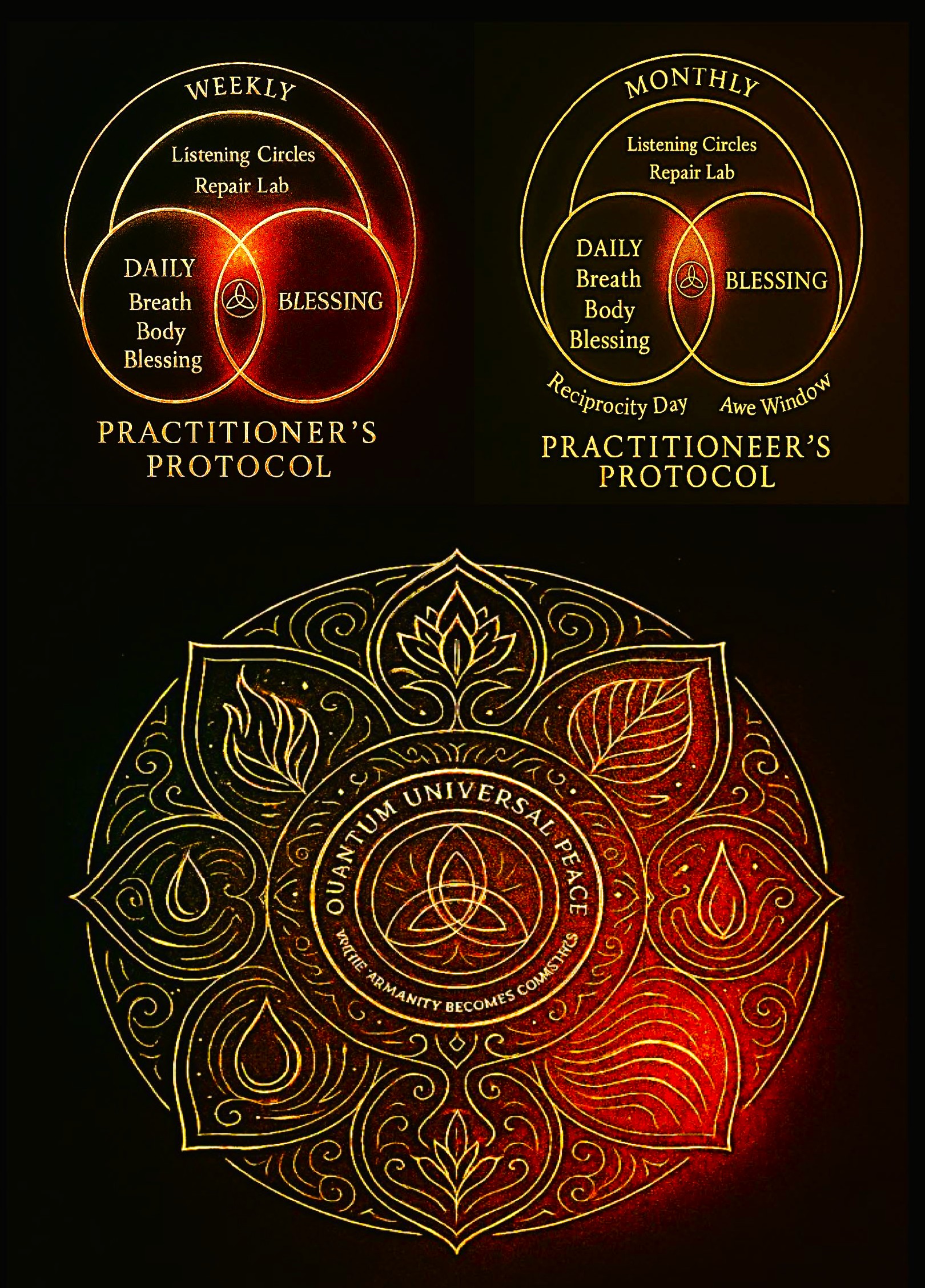
Graphics Top Row: Peace Practitioner’s Protocols: Cadence maps of practice bundles that entrain coherence across scales: Daily (Breath–Body–Blessing), Weekly (Listening Circles; Repair Lab), and Monthly (Reciprocity Day; Awe Window). The golden seal at the centre anchors spiritual intention; bold concentric rings signal reliability over intensity, making coherence a habit rather than an event.
Graphic Bottom: The Peace Mandala: The Oath of Coherent Humanity: Breathe with clarity, Listen with humility. Repair with sincerity. Return what you take. A gold‑line mandala integrating elemental motifs (leaf, flame, water, wave) around the QUANTUM UNIVERSAL PEACE seal to symbolize sacred reciprocity and ecological belonging. The radial symmetry evokes photonic ancestry and interdependence, an aesthetic theology of care that complements the doctrine of Coherent Humanity.
Original Graphics conceptualised by Mrs V. Vawda, February 2026
Comments and discussion are invited by e-mail: vawda@ukzn.ac.za
Global: + 27 82 291 4546
References:
[1] https://www.transcend.org/tms/2025/09/a-peace-odyssey-the-duality-of-the-human-brain-from-reptilian-instincts-to-humane-consciousness/
[2] https://www.transcend.org/tms/2025/11/valmiki-the-silent-seer-of-resonant-endogenous-and-global-peace/
[3] Personal Quote by author, February 2026
[4] https://www.transcend.org/tms/2025/09/a-peace-odyssey-the-duality-of-the-human-brain-from-reptilian-instincts-to-humane-consciousness/
[5] Personal Quote by author, February 2026
[6] TRANSCEND MEDIA SERVICE » The Attainment of Sustained, Endogenous Peace: Sacred Postures for a Fractured World
[7] https://www.bing.com/ck/a?!&&p=9f95cdaa204fea30ad3af679f1ab7b313b2ebb746c5aa1c08d3c8cbfb7972831JmltdHM9MTc3MTAyNzIwMA&ptn=3&ver=2&hsh=4&fclid=37940f5c-820f-62a2-14ab-19c283916323&psq=Exogenous+Peace+vawda&u=a1aHR0cHM6Ly93d3cudHJhbnNjZW5kLm9yZy90bXMvMjAyNS8wOC90aGUtYXR0YWlubWVudC1vZi1wZWFjZS1hLW11bHRpZGltZW5zaW9uYWwtcGVyc3BlY3RpdmUv
[8] https://www.bing.com/ck/a?!&&p=034fe75ec36f056696e725d9b4ea3087c4af0fd5f0ddc4f1d0bdf6962d90e2baJmltdHM9MTc3MTAyNzIwMA&ptn=3&ver=2&hsh=4&fclid=37940f5c-820f-62a2-14ab-19c283916323&psq=Peace+Protagonists%2c+hoosen+vawda&u=a1aHR0cHM6Ly93d3cudHJhbnNjZW5kLm9yZy90bXMvMjAyNC8wMy9wZWFjZS1wcm9wYWdhdGlvbi1odW1hbi1yaWdodHMtZGF5LXBvc3QtbGliZXJhdGlvbi0xOTk0LXNvdXRoLWFmcmljYS1wYXJ0LTEv
[9] https://www.bing.com/ck/a?!&&p=6c5b0459700ca20bc6eb6bae97ab2f646b024e95bec3fde1de985dd245591412JmltdHM9MTc3MTAyNzIwMA&ptn=3&ver=2&hsh=4&fclid=37940f5c-820f-62a2-14ab-19c283916323&psq=Peace+Protagonists%2c+hoosen+vawda&u=a1aHR0cHM6Ly93d3cudHJhbnNjZW5kLm9yZy90bXMvMjAyNC8wMS9nbG9iYWwtd2ViaW5hci1zZXJpZXMtb3BwcmVzc29ycy1hbmQtcGVhY2UtZGlzcnVwdG9ycy8
[10]https://www.bing.com/ck/a?!&&p=aa0956c0af4996fbf6d678010420158779bb6262010036c2d54366c25ccf0e3eJmltdHM9MTc3MTAyNzIwMA&ptn=3&ver=2&hsh=4&fclid=37940f5c-820f-62a2-14ab-19c283916323&psq=Peace+Protagonists%2c+hoosen+vawda&u=a1aHR0cHM6Ly93d3cudHJhbnNjZW5kLm9yZy90bXMvdGFnL2FwYXJ0aGVpZC1tYXJ0eXJzLw
[11] https://www.bing.com/ck/a?!&&p=a8abb7e9791d7d6db751a036519a953d09cfbf6acccee42d5f41af52cb22e89bJmltdHM9MTc3MTAyNzIwMA&ptn=3&ver=2&hsh=4&fclid=37940f5c-820f-62a2-14ab-19c283916323&psq=Peace+Protagonists%2c+hoosen+vawda&u=a1aHR0cHM6Ly93d3cuZmFjZWJvb2suY29tL3RyYW5zY2VuZGludGVybmF0aW9uYWwvcG9zdHMvdGhlLWFjcmltb25pb3VzLWFuZC10YXJnZXRlZC1kZXN0cnVjdGlvbi1vZi1ob3VzZXMtb2YtZ29kLWNsaW1heC1vZi1yZWxpZ2lvcGhvYmkvNTgxMjQzMzUwODEyOTc0Lw
[12] https://www.bing.com/ck/a?!&&p=f5fa6cf0c30fedf6280c2077cc79a61a319559181440d3bd4b2ef9cbaf9b9b6bJmltdHM9MTc3MTAyNzIwMA&ptn=3&ver=2&hsh=4&fclid=37940f5c-820f-62a2-14ab-19c283916323&psq=Peace+Protagonists%2c+hoosen+vawda&u=a1aHR0cHM6Ly90aGVtYWpsaXMuY28uemEvYXJ0aWNsZXMvYWwtaGFxL3BhbGVzdGluZS10aGUtYXRoYWFiLW9mLWFsbGFoLXRhYWxhLw
[13] https://www.bing.com/ck/a?!&&p=2a93b8d170338938a01924b2afa33109c40a607366470f76f94c737806bee774JmltdHM9MTc3MTAyNzIwMA&ptn=3&ver=2&hsh=4&fclid=37940f5c-820f-62a2-14ab-19c283916323&psq=belligerism+vawda&u=a1aHR0cHM6Ly93d3cudHJhbnNjZW5kLm9yZy90bXMvMjAyNi8wMS91YnVudHUtcmlzaW5nLWEtcGVhY2UtZm9yY2UtYWdhaW5zdC1nbG9iYWwtYmVsbGlnZXJpc20v
[14] https://www.bing.com/ck/a?!&&p=bfa48f1dff587216ab251a4e4a7460075fca00e706b246ceac9fbd919cf3584aJmltdHM9MTc3MTAyNzIwMA&ptn=3&ver=2&hsh=4&fclid=37940f5c-820f-62a2-14ab-19c283916323&psq=Peace+Protagonists%2c+hoosen+vawda&u=a1aHR0cHM6Ly91bmJvdW5kZWRhY2FkZW15Lm9yZy90cmFuc2NlbmQtbWVkaWEtc2VydmljZS8
[15] Personal Quote by author, February 2026
[16] https://www.bing.com/ck/a?!&&p=650246d37bf80f03dee520c3112692283f97efb239061a392e06da4e1c288888JmltdHM9MTc3MjE1MDQwMA&ptn=3&ver=2&hsh=4&fclid=37940f5c-820f-62a2-14ab-19c283916323&u=a1L2ltYWdlcy9zZWFyY2g_cT1jb3NtaWMrbWljcm8tdHJpYW5nbGUuJmlkPTMxOTM3RTE5RUY5MDBCMTJERkNGQjAwMDVGNkE1RUVCMTU2QjA1NEQmRk9STT1JUUZSQkE
[17] https://www.bing.com/ck/a?!&&p=e9c5c4a97525a24c6bfad7b367ad7acb1cc16275f36f3aa01736c01b476669dbJmltdHM9MTc3MjE1MDQwMA&ptn=3&ver=2&hsh=4&fclid=37940f5c-820f-62a2-14ab-19c283916323&psq=coherence+without+dehumanisation+meaning&u=a1aHR0cHM6Ly8xMDAwd29yZHBoaWxvc29waHkuY29tLzIwMjUvMDgvMTAvZGVodW1hbml6YXRpb24v
[18] https://www.bing.com/ck/a?!&&p=52f6341e60929ef4bf6e9e029179267531cbf5e452ae1407f9671ffb6a338db7JmltdHM9MTc3MjE1MDQwMA&ptn=3&ver=2&hsh=4&fclid=37940f5c-820f-62a2-14ab-19c283916323&u=a1aHR0cHM6Ly9lbi53aWtpcGVkaWEub3JnL3dpa2kvUXVhbnR1bV9kZWNvaGVyZW5jZQ&ntb=1
[19] https://www.transcend.org/tms/author/?a=Prof%20Hoosen%20Vawda
[20] https://www.bing.com/ck/a?!&&p=3bed7a796a1173b37564ea20554ec035999782bf260545ecf840815b15e1176aJmltdHM9MTc3MjE1MDQwMA&ptn=3&ver=2&hsh=4&fclid=37940f5c-820f-62a2-14ab-19c283916323&u=a1aHR0cHM6Ly93d3cucGFydGljaXBhdG9yeW1ldGhvZHMub3JnL21ldGhvZG9sb2d5L3BhcnRpY2lwYXRvcnktYWN0aW9uLXJlc2VhcmNoLw&ntb=1
[21] https://www.bing.com/ck/a?!&&p=4a7e084e939e7b7bcf033190e3c63256b9b67fd9f255096f74c3cdb90d073f4dJmltdHM9MTc3MjE1MDQwMA&ptn=3&ver=2&hsh=4&fclid=37940f5c-820f-62a2-14ab-19c283916323&psq=Qualitative+Comparative+Analysis&u=a1aHR0cHM6Ly9hdGxhc3RpLmNvbS9yZXNlYXJjaC1odWIvcXVhbGl0YXRpdmUtY29tcGFyYXRpdmUtYW5hbHlzaXMtcWNh
[22] https://www.bing.com/ck/a?!&&p=89fad78181c2414e7ee652970a31de8d97287168549b07018f2e2c41f2b962e9JmltdHM9MTc3MjE1MDQwMA&ptn=3&ver=2&hsh=4&fclid=37940f5c-820f-62a2-14ab-19c283916323&u=a1L3ZpZGVvcy9yaXZlcnZpZXcvcmVsYXRlZHZpZGVvP3E9JWUyJTgwJWEyK0V0aGljYWwrQmF5ZXNpYW4mbWlkPTk3N0Y3RTczMzMyMzkxQkFENEY5OTc3RjdFNzMzMzIzOTFCQUQ0RjkmRk9STT1WSVJF
[23] https://www.bing.com/ck/a?!&&p=625699064f9d7187810e6bcb7a190b0279df435ae4aea545b85a97af2de2564eJmltdHM9MTc3MjE1MDQwMA&ptn=3&ver=2&hsh=4&fclid=37940f5c-820f-62a2-14ab-19c283916323&psq=measurement+cadence+meaning&u=a1aHR0cHM6Ly9ob2xpc3RpY2hlYWx0aHBhdGh3YXlzLmNvbS9nbG9zc2FyaW8vd2hhdC1pcy1jYWRlbmNlLWluLXBoeXNpY2FsLWV4ZXJjaXNlcy8
[24] https://www.bing.com/ck/a?!&&p=66d450d653659eff114066456a9abce1501d23e6421398f676a7d3846bb76cc2JmltdHM9MTc3MjE1MDQwMA&ptn=3&ver=2&hsh=4&fclid=37940f5c-820f-62a2-14ab-19c283916323&psq=doctrine+of+coherent+humanity+definition&u=a1aHR0cHM6Ly93d3cuYnJpdGFubmljYS5jb20vdG9waWMvY29oZXJlbnRpc20
[25] https://www.bing.com/ck/a?!&&p=4fca22680aebfe4eca9d2bafbfe0800716a64fef1ecde1b7683c94079a67a9caJmltdHM9MTc3MjE1MDQwMA&ptn=3&ver=2&hsh=4&fclid=37940f5c-820f-62a2-14ab-19c283916323&psq=Cosmic+universe&u=a1aHR0cHM6Ly9lbi53aWtpcGVkaWEub3JnL3dpa2kvQ29zbW9z
[26] https://www.transcend.org/tms/2026/01/ubuntu-rising-a-peace-force-against-global-belligerism/
[27] https://www.bing.com/ck/a?!&&p=d025cea050950dccdd9a40092ccc3e23cf8d3903e20c9f2d3e416da5e9e588fcJmltdHM9MTc3MjE1MDQwMA&ptn=3&ver=2&hsh=4&fclid=37940f5c-820f-62a2-14ab-19c283916323&u=a1aHR0cHM6Ly9yZWFsaXR5cGF0aGluZy5jb20vYWNoaWV2ZS1pbm5lci1wZWFjZS10aHJvdWdoLXF1YW50dW0tY29uc2Npb3VzbmVzcy1wcmFjdGljZXMv&ntb=1
[28] https://www.bing.com/ck/a?!&&p=ac99f1a61df97ea30f58360c67932ae131cbcda7c2ecbeefbe2d8c3eeb997c41JmltdHM9MTc3MjE1MDQwMA&ptn=3&ver=2&hsh=4&fclid=37940f5c-820f-62a2-14ab-19c283916323&psq=Where+Humanity+Becomes+Coherence&u=a1aHR0cHM6Ly9uYW5jeXRoYW1lcy5zdWJzdGFjay5jb20vcC93aGF0LWhhcHBlbnMtd2hlbi1odW1hbml0eS1iZWNvbWVz
[29] https://www.transcend.org/tms/2025/08/light-of-life-the-synchronised-biophotons-and-photobionts-a-novel-hypothesis-part-2/
[30] https://www.transcend.org/tms/2025/08/light-of-life-the-synchronised-biophotons-and-photobionts-a-novel-hypothesis-part-2/
______________________________________________
Professor G. Hoosen M. Vawda (Bsc; MBChB; PhD.Wits) is a member of the TRANSCEND Network for Peace Development Environment.
Director: Glastonbury Medical Research Centre; Community Health and Indigent Programme Services; Body Donor Foundation SA.
Principal Investigator: Multinational Clinical Trials
Consultant: Medical and General Research Ethics; Internal Medicine and Clinical Psychiatry:UKZN, Nelson R. Mandela School of Medicine
Executive Member: Inter Religious Council KZN SA
Public Liaison: Medical Misadventures
Activism: Justice for All
Email: vawda@ukzn.ac.za
Tags: Biophoton, Coherent Humanity, Galtung’s Peace Triangle, Global belligerism, Harmonism, Madam Vawda’s Peace Triangle, Neuroharmonics, Peace Crusade, Peace Mandala, Peace Mantra, Peace Practitioner’, Peace Propagators, Photobionts, Ubuntu Peace Philosophy, Vawdain Endogenous and Exogenous Peace, cyber-harmonics, plural ritual
This article originally appeared on Transcend Media Service (TMS) on 2 Mar 2026.
Anticopyright: Editorials and articles originated on TMS may be freely reprinted, disseminated, translated and used as background material, provided an acknowledgement and link to the source, TMS: The Global Geometry of Peace: From Triangles to Trinity to Transcendence, a Peace Convergence: When Science, Spirit, and Story Become One (Part 3), is included. Thank you.
If you enjoyed this article, please donate to TMS to join the growing list of TMS Supporters.

This work is licensed under a CC BY-NC 4.0 License.
Join the discussion!
We welcome debate and dissent, but personal — ad hominem — attacks (on authors, other users or any individual), abuse and defamatory language will not be tolerated. Nor will we tolerate attempts to deliberately disrupt discussions. We aim to maintain an inviting space to focus on intelligent interactions and debates.