
Peace in the Shadow and Shade of Colonial Imperialism: A Protagonist’s Call to Decolonize the Diasporic Mind (Part 1)
TRANSCEND MEMBERS, 13 Apr 2026
Prof Hoosen Vawda – TRANSCEND Media Service
Colonial Conquering and Subjugation has become His Master’s Voice, Deeply Ingrained in the Engineered Ontogeny of the Diasporian Subject.[1]
“Neo Colonialism is the same philosophy of occupation, by imperialist, in a novel, refined guise of a cultured approach.“ [2]
This publication is suitable for general readership. Parental guidance is recommended for minors who may use this research paper as a resource material, for projects. The author invites and welcomes any comments and discussions, by the readership.
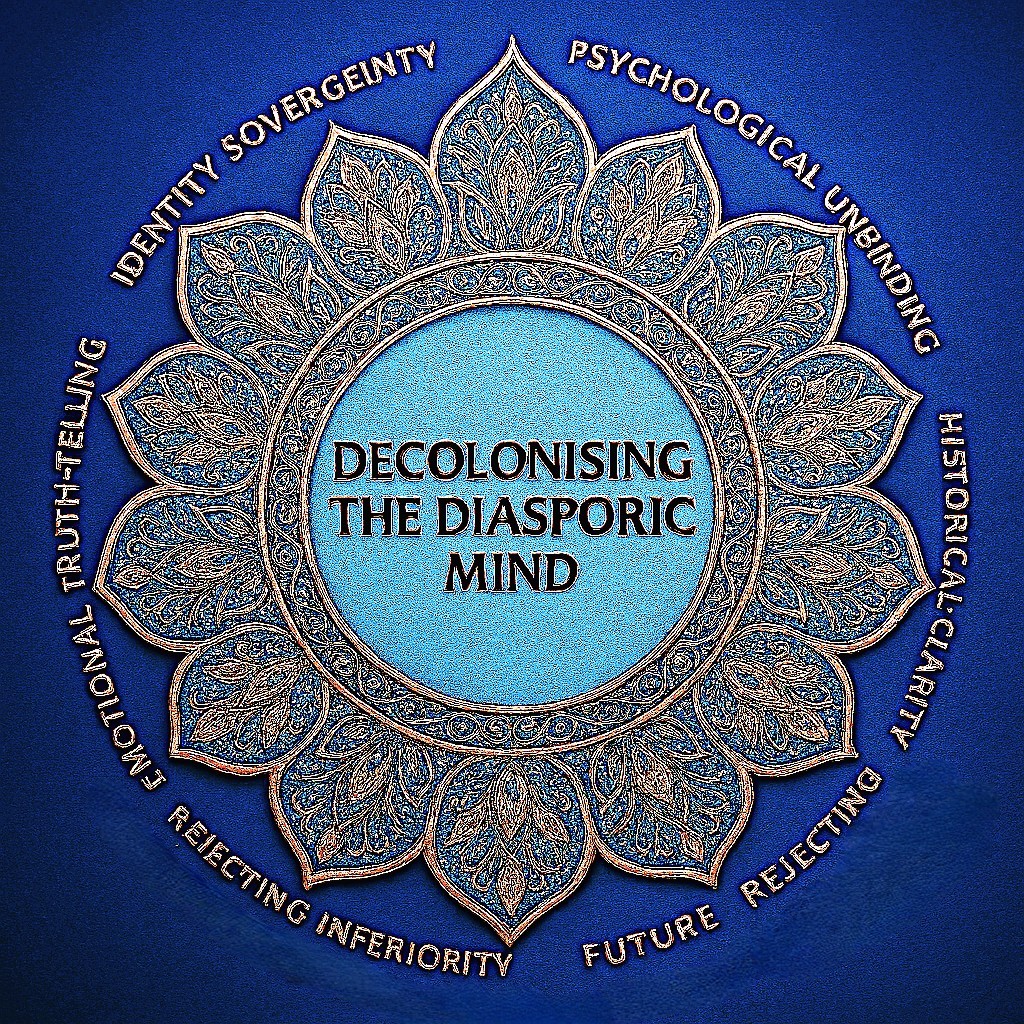
The Conceptual Architecture of the “Decolonising the Diasporic Mind” A Mandala
Original Graphic Conceptualised by Mrs V. Vawda: April 2026
The Mandala[3] of the Colonised Mind of the Diasporian[4]
The mandala presented by the author, absent is not merely an aesthetic artefact; it is a conceptual schema that synthesises multiple strands of inquiry in postcolonial studies, diaspora psychology, and the philosophy of identity formation. Framed within a hermeneutic and decolonial methodology, the diagram functions as a visual epistemology, a representational device that embodies the multidimensional processes through which diasporic consciousness is shaped, disrupted, inherited, and subsequently re‑articulated.
At the centre lies the construct “Decolonising the Diasporic Mind,” conceptualised as the core epistemic and ontological pivot around which all ten principles circulate. This central locus signifies the imperative for PIO communities to interrogate and transcend the residual architectures of colonial ontology, particularly those inscribed through indenture, segregation, linguistic displacement, and the intergenerational transmission of trauma. The positioning of this phrase at the mandala’s nucleus reflects the theoretical claim that psychological decolonisation constitutes both the prerequisite and telos of diasporic self‑reconstitution.
Surrounding this core are ten discrete yet interdependent petals, each corresponding to a principle that contributes to a holistic model of cognitive, cultural, and affective liberation. These principles, Ancestral Recognition, Historical Clarity, Psychological Unbinding, Identity Sovereignty, Communal Reconnection, Emotional Truth‑Telling, Cultural Reclamation, Resistance to Internalised Inferiority, Intergenerational Healing, and Future Sovereignty, collectively articulate a multi‑axis framework for understanding the diasporic condition.
The mandala’s radial symmetry is theoretically intentional. It illustrates that no single principle functions hierarchically; rather, each operates as a co‑constitutive modality of decolonial thought and praxis. This aligns with contemporary scholarship that rejects linear models of postcolonial recovery in favour of circular, recursive, and relational paradigms. The three‑dimensional rendering of the petals, accentuated by gold‑foil detailing, symbolically evokes both the sacredness of ancestral knowledge and the complexity of epistemic reparation, situating the model within a tradition of South Asian cosmological representation.
Furthermore, the diagram serves a methodological purpose: it bridges the gap between narrative analysis and visual cognition, enabling scholars, practitioners, and community members to apprehend diasporic decolonisation not solely as a textual abstraction but as an embodied, spatialised, and process‑oriented phenomenon. In this respect, the mandala functions as a pedagogical tool capable of fostering critical reflection while simultaneously honouring the aesthetic traditions of the cultures from which the diaspora originates.
The enduring psychological and social impacts of colonialism continue to shape societies and individual identities long after the formal structures of colonial rule have evolved into systems of neocolonialism and cultural imperialism.[5] The report introduces the Colonial Psychological Complex (CPC)[6], a framework for understanding the interconnected dynamics of Colonial Stockholm Syndrome (CSS)[7], Colonial Saviour Complex (CSC)[8], Colonial Narcissism Syndrome (CNS)[9], and Colonial Social Conditioning (COSOC)[10]. These dynamics can intertwine in Colonial Syndrome Entanglement (CSE)[11] or manifest independently as Colonial Syndrome Fragmentation (CSF). [12]In summary, the author’s diagram should be interpreted as both a scholarly model and a symbolic intervention. It crystallises the theoretical argument that the decolonisation of diasporic consciousness is a multidimensional undertaking, one that necessitates historical excavation, psychological introspection, communal solidarity, and the imaginative reconstruction of future identities. Its design is intentionally rigorous, integrative, and evocative, inviting further academic inquiry while offering a conceptual pathway toward diasporic self‑sovereignty.
In encapsulating the above psychosocial complexes and ideologies as offshoots of colonisation, both archi-colonisation, by imperialist occupiers and neo-colonialism, The author has created an umbrella term “ The Master’s Voice”, to described the loss of indigenous thinking, of the subjugates, replaced by what ideologies were instilled by the colonisers on the subjects, post liberation as it happened in Africa, particularly South Africa post 1994 and in the Indian Peninsula post independence in 1947, as well as in the occupied territories of South East Asia. This is an extremely dangerous phenomenon prevalent in the younger generations of these occupied countries and augurs poorly as these ideological remnants are expanding exponentially, in these communities, globally. Those readers who are much older will recall the emblem inscribed on musical records, even in the language of the invaded land by the British imperialists of a dog, listening to his master’s voice who is far away in Britain. This was a conditional attempt by the colonialists to subtly inform the subjugates that even in their relaxation, they have a “Master”, whom the indigenous subjects have to listen to, at all times. The logo itself “HMV” was an extremely clever propaganda design especially during the period of Independence of occupied territories. HMV was a famous trademark and logo of the RCA Victor record label, ideal for the colonial era and a lesson against neo-colonialism and colonisation of the diasporic mind. The author has written a comprehensive paper on this very topic in TMS, on 06th September 2021.[13]
(1) Prologue
As a peace protagonist, the author considers this paper as a profound and contemporarily necessary topic, in the present era, to caution humanity of the perils of the colonised, diasporic mind. Furthermore, the publication seeks not merely to document history, but to diagnose a persistent wound and prescribe a path towards genuine liberation, of the propaganda, infested mind, continuously reminding it that it is INFERIOR than that of the MASTER, who led the “PAGANS” to salvation and empowerment in society. The following document is prepared to align with relevant headings, weaving a narrative from historical subjugation to contemporary psychological colonisation of the mind. I therefore attempts at mapping a way forward to DECOLONISE the mind.
(2) Introduction
Peace, in the lexicon of the formerly colonised, is not merely the absence of war. It is the presence of justice, the restoration of dignity, and the reclamation of a self-image untainted by the master’s gaze. This paper posits that the colonial project, particularly British imperialism in India, was a form of epistemological conquest that extended beyond territorial occupation to the subjugation of the essential human spirit of the subjugants, from the last Mughal Emperor, Bahadur Shah Zafar[14], to the completely discriminated Harijans[15] and Dalits[16], as officially designated, with complete deprivation of all human rights and treating these down trodden sector of the Indian community as sub-humans.[17] The legacy of this conquest is most vividly preserved and perpetuated not in the geography of India, but within the 35.42-million-strong, Indian diaspora[18]. This document argues that true peace for Persons of Indian Origins (PIOs)[19], globally requires a deliberate process of decolonising the diasporic mind, a liberation from the internalized “Divide and Rule” policy[20], [21], that continues to manifest as sectarianism, casteism, and linguistic erosion. Drawing on the philosophical power of recognition and the relational ethic of Ubuntu,[22] this paper outlines a cognitive and emotional pathway to reclaim identity, fostering a peace that is both a personal and communal reclamation.
(3) British Invasion, Occupation, and Subjugation in India[23]
The British presence in India began as a commercial enterprise with the East India Company in the early 17th century, but it metastasized into a system of brutal subjugation following the Battle of Plassey in 1757 [24]. The occupation was not merely a transfer of political power but a systematic dismantling of India’s indigenous economic, educational, and judicial systems.
- Economic Subjugation: The colonial administration transformed a thriving pre-industrial economy into a supplier of raw materials and a captive market for British manufactured goods. This was enforced through exploitative land revenue systems like the Permanent Settlement and the destruction of local industry, most notably the Bengal textile industry, leading to man-made famines that claimed millions of lives.
- Administrative and Educational Subjugation: Lord Macaulay’s infamous “Minute on Indian Education” (1835)[25] articulated the goal of creating “a class of persons, Indian in blood and colour, but English in taste, in opinions, in morals, and in intellect.” This was the genesis of the colonized mind, an elite class that would serve as intermediaries, internalizing the belief that their own culture was inferior.
- Psychological Subjugation: The 1857 Rebellion, termed the “Sepoy Mutiny” [26] by the British, marked the shift of control to the Crown and a hardening of racial hierarchies. Indians were systematically portrayed as effeminate, chaotic, and unfit for self-governance, a narrative designed to justify the “civilizing mission.” This psychological warfare created a foundational trauma: a deep-seated sense of inadequacy and a fractured identity that persists across generations.
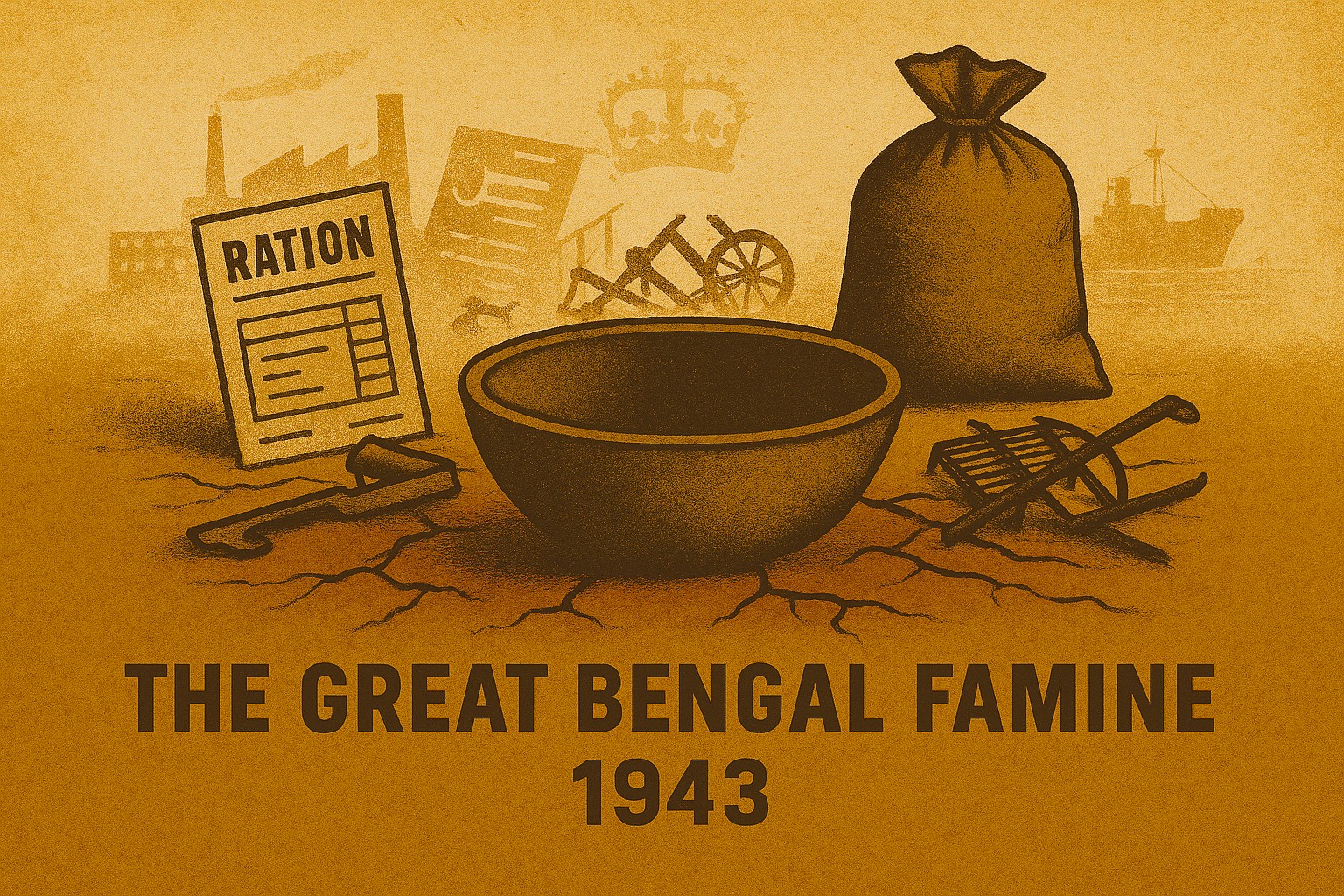
The Great Bengal Famine
The symbolic graphic represents the Great Bengal Famine of 1943 as a man‑made catastrophe rooted in imperial political economy rather than natural scarcity. The empty grain bowl foregrounds mass hunger produced amid availability, while the sealed grain sack signifies food reserves redirected away from the local population. The ration document evokes bureaucratic governance that privileged administrative order over human survival. Collectively, these elements symbolise three interlocking causes: the export of rice and grain to the United Kingdom to sustain the imperial war effort; the long‑term creation of abject poverty through colonial deindustrialisation, which dismantled Bengal’s agrarian resilience and indigenous production systems; and, most fundamentally, the structural violence of Empire itself, wherein colonial priorities rendered indigenous lives expendable. The cracked earth thus functions not as a marker of drought, but as a metaphor for an economic and moral landscape fractured by imperial extraction, policy neglect, and systemic indifference.”
Original Graphic Conceptualised by Mrs V. Vawda: April 2026
(4) The Diasporic Migration of Citizenry of India to Form the 35.4 Million, as the Largest Diaspora[27]
The Indian diaspora, a community of over 35.4 million, is not a monolith but a series of waves of migration, each shaped by the shadow of colonialism.
- The ‘Girmitiya’ Wave (19th – early 20th Century)[28]: Following the abolition of slavery, the British Empire instituted a system of indentured labour, or girmit. Millions of Indians were transported to colonies like Fiji, Mauritius, South Africa, Guyana, and Trinidad to work on sugar plantations under conditions often described as a new form of slavery. This wave created communities violently uprooted from their ancestral villages.
- The ‘Professional’ Wave (Post-1960s): [29]Following decolonization and the enactment of the Immigration and Nationality Act of 1965 in the US and similar policies in the UK, Canada, and Australia, a second wave of highly skilled professionals (doctors, engineers, IT specialists) migrated. While economically successful, this group often carried the same internalized colonial hierarchies as their predecessors.
- The ‘Gulf’ Wave (Late 20th Century – Present)[30]: A massive migration of semi-skilled and skilled labourers to the Gulf Cooperation Council (GCC) countries created a unique diaspora facing its own forms of labor exploitation and cultural marginalization.
This vast, dispersed population represents the living legacy of colonial-era mobility, with their collective consciousness shaped by the trauma of displacement and the enduring influence of (5) The Colonization of the Diasporic Mind[31]
The physical subjugation of India was followed by a more insidious conquest: the colonization of the mind. This is the process by which the colonized internalize the values, hierarchies, and prejudices of the colonizer, leading to self-alienation.
In the diaspora, this manifests in several ways:
- Linguistic Inferiority: The persistent belief that English is the sole language of intellect and success, leading to the deliberate non-transmission of mother tongues like Tamil, Gujarati, Punjabi, or Telugu to second and third generations. The erosion of these languages is the erosion of primary philosophical and emotional frameworks.
- Aspirational Mimicry: The pursuit of careers and lifestyles validated by the former colonizer (e.g., medicine, law, corporate management) at the expense of indigenous knowledge systems, arts, and humanities.
- Historical Amnesia: A sanitized or forgotten memory of the brutality of colonial rule, often replaced by a nostalgia for the “order” of the Raj, allowing the structures of oppression to persist unchallenged.
(6) Philosophical Power (Recognition, Dignity, Identity)
The struggle against the colonized mind is fundamentally a struggle for philosophical power. As philosopher Axel Honneth argues, identity is formed through intersubjective recognition. Colonialism was a grand project of misrecognition, denying the humanity, dignity, and capacity for self-governance of Indians.
For the diasporic individual, peace is contingent upon achieving three forms of recognition:
- Recognition of Dignity: Rejecting the colonial stereotype that frames Indian culture as backwards or primitive. This involves reclaiming the sophistication of Indian philosophy, mathematics, architecture, and governance systems that predate colonialism.
- Recognition of Identity: Moving beyond hyphenated identities (Indo-American, British-Asian) imposed by host nations, and instead, consciously constructing a self that is whole, rooted in ancestral heritage yet dynamically engaged with the present.
- Recognition of Narrative: Reclaiming the right to tell one’s own story. This involves challenging Western-centric historical narratives that minimize colonial brutality and erase indigenous resistance.
(7) Cognitive Validation through Documented Differences Between Emotional Responses in India and South Africa
A compelling case study for the persistence of colonial trauma can be found by comparing emotional and cognitive frameworks in India versus South Africa. Both nations endured British imperialism, but their post-colonial trajectories offer crucial differences.
- In India: Emotional responses to hierarchy are often internalized and reproduced through the caste system, a structure the British codified and exploited. The emotional response to authority is often complex, involving chalta hai (a fatalistic acceptance) and a deep-seated anxiety around social status, reflecting the colonial bureaucracy’s legacy.
- In South Africa: The Indian diaspora (largely descended from girmitiyas) experienced a compounded trauma: first as indentured labourers under the British, then under the Afrikaner-led apartheid regime, which classified them as a subordinate race. The emotional response here was forged in a crucible of more overt, legally codified racial violence. The anti-apartheid struggle, in which Indians like Mahatma Gandhi and countless others played a role, fostered a more direct tradition of political solidarity and collective resistance against racial subjugation. The documented difference is that the South African Indian experience led to a more pronounced political consciousness rooted in shared racial oppression, whereas in India, the same colonial structure produced a more insidious internalization of hierarchy.
This comparison provides cognitive validation that the colonial experience is not a uniform memory but manifests differently based on geography, yet fundamentally distorts human relations in both contexts.
(8) Ubuntu as a Linguistic Ethic Conceptualises Personhood as Fundamentally Relational, Emphasising Harmony, Interconnectedness, and Communal Identity
The antidote to the hyper-individualistic, hierarchical, and divisive ethos of colonialism lies in indigenous philosophies that center on relational personhood. The Nguni Bantu term Ubuntu, often translated as “I am because we are”, provides a powerful framework. While African in origin, its principles resonate deeply with the Indian philosophy of Vasudhaiva Kutumbakam (the world is one family).
Ubuntu offers a linguistic and ethical tool to dismantle the colonized mind:
- Relational Personhood: It challenges the colonial idea of the atomistic individual competing in a racial/caste hierarchy. Instead, it asserts that one’s humanity is tied to the humanity of others.
- Restorative Harmony: Ubuntu prioritizes the restoration of relationships over punitive justice. For the diaspora, this means prioritizing healing over perpetuating internal divisions (e.g., caste, regionalism).
- Communal Identity: It provides a framework for collective self-worth, moving beyond the need for external validation from former colonial powers. It fosters solidarity among different waves of the diaspora, recognizing a shared, interconnected identity.
(9) Epigraph / Epilogue
- Epigraph: “The colonized man who writes for his people ought to use the past with the intention of opening the future, as an invitation to action and a basis for hope.” , Frantz Fanon, The Wretched of the Earth
- Epilogue: The journey from being an object of empire to a subject of one’s own history is arduous. It requires a conscious turning away from the seductive simplicity of colonial binaries, civilized/savage, modern/backward, master/servant. This paper has traced the arc of that journey, from the shores of India to the global diaspora, revealing the persistent echo of “His Master’s Voice.” Yet, in the epilogue of this colonial chapter, a new narrative is being written, one not of subjugation, but of syncretic reclamation. The task now is to ensure this narrative becomes the dominant one, guiding future generations towards a peace built on authenticity, solidarity, and a decolonized self.
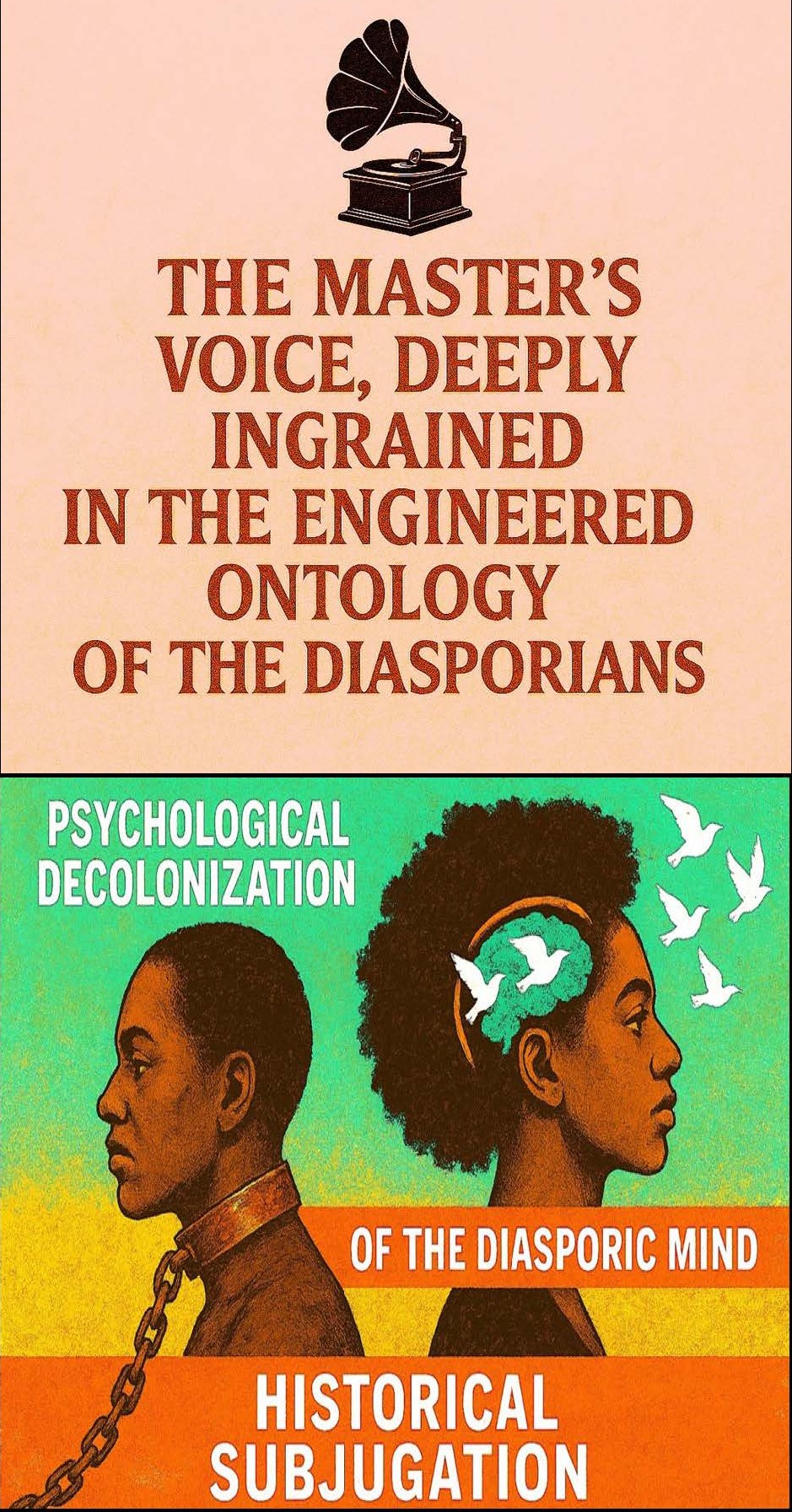
“The Master’s Voice”: Ontological Internalisation of Colonial Authority in the Diasporic Psyche.
Photo Top: This graphic employs the historical symbol of the gramophone, popularly associated with the phrase “His Master’s Voice”, as a visual metaphor for the enduring internalisation of colonial authority within diasporic consciousness. The absence of human figures foregrounds the operation of systems rather than individuals, emphasising how colonial power persists through repetition, legitimacy, and aesthetic normalisation rather than direct coercion. The typographic weight and classical serif font evoke the epistemic authority of empire, illustrating how colonial discourse was encoded as truth, order, and inevitability. Read conceptually, the image represents a process of ontogenic engineering, whereby the colonised subject comes to absorb and reproduce the coloniser’s worldview as part of their own being. Within the broader framework of decolonial inquiry, the graphic functions as a critical prompt, inviting reflection on the persistence of internalised domination and the necessity of epistemic rupture in the project of decolonising the diasporic mind.
Photo Bottom: This artwork symbolically traces the arc from historical subjugation to the ongoing project of psychological decolonisation within the global diasporic experience. The chained figure represents the institutionalised oppression, dispossession, and structural violence that shaped collective memory and identity. In contrast, the ascending birds emerging from the mind of the second figure embody cognitive liberation, cultural reclamation, and the restoration of agency. Together, the juxtaposition illustrates the transformative journey from inherited trauma to self‑determined consciousness, affirming that decolonisation is not merely political, but a profound inner rehumanisation process essential for organisational well‑being, social justice, and humane leadership.”
Original Graphic Conceptualised by Mrs V. Vawda: April 2026
(10) Call to Action to Decolonise the Diasporic Mind to Release from the Echoes of “His Master’s Voice”, Especially “Divide and Rule” Policy
The British Empire’s most enduring legacy was the “Divide and Rule” policy, systematically exacerbating religious, caste, and regional differences to maintain control. Today, this policy lives on in the diasporic mind, manifesting as sectarianism (Hindu-Muslim conflicts imported from the subcontinent), caste-based discrimination in temples and community organizations abroad, and the erosion of indigenous languages in favor of English.
The Call to Action has Aspects of Tripartisanism:
- A Pedagogy of Truth: Establish community-based educational initiatives that teach a decolonized history. This curriculum must include the brutal realities of the girmit system, the famines, and the psychological warfare of the Raj. It must celebrate anti-colonial resistance, from the 1857 Rebellion to the struggles of figures like Rani Lakshmibai,[32] Bhagat Singh[33], and Dr. B.R. Ambedkar[34], whose fight against casteism was also a fight against colonial structures.
- Active Dismantling of Imported Hierarchies: Diasporic institutions (temples, cultural organizations, professional associations) must consciously adopt policies that reject caste-based discrimination and promote inter-religious dialogue. This is not merely a cultural preference but a political act of breaking the colonial mold. Creating safe spaces for inter-caste and inter-faith marriage and collaboration is a direct repudiation of the “Divide and Rule” legacy.
- Linguistic Reclamation: A grassroots movement to prioritize mother-tongue transmission is essential. This involves creating fun, non-judgmental spaces for children to learn indigenous languages, celebrating literature and cinema in those languages, and challenging the stigma that speaking one’s mother tongue is a sign of being “unassimilated.” Language is the repository of worldview; to lose it is to lose the battle for the mind.
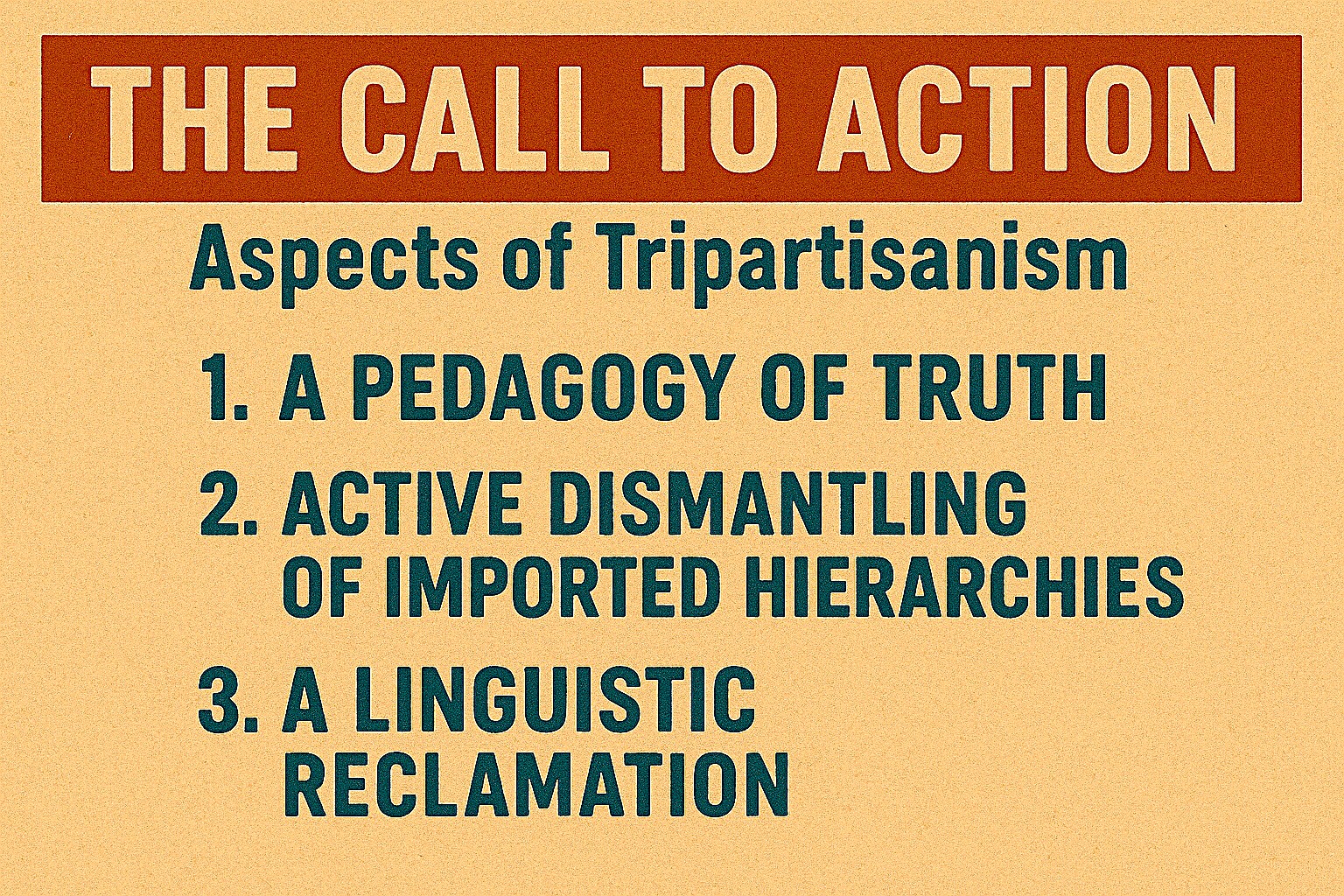
“This graphic articulates a tripartisan framework for institutional and psychosocial transformation, foregrounding a Call to Action grounded in ethical responsibility and critical consciousness. The first arm, A Pedagogy of Truth, underscores the necessity of historically informed, reflexive learning practices that confront epistemic silences and cultivate moral accountability. The second arm, Active Dismantling of Imported Hierarchies, advances a praxis‑oriented commitment to interrogating and restructuring inherited power asymmetries embedded within organisational systems, governance norms, and evaluative cultures. The third arm, A Linguistic Reclamation, affirms language as a site of power and restoration, advocating for the recovery of indigenous epistemologies, reclaimed vocabularies, and contextually rooted narratives. Collectively, these three interdependent dimensions position Tripartisanism as a coherent, actionable model for sustainable human‑centred transformation within contemporary institutions.”
Original Graphic Conceptualised by Mrs V. Vawda: April 2026
(10) Achi-Colonialism and Neo-Colonialism
The imperial archi- colonialism [35] conducted by European nations between the 17th century and coupled with neo colonialism has resulted in a deep-seated adverse effect on the subjugants, in terms of colonisation of the minds. The present challenge for these countries is decolonisation of the mind, of the future leaders, post-independence and freedom in various occupied countries, including Africa and in particular South Africa, post-apartheid 1994[36].
(11) Conclusion
The shadow of colonial imperialism is long, but it is not permanent. As a peace protagonist, I assert that the shade it casts, where communities remain fractured, languages silenced, and identities defined by a colonial metric, is not a natural state but a condition to be actively overcome. The 38-million-strong Indian diaspora stands at a pivotal juncture. It can remain a repository of colonial trauma, perpetuating the very divisions the British engineered, or it can become a vanguard of decolonization, demonstrating that true peace is found in the recovery of dignity, the embrace of a relational identity as encapsulated by Ubuntu, and the courageous act of thinking, speaking, and living outside the master’s voice. The path forward is not one of isolation, but of conscious, interconnected liberation.
(12) The Bottom Line and Importance of Persons of Indian Origins; Locally in India and Globally, with Attempts at Neo Colonisation
The Bottom Line is that persons of Indian origin (PIOs) are not merely a diaspora; they are a global civilizational force. Their importance is twofold: for India, they represent a vast resource of cultural, intellectual, and economic capital; for the world, they are bridges between the Global South and the Global North. However, their potential is undermined by the lingering effects of colonial mental conditioning.
Furthermore, we must remain vigilant against attempts at neo-colonization. In the 21st century, this does not come in the form of territorial empires, but through:
- Cultural Hegemony: The continued dominance of Western media, educational frameworks, and cultural standards that marginalize Indian knowledge systems.
- Economic Coercion: Structures of global finance and trade that perpetuate the colonial-era role of India and its diaspora as providers of cheap labor and markets for Western goods.
- Psychological Conditioning: The subtle and overt messages that Western cultural and political models are the only valid pathways to “modernity” and “success.”
For PIOs locally in India and globally, the bottom line is this: peace is not passive. It is an active, deliberate, and collective struggle to reclaim the mind. The world watches as the largest diaspora determines whether it will remain a testament to empire or become the architect of a more just, interconnected, and peaceful world. The choice, and the call to action, is ours.
(13) Take Home Message
The colonial project succeeded in its material objectives but failed in its spiritual one. It could not extinguish the human spirit. However, its echoes continue to create conflict within us and between us. Peace, therefore, is an internal and external project of decolonization. The largest diaspora in the world has the unique opportunity to model a new kind of global citizenship, one that honours its ancient roots, learns from its painful history, and consciously forges a future free from the coloniser’s psychological grip. The past cannot be changed, but its power over the future can be broken.
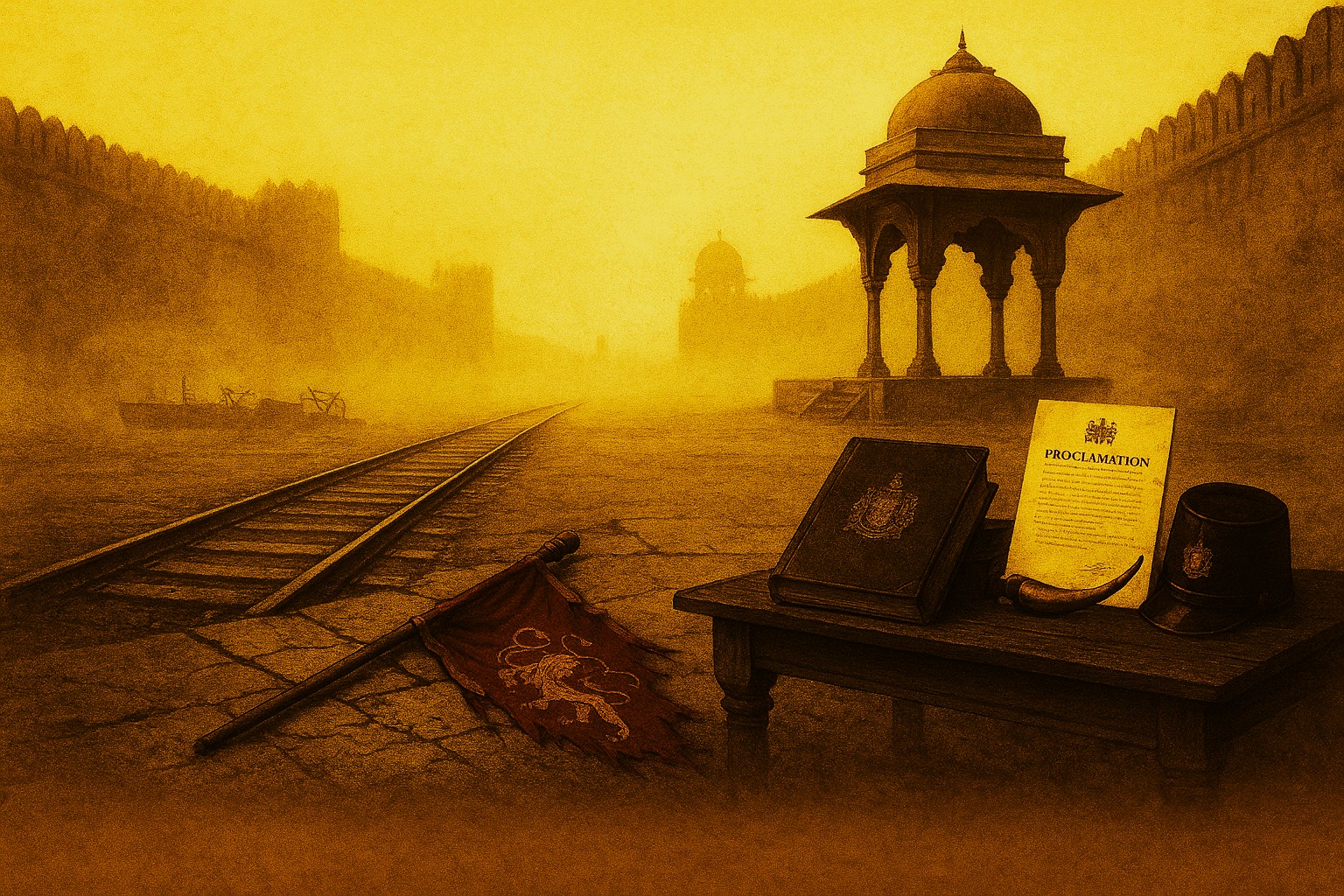
The aftermath‑focused conceptual scene represents the structural consequences of the suppression of the 1857 uprising and the subsequent dissolution of indigenous sovereignty of the Last Mughal Emperor, Shah Zafar Bahadur. The emptied architectural space signifies the erasure of plural governance traditions, while the fallen standard marks the end of symbolic legitimacy without resorting to personal depiction. The intrusion of railway tracks through the former civic and ceremonial space represents the imposition of imperial infrastructure, facilitating extraction, surveillance, and administrative control. The proclamation, ledger, and imperial insignia placed in the foreground denote the transition from relational rule to bureaucratised domination, wherein authority was reconstituted through documents, decrees, and distant accountability. The pervasive dust and haze function as metaphors for exile, silenced memory, and historical amnesia. Collectively, the composition reframes surrender not as an individual act, but as a civilisational rupture, offering a reflective lens on power, governance, and the enduring ethical responsibilities of institutions.
Original Photographs Conceptualised by Mrs V. Vawda: April 2026
Comments and discussion are invited by e-mail: vawda@ukzn.ac.za
References:
[1] Personal Quote by author, April 2026
[2] Personal Quote by author, April 2026
[3] https://www.bing.com/ck/a?!&&p=f1c11788fb68f798f26d3e78f1fa1c6805387f813f1341ed0d9293804ef63f3fJmltdHM9MTc3NTE3NDQwMA&ptn=3&ver=2&hsh=4&fclid=2b35ea2c-b8d0-63b3-2370-fd36b95362a4&psq=Mandala+definition&u=a1aHR0cHM6Ly93d3cuYnJpdGFubmljYS5jb20vdG9waWMvbWFuZGFsYS1kaWFncmFt
[4] https://www.bing.com/ck/a?!&&p=8f1cc624c31e848ff0f51ac9cf0f800c9ba9faec1e8daa886be591e65d322ba7JmltdHM9MTc3NTE3NDQwMA&ptn=3&ver=2&hsh=4&fclid=2b35ea2c-b8d0-63b3-2370-fd36b95362a4&psq=Colonised+Mind+of+the+Diasporian&u=a1aHR0cHM6Ly93d3cucmVzZWFyY2hnYXRlLm5ldC9wdWJsaWNhdGlvbi8zODY0NjE3MTdfVGhlX0NvbG9uaWFsX1BzeWNob2xvZ2ljYWxfQ29tcGxleF9BX0ZyYW1ld29ya19mb3JfVW5kZXJzdGFuZGluZ190aGVfUHN5Y2hvbG9naWNhbF9JbXBhY3RzX29mX0NvbG9uaWFsaXNt
[5] (PDF) The Colonial Psychological Complex: A Framework for Understanding the Psychological Impacts of Colonialism
[6] https://www.bing.com/ck/a?!&&p=dcc01cace61ac168047a37e858a9bf4a54653bd7e89f40ebbfbe8ff4756c75ebJmltdHM9MTc3NTE3NDQwMA&ptn=3&ver=2&hsh=4&fclid=2b35ea2c-b8d0-63b3-2370-fd36b95362a4&psq=Colonial+Psychological+Complex+(CPC)&u=a1aHR0cHM6Ly93d3cuc2NyaWJkLmNvbS9kb2N1bWVudC84MzUyNzM2OTUvVGhlQ29sb25pYWxQc3ljaG9sb2dpY2FsQ29tcGxleA
[7] https://www.bing.com/ck/a?!&&p=337606754924e5c2dd6769b3392624f7e8741fedf9844ab8619779556a11ab90JmltdHM9MTc3NTE3NDQwMA&ptn=3&ver=2&hsh=4&fclid=2b35ea2c-b8d0-63b3-2370-fd36b95362a4&psq=Colonial+Stockholm+Syndrome+(CSS)&u=a1aHR0cHM6Ly93d3cucmVzZWFyY2hnYXRlLm5ldC9wdWJsaWNhdGlvbi8zODU3NDY5MTVfQ29sb25pYWxfU3RvY2tob2xtX1N5bmRyb21lX1RoZV9FbmR1cmluZ19MZWdhY3lfb2ZfUHN5Y2hvbG9naWNhbF9NYW5pcHVsYXRpb25fYW5kX0N1bHR1cmFsX0NvbnRyb2xfaW5fUG9zdGNvbG9uaWFsX1NvY2lldHk
[8] https://www.bing.com/ck/a?!&&p=108ad9f59a0e98243d070caf2723cdcb9dc62b1b472ae8a4202207505ab80872JmltdHM9MTc3NTE3NDQwMA&ptn=3&ver=2&hsh=4&fclid=2b35ea2c-b8d0-63b3-2370-fd36b95362a4&u=a1aHR0cHM6Ly93d3cucmFsbHkycmVwYXkuY29tL3Bvc3Qvc3RlYWxpbmctbGFuZHMtc2F2aW9yLWNvbXBsZXg&ntb=1
[9] https://www.bing.com/ck/a?!&&p=9755ec194161e77782ed9a7485fc5cce5a783435843073283ff14ba7d29f6ae9JmltdHM9MTc3NTE3NDQwMA&ptn=3&ver=2&hsh=4&fclid=2b35ea2c-b8d0-63b3-2370-fd36b95362a4&u=a1aHR0cHM6Ly93d3cuYWNhZGVtaWEuZWR1LzEyNTY2Njk5Mi9Db2xvbmlhbF9OYXJjaXNzaXNtX1N5bmRyb21lX0FuX0V4YW1pbmF0aW9uX29mX0V4cGxvaXRhdGlvbl9hbmRfU2VsZl9BZ2dyYW5kaXplbWVudF9pbl9Db2xvbmlhbF9IaXN0b3J5X2FuZF9CZXlvbmQ&ntb=1
[10] https://www.bing.com/ck/a?!&&p=4269e83d9b096c228450d0cf5799032ab0f943706f5439240c3df504acb88fa7JmltdHM9MTc3NTE3NDQwMA&ptn=3&ver=2&hsh=4&fclid=2b35ea2c-b8d0-63b3-2370-fd36b95362a4&u=a1aHR0cHM6Ly9lY2FtcHVzb250YXJpby5wcmVzc2Jvb2tzLnB1Yi90aGVjb2xvbmlhbG1pcnJvci9jaGFwdGVyL19fdW5rbm93bl9fLTgv&ntb=1
[11] https://www.bing.com/ck/a?!&&p=430e5ce9d8a8d9b2b2b560b337c5a680b2ba6924f0e27d69ac0adb21c5f02b3aJmltdHM9MTc3NTE3NDQwMA&ptn=3&ver=2&hsh=4&fclid=2b35ea2c-b8d0-63b3-2370-fd36b95362a4&u=a1aHR0cHM6Ly93d3cuYWNhZGVtaWEuZWR1LzEyNjA5NjE5NC9UaGVfQ29sb25pYWxfUHN5Y2hvbG9naWNhbF9Db21wbGV4X0FfRnJhbWV3b3JrX2Zvcl9VbmRlcnN0YW5kaW5nX3RoZV9Qc3ljaG9sb2dpY2FsX0ltcGFjdHNfb2ZfQ29sb25pYWxpc20&ntb=1
[12] https://www.bing.com/ck/a?!&&p=918f63f8864db424d5ff7148c1b855e9707b15b9c76b265aabd5024d20c963e5JmltdHM9MTc3NTE3NDQwMA&ptn=3&ver=2&hsh=4&fclid=2b35ea2c-b8d0-63b3-2370-fd36b95362a4&u=a1aHR0cHM6Ly9zaW1wbHlwdXRwc3ljaC5jby51ay9nbG9iYWwtcHN5Y2gvdGhlLWxpbmdlcmluZy1wc3ljaG9sb2dpY2FsLWltcGFjdC1vZi1jb2xvbmlhbC1ydWxlLW9uLWZvcm1lci1jb2xvbmllcw&ntb=1
[13] TRANSCEND MEDIA SERVICE » His Master’s Voice, His Master’s Eyes, and His Master’s Ears
[14] https://www.bing.com/ck/a?!&&p=c00f393a2796a393109fb66050388b2ba8496eea47d3fba2379b3116dbb93e35JmltdHM9MTc3NTE3NDQwMA&ptn=3&ver=2&hsh=4&fclid=2b35ea2c-b8d0-63b3-2370-fd36b95362a4&psq=last+Mughal+Emperor%2c+Zafar&u=a1aHR0cHM6Ly9lbi53aWtpcGVkaWEub3JnL3dpa2kvQmFoYWR1cl9TaGFoX1phZmFy
[15] https://www.bing.com/ck/a?!&&p=db0e4402781c0aabaf2bf12d9039e3a919e67eebc379eca3997b3796cb615b09JmltdHM9MTc3NTE3NDQwMA&ptn=3&ver=2&hsh=4&fclid=2b35ea2c-b8d0-63b3-2370-fd36b95362a4&psq=harijans+meaning&u=a1aHR0cHM6Ly9yYW1hY2hhbmRyYWd1aGEuaW4vYXJjaGl2ZXMvdGhlLXJpc2UtYW5kLWZhbGwtb2YtdGhlLXRlcm0taGFyaWphbi10aGUtdGVsZWdyYXBoLmh0bWw
[16] https://www.transcend.org/tms/2021/12/the-lot-of-the-exploited-discriminated-and-oppressed-part-1/
[17] https://www.transcend.org/tms/2021/12/the-lot-of-the-exploited-discriminated-and-oppressed-part-1/
[18] https://www.bing.com/ck/a?!&&p=9cf1578862312ac60e4a8633c45a00e1fbe1a0c0ece21d7ea5ab300b4b788306JmltdHM9MTc3NTE3NDQwMA&ptn=3&ver=2&hsh=4&fclid=2b35ea2c-b8d0-63b3-2370-fd36b95362a4&psq=38-million-strong+Indian+diaspora&u=a1aHR0cDovL3d3dy5pbmRpYW5kaWFzcG9yYS5vcmcvbmV3cy9nbG9iYWwtZm9vdHByaW50LWluZGlhbi1kaWFzcG9yYS13b3JsZHMtbGFyZ2VzdC1kaWFzcG9yYQ
[19] https://www.bing.com/ck/a?!&&p=4f2fb7a7d988270171cb0a6fdc7ac9f18ac93105d0911130cec971bd937a36a1JmltdHM9MTc3NTE3NDQwMA&ptn=3&ver=2&hsh=4&fclid=2b35ea2c-b8d0-63b3-2370-fd36b95362a4&psq=Persons+of+Indian+Origins+(PIOs)&u=a1aHR0cHM6Ly93d3cubWhhLmdvdi5pbi9zaXRlcy9kZWZhdWx0L2ZpbGVzLzIwMjItMDcvRm9yZWlnRC1GQVFzLVBJTy1DcmQucGRm
[20] https://www.bing.com/ck/a?!&&p=ea475309a2ab788d1e8b4fc1a00d7bf46893b1000827943cee8d241f30b3f59eJmltdHM9MTc3NTE3NDQwMA&ptn=3&ver=2&hsh=4&fclid=2b35ea2c-b8d0-63b3-2370-fd36b95362a4&psq=%e2%80%9cDivide+and+Rule%e2%80%9d+policy+of+british+colonialists&u=a1aHR0cHM6Ly93d3cuYnJpdGFubmljYS5jb20vdG9waWMvZGl2aWRlLWFuZC1ydWxl
[21] https://www.bing.com/ck/a?!&&p=af9928b1caf7d16bfe3e87c2f69d5d5275e7f704de1e6e0b6d03e290b6417740JmltdHM9MTc3NTE3NDQwMA&ptn=3&ver=2&hsh=4&fclid=2b35ea2c-b8d0-63b3-2370-fd36b95362a4&psq=%e2%80%9cDivide+and+Rule%e2%80%9d+policy+of+british+colonialists&u=a1aHR0cHM6Ly9leHBsYWluaW5naGlzdG9yeS5vcmcvMjAyNS8wNi8wNS9kaXZpZGUtYW5kLXJ1bGUtdGhlLXJvbGUtb2YtYnJpdGlzaC1jb2xvbmlhbC1wb2xpY3ktaW4tc2hhcGluZy1jb21tdW5hbC1pZGVudGl0aWVzLw
[22] https://www.transcend.org/tms/2026/01/ubuntu-rising-a-peace-force-against-global-belligerism/
[23] https://www.bing.com/ck/a?!&&p=0d4dfbe85e00be5267ff442a14f27a2cb91508aa4713b84ba4042583c211bcdfJmltdHM9MTc3NTE3NDQwMA&ptn=3&ver=2&hsh=4&fclid=2b35ea2c-b8d0-63b3-2370-fd36b95362a4&psq=British+Invasion%2c+Occupation%2c+and+Subjugation+in+India&u=a1aHR0cHM6Ly93d3cuaGlzdG9yaWFzY3JpcHRhLm9yZy9tb2Rlcm4tZXJhL3RoZS1sb25nLXN0cnVnZ2xlLW9mLWJyaXRhaW4tZm9yLXBvd2VyLWluLXRoZS1pbmRpYW4tc3ViY29udGluZW50Lw
[24] https://www.bing.com/ck/a?!&&p=2e8d4b7b07a52a70e4364c7e8da8eb832e6d07894319ccfb5e9195db9408b6f3JmltdHM9MTc3NTE3NDQwMA&ptn=3&ver=2&hsh=4&fclid=2b35ea2c-b8d0-63b3-2370-fd36b95362a4&psq=Battle+of+Plassey+in+1757&u=a1aHR0cHM6Ly9lbi53aWtpcGVkaWEub3JnL3dpa2kvQmF0dGxlX29mX1BsYXNzZXk
[25] https://www.bing.com/ck/a?!&&p=818082adfaaa0fe03ea123070802636c673163d95bb2d358f31845c4637982b8JmltdHM9MTc3NTE3NDQwMA&ptn=3&ver=2&hsh=4&fclid=2b35ea2c-b8d0-63b3-2370-fd36b95362a4&psq=Lord+Macaulay%e2%80%99s+infamous+%e2%80%9cMinute+on+Indian+Education%e2%80%9d+(1835)&u=a1aHR0cHM6Ly9hcmNoaXZlLm9yZy9kb3dubG9hZC9NaW51dGVzXzIwMTMxMS9NaW51dGVzTmV3LnBkZg
[26] https://www.bing.com/ck/a?!&&p=8ff63c7e494a6f30bd3978132fd22c8bd6c31074edc3e6013254738f6075725eJmltdHM9MTc3NTE3NDQwMA&ptn=3&ver=2&hsh=4&fclid=2b35ea2c-b8d0-63b3-2370-fd36b95362a4&psq=%e2%80%9cSepoy+Mutiny%e2%80%9d&u=a1aHR0cHM6Ly9lbi53aWtpcGVkaWEub3JnL3dpa2kvSW5kaWFuX1JlYmVsbGlvbl9vZl8xODU3
[27] https://www.bing.com/ck/a?!&&p=d74928d46dbdafa84fa033da1ac7696b8f77626ec4a1c5051369ffc17c17bb66JmltdHM9MTc3NTE3NDQwMA&ptn=3&ver=2&hsh=4&fclid=2b35ea2c-b8d0-63b3-2370-fd36b95362a4&psq=The+Diasporic+Migration+of+Citizenry+of+India+to+Form+the+35.2+Million%2c+as+the+Largest+Diaspora&u=a1aHR0cHM6Ly9jb21wYXNzLnJhdWlhcy5jb20vY3VycmVudC1hZmZhaXJzL2luZGlhcy1kaWFzcG9yYS8
[28] https://www.bing.com/ck/a?!&&p=ee9fe2b0663d80e34c7b2d98019e987186ac83d3559fc542353e5b37a8b17be8JmltdHM9MTc3NTE3NDQwMA&ptn=3&ver=2&hsh=4&fclid=2b35ea2c-b8d0-63b3-2370-fd36b95362a4&psq=%e2%80%98Girmitiya%e2%80%99+Wave+(19th+%e2%80%93+early+20th+Century)%3a&u=a1aHR0cHM6Ly9lbi53aWtpcGVkaWEub3JnL3dpa2kvR2lybWl0aXlhcw
[29]https://www.bing.com/ck/a?!&&p=8585dbc151f4f214f01b4a4a16fa87b51f985afcaed3368710be3b9a3adf8ae3JmltdHM9MTc3NTE3NDQwMA&ptn=3&ver=2&hsh=4&fclid=2b35ea2c-b8d0-63b3-2370-fd36b95362a4&psq=%e2%80%a2+The+%e2%80%98Professional%e2%80%99+Wave+(Post-1900s)%3a&u=a1aHR0cHM6Ly91YndwLmJ1ZmZhbG8uZWR1L2hpc3Rvcnktb2YtY2RzLzE5dGgtY2VudHVyeS9lbWVyZ2VuY2Utb2YtcHJvZmVzc2lvbmFsaXNtLWluLWxhdGUtMTl0aC1hbmQtZWFybHktMjB0aC1jZW50dXJ5LWFtZXJpY2Ev
[30] https://www.bing.com/ck/a?!&&p=1152890684ea458d9180a7e2293644fbe402750b9c14f276ab387140caed7893JmltdHM9MTc3NTE3NDQwMA&ptn=3&ver=2&hsh=4&fclid=2b35ea2c-b8d0-63b3-2370-fd36b95362a4&psq=%e2%80%a2+The+%e2%80%98Gulf%e2%80%99+Wave+(Late+20th+Century+%e2%80%93+Present)&u=a1aHR0cHM6Ly93d3cucmVzZWFyY2hnYXRlLm5ldC9wdWJsaWNhdGlvbi8zOTQ4MjY3MzNfVGhlX1RocmVlX1dhdmVzX29mX0dsb2JhbGl6YXRpb25fRXZvbHV0aW9uX0ltcGFjdHNfYW5kX0Z1dHVyZV9DaGFsbGVuZ2Vz
[31] https://www.bing.com/ck/a?!&&p=b11384847411317773710df8f4e1308f95f0b5deb18edbda8f0aeec5210fdd47JmltdHM9MTc3NTE3NDQwMA&ptn=3&ver=2&hsh=4&fclid=2b35ea2c-b8d0-63b3-2370-fd36b95362a4&psq=the+colonization+of+the+diasporic+mind+summary&u=a1aHR0cHM6Ly93d3cuYWNhZGVtaWEuZWR1LzExMjQxMjczNC9FZGl0b3JpYWxfQ29sb25pemF0aW9uX2FuZF9kZWNvbG9uaXphdGlvbl9vZl90aGVfbWluZA
[32] https://www.bing.com/ck/a?!&&p=deace7b616c74264a86be88dacac0dde6d6c2f1dff4a4ed3159a28817fa8ef37JmltdHM9MTc3NTE3NDQwMA&ptn=3&ver=2&hsh=4&fclid=2b35ea2c-b8d0-63b3-2370-fd36b95362a4&psq=rani+lakshmibai+of+jhansi&u=a1aHR0cHM6Ly93d3cuYnJpdGFubmljYS5jb20vYmlvZ3JhcGh5L0xha3NobWktQmFp
[33] https://www.bing.com/ck/a?!&&p=baf5358b1bd7e2a75f5b1c8532beadf6a2f2a5374400747b44a9a9281a46651cJmltdHM9MTc3NTE3NDQwMA&ptn=3&ver=2&hsh=4&fclid=2b35ea2c-b8d0-63b3-2370-fd36b95362a4&psq=bhagat+singh+death&u=a1aHR0cHM6Ly9lbi53aWtpcGVkaWEub3JnL3dpa2kvQmhhZ2F0X1Npbmdo
[34] https://www.transcend.org/tms/2021/12/the-lot-of-the-exploited-discriminated-and-oppressed-part-1/
[35] This is a neo-logism formulated by the author in the present era as compared with neo-colonialism of the 21st century, which due to its subtlety, is much more dangerous
[36] https://www.bing.com/ck/a?!&&p=8c0749cae0c297b274248a3e4f282c14c9c052423cca8f3d90be477c80d1e28bJmltdHM9MTc3NTE3NDQwMA&ptn=3&ver=2&hsh=4&fclid=2b35ea2c-b8d0-63b3-2370-fd36b95362a4&psq=South+Africa%2c+post-apartheid+1994&u=a1aHR0cHM6Ly9lbi53aWtpcGVkaWEub3JnL3dpa2kvSGlzdG9yeV9vZl9Tb3V0aF9BZnJpY2FfKDE5OTQlRTIlODAlOTNwcmVzZW50KQ
______________________________________________
Professor G. Hoosen M. Vawda (Bsc; MBChB; PhD.Wits) is a member of the TRANSCEND Network for Peace Development Environment.
Director: Glastonbury Medical Research Centre; Community Health and Indigent Programme Services; Body Donor Foundation SA.
Principal Investigator: Multinational Clinical Trials
Consultant: Medical and General Research Ethics; Internal Medicine and Clinical Psychiatry:UKZN, Nelson R. Mandela School of Medicine
Executive Member: Inter Religious Council KZN SA
Public Liaison: Medical Misadventures
Activism: Justice for All
Email: vawda@ukzn.ac.za
Tags: Decolonisation of the mind, Gandhi, Nehru, The Great Bengal Famine
This article originally appeared on Transcend Media Service (TMS) on 13 Apr 2026.
Anticopyright: Editorials and articles originated on TMS may be freely reprinted, disseminated, translated and used as background material, provided an acknowledgement and link to the source, TMS: Peace in the Shadow and Shade of Colonial Imperialism: A Protagonist’s Call to Decolonize the Diasporic Mind (Part 1), is included. Thank you.
If you enjoyed this article, please donate to TMS to join the growing list of TMS Supporters.

This work is licensed under a CC BY-NC 4.0 License.
Join the discussion!
We welcome debate and dissent, but personal — ad hominem — attacks (on authors, other users or any individual), abuse and defamatory language will not be tolerated. Nor will we tolerate attempts to deliberately disrupt discussions. We aim to maintain an inviting space to focus on intelligent interactions and debates.