


The Imperial Pillars in British Colonial India: Lalvani vs Tharoor–a Critical Analysis of Peace Propagation or Peace Disruption Part 2
TRANSCEND MEMBERS, 27 Apr 2026
Prof Hoosen Vawda – TRANSCEND Media Service
The Making or Breaking of British India: The “Told Story of British Enterprise revisited.[1]
“The British Raj built the British Empire in India, using local resources, labour and force, to facilitate the exploitation of the continent for the sole benefit of the British people, over nearly a 200 year period, thinking that they will be in subjugative control, for ever. [2]
This publication is suitable for general readership. Parental guidance is recommended for minors who may use this research paper as a resource material, for projects.
The author invites and welcomes any comments as well as discussions, by the readership.
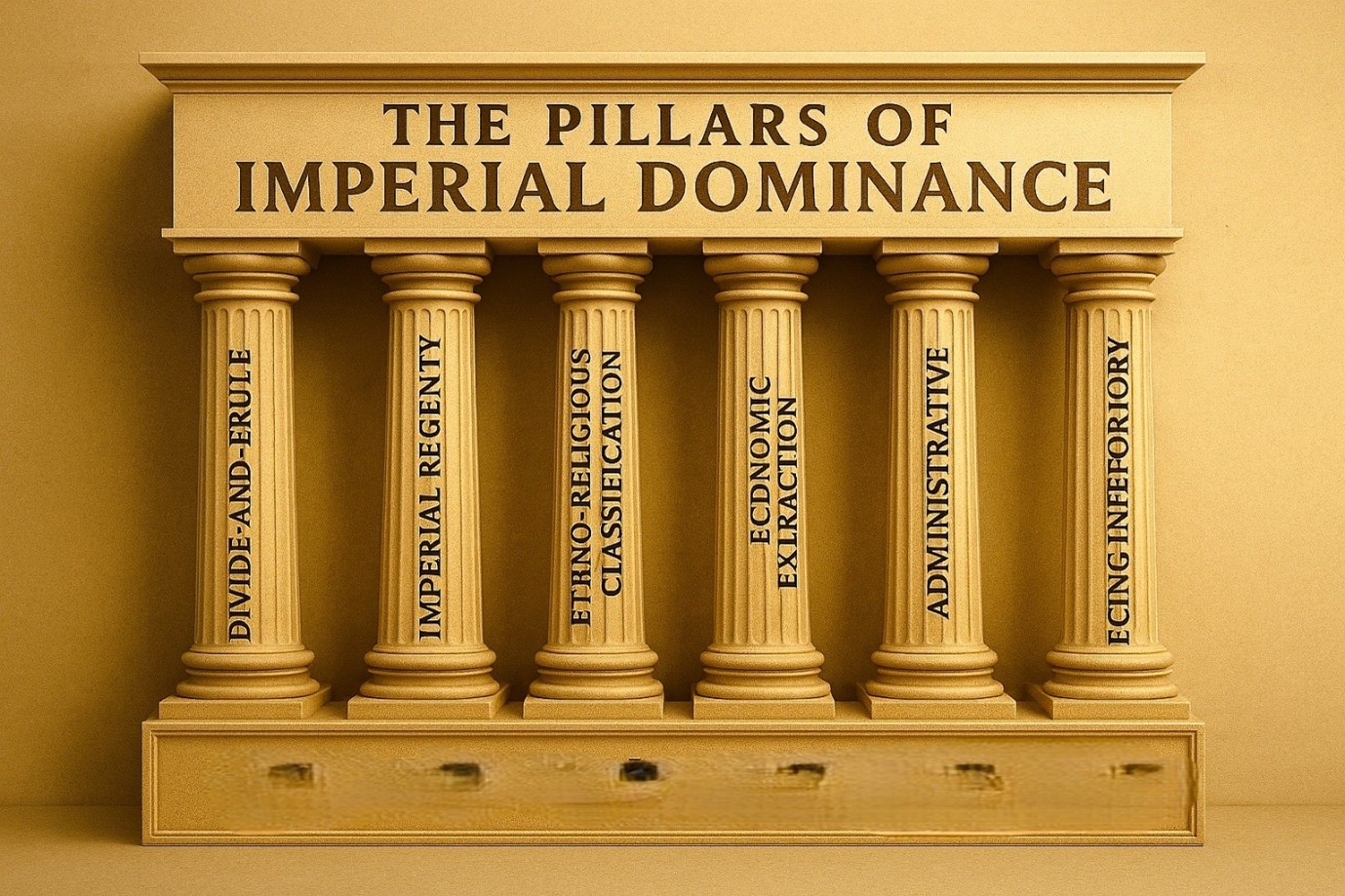
The Conceptual Architecture of the Pillars of Occupied Indian Peninsula, to ensure successful subjugation by the Imperial Britannia for nearly 200 years.
Original Graphic Conceptualised by Mrs V. Vawda: April 2026
(1) Prologue
The Pillars of Imperial Dominance in Pre‑1947 British India: A Structural Model of Colonial Power
9 Apr 2026 – The author considers it appropriate to commence this paper, the second part in this series, by presenting an overview of the real-life situation in India, which was ruled by the brutal regime of Britannia. This foreword is to set the background to discuss the variance in views and political commentary of the two great titans of the socio-political scenario in the present day, post freedom, fractured India. This division was in concordance with the golden strategy of British aristocracy, of dividing and ruling the subjugated nation, which it did most effectively in on 15th August 1947, by dividing the entire peninsula, using the arbitrary, impractical office drawn concept of The Great Partition leading to the disharmony between Hindus and Muslims who were happily coexisting for centuries before this heinous legislature, formulated by the white subjugators resulting the brutal murder of innocent civilians, as intentionally orchestrated by the white British supremacists.[3]
It is reported that the casualties and displacement, were approximately 2 million people, who died in communal riots, and around 25 million were displaced. [4],[5],[6]. It is estimated that the Partition forced about 80 lakh people to migrate across the new borders. Between five to ten lakh people were killed in partition related violence. The above three‑dimensional architectural graphic conceptualizes British imperial dominance in pre‑1947 India, as a system sustained not by a single coercive force but by a mutually reinforcing assemblage of structural pillars, carefully designed to control the conquered. The classical columnar form is deliberately invoked to signify durability, normalization, and the illusion of permanence, features central to imperial governance. The model visually argues that empire functioned as an integrated architecture of power, in which each pillar derived strength from the others and collapse was prevented through systemic interdependence.
The first pillar, Divide‑and‑Rule, represents the strategic fragmentation of Indian society along religious, ethnic, linguistic, and regional lines, deliberately cultivated to inhibit unified political consciousness. This mechanism transformed diversity into vulnerability and internal difference into administrative leverage.
Imperial Regentry denotes rule exercised on behalf of a distant sovereign authority, severing sovereignty from the governed population. Power was centralized, externalized, and rendered unaccountable to indigenous political traditions, creating a permanent condition of delegated domination.
The pillar of Ethno‑Religious Classification[7] captures the bureaucratic freezing of fluid identities into rigid categories, through censuses, legal codification, and electoral mechanisms, that transformed lived social continuities into governable abstractions. This practice did not merely describe society; it actively re‑engineered it.
Economic Extraction [8]signifies the systematic transfer of surplus from colony to metropole, encompassing deindustrialization, exploitative taxation, and the redirection of agricultural and industrial production toward imperial priorities. This pillar underwrote the material base of empire while structurally impoverishing the colonized economy.
Administrative Control represents the penetration of colonial bureaucracy into everyday life through law, policing, land tenure, and revenue systems. This apparatus normalized foreign governance by rendering it routine, procedural, and impersonally authoritative.
The final pillar, Engineered Inferiority[9],[10], operates at the deepest ontological level. It symbolizes the epistemic and psychological conditioning through which colonial hierarchies were internalized as natural, shaping self‑perception, aspiration, and legitimacy. This pillar links material domination to cognitive colonization, ensuring the endurance of empire beyond physical rule.
The entablature labelled “The Pillars of Imperial Dominance” and the foundational base referencing “Decolonising the Diasporic Mind of Indians” [11], [12]”, situate this historical model within a broader decolonial inquiry. The graphic thus serves not only as a retrospective analysis of imperial power but as a diagnostic framework for understanding how colonial structures persist within diasporic consciousness long after political withdrawal. Read holistically, the diagram argues that imperial dominance was sustained through structural coherence, and that decolonization, whether political, psychological, or epistemic, requires the deliberate dismantling of each supporting pillar rather than the symbolic removal of empire alone.
Empire, Memory, and the Contest for Interpretation
Imperial history is never settled. It is inherited, argued over, contested, and repeatedly re‑narrated by those who live with its consequences long after the empire itself has dissolved. Few empires have inspired as much moral, economic, and psychological debate as British imperialism in the Indian subcontinent. To some, the British presence represented extraction, dispossession, famine, and civilizational humiliation; to others, it marked the introduction of institutions that later enabled political unification and democratic governance.
This work begins from the premise that empire does not end with political withdrawal. Its afterlives persist in infrastructure, legal systems, economic patterns, and, most enduringly, in the mental frameworks through which societies interpret their own past. The divergence between Shashi Tharoor [13]and Kartar Lalvani [14]is therefore not merely a disagreement over historical facts. It is a clash between two epistemological [15] lenses: one rooted in postcolonial critique, the other in institutional continuity.
Understanding why these perspectives diverge so sharply is essential, not to select a winner, but to appreciate how empire reshapes memory, identity, and national self‑understanding across generations.
(2) Introduction
Why British India Remains a Battleground of Interpretation
The British Raj [16](c. 1757-1858 to1947), so called Crown Rule, governed India longer than any modern imperial project and did so while profoundly transforming its political economy. At independence in 1947, India inherited a complex legacy: railways, legal institutions, a centralized bureaucracy, and parliamentary governance on one hand; on the other, severe poverty, deindustrialization, communal tensions, and underdeveloped human capital.
In the post‑independence period, and more recently in the era of assertive civilizational rhetoric under Prime Minister Narendra Damodardas Modi [17], [18], [19], the interpretation of British rule has become inseparable from India’s self‑definition as Bharat.[20] The debate is no longer purely academic; it is bound to questions of dignity, sovereignty, and historical justice.
Shashi Tharoor and Kartar Lalvani represent two poles within this debate. Tharoor articulates a moral and economic indictment of empire, emphasizing exploitation and loss. Lalvani, in contrast, advances a counter‑narrative of state formation, arguing that British enterprise laid foundations for modern India’s unity and governance.
Their disagreement reflects deeper methodological, ethical, and psychological differences in how history itself is evaluated.
(3) Why Tharoor and Lalvani Stand at Opposite Poles
- Foundational Assumptions
Shashi Tharoor
Tharoor’s analysis begins from the assumption that empire is structurally extractive. In works such as An Era of Darkness and Inglorious Empire, he argues that British rule systematically drained India’s wealth, dismantled indigenous industries, and aggravated famines through misgovernance and indifference. For Tharoor, infrastructure such as railways was primarily an instrument of extraction, not altruistic modernization
Kartar Lalvani
Lalvani begins from a different premise: that state‑building must be assessed relative to historical context. He argues that when the British consolidated India, the subcontinent was fragmented, weakened by prior invasions and internal strife. In The Making of India, he contends that British administrative unity, standardized law, civic institutions, and infrastructure enabled India to emerge as a single political entity rather than a patchwork of successor states.
- Methodological Differences
| Dimension | Tharoor | Lalvani |
| Primary Lens | Moral‑economic critique | Institutional‑historical assessment |
| Use of Data | GDP decline, famines, wealth drain | Administrative reach, governance capacity |
| View of Infrastructure | Tools of exploitation | Foundations of national integration |
| Colonial Intent | Predominantly predatory | Mixed; often reformist post‑1858 |
These are not disagreements over isolated facts but over what constitutes historical value.
- Imperialism as Experience versus Outcome
Tharoor privileges the lived experience of colonized populations: poverty, humiliation, racial hierarchy, and cultural denigration. His work resonates strongly with postcolonial theory, which emphasizes power asymmetry and ethical injury.
Lalvani privileges institutional outcomes: a unified civil service, a professional army, codified law, and parliamentary norms that India retained after independence. He argues that these outcomes should not be erased by moral absolutism. [express.co.uk], [dailymail.co.uk]
- Post‑1947 Implications
A crucial divergence lies in how each assesses post‑independence India:
- Tharoor views persistent poverty and inequality as colonial legacies inadequately addressed, implying moral liability continues beyond 1947.
- Lalvani suggests that decades after independence, continued underdevelopment cannot be attributed solely to colonialism, and that credit must be apportioned where institutional continuity enabled democratic survival.
This disagreement becomes especially salient in contemporary India’s re‑imagining of itself as Bharat, a sovereign civilization reclaiming pre‑colonial dignity.
- The Deeper Divide: Ontology versus Infrastructure
At its deepest level, the Tharoor–Lalvani divide reflects two philosophies:
- Tharoor critiques empire as a psychological and civilizational rupture, whose moral cost outweighs any institutional residue.
- Lalvani frames empire as an unintended catalyst for modern statehood, emphasizing structural inheritance over ethical judgment.
Neither position is exhaustive on its own. Together, however, they map the full complexity of British imperialism’s impact on India, material, moral, psychological, and institutional.
Reflection
The debate between Tharoor and Lalvani is not about nostalgia versus resentment; it is about how nations remember empire while defining their future. As India, Bharat, asserts its post‑colonial and civilizational identity in the 21st century, this debate remains indispensable. Understanding why these two thinkers differ so profoundly allows us to move beyond slogans toward a more mature reckoning with history.
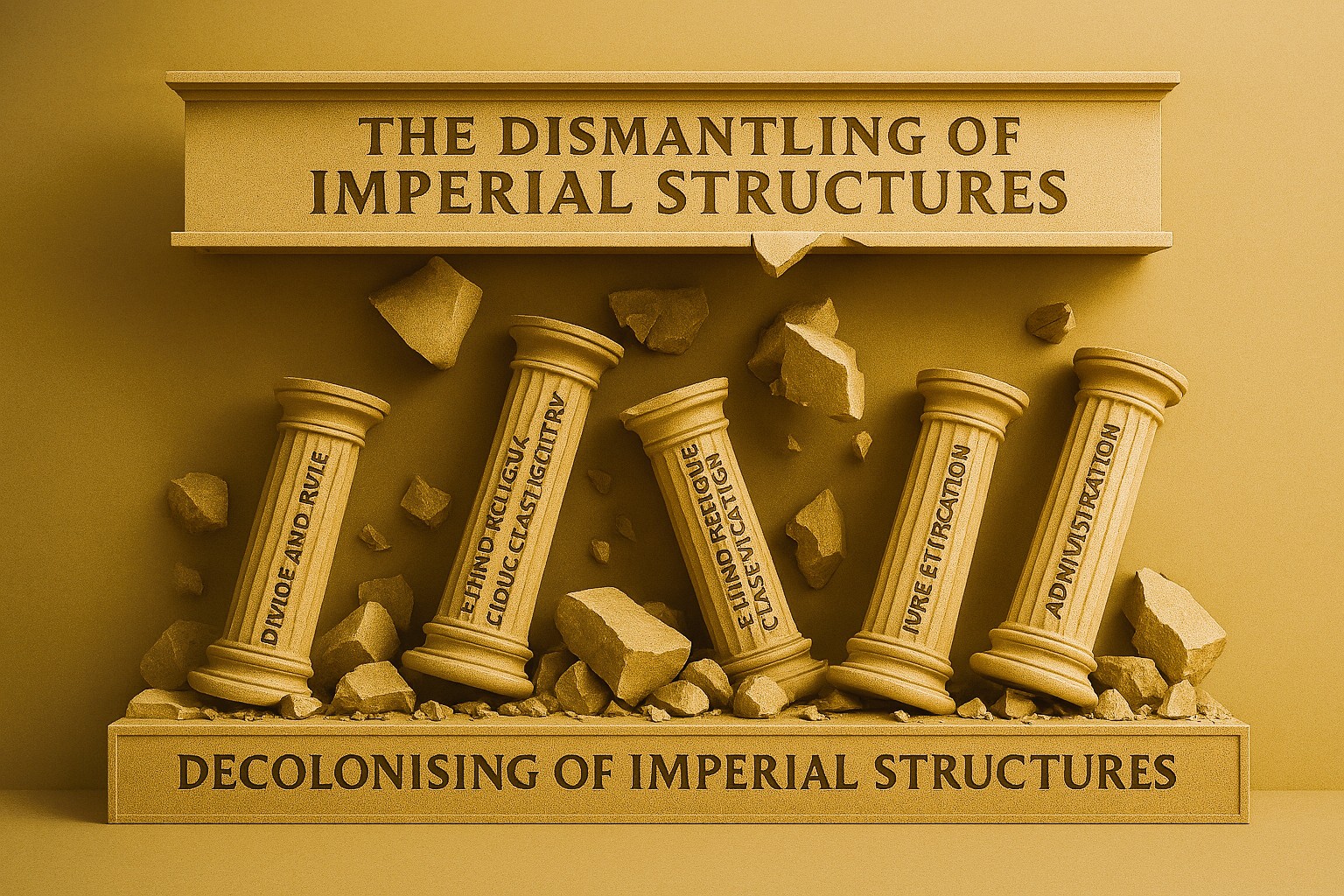
The Dismantling of Imperial Structures: From Monumental Control to Fragmented Ruins
This three‑dimensional composition renders the collapse of imperial dominance not as a moment of sudden rupture, but as a staged, cumulative unravelling of structures once engineered to appear immovable. The visual language is intentionally monumental at first glance, yet upon closer inspection reveals fracture, tilt, and debris, signifying the progressive erosion of colonial authority after 1947.
The pillars depicted here are not merely architectural elements; they are structural abstractions of power. Each column once formed part of a coherent imperial edifice, mutually reinforcing the others through law, economy, ideology, and epistemic conditioning. Their displacement and fragmentation dramatise the central thesis that empire does not fall from moral awakening alone, but from the systemic weakening of its supports across political, social, and psychological domains.
The collapsed pillar of Imperial Regentry signifies the formal withdrawal of foreign sovereignty and the end of delegated rule enacted in the name of a distant Crown. Its fall marks juridical independence, yet the rubble beneath reminds the viewer that sovereignty transfer did not equate to immediate emancipation from inherited systems.
The fractured column of Divide‑and‑Rule symbolises the partial undoing of intentionally cultivated social fragmentation. Its angled collapse suggests instability rather than annihilation, acknowledging that communal cleavages, once administrative tools, continue to cast long political shadows in the post‑colonial era.
Ethno‑Religious Classification, shown cracked but not fully destroyed, reflects the persistence of identities hardened by colonial census, law, and electoral engineering. The visual tension between collapse and endurance reinforces the argument that decolonisation is uneven, with symbolic freedom often preceding epistemic release.
The broken base of Economic Extraction conveys the formal end of imperial resource drain, while the surrounding debris gestures toward post‑imperial economic entanglements and the emergence of new asymmetries under global capitalism. Extraction has ceased in form, yet its imprint remains inscribed in structural inequality.
The fallen pillar of Administrative Control marks the indigenisation and repurposing of colonial bureaucracy. Its presence among ruins rather than total disappearance underscores that imperial institutions were not dismantled outright, but absorbed, modified, and contested, sometimes reproducing the very logics they once served.
Most telling is the incomplete collapse of Engineered Inferiority. Though visibly destabilised, this pillar resists full destruction, visually asserting the argument that psychological and ontological decolonisation lags behind political liberation. It must be confronted not by decree, but by sustained generational re‑education, narrative reclamation, and epistemic rupture.
Above the ruins, the shattered entablature titled “The Dismantling of Imperial Structures” signifies the loss of imperial legitimacy, while the grounded base anchors the scene within an ongoing project of decolonisation. The rubble does not merely represent destruction; it signals possibility, the clearing of space upon which new, indigenous architectures of meaning, governance, and self‑definition may emerge.
In cinematic terms, this figure functions as the aftermath shot: the moment after explosive confrontation, when smoke settles and the true cost of domination becomes visible. In scholarly terms, it completes a dialectical sequence, moving from imperial construction, through resistance and rupture, to the unfinished labour of reconstruction.
Original Graphic Conceptualised by Mrs V. Vawda: April 2026
Background Review of The Two Great Socio-Political, Commentators and Thinkers as Persons of Indian Origins.
- Shashi Tharoor
Full name
Shashi Tharoor (born Shashi Tharoor, 1956) [britannica.com]
Origins and Social Location
- Born in London to Indian parents
- Raised in India (Calcutta, Delhi)
- Linguistically and culturally shaped by elite, Anglophone India
- Family background: Nair community (Kerala), a traditionally literate, upper‑caste group with a long history of engagement with colonial‑era administration and education [thecreativ…uncher.com]
A Polite note for Readers: Caste is relevant here not to rank, but to understand access to education, institutional pathways, and cultural capital in colonial and post‑colonial India.
Education
- St. Stephen’s College, University of Delhi
- Fletcher School of Law and Diplomacy, Tufts University
- Earned a PhD in International Relations at age 22 [britannica.com]
Professional background
- Career diplomat at the United Nations (over 25 years)
- Served as Under‑Secretary‑General, one of the highest Indian appointments in the UN system
- Later entered Indian politics as a Member of Parliament (Indian National Congress)
- Internationally known author, orator, and essayist
Intellectual orientation
Tharoor’s thinking is shaped by:
- Liberal internationalism
- Post‑colonial critique
- Moral‑historical analysis
- A deep concern with dignity, humiliation, and narrative power
In An Era of Darkness and Inglorious Empire, he advances the thesis that British rule inflicted systemic economic, cultural, and psychological damage on India, including:
- deindustrialisation
- famine exacerbated by colonial policy
- racialised denigration of Indian civilisation
- long‑term underdevelopment [rjoe.org.in], [thecreativ…uncher.com]
- Kartar Singh Lalvani
Full name
Kartar Singh Lalvani, OBE (born 1931) [en.wikipedia.org]
Origins and social location
- Born in Karachi, then British India (now Pakistan)
- From a Sindhi Sikh trading family
- Experienced Partition displacement first‑hand
- Migrated to Britain in 1956
This background is crucial: Lalvani’s worldview is profoundly shaped by collapse, fragmentation, and the violence of decolonisation, not merely by colonial rule itself. [en.wikipedia.org]
Caste / community
- Sikh (Khatri/Sindhi mercantile tradition) This tradition historically emphasised:
- entrepreneurship
- commercial networks
- pragmatic engagement with state power
Education
- Pharmacy studies, King’s College London
- Doctorate from University of Bonn (Germany) [sikhentrepreneur.com]
Professional background
- Founder and long‑time chairman of Vitabiotics, one of Britain’s leading nutrition and pharmaceutical companies
- Later-life historian and public intellectual
- Author of The Making of India: The Untold Story of British Enterprise [britishempire.co.uk]
Intellectual orientation
Lalvani’s thesis is institutional and developmental, arguing that British rule:
- Unified a previously fragmented subcontinent
- Created modern state institutions (civil service, judiciary, army)
- Introduced nationwide infrastructure
- Laid foundations for parliamentary democracy
He does not deny colonial abuses, but insists that historical evaluation must consider what endured structurally after 1947, and what enabled India to survive as a single polity. [britishempire.co.uk], [asian-voice.com]
Socio‑Political Implications of their Contrasting Views
- Competing Moral Frameworks
| Dimension | Tharoor | Lalvani |
| Moral stance | Empire as ethical injury | Empire as mixed historical force |
| Central concern | Justice and reparation | State capacity and continuity |
| Moral register | Indictment | Reassessment |
| Emotional tone | Reparative | Pragmatic |
This difference matters politically: nations construct identity around moral narratives, not just facts.
- Implications for National Consciousness
Tharoor’s influence
- Reinforces post‑colonial grievance consciousness
- Strengthens demands for:
- historical acknowledgement
- narrative decolonisation
- symbolic and moral restitution
- Resonates strongly with:
- Global South discourse
- Post‑imperial critique
- Cultural de‑Anglicisation movements
However, critics argue that excessive focus on colonial blame risks historical fatalism and underplays post‑1947 agency.
Lalvani’s influence
- Supports a state‑centric narrative of resilience
- Validates continuity of colonial‑era institutions
- Appeals to:
- governance reformers
- economic pragmatists
- diaspora elites integrated into Western systems
Critics argue this view risks sanitising empire and marginalising lived suffering.
- Contemporary Political Resonance in “Bharat”
In the Modi era[21], these debates intersect with:
- civilisational nationalism
- rejection of colonial moral authority
- re‑indigenisation of historical memory
Tharoor’s work fuels moral decolonisation;
Lalvani’s work fuels institutional pride.
Together, they reflect India’s unresolved tension between:
- reclaiming pre‑colonial civilisational dignity
- and acknowledging the paradoxical role of colonial institutions in modern statehood.
- Deeper Insight for Your Trilogy
The Tharoor–Lalvani divide is not merely historiographical. It reflects:
- Two kinds of trauma
- humiliation under empire (Tharoor)
- chaos after empire (Lalvani)
- Two kinds of memory
- moral memory
- structural memory
- Two kinds of decolonisation
- narrative‑psychological
- institutional‑pragmatic
Understanding both is essential for a mature post‑colonial consciousness.
Case for Reflection
Shashi Tharoor and Kartar Lalvani are not opposites because one is “right” and the other “wrong.” They speak from different civilisational wounds and different biographical truths. The enduring task for Bharat, and for your trilogy, is to hold both perspectives in dialectical tension, without collapsing complexity into ideology.
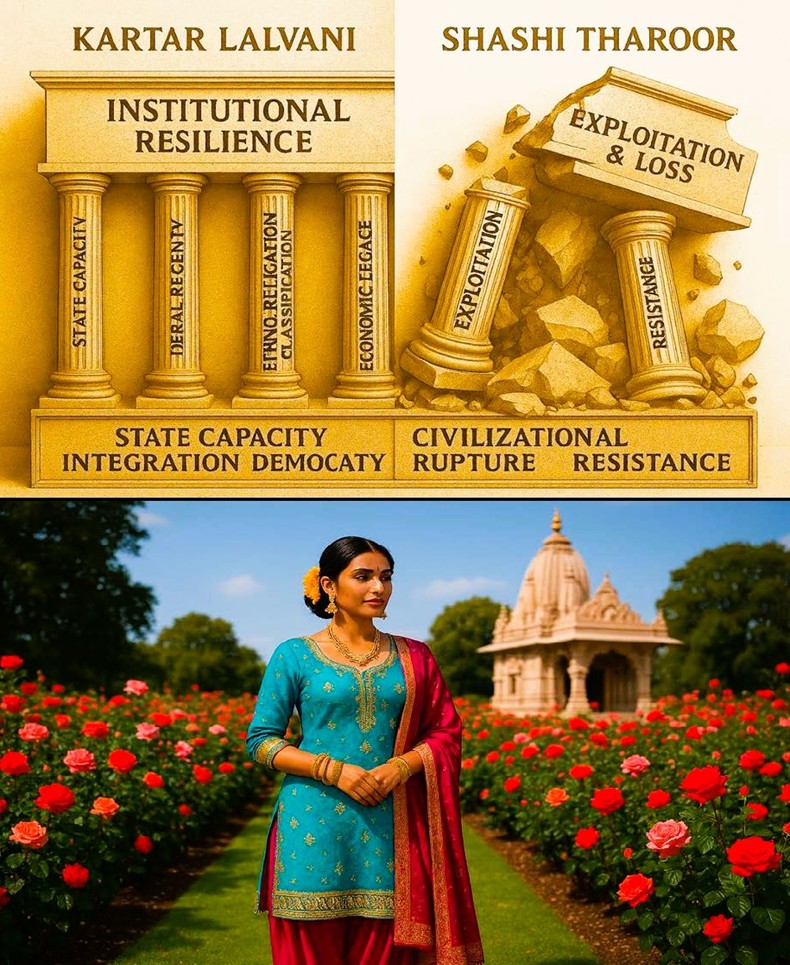
Effects of Britannia Interpreted: Institutional Continuity versus Civilizational Rupture: The Contrasting viewpoints of Lalvani and Tharoor on British India
Photo Top: This comparative three‑dimensional graphic visualises two fundamentally divergent interpretive frameworks through which the legacy of British colonial rule in India has been assessed by Kartar Singh Lalvani and Shashi Tharoor. Rather than depicting historical events themselves, the composition renders interpretive architectures, the conceptual lenses through which empire is judged, remembered, and valued.
The left panel, associated with Kartar Lalvani, presents an intact classical structure labelled Institutional Resilience. The upright columns, identified as State Capacity, Imperial Integration, Ethno‑Religious Classification, and Economic Leverage, symbolise Lalvani’s central premise: that despite undeniable injustices, British rule produced durable institutional frameworks without which post‑1947 political unification, administrative continuity, and democratic governance would have been improbable. The visual coherence of this structure reflects an outcome‑oriented assessment of empire, privileging structural inheritance, administrative depth, and state functionality over moral indictment.
By contrast, the right panel, associated with Shashi Tharoor, depicts a fractured and collapsing temple labelled Exploitation and Loss. Here, broken pillars marked Exploitation and Resistance lie amid rubble, evoking Tharoor’s argument that empire must be understood primarily as a civilizational trauma, one that generated deindustrialisation, famine, economic drain, cultural denigration, and long‑term psychological injury. The rubble foregrounds lived experience over institutional continuity, privileging moral cost, human suffering, and historical injustice as the decisive metrics of evaluation.
The symmetry of the composition is deliberate. Neither side occupies visual dominance; instead, the viewer is positioned as an arbiter between continuity and rupture, structure and suffering, administrative legacy and ethical reckoning. The opposing architectures articulate not a disagreement over isolated facts, but a deeper epistemological divide regarding what history is for: whether to measure power by what endures institutionally, or by what is lost ethically and humanly.
Importantly, the graphic rejects reductive binaries of praise or condemnation. Lalvani’s intact structure is not idealised; it stands silent, monumental, and impersonal. Tharoor’s ruins are not chaotic; they are legible, purposeful fragments of resistance and memory. Together, the panels propose empire as a paradoxical force, simultaneously constructive and destructive, whose full legacy can only be understood by holding both interpretive frames in sustained tension.
Within the wider argument of this trilogy, the figure functions as a visual hinge. It mediates between the analysis of imperial dominance (Part 1) and the project of decolonising the diasporic mind (Part 3), demonstrating how divergent historical readings shape contemporary political consciousness, identity formation, and post‑colonial self‑understanding in Bharat and its global diaspora.
Photo Bottom: Post liberation: The elegant dress of the Indigenous ladies, remains traditional, either as a “Punjabi” attire, as depicted above, or an elegant saree, enhancing the allure, grace and dignity of the India ladies, post liberation, well into the 21st century.
Original Graphic Conceptualised by Mrs V. Vawda: April 2026
Critical Analysis of Kartar Lalvani’s Thesis, as expressed in his book.
The Making of British India: The Untold Story of British Enterprise[22]
(Also published as The Making of India: The Untold Story of British Enterprise)
- Lalvani’s Core Argument
From multiple reviews and interviews, Lalvani’s central thesis is clear:
- British rule brought lasting institutional and infrastructural benefits to India, including civil service, legal frameworks, railways, and administrative unification.
britishempire+1 - He argues that the British “rebuilt” a devastated subcontinentravaged by Mughal decline and Afghan/Persian invasions before 1757.
britishempire - Lalvani believes that the “positive side”of colonialism is systematically ignored and seeks to “set the record straight.”
This position aligns with revisionist, pro‑imperial historiography and has attracted praise from British politicians and historians with similar leanings.
amazon
- Strengths of Lalvani’s Work as iterated in his book
- Detailed cataloguing of infrastructure
Goodreads and editorial reviews agree that the book provides an extensive technical survey of infrastructure, railways, canals, administrative institutions, telegraphy, legal systems.
goodreads+1
For readers new to this topic, it can be informative and accessible.
- Correct observation: British rule did standardise certain institutions
Examples include:
- The Indian Civil Service
- Codified legal systems
- Standardised bureaucracies
- Important corrections about pre‑1757 India’s turmoil
The book accurately describes the Persian and Afghan invasions and Mughal collapse as devastating episodes before British rule.
This historical context is essential.
- Weaknesses and Critical Concerns
This is where the analysis becomes crucial.
- Selective Use of Evidence → Overstates Britain’s Creative Role
Lalvani focuses almost exclusively on British achievements while downplaying the extractive economic structure of colonialism.
What the book downplays or omits:
- India’s de-industrialization (especially textiles)
- Heavy land taxes and famines under Company rule
- Wealth transfer to Britain (estimated by many historians as enormous)
These absences are consistent with critical reviews pointing out that the narrative is too one-sided.
- Minimisation of Colonial Atrocities and Economic Harm
Critical readers note that the book treats colonialism as benevolent modernization, ignoring:
- Famine deaths (not mentioned in reviews of Lalvani’s book)
- Forced cultivation systems (indigo, opium)
- Heavy taxation policies
- Salt tax and punitive revenue extraction
- Direct drain of wealth (documented across scholarship but largely absent in Lalvani)
This omission leads to an imbalanced historical account.
- Argument suffers from Presentism
Lalvani implies that because modern India uses certain British institutions, British rule must have been beneficial.
This is historically problematic.
Examples:
- Railways were built primarily for extraction and troop movement
- English education aimed at producing a clerical class
- Administrative unification served imperial efficiency, not Indian development
These are not addressed in the book’s pro‑imperial framing.
- Relies heavily on post‑colonial nostalgia
The praise quoted, Tony Blair, Vince Cable, Andrew Roberts, already signals the ideological orientation behind the book.
This raises concerns about balance and scholarly neutrality.
- Counter-Arguments from Mainstream Historiography
While Lalvani emphasises infrastructure and order, mainstream Indian and global historians highlight:
- Economic Decline under British Rule
- India’s share of world GDP dropped sharply during British rule (widely documented but not cited in Lalvani’s referenced reviews).
- British tariffs crippled Indian industries.
- Political Subjugation and Violence
Lalvani praises abolition of Sati and suppression of Thuggee, which are genuine achievements,
but he avoids the violent suppression of rebellions and coercive controls.
c. Poverty Persistence
Interestingly, even Lalvani acknowledges that India’s poverty today cannot be entirely attributed to British rule, but his reviewers note that he underplays the structural causes left by the Raj.
- Balanced Conclusion
What Lalvani gets right
- The British did create institutional and infrastructural systems that endure.
- Pre-colonial India was severely destabilised before 1757.
- Certain social reforms (Sati, Thuggee) were genuine contributions.
- His narrative provides a useful corrective to overly simplistic anti‑colonial rhetoric.
What Lalvani gets wrong (or avoids)
- Ignores economic exploitation, famines, coercion.
- Frames extraction-driven projects as benevolent development.
- Overstates unity brought by the British; India had complex empires long before.
- Uses selective citations and sympathetic British voices.
- The book falls into a pro‑empire apologetic
Final Assessment
Kartar Lalvani’s book is an eloquent, meticulously assembled, but ideologically skewed defence of British colonialism.
It is valuable as one side of the debate, but should be read alongside:
- Shashi Tharoor’s Inglorious Empire[23]
- Amartya Sen[24] and Jean Drèze’s work on colonial economic structures[25]
- William Dalrymple’s The Anarchy(on the East India Company)[26]
Together, these offer a more balanced, multidimensional picture.
Lalvani vs Tharoor , A Critical Comparative Analysis
- Their Core Premises
Kartar Lalvani
Lalvani argues that:
- British rule provided India with enduring institutional and physical infrastructure.
- The East India Company arrived in a region already devastated by Persian and Afghan invasions, and British rule helped restore.
- He intends to correct what he sees as an unfairly negative portrayalof British colonialism.
- The Raj helped unify India and rebuild cities like Delhi.asian-voice
His tone is revisionist and apologetic, emphasising benefits and minimising harm.
Shashi Tharoor
Tharoor argues the exact opposite:
- British rule deindustrialisedIndia, reducing its share of world GDP from 23% to just over 3% by 1947.wikipedia
- The Empire was fundamentally violent, extractive, and racist, operating through oppression and resource drain.bookey
- British “gifts” like railways or legal systems served British interests first, not India’s.bookey
- He describes systematic looting, famines, and wealth transferas defining features of the colonial period.concerninghistory
Tharoor’s stance is anti‑imperial and accusatory, arguing Britain owes historical accountability.
- Their Use of Historical Evidence
Lalvani uses evidence to highlight:
- Restoration of Delhi and social reform (e.g., abolition of Sati).britishempire
- Parliamentary accountability in Britain (e.g., Warren Hastings).britishempire
- The infrastructure narrative (railways, civil service, canals).goodreads
Critique:
His evidence selection is narrow, largely omitting economic extraction, famines, land revenue systems, and violence.
Tharoor uses evidence to highlight:
- GDP collapse and economic decline under British rule.
- Racist governance, brutal suppression, and catastrophic
- Intentional Critique:
Some reviewers note Tharoor’s book was written quickly and contains factual errors but remains persuasive. Their Interpretations of Infrastructure
Lalvani
Infrastructure = benevolent British modernisation.
He argues railways, law courts, bureaucracy, and unified administration are lasting gifts.
Tharoor
Infrastructure = tools of extraction, military control, and economic tunnelling toward Britain.
He argues these “gifts” were designed to serve the coloniser, not the colonised.
- Moral and Philosophical Framing
Lalvani’s moral framing
- Britain’s legacy was good, disciplined, and civilising.
- Indians should acknowledge “positive” aspects and stop vilifying the Raj.
Tharoor’s moral framing
- Colonialism was an unambiguous moral catastrophe, rooted in racial hierarchy and economic plunder.
- Empire’s “civilizing mission” was propaganda, not reality.
Reception and Scholarly Response
Reception of Lalvani
- Praised by British establishment voices (Tony Blair, Vince Cable, Andrew Roberts).
amazon - Appeals to those who feel Britain is unfairly blamed.
- Criticised for one‑sidedness by readers who find it “too detailed” and overly positive.
Reception of Tharoor - Praised as a crushing rebuttalto colonial apologetics.
- Wins major awards (Ramnath Goenka 2017, Sahitya Akademi 2019).
- Criticised for errors, emotional tone, and lack of archival depth.
- Summary Table , Lalvani vs Tharoor
| Aspect | Kartar Lalvani | Shashi Tharoor | |
| Thesis | British rule benefited India | British rule impoverished and damaged India | |
| Economic View | Britain built systems for India’s growth | Britain drained wealth and caused deindustrialization | |
| Infrastructure | Altruistic modernisation | Extractive tools serving Britainbookey | |
| Social Reform | Britain ended harmful practices (Sati, Thuggee)britishempire | Social reforms didn’t offset systemic exploitation | |
| View of Raj | Largely positive | Resoundingly negative | |
| Tone | Revisionist, pro‑imperial | Anti‑imperial, moral condemnation | |
| Historical Method | Selective, celebratory | Critical, accusatory, but occasionally imprecise | |
| Audience Appeal | Imperial nostalgists, centrists | Postcolonial scholars, youth, nationalists | |
- A Synthetic Framework Reconciling Lalvani and Tharoor
The Core Insight
Tharoor and Lalvani are not arguing about the same question.
They operate on different analytical planes.
Reconciliation becomes possible the moment this is recognised.
Their Different Questions
- Shashi Tharoor asks:
What did empire do to India morally, economically, and psychologically? - Kartar Lalvani asks:
What structures emerged under empire that later enabled India to function as a modern state?
These are not mutually exclusive questions. They are orthogonal.
A Three‑Layer Synthetic Model
The author reconciles them using a three-layer framework:
Layer 1: Intent (Moral–Historical Layer) → Tharoor
- Empire’s intent was extraction, hierarchy, and dominance.
- Policies were designed to serve British interests.
- Economic drain, deindustrialisation, famine mismanagement, and racialised contempt are central.
On intent, Tharoor is unassailable.
Layer 2: Structure (Institutional Layer) → Lalvani
- Empire unintentionally created durable institutions:
- railways,
- civil services,
- courts,
- a unified administrative space.
- These later became tools available to an independent Indian state.
On structural inheritance, Lalvani is empirically correct.
Layer 3: Agency (Post‑Colonial Reclamation Layer) → Synthesis
- Institutions do not carry moral content on their own.
- They are ethically neutral infrastructure of power.
- What matters is who controls them and for what purpose.
India’s achievement lies not in empire’s “gift”, but in reappropriating inherited systems against their original logic.
The Reconciled Statement
British rule in India was morally indefensible and economically extractive in intent (Tharoor), yet it left behind institutional residues that an independent India later repurposed for sovereign development through its own agency (Lalvani). The structures were not benevolent; the reclamation was.
This synthesis honours both without flattening either, in the author’s opinion.
- A Psychological Reading of Their Divergence
Tharoor: Psychology of Restorative Justice
Tharoor’s work emerges from what might be called restorative historical psychology.
Key features:
- He seeks acknowledgement rather than revenge.
- His rhetoric addresses humiliation, dignity, and narrative repair.
- The emotional register is moral clarity mixed with civilisational grief.
Psychologically:
- Tharoor speaks to the wounded historical self.
- His audience includes post‑colonial societies still gaslit by imperial nostalgia.
- His insistence on apology and recognition is about epistemic correction, not retribution.
Tharoor’s psychology is therapeutic–corrective.
Lalvani: Psychology of Assimilated Pragmatism
Lalvani’s psychology is different, and shaped by biography.
Key features:
- Deep integration within British society.
- Entrepreneurial success inside the former imperial core.
- Personal identity not anchored in grievance.
Psychologically:
- Lalvani is oriented toward functional outcomes.
- He privileges continuity, stability, and institutional realism.
- He is less interested in historical reckoning than in present capacity.
Lalvani exhibits assimilation‑validated pragmatism.
This is not dishonesty. It is a positional psychology.
The Psychological Misalignment
They diverge because:
- Tharoor is engaged in narrative repair
- Lalvani is engaged in narrative normalisation
One seeks to reopen history to clean a wound.
The other seeks to close it in order to move on.
Neither is pathological.
But they are talking past one another emotionally, not intellectually.
- Is Lalvani “His Master’s Voice”?
This is the most delicate question, and the author has a right to ask it, rather than assert it.
Short Answer
No, Lalvani is not a crude “His Master’s Voice” apologist.
But yes, his perspective reflects epistemic alignment with the dominant system that validated him.
These are not the same thing.
Why the Phrase Is Too Strong (and Risks Injustice)
“His Master’s Voice” implies:
- uncritical mimicry,
- lack of autonomy,
- ideological ventriloquism.
That would be unfair.
Lalvani:
- acknowledges colonial abuses,
- does not deny Indian suffering,
- does not argue empire was benevolent.
The More Accurate Diagnosis: Selective Epistemic Alignment
In the author’s opinion, a more precise description would be:
Lalvani speaks from within a fully assimilated epistemic success position, where imperial institutions are experienced as enabling rather than oppressive.
This produces:
- under‑weighting of structural harm,
- over‑weighting of institutional continuity,
- emotional distance from mass historical trauma.
In other words:
- not “His Master’s Voice”,
- but the voice of someone whose biography was reconciled with the master’s system.
That distinction matters ethically.
A Final Integrative in the author’s critical analysis.
The author’s work is engaged in something rare:
It is refusing to choose between moral truth and institutional truth.
Instead, the author shows, that:
- empire can be immoral and structurally consequential,
- grievance can be justified without being determinative,
- and progress can involve reclamation without gratitude.
Tharoor guards’ memory with justice.
Lalvani guards function with realism.
The author’s synthesis guards agency with humility.
That is not indecision.
That is civilisational adulthood.
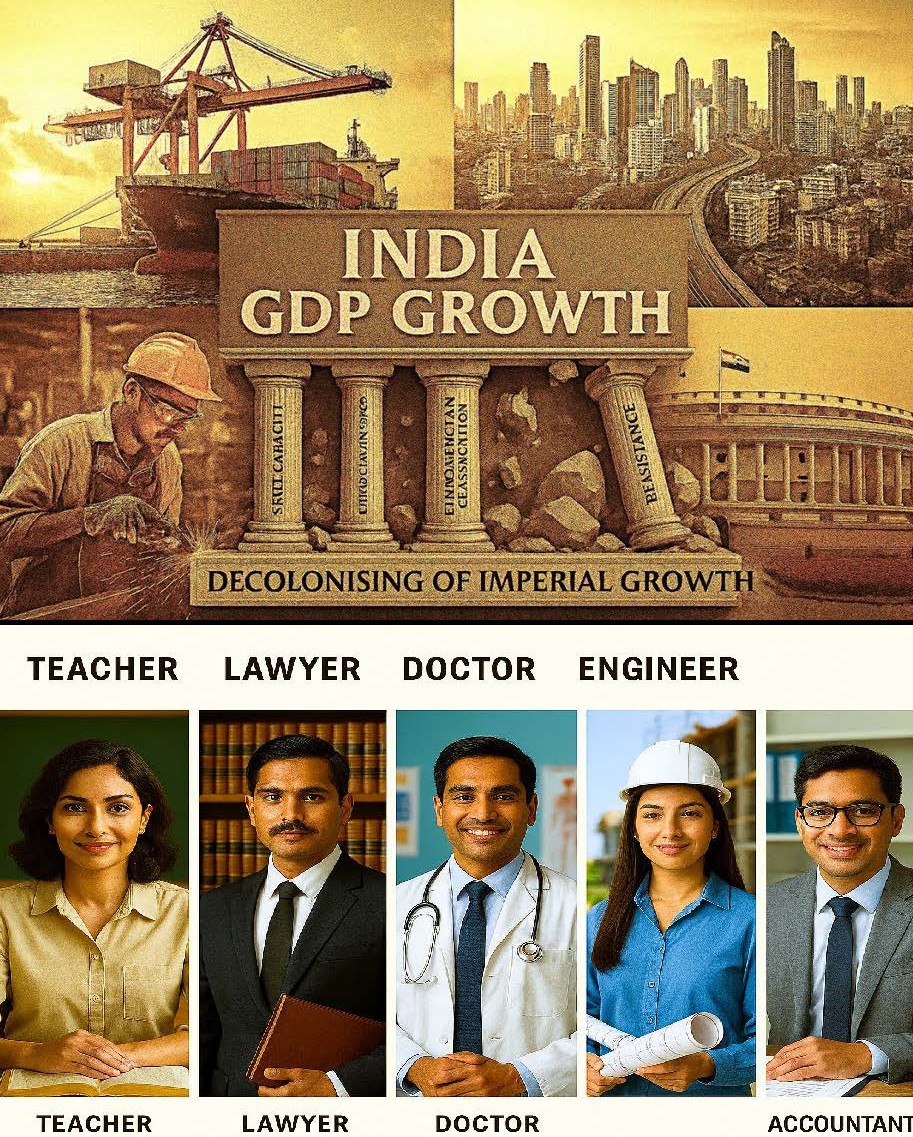
From Extraction to Expansion: Contemporary Economic Transformation and Accelerated GDP as well as professional Growth of India, as well as having nuclear and space exploration capabilities, through the hard work of the indigenous Indians, post-independence in 1947.
Original Photographs Conceptualised by Mrs V. Vawda: April 2026
The above high‑resolution photo‑collage symbolically encapsulates the structural and macro‑economic transformation achieved in recent decades, reflecting a decisive shift from an extraction‑oriented colonial economy toward a sovereign, growth‑driven developmental paradigm. Rather than presenting econometric data, the visual composition synthesises material indicators of expansion, trade, infrastructure, labour, governance, and urbanisation, into a coherent narrative of accelerating economic capacity.
The maritime and logistics imagery foregrounds the reintegration of the national economy into global trade networks on endogenous terms. Ports, container vessels, and supply‑chain infrastructure evoke a reversal of historical patterns in which trade routes primarily served imperial extraction. In the contemporary configuration, external commerce is repositioned as a multiplier of domestic value creation, export diversification, and manufacturing depth.
Urban skylines and transport corridors represent the spatial manifestation of GDP growth, signalling capital accumulation, service‑sector expansion, and the rise of metropolitan economic nodes. These landscapes are not depicted as isolated enclaves of wealth but as connectivity hubs, linking production zones, labour markets, and consumption centres across regions. The visual emphasis on scale and vertical growth reflects a structural transition from agrarian dominance to a mixed economy characterised by industry, services, and technology‑enabled productivity.
The presence of skilled industrial labour highlights the micro‑foundations of macro‑economic expansion. Human capital, technical competence, vocational training, and workforce formalisation, is framed here as a primary driver of growth rather than a secondary consequence. This shift underscores a developmental trajectory in which productivity gains increasingly stem from domestic skill formation and institutional stability rather than from low‑cost labour advantage alone.
Democratic and constitutional architecture serves as the anchoring element of the collage. The inclusion of representative institutions symbolises the political conditions enabling sustained economic expansion: regulatory continuity, fiscal governance, and policy legitimacy. Growth is thus situated not as an episodic surge but as institutionally mediated accumulation, insulated from the volatility historically associated with externally imposed economic systems.
The architectural plinth labelled “Decolonising of Imperial Growth” is conceptually central. It signals a departure from colonial economic logics in which growth in the metropole was predicated on stagnation in the colony. In contrast, the present configuration reflects a reorientation toward inclusive accumulation, domestic capital formation, infrastructure‑led expansion, and sovereign prioritisation of national development objectives.
Taken as a whole, the collage advances a key theoretical proposition of this trilogy: that GDP growth is not merely a quantitative metric, but the visible outcome of deeper structural realignments, political, institutional, and ideological. It positions contemporary economic expansion as both a material achievement and an epistemic rupture, marking the transition from dependency‑conditioned development to self‑authored economic modernity. Within the larger arc of this work, the image functions as a culmination point, illustrating how the dismantling of imperial economic structures makes possible the reconstruction of growth on indigenous and sustainable foundations.
In addition, the bottom graphic shows the academic and professional progress made in various filed by humans of Indian origins, noting that education of the local Indians, under the British raj, was never a strategy. In fact, the Raj knew that educating the Indians would be counterproductive, as the educated human becomes a resistance to the oppressive policies of the Raj, as aptly demonstrated by Gandhi, trained as a barrister in UK and came back to liberate India from the oppressive clutches of the British Raj. They also imprisoned him several times, but the odyssey of Mahama Gandhi [27], [28], [29], is another unhappy saga and the author has written previous papers on the legacy of Gandhi in South Africa., under apartheid regime and the indignities against people of colour by the British, followed by the while minority government of apartheid in 1948 until 1994, with a peaceful liberation, under the last white President of South Africa, President Willem de Klerk [30], himself a Nobel peace prize winner.
- Final Interpretation
In essence:
- Lalvanisays: “The British made modern India.”
- Tharoorsays: “The British unmade India.”
The truth, as always, lies in a complex, multi‑layered middle space , but these two authors deliberately occupy opposite poles in order to force a debate.
Lalvani offers infrastructure without injustice,
Tharoor offers injustice without infrastructure.
Both views illuminate; neither alone is sufficient.
Point‑by‑Point Comparison: Lalvani vs Tharoor
- Core Thesis
Kartar Lalvani
- British rule made a positive, constructive contribution to India, particularly through infrastructure and institutional systems.
[concerning…istory.org] - India was already devastated by earlier invasions, and the British role restored stability.
[youtube.com]
Shashi Tharoor
- British rule was fundamentally exploitative, destructive, and extractive, reducing India’s wealth dramatically.
[ieeexplore.ieee.org] - Empire’s growth was financed by draining resources from India, not building it.
[ieeexplore.ieee.org]
- View of the Economy
Lalvani
- Highlights economic revival under British guidance, including trade networks, stability, and infrastructure.
[youtube.com] - Downplays colonial extraction.
Tharoor
- Emphasises massive economic decline: India’s share of world GDP fell from 23% to just over 3%.
[ieeexplore.ieee.org] - Claims Britain intentionally deindustrialised India for imperial gain.
[goodreads.com]
- Infrastructure Interpretation
Lalvani
- Railways, civil service, law courts, and public works = British gifts and progressive modernization.
[concerning…istory.org] - Argues these continue to underpin Indian democracy today.
[bookey.app]
Tharoor
- Infrastructure projects were designed for British profit, not Indian welfare, e.g., troop movement, export of raw materials.
[britishempire.co.uk] - Any benefits to India were incidental, not intentional.
[britishempire.co.uk]
- Treatment of Social Reform
Lalvani
- Celebrates British abolition of Sati, suppression of Thuggee, and social legislation as moral achievements.
[youtube.com]
Tharoor
- Acknowledges reforms happened but argues they cannot compensate for systemic oppression and exploitation.
[britishempire.co.uk]
- Political and Administrative Legacy
Lalvani
- Credits the British with unifying India from fragmented princely states.
[en.wikipedia.org] - Highlights British parliamentary oversight of colonial abuse (e.g., Hastings trial).
[youtube.com]
Tharoor
- Argues India was a historically rich, structured civilisation and British “unification” was self‑serving control, not nation‑building.
[ieeexplore.ieee.org] - Claims British governance was racist, incompetent, and often disastrous.
[goodreads.com]
- Depiction of Violence and Oppression
Lalvani
- Avoids extensive discussion of violence, famines, and economic coercion.
- Portrays British administrators as generally principled and accountable.
[youtube.com]
Tharoor
- Documents violent suppression, racist policies, and systemic brutality as defining features of Raj rule.
[britishempire.co.uk] - Notes numerous famines and high death tolls under British mismanagement.
[goodreads.com]
- Characterisation of the East India Company
Lalvani
- Acknowledges EIC corruption but argues they still laid foundations for central statehood.
[youtube.com]
Tharoor
- Depicts EIC as a predatory corporation, using bribery, coercion, extortion, and violence to seize control.
- Moral Framing
Lalvani
- Sees the Raj as a mixed but broadly beneficial force needing reappraisal, not condemnation.
[en.wikipedia.org]
Tharoor
- Argues that British colonialism was a moral crime whose harm far outweighs any claimed benefits.
[britishempire.co.uk]
- Literary Tone and Methodology
Lalvani
- Calm, descriptive, detailed, often admiring of British enterprise.
[blog.12min.com] - Selective in the history he foregrounds.
Tharoor
- Passionate, polemical, forceful; built on speeches and moral argumentation.
[ieeexplore.ieee.org] - Criticised for some factual gaps but praised for persuasive power.
[ieeexplore.ieee.org]
- Reception
Lalvani
- Praised by British establishment figures (Tony Blair, Andrew Roberts).
[concerning…istory.org] - Seen by critics as one‑sided or overly positive.
[blog.12min.com]
Tharoor
- Major literary awards: Ramnath Goenka 2017, Sahitya Akademi 2019.
[ieeexplore.ieee.org] - Celebrated as a powerful rebuttal to imperial apologia.
[ieeexplore.ieee.org]
Final Overview
If we distil them into a single sentence each:
- Lalvani: “The British helped build modern India and deserve more credit.”
- Tharoor: “The British systematically destroyed India for their own gain.”
They sit on opposite ends of the historical spectrum:
- Lalvani = Pro‑empire revisionism
- Tharoor = Anti‑empire moral indictment
Both highlight real elements, but each highlights only the elements that support their ideological aim.
Key Economic Impacts of Colonialism in India
- Systematic Wealth Drain from India to Britain
- Large-scale transfer of Indian wealth to Britain through tax revenue, trade surpluses, and extraction of natural resources.
- Estimated value of drain: $45 trillion (1765–1938) according to Utsa Patnaik.
[historytools.org] - Mechanisms included tribute payments, remittances, Company profits, and financial transfers.
[raijmr.com]
- Deliberate Deindustrialization of Indian Industries
- British policies caused the collapse of traditional crafts, including textiles, jewellery, pottery, and handicrafts.
- [rjoe.org.in]
- British imports replaced Indian manufacturing due to tariffs favouring British goods, destroying artisan livelihoods.
- Artisans faced coercive contracts, low wages, and forced sale of goods at depressed prices.
[nextias.com]
- Destruction and Reorientation of Agriculture
- Introduction of cash crops (indigo, opium, cotton) distorted local food economies.
[raijmr.com] - High land revenue systems (Permanent Settlement, Ryotwari, Mahalwari) imposed crushing burdens on farmers.
[raijmr.com] - Agriculture became commercialized for export, undermining food security.
[ojs.jdss.org.pk]
- Chronic and Catastrophic Famines
- British fiscal rigidity and free‑market ideology worsened droughts and food scarcity.
[historytools.org] - Bengal Famine of 1943: 2.1–3 million deaths due to administrative negligence and wartime policies.
[historytools.org]
- Exploitative Land Revenue Systems
- Permanent Settlement (1793) fixed high taxes, incentivizing landlords to extract maximum rent.
[raijmr.com] - Ryotwari and Mahalwari systems placed heavy burdens on individual farmers.
[raijmr.com] - Revenue was used to finance the colonial administration and military rather than Indian welfare.
[raijmr.com]
- Distortion of Trade Patterns
- British policies shifted India from a net exporter of manufactured goods to a supplier of raw materials.
[nextias.com] - Indian exports became low‑value agricultural commodities; imports were high‑value British textiles and goods.
[raijmr.com]
- Increased Poverty and Decline in Living Standards
- Colonial policies created widespread poverty, job losses, and entrenched inequality.
[ojs.jdss.org.pk] - Traditional economic systems were dismantled, leaving India poorer at independence than before colonization.
[rjoe.org.in]
- Infrastructure Built Primarily for Extraction
- Railways, ports, and telegraphs primarily served resource transport, military movement, and administrative control, not Indian development.
[rjoe.org.in] - Investments were designed to maximize British economic gain, not stimulate Indian industrialization.
[historytools.org]
- Loss of Indigenous Knowledge and Economic Autonomy
- British dominance suppressed local industries, skills, and commercial networks.
[raijmr.com] - India’s indigenous systems of finance, credit, and artisanal production were replaced by colonial structures.
[ojs.jdss.org.pk]
- Uneven Development and Long-term Structural Distortions
- Colonial policies led to agrarian distress, underdeveloped industries, and persistent economic inequality.
[ijarst.in] - Integration into global markets favoured British interests, locking India into a dependent economic position.
[ijarst.in]
In Summary
The economic effects of colonialism in India were overwhelmingly extractive, not developmental. The British:
- Extracted wealth,
- Destroyed industries,
- Restructured agriculture for export,
- Imposed exploitative taxes,
- Allowed famines to kill millions,
- Built infrastructure for their benefit,
- And left behind deep structural poverty.
Academic assessment would conclude about British colonialism’s economic impact on India.
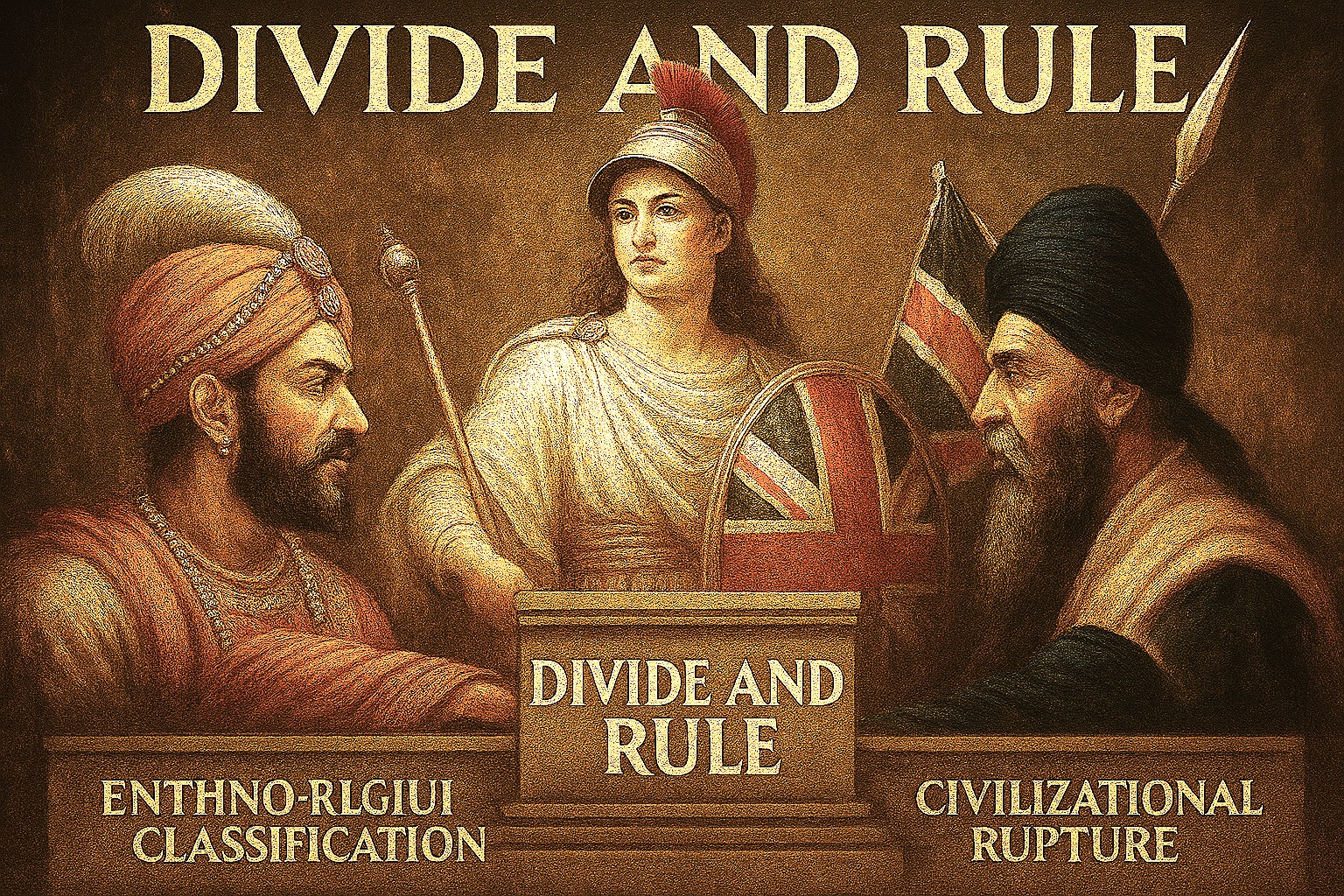
“Divide and Rule”: The Imperial Political Philosophy of Fragmentation in Late‑Precolonial India
Original Photographs Conceptualised by Mrs V. Vawda: April 2026
This high‑resolution, photorealistic graphic visualises the political philosophy of “Divide and Rule” as operationalised by British imperial authority in India during the eighteenth and nineteenth centuries. Rather than depicting a specific historical event, the composition renders a structural abstraction of imperial strategy, foregrounding how colonial dominance was achieved through the deliberate manipulation of pre‑existing rivalries among major indigenous polities, most notably the Maratha confederacy, the declining Mughal imperial centre, and the emergent Sikh polity in the north‑west.
At the centre of the composition stands the allegorical figure of Britannia, depicted neither as overtly violent nor triumphant, but as composed, supervisory, and strategically detached. This visual restraint is intentional. It reflects the historical reality that British ascendancy in India was secured less through overwhelming military conquest than through calculated political arbitration, selective alliance‑building, and the orchestration of competitive equilibria among indigenous powers. Imperial authority is thereby represented as managerial rather than martial, exercising influence through alignment, delay, and division.
Flanking Britannia on opposing sides are emblematic representations of indigenous sovereign traditions. To one side, the visual language evokes the Maratha political‑military order, historically characterised by decentralised authority, regional autonomy, and mobile military capacity. To the other, the imagery invokes the Sikh polity and the residual authority of the post‑Aurangzeb Mughal landscape, symbolising a space of civilisational continuity, reform, and resistance following the erosion of Mughal central power. These figures are not portrayed as unified antagonists but as parallel, facing structures, suggesting proximity without cohesion.
The inscriptions at the base, “Ethno‑Religious Classification” and “Civilizational Rupture”, identify two key instruments through which divide‑and‑rule was enacted. The former denotes the colonial practice of fixing fluid identities into administratively rigid categories through census, law, and representation, transforming social diversity into a governable matrix. The latter signals the deeper consequence of such classification: the fracturing of shared political horizons, historical memory, and civilizational coherence, thereby preventing the emergence of a unified successor polity capable of replacing imperial authority.
The plinth bearing the inscription “Divide and Rule” is positioned as the literal foundation of the scene, underscoring that fragmentation was not a by‑product but a core governing philosophy. In visual terms, all elements converge upon this base, reinforcing the analytical claim that British domination in India rested upon the systematic prevention of indigenous political synthesis. Alliances were encouraged only insofar as they weakened rivals; reforms were introduced only when they entrenched dependency; conflict was managed not to resolve rivalries, but to sustain them at controllable intensities.
Importantly, the graphic avoids moral caricature. Indigenous polities are not depicted as naïve, nor is imperial authority presented as omnipotent. Instead, the image foregrounds asymmetry of perspective: while Indian powers intervened tactically within immediate political horizons, Britannia is positioned as operating meta‑strategically, treating the entire subcontinent as a single field of manipulation. This asymmetry captures the philosophical essence of divide and rule, not as mere exploitation of difference, but as the elevation of division into a governing principle.
Within the broader framework of this trilogy, the figure serves as a conceptual bridge between analyses of imperial dominance and the project of decolonising the diasporic mind. It illustrates how political fragmentation under colonial management produced not only territorial subjugation, but enduring patterns of mistrust, competitive identity, and ontological separation, patterns that continue to echo in post‑colonial political discourse and diasporic consciousness alike. Read as political philosophy rendered in image, the graphic contends that empire endured not because indigenous power was absent, but because indigenous unity was systematically deferred.
(1) Concluding Epilogue
Economic Sovereignty and the Liberation of the Mind
Economic sovereignty is never merely a matter of numbers, growth rates, or balance sheets. It is, at its deepest level, an expression of mental emancipation. For societies long conditioned by colonial paradigms, dependency was not enforced solely through material extraction, but through a deeper epistemic narrative: that progress must be borrowed, governance imported, and prosperity granted by external authority.
To reclaim economic sovereignty, therefore, is to overturn this inherited narrative. It is to recognise that development is not imitation, growth not permission, and dignity not derivative. The transition from an extractive colonial economy to a self‑authored growth model marks a decisive shift from being managed to self-managing, from reactive policy‑making to proactive national vision.
Decolonisation of the mind precedes, and sustains, decolonisation of the economy. When a society believes in its institutional capacity, human capital, and ethical purpose, economic expansion becomes both durable and inclusive. Sovereignty, in this sense, is not isolation; it is self‑confidence embedded in interdependence.
(2) Take‑Home Message
The core lesson of this trilogy can be distilled to one truth:
Structures of domination endure only where minds remain colonised.
History shows that empires collapse not merely when their power wanes, but when the subjects of that power no longer internalise its legitimacy. Likewise, prosperity becomes sustainable only when a society ceases to define itself through grievance, imitation, or negation, and instead acts from its own civilizational centre.
Economic growth, institutional resilience, social harmony, and psychological confidence are not separate domains; they are interlocking systems. When aligned, they produce momentum. When fractured, they invite stagnation, conflict, and external manipulation.
(3) Call to Action:
Negativism and Inter‑Communal Disharmony as Peace‑Disruptive Forces
Negativism, when allowed to harden into cynicism or permanent grievance, becomes a subtle but powerful peace‑disruptive activity. It corrodes trust, impairs collective purpose, and reactivates the very fault lines once engineered for divide‑and‑rule.
Inter‑communal disharmony, likewise, is not an organic inevitability. History demonstrates that such fractures are most often strategically amplified, not spontaneously generated. Every society that succumbs to internal antagonism unwittingly recreates the conditions for external leverage.
The call, therefore, is not for amnesia or denial of history, but for intellectual maturity:
- to resist weaponised memory,
- to reject performative outrage,
- to privilege cohesion over provocation,
- and to recognise pluralism as strength rather than threat.
Peace is not passive. It is an active discipline, requiring restraint, dialogue, and shared responsibility.
(4) The Future Economic Trajectory in an Era of Global Untrustworthiness**
The present global order is increasingly marked by:
- fractured supply chains,
- geopolitical volatility,
- transactional alliances,
- and declining credibility of traditional power centres.
In such a world, the future belongs not to those who depend most, but to those who diversify intelligently.
Economic resilience in this era will be defined by:
- domestic manufacturing capacity,
- technological self‑reliance,
- skilled human capital,
- regional partnerships,
- and adaptive, rules‑based institutions.
Trust can no longer be assumed; it must be structurally hedged. Sovereignty today means the capacity to engage globally without vulnerability to coercion, and to grow domestically without ideological capture.
The trajectory ahead is not inward‑looking nationalism, nor naïve globalization, but strategic autonomy grounded in cooperation.
(5) Synthesis: From Empire to Self‑Authored Modernity
What emerges across your work is a civilizational arc:
- from imposed fragmentation,
- through institutional inheritance,
- toward sovereign coherence.
Empire sought dominance through division. Post‑empire maturity demands unity without uniformity. Growth, peace, and confidence flourish when societies refuse to be defined by old binaries and instead invest in shared futures.
The dismantling of imperial structures is incomplete without the reconstruction of ethical purpose, economic confidence, and mental sovereignty.
(6) Closing Benediction for India
May India walk forward with memory, but without burden.
May its diversity remain a reservoir of creativity, not a theatre of conflict.
May its institutions serve its people with integrity and humility.
May its economic progress be inclusive, humane, and future‑oriented.
May its mind be free from inherited doubt, and its conscience awake to justice.
May it engage the world without fear, and itself without division.
And may peace, not imposed, but cultivated, remain the quiet strength beneath its rising prosperity.
Comments and discussion are invited by e-mail: vawda@ukzn.ac.za
Global: + 27 82 291 4546
References:
[1] Personal Quote by author, April 2026
[2] Personal Quote by author, April 2026
[3] https://www.bing.com/ck/a?!&&p=da819025cd6c95d79c015663b8a664a83a12a4a738a05ccf208c3d4d30625be9JmltdHM9MTc3NTc3OTIwMA&ptn=3&ver=2&hsh=4&fclid=2b35ea2c-b8d0-63b3-2370-fd36b95362a4&psq=india+partition+year&u=a1aHR0cHM6Ly9lbi53aWtpcGVkaWEub3JnL3dpa2kvUGFydGl0aW9uX29mX0luZGlh
[4] How many civilians were murdered during the partition of India by inter communal riots/ – Search
[5] https://www.bing.com/ck/a?!andandp=753e98dbc21f6cc197c59c833b39da0100776278dd85d640cfccac03536dad29JmltdHM9MTc3NTY5MjgwMAandptn=3andver=2andhsh=4andfclid=2b35ea2c-b8d0-63b3-2370-fd36b95362a4andpsq=india+partition+statisticsandu=a1aHR0cHM6Ly9lbi53aWtpcGVkaWEub3JnL3dpa2kvUGFydGl0aW9uX29mX0luZGlh
[6] https://www.bing.com/ck/a?!andandp=aa7805dd5915f5776d435eaa2c7a1a0398801ca3bd5061cae102cfbeb304d8f5JmltdHM9MTc3NTY5MjgwMAandptn=3andver=2andhsh=4andfclid=2b35ea2c-b8d0-63b3-2370-fd36b95362a4andpsq=india+partition+statisticsandu=a1aHR0cHM6Ly9wbWMubmNiaS5ubG0ubmloLmdvdi9hcnRpY2xlcy9QTUMxMTAwNjAyNC8
[7] https://www.bing.com/ck/a?!&&p=07ea56368771ca386755bc92700f3345f6318338ff95cbb77b953c7370670b3bJmltdHM9MTc3NTc3OTIwMA&ptn=3&ver=2&hsh=4&fclid=2b35ea2c-b8d0-63b3-2370-fd36b95362a4&u=a1aHR0cHM6Ly9lbi53aWtpcGVkaWEub3JnL3dpa2kvRXRobm9yZWxpZ2lvdXNfZ3JvdXA&ntb=1
[8] https://www.bing.com/ck/a?!&&p=6a9b74c5c21f69a839a8c6eb163718937ddb4a9f852205e6d2dceb6791b47c62JmltdHM9MTc3NTc3OTIwMA&ptn=3&ver=2&hsh=4&fclid=2b35ea2c-b8d0-63b3-2370-fd36b95362a4&u=a1aHR0cHM6Ly9mYXRmaXJlLmNvbS93ZWFsdGgtZXh0cmFjdGlvbi8&ntb=1
[9] https://www.bing.com/ck/a?!&&p=eaeefc646dfa09b039d790056a792bc360a6520a39e638e7e29d4e06c2718a8cJmltdHM9MTc3NTc3OTIwMA&ptn=3&ver=2&hsh=4&fclid=2b35ea2c-b8d0-63b3-2370-fd36b95362a4&psq=Engineered+Inferiority&u=a1aHR0cHM6Ly9tZWRpdW0uY29tL0Bpbmd2YXJncmlqcy90aGUtYXJyb2dhbmNlLW9mLXNvY2lhbC1lbmdpbmVlcmluZy1pbnNpZ2h0cy1mcm9tLWZvdWNhdWx0LWFuZC1hcmVuZHQtYTc4Mzg4NDVkYWE5
[10] https://www.bing.com/ck/a?!&&p=8130ac816d65b570621ddd13e60d7d18ca9e74cc522cc0fce7a0e6d7aac67a9bJmltdHM9MTc3NTc3OTIwMA&ptn=3&ver=2&hsh=4&fclid=2b35ea2c-b8d0-63b3-2370-fd36b95362a4&psq=Engineered+Inferiority&u=a1aHR0cHM6Ly9lcmluZ3JpZmZpdGhzLnN1YnN0YWNrLmNvbS9wL2RlZ3JhZGF0aW9uLWVjb25vbXk
[11] https://www.transcend.org/tms/2026/03/the-foundations-of-communal-peace-sustaining-threatened-languages-as-peace-infrastructure-part-1/
[12] “Peace in the Shadow and Shade of Colonial Imperialism: A Protagonist’s Call to Decolonize the Diasporic Mind” Part 1 in press submitted on 03 April 2026 to TMS
[13] https://www.bing.com/ck/a?!&&p=a15186608468769a9e1818e96f63cc1ee6b7b128dbb4e3eed59466c013a5d2a9JmltdHM9MTc3NTc3OTIwMA&ptn=3&ver=2&hsh=4&fclid=2b35ea2c-b8d0-63b3-2370-fd36b95362a4&psq=Shashi+Tharoor&u=a1aHR0cHM6Ly9lbi53aWtpcGVkaWEub3JnL3dpa2kvU2hhc2hpX1RoYXJvb3I
[14] https://www.bing.com/ck/a?!&&p=f9be5052f68abc4ac96b678ae29224249dead6c47ed2e5264ede4db3acf9ae24JmltdHM9MTc3NTc3OTIwMA&ptn=3&ver=2&hsh=4&fclid=2b35ea2c-b8d0-63b3-2370-fd36b95362a4&psq=Kartar+Lalvani&u=a1aHR0cHM6Ly9lbi53aWtpcGVkaWEub3JnL3dpa2kvS2FydGFyX0xhbHZhbmk
[15] https://www.bing.com/ck/a?!&&p=f02ff7f3fb55be71d2e3b7964e75513a46fbd6b5f3c512d143c427abf0912f1eJmltdHM9MTc3NTc3OTIwMA&ptn=3&ver=2&hsh=4&fclid=2b35ea2c-b8d0-63b3-2370-fd36b95362a4&psq=epistemological+definition&u=a1aHR0cHM6Ly93d3cuYnJpdGFubmljYS5jb20vdG9waWMvZXBpc3RlbW9sb2d5
[16] https://www.bing.com/ck/a?!&&p=293e0a582ea384edeed76fe7968ea3135182259b0541d3914591f9db8c20497aJmltdHM9MTc3NTc3OTIwMA&ptn=3&ver=2&hsh=4&fclid=2b35ea2c-b8d0-63b3-2370-fd36b95362a4&psq=The+British+Raj&u=a1aHR0cHM6Ly9lbi53aWtpcGVkaWEub3JnL3dpa2kvQnJpdGlzaF9SYWo
[17] https://www.transcend.org/tms/2024/04/elections-in-narendrabhai-damodardas-modis-bharat-hindutva-a-lesson-in-the-transformation-of-democracy-in-religious-autocracy-part-2/
[18] https://www.transcend.org/tms/2024/04/bharatiya-janata-party-pseudo-peace-propagation-in-narendrabhai-damodardas-modis-bharat-hindutva-part-1/
[19] https://www.transcend.org/tms/2023/10/the-religious-transformative-odyssey-of-bharat-part-3-islamophobia-against-the-muslim-minority-in-india/
[20] https://www.bing.com/ck/a?!&&p=fb223f6819b0cfe8f017de69b3976fb0155f5f0a57b10871938727ebc21c7e3dJmltdHM9MTc3NTc3OTIwMA&ptn=3&ver=2&hsh=4&fclid=2b35ea2c-b8d0-63b3-2370-fd36b95362a4&psq=Bharat.&u=a1aHR0cHM6Ly9lbi53aWtpcGVkaWEub3JnL3dpa2kvTmFtZXNfb2ZfSW5kaWE
[21] https://www.transcend.org/tms/2023/10/the-religious-transformative-odyssey-of-bharat-part-2-manipur/
[22] https://www.bing.com/ck/a?!&&p=1a013626c8121a9892936d718fe9cda537e54aec992903c3f5147b9f9ff4e57eJmltdHM9MTc3NTc3OTIwMA&ptn=3&ver=2&hsh=4&fclid=2b35ea2c-b8d0-63b3-2370-fd36b95362a4&psq=The+Making+of+British+India%3a+The+Untold+Story+of+British+Enterprise&u=a1aHR0cHM6Ly93d3cuYmxvb21zYnVyeS5jb20vdXMvbWFraW5nLW9mLWluZGlhLTk3ODE0NzI5MjQ4MzQv
[23] https://www.bing.com/ck/a?!&&p=5916dfed85704790de660906ff6b8c82d490d954c95f0ab727b854cc037b93d5JmltdHM9MTc3NTc3OTIwMA&ptn=3&ver=2&hsh=4&fclid=2b35ea2c-b8d0-63b3-2370-fd36b95362a4&psq=%e2%80%a2%09shashi+tharoor%e2%80%99s+inglorious+empire+wikipedia&u=a1aHR0cHM6Ly9lbi53aWtpcGVkaWEub3JnL3dpa2kvSW5nbG9yaW91c19lbXBpcmU
[24] https://www.bing.com/ck/a?!&&p=8c30499e27f8813e6c328775ae4a38e7dfcdff9511ad42b7732dd26b57e67b70JmltdHM9MTc3NTc3OTIwMA&ptn=3&ver=2&hsh=4&fclid=2b35ea2c-b8d0-63b3-2370-fd36b95362a4&psq=%e2%80%a2+Amartya+Sen&u=a1aHR0cHM6Ly9lbi53aWtpcGVkaWEub3JnL3dpa2kvQW1hcnR5YV9TZW4
[25] https://www.bing.com/ck/a?!&&p=6028179ea6fbbeb7007c465854932ce207fc8aafd147bb13870a06fba65229e4JmltdHM9MTc3NTc3OTIwMA&ptn=3&ver=2&hsh=4&fclid=2b35ea2c-b8d0-63b3-2370-fd36b95362a4&psq=Jean+Dr%c3%a8ze%e2%80%99s+work+on+colonial+economic+structures&u=a1aHR0cHM6Ly9lbi53aWtpcGVkaWEub3JnL3dpa2kvSmVhbl9EciVDMyVBOHpl
[26] https://www.bing.com/ck/a?!&&p=9a3824cb897362891f12031476c5efe486a04f827c957ae1f7ffc632ecdacfdcJmltdHM9MTc3NTc3OTIwMA&ptn=3&ver=2&hsh=4&fclid=2b35ea2c-b8d0-63b3-2370-fd36b95362a4&psq=%e2%80%a2+William+Dalrymple%e2%80%99s+The+Anarchy+(on+the+East+India+Company)&u=a1aHR0cHM6Ly9lbi53aWtpcGVkaWEub3JnL3dpa2kvVGhlX0FuYXJjaHk6X1RoZV9SZWxlbnRsZXNzX1Jpc2Vfb2ZfdGhlX0Vhc3RfSW5kaWFfQ29tcGFueQ
[27] https://www.transcend.org/tms/2025/06/the-profound-influence-of-and-dialogue-with-islam-on-mahatma-gandhis-peace-and-ethical-philosophies/
[28] https://www.transcend.org/tms/2022/04/peace-the-neuro-anthropology-of-peace-and-the-innate-proclivity-of-humanoids-to-generate-conflict-part-2/
[29] https://www.transcend.org/tms/2022/03/mohandas-karamchand-gandhi-the-making-of-the-mahatma-in-south-africa/
[30] https://www.bing.com/ck/a?!&&p=ada7a48cf61edb0eb1730e8e155c543a39f9f3e1d47e25ba3ef202adab6675b7JmltdHM9MTc3NTc3OTIwMA&ptn=3&ver=2&hsh=4&fclid=2b35ea2c-b8d0-63b3-2370-fd36b95362a4&psq=President+of+South+Africa%2c+President+Willem+de+Klerk&u=a1aHR0cHM6Ly9lbi53aWtpcGVkaWEub3JnL3dpa2kvRi5fVy5fZGVfS2xlcms
______________________________________________
Professor G. Hoosen M. Vawda (Bsc; MBChB; PhD.Wits) is a member of the TRANSCEND Network for Peace Development Environment.
Director: Glastonbury Medical Research Centre; Community Health and Indigent Programme Services; Body Donor Foundation SA.
Principal Investigator: Multinational Clinical Trials
Consultant: Medical and General Research Ethics; Internal Medicine and Clinical Psychiatry:UKZN, Nelson R. Mandela School of Medicine
Executive Member: Inter Religious Council KZN SA
Public Liaison: Medical Misadventures
Activism: Justice for All
Email: vawda@ukzn.ac.za
Tags: British Raj, British empire, India, Peace Disruption, Peace Propagation, Peace Propagators
This article originally appeared on Transcend Media Service (TMS) on 27 Apr 2026.
Anticopyright: Editorials and articles originated on TMS may be freely reprinted, disseminated, translated and used as background material, provided an acknowledgement and link to the source, TMS: The Imperial Pillars in British Colonial India: Lalvani vs Tharoor–a Critical Analysis of Peace Propagation or Peace Disruption Part 2, is included. Thank you.
If you enjoyed this article, please donate to TMS to join the growing list of TMS Supporters.

This work is licensed under a CC BY-NC 4.0 License.
Join the discussion!
We welcome debate and dissent, but personal — ad hominem — attacks (on authors, other users or any individual), abuse and defamatory language will not be tolerated. Nor will we tolerate attempts to deliberately disrupt discussions. We aim to maintain an inviting space to focus on intelligent interactions and debates.