
Why the Israeli and US War in Iran Is “Not Europe’s War”
EUROPE, 20 Apr 2026
Jeanne Macé and Alžběta Frommerová | Genocide Watch - TRANSCEND Media Service
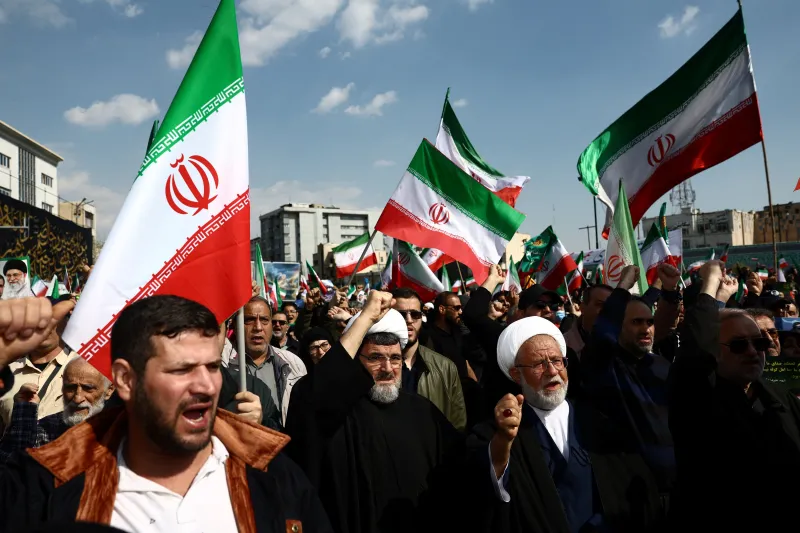
At a funeral ceremony for a killed Iranian military commander, Tehran, April 2026 Majid Asgaripour / West Asia News Agency / Reuters
17 Apr 2026 – Since the launch of the Israel and US war against Iran on 28 Feb 2026, European countries have been exposed to the consequences of a conflict they neither initiated nor sought to join. Beyond triggering an energy crisis, the Middle East war has shifted European leaders’ attention away from Ukraine, plunged the North Atlantic Treaty Organization (NATO) into an existential crisis, and raised fears of a migration wave and security threats that will increase support for anti-immigrant parties. Whether or not the current ceasefire in the Middle East holds, the war’s repercussions will be long-lasting for Europe.
Europe’s Collective Refusal to Follow Washington into War
Despite the difficulty European states faced in articulating a unified position since the outset of the war, the announcement of a two‑week ceasefire agreement between the United States (US) and Iran was broadly welcomed by European Union (EU) members on April 8. European countries are widely represented in the coalition launched by the United Kingdom (UK) to restore free passage through the Strait of Hormuz.
European nations are united in their refusal to become directly involved in the Israeli and US war. Their reluctance reflects a desire for autonomy from the US policy following a year of US President Trump’s threats and hostile actions. Since returning to the White House in January 2025, Donald Trump has imposed arbitrary tariffs on European Union exporters. He engaged Russia in negotiations over Europe’s future while excluding both European countries and Ukraine. Trump incredibly blames Ukraine for Russia’s invasion and its genocide against Ukraine. Trump has declared his intention to seize Greenland, which for centuries has been a semi-autonomous territory of Denmark, a loyal member of NATO.
Europe’s shared refusal to join the war against Iran reflects Europe’s memory of the collective trauma caused by its involvement in the Iraq and Afghanistan Wars. In 2003, American neoconservatives dragged the UK, Spain, and numerous post-communist Central and Eastern European states into the Iraq war, ignoring opposition from France and Germany. The George W. Bush administration created a division between the “new Europe”, compliant with US policy, and the “old Europe” which resisted US domination. Today, European nations are determined not to be drawn into another US-led war, regardless of Donald Trump’s aggressive attacks on NATO and his tariff blackmail policies.

Ukraine, the Collateral Victim
European countries have rejected military involvement in the Iran war because “This is not Europe’s war,” as EU High Representative for Foreign Affairs and Security Policy, Kaja Kallas, stated. “Europe’s war is Ukraine.” As rising oil prices and suspension of US sanctions on Russian oil boost Russia’s wartime economy, Ukraine needs even greater financial and military support. Since the outbreak of the Iran war, Russia has earned over $150 million every day in added sales of oil.
Meanwhile, the US administration has cut off most of its direct security assistance to Ukraine. Under European pressure, the US agreed to supply US made military equipment purchased from the US by Europeans under the Prioritized Ukraine Requirements List (PURL) program implemented by NATO.
In early April, Donald Trump threatened to block even those weapons supplies to Ukraine if European allies refused to help reopen the Strait of Hormuz. Before the temporary ceasefire agreement, the Pentagon was even considering redirecting weapons bought by Europe for military assistance to Ukraine to resupply US arsenals depleted by the Iran war. The Trump regime has adopted a strategy of meddling in the domestic political affairs of European countries. Trump and Vice President Vance have publicly endorsed a German right-wing party and directly campaigned for the autocratic Orban party in Hungary.
To prevent Ukraine from falling to Russia’s relentless aggression in Ukraine, European states and the EU must continue to support Ukraine independently of the NATO alliance. European leaders should also collectively condemn and counter attempts by Trump to interfere in their political affairs.
Europeans must maintain a firm stance against Putin’s goal of reestablishing the Russian and Soviet empire. The Belgian prime minister’s appeasement proposal to normalize relations between the EU and Russia to secure cheaper energy supplies sparked a European outcry. The Iran war demonstrates how crucial energy independence is to Europe’s defense strategy against Russian aggression.
European Division Weakens Europe
Despite their shared refusal to engage directly in the Iran war, European leaders have reacted in a fragmented and inconsistent way to the Iran war. Most European states have not directly condemned the US and Israel for the illegality of their war under international law. The initial statement by the E3 group (UK, Germany, France) emphasized the threat presented by Iran’s nuclear program without stressing the importance of complying with international law. The Italian Council of Ministers President, Giorgia Meloni, opted to “neither condemn nor condone” the war, kissing the golden ring of the narcissistic Donald Trump.
Finland, Norway and Spain were among the few European states to explicitly say “no to war” and to call on all parties to uphold international law. Spain denied US forces permission to use their joint military bases of Rota and Morón. Spain also withdrew its ambassador to Israel, and closed Spanish airspace to American aircraft involved in strikes on Iran. Access to airspace by the US Airforce was also denied by Italy and France., Switzerland and Austria invoked their wartime neutrality policy to deny access to US military aircraft.
Nevertheless, many countries, notably Germany, are reluctant to deny the United States access to their joint military bases out of respect for their obligations in NATO. The 31 permanent bases and 19 military sites operated by the US across Europe are governed by bilateral agreements that allow the US to use them for NATO purposes. However, these military facilities remain under the sovereign control of European states. European governments should leverage their strategic influence assertively to protect European interests when faced with the America First policies of the US President.
The End of NATO?
In response to the increasingly united policies of European countries toward the US, Donald Trump has openly threatened to withdraw from the NATO alliance. US withdrawal would be a fatal blow to the world’s largest and most successful military alliance. US withdrawal from NATO would prove detrimental to Europe. But it would also be disastrous for the US with its heavy reliance on its European allies for military bases, intelligence sharing, and diplomacy. Mediation by Türkiye, NATO’s second largest military power, might help prevent this strategic disaster. Withdrawal from NATO would require Congressional approval under US law. But Republican control of the US Congress makes this a weak reed to grasp.
US officials have told their European counterparts to prepare to assume primary responsibility for Europe’s defense by 2027, Europeans could seize this opportunity to step out from under the US military umbrella. To do that, the EU would have to substantially increase its defense spending to compensate for the loss of US security. European defense budgets have already doubled since the Russian invasion of Ukraine in 2022 and since Donald Trump’s return to the White House. In countries with low growth and high public debt, financing massive rearmament will mean cutting social spending, which will increase social and political instability across Europe. Popular insecurity leads to the rise of “populist” security states led by right-wing parties.
The EU has historically struggled to achieve coordination in defense matters. This fact was demonstrated in 1954 by the failure of the European Defense Community following the French Parliament’s rejection of the NATO treaty. European Union military decisions still require unanimity. With this barrier to acting swiftly and unanimously on defense issues, the future of European security will rest on a few powerful states: Germany, which has the fourth largest defense budget in the world, Poland which has the largest economy on Europe’s eastern front and already spends 4.5% of its GDP on defense, and France and the UK, the two European states that possess the strategic power of nuclear deterrence.
Spillover Risks
Military experts have outlined two possible escalation scenarios outside the Middle East. One would be set off by Iranian strikes on the US military base in Türkiye that stores US nuclear weapons for Europe’s defense. A second would be a ballistic missile attack on Europe using long range missiles that could reach London or Paris. Iran has launched two long range ballistic missiles at the joint British – American military base on Diego Garcia in the Indian Ocean. Neither hit its target.
Both these scenarios for escalation are unlikely. Iran is likely to limit attacks against countries beyond Israel, the US, and tiny Gulf states to avoid widening the war and increasing the number of adversaries it must confront. European governments are strengthening defense of critical infrastructure. European countries fear an increase in proxy-led terrorist attacks orchestrated by Iran, similar to the thwarted attack on March 29 against the Paris offices of Bank of America, which was allegedly carried out by a pro-Iranian group that has called for attacks against the Jewish community in Europe.
A New Migrant Crisis in Europe and Strategic Opportunism for Far-Right Groups
Europeans fear a new migration surge as refugees flee the wars in the Middle East. Lebanese are likely to flee to Europe, as southern Lebanon has been emptied by Israeli evacuation orders and intense bombardment by the Israeli military in its war against Hezbollah, the Iranian-backed Shiite militia. The Israeli offensive has displaced more than 1.2 million people in Lebanon – one-fifth of the country’s population.
The International Organization for Migration (IOM) has not yet recorded a massive cross-border movement of refugees leaving Lebanon or Iran. But EU leaders, fearing a migration crisis like the Syrian displacement of 2015, have already held consultations with Türkiye, the transit route between Iran and Europe. Türkiye has agreed to confine refugees at the border. Huge refugee camps could create a new humanitarian catastrophe.
Türkiye is leveraging its strategic geographical position and seeking to position itself as a mediator in numerous conflicts, particularly in the Middle East and Ukraine. Türkiye hopes to bolster its candidacy for acceptance into the European Union. European nations are asked to avert their eyes and ignore Türkiye’s backsliding into authoritarianism and its commission of crimes against humanity against Kurds in Türkiye, Iraq and Syria.
Anti-migrant parties have already significantly increased their support all over Europe. The Iran war could have a long-term negative effect on European democracies. Temporarily ending Iran’s development of nuclear weapons is a laudable outcome for this war. But unless the theocratic tyranny in Iran is overthrown, the war will not be “won.” Only the Iranian people can do that. All democracies should generously support non-violent resistance by Iranians, the best way, the only good way, to defeat tyranny.
Genocide Watch Recommends:
-
The EU should unite its foreign policy to resist authoritarian regimes in Russia, Iran, and the US.
-
The EU should pressure Israel, the US, and Iran for lasting ceasefires in the wars in Iran and Lebanon.
-
The EU should explicitly condemn the illegality of the Iran war and the US president’s genocidal threats.
-
The EU should pressure the United States to renew full US sanctions on Russian oil.
Tags: Bullying, Direct violence, Europe, European Union, Evil empire, Invasion, Iran, Israel, Khamenei, Middle East, NATO, Netanyahu, Official Lies and Narratives, Regime Change, Rogue states, Russia, State Terrorism, Structural violence, Trump, Türkiye, US empire, USA, Ukraine, Warfare, Zionism
DISCLAIMER: The statements, views and opinions expressed in pieces republished here are solely those of the authors and do not necessarily represent those of TMS. In accordance with title 17 U.S.C. section 107, this material is distributed without profit to those who have expressed a prior interest in receiving the included information for research and educational purposes. TMS has no affiliation whatsoever with the originator of this article nor is TMS endorsed or sponsored by the originator. “GO TO ORIGINAL” links are provided as a convenience to our readers and allow for verification of authenticity. However, as originating pages are often updated by their originating host sites, the versions posted may not match the versions our readers view when clicking the “GO TO ORIGINAL” links. This site contains copyrighted material the use of which has not always been specifically authorized by the copyright owner. We are making such material available in our efforts to advance understanding of environmental, political, human rights, economic, democracy, scientific, and social justice issues, etc. We believe this constitutes a ‘fair use’ of any such copyrighted material as provided for in section 107 of the US Copyright Law. In accordance with Title 17 U.S.C. Section 107, the material on this site is distributed without profit to those who have expressed a prior interest in receiving the included information for research and educational purposes. For more information go to: http://www.law.cornell.edu/uscode/17/107.shtml. If you wish to use copyrighted material from this site for purposes of your own that go beyond ‘fair use’, you must obtain permission from the copyright owner.
Join the discussion!
We welcome debate and dissent, but personal — ad hominem — attacks (on authors, other users or any individual), abuse and defamatory language will not be tolerated. Nor will we tolerate attempts to deliberately disrupt discussions. We aim to maintain an inviting space to focus on intelligent interactions and debates.