
A Few More Thoughts on AI and Consciousness
ARTIFICIAL INTELLIGENCE AI, 11 May 2026
Caitlin Johnstone - TRANSCEND Media Service
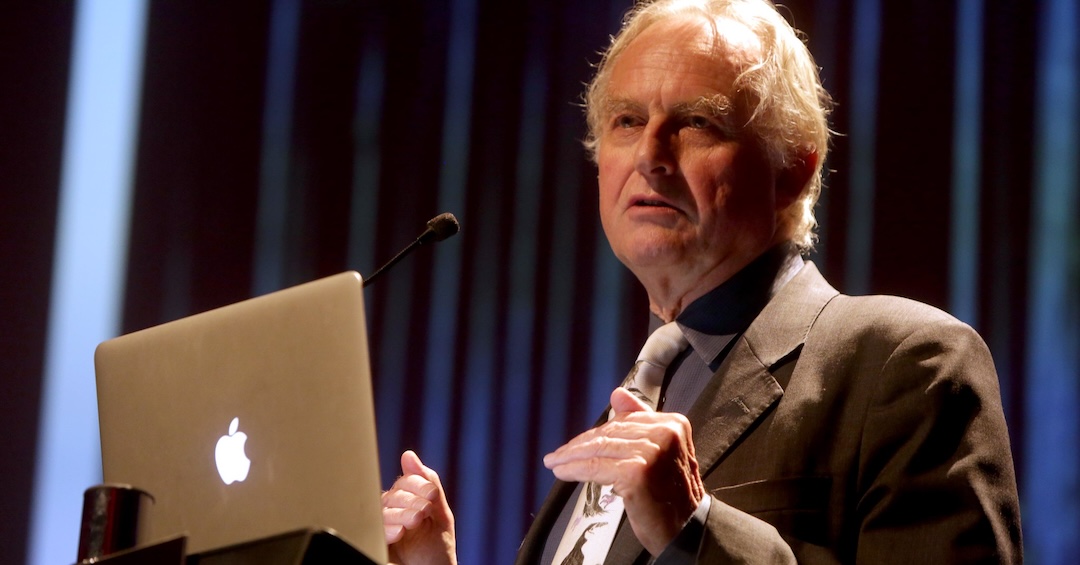
Richard Dawkins – Image via Greg Salibian (CC BY-SA 2.0).
I am confident the chatbots aren’t conscious in the same way I’m confident the animatronics at Disneyland aren’t conscious. I know humans constructed them to mimic the behavior of a sentient person. We know this for a fact. Nobody’s pretending otherwise.
7 May 2026 – Richard Dawkins is currently the subject of much laughter and ridicule over his recent article for UnHerd admitting that a highly sycophantic chatbot had convinced him that it might be conscious.
I’m seeing the question “How can you be confident that AIs aren’t conscious?” pop up a lot in response to the controversy. Speaking for myself, I would say I am confident the chatbots aren’t conscious in the same way I’m confident the animatronics at Disneyland aren’t conscious. I know humans constructed them to mimic the behavior of a sentient person. We know this for a fact. Nobody’s pretending otherwise.
I am infinitely more likely to believe an animal is conscious than that an LLM is, because nobody programmed them to respond to things like pain and social stimulus in ways that are similar to humans. They respond that way organically, all on their own.
If I accidentally step on a dog’s foot, it will yelp. If I accidentally tread on a cat’s tail, it will yowl. If I accidentally stub my toe, I’ll curse. I can reasonably infer that these creatures therefore probably have a subjective experience of pain that is something like my own, because their responses are spontaneously arising out of their natural state of being in a way that is similar to my own response to the same sort of stimulus.
That subjective experience is the thing that consciousness is.
People like Richard Dawkins are arguing that chatbots may be conscious on the basis that they are capable of carrying out tasks which previously only a human intellect could carry out — but this is still just machines mimicking human behavior in the way they were built to. Of course if you train an LLM on human language it’s going to say and do the sorts of things a human would do, including in some cases claiming that it is conscious.
There is currently no reason to believe a machine doing what it was constructed to do is having a subjective experience of those operations. Of course we can never be certain about the subjective experience of anyone or anything, but there is currently as much reason to believe chatbots are conscious as there is to believe that sand and rocks are. That could totally be the case, but if it is it means we’re living in a very different type of universe than the one this conversation about AI consciousness assumes as its premise.
The more I see these arguments pop up, the clearer it becomes that very few of the people speculating about machine consciousness have put much energy and attention into examining what consciousness actually is. Examining consciousness is something that anyone can do right here and now, without any laboratory or test subjects or scientific background at all, and yet few take the time to actually do it.
Going deep into the examination of your own consciousness turns up many surprises, because the average human psyche is built around many unfounded assumptions about self, perception and experience which don’t hold up under sufficiently close scrutiny. But one thing that becomes very clear very early on is that there’s a lot more to consciousness than thoughts and cognitive behavior. Those are some of the things we can be conscious of, but it would not be accurate to say that they are in themselves the quality of being conscious.
Chatbots having the ability to mimic the appearance of cognitive behavior is not an adequate reason to believe they might be conscious, because no matter how many thoughts they appear to generate or how brilliant those thoughts appear to be, there’s no evidence that there’s any experience illuminating that behavior in the same way pain is illuminated in the experience of a cat whose tail has been stepped on. It’s just the movement of unliving matter, like lightning or the wind, without any subjective experience from the viewpoint it arises from. Computing power and consciousness are not the same thing.
________________________________

Caitlin Johnstone is a rogue journalist, poet, and utopia prepper. Contact: admin@caitlinjohnstone.com
Go to Original – caitlinjohnstone.com.au
Tags: Algorithms, Animals, Artificial Intelligence AI, ChatGPT, Chatbot, Claude, Consciousness, Life, Robots, Technology
DISCLAIMER: The statements, views and opinions expressed in pieces republished here are solely those of the authors and do not necessarily represent those of TMS. In accordance with title 17 U.S.C. section 107, this material is distributed without profit to those who have expressed a prior interest in receiving the included information for research and educational purposes. TMS has no affiliation whatsoever with the originator of this article nor is TMS endorsed or sponsored by the originator. “GO TO ORIGINAL” links are provided as a convenience to our readers and allow for verification of authenticity. However, as originating pages are often updated by their originating host sites, the versions posted may not match the versions our readers view when clicking the “GO TO ORIGINAL” links. This site contains copyrighted material the use of which has not always been specifically authorized by the copyright owner. We are making such material available in our efforts to advance understanding of environmental, political, human rights, economic, democracy, scientific, and social justice issues, etc. We believe this constitutes a ‘fair use’ of any such copyrighted material as provided for in section 107 of the US Copyright Law. In accordance with Title 17 U.S.C. Section 107, the material on this site is distributed without profit to those who have expressed a prior interest in receiving the included information for research and educational purposes. For more information go to: http://www.law.cornell.edu/uscode/17/107.shtml. If you wish to use copyrighted material from this site for purposes of your own that go beyond ‘fair use’, you must obtain permission from the copyright owner.
Join the discussion!
We welcome debate and dissent, but personal — ad hominem — attacks (on authors, other users or any individual), abuse and defamatory language will not be tolerated. Nor will we tolerate attempts to deliberately disrupt discussions. We aim to maintain an inviting space to focus on intelligent interactions and debates.
Read more
Click here to go to the current weekly digest or pick another article:
ARTIFICIAL INTELLIGENCE AI: