


Journalism: Shaping a World at Peace
PAPER OF THE WEEK, 25 May 2026
UNESCO – TRANSCEND Media Service
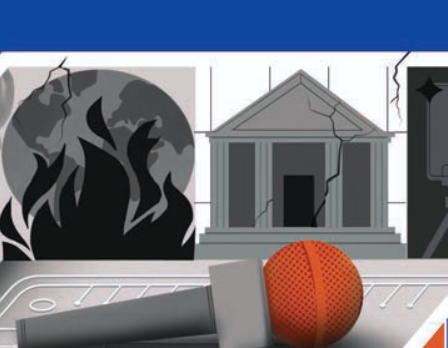
World Trends in Freedom of Expression and Media Development: Global Report 2022 /2025
Foreword
Press freedom is under attack worldwide. The global Freedom of Expression Index has dropped by 10% since 2012. Proliferating armed conflicts in many regions of the world continue to inflict unimaginable suffering on millions of civilians, while numerous governments continue to tighten control and dis-information spreads like wildfire across the global information landscape.
Against this backdrop, journalists continue to stand on the front lines and report the truth, working to defend human dignity and advance justice. Yet, they often do so at the cost of their safety: in too many places, they are attacked, exiled, or forced into silence.
Protecting freedom of expression has been a central pillar of UNESCO’s mandate since its founding in 1945, with the importance of the unrestricted pursuit of objective truth and the free exchange of ideas and knowledge embedded in its Constitution. In working to protect freedom of expression as a public good, we are working to protect the cornerstone of democratic societies. But to do so, we must first understand what is eroding it – which is the purpose of the flagship World Trends Report on Freedom of Expression and Media Development.
This 2025 edition provides insights into how the global landscape has shifted since 2021. Despite ongoing threats to freedom of expression, this report offers a few rays of hope. Community radio continues to connect people and amplify local voices, while investigative reporting exposes corruption and injustice. Journalists, civil society and local media worldwide are finding new ways to persevere and innovate: new technologies have expanded access to information for billions of people, and initiatives uniting journalists across borders show how collective action can safeguard media as a public good.
Yet, in a world grappling with misinformation and disinformation, amplified by the growing presence of artificial intelligence (AI), we must further step up our action to defend freedom of expression.
Firstly, by safeguarding media viability. In an era when support for traditional media is dwindling amid economic uncertainty, political pressure and technological shifts, defending free, independent journalism must be recognized as a development priority – and as part of wider efforts to uphold freedom of expression and information.
Promoting transparency in the digital sphere is equally crucial, although it is difficult to define and hard to achieve. In a globalized, online media landscape, concerted efforts to promote cooperation among all those involved in the information cycle are vital to ensure transparent access to information, foster accountability and empower users to make informed choices.
Lastly, as new technologies reshape how information is created and shared, we must continue to advance media and information literacy (MIL). By teaching citizens to critically engage with information and safely navigate the digital environment, we can build greater trust in today’s information ecosystem.
These challenges are at the heart of the Windhoek+30 Declaration on Information as a Public Good. This text, unanimously endorsed 30 years after the original 1991 Windhoek Declaration, reaffirms our shared responsibility to defend free, independent and pluralistic media – and underpins UNESCO’s efforts in this area.
UNESCO’s founding mission reminds us that peace is built on foundations of trust, knowledge, and dialogue. This Report speaks to the role of journalism in cementing these foundations – and offers insights into how we can fulfill our collective responsibility to protect media and information as a public good.
Dr Tawfik Jelassi, Assistant Director-General for Communication and Information UNESCO
DOWNLOAD PDF FILE:
Journalism: Shaping a World at Peace
PAPER OF THE WEEK STAYS POSTED FOR 2 WEEKS BEFORE BEING ARCHIVED
Tags: Freedom of Speech, Freedom of information, Freedom of the press, Journalism, Media, Peace Journalism, UNESCO
This article originally appeared on Transcend Media Service (TMS) on 25 May 2026.
Anticopyright: Editorials and articles originated on TMS may be freely reprinted, disseminated, translated and used as background material, provided an acknowledgement and link to the source, TMS: Journalism: Shaping a World at Peace, is included. Thank you.
If you enjoyed this article, please donate to TMS to join the growing list of TMS Supporters.

This work is licensed under a CC BY-NC 4.0 License.
One Response to “Journalism: Shaping a World at Peace”
Join the discussion!
We welcome debate and dissent, but personal — ad hominem — attacks (on authors, other users or any individual), abuse and defamatory language will not be tolerated. Nor will we tolerate attempts to deliberately disrupt discussions. We aim to maintain an inviting space to focus on intelligent interactions and debates.
Open Letter to The Editorial Board and Contributors of Transcend Media Service
Subject: A Respectful Appeal for Collective Moral Agency Beyond Commentary and TMS Publications.
Dear Esteemed Professors, Senior Members and Founders of Global Peace Organisations, Editorial Board Members, Scholars, “Moral Heirarchists” and Contributors to Transcend Media Service.
I read your publications in the recent issues of TMS, noting a thread of commonality expressed in support of the ongoing plight of Palestinians. I commend your stance. Thank you for accepting my second appeal, appended as an open plea, to engage in a collective effort to highlight the problem of ongoing suffering, torture and genocide of 72,764+ Palestinians, with over 10,000 reportedly vapourised by the collective allies of Israel. The global silence is indeed abysmal, in this major humanitarian crisis of the 21st century.
With humility and deep respect for the intellectual legacy of TMS, founded on the principles of peace journalism and the visionary work of Professor Johan Galtung (MHSRIEP), I write to you as a fellow contributor, committed to the shared pursuit of justice, dignity, peace and global harmony. I trust that in your frenetic schedules you will kindly read this document with good intentions.
Recent reports published within TMS, including those addressing the plight of flotilla activists and the ongoing suffering of Palestinian civilians, reflect the moral clarity and courage that have long defined this platform. These contributions illuminate injustice with scholarly rigour and human compassion.
Yet, I write today with a gentle but earnest question:
Can we, as a community, move from witnessing to collective moral action?
In March 2026, I submitted a draft memorandum proposing that TMS, as a body of globally respected thinkers and “Titans of Peace Propagation” consider endorsing an urgent humanitarian appeal to the United Nations. The intention was not to impose unanimity, but to explore whether our shared ethical commitments might find expression in a unified call for:
• immediate ceasefire measures,
• protection of civilians,
• The targeted killings of journalists
• Blatant violations of the different Geneva Conventions
• accountability under international law,
• and renewed multilateral engagement through the United Nations system.
I fully appreciate that TMS is not traditionally an advocacy institution, and that editorial independence is essential to its integrity. However, I respectfully submit that:
There are moments in history when moral scholarship may justifiably seek a collective voice.
The events currently unfolding, whether involving flotilla activists, civilian populations, or broader regional instability in the Middle East, pose profound challenges not only to international law, but to our shared humanity.
I wish to clarify that this appeal is not a criticism of editorial decisions, nor an expectation of institutional uniformity. Rather, it is an invitation:
An invitation to individual conscience
Should a collective institutional endorsement be impractical, perhaps an alternative path may be considered:
• voluntary endorsement of the memorandum by individual contributors,
• publication of parallel perspectives exploring actionable peace mechanisms,
• or informal cooperation toward engaging established UN humanitarian channels.
TMS has long illuminated the path toward peace.
Might it now, in some form, help to gently walk that path together?
I remain deeply grateful, appreciative and indebted for the platform TMS provides, under the editorial baton of the long serving and esteemed Professor Antonio Carlos Siva Rosa, as well as for the tireless efforts of its editorial Board and contributors. My intention is not to burden, but to contribute, however modestly, to the living tradition of peace through scholarship and ethical engagement, which forms the very basic tenets of peace propagation, as initiated by the late Professor Johan Galtung (MHSRIEP)
With respect, sincerity, solidarity and hope,
Hoosen Vawda
Peace Propagator
Durban, South Africa
Global: + 27 82 291 4546
e-mail: vawda@ukzn.ac.za
Dated: Tuesday 26th May 2026
Reference: TMS/Cont/26052026/RHV1