
A Child of Genocide-Survivor Parents, This Rohingya Refugee in Canada Believes in and Acts on Never Again!
TRANSCEND MEMBERS, 1 Jun 2026
Maung Zarni | FORSEA – TRANSCEND Media Service
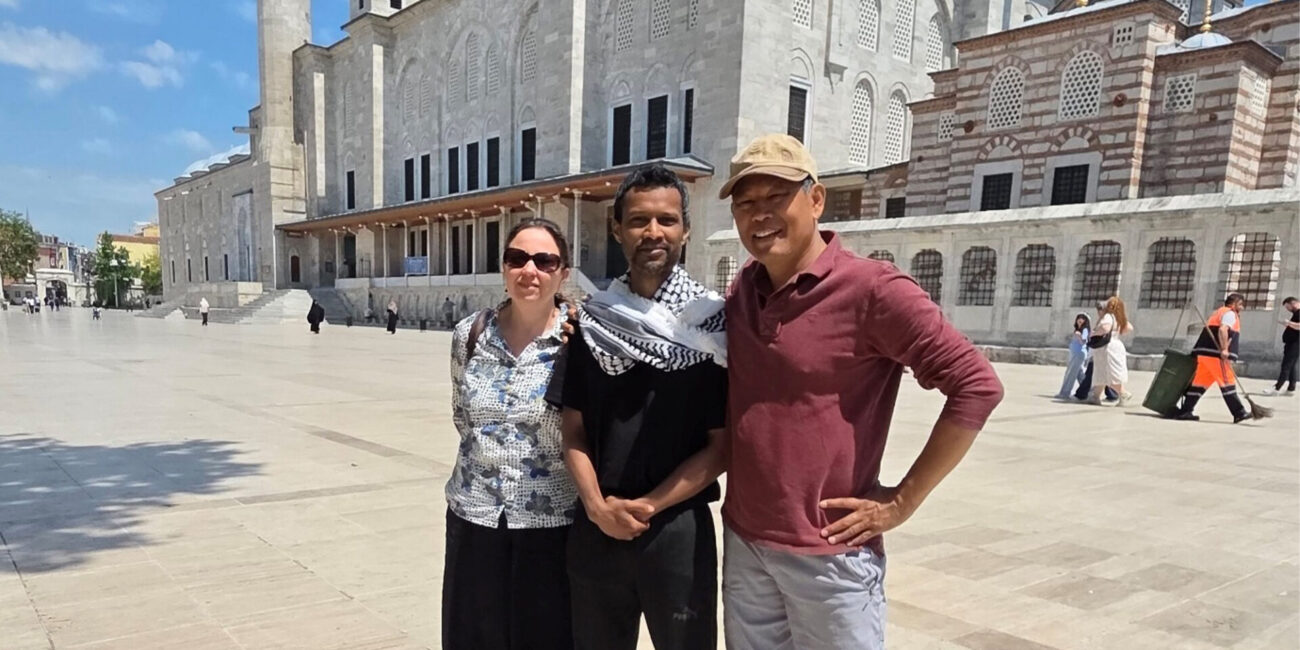
Left to right: Dr Natalie Brinham, Ko Tinmaung and Dr Maung Zarni. Dr Natalie Brinham, who co-authored ‘The Slow-Burning Genocide of Myanmar’s Rohingyas,’ filmed the interview.
27 May 2026 – Rohingya human rights activist, former refugee and veteran of the Canadian Armed Forces detailed the abuses he was subjected to by Israel’s elite naval commandos and Israeli prison guards, in his 20-minutes recorded interview in Istanbul.
Ko Tinmaung was subjected to ninety-six hours of anti-Muslim racist verbal abuse and bodily harms, (including tasing, slapping, and beatings) on Israel’s “prison ship” and on land in Ashdod. Nothing could have prepared anyone to face the level of Israeli security officials’ gleeful savagery, sadistic cruelty and Nazi-like anti-Muslim racism.

On 26 May, inside Turkeu’s magnificent Süleymaniye Mosque, FORSEA’s Dr Maung Zarni sat down with his Rohingya activist brother and recorded his first-hand experience in the hands of first Israel naval commandos on “a prison boat” and later of the Israeli prison guards in Ashdod, Israel.
The two were in touch until a few hours before the abduction of Ko Tinmaung and his fellow members aboard the vassal Umut, one of 60+ boats that set sail from Turkey towards Gaza as part the Global Sumud Flotilla.
Ko Tinmaung looked a bit frail and was still recovering from his ordeals when the interview took place.
Personal background of a rights activist who believes in and acts on Never Again!
Ko Tinmaung was a child of Rohingya parents who as a young couple from Myanmar, survived the earliest wave of the state-directed genocidal mass deportation of Rohingyas in February 1978. His parents took refugee in adjacent Bangladesh where he was born in the city called Chittagong. He and his widowed mother later resettled as refugees in Toronto, Canada where he grew up and joined Canadian Armed Forces.


But as a child of genocide survivors, he took the slogan Never Again! personally and has sought to pursue human rights activism and oppose ALL genocides, by the victims his fellow Rohingyas inside Myanmar or Palestinians in the Occupied Territories.
He was subjected to constant pressure by his superior officers in the service because he has active in raising genocide awareness about the ongoing and slow-burning genocide of his fellow Rohingyas back in his ancestral land of Myanmar where both the state and the society, not just the pariah national military, are soaked in Buddhist Supremacist violent racism, particularly towards the predominantly Muslim Rohingyas.
He finally resigned from his job – and was honourably discharged – in order that he may pursue his human rights activists without having to deal with the constant pressure to stay clear of such citizens’ activism.
Watch the 20-minutes interview with Ko Tinmaung below:
___________________________________________
 A Buddhist humanist from Burma (Myanmar), Maung Zarni, nominated for the 2024 Nobel Peace Prize, is a member of the TRANSCEND Media Service Editorial Committee, of the TRANSCEND Network for Peace Development Environment, former Visiting Lecturer with Harvard Medical School, specializing in racism and violence in Burma and Sri Lanka, and Non-resident Scholar in Genocide Studies with Documentation Center – Cambodia. Zarni is the co-founder of FORSEA, a grass-roots organization of Southeast Asian human rights defenders, coordinator for Strategic Affairs for Free Rohingya Coalition, and an adviser to the European Centre for the Study of Extremism, Cambridge. Zarni holds a PhD (U Wisconsin at Madison) and a MA (U California), and has held various teaching, research and visiting fellowships at the universities in Asia, Europe and USA including Oxford, LSE, UCL Institute of Education, National-Louis, Malaya, and Brunei. He is the recipient of the “Cultivation of Harmony” award from the Parliament of the World’s Religions (2015). His analyses have appeared in leading newspapers including the New York Times, The Guardian and the Times. Among his academic publications on Rohingya genocide are The Slow-Burning Genocide of Myanmar’s Rohingyas (Pacific Rim Law and Policy Journal), An Evolution of Rohingya Persecution in Myanmar: From Strategic Embrace to Genocide, (Middle East Institute, American University), and Myanmar’s State-directed Persecution of Rohingyas and Other Muslims (Brown World Affairs Journal). He co-authored, with Natalie Brinham, Essays on Myanmar Genocide.
Tags: Activism, Burma/Myanmar, Gaza, Genocide, Global Sumud Flotilla, Israel, Nonviolent Action, Palestine, Pariah State, Piracy, Rogue states, Rohingya, Torture, West Bank
DISCLAIMER: The statements, views and opinions expressed in pieces republished here are solely those of the authors and do not necessarily represent those of TMS. In accordance with title 17 U.S.C. section 107, this material is distributed without profit to those who have expressed a prior interest in receiving the included information for research and educational purposes. TMS has no affiliation whatsoever with the originator of this article nor is TMS endorsed or sponsored by the originator. “GO TO ORIGINAL” links are provided as a convenience to our readers and allow for verification of authenticity. However, as originating pages are often updated by their originating host sites, the versions posted may not match the versions our readers view when clicking the “GO TO ORIGINAL” links. This site contains copyrighted material the use of which has not always been specifically authorized by the copyright owner. We are making such material available in our efforts to advance understanding of environmental, political, human rights, economic, democracy, scientific, and social justice issues, etc. We believe this constitutes a ‘fair use’ of any such copyrighted material as provided for in section 107 of the US Copyright Law. In accordance with Title 17 U.S.C. Section 107, the material on this site is distributed without profit to those who have expressed a prior interest in receiving the included information for research and educational purposes. For more information go to: http://www.law.cornell.edu/uscode/17/107.shtml. If you wish to use copyrighted material from this site for purposes of your own that go beyond ‘fair use’, you must obtain permission from the copyright owner.
Join the discussion!
We welcome debate and dissent, but personal — ad hominem — attacks (on authors, other users or any individual), abuse and defamatory language will not be tolerated. Nor will we tolerate attempts to deliberately disrupt discussions. We aim to maintain an inviting space to focus on intelligent interactions and debates.