


UK: Terrorist Sentence for Palestine Action Activists Marks ‘Dangerous’ Move against Right to Protest
ACTIVISM, 15 Jun 2026
Amnesty International UK - TRANSCEND Media Service
13 Jun 2026 – In response to Judge Mr Justice Johnson’s announcement to the Court that he would be sentencing the Palestine Action ‘Filton 4’ protesters on the basis that their raid of Elbit Systems had a “terrorist connection”, Kerry Moscogiuri, Amnesty International UK’s Chief Executive, said:
“The defendants in today’s case were sentenced as terrorists because prosecutors want to make an example of them and set a precedent for how direct action protesters could be treated in the future.
“Criminal damage has never been treated as terrorism within the UK justice system before and it is dangerous to treat them as the same thing. We should all be worried about what this means for other individuals taking direct action in protest of a genocide or any other issue.
“The right to protest is one of the most effective tools we have to hold our leaders to account and today is another step in the ongoing crackdown in this country against it.
“It is completely disproportionate to punish protesters for criminal damage as if they were terrorists, a sentence that will stay with them for the rest of their lives.
“The use of terrorism laws against direct action protesters must end.”
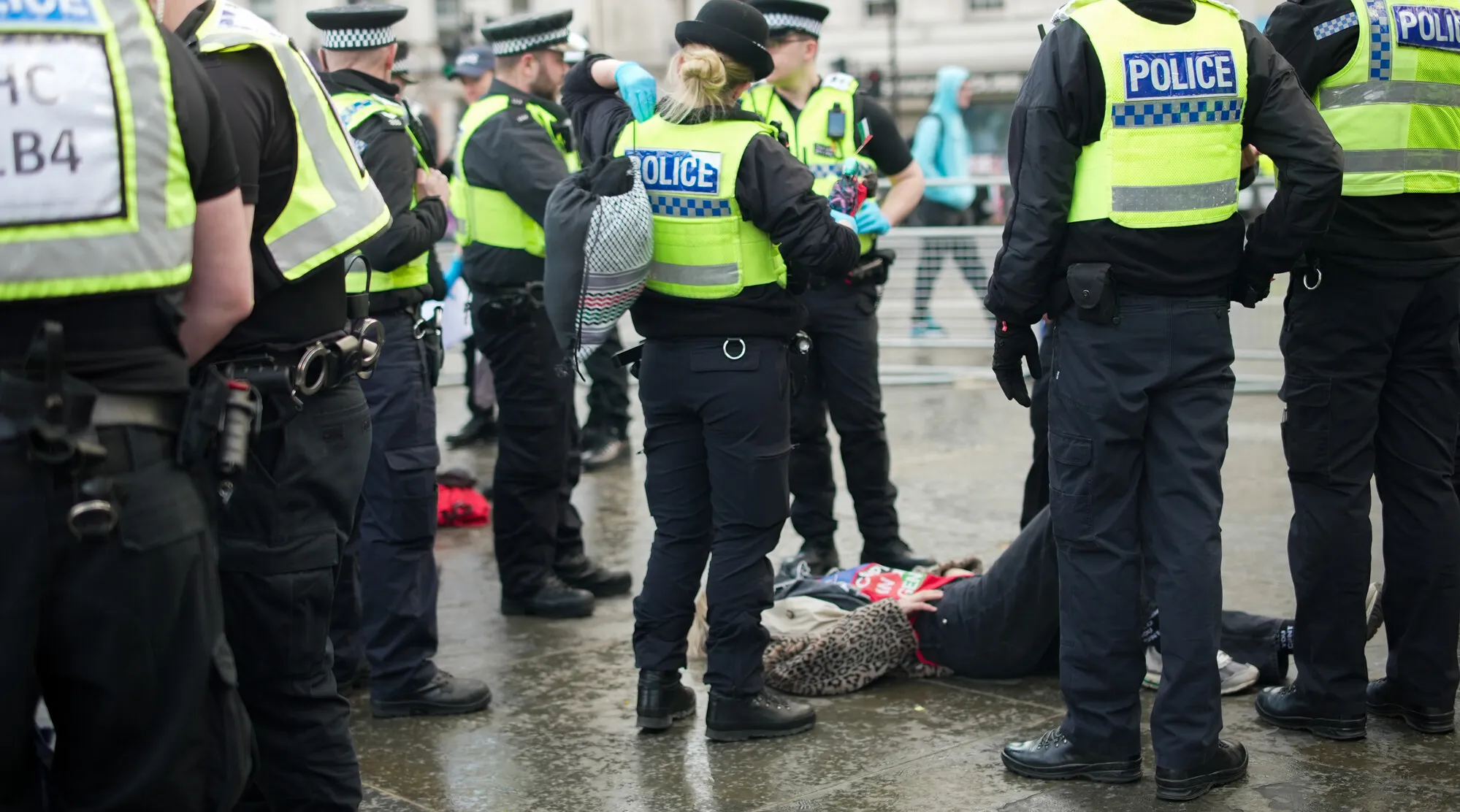
© Leah Rustomjee
Background
Today, the four Palestine Action activists known as ‘the Filton 4’ – Charlotte Head, 29; Samuel Corner, 23; Leona Kamio, 30; and Fatema Rajwani, 21 – were told by Judge Mr Justice Johnson they would be sentenced as having a ‘terrorist connection’ following convictions for criminal damage arising out of their involvement in direct action at the Elbit Systems factory in Filton, near Bristol.
As Amnesty International has set out in a paper on the issue, until recently the UK courts have largely operated an approach to dealing with protests and other forms of direct action with a degree of toleration. Criminal law has always been applied, and in the context of protest acts, such as criminal damage, have been distinguished from ordinary criminality and treated more leniently than ordinary criminality. The approach of toleration, while still applying the criminal law, has been central to meeting the UK’s human rights obligations to act proportionately in its treatment of the rights to freedom of expression, peaceful assembly and association.
Amnesty is seriously concerned that resorting to a Section 69 finding in cases of criminal damage committed during direct action would invert this principle and misconstrue activists’ conscientious motivation for their actions, and instead consider them an aggravating factor to justify the use of terrorism sentencing powers.
Go to Original – amnesty.org.uk
Tags: Activism, Amnesty International, Authoritarianism, Demonstrations, Europe, Fake Justice, Freedom of Speech, Gaza, Genocide, Israel, Nonviolent Action, Palestine, UK, USA, West Bank
DISCLAIMER: The statements, views and opinions expressed in pieces republished here are solely those of the authors and do not necessarily represent those of TMS. In accordance with title 17 U.S.C. section 107, this material is distributed without profit to those who have expressed a prior interest in receiving the included information for research and educational purposes. TMS has no affiliation whatsoever with the originator of this article nor is TMS endorsed or sponsored by the originator. “GO TO ORIGINAL” links are provided as a convenience to our readers and allow for verification of authenticity. However, as originating pages are often updated by their originating host sites, the versions posted may not match the versions our readers view when clicking the “GO TO ORIGINAL” links. This site contains copyrighted material the use of which has not always been specifically authorized by the copyright owner. We are making such material available in our efforts to advance understanding of environmental, political, human rights, economic, democracy, scientific, and social justice issues, etc. We believe this constitutes a ‘fair use’ of any such copyrighted material as provided for in section 107 of the US Copyright Law. In accordance with Title 17 U.S.C. Section 107, the material on this site is distributed without profit to those who have expressed a prior interest in receiving the included information for research and educational purposes. For more information go to: http://www.law.cornell.edu/uscode/17/107.shtml. If you wish to use copyrighted material from this site for purposes of your own that go beyond ‘fair use’, you must obtain permission from the copyright owner.
Join the discussion!
We welcome debate and dissent, but personal — ad hominem — attacks (on authors, other users or any individual), abuse and defamatory language will not be tolerated. Nor will we tolerate attempts to deliberately disrupt discussions. We aim to maintain an inviting space to focus on intelligent interactions and debates.