
The “Key to Peace” Comes in a Gun Box: Reflections on NATO’s Ankara Summit
NATO, 13 Jul 2026
Derya Yüksek - TRANSCEND Media Service
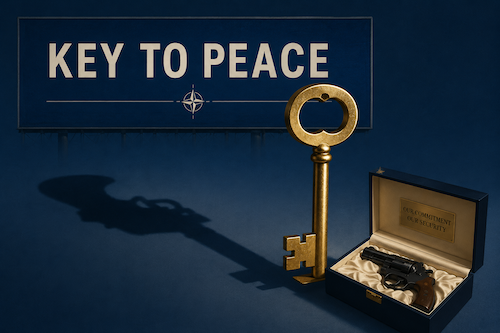
10 Jul 2026 – As world leaders gathered in Ankara for NATO’s 2026 Summit, giant navy-blue billboards greeted them with reassuring slogans: “Key to Peace,” “Key to Security,” and “A Shared Future in Peace.” For a few days, peace was everywhere in words—in the city’s visual landscape, official messaging and carefully curated public imagery.
Yet when the summit concluded, one image lingered above all others. President Recep Tayyip Erdoğan presented the attending heads of state and government with commemorative Turkish-made revolvers, elegantly displayed in presentation boxes, as diplomatic gifts.
It was a striking piece of symbolism: the “key to peace” had come in a gun box. The irony is difficult to ignore.
Inside the summit, leaders celebrated unprecedented investments in military capabilities, reaffirmed deterrence as NATO’s central mission, pledged tens of billions in additional military assistance to Ukraine, expanded defense-industrial cooperation, accelerated investments in AI-enabled warfare and military technologies, and called for greater preparedness against emerging threats.
Outside, another Ankara existed. Roads were closed, large parts of the city were heavily securitized, and public space was carefully insulated from those wishing to express dissent. Protesters attempting to voice anti-NATO perspectives were detained as demonstrations were dispersed. Yet across this tightly controlled urban landscape, the billboards continued to promise peace.
This contrast is more than symbolic. It reflects a much deeper transformation in contemporary security politics: peace is increasingly being articulated through the language of military power (and war).
This article is therefore not simply about NATO. It is about peace itself. More specifically, it is about who gets to define peace, and what happens when the vocabulary of peace becomes increasingly absorbed into the vocabulary of deterrence, military preparedness and technological superiority in warfare.
Who Speaks for Peace?
In an earlier article for Transcend Media Service, I asked a simple question: Who gets to sit on a “Board of Peace”? Who possesses the authority to define what peace means, how it is pursued and whose voices are heard?
The Ankara Summit invites us to ask the same question once again.
Military alliances inevitably define themselves through defense—articulated as armed deterrence and collective military action against perceived threats. Yet increasingly they also speak in the name of peace. Peace appears in summit slogans, strategic communications and political narratives, while the policies associated with that language remain overwhelmingly centered on military investment and strategic competition.
The problem is not that NATO speaks about peace. The problem begins when deterrence itself becomes peace.
When that happens, the rich traditions of peacebuilding, reconciliation, mediation, restorative justice, dialogue and conflict transformation gradually disappear from public imagination. Peace ceases to be understood as a social and political process and instead becomes reduced to the anticipated outcome of military superiority.
If peace is imagined only in military terms, alternative ways of creating it become increasingly difficult even to conceive.
NATO 3.0—But What About Peace?
A recent Transcend Media Service article argued that NATO is evolving into something larger than a traditional military alliance—an increasingly integrated military-industrial investment ecosystem. The Ankara Summit appears to reinforce this observation. Defense production, technological innovation, AI-enabled military systems, industrial capacity and long-term strategic investment occupied a central place in the summit’s agenda.
In this sense, NATO is clearly “evolving”.
But while defense is being radically reinvented, peace remains trapped inside an outdated Cold War vocabulary.
The summit outcomes speak for themselves. Defense, deterrence, military readiness, industrial production, strategic capabilities and technological innovation dominated the agenda. Allies proudly announced their “historic steps” including more than €50 billion in procurement agreements for new military capabilities; over US $40 billion in counter-drone capabilities; major investments in fuel storage and distribution infrastructure for military readiness; around €70 billion in military equipment, assistance and training for Ukraine in 2026 alone; and unprecedented increases in defense spending across Europe, with some governments committing to the largest military build-ups in decades.
Meanwhile, in a summit promoted through the slogans of peace, concepts fundamental to peace and peacebuilding—dialogue, reconciliation, trust-building, peace education, restorative justice, mediation, or conflict transformation—were entirely absent. For NATO allies, peace appears to be an expected consequence of increasingly sophisticated military capacity—as if it could be purchased through larger military budgets.
This reflects a particular understanding of peace—one that peace studies has tirelessly questioned, critiqued, and worked against, for decades.
The Security Paradox
The tragedy is that militarized understandings of peace often generate precisely the insecurities they seek to prevent.
International relations scholars describe this as the security dilemma. Measures one actor considers defensive are interpreted by another as offensive. Each side responds by strengthening its own capabilities. Both claim to be acting in the name of security.
Collectively, they produce greater insecurity—not only for states, but increasingly for societies, ecosystems and future generations.
Russia’s invasion of Ukraine illustrates this dynamic. Armed aggression against a sovereign state cannot be justified under international law. Yet understanding a conflict should never be confused with legitimizing it.
For years, Russian leaders framed NATO’s eastward enlargement as an existential threat to Russia’s security, warning that continued expansion would provoke military responses. NATO, meanwhile, consistently viewed enlargement as the sovereign choice of independent states seeking collective defense.
Each side understood its own actions as defensive. Each interpreted the other’s actions as increasingly threatening. The result was not peace through deterrence, but a catastrophic war.
The same logic can be observed elsewhere.
The war between the United States/Israel and Iran, growing military competition in the Indo-Pacific, record investments in artificial intelligence for warfare and rapidly expanding global arms industries all reflect a world increasingly seeking security through ever greater military capacity.
Everyone claims to be investing in security. Yet the world feels increasingly insecure.
This is not simply a failure of policy. It is also a failure of political imagination.
We have become remarkably innovative in designing new architectures of war while investing comparatively little imagination in designing new architectures of peace.
A peace infrastructure capable of preventing wars remains remarkably absent from contemporary security debates.
Where are the ambitious investments in peace education?
Where are the resources devoted to dialogue across divided societies?
Where are long-term reconciliation initiatives?
Where are independent media programmes designed to reduce polarization?
Where are sustained commitments to conflict prevention before violence erupts?
If NATO countries can mobilize hundreds of billions for military preparedness, why does even a fraction of that ambition rarely accompany investments in peacebuilding?
Who Pays for This Vision of Security?
The summit’s emphasis on militarized security also raises another question, about the democratic politics of security.
NATO also consistently presents itself as an alliance committed not only to collective defense but also to democracy, freedom and shared democratic values. Yet democracy is more than defending political systems against external threats. It is about how collective priorities are decided, whose voices are heard, and who has the opportunity to shape the futures that will affect them.
The billions announced in Ankara are routinely described as commitments made by governments or allies. Yet governments do not produce wealth; societies do. These unprecedented military investments will ultimately be financed by taxpayers, workers and future generations through public budgets, debt and political priorities. Every euro, pound or dollar allocated to rearmament is also a political choice not to invest those same resources in education, healthcare, ecological transition, affordable housing, social justice or peacebuilding.
If societies are expected to finance these choices, bear their economic consequences and ultimately live with their political and security implications, should they not also participate more meaningfully in shaping them?
Decisions involving hundreds of billions are negotiated among political and military elites, while the societies expected to fund them remain largely as spectators. Democratic legitimacy cannot be reduced to electoral mandates every few years. Decisions that will shape the world’s security architecture for decades deserve far broader public deliberation.
The question, therefore, is not only who speaks for peace, but also who gets to participate in defining security (and peace) itself.
Recovering Peace
This is not ultimately an argument about NATO. It is an argument about peace.
Military alliances may continue to pursue deterrence. States may continue to seek security through military means.
Meanwhile, peace studies, peace practitioners and civil society cannot allow the meaning of peace to be quietly redefined through the language of military power. Security is too important to be left only to the hands of generals; peace is too important to be left only to the hands of military alliances.
Peace deserves its own vocabulary.
Its own institutions.
Its own political imagination.
Peace is not simply the absence of military defeat. Nor is it the product of larger defense budgets or more advanced weapons systems.
Peace is built through diplomacy, justice, dialogue, reconciliation, democratic participation, education, trust and the patient reconstruction of relationships fractured by violence.
The most important question raised by the Ankara Summit is therefore not whether NATO has become stronger.
The more important question is whether peace is becoming weaker in our collective political imagination.
The image of leaders arriving beneath billboards proclaiming “The Key to Peace” and departing with commemorative revolvers captures more than the contradictions of a single summit.
It symbolizes a broader historical moment in which military institutions increasingly speak the language of peace while peace itself is progressively being reduced to armed deterrence, military preparedness and technological superiority in defense.
If the key to peace now comes in a gun box, perhaps the greatest danger is not only that we continue preparing for future wars.
It is that we gradually forget how to imagine peace in any other language.
A language of dialogue before deterrence.
Of justice before domination.
Of cooperation before competition.
Of education before militarization.
Of reconciliation before rearmament.
Recovering that language—and reclaiming the authority to imagine peace beyond the confines of military thinking—is one of the most urgent democratic, intellectual and civic tasks of our time.
________________________________________________________
 Dr. Derya Yüksek is a communication and media studies scholar whose work focuses on alternative media, participatory democracy, and conflict transformation. Her research bridges theory and practice to examine how participatory processes reconfigure political imagination and civic agency in contexts marked by division and protracted conflict. Alongside her academic career, she has specialized in project management and worked as a manager and consultant on international cooperation initiatives in the field of culture, arts, and education across the Euro-Mediterranean and beyond.
Tags: Anti-militarism, Double Standards, NATO, Peace, Warfare
This article originally appeared on Transcend Media Service (TMS) on 13 Jul 2026.
Anticopyright: Editorials and articles originated on TMS may be freely reprinted, disseminated, translated and used as background material, provided an acknowledgement and link to the source, TMS: The “Key to Peace” Comes in a Gun Box: Reflections on NATO’s Ankara Summit, is included. Thank you.
If you enjoyed this article, please donate to TMS to join the growing list of TMS Supporters.

This work is licensed under a CC BY-NC 4.0 License.
Join the discussion!
We welcome debate and dissent, but personal — ad hominem — attacks (on authors, other users or any individual), abuse and defamatory language will not be tolerated. Nor will we tolerate attempts to deliberately disrupt discussions. We aim to maintain an inviting space to focus on intelligent interactions and debates.