
The Qadri Legacy: Social Vision of Islamic Scholarship and Sufi Ethics
TRANSCEND MEMBERS, 13 Jul 2026
Moin Qazi - TRANSCEND Media Service
“Sorrow prepares you for joy. It violently sweeps everything out of your house, so that new joy can find space to enter. It shakes the yellow leaves from the bough of your heart, so that fresh, green leaves can grow in their place. It pulls up the rotten roots, so that new roots hidden beneath have room to grow. Whatever sorrow shakes from your heart, far better things will take their place.”
— Jalaluddin Rumi, Masnavi, Divan-e Shams
In the chaos that prevails around us, the most authentic hope comes from Sufis whose poetry and philosophy combine the virtuous message of formal religion with the transcendental values of love and harmony. The foundation of Sufism is the life-determining belief in God. Sufis are touched and moved by Him, pervaded by the awareness of God. Their lives are centred entirely on God. They have unlimited faith in Him who cares for everyone. Sufism has been concerned with building bridges, not least between communities whose contact can be mutually beneficial. Over the years, Sufi masters have developed a scientific approach to achieving such refinement.
The legacy of the Qadri family is therefore not confined to individual achievements in Arabic scholarship, Islamic thought, or spiritual tradition. It represents a broader civilisational ideal—one in which knowledge is accompanied by humility, spirituality is expressed through service, and intellectual excellence finds its highest purpose in the betterment of humanity.
The intellectual and spiritual heritage represented by scholars like Syed Rafiuddin Qadri and Syed Firozuddin Qadri carries a broader message: knowledge must remain connected to human welfare. Classical Arabic scholarship, Islamic thought, Sufi spirituality, and social responsibility were never separate domains; they formed part of a larger civilisational vision where learning served humanity.
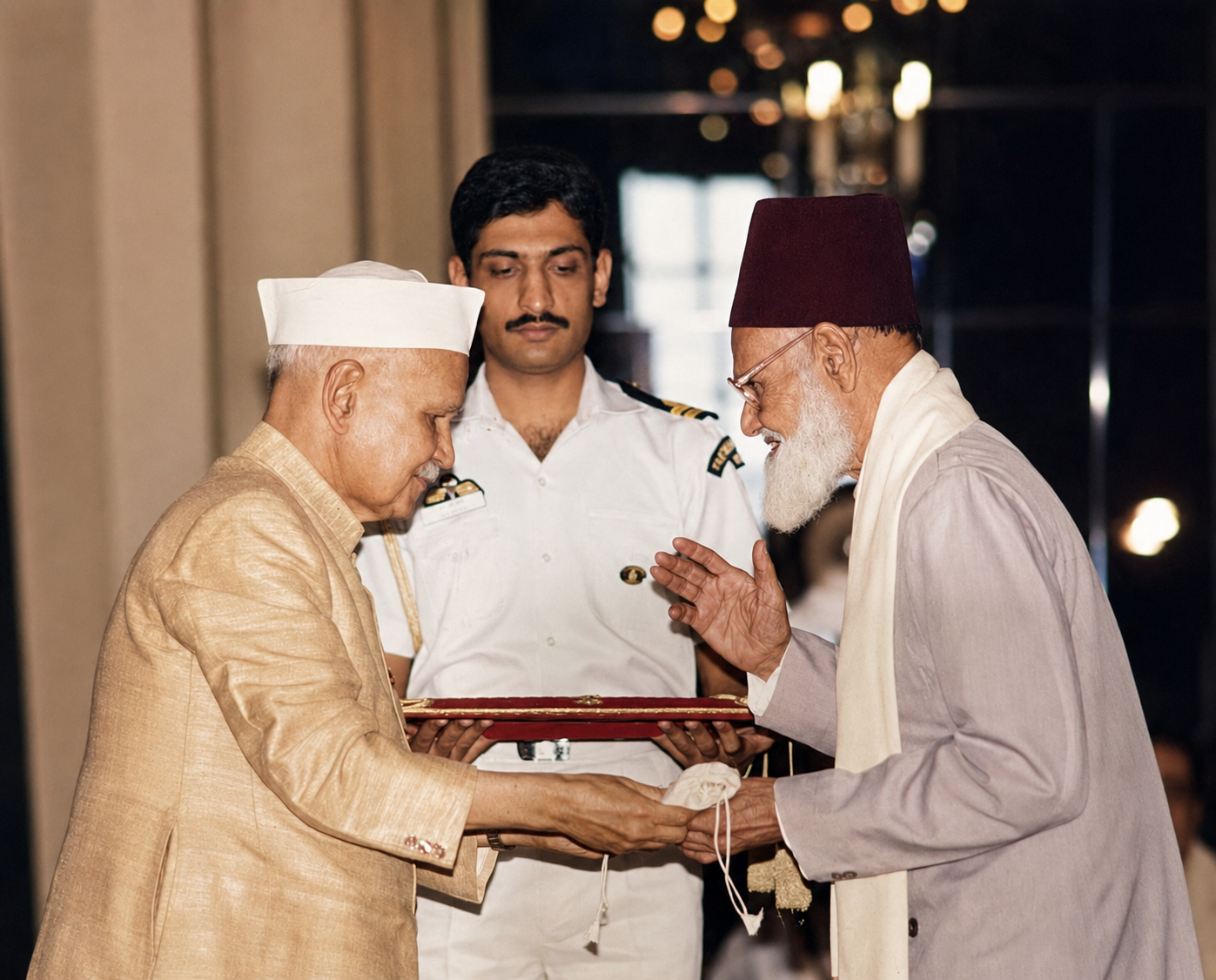
Dr S Rafiuddin Qadri receiving the President award for Arabic – Copy
The scholarly legacy of the Qadri family of the erstwhile Berar Province represents not merely an individual achievement but a continuation of a wider tradition in which knowledge, spirituality, moral responsibility, and social concern were deeply interconnected. The contributions of scholars such as Syed Rafiuddin Qadri and Syed Firozuddin Qadri belong to a heritage where Islamic learning was never confined to texts alone; rather, it sought to address human dignity, ethical conduct, community welfare, and the preservation of civilisational knowledge.
Among the most respected representatives of the Qadri intellectual tradition in Central India was Syed Rafiuddin Qadri (14 January 1918 – 27 November 2017), a scholar whose life embodied the enduring values of Islamic learning, spiritual refinement, and public service. Revered for his scholarship, humility, and unwavering commitment to preserving religious tradition, he belonged to a distinguished lineage that combined intellectual excellence with deep spiritual devotion.
Born on 14 January 1918 in Telegaon Dasasar, in the Amravati District of the erstwhile Berar Province (now in Maharashtra), Syed Rafiuddin Qadri was the son of Syed Inayat Mohiuddin and Maqbool Begum. From an early age, he was nurtured in an environment where learning was regarded not merely as an academic pursuit but as a sacred trust, inseparable from moral discipline and spiritual growth.
Throughout his long and productive life, Syed Rafiuddin Qadri remained steadfast in his dedication to the classical Islamic sciences. He represented that increasingly rare generation of scholars who regarded themselves not as innovators seeking personal prominence but as faithful custodians of a rich intellectual inheritance handed down through successive generations. His scholarship was characterised by meticulous fidelity to the Qur’an, the Sunnah, and the classical juristic and theological traditions, while remaining sensitive to the ethical and social challenges of contemporary society.
Beyond his erudition, he was admired for his simplicity, personal integrity, and accessibility. Students, colleagues, and members of the wider community found in him not only a learned teacher but also a compassionate guide whose wisdom was tempered by humility. His influence extended far beyond formal institutions, shaping generations through personal instruction, counsel, and the quiet example of a life devoted to faith and service.
Living for nearly a century, Syed Rafiuddin Qadri witnessed profound political, social, and religious transformations—from the final decades of British India through Independence and into the twenty-first century. Amid these changes, he remained a steadfast guardian of the Qadri scholarly tradition, demonstrating that authentic religious learning is sustained not merely through books and institutions but through lives of exemplary character.
His passing on 27 November 2017 marked the end of an era. Yet his legacy continues to inspire students of Islamic scholarship, reminding future generations that the true scholar is not only a transmitter of knowledge but also a custodian of wisdom, ethics, and spiritual civilisation.
His life reflected the classical ideal of scholarship combined with social responsibility. His learning represented the continuity of a tradition in which religious knowledge, ethical instruction, and community guidance were inseparable.
Like many scholars of Berar, his importance extended beyond formal academic credentials. His influence emerged through teaching, personal guidance, intellectual discussions, and the transmission of values to younger generations.
The role of scholars such as Syed Rafiuddin Qadri was particularly important during a period when traditional institutions faced new challenges. They became bridges between inherited knowledge systems and the educational aspirations of a changing society.
Dr Qadri represents the distinguished Indian tradition of Arabic scholarship, where language is not merely a medium of communication but the foundation for engaging with the deepest layers of Islamic thought. Honoured with the President’s Certificate of Honour for Classical Language scholarship in Arabic, he stands among those scholars who preserved and enriched the intellectual legacy of Arabic learning in India.
His contribution reflects the classical understanding that the Qur’an can only be approached with precision through mastery of its original language—its vocabulary, grammar, eloquence, and rhetorical dimensions. Arabic scholarship bridges the revealed text with its ethical, spiritual, and intellectual meanings.
The conferment of the President’s Award for Arabic upon Rafiuddin Qadri is a distinguished recognition of his outstanding contribution to the promotion, preservation, and enrichment of the Arabic language and scholarship. Rooted in the noble Qadri tradition and inspired by the spiritual legacy of Peer Nanhe Miya of Bhopal, this honour celebrates a lifelong commitment to knowledge, learning, and cultural service.
Rafiuddin Qadri’s work reflects the enduring values of the Qadri heritage—devotion to education, respect for wisdom, and dedication to building bridges of understanding through language and literature. His achievement represents not only a personal distinction but also a celebration of India’s rich tradition of Arabic studies and its historic engagement with the Arabic intellectual world.
The legacy of Dr Qadri lies in safeguarding a tradition that connects linguistic excellence with moral inquiry. His scholarly orientation represents an approach in which Qur’anic engagement is rooted in authenticity, discipline, and reverence for classical sources while remaining relevant to contemporary human concerns.
His life represented the continuation of a scholarly tradition where knowledge was inseparable from humility, discipline, and service. His legacy remains associated with devotion to Arabic scholarship, preservation of intellectual heritage, and the transmission of classical learning to future generations.
The Spiritual Foundation
The Sufi tradition, particularly the Naqshbandi-Mujaddidi tradition associated with Hazrat Yaqub Mujaddidi, popularly known as Peer Nanhe Mian Sahib, placed great emphasis on purification of the self, service to humanity, humility, and social responsibility. The Khanqah was historically not only a place of spiritual instruction but also a centre of learning, compassion, charity, and community support.
The Sufi understanding of spirituality recognised that a person’s greatness was not measured merely by intellectual achievement or social position, but by sincerity, service, and moral character. In an age of fragmented understanding, scholars like Dr Qadri remind us that the preservation of language is ultimately the preservation of thought, memory, and civilisation.
Syed Firozuddin Qadri
Syed Firozuddin Qadri represented another important dimension of the family’s scholarly inheritance. His contribution reflected the continuing relevance of traditional learning in the modern period.
The strength of such personalities lay in their ability to maintain intellectual continuity. They preserved connections with earlier generations of scholars while encouraging engagement with contemporary realities. The significance of figures like Syed Firozuddin Qadri lies not only in what they personally accomplished but also in the intellectual environment they helped sustain—an environment where learning remained a family value, and education remained a social mission.
Syed Firozuddin Qadri was regarded as a distinguished scholar deeply engaged with the life and legacy of Shah Waliullah Dehlawi, one of the greatest Islamic thinkers and reformers of the Indian subcontinent. Shah Waliullah’s scholarship represented a synthesis of Qur’anic understanding, Hadith, jurisprudence, spirituality, and social reflection. He sought to uncover the deeper wisdom (ḥikmah) behind Islamic teachings and address the moral and social challenges of his time.
Firozuddin Qadri’s engagement with Shah Waliullah reflected a commitment to preserving classical Islamic scholarship while connecting it with contemporary realities. Shah Waliullah viewed society as a moral and economic order based on justice, balance, education, and ethical responsibility. He warned against excessive concentration of wealth and power and emphasised that social institutions must promote harmony and human welfare.
This vision extended to the preservation of traditional occupations and skills. Muslim artisan communities historically contributed through weaving, metalwork, embroidery, carpentry, leatherwork, and other crafts, representing generations of knowledge and creativity. Industrialisation and mechanised production displaced many such communities, not because of a lack of ability, but because of changing economic structures, limited access to capital, and inadequate institutional support.
Recognising this challenge, Syed Firozuddin Qadri focused his later efforts on channelling the technical talent of Muslim youth towards skill development, vocational training, and employment-oriented education. He was closely associated with initiatives aimed at creating technically skilled Muslim youth capable of self-employment and economic advancement. This approach reflected a classical Islamic ethic: productive work is a source of dignity. In Islamic tradition, the artisan, farmer, trader, and craftsman all contribute to society, and spiritual excellence is inseparable from responsibility towards humanity.
In an age of rapid change, when many traditional bonds of knowledge and culture risk fading, preserving such memories becomes an act of gratitude and responsibility. The lives of scholars like Syed Rafiuddin Qadri and Syed Firozuddin Qadri remind us that true scholarship does not end with books written or lessons taught; it continues through the values it leaves behind.
The lives of such luminous figures remind us that the finest legacy one can leave behind is not merely in achievements recorded in books or honours received. Still, in the values one plants in the hearts of people and the institutions one strengthens for generations yet to come.
____________________________________________
 Moin Qazi, PhD Economics, PhD English, is a member of the TRANSCEND Network for Peace Development Environment and a member of NITI Aayog’s National Committee on Financial Literacy and Inclusion for Women. He is the author of the bestselling book, Village Diary of a Heretic Banker. He has worked in the development finance sector for almost four decades in India and can be reached at moinqazi123@gmail.com.
Tags: Ethics, Islam, Sufis
This article originally appeared on Transcend Media Service (TMS) on 13 Jul 2026.
Anticopyright: Editorials and articles originated on TMS may be freely reprinted, disseminated, translated and used as background material, provided an acknowledgement and link to the source, TMS: The Qadri Legacy: Social Vision of Islamic Scholarship and Sufi Ethics, is included. Thank you.
If you enjoyed this article, please donate to TMS to join the growing list of TMS Supporters.

This work is licensed under a CC BY-NC 4.0 License.
Join the discussion!
We welcome debate and dissent, but personal — ad hominem — attacks (on authors, other users or any individual), abuse and defamatory language will not be tolerated. Nor will we tolerate attempts to deliberately disrupt discussions. We aim to maintain an inviting space to focus on intelligent interactions and debates.