


How Israel Uses Settler-Soldier Terror to Colonise the West Bank
PALESTINE ISRAEL GAZA GENOCIDE, 3 Aug 2026
Mariam Barghouti | Al Jazeera – TRANSCEND Media Service
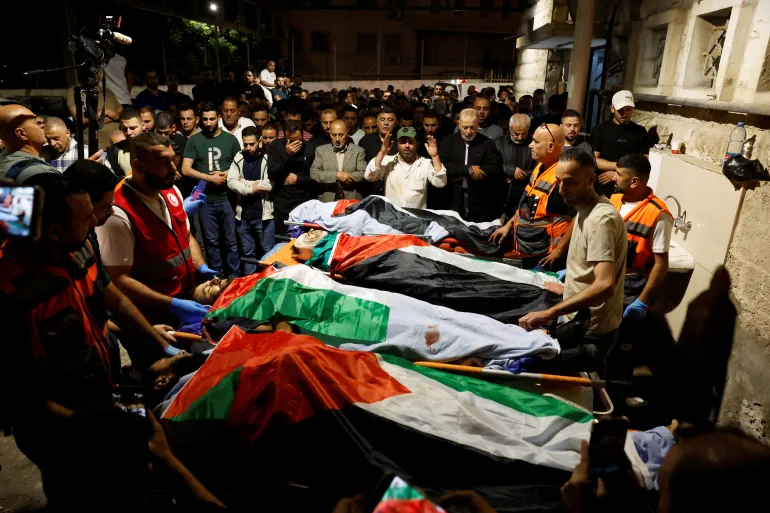
Palestinians pray next to the bodies of Palestinians killed by Israeli forces near the village of Tal, in Nablus, in the Israeli-occupied West Bank on 25 Jul 2026.
[Mohammed Torokman/Reuters]
Settler attacks are not isolated incidents. They are all part of a strategy to grab land and colonise.
27 Jul 2026 – The violent scenes playing out in the West Bank over the past few days are painfully familiar. Settlers setting fire to homes and places of worship, Palestinian villages coming under vicious attacks, families forced to leave their homes at gunpoint with nothing but what they can carry, and the Israeli army carrying out lethal raids.
This latest episode of violence is framed as a consequence of a deadly confrontation in the village of Tal in the northern West Bank, where Israeli settlers who attacked the community were confronted by Palestinian men. Two settlers died.
In its aftermath, Israeli Prime Minister Benjamin Netanyahu pledged to increase military operations in the West Bank to target “terrorist hotbeds” while Defence Minister Israel Katz said the expansion of Israeli outposts and settlements in the West Bank is now a strategic and important aspect of Israeli security.
Listening to Israeli officials, one may think Israeli military operations and settlements in the West Bank are a reaction. But they are not. They are a strategy – a strategy of colonisation.
The settler-soldier sequence
For years, the presence of the Israeli military in the West Bank was justified by the presence of Israeli settlers. Perhaps this may have held some truth in the past, but within the past five years, the distinction between a soldier and an average Israeli settler has diminished to the fact that one wears a uniform and has a chain of command while the other dresses in jeans and can shoot on a whim.
There may be little difference between the two, but each plays a specific role in an important strategic sequencing.
First, the Israeli army weakens Palestinian communities through military operations that sweep through villages and towns, destroying infrastructure, detaining, torturing and even killing Palestinians. Then, the settler incursions increase and finally the administrative arm of the government consolidates territorial reconfiguration.
This is what happened in Jenin. The Israeli army launched several deadly offensives on the city and the refugee camp, the latest being “Operation Iron Wall” in 2025. Then the settlers came. Today, three new Israeli settlements are being built near the city with others under way in Tulkarem.
Not only do the Israeli government and security apparatus provide protection to Israeli settlers, but the reverse is also true. For years, Israeli soldiers who have committed torture, rape and murder against Palestinians were acquitted due to support and lobbying from settler groups.
This is precisely why reporting on Israeli violence in the West Bank as “settler violence” does not tell the full story. Settler violence suggests sporadic lawlessness that operates outside the state, rather than a well-thought-out strategy of colonisation of illegally occupied land.
Permanent colonial terror
For years, Palestinians spoke of settler violence as a warning of what might come. Every year of the past decade set new records in settlement expansion, land dispossession, frequency of Israeli violence and Palestinians killed.
Every olive harvest disrupted, every outpost expanding over the hills was understood as part of a gradual encroachment whose ultimate consequences remained just over the horizon.
Today, that horizon has collapsed. The Palestinians are living in a constant state of colonial terror, besieged and abandoned. They are expected to survive under conditions in which women are forced to endure miscarriages while stuck at checkpoints, where schools are teargassed by the army, where children never get to school because settlers attack their bus. Every day the space to exist safely shrinks.
While land is stolen, Palestinian bodies are treated as objects through which Israelis perform domination, publicly and repeatedly. Stories of displacement, torture and humiliation punctuate daily Palestinian life.
Perhaps this is precisely why last week, Forouq Ramadan, a resident of Tal, decided to capture a gun from an invading Israeli settler and shoot him.
That moment is significant because Israel’s violent response in the West Bank over the weekend was not really over the fact that an Israeli was killed. It was over the idea that a Palestinian man could successfully capture the weapon of an armed Israeli settler and shoot him dead.
In any case, this violent episode is now used as yet another opportunity to accelerate the colonisation project. This is why it should not be identified as an “escalation”. It is not a separate incident of settler violence; it is part and parcel of a colonisation strategy.
Israel’s hunger for land
What happened in Tal on Thursday and what is happening in the West Bank today cannot and should not be divorced from what’s been happening regionally.
Settler violence, genocidal military campaigns, illegal eviction orders for entire communities, mass detentions all function within the same strategic logic: territorial acquisition. Israel will constantly search for justifications and recycle the same security narrative that has effectively shielded it from international scrutiny for decades.
The recent events in the West Bank are not extraordinary but serve as a reflection of the overarching reality. Territorial fragmentation and conquest advance faster than the world is willing to acknowledge.
This is not a security issue. This is a territorial project. While the methods differ, Israel is reshaping the landscape in Gaza, in the West Bank, in Jerusalem and even in Syria and Lebanon in the same direction.
There was a time when Israeli territorial expansion into the West Bank was a warning sign for the world. Today, it is a reality well beyond the occupied Palestinian territory. And yet, the world still frames it as an issue of “Israeli security”.
________________________________________
 Mariam Barghouti is a Palestinian American writer based in Ramallah. Her political commentary has been featured in the International Business Times, The New York Times, TRT-World, among others.
Go to Original – aljazeera.com
Tags: Anti Zionism, Collective Punishment, Colonialism, Colonization, Crimes against Humanity, Cultural violence, Direct violence, Ethnic Cleansing, Genocide, Israel, Israeli occupation, Palestine, Palestinian Holocaust, Sociocide, State Terrorism, Structural violence, USA, War crimes, West Bank
JOIN THE BDS-BOYCOTT, DIVESTMENT, SANCTIONS CAMPAIGN TO PROTEST THE ISRAELI BARBARIC GENOCIDE OF PALESTINIANS IN GAZA.
DON'T BUY PRODUCTS WHOSE BARCODE STARTS WITH 729, WHICH INDICATES THAT IT IS PRODUCED IN ISRAEL. DO YOUR PART! MAKE A DIFFERENCE!
7 2 9: BOYCOTT FOR JUSTICE!
DISCLAIMER: The statements, views and opinions expressed in pieces republished here are solely those of the authors and do not necessarily represent those of TMS. In accordance with title 17 U.S.C. section 107, this material is distributed without profit to those who have expressed a prior interest in receiving the included information for research and educational purposes. TMS has no affiliation whatsoever with the originator of this article nor is TMS endorsed or sponsored by the originator. “GO TO ORIGINAL” links are provided as a convenience to our readers and allow for verification of authenticity. However, as originating pages are often updated by their originating host sites, the versions posted may not match the versions our readers view when clicking the “GO TO ORIGINAL” links. This site contains copyrighted material the use of which has not always been specifically authorized by the copyright owner. We are making such material available in our efforts to advance understanding of environmental, political, human rights, economic, democracy, scientific, and social justice issues, etc. We believe this constitutes a ‘fair use’ of any such copyrighted material as provided for in section 107 of the US Copyright Law. In accordance with Title 17 U.S.C. Section 107, the material on this site is distributed without profit to those who have expressed a prior interest in receiving the included information for research and educational purposes. For more information go to: http://www.law.cornell.edu/uscode/17/107.shtml. If you wish to use copyrighted material from this site for purposes of your own that go beyond ‘fair use’, you must obtain permission from the copyright owner.
Join the discussion!
We welcome debate and dissent, but personal — ad hominem — attacks (on authors, other users or any individual), abuse and defamatory language will not be tolerated. Nor will we tolerate attempts to deliberately disrupt discussions. We aim to maintain an inviting space to focus on intelligent interactions and debates.
Read more
Click here to go to the current weekly digest or pick another article:
PALESTINE ISRAEL GAZA GENOCIDE: