
The Narco Trap: When Power Chooses Its Criminals and Its Heroes
TRANSCEND MEMBERS, 8 Dec 2025
Raïs Neza Boneza – TRANSCEND Media Service
3 Dec 2025 – There are moments in geopolitics where reality becomes so absurd it feels like satire — and yet, it’s official policy. The word “narcotrafficking” has now become one of those magic labels politicians use not to describe crime, but to justify power plays, invasions, coups, and sanctions.
Over the past months, Donald Trump has repeated — with the confidence of a late-night televangelist — that Venezuelan president Nicolás Maduro is linked to drug trafficking. According to him, Venezuela isn’t just an oil-rich nation with the world’s largest reserves — it’s a cartel with a flag.
Convenient timing, isn’t it?
Meanwhile, under this excuse flavored with political cocaine, Trump ordered the killing of 80 Venezuelan fishermen — no trial, no court, no Netflix documentary — nothing.
Even if one of them had been a trafficker, last time we checked, humans (even guilty ones) get a trial.
But Trump? Trump prefers pirate law. Not the cool Jack Sparrow kind — the petty colonial version.
One thing remains true: Rights are not conditional. Justice isn’t optional. Unless, of course, you’re interpreting the law like a reality show host rewriting the rules mid-season.
And here comes the twist — so sharp it could cut through propaganda:
The narco figure Trump wants to pardon is not Maduro. Not a guerrilla. Not a socialist. Not a fisherman.
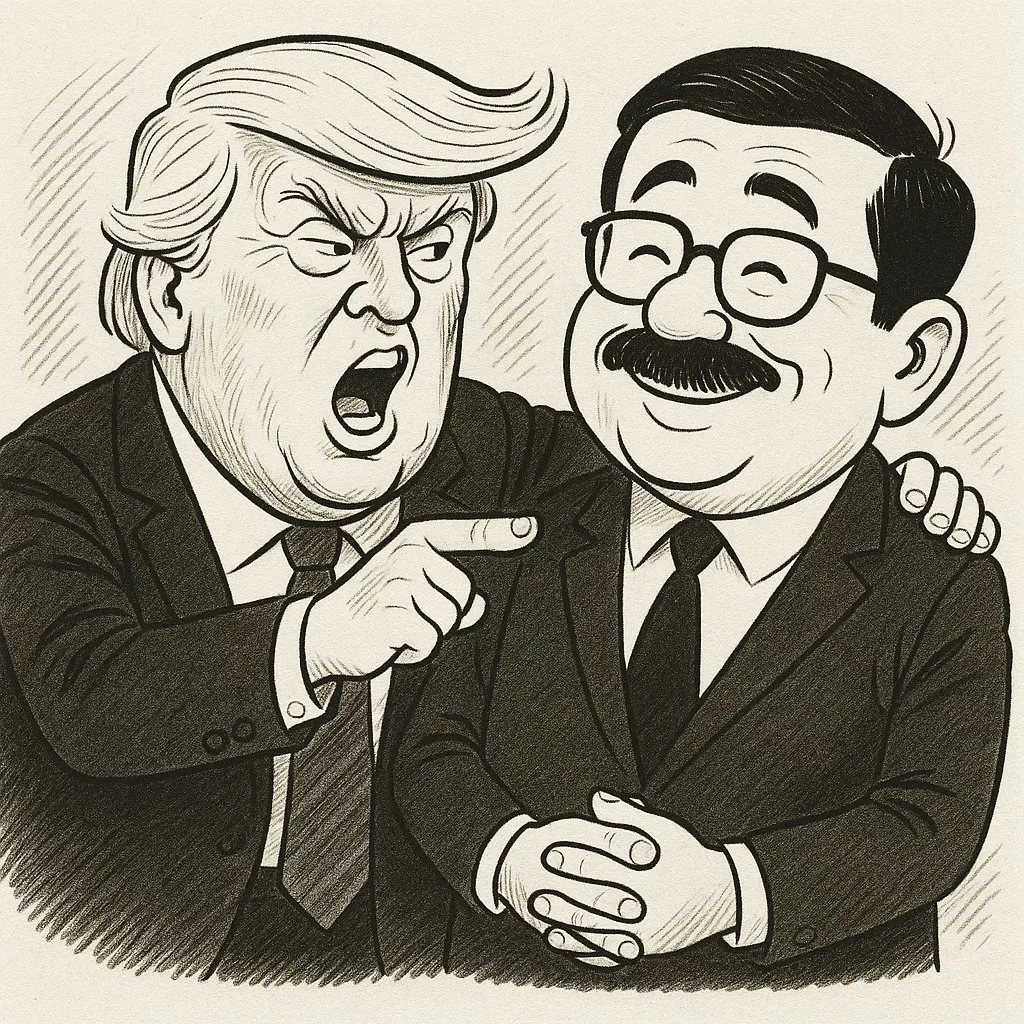
Hernández in Trump´s embrace…
It’s Juan Orlando Hernández, former president of Honduras — a man who wasn’t merely suspected of drug trafficking, but convicted in U.S. courts for protecting a massive cocaine route into the United States.
Sentence: 45 years. Status under Trump: Potential pardon. You could almost hear the drumroll if it weren’t so tragic.
So why pardon a convicted narco? Because in U.S. foreign policy, being a drug trafficker is not the problem. Being independent is.
Honduras has long operated as a strategic base for Washington — especially since neighboring Nicaragua dared to overthrow a U.S.-backed dictatorship in the 1980s and continues resisting U.S. influence to this day.
And this isn’t an isolated chapter. In 2009, the CIA and Obama administration supported a coup removing Honduran president Manuel Zelaya — whose greatest crime wasn’t cocaine, but autonomy.
The pattern is clear: If you obey Washington, you can traffic cocaine and still pose smiling for diplomatic handshakes. If you resist, you become a narco-dictator overnight. Headlines included. Sanctions extra.
The broader project: a continental reconstruction
Trump is working to assemble a far-right bloc across Latin America: Milei in Argentina, Bolsonaro in Brazil, compliant oligarchies in Chile, Ecuador, El Salvador, Honduras
And The goal is to crush left movements, open resources to U.S. corporations, and reestablish Latin America as a geopolitical plantation — just with better public relations.
In this framework, pardoning Hernández isn’t an anomaly — it’s a signal. A loud one. it declares:
“Crimes don’t matter. Loyalty does.”
So what do we call this?
Hypocrisy? Yes. But it’s more than that. It’s a reversal of morality, where those who defend sovereignty are labeled criminals, while those who violate law — but obey foreign power — are elevated, pardoned, and protected.
It shows us that the so-called War on Drugs was never about drugs — but about maintaining geopolitical obedience.
And here is the uncomfortable truth: Sometimes, the biggest trafficker isn’t the man being accused…It’s the one doing the accusing.
So let us say it plainly, publicly, and loudly enough to break the narrative: Criminality cannot be selective, sovereignty is not a crime, Justice cannot depend on political convenience.
History may be slow, but it is watching — and it has an excellent memory.
Let’s make sure it records the truth, not the propaganda.
____________________________________________
 Raïs Neza Boneza is the author of fiction as well as non-fiction, poetry books and articles. He was born in the Katanga province of the Democratic Republic of Congo (Former Zaïre). He is also an activist and peace practitioner. Raïs is a member of the TRANSCEND Media Service Editorial Committee and a convener of the TRANSCEND Network for Peace Development Environment for Central and African Great Lakes. He uses his work to promote artistic expressions as a means to deal with conflicts and maintaining mental wellbeing, spiritual growth and healing. Raïs has travelled extensively in Africa and around the world as a lecturer, educator and consultant for various NGOs and institutions. His work is premised on art, healing, solidarity, peace, conflict transformation and human dignity issues and works also as freelance journalist. You can reach him at rais.boneza@gmail.com – http://www.raisnezaboneza.no
Tags: Anglo America, Bullying, Colombia, Coup, Hegemony, Honduras, Imperialism, Latin America Caribbean, Maduro, Narco state, Narcotraffic, North America, Official Lies and Narratives, Regime Change, Right Politics, Rogue states, South America, Trump, USA, Venezuela
DISCLAIMER: The statements, views and opinions expressed in pieces republished here are solely those of the authors and do not necessarily represent those of TMS. In accordance with title 17 U.S.C. section 107, this material is distributed without profit to those who have expressed a prior interest in receiving the included information for research and educational purposes. TMS has no affiliation whatsoever with the originator of this article nor is TMS endorsed or sponsored by the originator. “GO TO ORIGINAL” links are provided as a convenience to our readers and allow for verification of authenticity. However, as originating pages are often updated by their originating host sites, the versions posted may not match the versions our readers view when clicking the “GO TO ORIGINAL” links. This site contains copyrighted material the use of which has not always been specifically authorized by the copyright owner. We are making such material available in our efforts to advance understanding of environmental, political, human rights, economic, democracy, scientific, and social justice issues, etc. We believe this constitutes a ‘fair use’ of any such copyrighted material as provided for in section 107 of the US Copyright Law. In accordance with Title 17 U.S.C. Section 107, the material on this site is distributed without profit to those who have expressed a prior interest in receiving the included information for research and educational purposes. For more information go to: http://www.law.cornell.edu/uscode/17/107.shtml. If you wish to use copyrighted material from this site for purposes of your own that go beyond ‘fair use’, you must obtain permission from the copyright owner.
Join the discussion!
We welcome debate and dissent, but personal — ad hominem — attacks (on authors, other users or any individual), abuse and defamatory language will not be tolerated. Nor will we tolerate attempts to deliberately disrupt discussions. We aim to maintain an inviting space to focus on intelligent interactions and debates.