


Seeds of Resistance: GMO Deregulation and Grassroots Mobilization
ORGANIC, GMO, GENETIC ENGINEERING, 15 Dec 2025
Navdanya International – TRANSCEND Media Service
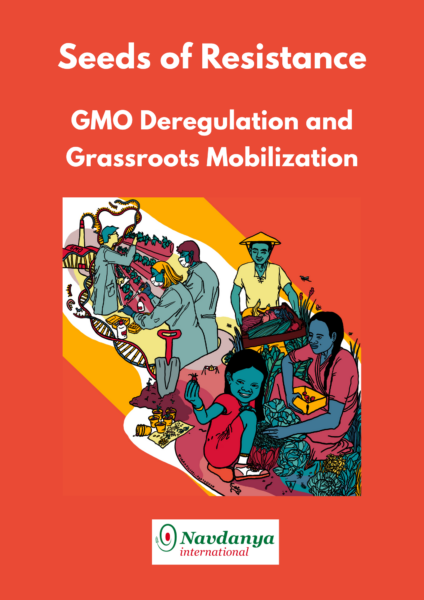
12 Dec 2025 – Across continents, a coordinated corporate and governmental assault on biosafety is accelerating as powerful interests push to deregulate genetically modified organisms (GMOs) and new gene-editing technologies (NGTs). This global trend rolls back essential regulations, privatizes the governance of our food systems, and replaces state-led risk assessment with corporate self-regulation. In direct opposition, a powerful wave of grassroots resistance is rising. Led by farmers, indigenous peoples, and civil society movements, this global mobilization challenges the narrative that gene technologies are the inevitable future of food, reframing the conflict as a fundamental political struggle over who controls our seeds, our food, and our ecological future.
The debate is driven by two profoundly conflicting narratives. On one side, industry and government proponents frame deregulation as essential for “innovation” and “climate resilience,” rebranding new genomic techniques as “precise” and “natural-like” to secure fast-tracked market entry with minimal oversight. In stark contrast, this report marshals overwhelming scientific evidence demonstrating the profound risks of this agenda. It exposes how deregulation is a vehicle for heightened corporate control and new forms of digital biopiracy, where genetic data from the commons is patented using Digital Sequence Information (DSI) without ever leaving the lab. Critically, with no international scientific consensus on GMO/NGT safety, the report details how techniques like CRISPR can bypass natural repair mechanisms and cause unforeseen impacts on plant metabolism, as seen in the GABA tomato, directly refuting industry claims of precision.
Seeds of Resistance provides a comprehensive global analysis of these dynamics, with in-depth case studies from Latin America, Asia, Africa, Oceania, and Europe. The report illuminates how the “Argentina model”—a regulatory framework being replicated globally that exempts gene-edited crops from all GMO safety and labeling laws if they contain no foreign DNA—is being used to accelerate corporate capture. Simultaneously, it documents the remarkable success of grassroots defiance. This includes landmark victories such as Mexico’s landmark constitutional amendment, which legally enshrines native maize as a national biocultural heritage, and the court-ordered halt to the commercialization of both Golden Rice and Bt Eggplant in the Philippines, a legal triumph for farmers and food sovereignty advocates. These examples reveal a deeply polarized landscape where corporate power is met with sophisticated, community-led resistance.
Ultimately, this report reveals that the struggle over GMOs is a fight to defend life itself against commodification. It is about protecting seeds as living ancestors and the cultural commons—the legacy of millennia of farmers’ breeding—from being reduced to patented intellectual property. More than an analysis of the problem, this report is a powerful testament to the resilient, life-affirming alternatives already flourishing in fields worldwide. It showcases how agroecology and community-led seed systems offer true resilience, foster biodiversity, and secure food sovereignty.
December 2025 update:
In December 2025, the Council and the European Parliament reached a provisional trilogue agreement on new rules for so‑called new genomic techniques, creating a two‑tier system that distinguishes between “NGT 1” plants, treated as equivalent to conventional varieties, and “NGT 2” plants, which remain under the existing GMO regime. For NGT 1, the deal would largely remove prior risk assessment, traceability, and labeling obligations, while NGT 2 plants would still be subject to GMO rules and allow member states to opt out of their cultivation [1]. The deal is still pending final approval in Parliament and Council and has already been denounced by farmers’, organic, environmental, and consumer organizations across Europe, who have called on legislators to reject or substantially amend the text, as it represents a serious threat to food sovereignty, seed autonomy, and the precautionary principle [2] .
NOTES:
[1] Council of the European Union. New Genomic Techniques: Council and Parliament Strike Deal to Boost the Competitiveness and Sustainability of Our Food Systems. 4 Dec. 2025, https://www.consilium.europa.eu/en/press/press-releases/2025/12/04/new-genomic-techniques-council-and-parliament-strike-deal-to-boost-the-competitiveness-and-sustainability-of-our-food-systems/
[2] EU lawmakers must reject the deal to deregulate new GMOs.” Navdanya International, 4 Dec. 2025, https://navdanyainternational.org/eu-lawmakers-must-reject-the-deal-to-deregulate-new-gmos/
***************************
Click to Download PDF File: Seeds-of-Resistance-Executive-Summary-1
Click to Download PDF File: Seeds-of-Resistance-Report-Navdanya
________________________________________________
 Navdanya and the Navdanya movement were created by Dr. Vandana Shiva 30 years ago in India to defend Seed and Food sovereignty and small farmers around the world. Navdanya pioneered the movement of seed saving and seed freedom, which began in response to the crisis of erosion of agricultural biodiversity and introduction of GMOs and patents on seeds through intellectual property rights (IPRs) and so-called ‘free trade’ agreements. It has long fought against biopiracy, the patenting of indigenous knowledge by self-interested multinational corporations and won cases related to Neem, basmati rice and wheat in India. Navdanya promotes a new agricultural and economic paradigm, a culture of food for health, where ecological responsibility and economic justice replace the present greed, consumerism and competition which have become dominant in society. It aims at regaining the common good as a foundation for a renewed sense of community, solidarity and culture of peace. We strive to achieve these goals through the conservation, renewal and rejuvenation of the gifts of biodiversity we have received from nature and our ancestors, and to defend these gifts as commons. info@navdanyainternational.org – More…
Go to Original – navdanyainternational.org
Tags: European Union, GMO, Genetic engineering, Genetic manipulation, Navdanya International, Organic Agriculture, Organic food, Vandana Shiva, World
DISCLAIMER: The statements, views and opinions expressed in pieces republished here are solely those of the authors and do not necessarily represent those of TMS. In accordance with title 17 U.S.C. section 107, this material is distributed without profit to those who have expressed a prior interest in receiving the included information for research and educational purposes. TMS has no affiliation whatsoever with the originator of this article nor is TMS endorsed or sponsored by the originator. “GO TO ORIGINAL” links are provided as a convenience to our readers and allow for verification of authenticity. However, as originating pages are often updated by their originating host sites, the versions posted may not match the versions our readers view when clicking the “GO TO ORIGINAL” links. This site contains copyrighted material the use of which has not always been specifically authorized by the copyright owner. We are making such material available in our efforts to advance understanding of environmental, political, human rights, economic, democracy, scientific, and social justice issues, etc. We believe this constitutes a ‘fair use’ of any such copyrighted material as provided for in section 107 of the US Copyright Law. In accordance with Title 17 U.S.C. Section 107, the material on this site is distributed without profit to those who have expressed a prior interest in receiving the included information for research and educational purposes. For more information go to: http://www.law.cornell.edu/uscode/17/107.shtml. If you wish to use copyrighted material from this site for purposes of your own that go beyond ‘fair use’, you must obtain permission from the copyright owner.
Join the discussion!
We welcome debate and dissent, but personal — ad hominem — attacks (on authors, other users or any individual), abuse and defamatory language will not be tolerated. Nor will we tolerate attempts to deliberately disrupt discussions. We aim to maintain an inviting space to focus on intelligent interactions and debates.
Read more
Click here to go to the current weekly digest or pick another article:
ORGANIC, GMO, GENETIC ENGINEERING: