
Harn Yawnghwe, an Extraordinary Life in Public Service & a Barricade against the Erasure of the Shan from Myanmar’s Memory (Part 3)
TRANSCEND MEMBERS, 2 Mar 2026
Maung Zarni | FORSEA – TRANSCEND Media Service
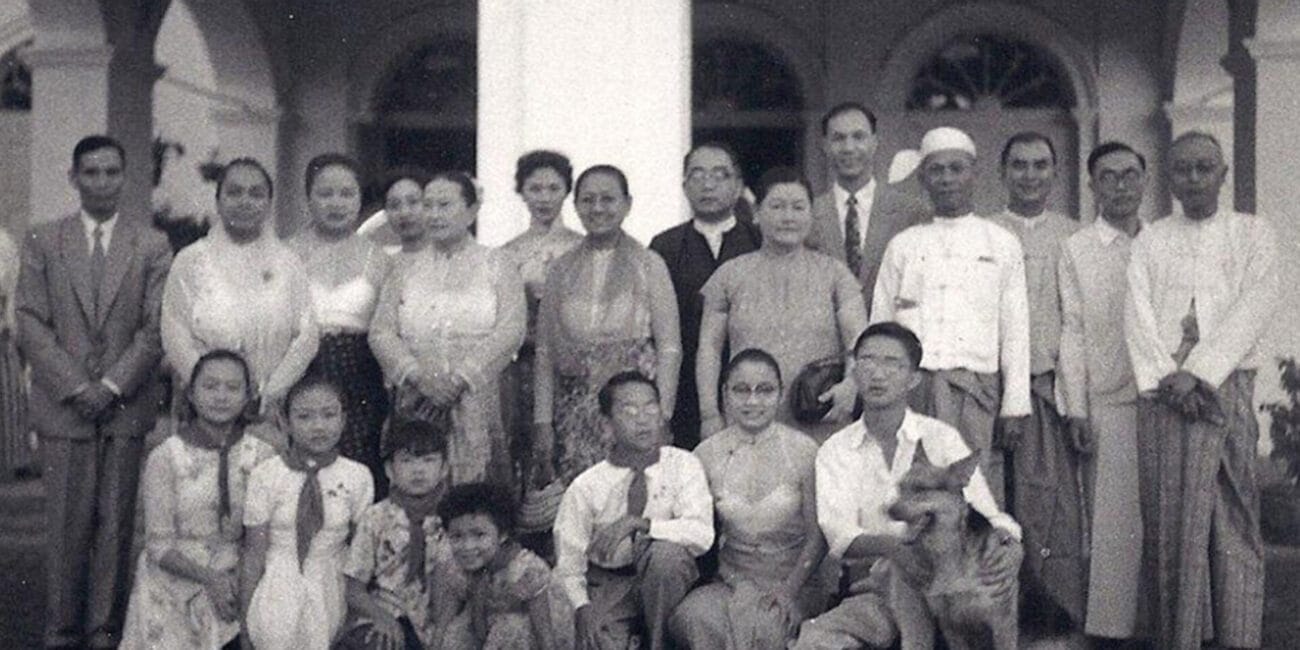
Post-colonial national vision for Myanmar came from a combination of leftist progressive analyses and non-blood-and-soil secular civic nationalism, both of which seek to honour ethnic group equality and right to self-determination.
21 Feb 2026 – In the two previous parts, I have painted a sketch of Sao Harn Yawnghwe, my fellow Myanmar exile from a Shan ethnic background whom I have personally known and worked with for over a quarter of a century. This 3-part semi-biographical essay is not meant to be a hagiography, but rather an individual attempt, in my capacity as an ethnic Bama (or Myanmar) who grew up, ethno-nationalist and militarist, in order to counter the dominant trend among my fellow Bama activists and scholars to marginalize, trivialize and ultimately erase the noteworthy contributions towards building a new nation, made by non-Bama and/or non-Buddhist individuals and communities.
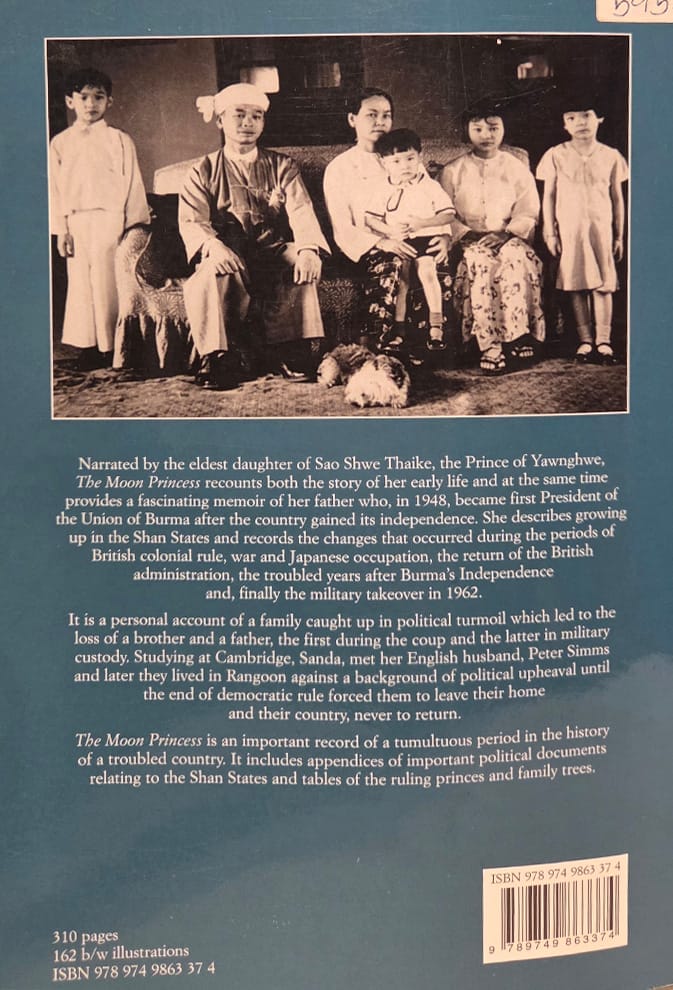
To recap my account of Harn’s life, imagine your father died in solitary confinement at the hands of the military coup regime in 1963. The father was no average Joe, but rather a co-founder of the independent Union of Burma (or since 1989, Myanmar) which he served as its 1st President. Your father’s passing in General Ne Win’s captivity was also preceded by the murder of your closest brother with whom you shared the bedroom during the pre-dawn armed raid aimed at detaining both your parents.
Your mother escaped, with you, the prospect of imprisonment or worse, first to neighbouring Thailand and eventually into permanent exile in Canada where she died. Your two older brothers, a revolutionary-scholar and a western-educated technocrat, also died in exile, while trying to find ways to contribute to anti-junta resistance movements in their own ways.
In spite of all this deep personal trauma, you have retained your concern for the country, her people and their future since you arrived as a refugee in Canada some 50 years ago and have been doing everything in your power to contribute to reconciliation and/or resistance.
Much of your family’s trauma was rooted in the fact that the state in Myanmar has long been captured and controlled by the country’s biggest armed organization, the Tatmadaw or the national armed forces. The military leaders have become internal colonizers, who effectively have morphed into ethno-nationalist militarists wrapped in Buddhist chauvinism and soaked in a sense of Bama superiority.
Still, informed by your practising Christian faith of forgiveness you have tried to assist, in good faith, the misguided lot, as they began to see the country’s ethnically driven civil war as the greatest obstacle for the nation’s economic and political development.
And yet, the most brazen denial of your access to the country of your birth, which your father co-founded, was made not by the leaders of the repressive military, but by a fellow democrat, namely Aung San Suu Kyi.
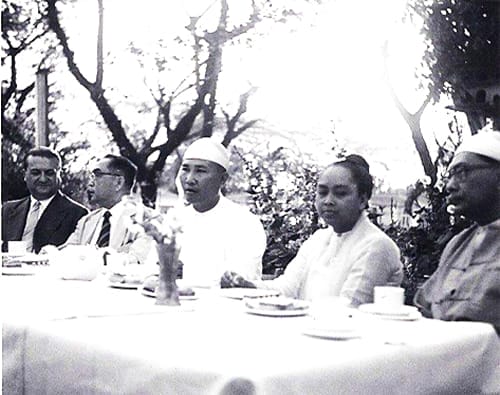
(Second from right) Daw Khin Kyi, the widow of Myanmar’s national martyr General Aung San and the mother of Aung San Suu Kyi, at the garden party hosted by Sao Shwe Thaike. (Second from left, in business attire with spectacles), a Shan cofounder of the Union of Burma and 1st president of independent Burma, at the temporary residence in Rangoon (the 2nd President Dr Ba Oo’s private residence), after his inaugural term (circa. 1952). (Photo courtesy of Harn Yawnghwe)
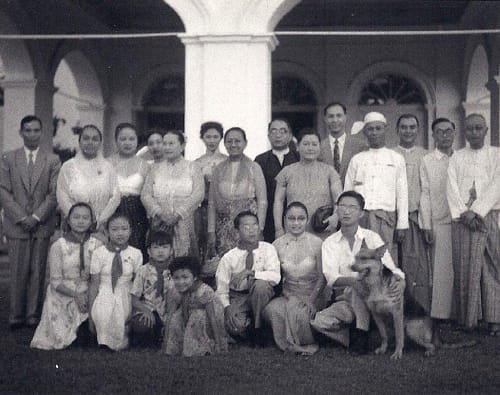
A historic photo of Harn’s family with Aung San Suu Kyi’s mother, at home in Rangoon (Yangon) 1957 (photo courtesy of Harn Yawnghwe).
Harn (first row, 3rd the left, wearing Mao’s Young Pioneers scarf, which he and his siblings brought back from the father’s state visit as Chairman Mao’s guest to China in 1957., with his siblings and half-siblings. Holding their family dog (first row, far right) was Dr Eugene Thaike (Chao Tzang Yawnghwe, a former commander of Shan State Army and a well-known political scientist, who died in exile in Vancouver in 2004). To the right of Eugene was bespectacled Sao Ying Sida, the older journalist sister, now in assisted living in Thailand. To Sao Ying’s right was Harn’s brother Sao Myee, the 1st casualty of General Ne Win’s military coup of 1962 (and the 26-years of military rule) as he was shot dead right at the front entrance of their family residence, at the corner of Kokine Road (Kaba Aye) and Goodliffe Road (Saya San), Rangoon (Yangon).
From our numerous in-person conversations over these years, I knew that meeting with Chairman Mao has had a lasting impact on the then pre-teenage Shan prince. Every time the subject comes up, “you know I sat on Mao’s laps”, with a big grin on his face. Manor-born children of a prominent Shan ruling house of Yawnghwe, wearing the Young Pioneers scarfs. Imagine that! (Take a look at the above photo.)
So, I queried about his visit to China which he made as a pre-teen boy, a young prince then, he wrote back:
“We spent 2 months in China. From Kunming by air to Chunking/Chongqing, then down the Yangtze River by ship through the Three Gorges, to Nanjing. By train to Hangzhou and then to Shanghai. From there to Beijing where we met many leaders including Liu Shaoqi, Marshal Lin Biao, Marshal Zhu De, Madam Soong Ching Ling, widow of Dr Sun Yat-sen, and Pu Yi, the last emperor in re-education camp. Then by train to Harbin in Manchuria and the sea port/base at Dalian – we even went into a submarine – likely a captured/surrendered Japanese one. Then we flew back to Kunming and Rangoon.”
Why would Myanmar’s most influential political leader, then in power as both Foreign Minister and State Counsellor (a position Aung San Suu Kyi herself declared “above-the-President”), deny visa to a fellow democrat?
A brief detour here
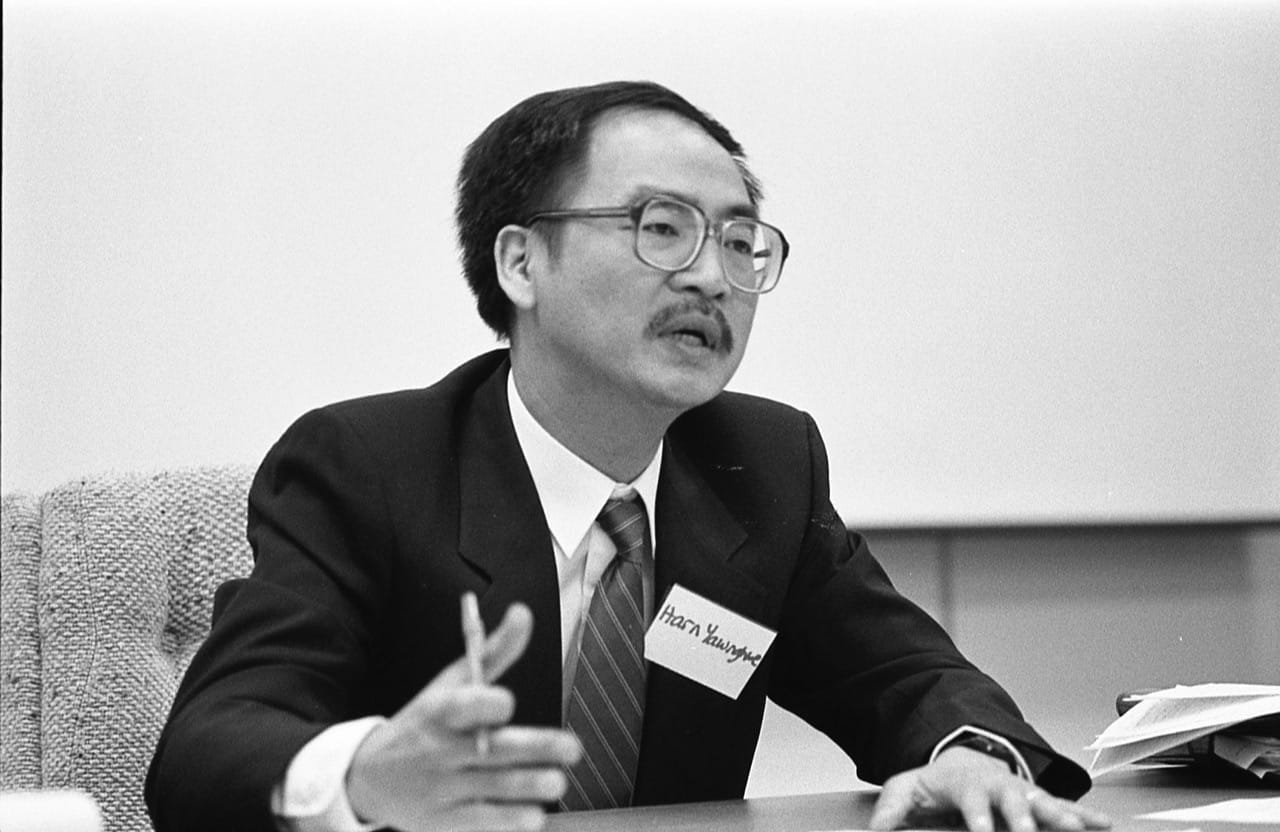
Harn Yawnghwe speaking at the Canadian Friends of Burma (CFOB) seminar entitled “Obstacles to Development in Burma,” the Canadian Parliament, 1991. He was joined by Maran Brang Seng (deceased), Chairman of the Kachin Independence Organization. (photo courtesy of Richard Weeks, co-founding chair of CFOB)
Since the late 1970’s Harn has been a leading ethnic Shan exile who supported the country’s democratic resistance, opening and reconciliation – in that chronological order. His involvement predates the Burmese political leader’s entry into the popular revolt of 1988.
Below – Snapshots of the two issues of Burma Alert, from 1977 and 1994. (Photo courtesy of Harn)
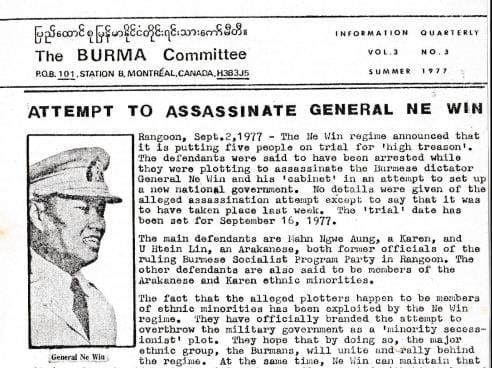
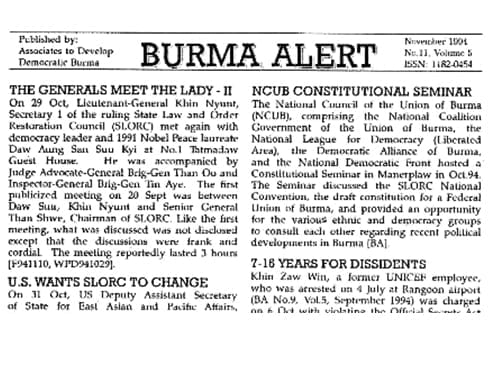
Almost two decades before the Internet, Harn gathered Burma news, pertaining to the political repression by the military dictatorship in his native country, which the generals kept isolated and closed off for a quarter century (1962-1988) and circulated hardcopies via postal service to anyone who requested Burma updates. Any exile who had done this information dissemination knows it really was a labour of love, time-consuming and even costly, particularly during those pre-worldwide web and AOL email years.
Burma Alert (Summer of 1977) which Harn started publishing was aimed at keeping Myanmar diaspora and foreigners with a Burma concern, in Montreal, Canada, where he continued his post-graduate studies after having resettled from Thailand.
The reason Aung San Suu Kyi blocked Harn’s entry to Myanmar was straightforward.
Harn was supporting the 1st reformist military leadership of ex-General and President Thein Sein in the latter’s attempts to bring as many ethnic armed organizations as possible into the political process aimed at reaching a Nationwide Ceasefire Agreement which was signed a month before the end of Thein Sein’s presidency in October 2015.
As a matter of fact, the then leader of the opposition National League for Democracy, Aung San Suu Kyi had reportedly urged armed organizations not to rush to sign the agreement.
Ex-Captain Win Htein who at the time was the NLD leader’s top policy aide, told the Democratic Voice of Burma that she advised the ethnic armies, “not to quickly signing the NCA. Signing the NCA must be meaningful. Everyone will have to follow it. Some will sign the agreement, but some won’t. In this state, it is not easy for our political party to understand it.”
For historical record and in the interest of factual accuracy, I asked Harn to explain the background to the sordid denial of his request for visa – Harn is Canadian by nationality and holds a Canadian passport. He kindly wrote back. It is worth quoting him at length.
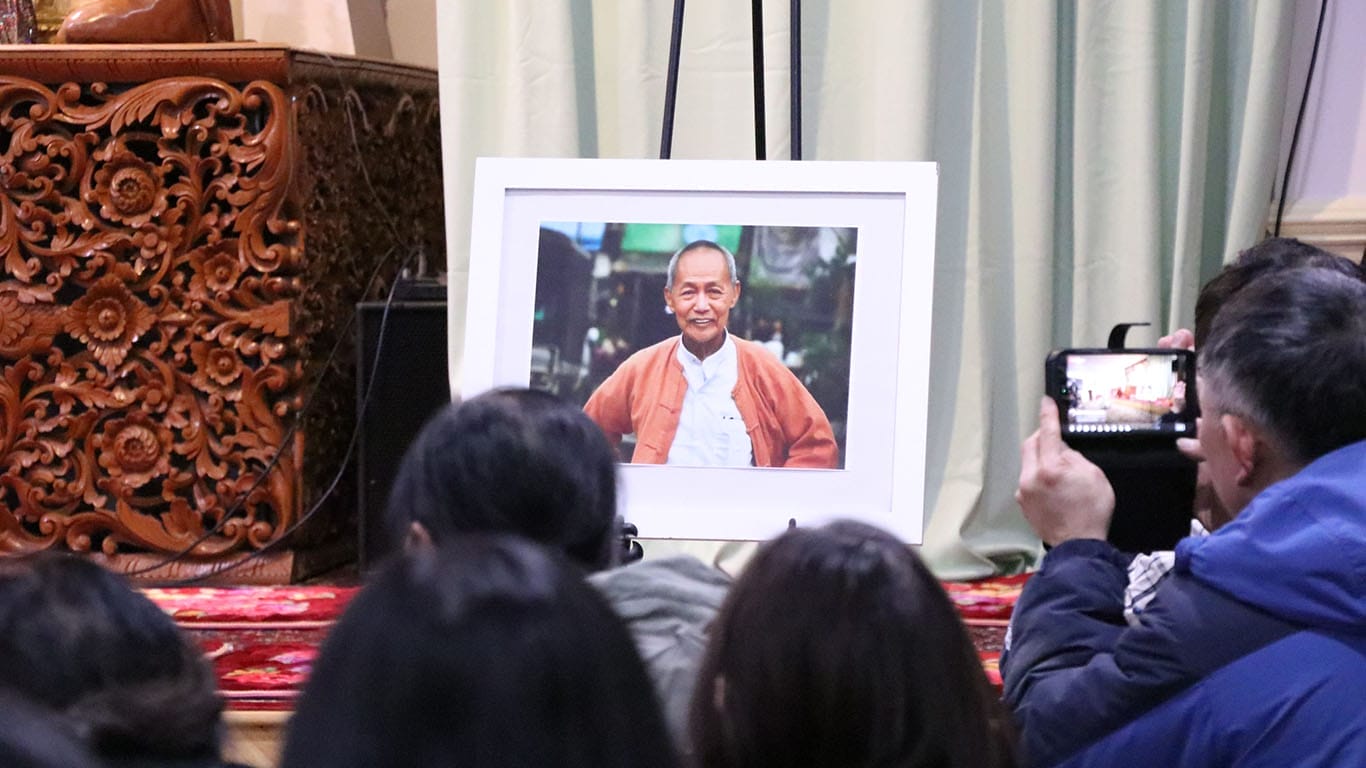
Harn’s former colleague and “boss,” the leader of the exiled government, the late Dr Sein Win (in photo), on display at his Buddhist funeral ritual in Maryland, USA on 6 February 2026.
Source: https://english.dvb.no/myanmar-democracy-campaigner-sein-win-honoured-with-buddhist-rites-after-passing-in-us/
In Harn’s words:
“After becoming advisor to Dr Sein Win, (Aung San Suu Kyi’s cousin who headed the exiled National Coalition Government of the Union of Burma) in 1991, I reported confidentially and regularly to Daw Aung San Suu Kyi, Dr Sein Win, and her husband Dr Michael Aris in Oxford, UK, on my activities, observations and possible developments. I might even have been indirectly responsible for Dr Aris being barred from re-entering Myanmar from 1995 onwards. There had been rumours of ASSK meeting with the junta and I expressed to Dr Aris that ethnic leaders might worry that she will make a deal with the military without including them. He delivered the message in December 1994 and when he came out, he gave a press conference in Bangkok in January 1995, stating that she would not make a separate deal with the military. After that, he was barred from entering Burma.
After Dr Aris died, I continued to report to DASSK and Dr Sein Win. Later I also used emissaries who could travel to Yangon to report to her. From time to time, my brother Dr Chao Tzang also reported to her on developments. Neither of us ever got a response.”
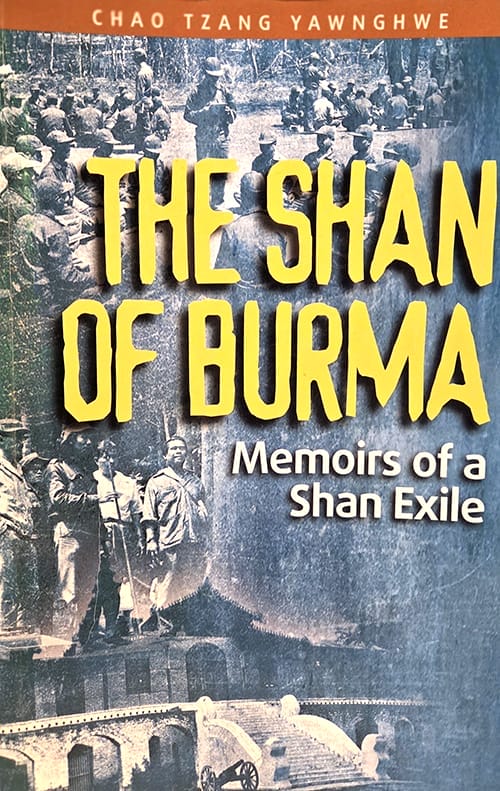
Below cover left – SSA Commander Eugene Thaike (aka. Dr Chao Tzang), addressing his Shan State Army troops in the war-torn Shan Plateau (circa. Mid-1960s)
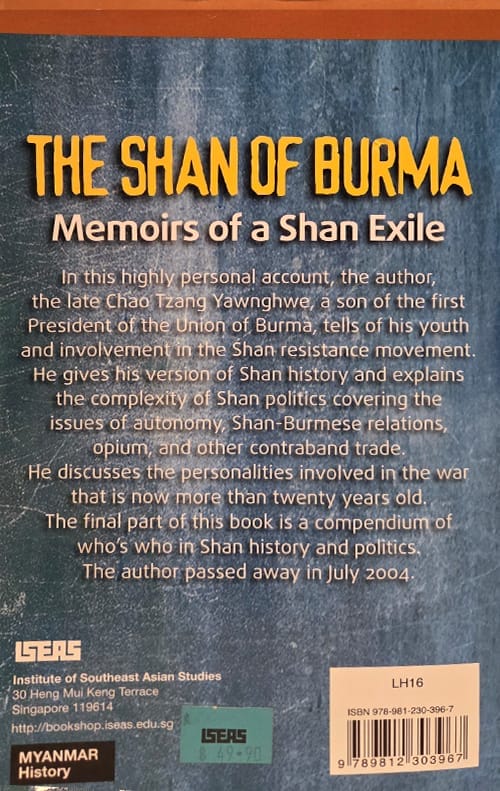
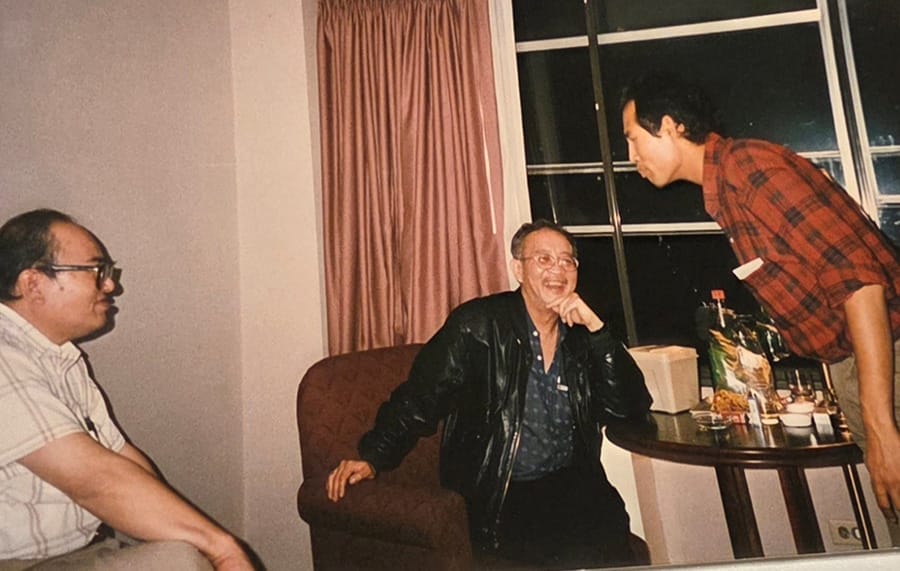
Me (standing) cracking a joke with the two fellow dissidents in exile, Dr Chao Tzang (in black) and the late Burmese poet and co-founder of the National League for Democracy party U Win Khet, in a hotel room in New York City, 1996.
The late Dr Chao Tzang (aka Eugene) was a friend and a role model as an exiled intellectual for me since we first met at a Southeast Asian academic conference at the University of British Columbia in the fall of 1991.
Though a born prince like Harn, Ahko Eugene was heavily influenced by the anti-feudal Marxian literature. He recounted that the rank-and-file soldiers of the Shan State Army, the greatest majority of whom were from rural Shan region did not react favourably towards a princely resistance leader in his mid-20’s – treating the soldiers with egalitarian ethos. “You know they expected me to behave like a (hierarchical) prince from the ruling house, not as their equal!)”
Neither Harn nor Eugene ever talked down to anyone of us, the younger generation dissidents and exiles from Myanmar, whatever our social or familial backgrounds. Certainly many of us were not from their political or social league. To many of us exiles, not born with silver spoon in our mouths, we appreciated their fundamentally respectful egalitarian or democratic behaviour. In a way, the two brothers taught us by modelling themselves as democrats, with a small “d”.
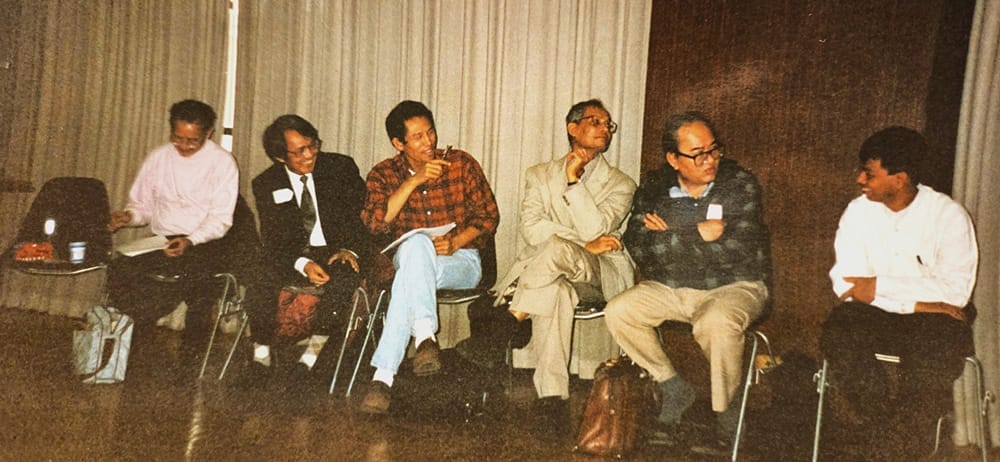
A group of Myanmar exiles had a private meeting in New York City on the sidelines of the public event on Myanmar democratic resistance, hosted by the Open Society Institute Burma Project, NYC, 1996. (from left to right: Dr Chao Tzang Yawnghwe, Dr Sein Win, Zarni, Dr Aye Kyaw who was Rakhine scholar and drafter of the controversial Citizenship Act of 1982 for General Ne Win’s regime, NLD co-founder Poet U Win Khet and former NLD youth activist Aung San Min. Only Zarni and Aung San Min are alive today).
Once Dr Chao Tzang shared with me copies of his type-written briefs addressed to the NLD leader Aung San Suu Kyi.
I was surprised how deferential Dr Chao Tzang’s letters to the NLD leader were in tone and word choices, in spite of the fact that Chao Tzang was an intellectual and revolutionary heavyweight in Myanmar’s anti-dictatorship politics since the early 1960’s with the father who was General Aung San’s co-equal as a founder of modern Burma.
Substantively, the letters were grounded in his experience as a veteran of Shan revolution and a peace negotiator for Shan struggle in the very first peace overture in Rangoon which General Ne Win made a few years after the 1962 coup. Besides, there were anchored in his scholarly understanding of comparative ethnic conflicts in the military-dominated countries comparable to Myanmar – such as Indonesia. There was never an acknowledgement of receipt, much less a reply from the Burmese leader which they deserved, if my memory of regular communications with the Dr Chao Tzang serves me well.
Harn continues:
“(j)ust before ASSK was released, several individuals tried to arrange for me to at least talk to her on the phone to brief her on the situation. It did not materialize. After I returned to Myanmar in Oct 2010, and she was released in Nov 2010, at least three high-level attempts were made for us to meet, to no avail.
At the time, the Nationwide Ceasefire Coordination Team was finalizing the NCA with the government. On 31 March, they officially (16 groups) agreed, in unanimity, on the text of the NCA. The NCA was finally signed on 15 October 2015 by eight groups.
NCA was admittedly flawed, but it was better than the protracted civil war that had erupted even before the country regained independence from Britain in 1948.
According to Harn, the Nationwide Ceasefire Agreement was flawed and failed because its terms were not implemented or followed up at all during the NLD’s tenure in government (2016-2020). In addition, after the 1st reformist military government of President Thein Sein was replaced by the new elected National League for Democracy Party of Aung San Suu Kyi, the Ethnic Armed Organizations had to negotiate with both the democratically elected NLD leadership and the Tatmadaw who controlled security portfolios at the same time, instead of negotiating with the government as a cohesive political entity.
Harn recounted, “(w)hat is agreed today in the negotiation room is usually vetoed the next morning by the leaders of the NLD and the military. That was what happened when the two teams reported back to their respective decision-makers in the evening. Talks were deadlocked. Nothing that was not already in the 2008 Constitution were regularly vetoed by Min Aung Hlaing. The NA-1 and NA-2 (National Accords) reaffirmed principles in the 2008 Constitution. NA-3 agreed to postpone negotiations until after the elections in the hope that the next government would do better.”
In his written interview with Indonesia’s leading English news magazine TEMPO (dated 15 October 2017), Harn said, “when my visa was denied it became clear that she doesn’t appreciate my work and she doesn’t want me to continue to be involved (in facilitating ethnic armies’ involvement in the peace process).”
Harn was not the only person whose entry to the country she had barred. According to former UN Special Rapporteur on human rights in Myanmar S. Korean professor Yanghee Lee who recounted to me about her last one-on-one meeting in person with Aung San Suu Kyi the latter’s office Naypyidaw, Myanmar leader unveiled the threat of visa denial in no uncertain terms. In Suu Kyi’s words verbatim, “If you keep pushing the UN line (of focusing solely on human rights), you won’t be able to come back here.”
As I write, Myanmar’s coup regime that ousted Aung San Suu Kyi’s re-elected government in February 2021 has reportedly ordered Chargé d’Affairs of the Embassy of Timor-Leste in Myanmar, Mr Elisio do Rosario de Sousa, to leave the country within one week (by 20 February). His crime: a court in Timor-Leste accepted a criminal complaint against human rights abuses Chin ethnic communities have suffered at the hands of Myanmar junta filed by Chin Human Rights Organization (CHRO).
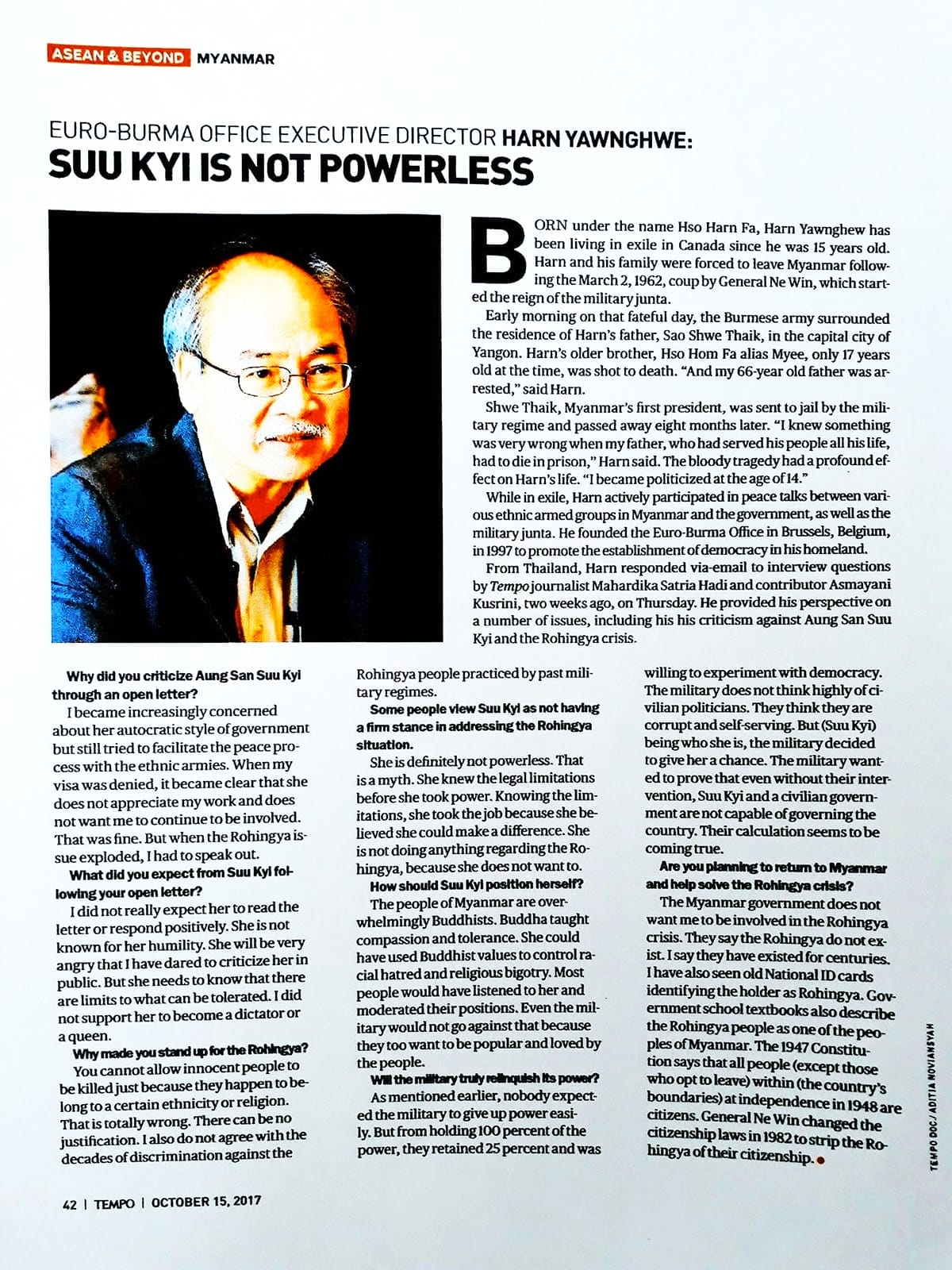
This, in a nutshell, is a personal and political trajectory of Harn Yawnghwe, Canada-exiled Myanmar democrat, since he and his late mother’s successful escape from the first military junta’s capture in the fall of 1963.

(From right to left) UK Ambassador to the Union of Burma Mr Richard Speight, then sitting President Sao Shwe Thaik with Sao , Wing Commander Ward, Mahadevi of Yawnghwe with Harn (4), Mrs Ward, Catherine Weeks ( (the wife of the photographer and the visiting WHO Malaria expert Dr Ward of Canada), and Mrs Speight, Lashio Airport, Northern Shan State, Burma, 1952 (photo courtesy of Richard Weeks, Co-founding President of the Canadian Friends of Burma).
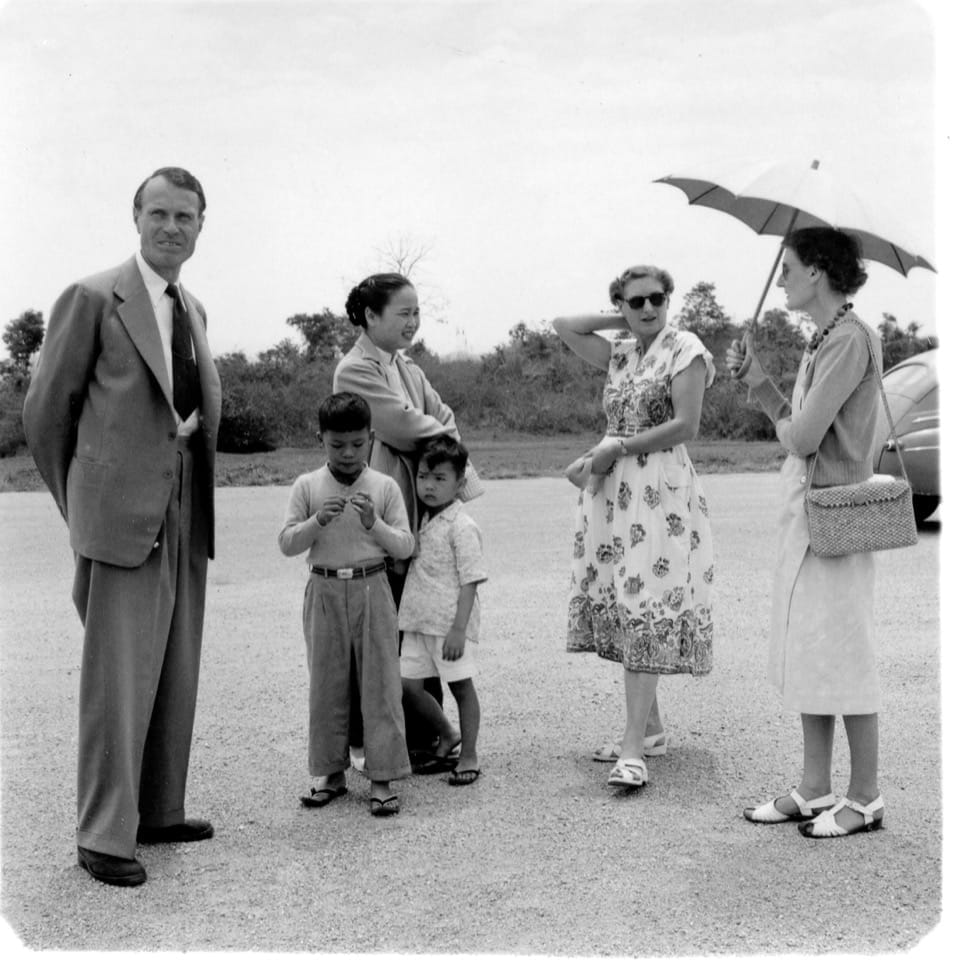
(From right to left) UK Ambassador to the Union of Burma Mr Richard Speight, then sitting President Sao Shwe Thaik with Sao , Wing Commander Ward, Mahadevi of Yawnghwe with Harn (4), Mrs Ward, Catherine Weeks ( (the wife of the photographer and the visiting WHO Malaria expert Dr Ward of Canada), and Mrs Speight, Lashio Airport, Northern Shan State, Burma, 1952 (photo courtesy of Richard Weeks, Co-founding President of the Canadian Friends of Burma).
Exiles In the Changing World: From the Cold War to Washington’s World
In this section, I offer my grounded perspective in the post-Cold War world which effectively defined the parameters of the exilic activism of all Myanmar dissidents in exile.
That political exiles don’t operate in vacuum cannot be over-stated.
From the 18th century unitarian anti-monarchist Thomas Paine to Karl Marx and European revolutionary exiles in the 19th century London, from Lenin and his comrades in exile in Zurich in the early 20th century, to Ayatollah Khomeini and Yasar Arafat, political exiles were trapped in the same geopolitical and economic spaces as the repressive regimes they seek to radically change. That is, exiles live and work within certain parameters of possibilities, potentials for success, or lack thereof.
Throughout the Cold War decades, Burma’s anti-junta democrats were in the political wilderness in Western capitals. Even President Jimmy Carter, known as “Mr Human Rights”, went along with the American deep state’s institutional position of supporting their own “bastards” (dictators) as part of the Containment Strategy globally. While politicians, policy makers, and foreign policy functionaries and State Department bureaucrats kept the Burmese exiles at arm’s length, Ne Win played this Cold War game cleverly positioning himself as a leader of the Non-aligned Movement, fighting hardcore communist movements.
General Ne Win was simply disguising his neo-feudalist, repressive military dictatorship coated in the thin veneer of “the Burmese Way to socialism”. The Ne Win dictatorship was in active opposition to the armed Burmese Communist Party backed by Mao’s China.
For Washington’s Cold War warriors, and their deep state, as long as Ne Win was locking up Burmese communists and crushing chronic revolts by the leftist-inspired labour and student movements, the Americans could do business with Ne Win. According to the late Louis Walinsky, who lived in Rangoon as the resident economic adviser to the Union of Burma Government under U Nu (1953-1958), Washington saw him and his “Left Unity” peace overture to a garden variety leftist parties and underground movements as “too soft” for the US, would contain or preferably crush any communist or hard left in the country. So, Washington looked the other way, when General Ne Win staged the pre-dawn coup and ended the country’s attempt to grow a parliamentary democracy as the post-colonial system of representative government and deposed the last democratically elected Prime Minister U Nu.
Nu did have a popular mandate as he won the 1961 election comfortably amongst the country’s majority traditionalist Buddhist voters. having positioned himself as the leader who would promote Buddhism as a state religion.
Source: Head of State Visits
As a matter of fact, a few years after the military coup of 1962, US President Lyndon B. Johnson brought the Burmese coup leader, hosted a full state banquet, a ceremonial horse cart ride on Pennsylvania Avenue and a 21-shots gun salute.
Watch General Ne Win’s official visit to the White House as LBJ’s guest, in 1966.
Never mind that Ne Win’s coup at home had already wrecked the young political state’s entire democratic system, the US-assisted economic reconstruction, imprisoned nearly 100 most influential civil society and political figures, the deaths of an ex-President and a key leader of Federal Movement (for more equitable power sharing among the country’s diverse ethnic communities) Sao Shwe Thaike in solitary confinement, the murder of his second youngest son, Sao Myee, Harn’s older brother, in the pre-dawn armed raid at the Yawnghwe residence in Rangoon.
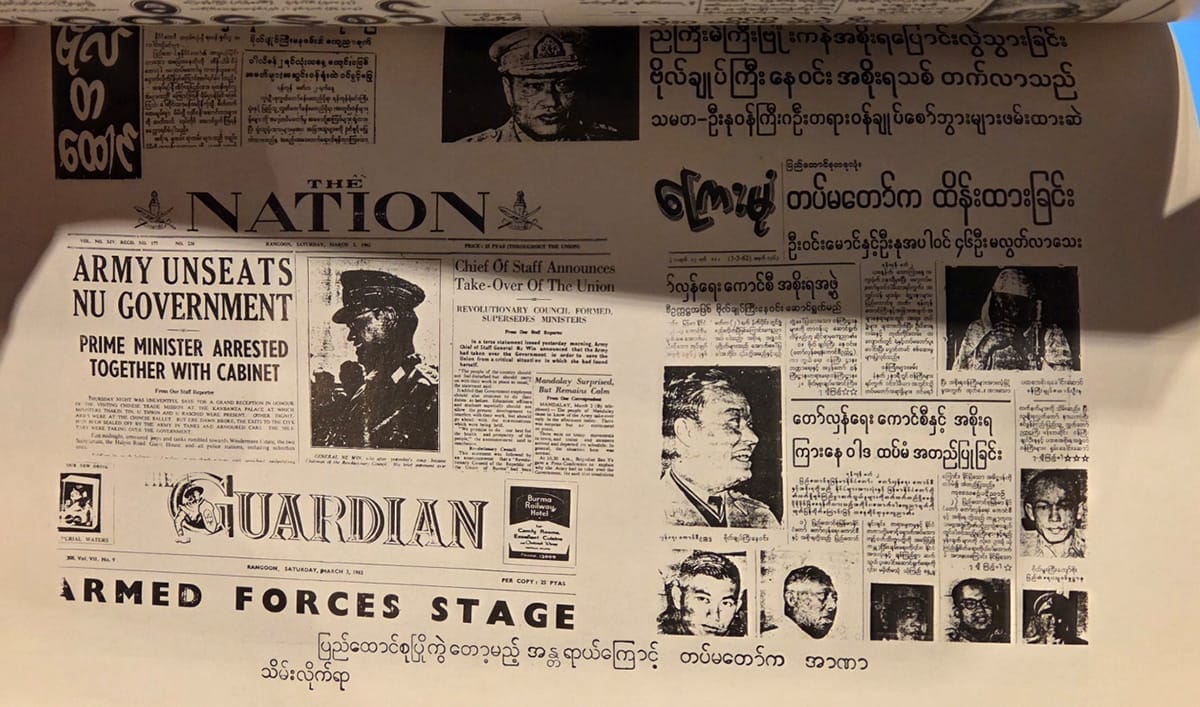
Nor was LBJ bothered by either the junta’s widely reported slaughter of several hundred students and activists on the beautiful leafy Rangoon University campus in broad day light. There was also the forced exodus, one decade before the infamous Ide Aman’s cleansing of Uganda of ancestrally Indian Ugandans, of 100,000 largely Indo-Burmese who had made the colonial Burma their homes during one hundred and twenty years of British rule.
No sooner had the Cold War ended after the fall of the Berlin Wall in November 1989, which was followed by Gorbachev’s unilateral dissolution of the USSR in the opening decade of the 1990’s, Washington (and the West in general) re-discovered human rights, democracy and civil society.
In the midst of Burma’s nationwide uprisings in the autumn of 1988 – a year before the fall of Berlin Wall – the United States Congressman Stephan Solarz, then Chair of the House of Representatives Sub-Committee on Asia and Pacific Relations, reportedly descended upon Rangoon, then in political turmoil, meeting with the representatives of the old regime and the emerging opposition figures such as Aung San Suu Kyi.
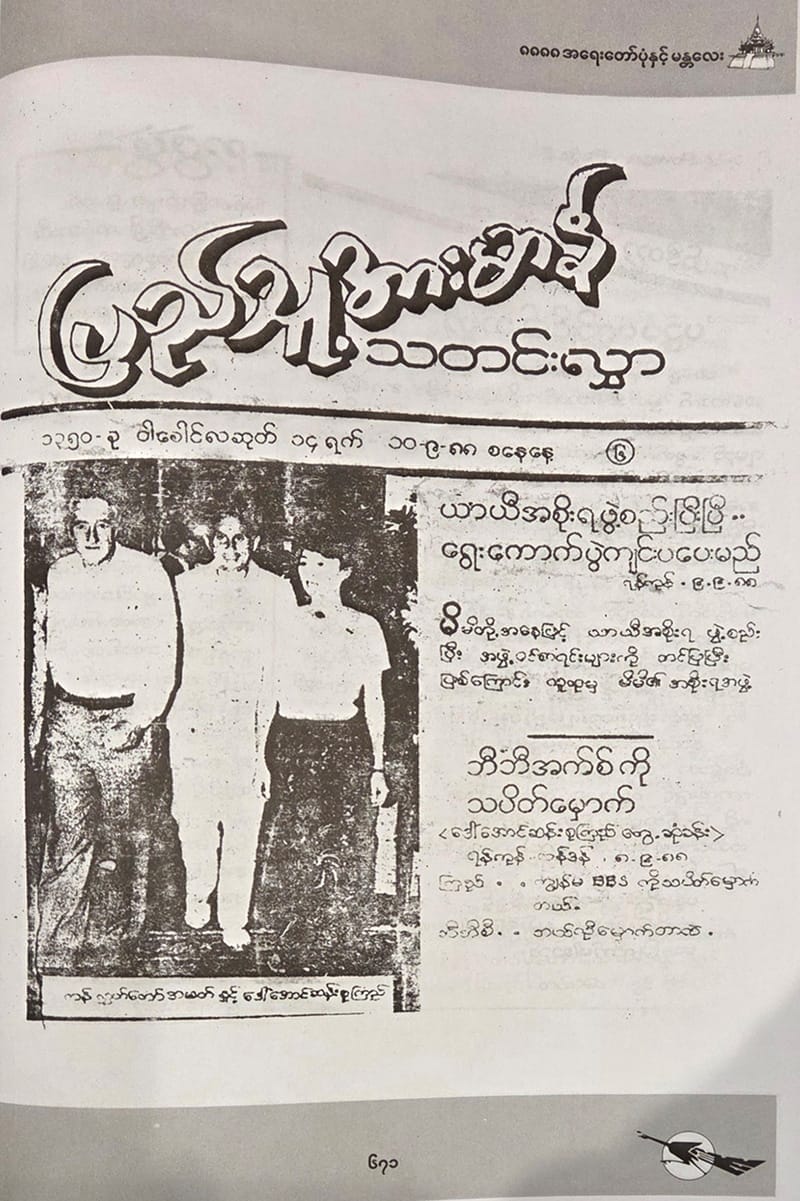
The late Stephen Solarz, then US Congressman (at the center) with Aung San Suu Kyi in Rangoon, amidst nationwide revolt against the nominally socialist military dictatorship, a week before the military’s bloody crackdown. Solarz went on to found the International Crisis Group (ICG) which he co-chaired with Chris Patten of UK. (A local newspaper named “People Power”, 10 Sept. 1988, photo by Zarni).
New Yorker (dated 2 Oct. 1989) ran a feature article on Burma, entitled “A Rich Country Gone Wrong”, Solarz was characterized as “something of a hero” to local protestors who were wildly excited about the rumours that the United States Navy Seventh Fleet was “invading Burmese waters” to support democratic uprising! I remember reading the English language news that the good Congressman urged the late Dr Maung Maung, the interim president, to relinquish power to the democrats in revolt. I was then already in Northern California to start my American university education.
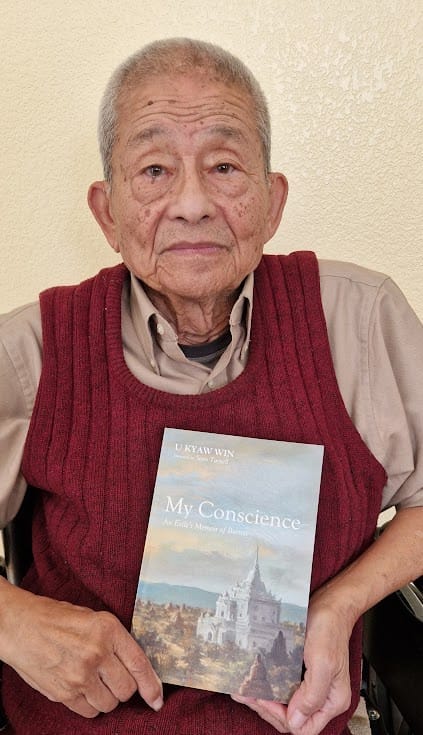
U Kyaw Win (91), Myanmar Exile at home in Boulder, Colorado, USA, (retired Professor of Counselling Psychology, Orange Coast College, Los Angeles) holding his memoir My Conscience: An Exile’s Memoir of Burma (photo by Zarni, Nov. 2024)
The New Yorker chose not to make a single mention of Washington’s role in propping up the Burmese generals whose isolationist policies, ethnic divide and rule, and political repression brought the economy and society to ruins and deeply poisoned ethnic relations. The CIA, DEA, US Staff colleges were all training our torturers and tormentors in police and military uniform. But we were led to believe that the United States was the beacon of freedom and democracy while only the Soviet Union was “the evil empire”, with the wall that needed to be torn down, as Ronald Reagan famously demanded. “Moscow” was our nickname for the US-backed military dictatorship’ prisons managed by CIA, Mossad and Taipei-trained intelligence officers was. What irony!
According to one prominent dissident, the retired Professor Kyaw Win, the US politicians supported Ne Win dictatorship with military and police training, dual use military hardware (for instance, Bell choppers) and over one hundred millions of $ in anti-narcotic operations, would not really listen to what the Burmese dissidents had to input.
The truth was Ne Win was using narcotic militias to create horizontal conflicts in Shan and other non-Burmese ethnic regions between the genuinely ethnic liberation movements and the drug-producing militia groups. U Kyaw Win said, “Solarz wasn’t even willing to meet with us, from CRDB, to hear our anti-dictatorship and pro-democratic views.” Even during the few years prior to the promising nationwide uprising in Burma.”
A handful of Burmese exiles would organize small rallies on the steps of US Congress, in protest of Washington’s supplies of dual-use aircrafts for aerial spray on opium fields in the highlands of Myanmar. No US politicians nor journalists would take notice of them.
Also, a fellow and a friend of Harn, U Kyaw Win cofounded the Committee for the Restoration of Democracy in Burma (CRDB) in 1986, two years prior to Myanmar’s historic national uprising of 8.8.1988, the first global network of Burmese dissidents in exile, architect Bilal M. Rashid, and the late U Tin Maung Win and the late U Ye Kyaw Thu.
Before the collapse of the Berlin Wall in November of 1989, and in the absence of the western human rights watchdogs with an interest in Myanmar, the Burmese exiles founded CRDB, as the first globally organized network of Burmese democrats with branches and/or affiliates in Europe, N. America, Japan, Australia and Thailand.
This crop of exiles were generally well-educated, and drawn from prominent political families whose lives had been variously destroyed and displaced by General Ne Win’s 1962 military coup, who had been seeking ways to oppose the US-backed military dictatorship of General Ne Win and mobilize support for the largely unknown democratic underground and ethnic armed resistance movements by Shan, Kachin, Shan, and so on in their birthplace.
Source: Bilal M. Rashid, The Invisible Patriot: Reminiscences of Burma’s Freedom Movement, Maryland, USA, 2015, p. 408
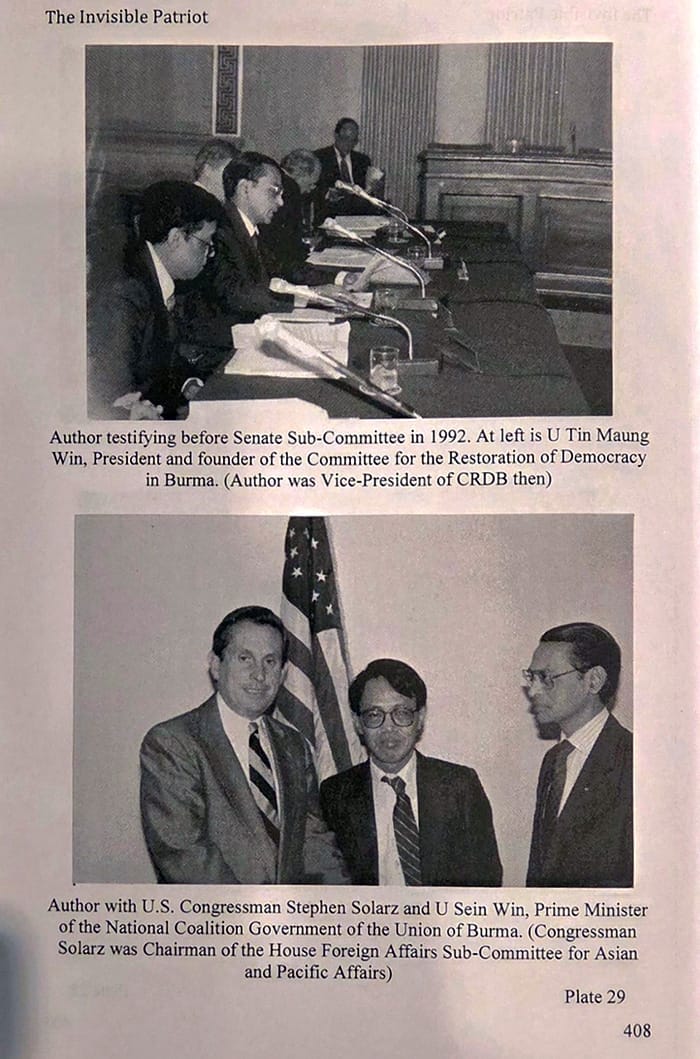
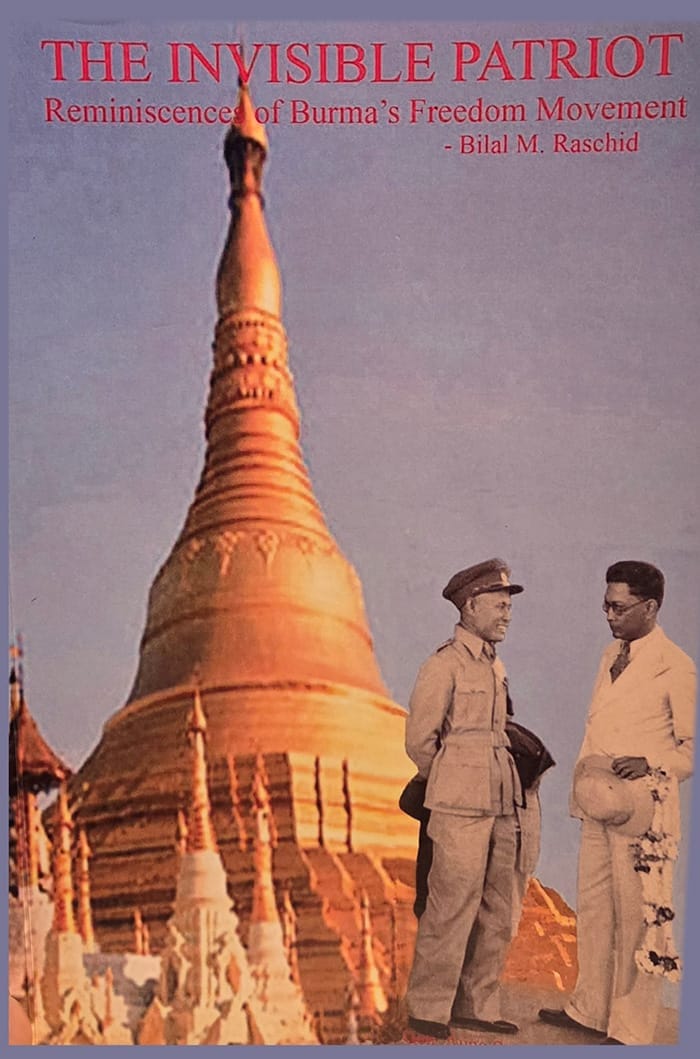
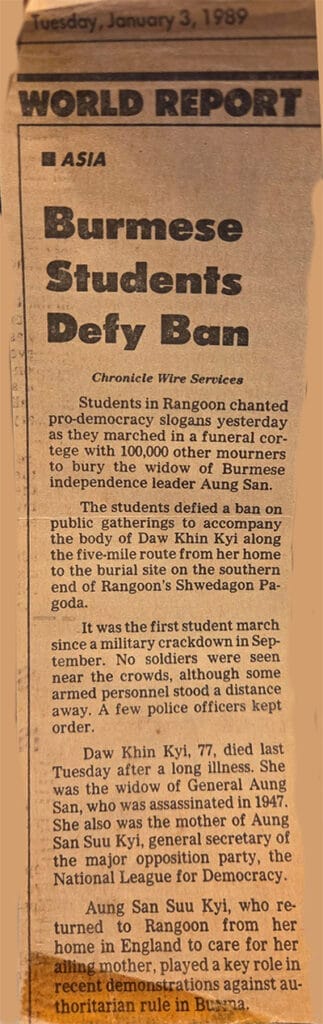 Fast forward to the 1990’s, Washington was a lot “friendlier” place for the new wave of Burmese exiles and political refugees, or someone like myself who arrived in the United States just in time to have missed the 1988 uprisings back home in Burma but got involved with the diaspora activism subsequently.
This sudden welcome in Washington circles towards Burmese exiles and their exilic policy advocacy and grassroots activism had everything to do with American (and Western) rediscovery of human rights and democracy in the ending Cold War. The 17h century concept of “civil society” was already dusted off the shelf of the European Enlightenment, so-called, by the American Cold Warriors – and the Vatican led by John Paul II, the Polish Pope from Krakow, to deal the Evil Communist Empire one final blow.
That the Norwegian Nobel Peace Institute’s gold standard activist endorsement of our anti-dictatorship opposition via its choice Aung San Suu Kyi, then under her 1st house arrest, as the winner for the 1991 Nobel Peace Prize gave the exiles’ anti-dictatorship activism a great deal of tail wind. That she was a textbook liberal who kept her mouth sealed on the rising neo-liberalist Capitalism with increasingly dark consequences, for the planet and humans, won hearts and minds in the seats of power in the West.
In those days, the history was about to end in Myanmar as well, not just in the USSR and the Eastern Bloc, or so we thought euphorically after the dissolution of the Soviet Union. After all, we grew calling prisons “Moscow”.
Moreover, the arrival in the United States of the younger generation dissidents in their early 20’s, as political refugees, after the near total collapse of the armed student revolution, known as the All Burma Students Democratic Front (ABSDF) helped spur the growth of what then came to be known as the Free Burma activism. These refugees were my peers, and Harn, his brother Eugene, Bilal M. Rashid, Professor Kyaw Win and the CRDB exiles were contemporaries of our parents, more or less.
We were born after the 1962 coup and cut political teeth during the quarter century of the Washington-backed military dictatorship of General Ne Win.

The 13 March 1990-dated newspaper clipping, on the author’s files. Photo, Zarni.
The two further developments that favoured what really was the explosion of Burma awareness and support in USA and much of the Western world were the arrival first on university campuses and the commercial spread of the 1st generation of the Internet and World Wide Web. Finally, that the end of the apartheid in S. Africa, and its anti-apartheid BDS movements across the Western world afforded a small number of Burmese exiles over two generations a great opportunity to build our Free Burma support networks and campaigns.
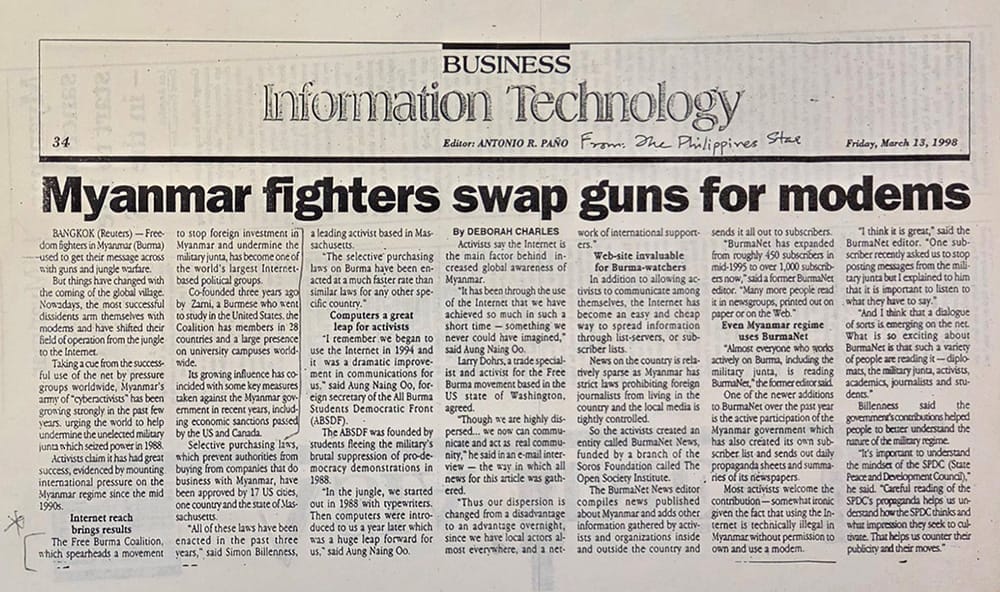
The newspaper clipping on the author’s files. Photo, Zarni.
Finally, the early successes of the exilic activism and policy advocacy came about as the result of a combination of several major changes in the World Order and the new ideological wind of Neo-liberal capitalism. Capitalist way of life felt the only uncontested option for humanity at large.
The best we could do for social justice, human emancipation and any type of progress and development was to humanize what Marx and early revolutionary thinkers and revolutions saw as the Monster System where Capital, not human welfare, reigns supreme. That was the foregone conclusion of the global intelligentsia and political class, following the break-up of the Soviet Union, dissolution of the Eastern Bloc and the Balkanization of Yugoslavia.
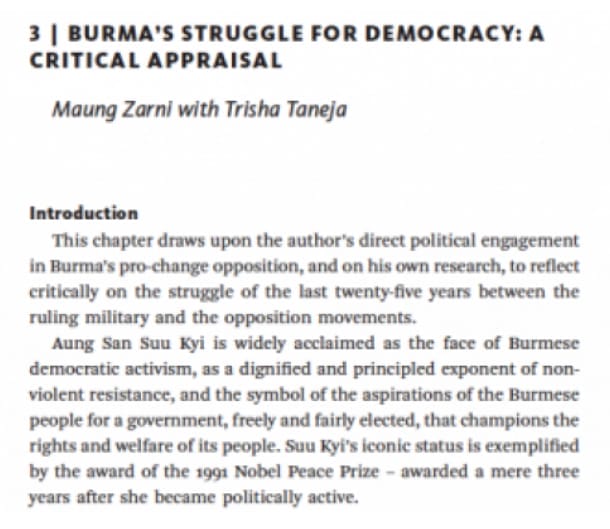
Source: Advocacy in Conflict: Critical Perspectives on Transnational Activism, Alex De Waal et al, London, 2015.
Against this capitalist triumphalism in the West, Harn and the older generation of exiles whose names I mentioned previously and the younger generation new arrivals of Myanmar dissidents in western countries teamed up and tried our best to make our respective contributions to the democratic resistance at home, under the flagship opposition party of Aung San Suu Kyi, known as the National League for Democracy.
I have written extensively on this chapter of exilic activism elsewhere.
Suffice it to say that there existed a tremendous goodwill, respect, appreciation and cooperation among the exiles of two different generations. We the younger ones looked at the older generation of exiles and dissidents with admiration, and sought strategic advice and guidance from our elders, despite the fact that they did not succeed in their struggle to dislodge the junta at home.
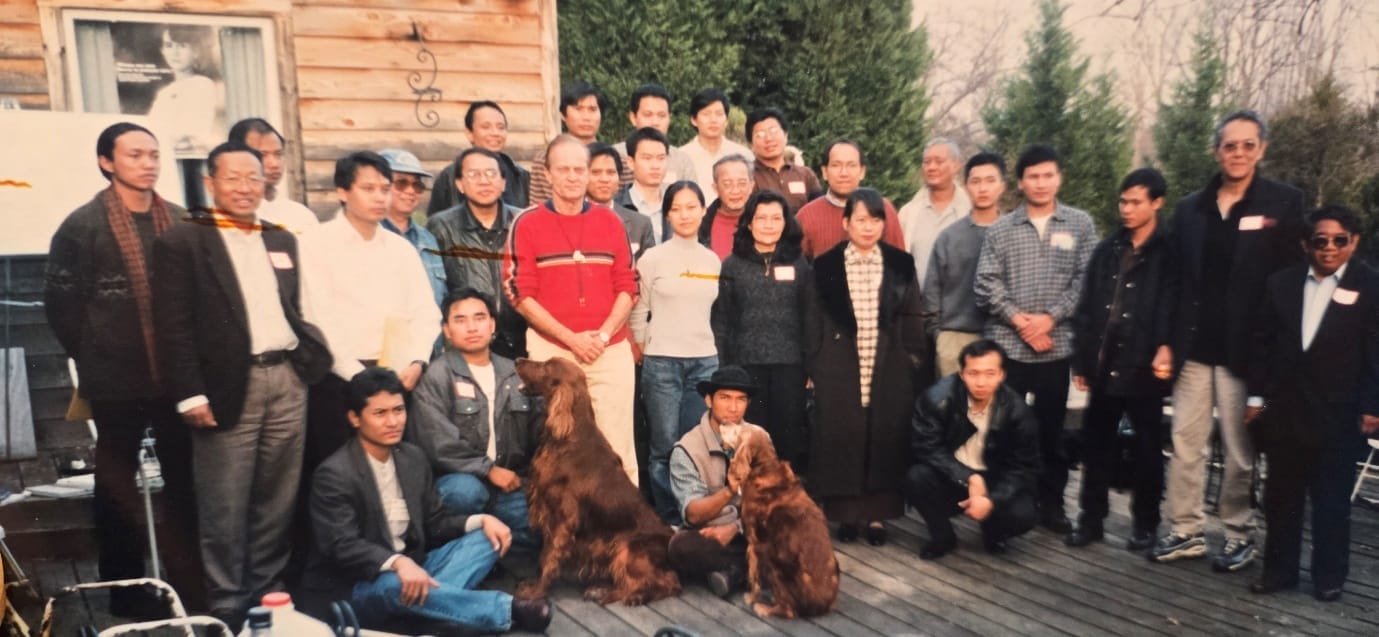
A weekend retreat of two-generations of Myanmar exiles from Thailand, USA, Canada, Europe and the Caribbeans on the farm that belonged to the late Professor W. Scott Thompson (in red), an ex-son-in-law of Paul Nitze, known as the architect of Washington’s militant Containment Policy, Manassas, Virginia, USA. 2000 (photo by Zarni) The bespectacled Dr Chao Tzang Yawnghwe is to the left of Prof. Thompson, second row, behind the three women.
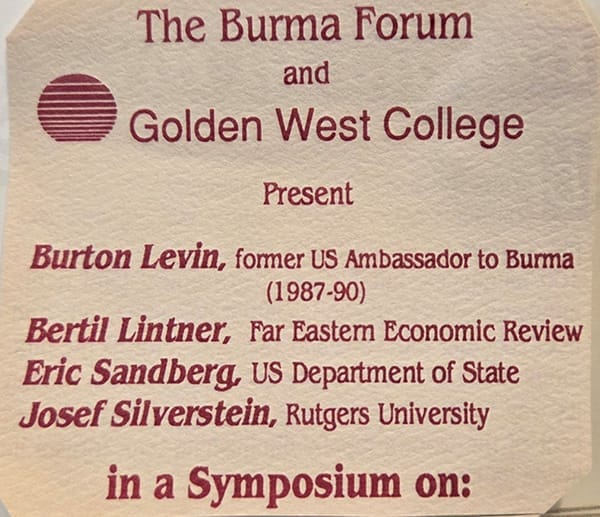
We did benefit a great deal from our international supporters including a small number of leading Western scholars on Myanmar and in peace studies such as the late Josef Silverstein, Louis Walinsky and Johan Galtung.
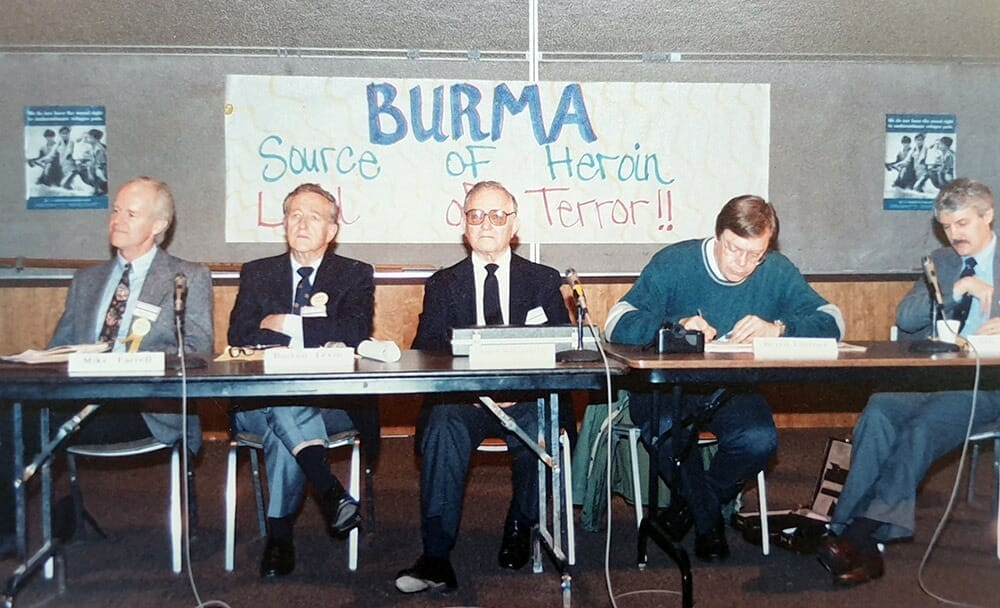
From left to right (American actor and activist Mike Farrell, Burton Levin, Professor Josef Silverstein, the Swedish journalist Bertil Lintner, and the US State Department representative Eric Sandberg).
Zarni’s photos from an intergenerational exilic Burma event, organized by Professor Kyaw Win, Los Angeles, circa. 1991.
Obviously, all our exilic efforts over the last four or five decades fell short – far short – of what is needed to bring about not simply “the regime change” but the fundamental system change.
Why have Myanmar’s democratic movements gone awry?
As a matter of fact, all things Myanmar democratic opposition have gone wrong, horribly wrong.
Today, the once global icon of moral leadership, Aung San Suu Kyi herself, is named among the two dozen wanted criminals in Myanmar’s genocidal destruction of Rohingya minority, in the recent Argentina court ruling, anchored in the international legal principle known as the Universal Jurisdiction.
Her twice-elected party – the NLD – has been forcibly deregistered by the military junta that ended the NLD’s second term government in a coup of February 2021.
Myanmar as a signatory state to the Convention on the Prevention and Punishment of the Crime of Genocide now awaits the final ruling in the genocide case known as Gambia vs. Myanmar at the International Court of Justice.
As I has stressed on numerous occasions, genocide is a crime jointly perpetrated by the state organs and dominant society at large. Beyond judicial rulings and international consequences, if any, for Myanmar as a country, a society that has gone along with a policy of genocidal destruction of a national minority or minorities self-afflicts long-term and profound harm to its “soul”, or simply, the body politics.
Instead of moving towards ceasefire, let alone peace and reconciliation, the country and her people have found themselves in a ‘situation far more violent and war-torn than the country that emerged from the ashes of the Second World War: for 3 years (1942-45), the colonial Burma was a major theatre of war between the occupying Fascist Japan and the old colonizer British.
A little over a year ago, I wrote these words on the pages of the Jakarta Post, and they remain as true today as they were then:
Myanmar looks more like ASEAN’s Syria than a democracy-in-waiting. Over the past three years since the Myanmar military seized power, the armed conflicts have morphed into a civil war, with anti-junta groups fighting for their own interests without a single, unifying vision, and the Rohingya people still caught in a decades-long genocide.
The toxic politics of Bama Buddhist Supremacy and statist militarism
With the benefit of the hindsight, after almost four-decades since the country under the first military dictatorship of General Ne Win revolted in the 8.8.88 (August 8, 1988) uprisings, Myanmar affairs, both in terms of in-country anti-dictatorship opposition and the exilic activism have been devoid of serious progressive ideals including ethnic equality and social justice (that is, economic and gender equality), beyond liberal (read individualistic) democratic objectives.
Three things account for this. First, the ideological winds of post-USSR were blowing in the neo-liberal direction economically. Second, the ethnicity-based nation-state was coming back in vogue. in the Balkans and the formerly Eastern Bloc Europe. And last but not least, the overwhelming majority of Myanmar people came to associate any type of progressive social thought (that is, leftist, Marxian and socially revolutionary), including the role of the central state as class, gender and ethnic equalizer and, accordingly, reject viscerally any mention of socialistic ideals or values.
Unable to go beyond the dictatorship’s official polemic, the majority of Myanmar, including intelligentsia equated General Ne Win’s “Burmese Way to Socialism” (1962-88), a faux socialism, with poverty, political repression and absence of civil rights.
Previously, I made a mention that Dr Chao Tzang read Marx and other critical egalitarian literature and encouraged the younger generation exiles to do the same, though a born-prince o a highly privileged feudal family and social class milieu. This may be in no small part because he escaped Ne Win’s faux socialist dictatorship: he took up arms to fight it as a young guerrilla leader in his mid-20’s with the Shan State Army.
Equally important, his generation – that is, my parents’ generation – came of age in the era of national liberation movements against Western Colonialisms, which, to them, was coterminous with global Capitalism. Their generation and that of the preceding nationalist generation of their fore parents were more or less informed by radical leftist ideas and perspectives. The anti-imperialist Bandung Conference (in Indonesia) of 1955 which attracted the likes of Fidel Castro and Che Guevara was a concrete result at the level of newly independent states. Noteworthy is the fact that Myanmar was one of the five original organizers of the conference – the other four were India, Sri Lanka, Indonesia and Pakistan – which midwifed the Third World and the Non-Aligned Movement.
This progressivism among both urban and rural populations, particularly students and intelligentsia, was in fact a continuation of the progressive ideological trend, unleashed around the world, in both industrial economies of the colonial and semi-colonial West, as the direct result of the 1929 Great Crash (of the stock market), with significant global ramifications such as the rise of Nazism/Fascism in Europe and the Marxist-Leninist-inspired anti-capitalist/imperialist struggles – for national liberation.
It must be stressed that the post-colonial national vision for Myanmar then Burma under the British rule -as a union that mitigated the domineering impulses amongst ethno-majoritarian and Buddhist traditionalist Bama or Myanmar politicians, public and intelligentsia, came from the radical progressive analyses and leftist or socialist values.
The martyred General Aung San, a key architect of the federalist union, alongside Harn’s father Sao Shwe Thaike, then the host of the Panglong Conference of February 1947, drew heavily on the two seemingly opposing trends of non-racial and non-ethnocentric perspectives, namely the Soviet Union with its Marxist-Leninist anchor, and the United States, with its liberal ideals.
The national vision of Myanmar’s co-founders rested on several major thematic pillars including separation of faith/church and state, equality of ethnic groups, the conception of post-colonial citizenship based on both ethnicity or indigeneity and residency, irrespective of race and faith and socialistic economic and welfarist policies.
Tragically for the multi-ethnic peoples of the Union, no sooner had Aung San as the Bama leader with foresight and radical non-ethicized national vision been murdered than the rest of the Bama ethnonationalist politicians, including his deputy U Nu, later Prime Minister, until ousted in the 1962 coup, had jettisoned the blueprint for Myanmar as the genuinely federated, secularist state.
Upon independence in 1948, Myanmar society, state and economy had the multi-cultural, multiethnic and multifaith character. Aung San made it clear to any racial or faith communities – Chinese, Indians, Eurasians, Europeans, etc. that a new post-independence Burma was theirs, irrespective of their background, as long as they transferred their old loyalties, if any, from the colonial British to the new Burma. “If you so choose, adopt Myanmar as your home, and work towards making it peaceful and prosperous you will enjoy full equality, non-discrimination and non-exclusion”, was his loud and welcoming message, particularly to those who may feel they were “native” or “indigenous” to the land, about to become a new nation-state.
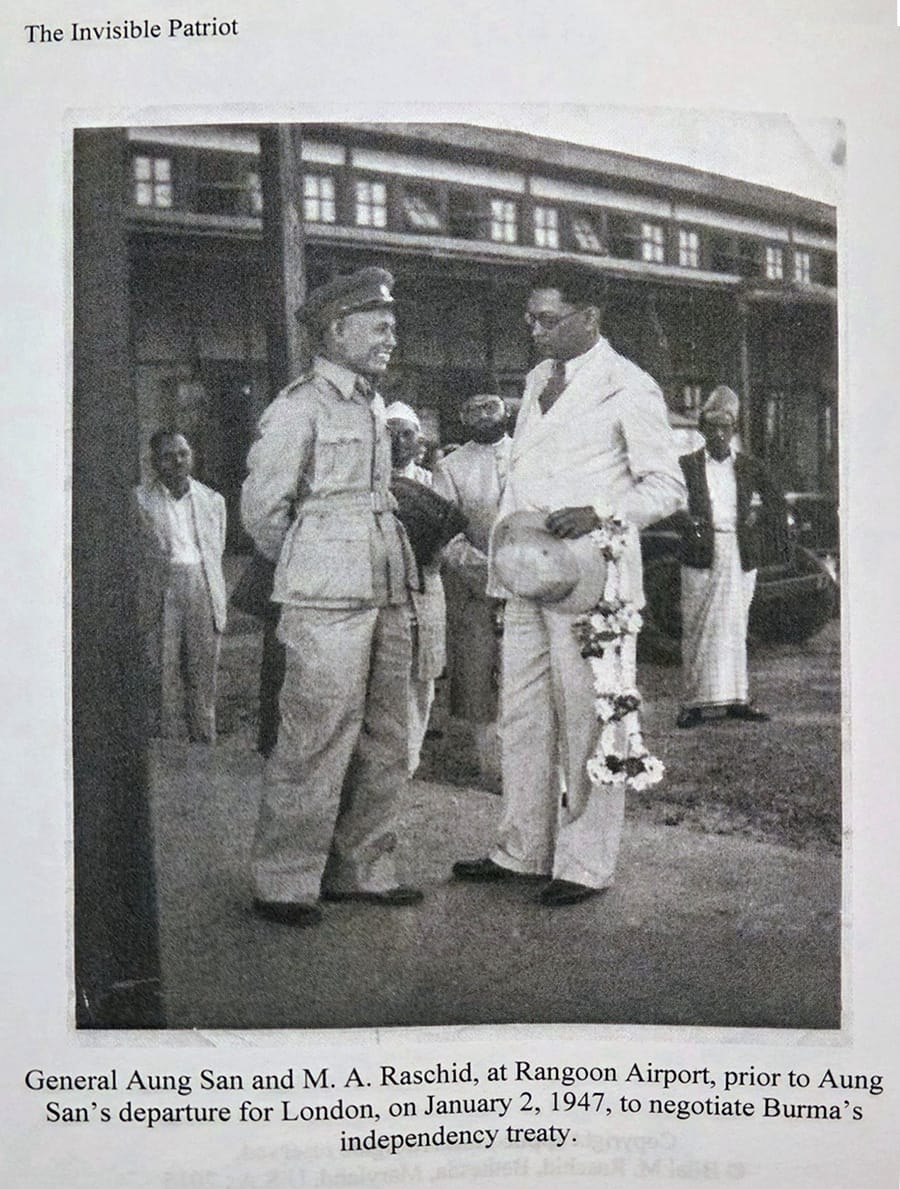
Source: Bilal M. Rashid, The Invisible Patriot: Reminiscences of Burma’s Freedom Movement, Maryland, USA, 2015
The Union of Burma emerged with its multicultural, multiracial and secularist independent state on 4 January 1948. Her first ambassador to the United States was James Barrington, a Eurasian; the Commander-in-Chief of the Armed Forces (known as the Tatmadaw was named General Smith Dunn, a British-trained Christian Karen; the Vice Chief of Staff of the Air Force was Brigadier Tommy Cliff, another Eurasian. Colonel Khun Nawn, a Kachin Baptist, was the principal of the Defence Services Academy. A prominent cabinet member in charge of Labour Ministry was M. A. Rashid, an Indo-Burmese Muslim and a very close comrade of Aung San since their Rangoon University Student Union days in the 1930’s. The Commissioner of Education was a British-educated Sino-Burmese named U Kaung. Its 1st President was a Shan royal ruler, Sao Shwe Thaike. And a long list of many other distinguished individuals drawn from a rich variety of backgrounds.
However, post-Aung San’s assassination, the country underwent gradually a Bama or Burmese-centric ethnonationalist rightward drift. This in turn triggered different waves of ethnic resistance, from religious and ethnic non-majority.
As I noted in the previous part of this essay, it began with the sacking of an ethnic Karen Commander in Chief, India-trained, British-commissioned General Smith Dunn in January 1949. The Bama nationalists in power led by Prime Minister U Nu convinced themselves that Dunn was not to be trusted on account of his Karen ethnicity and Christian faith in the face of the Karen armed revolt, which followed the armed insurrection by the Burmese Community Party in March 1948.
Within 14 years on this trajectory, the Union of ethnically equal communities was officially buried with the coup in 1962: the coup leaders binned the Constitution of 1947 which at least contained the spirit of federalist aspirations, if not honouring it to the letters, abolished any trappings of a parliamentary democracy and ushered in a new era of dictatorship, with programs designed to re-engineer Myanmar society and state, along the lines of “ethnic” and “faith” purity. No institution – from pre-schools to post-graduate level university classes, economy to state organs – was left untouched by the Revolutionary Council, the name of the coup regime in 1962. This was a painful subject of my PhD thesis.
A year after Harn began his Thai high school in Chiang Mai, Northen Thailand, the Revolutionary Council began its first bloodless ethnic cleansing of Myanmar’s Indo-Burmese communities, particularly from the economic sector.
On 24 July 1964, just a week before my first birthday living in Mandalay, the New York Times offered a peak into the increasingly dark and isolated world of the military’s Myanmar. Its news headlines reads, “Uprooted Burma Traders Reach Indian ‘Home’; Nationalization Drive Expels Many Who Have Never Seen Ancestral Land”.
A series of economic laws enacted between 1963-1972 destroyed the foundations of livelihoods for Indo-Myanmar communities, some 97,000 out of a total of 109,000 Indo-Myanmar and 12,000 out of 26,000 Myanmar of Pakistanis migratory background left the country by July 1965.
Having crushed a peaceful political movement, the Federal Movement, which Harn’s parents were involved in as its leaders, Myanmar’s military leaders set their sight on communities that they considered ancestrally foreign, that is, Sino-, Indo- and Euro-Burmese cultural backgrounds.
The Rohingyas, the largest Muslim population with their bi-cultural or bi-national ties to both East Bengal and Arakan of ancient Myanmar
In this process of large-scale ethnic cleansing and genocidal campaigns, the public was gradually primed via various cultural, information and educational institutions, to go along with the military’s racist, xenophobic policies.
So, when Harn joined the exiled opposition government in 1992, he drafted a confidential position paper for the NCGUB to engage at the level of international policy.
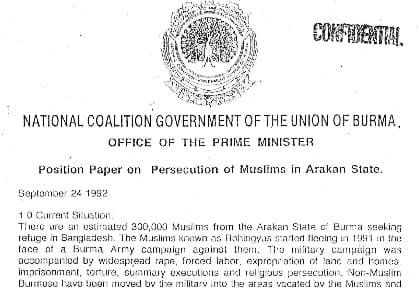
However, the Member Parliament-elect who formed the core of the exile government rejected the draft, which outlined a plan of action to address the outstanding issue of the discrimination, persecution, and other systemic breaches of minority and basic human rights of Muslim Rohingyas.
See the full draft of this important brief (PDF) HERE
In retrospect, Myanmar’s democratic opposition leaders in exile who were fighting for their own political, human and civil rights were unable to extend the same rights to the country’s most persecuted minority did not bode well for Myanmar’s democracy movement under Aung San Suu Kyi.
The rest is history as they say.
Finally, a word about the role of intelligentsia in the toxic affairs of Myanmar politics, both among exiles and those who remain inside the country. One of the fundamentally regressive threads all throughout Myanmar’s struggles for freedom is the mono-ethnicity-anchored “Myanmar Mind,” bordering on the blood-and-soil ideology, one associates with fascism and race-supremacist ideologues.
Within Myanmar’s political context, the Bama ethnic supremacy, based on the false belief in the “blood purity”, has been the biggest mental virus.
Even some of the most influential leftist ideologues and revolutionary leaders, from Buddhist and Burmese or Myanmar backgrounds, for instance, the Red Flag (Trotskyite) communist Thakhin Soe and novelist Thein Pe Myint, also a well-known communist leader, admitted they succumbed to this deep racism even at the height of the labour-led anti-imperialist strikes and marches against the British colonial rule in the 1930’s.
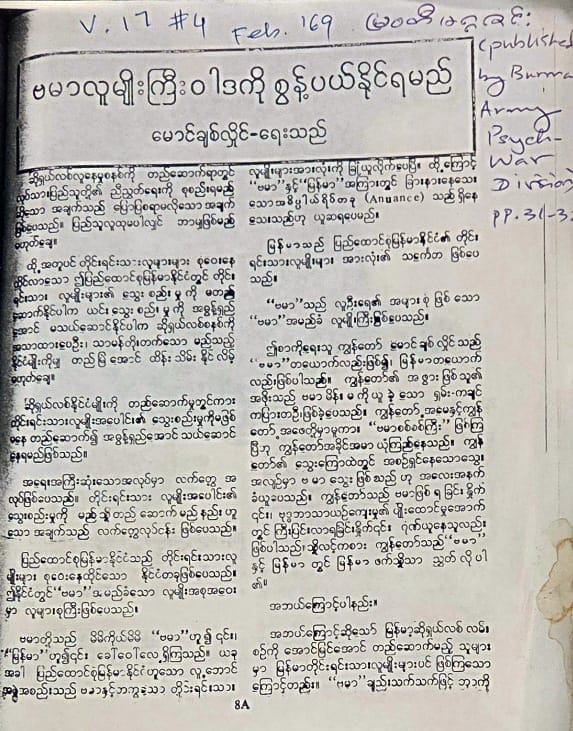
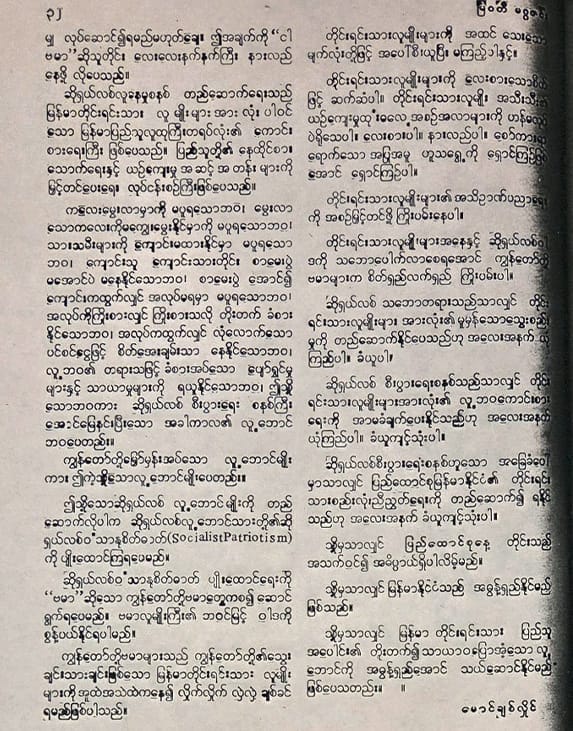
In the early days of the first military junta led by General Ne Win, the chief ideologue U Chit Hlaing, who headed the influential Central School of Political Science, identified this ethnic supremacy in Myawaddy magazine (February 1969, see the photos below), the main propaganda organ of the Armed Forces and urged its eradication. In his words, my grandparents were ethnically mixed; nonetheless, I convinced myself that my parents were “pure blooded Bama.”
Photos by Zarni, hard copies in his files
Almost one century later, this blood-and-soil type racism of the dominant majority is what enabled Myanmar military to bring the country’s majoritarian Buddhist public along as it perpetrated what my wife and scholar colleague Natalie Brinham call “the slow burning genocide” against the Rohingya people.
It is also this same toxic ethno-nationalism that has long wrecked the federalist blueprint and aspirations of non-majoritarian ethnic peoples including Shan, Kachin, Rakhine, Karenni, Karen, Chin, Mon, Rohingya and so on, the Bama supremacist mindset which denies the minorities’ right to self-determination, thereby fuelling one of the world’s longest ethnic conflict since 1947.
See the relevant pages of the 11-page, Burmese language, type-written letter by the late ex-Prime Minister U Nu, addressed to his comrades in the anti-military dictatorship armed resistance, dated 2 March 1973.
The authenticated copy of the letter, in Zarni’s files. A gift from the editor Professor Kyaw Win, an adviser to the exile leader ex-PM U Nu
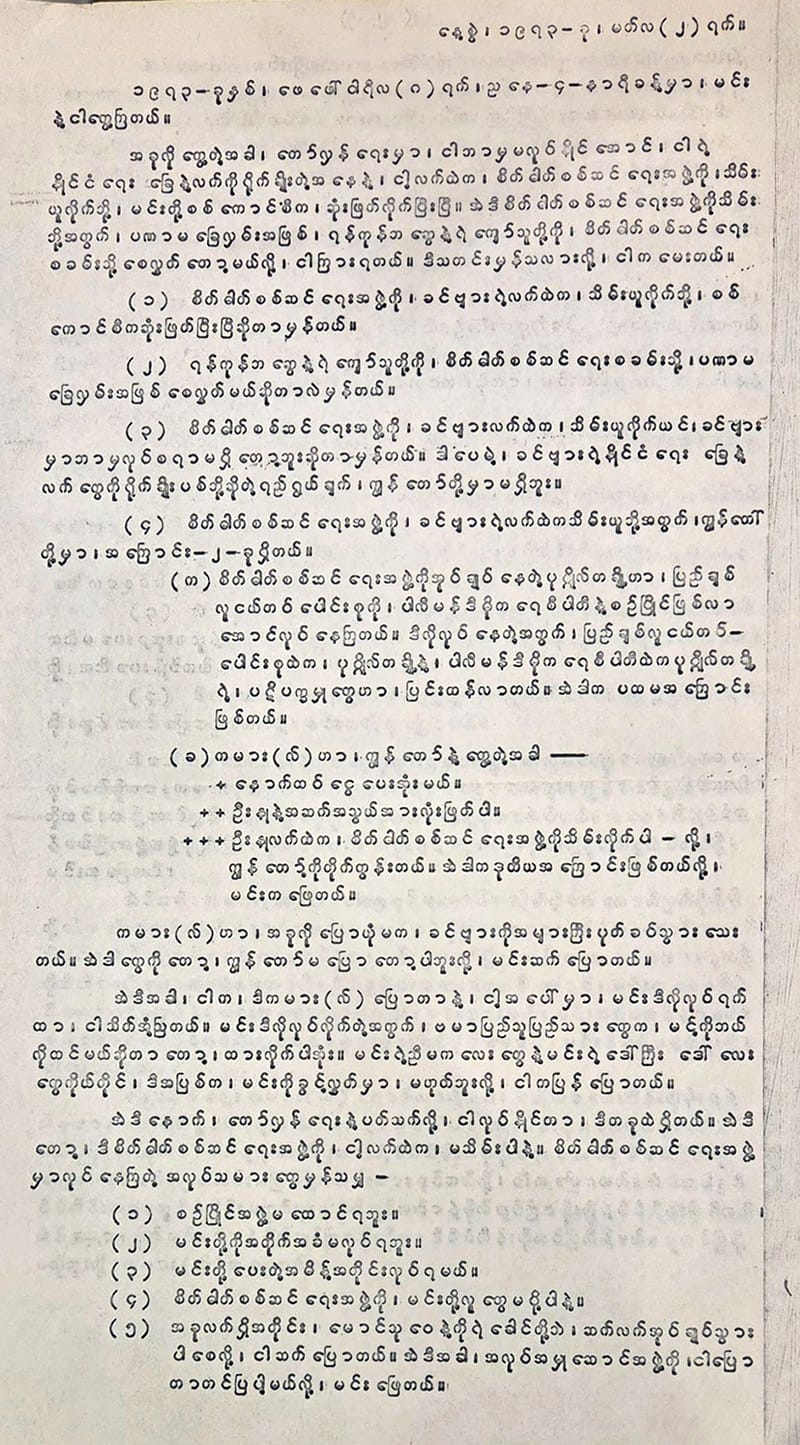
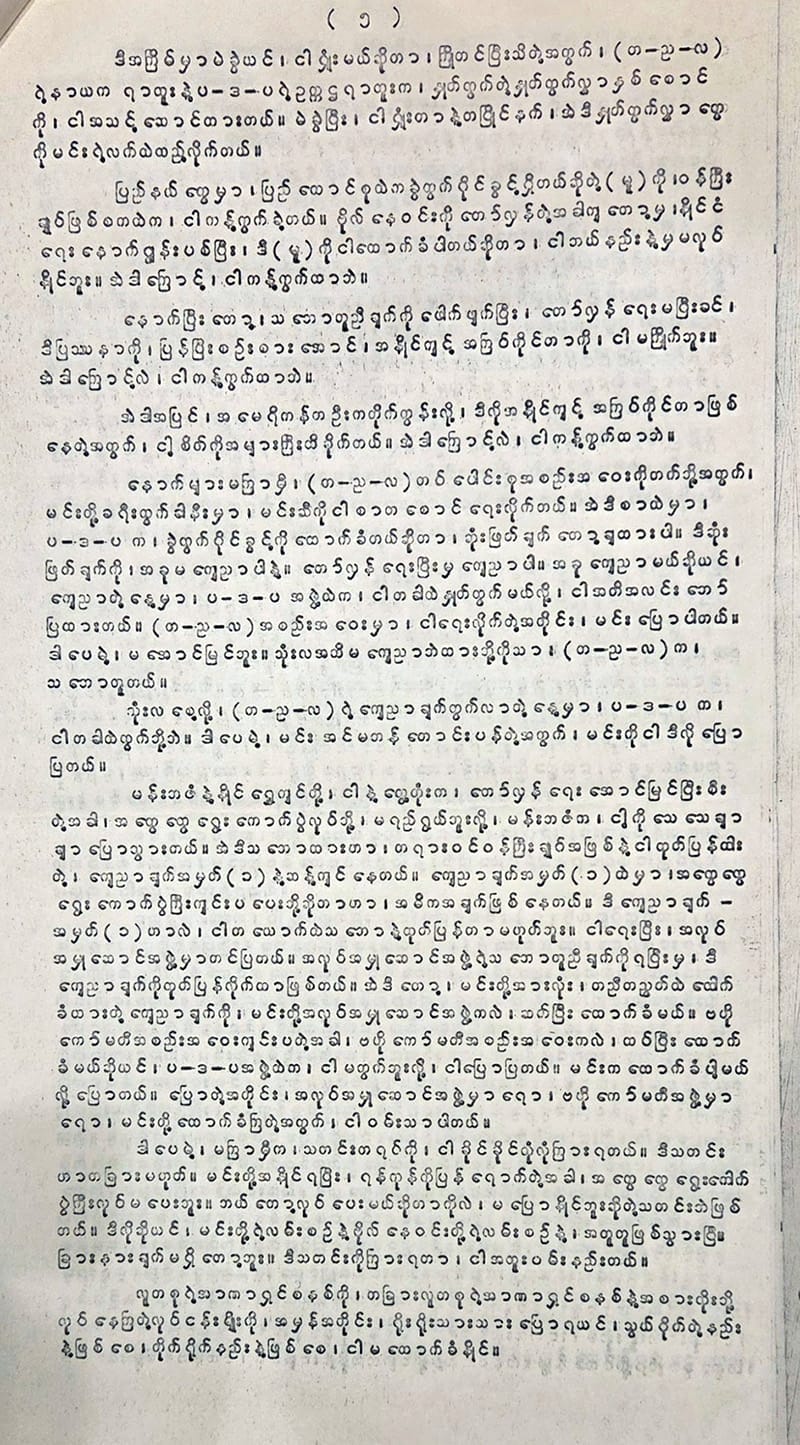
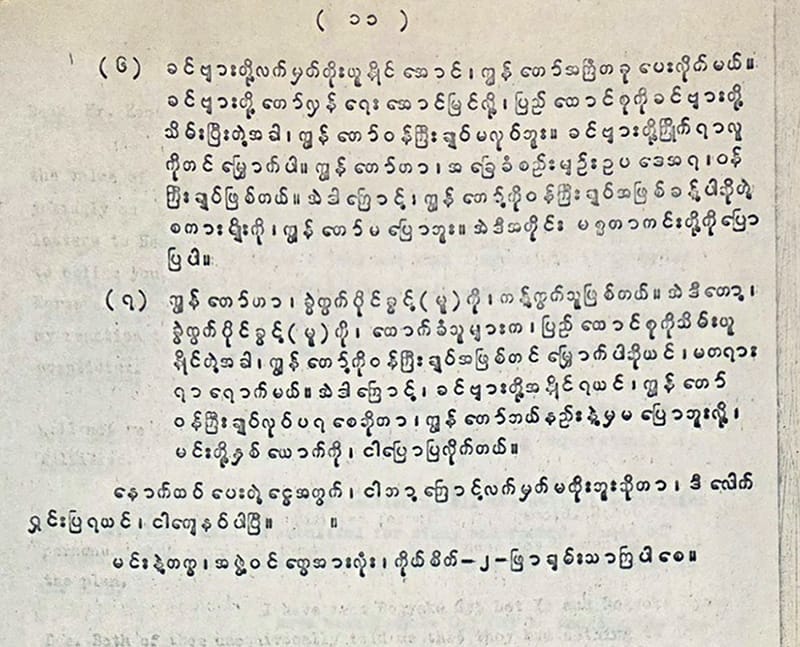
The main points of the letter relevant to this essay on recognizing non-Bama peoples’ contributions to nation-building and democratic struggle, were as follows: Nu stressed his belief in majoritarian electoral democracy while rejecting categorically ethnic minorities’ right to self-determination. He was emphatic that since the day he succeeded the martyred Aung San in July 1947, as the leader of Myanmar, on the eve of Myanmar’s independence from Britain, he had rejected such right to self-determination, including ethnic states’ right to secession, although the Constitutions of 1947 and 1948 granted two ethnic groups, namely Shan and Kachin, such fundamental right.
Post-colonial national vision for Myanmar came from a combination of leftist progressive analyses and non-blood-and-soil secular civic nationalism, both of which seek to honour ethnic group equality and right to self-determination.
The history of post-colonial Union of Burma or Myanmar is a history of the betrayal of its founding principles. Until and unless serious efforts are made to revive these principles the future of Myanmar remains as tortuous and tumultuous as it has been over the last almost eighty years.
No amount of armed resistance or people power revolt will resolve Myanmar’s violent political conflicts. The solutions may be found in reflecting honestly on why and how this mineral rich country of 50-million hard-working people of multiple ethnic backgrounds have gotten into this hellish mess, not more international support, western economic sanctions or further pariahization of the country’s Tatmadaw or military, no longer seen as representing even the ethnic Bama majority.
The winds of change are blowing around the world. They are blowing in the anti-democratic lawlessness. They don’t favour either democratization or minority rights.
___________________________________________
 A Buddhist humanist from Burma (Myanmar), Maung Zarni, nominated for the 2024 Nobel Peace Prize, is a member of the TRANSCEND Media Service Editorial Committee, of the TRANSCEND Network for Peace Development Environment, former Visiting Lecturer with Harvard Medical School, specializing in racism and violence in Burma and Sri Lanka, and Non-resident Scholar in Genocide Studies with Documentation Center – Cambodia. Zarni is the co-founder of FORSEA, a grass-roots organization of Southeast Asian human rights defenders, coordinator for Strategic Affairs for Free Rohingya Coalition, and an adviser to the European Centre for the Study of Extremism, Cambridge. Zarni holds a PhD (U Wisconsin at Madison) and a MA (U California), and has held various teaching, research and visiting fellowships at the universities in Asia, Europe and USA including Oxford, LSE, UCL Institute of Education, National-Louis, Malaya, and Brunei. He is the recipient of the “Cultivation of Harmony” award from the Parliament of the World’s Religions (2015). His analyses have appeared in leading newspapers including the New York Times, The Guardian and the Times. Among his academic publications on Rohingya genocide are The Slow-Burning Genocide of Myanmar’s Rohingyas (Pacific Rim Law and Policy Journal), An Evolution of Rohingya Persecution in Myanmar: From Strategic Embrace to Genocide, (Middle East Institute, American University), and Myanmar’s State-directed Persecution of Rohingyas and Other Muslims (Brown World Affairs Journal). He co-authored, with Natalie Brinham, Essays on Myanmar Genocide.
Tags: Burma/Myanmar, History
DISCLAIMER: The statements, views and opinions expressed in pieces republished here are solely those of the authors and do not necessarily represent those of TMS. In accordance with title 17 U.S.C. section 107, this material is distributed without profit to those who have expressed a prior interest in receiving the included information for research and educational purposes. TMS has no affiliation whatsoever with the originator of this article nor is TMS endorsed or sponsored by the originator. “GO TO ORIGINAL” links are provided as a convenience to our readers and allow for verification of authenticity. However, as originating pages are often updated by their originating host sites, the versions posted may not match the versions our readers view when clicking the “GO TO ORIGINAL” links. This site contains copyrighted material the use of which has not always been specifically authorized by the copyright owner. We are making such material available in our efforts to advance understanding of environmental, political, human rights, economic, democracy, scientific, and social justice issues, etc. We believe this constitutes a ‘fair use’ of any such copyrighted material as provided for in section 107 of the US Copyright Law. In accordance with Title 17 U.S.C. Section 107, the material on this site is distributed without profit to those who have expressed a prior interest in receiving the included information for research and educational purposes. For more information go to: http://www.law.cornell.edu/uscode/17/107.shtml. If you wish to use copyrighted material from this site for purposes of your own that go beyond ‘fair use’, you must obtain permission from the copyright owner.
Join the discussion!
We welcome debate and dissent, but personal — ad hominem — attacks (on authors, other users or any individual), abuse and defamatory language will not be tolerated. Nor will we tolerate attempts to deliberately disrupt discussions. We aim to maintain an inviting space to focus on intelligent interactions and debates.