
Europe’s ‘War on Vitamins’ Returns: How EU Restrictions Risk Deepening a Silent Public Health Crisis
EUROPE, 20 Apr 2026
Paul Anthony Taylor | Dr. Rath Health Foundation - TRANSCEND Media Service
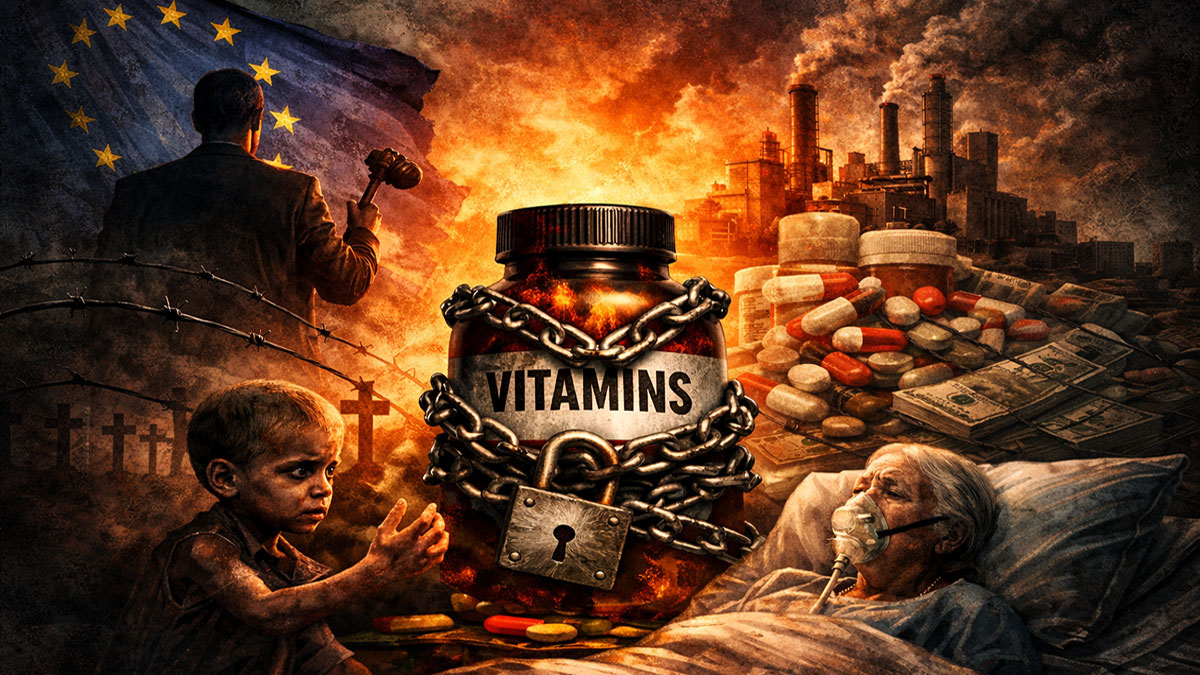
17 Apr 2026 – Across Europe, a dangerous regulatory push is gathering pace – one that could soon strip citizens of access to meaningful amounts of the essential nutrients that their bodies depend on to survive and thrive. Under the misleading banner of ‘safety,’ the European Union (EU) is moving toward enforcing draconian limits on the permitted dosages of vitamins and minerals contained in supplements. Coming at a time when studies show that micronutrient deficiencies are widespread across Europe, the planned restrictions amount to a deeply cynical attack on the health, lives, and freedom of choice of millions of people. If implemented, far from protecting public health, bans on higher dose supplements will deliberately undermine it. The primary beneficiary will be the pharmaceutical industry and its ‘business with disease.’
The roots of this authoritarian move stretch back more than two decades. In 2002, the EU adopted its so-called Food Supplements Directive, a law that set strict controls on which forms of vitamins and minerals could be contained in supplements sold in Europe. However, faced with a massive consumer backlash, the question of permitted dosages was left unresolved at the time. Since then, efforts to impose EU-wide limits have repeatedly stalled. Reports now suggest that the European Commission – the unelected executive body of Europe – is preparing to act in 2026. What is being proposed should alarm anyone concerned with health, science, or basic common sense.
Regulatory overreach
Behind closed doors, EU regulators are developing so-called ‘risk assessment’ models that treat vitamins not as essential nutrients, but as potential hazards to be tightly controlled. The approach being considered is rooted in extreme caution – so much so, in fact, that it borders on absurdity. Instead of examining what levels people actually need in order to achieve and maintain optimum health, the focus is overwhelmingly on hypothetical risks from excessive intake. The result is a regulatory approach that ignores the far more pressing and widespread danger of chronic undernutrition.
This is not a minor oversight – it is a fundamental failure of public health policy. Across the globe, billions of people are known to be deficient in essential nutrients. Vitamin D deficiency is evident throughout the European population, for example, while a lack of vitamin C is surprisingly common worldwide. A recent scientific review described magnesium deficiency as a “silent” public health crisis.
In this context, restricting access to higher-dose supplements is not just misguided – it is reckless. For many people, these products are the only practical means of correcting deficiencies and maintaining health. As such, by imposing arbitrarily low limits, the EU risks cutting off this lifeline. The likely outcome is not improved safety, but a deepening of the very deficiencies that already burden healthcare systems and diminish quality of life.
Even more troubling is the flawed methodology underpinning the proposals. Experts warn that the models being used rely on unrealistic assumptions and worst-case scenarios that bear little resemblance to how people actually use supplements. Yet these imaginary risks are being given more weight than the real-world evidence of widespread deficiency and its consequences. If this misguided approach prevails, countless products could disappear from the market overnight, while others are diluted into ineffectiveness.
This is not science-based lawmaking – it is regulatory overreach. And it comes at a huge cost. Reduced product availability, higher prices, and fewer meaningful options will leave consumers with limited ability to take control of their own health. Those with the greatest need – people with chronic conditions, dietary restrictions, or increased nutritional needs – will be hit the hardest.
We must therefore consider who stands to gain from this damaging regulatory shift. Vitamins and minerals have long offered a safe, affordable, and accessible means of supporting health and preventing disease. They empower individuals to address nutritional needs and avoid expensive medical interventions. By contrast, pharmaceutical treatments come with significant costs and proven risks. Restricting access to effective supplements will inevitably result in a greater dependence on drug-based approaches. Whether intentional or not, the outcome is clear: an increased reliance on the pharmaceutical industry.
The irony is stark. Vitamins are among the safest substances people can consume. The human body requires them for countless biological processes, from energy production to immune defense. To impose restrictive limits – at levels well below those known to be safe – is to address a problem that doesn’t exist, while ignoring one that affects millions.
Europe stands at a crossroads
All this raises a critical question: how has public health policy in Europe become so detached from reality? At a time when scientific evidence increasingly confirms the role of micronutrient supplements in preventing chronic disease and supporting mental health, the EU appears poised to move in the opposite direction. Instead of expanding access to effective nutritional tools, it is preparing drastic measures to restrict them.
The consequences of getting this wrong will not be abstract. They will be measured in rising rates of deficiency, increased healthcare costs, and avoidable human suffering. They will be seen in babies born with preventable conditions, in adults struggling with illness and fatigue, and in elderly populations facing accelerated decline. Such an outcome would be indefensible.
Clearly, therefore, Europe stands at a crossroads. It can choose a rational, science-based approach that recognizes the essential role of nutrition in promoting health. Or it can pursue a path of excessive restriction, driven by misplaced fears and outdated assumptions. The former would empower individuals and strengthen public health. The latter will do the opposite.
If these outrageous plans are allowed to go ahead, the EU will not just be regulating supplements – it will be waging an open war on nutritional health approaches. And the casualties will be counted not in headlines, but in the silent spread of deficiency and ill health across an entire continent. The only people celebrating will be executives and shareholders of the pharmaceutical industry.
_____________________________________________________
 Executive Director of the Dr. Rath Health Foundation and one of the coauthors of our explosive book, “The Nazi Roots of the ‘Brussels EU‘, Paul is also our expert on the Codex Alimentarius Commission and has had eye-witness experience, as an official observer delegate, at its meetings. Prior to joining the Foundation, Paul’s background was in the music industry, where he worked as a keyboard player and programmer with artists including Paul McCartney, Bryan Ferry, Bill Withers, the Verve, Texas, and Primal Scream. He first became interested in natural health after falling ill with a chronic fatigue syndrome-related disorder in 1991 and subsequently making a full recovery through the use of natural health therapies. After meeting Dr. Rath and Dr. Niedzwiecki at an anti-Codex rally in Berlin in 2002, Paul was inspired to make a life-changing decision to leave the music industry to work for the Foundation and help defend the right of patients worldwide to have free access to natural health approaches.
Go to Original – dr-rath-foundation.org
Tags: European Union, Health, Organic food, Public Health, Synthetic food
DISCLAIMER: The statements, views and opinions expressed in pieces republished here are solely those of the authors and do not necessarily represent those of TMS. In accordance with title 17 U.S.C. section 107, this material is distributed without profit to those who have expressed a prior interest in receiving the included information for research and educational purposes. TMS has no affiliation whatsoever with the originator of this article nor is TMS endorsed or sponsored by the originator. “GO TO ORIGINAL” links are provided as a convenience to our readers and allow for verification of authenticity. However, as originating pages are often updated by their originating host sites, the versions posted may not match the versions our readers view when clicking the “GO TO ORIGINAL” links. This site contains copyrighted material the use of which has not always been specifically authorized by the copyright owner. We are making such material available in our efforts to advance understanding of environmental, political, human rights, economic, democracy, scientific, and social justice issues, etc. We believe this constitutes a ‘fair use’ of any such copyrighted material as provided for in section 107 of the US Copyright Law. In accordance with Title 17 U.S.C. Section 107, the material on this site is distributed without profit to those who have expressed a prior interest in receiving the included information for research and educational purposes. For more information go to: http://www.law.cornell.edu/uscode/17/107.shtml. If you wish to use copyrighted material from this site for purposes of your own that go beyond ‘fair use’, you must obtain permission from the copyright owner.
Join the discussion!
We welcome debate and dissent, but personal — ad hominem — attacks (on authors, other users or any individual), abuse and defamatory language will not be tolerated. Nor will we tolerate attempts to deliberately disrupt discussions. We aim to maintain an inviting space to focus on intelligent interactions and debates.