
Beyond the Whistle: How Football [Soccer] Exposes and Escapes Its Own Bigotry
TRANSCEND MEMBERS, 13 Jul 2026
Raïs Neza Boneza – TRANSCEND Media Service
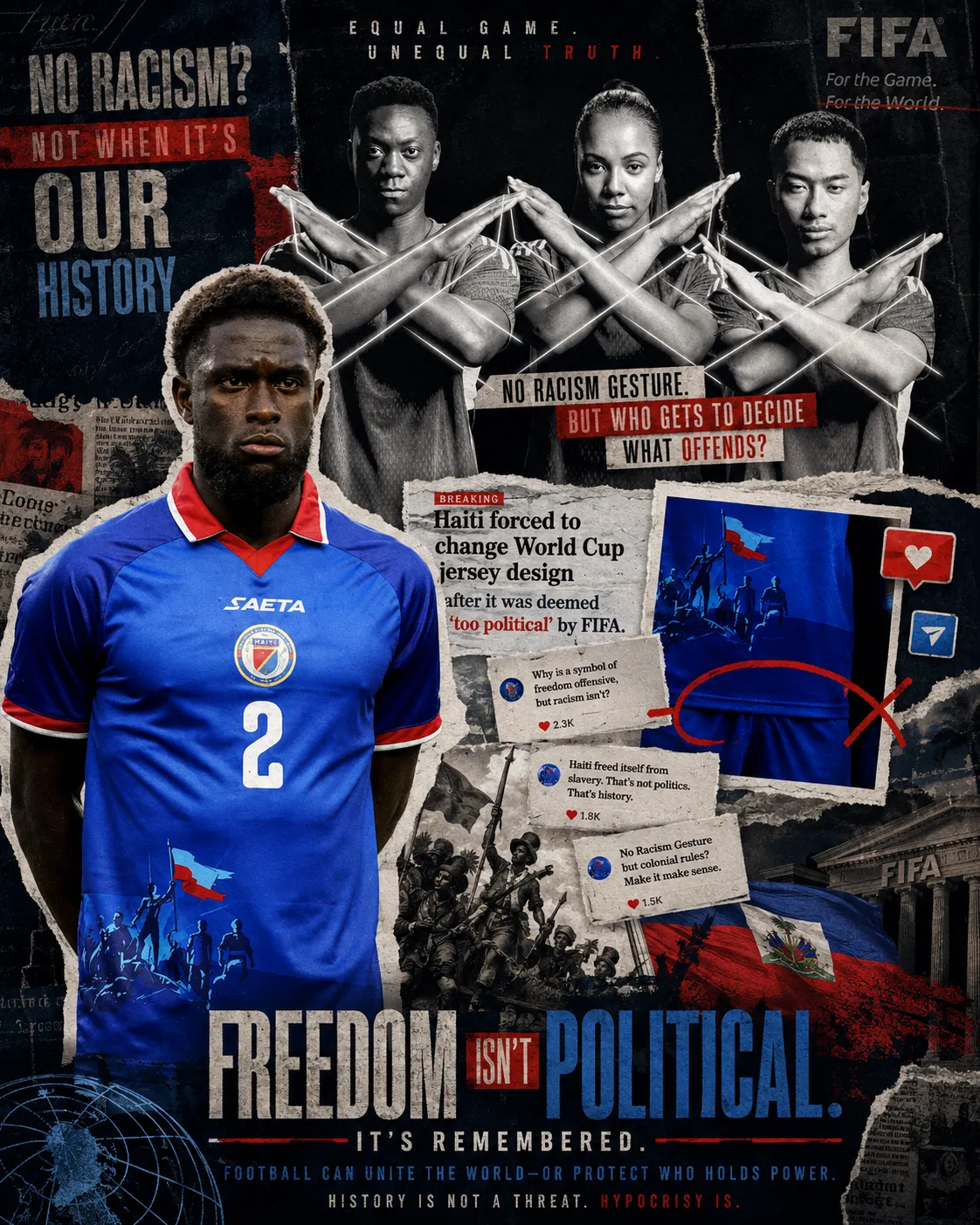
8 Jul 2026 – So, FIFA deemed Haiti’s World Cup jersey “too political.” Not the tournament itself, obviously. Not the flags, the anthems, or the presidents sitting in luxury boxes pretending they personally completed a high press. Not the border controls deciding which supporters are welcome to spend money at the global festival of unity. No, the political emergency was Haiti remembering Haiti.
The disputed design reportedly referenced the Battle of Vertières: the revolution, the anti-slavery uprising, the moment Haitians fought for and won independence. A man holding a flag. A people holding onto history. Apparently, that was where football’s neutral zone ended. Let us admire the consistency. America can do Uncle Sam, fireworks, military flyovers and an entire national holiday celebrating independence from Britain. England can arrive with flags, monarchy, imperial nostalgia and a hymn to the King. France can cover every public square in tricolours and call it civic identity. But Haiti references the revolution that made it the first independent Black republic, and suddenly FIFA reaches for the emergency whistle. Too political.
Of course it is political. Independence is political. Colonialism was political. Slavery was political. Haiti’s punishment after emancipation was political. Demanding that Haiti pay France for the crime of having freed itself was political. The long international habit of treating Haiti as a problem to be managed rather than a nation to be respected is political. What FIFA seems to mean is not “no politics.” It means: no politics that make powerful people uncomfortable. And Haiti’s story has now changed again. Haiti was in the World Cup. Haiti had ended a 52-year absence from the tournament. Haiti did qualify. Haiti did stand on the stage. Haiti is no longer in the competition. That matters.
Because the point is not to turn Haiti into a tragic football metaphor, as if a country can only be noticed when it is suffering bravely in a group stage. The point is that Haiti arrived, carried its history, and was still told that history needed editing before it could be publicly displayed. A nation can be allowed into the tournament but not fully into the picture. That is FIFA-style inclusion: welcome to the party; please leave your memory at reception.
The Citizenship Test
And while we are discussing who gets to look national enough, let us visit Norway. Norway loves a football celebration. Scarves. Flags. “Heia Norge.” A city square full of people suddenly rediscovering every lyric to every chant. Everyone is Norwegian, apparently, until the camera lands on a Norwegian woman in hijab celebrating the same victory. Then the citizenship detectives clock in. Suddenly, some people who have spent years practising tolerance between ski seasons begin asking whether she is “Norwegian enough.” Not whether she pays taxes, speaks Norwegian, grew up here, supports the team, lives the national joy, or has the exact same right to shout when Norway scores. No. The concern is the scarf. A white Norwegian in a Viking helmet with plastic horns is national heritage. A Norwegian Muslim woman in hijab waving the flag is apparently a constitutional crisis.
This is the absurdity of racism in modern Europe: a man dressed as a fictional Norse warrior can be treated as the authentic face of Norway, while an actual Norwegian is told she looks too foreign to celebrate a Norwegian victory. The Viking costume gets a standing ovation. The hijab gets an interrogation. That is not patriotism. That is a dress code pretending to be identity. France knows this routine well. A Black French player can score a goal and become “our hero.” Miss a penalty and suddenly he becomes a migrant, an African, an outsider, a question mark with boots. The player has not changed nationality between the 89th minute and the next morning’s headlines. What changed was the score.
England has perfected its own version. It can launch anti-racism campaigns, wear slogans, film heartfelt advertisements and then watch Black players receive racist abuse the second a match goes badly. It is a national ritual: say racism has no place in football, then discover it has somehow renewed its season ticket. Germany, too, remains vulnerable to the old vocabulary dressed up as analysis. When Black teams play with pace, strength or confidence, the language quickly becomes “wild,” “physical,” “chaotic,” “undisciplined.” When European teams do exactly the same thing, it becomes “intensity,” “pressing,” “mentality,” and perhaps a documentary narrated by a man in a turtleneck. The difference is not football. The difference is who is being described.
The Myth of the Exception
And then there is Argentina, a country that deserves more than the lazy line that it is “the most racist country in the world.” Racism is not a league table, and no country should be allowed to escape scrutiny because another one may be worse. But Argentina’s racial history is real, and its mythology is revealing. For generations, Argentina cultivated the story that it was the “white” or “European” exception in Latin America. That story did not emerge from nowhere. Afro-Argentines were not simply absent; they were pushed to the margins of public memory, census categories, national storytelling and elite ideas of who counted as modern. “Whitening” policies, mass European immigration and racial erasure helped build the fantasy of a country with no Black history to confront. It is not that Black Argentines disappeared. It is that the nation became very skilled at looking away.
That historical amnesia helps explain why racist incidents can still be waved off as jokes, passion, banter, or “how people talk here.” It helps explain the recurring chants about Black players, the racial abuse directed at French players, and the remarkable speed with which some supporters turn a football match into an anthropology seminar from 1887. The most offensive part is often not even the slur. It is the excuse afterwards. “Oh, it was just a song.” “Just a joke.” “Just football.” Racism always wants to be harmless once the cameras are on.
The Real Offside
And this is where FIFA’s jersey decision becomes bigger than a jersey. Football institutions are very good at condemning racism after it has gone viral. They are less reliable at understanding the conditions that make racism so comfortable in the first place: selective borders, selective belonging, selective history, selective outrage. A Black player is welcome when he scores. A Black nation is welcome when it entertains. A Black supporter is welcome until she wears the wrong symbol of faith. A Black country is welcome until it remembers it was once brave enough to free itself. Then, suddenly, everybody becomes worried about politics.
The hypocrisy deserves overtime pay. FIFA should either ban all national symbolism — every flag, anthem, royal salute, military spectacle, patriotic costume, independence celebration and historical reference — or admit that the issue is not politics. The issue is permission. Who is allowed to be proud without being called provocative? Who is allowed to celebrate history without being accused of importing conflict? Who is allowed to belong without looking like the version of belonging that racists have already approved?
Haiti is out of this World Cup now. There will be no fairy-tale final against France. No neat cinematic revenge. No perfect script in which a goal settles centuries of violence, debt, humiliation and disrespect. History is not that tidy. But Haiti did not need to win the tournament to prove its history belongs on its shirt. Norway does not need to choose between a flag and a hijab. France does not need to ask Black citizens whether they are French enough.
Remember your history, but only if it doesn’t make colonizers uncomfortable. Celebrate your independence, but don’t remind anyone what you became independent from. Meanwhile Argentina can walk around as the great “European” miracle of South America after spending generations manufacturing the myth that Black Argentina simply disappeared. As if enslaved Africans were never there. As if Afro-Argentines did not shape the country’s music, labor, culture, and history. As if war, disease, forced assimilation, whitening policies, census erasure, and state-sponsored national amnesia all just accidentally produced a country that could tell itself, “There are no Black people here, therefore there is no racism here.”
How convenient. Haiti’s jersey is the problem. A Haitian flag is dangerous. A Black republic remembering its revolution is provocative. Argentina does not need more excuses; it needs a reckoning with the people and histories its national myth has tried to erase.
And FIFA does not need another slogan. It needs to stop calling liberation “political” while selling nationalism by the truckload. Because the problem was never Haiti’s jersey. The problem is that some people can wave a flag and be called patriotic, while others wave the same flag and are told they are making everyone uncomfortable.
And then, as if satire had been invited into the boardroom and given accreditation, FIFA created a “Peace Prize” and handed it to Donald Trump, a man whose politics have rarely mistaken themselves for tenderness. This is the same FIFA that can tremble before a Haitian flag on a shirt, yet smile politely while power receives a trophy for peace. Then came the red-card scandal: a suspension postponed, reviewed, softened, or magically civilized after the most powerful host-country politician picked up the phone. That is not neutrality. That is moral corruption wearing a suit and calling itself procedure.
This is where FIFA’s language becomes almost obscene. “Peace.” “Unity.” “Football for all.” These words are repeated until they no longer mean anything. They become institutional mental masturbation: powerful men congratulating themselves for their own virtue while the rest of the world watches the rules bend in real time. A Haitian memory is too political, but a peace prize for power is acceptable. A liberation symbol is dangerous, but political pressure on discipline is administrative. That is not football governance. That is hypocrisy with a lanyard.
The Escape
And yet, behind all this direct and structural racism, behind the border checks, the insults, the double standards, the selective outrage and the ridiculous panic over a Haitian memory on a shirt, football still escapes the hands of those trying to police it. That is the part they hate most. Because children do not fall in love with football through FIFA regulations. They fall in love through movement, joy, rhythm, courage and imagination. They watch Haaland break through defences like a Nordic myth with boots. They watch Mbappé run as if speed itself has chosen a side. They watch Messi turn the impossible into a casual afternoon. They watch players from Munich to Port-au-Prince, from Oslo to Bondy, from Buenos Aires to Cape Verde, from Congolese fimbu´s dance steps to Champions League nights, and they see something larger than borders. They see possibility.
Racism tries to reduce players to skin, passports, ancestry and suspicion. Football, at its best, does the opposite. It expands them. It turns a child in Norway, Haiti, France, Argentina, England, Germany or the United States into someone who believes that greatness can look like them, speak like them, pray like them, dance like them, and still belong. That is why the racists are so loud. Not because they are winning, but because they can feel the world slipping beyond their categories. They want football to remain a museum of old hierarchies. But the game keeps becoming a street, a drum, a playground, a dance floor, a migration story, a family argument, a prayer, a rebellion, a celebration.
So yes, expose the racism. Name it. Mock it. Confront it. Do not let institutions hide behind “neutrality” when their neutrality protects power. But also remember this: the game is bigger than the people trying to shrink it. From Haaland to Mbappé, from Lamine Yamal to Messi, from Haiti’s revolution to a child kicking a ball against a wall somewhere tonight, generations across the world are still being inspired beyond the divisions others try to sell them. That should be the real politics of football. And it is beautiful.
____________________________________________
 Raïs Neza Boneza is the author of fiction as well as non-fiction, poetry books and articles. He was born in the Katanga province of the Democratic Republic of Congo (Former Zaïre). He is also an activist and peace practitioner. Raïs is a member of the TRANSCEND Media Service Editorial Committee and a convener of the TRANSCEND Network for Peace Development Environment for Central and African Great Lakes. He uses his work to promote artistic expressions as a means to deal with conflicts and maintaining mental wellbeing, spiritual growth and healing. Raïs has travelled extensively in Africa and around the world as a lecturer, educator and consultant for various NGOs and institutions. His work is premised on art, healing, solidarity, peace, conflict transformation and human dignity issues and works also as freelance journalist. You can reach him at rais.boneza@gmail.com – http://www.raisnezaboneza.no
Go to Original – rboneza.substack.com
Tags: FIFA, Football, Racism, Soccer, Soccer World Cup, Sports, UEFA
DISCLAIMER: The statements, views and opinions expressed in pieces republished here are solely those of the authors and do not necessarily represent those of TMS. In accordance with title 17 U.S.C. section 107, this material is distributed without profit to those who have expressed a prior interest in receiving the included information for research and educational purposes. TMS has no affiliation whatsoever with the originator of this article nor is TMS endorsed or sponsored by the originator. “GO TO ORIGINAL” links are provided as a convenience to our readers and allow for verification of authenticity. However, as originating pages are often updated by their originating host sites, the versions posted may not match the versions our readers view when clicking the “GO TO ORIGINAL” links. This site contains copyrighted material the use of which has not always been specifically authorized by the copyright owner. We are making such material available in our efforts to advance understanding of environmental, political, human rights, economic, democracy, scientific, and social justice issues, etc. We believe this constitutes a ‘fair use’ of any such copyrighted material as provided for in section 107 of the US Copyright Law. In accordance with Title 17 U.S.C. Section 107, the material on this site is distributed without profit to those who have expressed a prior interest in receiving the included information for research and educational purposes. For more information go to: http://www.law.cornell.edu/uscode/17/107.shtml. If you wish to use copyrighted material from this site for purposes of your own that go beyond ‘fair use’, you must obtain permission from the copyright owner.
Join the discussion!
We welcome debate and dissent, but personal — ad hominem — attacks (on authors, other users or any individual), abuse and defamatory language will not be tolerated. Nor will we tolerate attempts to deliberately disrupt discussions. We aim to maintain an inviting space to focus on intelligent interactions and debates.