
Qazi Syed Saifuddin: Educationist, Student Leader, Institution Builder and Architect of Humanitarian Service
TRANSCEND MEMBERS, 10 Aug 2026
Moin Qazi - TRANSCEND Media Service
Acknowledgement
I record my deep appreciation to Dr Syed Nazim Qazi, whose generous support, insightful guidance, and patient encouragement enabled me to connect the scattered dots in the life and legacy of my beloved school mentor. His willingness to share perspectives, verify details, and illuminate forgotten strands of the narrative helped transform a collection of memories and historical fragments into an organically unified biographical essay.
This essay is far more than a historical account; it is my personal homage to a teacher whose influence has remained a guiding light throughout my life. Dr Qazi’s invaluable assistance made it possible to present that tribute with greater authenticity, coherence, and completeness. For his friendship, scholarship, and unstinting support, I offer my heartfelt gratitude.
***
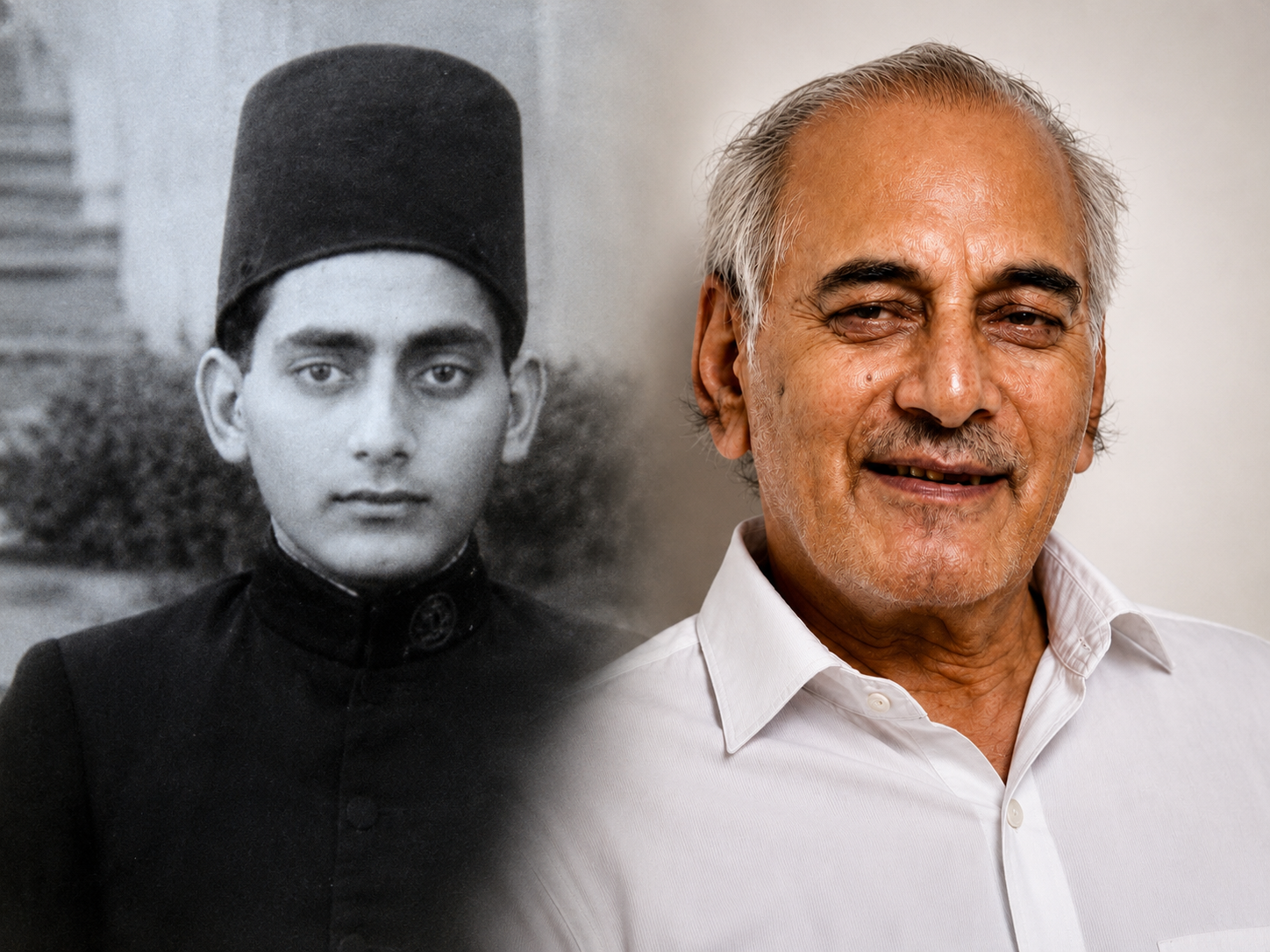
Qazi Syed Saifuddin – As alumni of AMU and in his later life
Among the distinguished educationists who shaped the intellectual and social landscape of Central India, Qazi Syed Saifuddin (4 June, 1917-11 September, 2001) occupies a place of distinction. Scholar, teacher, student leader, institution builder, humanitarian and mentor, he belonged to that remarkable generation of Indians who regarded education not merely as a profession but as a sacred public trust. Throughout a life spanning more than eight decades, he combined intellectual excellence with moral courage, personal sacrifice with public service, and scholarship with an unwavering commitment to the welfare of others. His enduring legacy lies not only in the institutions he served and established, nor solely in the generations of students he inspired, but in the values of integrity, discipline, compassion and selfless service that defined every aspect of his life.
To understand Qazi Syed Saifuddin is first to understand the remarkable intellectual tradition from which he emerged. He belonged to the distinguished Qazi Syed family of Darwha, a lineage long associated with scholarship, public service and cultural leadership in the Berar region. Situated in the present-day Yavatmal district of Maharashtra, Darwha occupies a distinctive place in the history of Central India. More than a prosperous market town, it developed into a centre of learning and literary culture, producing generations of scholars, jurists, educationists and public servants whose influence extended far beyond the boundaries of the district.
For generations, the Qazis of Darwha represented an ideal deeply rooted in the classical Islamic tradition: that knowledge carries with it a profound moral responsibility. Born in 1917, he was the son of Qazi Syed Waziruddin and Badshah Begum, whose home nurtured a deep respect for learning, discipline and public responsibility. Yet his childhood was marked not by privilege but by adversity. The untimely death of his father left the family confronting severe financial hardship at a time when agriculture provided only a modest livelihood. The burden of supporting the household fell heavily upon the elder sons, compelling them to sacrifice many of their own ambitions to ensure the family’s welfare.
For the young Saifuddin, this early encounter with responsibility became a defining influence upon his character. Long before he assumed positions of leadership in educational institutions, he had already learnt that true leadership begins with sacrifice. The difficult circumstances of his youth instilled habits of discipline, resilience and quiet determination that remained the guiding principles of his life. Rather than allowing adversity to diminish his aspirations, he transformed it into a source of moral strength.
His exceptional academic ability soon became evident. He proceeded to Aligarh Muslim University, one of the foremost centres of higher learning in India and the intellectual heart of the modern Muslim renaissance.
Within this stimulating environment, Qazi Syed Saifuddin flourished. Pursuing a Bachelor of Science, he distinguished himself not only through academic excellence but also through his active participation in student affairs. His leadership qualities earned him the respect of both his peers and his teachers, while his intellectual promise marked him as one of the university’s most outstanding students. The ideals of Aligarh—scientific temper, disciplined scholarship, social reform and enlightened leadership—became permanent features of his character and would shape his educational philosophy throughout his life.
His outstanding academic record culminated in one of the greatest opportunities available to a young Indian scholar of his generation. He was awarded a prestigious scholarship to pursue higher studies in the United States, a distinction reserved for students of exceptional promise. For many, such an opportunity would have been the gateway to an international academic career and a future of considerable distinction. Fate, however, had ordained a different path.
The death of his father had transformed the circumstances of the family, and the responsibility of caring for his widowed mother and younger siblings rested squarely upon his shoulders. Faced with the difficult choice between personal ambition and filial duty, Qazi Syed Saifuddin chose without hesitation the path of sacrifice. He relinquished the coveted scholarship and returned home, placing family responsibility above personal advancement.
That decision, taken in the prime of his youth, revealed the defining principle that would govern the remainder of his life: for Qazi Syed Saifuddin, duty was always greater than ambition.
A Teacher, Leader and Nation Builder
Having relinquished the opportunity to pursue higher studies abroad, Qazi Syed Saifuddin chose a path of service rather than personal advancement. In 1950, at the invitation of the Principal, he joined Bishop Cotton School, Nagpur, one of the most distinguished educational institutions in Central India.
At that time, the school was under the leadership of Headmaster Ashley Stacey, whose tenure during the late 1940s and early 1950s coincided with an important phase in the institution’s post-Independence development. Founded in 1862 by Bishop George Edward Lynch Cotton, the school already possessed a proud heritage. Still, Stacey recognised in the young Qazi Syed Saifuddin an exceptional combination of discipline, leadership, organisational ability and sporting excellence. Rather than confining him to conventional teaching responsibilities, he entrusted him with wider responsibilities that enabled his talents to flourish.
Working in close partnership with Stacey, Qazi Syed Saifuddin became one of the principal architects of the school’s remarkable transformation during the 1950s and early 1960s. Through his tireless commitment to academic discipline, character formation, games, physical education and the cultivation of leadership among students, he helped elevate Bishop Cotton School from a respected educational institution into one of the most admired and prestigious public schools in Central India. His influence extended well beyond the classroom, shaping a generation of students through integrity, discipline and service.
By the time Qazi Syed Saifuddin left Bishop Cotton School in 1964 to establish his own independent educational institution, he had completed fourteen years of distinguished service. The foundations laid during those years had become deeply embedded in the school’s ethos, and his contribution continued to be remembered as one of the defining influences in its post-Independence history.
The years immediately following Indian Independence were a period of profound national transition. While the country was forging a new political identity, institutions such as Bishop Cotton School continued to preserve the finest traditions of disciplined scholarship inherited from the British educational system. Within this stimulating academic environment, Qazi Syed Saifuddin quickly established himself as an exceptional science teacher whose influence extended far beyond the classroom.
He was a striking personality. Impeccably dressed in a well-cut suit and tie, he carried himself with effortless dignity, refined manners, and quiet authority. It was his ability to awaken curiosity and confidence in young minds. Possessing a rare gift for communicating scientific ideas with clarity and enthusiasm, he transformed the study of science from a collection of abstract principles into an exciting exploration of the natural world. His classrooms were characterised by intellectual rigour, lively discussion and meticulous preparation. He encouraged his students to question, investigate and think independently, believing that education should liberate the mind rather than merely prepare students for examinations.
For Qazi Syed Saifuddin, teaching was never confined to textbooks. He regarded education as the harmonious development of intellect, character and citizenship. Knowledge without integrity, he believed, was incomplete; scholarship without compassion ultimately failed society. His pupils were therefore expected to cultivate honesty, discipline, punctuality and responsibility alongside academic excellence. Many of those who later distinguished themselves in public life continued to acknowledge his formative influence long after they had left school.
His scholarship also found expression in authorship. Recognising the need for high-quality scientific literature in Urdu, he prepared the widely acclaimed Jadeed Science series, which combined scientific accuracy with lucid language accessible to young learners. The books were warmly received across Maharashtra and were prescribed in schools, making a significant contribution to science education in the Urdu medium.
His reputation as an educationist steadily grew, eventually leading to his appointment as a Senior Board Member of the Maharashtra Board of Secondary Education. In that capacity, he contributed to curriculum development, educational standards and academic policy at the state level. His opinions commanded respect because they were founded upon practical classroom experience, sound scholarship and an unwavering concern for the welfare of students.
During the closing years of the Second World War, Qazi Syed Saifuddin was selected for a commission in the Indian Air Force. This achievement reflected not only his academic brilliance but also his exceptional leadership qualities, physical fitness and disciplined character. In those years, such a commission represented one of the highest distinctions available to a young Indian. It promised a career of honour, responsibility and national service.
Once again, however, duty demanded sacrifice.
The death of his father had imposed obligations that could not be ignored. Rather than pursue personal ambition, he chose to remain with his family and shoulder responsibility for those who depended upon him. It was a decision that altered the course of his life but revealed the extraordinary moral strength that distinguished his character. He never expressed regret over the opportunity he relinquished, believing that service to one’s family was itself an honourable form of service to the nation.
Although he did not join the regular Air Force, his enthusiasm for aviation, discipline and leadership found enduring expression through the National Cadet Corps.
He was an Indian Air Force commissioned officer who later served on deputation to the NCC. Many early NCC Air Wing commanders were IAF officers.
He served in the Auxiliary Air Force or Royal Indian Air Force before Independence and later joined the NCC.
He was a civilian Gazetted Officer of the NCC, which also existed in the organisation’s early years.
His vision of the NCC extended beyond parade-ground precision. He regarded it as an institution dedicated to cultivating self-confidence, courage, teamwork, integrity and patriotic service. Every drill, every camp and every exercise was intended to shape character as much as competence. His cadets learned not merely how to march but how to lead, how to accept responsibility and how to place the common good above personal convenience.
The excellence achieved under his command brought recognition far beyond Nagpur. The Air Wing repeatedly earned the distinction of participating in the Republic Day Parade in New Delhi, one of the highest honours accorded to NCC contingents in India. Selection for the national parade demanded exceptional standards of discipline, training and leadership, and the repeated success of the Nagpur contingent testified to the quality of the organisation he had painstakingly built. Among the many students who benefited from Qazi Syed Saifuddin’s inspiring guidance was Air Marshal Tej Mohan Asthana, PVSM, AVSM (Retd.), one of the Indian Air Force’s most distinguished officers.
Years later, his elder cousin, Professor Rafiuddin Qadri, reflected upon the path that circumstances had denied him. Had Qazi Syed Saifuddin accepted his commission, he observed, he possessed every quality required to rise to the highest office in the Indian Air Force. “He would have become the Chief of the Air Force,” he remarked. Whether or not history would have fulfilled that prediction can never be known. What remains beyond doubt is that the nation gained an educationist whose influence reached far beyond the confines of any single profession.
Institution Builder and Humanitarian
If Bishop Cotton School established Qazi Syed Saifuddin’s reputation as an outstanding teacher, his greatest and most enduring contribution lay in institution building. He understood that the true measure of an educationist was not merely the number of students he taught, but the institutions he created to serve generations yet to come.
Guided by this conviction, he founded the Nagpur Residential School, a pioneering educational institution that was subsequently recognised by the Government in 1964. The school represented far more than another educational establishment; it embodied his deeply held belief that quality education should never remain the privilege of the affluent alone. Every deserving child, irrespective of economic or social background, deserved an opportunity to develop intellectually, morally and socially within a disciplined and nurturing environment.
At a time when residential education was largely confined to a limited number of elite institutions, Qazi Syed Saifuddin envisioned a school that combined academic excellence with moral formation. He believed that education extended far beyond classroom instruction. A residential school, in his philosophy, functioned as a complete community where students learnt responsibility, discipline, cooperation, respect for diversity and habits of independent living alongside formal scholarship.
His generosity became legendary among those who knew him. Living throughout his career on the modest income of a schoolteacher, he nevertheless regarded whatever he possessed as a trust to be shared with others. He never maintained accounts of money lent to friends or students, nor did he concern himself with whether it would ever be repaid. Material possessions held little attraction for him compared with the satisfaction of easing another person’s burden.
Many years after his passing, former students, colleagues and acquaintances continued to recount quiet acts of kindness that had transformed their lives. Some remembered educational expenses met without their knowledge; others recalled timely financial assistance during moments of crisis; still others spoke of patient guidance that restored confidence when hope seemed lost. These memories revealed the true measure of his philanthropy. His generosity was neither institutional nor ceremonial; it was deeply personal, discreet and profoundly humane.
The Home That Became an Institution
The same spirit of generosity characterised his family life. The residence within the Bishop Cotton School campus was far more than a private home. It became a centre of learning, hospitality and fellowship where relatives, friends, colleagues and students were received with equal warmth. At almost any time, numerous guests found accommodation under its roof, confident that they would be welcomed not as visitors but as members of the family.
This remarkable household owed much to the quiet strength of his wife, Begum Siddiqua Saifuddin, whose grace, patience and tireless devotion made such hospitality possible. She managed a constantly active home with extraordinary efficiency while enabling her husband to devote himself fully to his educational and humanitarian commitments. Their partnership exemplified mutual respect, shared responsibility and selfless service, demonstrating that enduring public achievements are often sustained by unseen sacrifices within the home.
Those privileged to grow up in that environment remember it with deep affection. Harmony prevailed naturally, disagreements were infrequent, and laughter was abundant. Young members of the family found not only affection but also guidance, discipline and encouragement. Every visitor departed with a renewed sense of belonging.
Courage in Adversity
One of Qazi Syed Saifuddin’s most admirable qualities was the serenity with which he faced adversity. Difficulties never diminished his optimism nor disturbed his inner equilibrium. Friends frequently heard him softly reciting Sahir Ludhianvi’s celebrated lines:
Main Zindagi Ka Saath Nibhata Chala Gay
Main zindagi ka saath nibhata chala gaya,
Har fikr ko dhuen mein udata chala gaya.
Barbadiyon ka sog manana fizool tha,
Barbadiyon ka jashn manata chala gaya.
Jo mil gaya usi ko muqaddar samajh liya,
Jo kho gaya main us ko bhulata chala gaya.
Har fikr ko dhuen mein udata chala gaya,
Main zindagi ka saath nibhata chala gaya.
(I kept moving along in companionship with life,
Letting every worry drift away like smoke.
It was futile to mourn life’s devastations;
I kept celebrating even my ruins as I moved on.
Whatever came to me, I accepted as destiny;
Whatever was lost, I kept learning to forget.
I kept sending every anxiety away into smoke,
And continued walking hand in hand with life.)
These verses beautifully captured his philosophy of life. Rather than lamenting misfortune, he accepted it with dignity, courage and quiet humour.
Even during a serious heart attack, when urged to seek immediate medical attention, he smiled. His concern, reassuringly, even in suffering, was to relieve the anxiety of those around him. That composure reflected a lifetime of faith, discipline and emotional strength.
Qazi Syed Saifuddin belonged to a generation of Indian educationists who regarded knowledge as a sacred trust and education as an instrument of national reconstruction.Today, generations of former students, colleagues, family members and friends continue to cherish his memory with gratitude and admiration. The institutions he strengthened, the values he transmitted and the lives he touched remain enduring monuments to a life lived with uncommon integrity and purpose. He was far more than an accomplished educationist. He was a nation builder in the truest sense—an inspiring teacher, a visionary institution builder, an exemplary mentor and a compassionate humanitarian whose influence continues to illuminate succeeding generations.
____________________________________________
 Moin Qazi, PhD Economics, PhD English, is a member of the TRANSCEND Network for Peace Development Environment and a member of NITI Aayog’s National Committee on Financial Literacy and Inclusion for Women. He is the author of the bestselling book, Village Diary of a Heretic Banker. He has worked in the development finance sector for almost four decades in India and can be reached at moinqazi123@gmail.com.
This article originally appeared on Transcend Media Service (TMS) on 10 Aug 2026.
Anticopyright: Editorials and articles originated on TMS may be freely reprinted, disseminated, translated and used as background material, provided an acknowledgement and link to the source, TMS: Qazi Syed Saifuddin: Educationist, Student Leader, Institution Builder and Architect of Humanitarian Service, is included. Thank you.
If you enjoyed this article, please donate to TMS to join the growing list of TMS Supporters.

This work is licensed under a CC BY-NC 4.0 License.
Join the discussion!
We welcome debate and dissent, but personal — ad hominem — attacks (on authors, other users or any individual), abuse and defamatory language will not be tolerated. Nor will we tolerate attempts to deliberately disrupt discussions. We aim to maintain an inviting space to focus on intelligent interactions and debates.