
The Three Forms of Violence and Their Responses
TRANSCEND MEMBERS, 17 Aug 2026
Prof. Antonino Drago – TRANSCEND Media Service
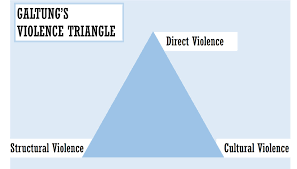
15 Aug 2026 – Johan Galtung gave his final definition of the three forms of violence (direct, structural and cultural) in 1990 with the publication of his essay “Cultural Violence” in the Journal of Peace Research.
Direct violence is what everyone well understands: a slap, an insult, an aggression, a theft, physical assault.
How can we react positively? Calmly, with empathy, with a creative response that releases tension, etc. In short, everything taught in nonviolence training.
Structural violence is more difficult to identify: an unemployed person doesn’t realize that in Strasbourg, unemployment is deliberately engineered to ensure that manufacturers always have an abundant workforce; someone who deposits money in a bank doesn’t realize that their money will fuel a financial system that allows for speculation hundreds, even thousands, of times upon the basic material goods of the poorest people of the World.
Those who join the army to find employment fail to realize that they become complicit in the panorama of death that surrounds us and which, along with nuclear deterrence, threatens humanity’s suicide. We must therefore be careful not to forget what Shantidas always emphasized: structural sin, in the face of which individual sins lose their meaning (the only commandment he mentions is “Thou shalt not kill,” in order to call for conversion in the face of war, intended as the exemplary structural violence). Shantidas helped to unmask structural violence when, in the 1950s, he denounced the greatest structural violence of his time: the Two Blocs that dominated the world and were complementary (The Four Plagues, 1959, §§ 1-24).
How can we respond positively to this? One can try to do it instinctively, but structures are precisely impervious to such reactions (for example, the programmers in Strasbourg have the police at their disposal to suppress protests). One can try emotionally, by speaking with the utmost empathy to a person in charge. But at best, the person in charge would change their mind, but the structure would persist.
Ordinary people are incapable of developing a social analysis adapted to the situation created by the social structure; indeed, a structure dominates because people generally ignore the complexity of a social structure: it is with this superiority that structures defend themselves. So, to respond effectively to them, it is necessary to establish a clear and precise analysis of the situation. In conclusion, a response is needed that appeals not only to humanity, but also to the intelligence that then adapts our energies to the weaknesses of the situation; otherwise, we strike where there is no nail.
Finally, there is cultural violence, even more subtle and less perceptible, but no less disastrous than the other two. Here too, Galtung, in my humble opinion, was unclear when he defined it as the support that culture provides to structural violence. Of course, this violence exists: for example, the violence of consumerist propaganda, which supports commercial capitalism; or the scholastic violence that fails to denounce the existing power system. But there is more: autonomous cultural violence who claims to have no alternatives. Consider, for example, the ideological violence of the Church, which declared anyone who read the Gospel in the vernacular a heretic (see the Waldensians), or the violence of money, which values everything by its price. It is this violence that Les Nouvelles de l’Arche highlights when it dedicates an issue to racism or patriarchy. This violence is pervasive.
Therefore, to detect it and ultimately avoid it, we must pay particular attention to it. Today there is the violence of science, which imposes itself on the mind as humanity’s inevitable path; and also the violence of technology, which invades our human world as an irreversible advancement. As early as the 1950s, Lanza del Vasto made a significant contribution to the fight against this type of violence, denouncing it as the greatest violence of our time. In his era, this violence only affected the external world of human beings (radio, television, automobiles, etc.).
Today, it presents itself at its full potential: artificial intelligence is capable of revolutionizing human civilization (to the point of inspiring transhumanism or fearing a hierarchy of robots dominating humanity). It will halve the number of available jobs in a short time, revolutionize the education system, create a state secret service a thousand times more powerful than James Bond, and fill all the gaps in the intermediate arsenal with new weapons. Today, anyone who owns a smartphone has been connected to AI since childhood.
According to the text of Revelation 13, the wisdom to escape lays in the ability to name these things, first and foremost modern science. And Shantidas has found its name: the quest for the infinite, not the infinite of human relationships, but the infinite of the animal world, the infinite things to enjoy, the infinite social structures in which to participate, and finally, the infinite potential of human (and artificial) intelligence to be discovered. The key to liberation is a “return to the obvious” of human nature in its simplicity and direct relationships.
In conclusion:
- the nonviolent response to direct violence is creativity in human relationships;
- the response to structural violence requires understanding the situation;
- the response of nonviolence to cultural violence requires being in the world without being of the world, that is, in the incessant and (through artificial intelligence) penetrating noise of modernity, converting to one’s own soul and fighting every absolutism and every irreversible progress.
Just as Gandhi and Shantidas did in their respective times.
______________________________________
 Prof. Antonino Drago: University “Federico II” of Naples, Italy and a member of the TRANSCEND Network. Allied of Ark Community, he teaches at the TRANSCEND Peace University-TPU. Master degree in physics (University of Pisa 1961), a follower of the Community of the Ark of Gandhi’s Italian disciple, Lanza del Vasto, a conscientious objector, a participant in the Italian campaigns for conscientious objection (1964-1972) and the campaign for refusing to pay taxes to finance military expenditure (1983-2000). Owing to his long experience in these activities and his writings on these subjects, he was asked by the University of Pisa to teach Nonviolent Popular Defense in the curriculum of “Science for Peace” (from 2001 to 2012) and also Peacebuilding and Peacekeeping (2009-2013. Then by the University of Florence to teach History and Techniques of Nonviolence in the curriculum of “Operations of Peace” (2004-2010). Drago was the first president of the Italian Ministerial Committee for Promoting Unarmed and Nonviolent Civil Defense (2004-2005). drago@unina.it.
Tags: Cultural violence, Direct violence, Johan Galtung, Nonviolence, Nonviolent Action, Structural violence, Violence triangle
This article originally appeared on Transcend Media Service (TMS) on 17 Aug 2026.
Anticopyright: Editorials and articles originated on TMS may be freely reprinted, disseminated, translated and used as background material, provided an acknowledgement and link to the source, TMS: The Three Forms of Violence and Their Responses, is included. Thank you.
If you enjoyed this article, please donate to TMS to join the growing list of TMS Supporters.

This work is licensed under a CC BY-NC 4.0 License.
One Response to “The Three Forms of Violence and Their Responses”
Join the discussion!
We welcome debate and dissent, but personal — ad hominem — attacks (on authors, other users or any individual), abuse and defamatory language will not be tolerated. Nor will we tolerate attempts to deliberately disrupt discussions. We aim to maintain an inviting space to focus on intelligent interactions and debates.
I want to write an essay on Violence But HOPE I need help