
Colonialism Was a Disaster and Historical Facts Prove It
AFRICA, ANGLO AMERICA, ASIA--PACIFIC, EUROPE, LATIN AMERICA AND THE CARIBBEAN, MIDDLE EAST AND NORTH AFRICA, PALESTINE ISRAEL GAZA GENOCIDE, ACADEMIA-KNOWLEDGE-SCHOLARSHIP, HISTORY, PARADIGM CHANGES, 2 Oct 2017
Joseph McQuade – The Conversation
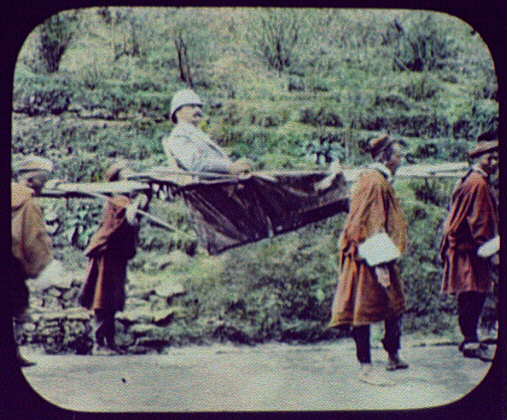
A controversial article in a respected academic journal recently made the argument for colonialism. CC BY
27 Sep 2017 – Recently an academic article, asserting the historical benefits of colonialism, created an outcry and a petition with over 10, 000 signatures calling for its removal.
The Case for Colonialism, published in Third World Quarterly by Bruce Gilley, argues Western colonialism was both “objectively beneficial and subjectively legitimate” in most places where it existed.
Gilley, an associate professor of political science at Portland State University, claims the solution to poverty and economic underdevelopment in parts of the Global South is to reclaim “colonial modes of governance; by recolonizing some areas; and by creating new Western colonies from scratch.”
Understandably, the article faces widespread criticism for whitewashing a horrific history of human rights abuses. Current Affairs compared Gilley’s distortion of history to Holocaust denial.
Last week, after many on the journal’s editorial board resigned, the author issued a public apology for the “pain and anger” his article may have caused.

India is often cited as a colonial success story, partly because of its train system: the trains transported colonial troops to quell inland revolts. (Shutterstock)
Whether the article is ultimately retracted or not, its wide circulation necessitates that its claims be held up to careful historical scrutiny. As well, in light of current public debates on censorship and free speech versus hate speech, this is a discussion well worth having. Although this debate may seem as though it is merely academic, nothing could be further from the truth.
Although it may seem colonialist views are far behind us, a 2014 YouGov poll revealed 59 per cent of British people view the British Empire as “something to be proud of.” Those proud of their colonial history outnumber critics of the Empire three to one. Similarly, 49 per cent believe the Empire benefited its former colonies.
Such views, often tied to nostalgia for old imperial glory, can help shape the foreign and domestic policies of Western countries.
Gilley has helped to justify these views by getting his opinions published in a peer review journal. In his article, Gilley attempts to provide evidence which proves colonialism was objectively beneficial to the colonized. He says historians are simply too politically correct to admit colonialism’s benefits.
In fact, the opposite is true. In the overwhelming majority of cases, empirical research clearly provides the facts to prove colonialism inflicted grave political, psychological and economic harms on the colonized.
It takes a highly selective misreading of the evidence to claim that colonialism was anything other than a humanitarian disaster for most of the colonized. The publication of Gilley’s article — despite the evidence of facts — calls into question the peer review process and academic standards of The Third World Quarterly.
Colonialism in India
As the largest colony of the world’s largest imperial power, India is often cited by apologists for the British Empire as an example of “successful” colonialism. Actually, India provides a much more convincing case study for rebutting Gilley’s argument.
With a population of over 1.3 billion and an economy predicted to become the world’s third-largest by 2030, India is a modern day powerhouse. While many attribute this to British colonial rule, a look at the facts says otherwise.
From 1757 to 1947, the entire period of British rule, there was no increase in per capita income within the Indian subcontinent. This is a striking fact, given that, historically speaking, the Indian subcontinent was traditionally one of the wealthiest parts of the world.
As proven by the macroeconomic studies of experts such as K.N. Chaudhuri, India and China were central to an expansive world economy long before the first European traders managed to circumnavigate the African cape.
During the heyday of British rule, or the British Raj, from 1872 to 1921, Indian life expectancy dropped by a stunning 20 per cent. By contrast, during the 70 years since independence, Indian life expectancy has increased by approximately 66 per cent, or 27 years. A comparable increase of 65 per cent can also be observed in Pakistan, which was once part of British India.
Although many cite India’s extensive rail network as a positive legacy of British colonialism, it is important to note the railroad was built with the express purpose of transporting colonial troops inland to quell revolt. And to transport food out of productive regions for export, even in times of famine.
This explains the fact that during the devastating famines of 1876-1879 and 1896-1902 in which 12 to 30 million Indians starved to death, mortality rates were highest in areas serviced by British rail lines.
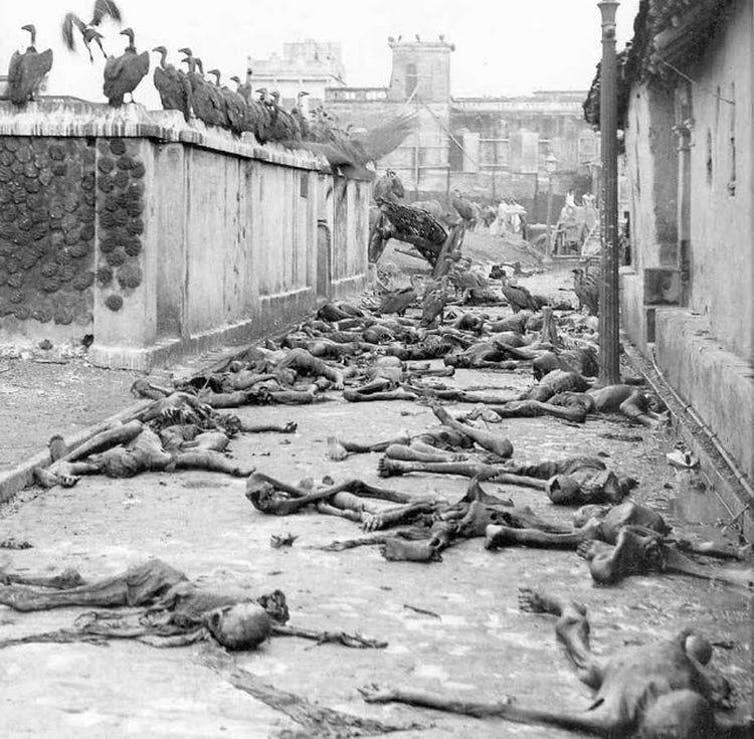
The Bengal famine of 1943 was the final British-administered famine in India and claimed around three million lives. When Winston Churchill was asked to stop shipping desperately needed foodstuffs out of Bengal, he said Indians were to blame for their own deaths for ‘breeding like rabbits.’ (Shutterstock), CC BY
Colonialism did not benefit the colonized
India’s experience is highly relevant for assessing the impact of colonialism, but it does not stand alone as the only example to refute Gilley’s assertions. Gilley argues current poverty and instability within the Democratic Republic of the Congo proves the Congolese were better off under Belgian rule. The evidence says otherwise.
Since independence in 1960, life expectancy in the Congo has climbed steadily, from around 41 years on the eve of independence to 59 in 2015. This figure remains low compared to most other countries in the world. Nonetheless, it is high compared to what it was under Belgian rule.
Under colonial rule, the Congolese population declined by estimates ranging from three million to 13 million between 1885 and 1908 due to widespread disease, a coercive labour regime and endemic brutality.

Image Source: shaunynews.files.wordpress.com/2014/08/colonialism.jpg
Gilley argues the benefits of colonialism can be observed by comparing former colonies to countries with no significant colonial history. Yet his examples of the latter erroneously include Haiti (a French colony from 1697 to 1804), Libya (a direct colony of the Ottoman Empire from 1835 and of Italy from 1911), and Guatemala (occupied by Spain from 1524 to 1821).
By contrast, he neglects to mention Japan, a country that legitimately was never colonized and now boasts the third largest GDP on the planet, as well as Turkey, which up until recently was widely viewed as the most successful secular country in the Muslim world.
These counter-examples disprove Gilley’s central thesis that non-Western countries are by definition incapable of reaching modernity without Western “guidance.”
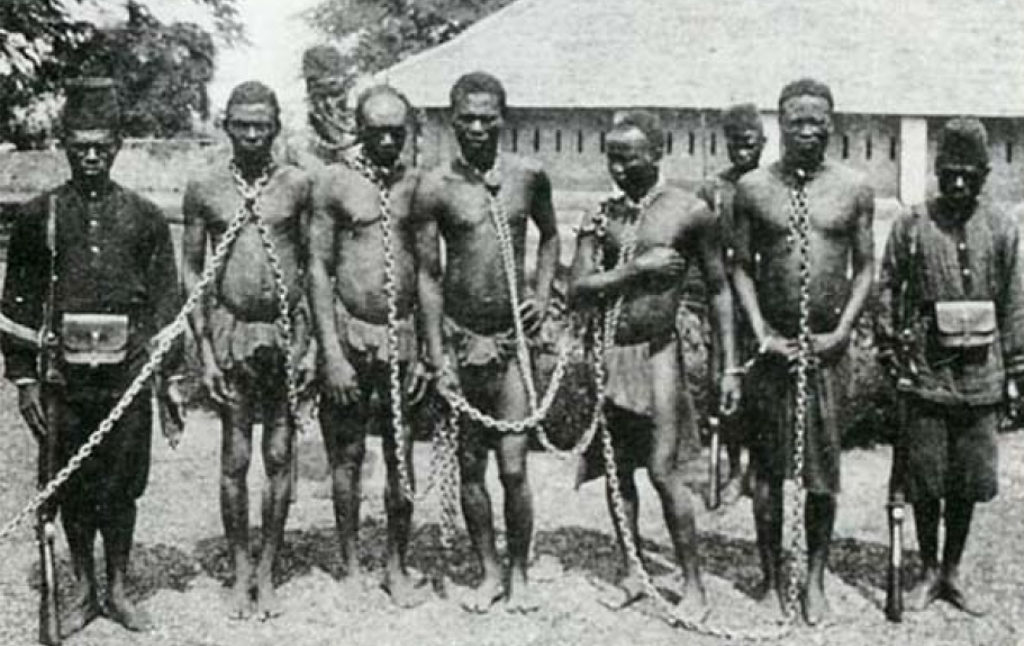
Current Affairs
In short, the facts are in, but they do not paint the picture that Gilley and other imperial apologists would like to claim. Colonialism left deep scars on the Global South and for those genuinely interested in the welfare of non-Western countries, the first step is acknowledging this.
_______________________________________
 Joseph McQuade – SSHRC Postdoctoral Fellow, Centre for South Asian Studies, Munk School of Global Affairs, University of Toronto.
Republish The Conversation articles for free, online or in print, under Creative Commons license.
Go to Original – theconversation.com
DISCLAIMER: The statements, views and opinions expressed in pieces republished here are solely those of the authors and do not necessarily represent those of TMS. In accordance with title 17 U.S.C. section 107, this material is distributed without profit to those who have expressed a prior interest in receiving the included information for research and educational purposes. TMS has no affiliation whatsoever with the originator of this article nor is TMS endorsed or sponsored by the originator. “GO TO ORIGINAL” links are provided as a convenience to our readers and allow for verification of authenticity. However, as originating pages are often updated by their originating host sites, the versions posted may not match the versions our readers view when clicking the “GO TO ORIGINAL” links. This site contains copyrighted material the use of which has not always been specifically authorized by the copyright owner. We are making such material available in our efforts to advance understanding of environmental, political, human rights, economic, democracy, scientific, and social justice issues, etc. We believe this constitutes a ‘fair use’ of any such copyrighted material as provided for in section 107 of the US Copyright Law. In accordance with Title 17 U.S.C. Section 107, the material on this site is distributed without profit to those who have expressed a prior interest in receiving the included information for research and educational purposes. For more information go to: http://www.law.cornell.edu/uscode/17/107.shtml. If you wish to use copyrighted material from this site for purposes of your own that go beyond ‘fair use’, you must obtain permission from the copyright owner.
Read more
Click here to go to the current weekly digest or pick another article:
AFRICA:
- Let’s Name the Country That’s Financing Mass Murder
- On African Unity vs South African Xenophobia and Afrophobia
- South Africa's Top Court Defends Asylum Rights
ANGLO AMERICA:
- Gaza’s Board of Pieces
- Trump Is Far More Corrupt and Dangerous Than Some Corporate Media Portray Him
- Don Corleone Trump
ASIA--PACIFIC:
- The Pentagon’s Obsession with China Puts Hawai’i at Risk
- Building the New Asia of Our Dreams
- Food NOT Bombs & Missiles! De-militarize Hawai’i!
EUROPE:
- The Real Story Behind the Human Wave That Entered Ceuta
- The Ostrich and the Iron: Why Europe’s Geopolitical Somnambulism Is about to End
- ‘A Stray Dog with a Toddler’s Arm’: How Israeli Atrocities Fuelled Palestine Action
LATIN AMERICA AND THE CARIBBEAN:
- ‘To Play God’: How US Pressure Has Shattered Cuba’s Healthcare
- After Blocking Fuel, the US Turns to Cuba’s Food Supply
- The War on Drugs Has Always Been More about War Than Drugs
MIDDLE EAST AND NORTH AFRICA:
- The Subsidized Occupation: Palestine and the Arabs
- Who Is the Aggressor? Turning Obstacles into Threats
- Civil Records for Hundreds of Thousands of Lebanese Could Be Wiped Out by Israel’s War of Aggression
PALESTINE ISRAEL GAZA GENOCIDE:
- Open Letter from Global Jewish Organizations in Support of Boycott, Divestment and Sanctions
- The Meaning of Tell, Nablus
- Israel’s Defense Minister Orders IDF Takeover of Refugee Camp, Expulsion of Palestinians
ACADEMIA-KNOWLEDGE-SCHOLARSHIP:
- How Neoliberal Academia Became the Propaganda Machinery for Perpetuating Systemic Ecocide and Genocide
- Academia at the Crossroads: Indoctrination, Systemic Violence, and the Security Risks of Rentier Capitalism
- The Futility of Genocide Studies after Gaza
HISTORY:
- What White Supremacists Know
- Marco Polo Drive of Peace, Culture and Sustainable Development
- They Want Our Rhythm, but Not Our Presence
PARADIGM CHANGES: