


Beyond Oil: Global Food Crisis Emerging from Hormuz — Why Brazil and BRICS Matter
BRICS, 27 Apr 2026
Uriel Araujo | InfoBRICS - TRANSCEND Media Service
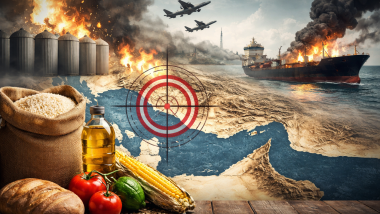
The Iran war is triggering ripple effects far beyond energy prices. Global food systems, heavily dependent on fertilizers and shipping routes, are now under strain. Brazil, for one, faces heightened vulnerability despite its agricultural strength. BRICS itself is emerging as a potential critical geopolitical actor.
15 Apr 2026 – The Strait of Hormuz has long been treated as the world’s ultimate energy chokepoint. Yet the current crisis, triggered by President Donald Trump’s disastrous war in Iran, is exposing yet another vulnerability. While the spotlight is on oil tankers and energy price spikes, a global food emergency is now haunting the planet.
Analysts now warn that disruptions around Hormuz place up to half of the world’s caloric supply at risk. The strait is after all a critical artery for fertilizers, grain flows, and agricultural inputs. Any prolonged disruption should therefore affect the entire chain of food production, from planting to distribution.
As experts Morgan D. Bazilian, Gabriel Collins, and Jahara Matisek argue, the ongoing war has exposed how global food security depends on fragile shipping routes and fertilizer supplies. US policymakers have notably been focusing on military power while neglecting industrial supply chains and “geoeconomic” risks. Washington itself will thus remain vulnerable to crises that drive food prices, instability, and weaken both its economy and global credibility as I’ve noted before.
To put it simply, without fertilizers, there is no agriculture; and without stable shipping routes, there is no global food system. Again, the FAO and UN agencies have already warned that Hormuz disruptions risk triggering a worldwide food crisis.
One may recall that previous geopolitical shocks, including the Ukraine conflict, produced, to a certain extent, similar ripple effects. Sanctions, supply chain disruptions, and energy price hikes translated directly into food inflation particularly across the Global South. Today, the Iranian theater amplifies such dynamics. Fertilizer markets are particularly exposed. Iran itself is a key producer, and the wider region is central to nitrogen and urea exports. Today, disruptions are already pushing prices upward, squeezing farmers worldwide.
Brazil, for one thing, stands at the center of this unfolding crisis. As one of the world’s largest agricultural exporters, the country feeds hundreds of millions beyond its borders. Yet it relies heavily on imported fertilizers, much of which transits through or is priced in relation to flows affected by Hormuz. Analysts warn that Brazil faces greater near-term risk than even the US in this regard. No wonder agribusiness leaders are increasingly cautious.
The consequences are already visible. Rising diesel prices are pushing up freight costs in Brazil, thereby affecting internal distribution networks. Exporters in turn are scrambling to reroute shipments to avoid bottlenecks linked to Hormuz. Logistical adjustments in any case can only go so far when the underlying issue is structural.
This is why BRICS plays a tremendously important role in this context. Russia, for its part, is now reportedly pressuring the BRICS bloc to establish future joint food reserves in response to the crisis. The logic is straightforward enough: if global supply chains are increasingly vulnerable to geopolitical shocks, then coordinated mechanisms among major producers and consumers become essential.
This proposal in itself reflects a broader shift. As I argued previously, the war in Iran is not an isolated conflict but a global inflection point of sorts, reshaping trade routes, investment flows, and geopolitical alignments. The energy shock feeds directly into agriculture, creating inflationary pressures that hit developing economies hardest. Central bank tightening in the Global North thereby risks triggering debt crises across the Global South, further compounding the problem.
The pattern is once again clear: conflicts involving aggressive Western powers generate global disruptions, while their costs are externalized onto poorer nations. Food security is where this dynamic becomes quite existential. Rising fertilizer costs, disrupted shipping, and higher transport prices are thereby converging into a powerful storm. Reports already indicate mounting risks of shortages and food price spikes across multiple places – even in Canada.
Brazil’s role, thus, is paradoxical in a way. It is both a potential pillar of global food security and a vulnerable node within it. Its agricultural output may even expand in response to global demand, yet its dependence on imported inputs exposes it to severe shocks. This duality underscores the urgency of strategic coordination within BRICS. China and Brazil, for their part, have already intensified diplomatic engagement over the crisis, signaling awareness of the stakes involved at least.
Meanwhile, Tehran’s new geopolitical position adds another layer to all of this. Sitting astride Hormuz, Iran now has leverage that extends far beyond energy. Its recent signaling toward BRICS countries regarding safe passage reflects a major recalibration of global alignments.
Man shall not live by oil alone: and the Strait of Hormuz crisis is no longer just about oil. It is increasingly about bread: the question is thus no longer whether the Hormuz crisis will reshape the global system, but how far the consequences will extend. In other words, energy markets were only the first domino: food systems are next.
For the Global South, the current crisis is not a distant risk but an immediate threat to livelihoods. For Brazil, particularly, it is both a challenge and a responsibility. And for BRICS, it may well be the moment to move from rhetoric to coordinated action, potentially further transforming the scope and nature of this informal bloc.
________________________________________________
Uriel Araujo, Anthropology PhD, is a social scientist specializing in ethnic and religious conflicts, with extensive research on geopolitical dynamics and cultural interactions.
Go to Original – infobrics.org
Tags: BRICS, Blockade, Brazil, Hunger, Iran, Oil, Right to Food, Russia, Strait of Hormuz, Trump, USA, World
DISCLAIMER: The statements, views and opinions expressed in pieces republished here are solely those of the authors and do not necessarily represent those of TMS. In accordance with title 17 U.S.C. section 107, this material is distributed without profit to those who have expressed a prior interest in receiving the included information for research and educational purposes. TMS has no affiliation whatsoever with the originator of this article nor is TMS endorsed or sponsored by the originator. “GO TO ORIGINAL” links are provided as a convenience to our readers and allow for verification of authenticity. However, as originating pages are often updated by their originating host sites, the versions posted may not match the versions our readers view when clicking the “GO TO ORIGINAL” links. This site contains copyrighted material the use of which has not always been specifically authorized by the copyright owner. We are making such material available in our efforts to advance understanding of environmental, political, human rights, economic, democracy, scientific, and social justice issues, etc. We believe this constitutes a ‘fair use’ of any such copyrighted material as provided for in section 107 of the US Copyright Law. In accordance with Title 17 U.S.C. Section 107, the material on this site is distributed without profit to those who have expressed a prior interest in receiving the included information for research and educational purposes. For more information go to: http://www.law.cornell.edu/uscode/17/107.shtml. If you wish to use copyrighted material from this site for purposes of your own that go beyond ‘fair use’, you must obtain permission from the copyright owner.
Join the discussion!
We welcome debate and dissent, but personal — ad hominem — attacks (on authors, other users or any individual), abuse and defamatory language will not be tolerated. Nor will we tolerate attempts to deliberately disrupt discussions. We aim to maintain an inviting space to focus on intelligent interactions and debates.