
Newcastle Upon Tyne: The First City to Erect a Genocide Memorial Monument for Myanmar’s Rohingya Survivors
TRANSCEND MEMBERS, 20 Apr 2026
Maung Zarni | FORSEA – TRANSCEND Media Service
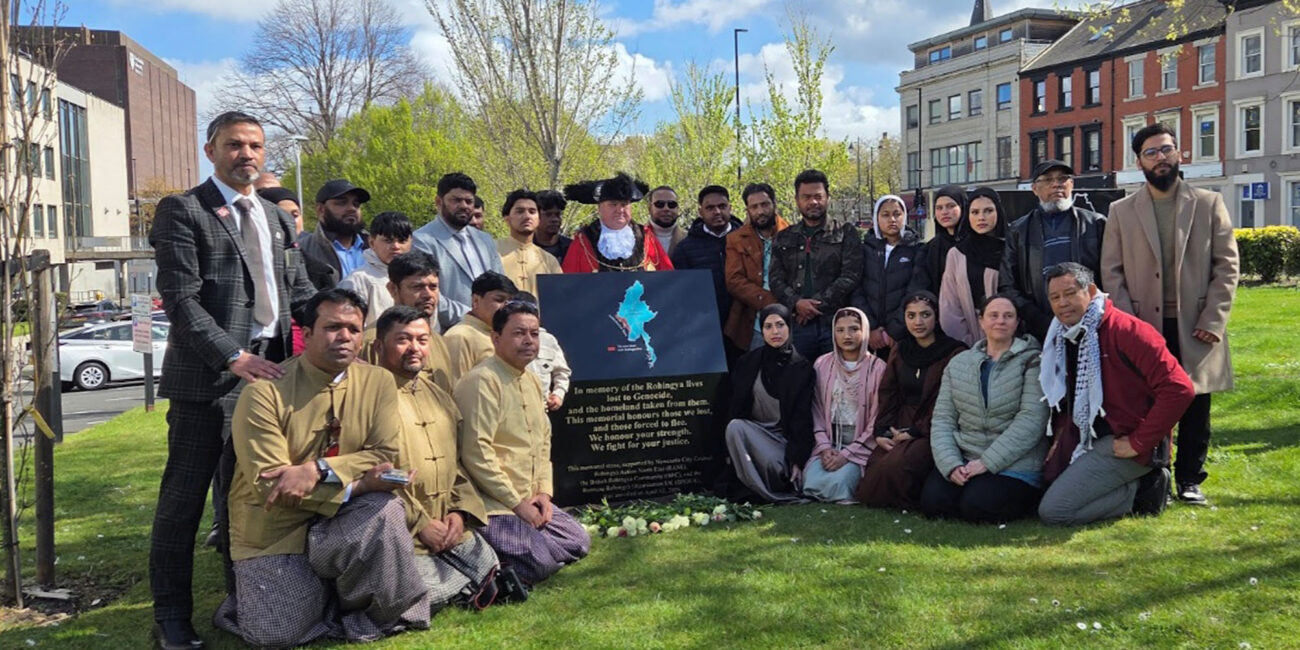
Rohingya community members with Lord Mayor of Newcastle and other supporters, including Councilman Habib Rahman at the Rohingya Genocide Monument. Photo by BROUK
Forgetting is a crime against memory. The city of Newcastle in the UK does not forget Myanmar’s genocide of Rohingya and pledges to support their quest for justice.
14 Apr 2026 – This past Sunday, 12 April 2026, Newcastle Upon Tyne, England became the world’s first city to erect a monument in recognition of a grave crime under both Myanmar and international law, which Rohingya people have suffered at the hands of their own countrymen and women, led by the military country-state over the last almost half-century.
It is fitting for the 2,000-years’ old city of with its rich history, to recognize that what Myanmar’s historically conscious Rohingya have suffered at the hands of the country’s ruling military, political parties and predominantly Buddhist civil society is nothing short of a textbook genocide.

Lord Mayor of Newcastle City and the 3-generation the representatives of Rohingya survivors unveiled the Rohingya Genocide Monument at The Peace Park, Civic Centre, Newcastle, 12 April 2026 (photos by Zarni)
The black granite memorial stone with its inlaid diamond-shaped map of Myanmar, with the red-coloured ancestral land of Rohingya – known as Arakan – took its historic place immediately adjacent to the Rwandan genocide monument in the city’s Peace Park.
Several steps away from Rohingya and Rwanda genocide monuments stands another genocide monument, recognizing the Nazi genocide of Roma and Sinti people.
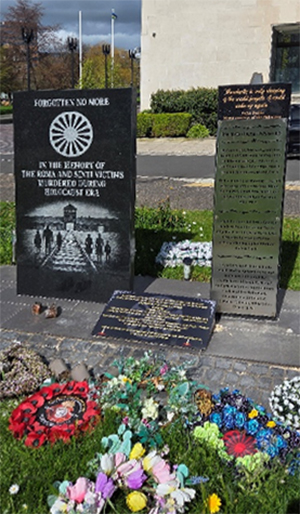
(photos by Zarni)
Post-Holocaust German politicians – and political class – have claimed Israel to be Germany’s Straatraison/Raison d’Etat, but had, for several decades, shamefully ignored non-Jewish victims of the Holocaust, specifically Roma and Sinti, after Auschwitz was closed by the Soviet Red Army on 27 January 1945.
So, I was pleased to see a dignified manner with which this old English city honoured the memories of Roma and Sinti people at the Civic Centre.
The monument in recognition of the crime of genocide which Rohingya have been subjected to reads:
“In memory of the Rohingya lives lost to Genocide, and the homeland taken from them. These memorial honours those we lost, and those forced to flee. We honour your strength. We fight for your justice.”
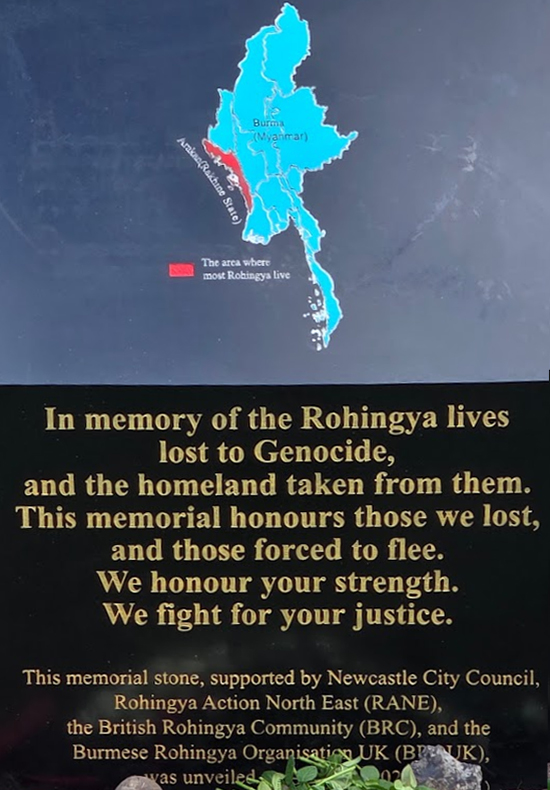
(photo Zarni)
The city’s move to formally recognize Myanmar’s crime against Rohingya as an identity-based people with deep root in Western Myanmar, before Myanmar ever became a post-colonial nation-state, was morally courageous and intellectually sound.
Following the genocidal expulsion and destruction of Rohingya people from Western Myanmar under the democratically elected leadership of Aung San Suu Kyi in 2016 and 2017, the city had demonstrated its moral clarity by stripping Myanmar Nobel Peace Prize winner of its civic honour.
(See Burmese leader set to lose freedom of Newcastle, Belfast Telegraph, 29 January 2018)

City Councilman Habib Rahman (far right in suit and tie), with his Rohingya Action Northeast (RANE) colleagues. Habib spearheaded the campaign for Rohingya genocide recognition at the city council (Photo by Zarni)
Given the deeply discouraging international context regarding justice for Rohingya, the city’s genocide recognition and the accompanying moral pledge to support the Rohingyas’ quest for justice makes it ever-more more meaningful for the Rohingya survivors both in UK and in the diaspora, including the 1 million Rohingyas in Bangladesh’s camps.
The world’s highest court of UN member states – the International Court of Justice – moves at a snail pace: the ICJ has only a few months ago completed its Merit Phase (that is, evidence and counter-evidence hearings), in Gambia vs. Myanmar genocide case. In December 2019, that is, six years ago, the State of Gambia brought the case against a fellow signatory state of “state party”, Myanmar, for allegedly breaching the treaty obligations under the UN Convention on the Prevention and Punishment of the Crime of Genocide.

Tun Khin, President of the Burmese Rohingya Organization UK, speaking on the Rohingyas’ quest for justice and the right of return to Myanmar with full citizenship, and in dignity, City Council Event, Newcastle (photo by BROUK)
The 11-member Association of Southeast Asian Nations (or ASEAN), of which Myanmar is a member state have chosen not to even consider the genocidal nature of the crimes against Rohingya people and have sought to frame it as “a humanitarian issue” with a cross-border consequences for Southeast Asian region.
The act of unveiling this historic monument in recognition of Rohingya genocide accompanied by a pledge to “fight for your justice” was made possible by the City Council. The effort was led by the Bangladeshi-born council member and rights activist Mr Habib Rahman, in collaboration with his activist group Rohingya Action North East (RANE), Bradford Rohingya Community (BRC) and the London-based Burmese Rohingya Organization UK (BROUK).
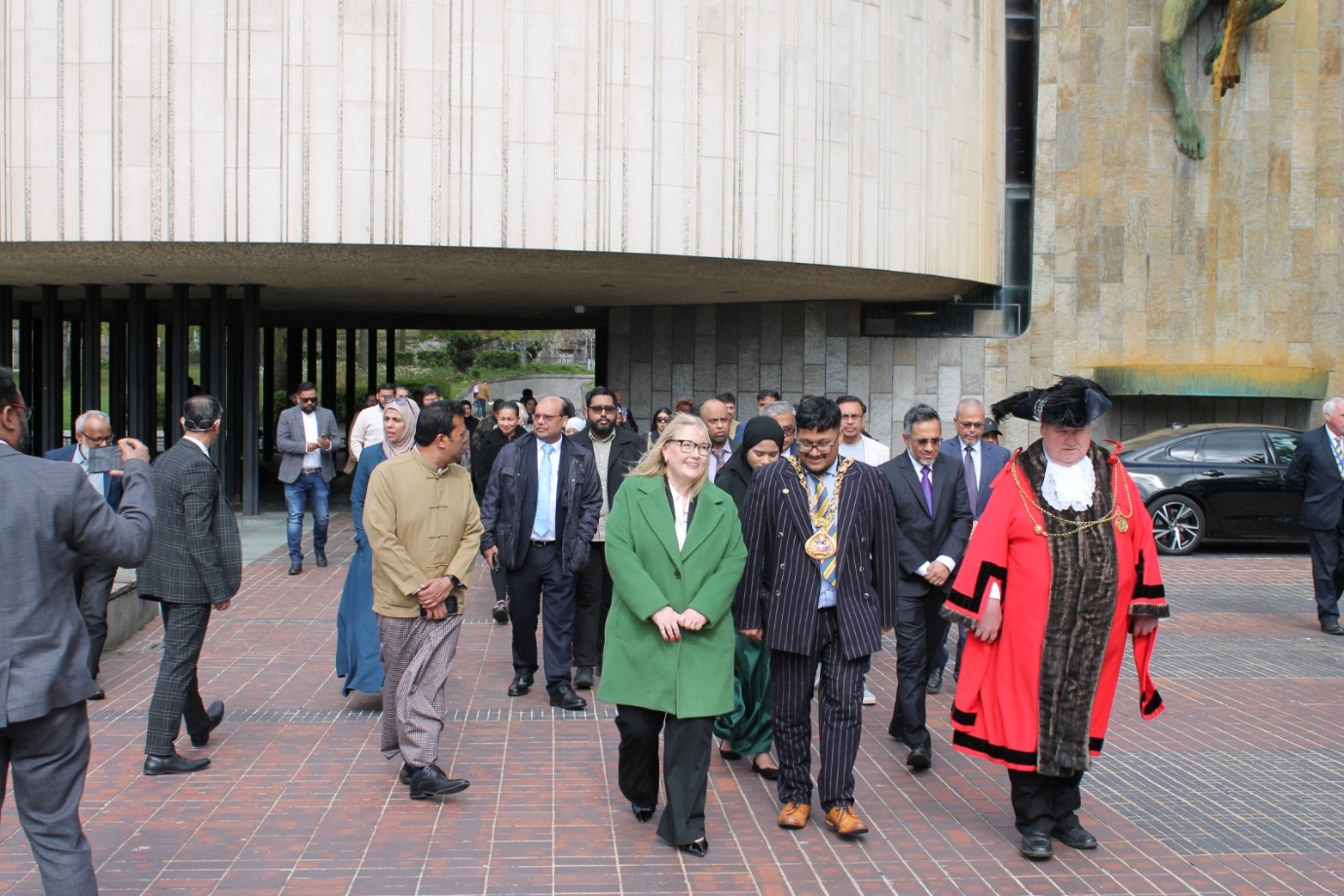
Lord Mayor of Sunderland (in stripy suit) and Lord Mayor of Newcastle (in red ceremonial dress), President of Burmese Rohingya Organization UK (BROUK) Tun Khin with other VIPs on their way from the City Council to the adjacent Peace Park to unveil the Rohingya Genocide Monument and participants at the ceremony, 12 April 2026 (photo by BROUK)
My scholar colleague and wife Natalie Brinham and I felt very privileged and honoured to have been a part of this historic event.

Dr Natalie Brinham (of Bristol University) (pseudonym Alice Cowley) and Dr Maung Zarni (FORSEA), the co-authors of the seminal research paper, The Slow-Burning Genocide of Myanmar’s Rogingya (2014), speaking at the City Council event, 12 April 2026 (photo by BROUK)
To be sure, genocide recognition is no substitute for the actual return to Rohingya’s ancestral homeland of Arakan (called Rakhine state today) of Western Myanmar.
Natlie’s address is below –
ZARNI’S address is below –
It was moving to hear Sirazul Islam, a young Rohingya lawyer-in-training from the city of Bradford, talk about how he could hold his head high as a Rohingya, as a result of Newcastle’s recognition of both Rohingya identity and waves of genocidal crime he and his ethnic community had suffered since the late 1970’s.
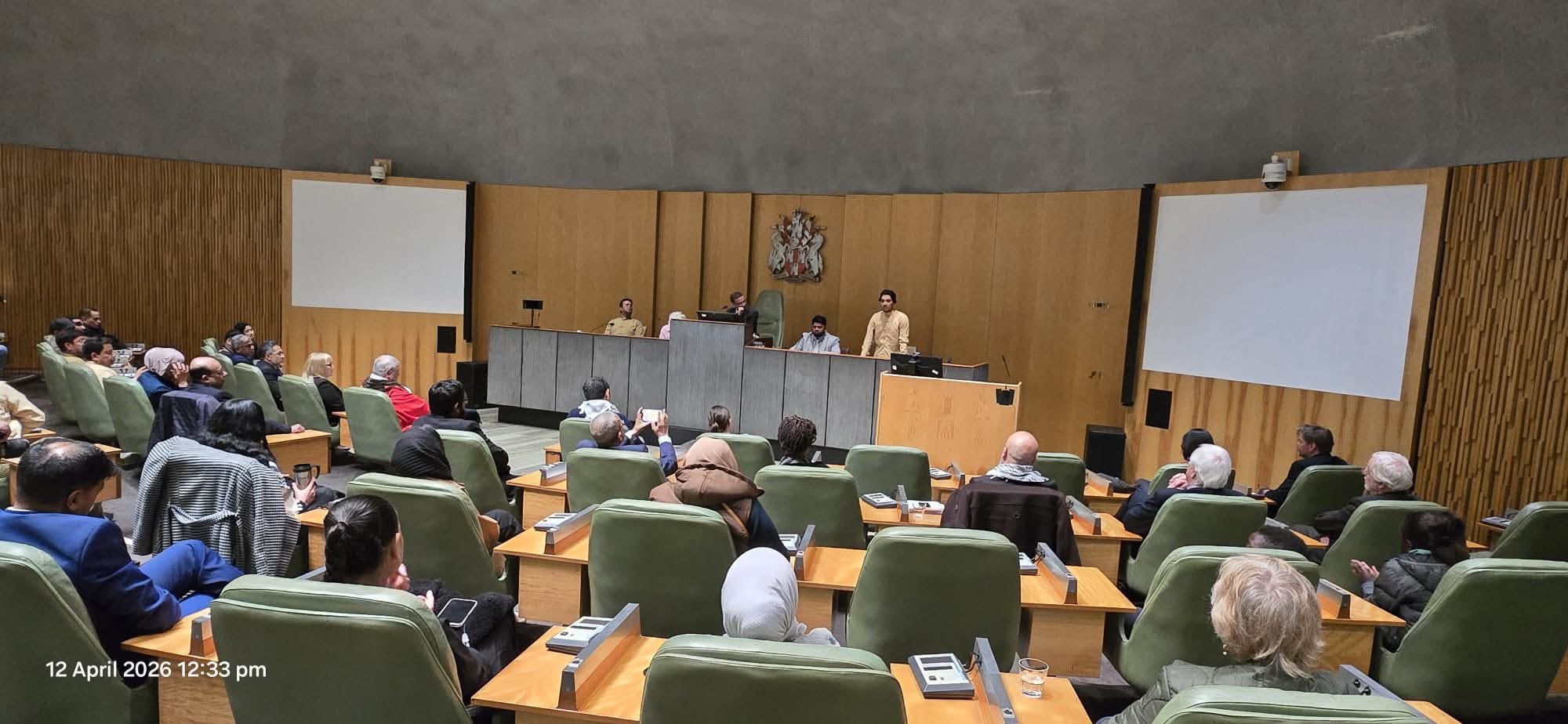
Sirazul Islam speaking about the importance of the city’s historic Genocide Monument for Rohingya (photo by BROUK)
From the podium, he repeated, with detectable passions, “I exist! I exist as a Rohingya. No one can take my identity away from me.”
His father, in his 70’s, fled the first wave of genocidal expulsion under Myanmar’s official pretext of sting operations against “illegal immigration” in 1978. He was born in a refugee camp in Bangladesh and immigrated to the United Kingdom during his childhood.
Video below, Tun Khin (Burmese Rohingya Organisation UK) and a plaintiff in Argentina’s Universal Jurisdiction crimes against humanity case against Myanmar genocidal leaders including ex-Senior General Min Aung Hlaing, now “elected President” and Aung San Suu Kyi.”
Amongst the speakers who came to offer their solidarity was a survivor of Rwandan genocide in 1994 during which nearly 1 million Tutsi (and many were ethnically mixed) were slaughtered within 100-days.
She said, “when we Rwandan refugees in Newcastle go to sleep, the Rwanda Memorial stone in Peace Park keep on telling our stories”. She meant stories of sufferings, pains, resilience and revival.
The closing speaker, a Palestinian refugee who leads the Palestine Solidarity Campaign in Northeast England, recounted his own personal loss and informed all of us that the city is preparing to extend its solidarity to Palestinians as they seek genocide recognition and justice.
___________________________________________
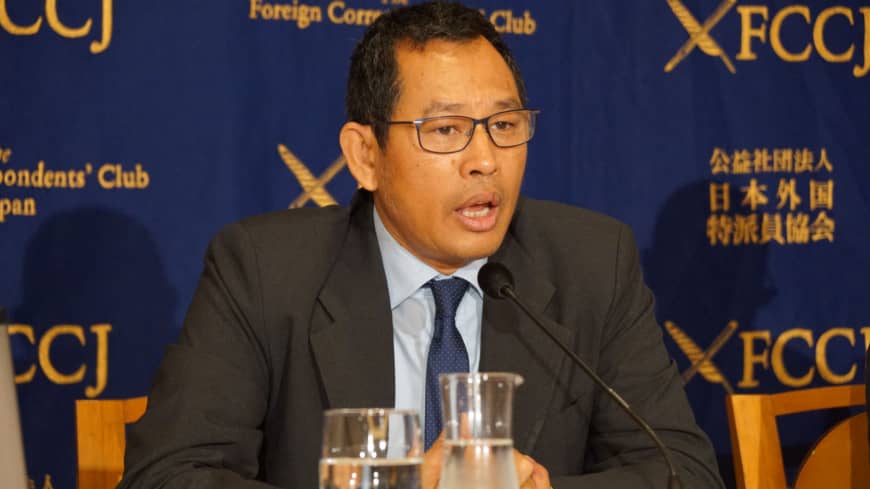 A Buddhist humanist from Burma (Myanmar), Maung Zarni, nominated for the 2024 Nobel Peace Prize, is a member of the TRANSCEND Media Service Editorial Committee, of the TRANSCEND Network for Peace Development Environment, former Visiting Lecturer with Harvard Medical School, specializing in racism and violence in Burma and Sri Lanka, and Non-resident Scholar in Genocide Studies with Documentation Center – Cambodia. Zarni is the co-founder of FORSEA, a grass-roots organization of Southeast Asian human rights defenders, coordinator for Strategic Affairs for Free Rohingya Coalition, and an adviser to the European Centre for the Study of Extremism, Cambridge. Zarni holds a PhD (U Wisconsin at Madison) and a MA (U California), and has held various teaching, research and visiting fellowships at the universities in Asia, Europe and USA including Oxford, LSE, UCL Institute of Education, National-Louis, Malaya, and Brunei. He is the recipient of the “Cultivation of Harmony” award from the Parliament of the World’s Religions (2015). His analyses have appeared in leading newspapers including the New York Times, The Guardian and the Times. Among his academic publications on Rohingya genocide are The Slow-Burning Genocide of Myanmar’s Rohingyas (Pacific Rim Law and Policy Journal), An Evolution of Rohingya Persecution in Myanmar: From Strategic Embrace to Genocide, (Middle East Institute, American University), and Myanmar’s State-directed Persecution of Rohingyas and Other Muslims (Brown World Affairs Journal). He co-authored, with Natalie Brinham, Essays on Myanmar Genocide.
Tags: Bangladesh, Burma, Europe, Genocide, Muslims, Myanmar, Refugees, Rohingya, UK
DISCLAIMER: The statements, views and opinions expressed in pieces republished here are solely those of the authors and do not necessarily represent those of TMS. In accordance with title 17 U.S.C. section 107, this material is distributed without profit to those who have expressed a prior interest in receiving the included information for research and educational purposes. TMS has no affiliation whatsoever with the originator of this article nor is TMS endorsed or sponsored by the originator. “GO TO ORIGINAL” links are provided as a convenience to our readers and allow for verification of authenticity. However, as originating pages are often updated by their originating host sites, the versions posted may not match the versions our readers view when clicking the “GO TO ORIGINAL” links. This site contains copyrighted material the use of which has not always been specifically authorized by the copyright owner. We are making such material available in our efforts to advance understanding of environmental, political, human rights, economic, democracy, scientific, and social justice issues, etc. We believe this constitutes a ‘fair use’ of any such copyrighted material as provided for in section 107 of the US Copyright Law. In accordance with Title 17 U.S.C. Section 107, the material on this site is distributed without profit to those who have expressed a prior interest in receiving the included information for research and educational purposes. For more information go to: http://www.law.cornell.edu/uscode/17/107.shtml. If you wish to use copyrighted material from this site for purposes of your own that go beyond ‘fair use’, you must obtain permission from the copyright owner.
One Response to “Newcastle Upon Tyne: The First City to Erect a Genocide Memorial Monument for Myanmar’s Rohingya Survivors”
Join the discussion!
We welcome debate and dissent, but personal — ad hominem — attacks (on authors, other users or any individual), abuse and defamatory language will not be tolerated. Nor will we tolerate attempts to deliberately disrupt discussions. We aim to maintain an inviting space to focus on intelligent interactions and debates.
Thank you to the Rohingya community, yourself, Natalie Brinham, and all the others who made this profound gesture in Newcastle upon Tyne a reality! May its significance ripple far and wide.