


The Criminal Underside of the Green Transition
ENVIRONMENT, 15 Jun 2026
Robert Muggah | Toda Peace Institute - TRANSCEND Media Service

How Critical Minerals Could Turn the Amazon into a Strategic Asset, or a Criminalized Supply Chain Frontier
Abstract
5 Jun 2026 – The global race for critical minerals is reshaping the Amazon Basin as a strategic frontier. Demand for cassiterite, coltan, niobium and rare earths is rising with the energy transition, defence procurement, and AI. Most exploration remains legal, and criminal groups are still less embedded in critical minerals than in illegal gold. Yet rising prices and the region’s mature illicit infrastructure are creating new vulnerabilities. The article argues that a ‘narco-mineral complex’ is emerging in parts of the Basin, linking illegal mining, criminal governance, corrupt administration and apparently legal trade. Drawing on cases from Brazil, Colombia, Peru and Venezuela, it shows how illicit ore can be made to appear legal. The central paradox is that the race to power a clean-energy future could deepen deforestation, mercury contamination, Indigenous dispossession and organized crime in one of the world’s most important climate and biodiversity systems.
The new geology of power
The Amazon is being reimagined. For decades, the world’s largest rainforest was framed as a climate regulator, biodiversity reserve, and stronghold of Indigenous resistance. It is now being recast in colder terms, as a reservoir of strategic minerals essential for clean energy and the next generation of artificial intelligence and weapons systems. The basin has become a prize in a global race whose rules are still being written.
This shift is being driven by two powerful forces. The first is decarbonization. Electric vehicles, batteries, grids, and data centres all depend on mineral-intensive supply chains. Mineral demand for clean energy technologies will roughly double by 2030 in a business-as-usual trajectory and grow by almost three times in a net zero scenario (IEA, 2024a). The second is geopolitics. Critical minerals have risen up policy agendas because of demand growth, supply bottlenecks, price volatility, and strategic competition (IEA, 2024b).
The reframing of the Amazon has international significance. The basin is increasingly treated not only as a carbon sink and biodiversity reserve, but as a strategic mineral frontier (Muggah, 2026a; USGS, 2025). The paradox is that mineral wealth in countries such as Brazil, Colombia, and Venezuela could help power the energy transition, while the mining required to deliver it is itself environmentally and socially hazardous, accelerating deforestation, water contamination, and the carbon emissions the transition is meant to avoid (Muggah, 2023). Decarbonization is shifting global dependency from fossil fuels to minerals, and that shift falls heaviest on fragile, climate-vulnerable territories where extraction can deepen the very ecological crisis it claims to solve (Lazard, 2025).
There is a danger in viewing the Amazon narrowly through the lens of great-power competition. The decisive question is no longer whether United States, China, Europe, Japan, Canada, Australia, or Amazonian countries can secure access to minerals. It is whether they can be extracted, traded, and governed without reproducing the violence, corruption, and ecological destruction that the green transition is meant to leave behind (UNEP, 2024). A United Nations Panel on Critical Energy Transition Minerals has made a similar point, arguing that the global energy transition must be grounded in equity, justice, human rights, environmental protection, and shared prosperity (UN, 2024).
The Amazon is more than a strategic mineral frontier. It is a supply chain integrity frontier. In parts of the basin, critical minerals can be contaminated long before they reach refiners, battery manufacturers, or defence contractors abroad. The contamination is institutional as much as chemical or ecological. It can occur through coercive territorial control, fraudulent licenses, falsified environmental permits, and laundering linked to the state actors, corrupt intermediaries, and armed groups. That institutional contamination is now a strategic risk, and the world has barely begun to reckon with it.
A critical mineral power
Brazil sits at the centre of this story. It is a mining giant with deposits of global scale, a substantial industrial base, and ambitions to move beyond raw material exports (Muggah, 2026b; Smith, 2023). Brazil dominates niobium production and holds the world’s second-largest rare earths reserves (USGS, 2025). Brazil’s Carajás mineral province in Pará is already one of the world’s major mining districts, and the Amazon’s critical mineral potential has made Brazil a key test case for hemispheric supply chain diversification.
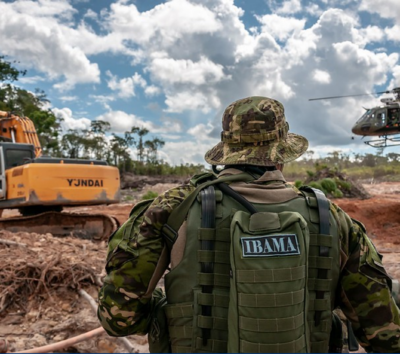
But the same Amazonian territories that make Brazil central to this agenda are also marked by illegal mining networks, weak enforcement, contested Indigenous lands, fraudulent licensing, and criminal factions expanding into environmental crime. The Yanomami Indigenous Territory in Roraima is a stark symbol of this crisis. Brazilian authorities launched operations in 2023 to expel illegal miners after a public health emergency involving contamination, disease, and malnutrition among Yanomami communities (Maisonnave and Barros, 2023). Studies have revealed mercury contamination among Yanomami people from nine villages in Roraima, with the highest exposure near illegal gold mining sites (Fiocruz, 2024).
Green metals, grey markets
The Amazon’s mineral boom does not begin with geology or end with industrial strategy. It runs through the region’s long-standing illicit economies. For decades, criminal networks have used Amazonian routes to move cocaine, gold, mercury, timber, and contraband. Cocaine trafficking and deforestation are increasingly linked across the Amazon Basin (UNODC and Igarape Institute, 2024). Yet environmental crime remains a blind spot in climate diplomacy, despite its role in driving deforestation, biodiversity loss, and illicit revenues (Muggah, 2025a).
This is the emerging narco-mineral complex. It is not a single cartel vertically integrating the mining sector, but a looser and more durable system: armed groups controlling territory, corrupt officials issuing or tolerating paperwork, shell companies laundering origin, and legal firms buying minerals whose provenance has already been compromised (Muggah, 2026a; UNODC and Igarape Institute, 2024). Its power lies in its ability to move illegally extracted minerals from remote jungle sites into apparently legitimate trade channels (Ionova, 2026).
Foreign demand can create market pull that accelerates extraction in areas where the state is absent, complicit, or outmatched
Mineral supply chains are penetrated through five mechanisms: territorial control, infrastructure reuse, documentary fraud, cross-border aggregation, and trade routes linked to China. Armed groups can tax mineral-bearing territory without formally owning mines (Ebus, 2025a). Criminal logistics networks can move minerals through routes already used for cocaine and contraband. Fraudulent permits, licenses, cooperatives, and environmental certificates can turn illegal ore into apparently legal merchandise. Cross-border aggregation can then mix, relabel, and document minerals again before export (Ebus, 2025b). Foreign demand can create market pull that accelerates extraction in areas where the state is absent, complicit, or outmatched.
Brazil’s cassiterite cases show documentary fraud at industrial scale. Operation Forja de Hefesto, a 2023 Federal Police investigation, targeted alleged illegal cassiterite extraction from Yanomami territory. A mining company, White Solder, appeared in records as the destination for R$166 million in cassiterite acquired through an intermediary cooperative linked to alleged illegal extraction (Business & Human Rights Resource Centre, 2023). Cassiterite, tin ore used in electronics, solar panels, lithium-ion batteries, and other industrial applications, has become a growing policing and environmental problem in Roraima, where illegal mining threatens Yanomami territory (Cowie, 2024).
A supply chain can look clean on paper while remaining compromised at origin
Operation Ouro Negro, launched in 2025, similarly targeted illegal mining in Yanomami territory, suspended company activities, and blocked R$265 million in assets (Brazil, 2025; Maia, 2025). The lesson is less that illegal ore enters the market than that apparently legal documentation can be manufactured to satisfy superficial due diligence. A supply chain can look clean on paper while remaining compromised at origin.
Colombia shows how illicit trade routes can carry strategic minerals toward global markets. Its eastern Amazon departments combine mineral deposits, weak state presence, riverine mobility, and armed group influence. In April 2025, Colombian authorities seized an estimated 50 tonnes of tin and coltan that officials said had been illicitly extracted in the east of the country and reportedly intended for China (Barrons, 2025). Colombian police linked the shipment to ex FARC rebels and valued it at roughly $1.2 million (AFP, 2025). The case connected a named armed group ecosystem to strategic mineral flows moving toward export markets.
Peru shows how illegal mining infrastructure can be repurposed. In Madre de Dios, decades of informal and illegal gold mining have created a durable extraction architecture of river corridors, dredging equipment, mercury supply lines, and informal processing networks. That architecture is now relevant beyond gold because the region’s fluvio-alluvial deposits and mining residues also contain rare earth-bearing minerals (Muggah, 2026c).
Venezuela offers the starkest case of state-enabled territorial control. The Orinoco Mining Arc, created in 2016, has been widely associated with illegal mining, violence, and human rights abuses (Dialogo Americas, 2026; Ebus, 2025b). The Arc is a centre of illegal gold mining, with local criminal networks, elements of the armed forces, and Colombian guerrilla groups profiting from mineral extraction and extortion (Business & Human Rights Resource Centre 2024). Minerals extracted under coercive criminal conditions can be aggregated, documented, and exported through formal or semi-formal channels, turning state-linked entities into laundering interfaces (Delacroix, 2026). Once illicit ore reaches foreign refiners, provenance can dissolve.
Downstream buyers should be alarmed. The dominant compliance model for critical minerals still assumes that risk can be managed through supplier declarations, certificates of origin, and periodic audits. That model is poorly suited to actors who actively cover their tracks. OECD due diligence guidance on critical minerals has provided some direction for conflict-affected and high-risk areas, but it requires companies to actively assess and manage risks rather than rely passively on supplier paperwork (OECD, 2016).
The friend-shoring fallacy
These risks rarely appear in the friend-shoring calculus. They should. Part of the problem is that the current geopolitical debate over critical minerals is too narrow. In Western capitals, the central concern is how to reduce dependence on China. That concern is understandable. Critical mineral processing is highly concentrated, especially in China, and China dominates rare earth supply chains while competing with the US and Europe for access to the Amazon’s critical mineral and rare earth potential (Muggah, 2025; Green, 2025). Much of the policy debate has therefore focused on reducing supply chain dependencies and vulnerabilities.
But shifting the geography of supply is not the same as governing supply. Friend-shoring can reduce dependence on China. It cannot, by itself, make a mineral supply chain clean, lawful, or secure. If alternative supply chains are built through weakly governed Amazonian corridors, they may simply replace one dependency with another. The result may be less exposure to Chinese geopolitical coercion, but more exposure to local extortion, fraud, environmental liability, and rights violations. Western Hemisphere sourcing is not inherently safer. It becomes safer only when buyers can verify origin, identify who profits, and show that affected communities have consented.
What is missing is a dedicated traceability instrument for Amazonian minerals
The US and other G7 countries have begun to recognize these risks, at least in principle. In 2020, the US and Brazil established a working group to improve critical minerals security, stimulate investment, promote technological innovation, and strengthen supply chain interconnectivity (U.S. Department of State, 2020). Brazil’s critical minerals and rare earths routinely feature in discussions of trade and tariff negotiations with Washington, especially since 2025 (Valor, 2026; Muggah, 2025b). A G7 Critical Minerals Action Plan likewise commits members to transparency, traceability, and sustainability in critical minerals supply chains (G7, 2025). These are the right principles, though the enforcement architecture remains thin.
What is missing is a dedicated traceability instrument for Amazonian minerals. A US–Brazil Critical Minerals Traceability Protocol could be built into the existing bilateral working group. It should combine digital licensing, geochemical mineral fingerprinting, beneficial ownership disclosure, and customs-to-customs data sharing. A complementary G7 and host-country verification facility, supported by financial intelligence units and the Inter-American Development Bank, could extend the model across the basin. Without an instrument of this kind, the principles in the G7 Action Plan remain aspirational.
Brazil is a decisive test case for whether mineral diversification can become something more than geopolitical rerouting. It has the geological assets, industrial base, and diplomatic leverage to become a major critical minerals partner for the US, Europe, Japan, and other economies looking beyond China. It also has a chance to define a different model, one that links mineral development to forest protection, traceability, and downstream value addition. But if licensing is weakened, enforcement remains uneven, and illegal extraction continues to merge with formal trade, Brazil could instead become a warning about how strategic mineral demand overwhelms governance capacity.
The test extends across the Amazon basin. The specific risks vary, from armed group influence in Colombia and informal mining in Peru to water conflicts in Ecuador and capacity constraints in Guyana and Suriname. The common denominator is institutional weakness. In this context, great power competition can either raise standards or lower them. It can improve the landscape if mineral partnerships support enforcement capacity, responsible processing, transparent licensing, credible traceability, and community rights. It can worsen it if buyers compete for access while tolerating weak standards, opaque intermediaries, and fast-tracked approvals. Strategic competition is not inherently destructive. But without rules, it rewards speed, opacity, and volume. In the Amazon, that is a dangerous combination.
Processing is not enough
Amazonian countries are right to resist being treated merely as raw material suppliers. Brazil, in particular, has an opportunity to use critical minerals to move up the value chain. Processing, refining, component manufacturing, and technology partnerships could create jobs, capture more domestic value, and reduce the old pattern of exporting raw commodities while importing finished goods. Upstream processing and value addition are central opportunities for Brazil and other Amazonian mineral producers (Muggah, 2026b).
Upstream processing is a governance test as much as an economic opportunity. Credible domestic processing hubs could strengthen traceability, sharpen customs oversight, and reduce reliance on opaque intermediaries. They could make it harder for illicit ore to disappear into cross-border aggregation networks. But processing capacity without licensing integrity, beneficial ownership transparency, and financial intelligence could simply create more sophisticated laundering nodes.
Integrity systems need to be built into industrial policy from the start. Processing hubs should be built around traceability, licensing integrity, customs intelligence, and independent audits. This is the logic of risk-based due diligence: companies must know where minerals come from, identify who profits, assess what risks attach to extraction and transport, audit those risks independently, and report publicly (OECD, 2016).
Fraudulent licensing is a supply chain security threat, not merely a local administrative offence
Downstream buyers must also change how they think about risk. Auditing the final exporter is insufficient. Companies should examine extraction zones, transport routes, environmental licenses, and aggregation points linked to the state. They should ask whether minerals passed through territories controlled by armed groups, whether documents were issued by compromised authorities, whether production volumes match geological and operational realities, and whether local communities recognize the legality of extraction.
Fraudulent licensing is a supply chain security threat, not merely a local administrative offence. When illicit ore is legalized through fake environmental permits, shell cooperatives, or falsified origin documents, the result is the corruption of strategic supply chains. That matters to governments concerned with defence procurement, energy resilience, sanctions evasion, and industrial policy. It also matters to companies exposed to reputational, legal, and operational risks.
Regulators are beginning to move in this direction, but not fast enough. The EU Corporate Sustainability Due Diligence Directive requires companies to address human rights and environmental impacts in their operations and value chains (European Commission, 2024). US conflict minerals disclosure rules require certain companies to disclose use of conflict minerals from the Democratic Republic of Congo and adjoining countries, but were designed for a different geography and a narrower conflict minerals regime (U.S. SEC, 2024).
The Amazon presents a different challenge. It includes industrial-scale extraction, sophisticated financial crime, and transnational routes that mix legal and illegal flows. The policy agenda therefore requires a wider definition of responsible minerals. ESG standards are necessary but insufficient. They were designed to audit, not investigate. Responsible development must also include mineral testing, customs intelligence, anti-money laundering controls, and beneficial ownership transparency.
A test of state capacity
The environmental stakes are enormous. Mining in the Amazon damages more than the extraction site. Roads, airstrips, and river landings can become corridors of forest loss, illegal logging, and permanent fragmentation. Illegal gold mining drives deforestation and mercury contamination, especially in protected areas and Indigenous territories (MAAP, 2024). In Brazil’s Amazon, organized crime groups such as the Comando Vermelho (CV) and the Primeiro Comando da Capital (PCC) have financed some operations (Sa Pessoa, 2026).
Governments should prioritize illegal mining and mercury trafficking before opening new mineral frontiers. The fastest biodiversity and public health gains will come not from approving new projects, but from dismantling the infrastructure that makes illegal extraction profitable: mercury suppliers, fuel networks, airstrips, river corridors, and the corrupt officials and financiers behind them. That dismantling requires regional cooperation among police, customs agencies, financial intelligence units, and Indigenous protection bodies.
Responsible mineral development in the Amazon is possible, but only under strict conditions. Some areas should be off limits entirely, especially intact forests with high carbon value, critical habitats, protected areas, and Indigenous territories where free, prior, and informed consent is absent. Extraction should likewise be concentrated, where possible, in already disturbed landscapes and existing mining districts, not used as a pretext to open new frontiers (UNEP, 2024).
Armed groups do not need to own mines to dominate them
The politics of acceleration are already visible in Brazil, where Congress approved a controversial environmental licensing law that critics called the ‘devastation bill’ (Rogero, 2025). President Lula later vetoed or altered 63 provisions, but Congress subsequently overturned 56 of those vetoes, restoring much of the bill’s most contested content (Escossia, 2025). Critics warn that the law could weaken environmental licensing by expanding simplified approval procedures, including self-declared licensing for some projects, and by limiting input from agencies representing Indigenous and quilombola communities (OHCHR, 2025).
The social risks are just as serious. Many mineral-rich zones overlap Indigenous territories, traditional communities, protected areas, and fragile frontier settlements. There are at least 1,827 mining applications for copper, lithium, rare earths, and other minerals relevant to technology within 40 kilometres of at least 45 isolated Indigenous groups in Brazil’s Legal Amazon alone (Harari, 2025). Even formally licensed projects can divide communities, as the proposed potash project in Brazil’s Amazon has done among the Mura Indigenous people, a reminder that consent, not just legality, is the relevant standard (Carvalho, 2025).
Criminalized mining deepens these harms because it creates systems of coercive governance. Armed groups do not need to own mines to dominate them. They can control access, extort communities and mandate ‘protection’, tax and regulate transport, and decide who operates. In parts of Brazil, Colombia, and Venezuela, mineral extraction is a form of territorial control and criminal governance, not simply an economic activity(Muggah, 2026b). Where the state is absent or complicit, mining revenues can strengthen armed actors and criminal factions, making formal governance more difficult.
All of this matters for the legitimacy of the green transition. A battery supply chain that reduces emissions but depends on minerals extracted through Indigenous dispossession, mercury contamination, and armed coercion cannot meaningfully be called clean. Nor can a defence supply chain be considered secure if it relies on minerals laundered through criminal networks or corruption linked to the state. Strategic supply chains should be judged not only by whether they reduce dependence on rivals, but by whether they strengthen or corrode the rule of law.
Avoiding the sacrifice zone
The Amazon’s mineral future will not be determined by geology alone. It will be shaped by state capacity, market integrity, territorial control, and the choices now being made by governments, foreign partners, companies, financiers, and communities. The region can contribute to the energy transition and strategic supply diversification. It can also become a cautionary tale of a rainforest sacrificed to clean energy and military competition, with criminal networks and corrupt intermediaries among the first beneficiaries.
The first principle should be restraint. Amazonian governments and their partners should protect no-go zones, dismantle illegal mining economies, strengthen state capacity, and only then consider new extraction under strict conditions. Indigenous territories without free, prior, and informed consent, protected areas, intact forests, critical habitats, and regions with isolated Indigenous peoples should be excluded from strategic mineral development.
The second principle should be integrity and accountability across the full supply chain. Critical minerals partnerships with Brazil and other Amazonian countries should be tied to enforceable governance benchmarks. These include digitized licensing, chain-of-custody verification, beneficial ownership disclosure, independent audits, and community monitoring. Downstream buyers, financiers, and governments should not be allowed to outsource risk to local intermediaries. Supplier declarations and certificates of origin are not enough in territories where armed groups, fraudulent cooperatives, corrupt officials, and shell companies can manufacture legality.
The third principle should be demand reduction. The green transition cannot be built only by digging faster and farther into the world’s remaining forests. Recycling, substitution, circular design, and lower-consumption pathways should be treated as strategic policies, not peripheral environmental measures. Reducing dependence on primary extraction is not anti-development. It is a necessary condition for ensuring that decarbonization does not become a new driver of ecological overshoot.
The choice is between different political economies of extraction, not between mining and conservation in the abstract. One path treats the Amazon as a warehouse of strategic inputs and assumes paperwork can manage the damage. The other recognizes that minerals extracted from weakly governed forests carry risks that travel with them into refineries, weapons systems, electric vehicles, and climate policy itself.
A green transition built on deforestation, corruption, and dispossession is not a transition. It is a transfer of harm from one geography to another, from fossil frontiers to mineral frontiers, from carbon emissions to contaminated rivers and criminalized territories. The Amazon’s new mineral rush is therefore far more than a test of supply-chain resilience. It is a test of political will: whether governments and companies can build a low-carbon future without laundering violence through the language of clean energy, and without turning the Amazon into the next sacrifice zone of the climate economy.
BIBLIOGRAPHY:
AFP (2025) Colombia seizes nearly 49 tonnes of China-bound smartphone minerals, AFP in SCMP, https://www.scmp.com/news/world/americas/article/3305011/colombia-seizes-nearly -49-tonnes-china-bound-smartphone-mineral (Accessed: 16 May 2026).
Barron’s (2025) Colombia seizes China-bound smartphone mineral. Available at: https://www.barrons.com/news/colombia-seizes-49-tons-of-china-bound-smartphone-mineral-1f1b7c84 (Accessed: 16 May 2026).
Brazil, government (2025) Federal mega-operation seizes one ton of cassiterite illegally extracted from Yanomami Land, destroys aircraft’, Secretaria de Comunicacao Social, February, https://www.gov.br/secom/en/latest-news/2025/02/federal-mega-operation-seizes-one-ton-of-cassiterite-illegally -extracted-from-yanomami-land-destroys-aircraft (Accessed: 16 May 2026).
Business & Human Rights Resource Centre (2023) ‘Brazil: White Solder company targeted by the Federal Police for illegal mining’. Available at: https://www.business-humanrights.org/en/latest-news/brazil-white-solder-company -targeted-by -the-federal-police-for-illegal-mining-allegedly -supplies-amazon-disney -and-starbucks/ (Accessed: 16 May 2026).
Business & Human Rights Resource Centre (2024) ‘Venezuela: Global Witness maps resource-driven violence’. Available at: https://www.business-humanrights.org/en/latest-news/venezuela-global-witness-maps-resource-driven-violence-in-the-country-and-reflects-on-challenges-posed-by -the-oil-industry/ (Accessed: 16 May 2026).
Carvalho, R. (2025) ‘Potassium mining project in Brazil’s Amazon rainforest divides Indigenous tribe’, AP, 7 March. Available at: https://apnews.com/article/brazil-amazon-potash-mining-canada-mura-madeira-2a4dee3774950fb1b11c4f4836c94519 (Accessed: 16 May 2026).
Cowie, S. (2024) ‘The lawless mining gangs targeting the Amazon’s precious green energy minerals’, The Guardian, 2 August. Available at: https://www.theguardian.com/global-development/article/2024/aug/02/black-gold-cassiterite-mining-energy-transition-minerals-destroying-indigenous-yanomami-rainforest-ibama-environment (Accessed: 16 May 2026).
Dialogo Americas (2026) Shadow partners: China’s collaboration with terrorist groups to plunder Venezuela’s strategic minerals, Dialogo Americas, February 24, https://dialogo-americas.com/articles/shadow-partners-chinas-collaboration-with-terrorist-groups-to-plunder-venezuelas-strategic-minerals/
Ebus, B. (2025a) ‘The price of progress: the dark side of critical minerals in the Amazon’, InfoAmazonia, 27 November. Available at: https://infoamazonia.org/en/2025/11/27/the-price-of-progress-the-dark-side-of-critical-minerals-in-the-amazon/ (Accessed: 16 May 2026).
Ebus, B. (2025b) ‘Drug trafficking, extortion, kidnapping: the lawless rush for rare earth minerals in Venezuela’, The Guardian, 7 November. Available at: https://www.theguardian.com/global-development/2025/nov/07/drug-trafficking-extortion-kidnapping-the-lawless-rush-for-rare-earth-minerals-in-venezuela (Accessed: 16 May 2026).
Escossia, F. (2025) ‘Devastation bill: Congress overturns Lula’s vetoes, destroying environmental laws in Brazil’, Sumaúma, 27 November. Available at: https://sumauma.com/en/pl-da-devastacao-o-congresso-derruba-vetos-de-lula-e-destroi-a-legislacao-ambiental-do-brasil/ (Accessed: 16 May 2026).
European Commission (2024) ‘Corporate sustainability due diligence’. Available at: https://commission.europa.eu/topics/business-and-industry /doing-business-eu/sustainability -due-diligence-responsible-business/corporate-sustainability -due-diligence_en (Accessed: 16 May 2026).
Fiocruz (2024) ‘Yanomamis from nine villages harassed by illegal mining are contaminated with mercury’. Available at: https://fiocruz.br/en/noticia/2024/04/yanomamis-nine-villages-harassed-illegal-mining-are-contaminated-mercury (Accessed: 16 May 2026).
G7 (2025) ‘G7 Critical Minerals Action Plan’, 17 June. Available at: https://g7g20-documents.org/database/document/2025-g7-canada-leaders-leaders-language-g7-critical-minerals-action-plan (Accessed: 16 May 2026).
Green, N. (2025) ‘The rare earths race is over and China won’, Asia Times, 21 October. Available at: https://asiatimes.com/2025/10/the-rare-earths-race-is-already -over-and-china-won/ (Accessed: 16 May 2026).
Harari, I. (2025) ‘Critical minerals surround 45 isolated Indigenous peoples in the Amazon’, Repórter Brasil, 27 October. Available at: https://reporterbrasil.org.br/2025/10/critical-minerals-surround-45-isolated-indigenous-peoples-in-the-amazon/ (Accessed: 16 May 2026).
IEA (2024a) Global Critical Minerals Outlook 2024: Outlook for key minerals. Available at: https://www.iea.org/reports/global-critical-minerals-outlook-2024/outlook-for-key -minerals (Accessed: 16 May 2026).
IEA (2024b) Global Critical Minerals Outlook 2024. Available at: https://www.iea.org/reports/global-critical-minerals-outlook-2024 (Accessed: 16 May 2026).
Ionova, A. (2026) ‘Illegal miners loot Amazon rainforest for critical minerals’, The New York Times, 3 May. Available at: MAAP (2024) ‘Illegal gold mining in the Amazon’. Available at: https://www.maapprogram.org/illegal-gold-mining-amazon/ (Accessed: 16 May 2026).
Lazard, O. (2025) The scramble to secure critical minerals could exacerbate geopolitical, ecological, and planetary instability, Global Futures Bulletin, Igarapé Institute, January. Available at: https://igarape.org.br/en/global-futures-bulletin-the-scramble-to-secure-critical-minerals-could-exacerbate-geopolitical-ecological-and-planetary -instability/ (Accessed: 16 May 2026).
MAAP (2024) ‘Illegal gold mining in the Amazon’. Available at: https://www.maapprogram.org/illegal-gold-mining-amazon/ (Accessed: 16 May 2026).
Maia, E. (2025) ‘Operação contra transporte irregular de “ouro negro” bloqueia R$ 265 mi’, CNN Brasil, 8 September. Available at: https://www.cnnbrasil.com.br/nacional/brasil/operacao-contra-transporte-irregular-de-ouro-negro-bloqueia-r-265-mi/ (Accessed: 16 May 2026).
Maisonnave, F. and Barros, E. (2023) ‘Brazil pushes illegal miners out of Yanomami territory’, AP, 8 February. Available at: https://apnews.com/article/brazil-government-climate-and-environment-indigenous-people-a902ff2529068ccb7965e505f250f0f7 (Accessed: 16 May 2026).
Muggah, R. (2023) ‘Will Brazil destroy the Amazon to save the climate?’, Foreign Policy, 22 April. Available at: https://foreignpolicy .com/2023/04/22/brazil-lula-amazon-climate-environment-mining-minerals-energy -transition-electric-cars-ev-batteris-metals-rare-earths/ (Accessed: 16 May 2026).
Muggah, R. (2025a) ‘COP must take environmental crime seriously’, Financial Times, 15 October. Available at: https://www.ft.com/content/f544b82f-c7d3-4112-b557-9234c131b201 (Accessed: 16 May 2026).
Muggah, R. (2025b) ‘Managing volatility in US-Brazil relations’, Brazilian Journal of International Affairs, 4(16). Available at: https://cebri.org/revista/br/artigo/245/gerenciando-a-volatilidade-nas-relacoes-estados-unidos-brasil (Accessed: 16 May 2026).
Muggah, R. (2026a) The Amazon and the new mineral resource order, Global Futures Bulletin, Igarape Institute, https://igarape.org.br/wp-content/uploads/2026/01/CI_ENG_GFB-The-Amazon(Accessed: 16 May 2026).
Muggah, R. (2026b) ‘The geopolitics of critical minerals in Brazil and Canada’, Igarape Institute Strategic Paper, forthcoming.
Muggah, R. (2026c) ‘Criminal governance and democratic erosion in Latin America and the Caribbean’, Frontiers in Political Science, 8. Available at: https://www.frontiersin.org/ journals/political-science/articles/10.3389/fpos.2026.1783654/full (Accessed: 16 May 2026).
OECD (2016) OECD Due Diligence Guidance for Responsible Supply Chains of Minerals from Conflict–Affected and High–Risk Areas. Available at: https://www.oecd.org/en/publications/oecd-due-diligence-guidance-for-responsible-supply -chains-of-minerals-from-conflict-affected-and-high-risk-areas_9789264252479-en.html (Accessed: 16 May 2026).
OHCHR (2025) ‘UN experts welcome Brazil’s veto of environmental licensing bill provisions’. Available at: https://www.ohchr.org/en/press-releases/2025/09/un-experts-welcome-brazils-veto-environmental-licensing-bill-provisions (Accessed: 16 May 2026).
Rogero, T. (2025) ‘Brazil passes devastation bill that drastically weakens environmental law’, The Guardian, 17 July. Available at: https://www.theguardian.com/world/2025/jul/17/brazil-passes-devastation-bill-that-drastically -weakens-environmental-law (Accessed: 16 May 2026).
Sa Pessoa, G. (2026) ‘A gold-fueled mining rush scars Brazil’s Amazon, spiking deforestation and mercury risks’, AP, 6 May. Available at: https://apnews.com/article/brazil-amazon-rainforest-illegal-mining-1e63f8025bc3920db192cbb2ce8f1419 (Accessed: 16 May 2026).
United Nations (UN) (2024) Report of the Secretary–General’s Panel on Critical Energy Transition Minerals. Available at: https://www.un.org/sites/un2.un.org/files/report_sg_panel_on_critical_energy _transition_minerals_11_sept_2024.pdf (Accessed: 16 May 2026).
UNEP (2024) Resourcing the Energy Transition. Available at: https://www.unep.org/resources/report/resourcing-energy -transition (Accessed: 16 May 2026).
UNODC and Igarape Institute (2024) The drugs-crime nexus in the Amazon Basin, https://igarape.org.br/en/the-drugs-crime-nexus-in-the-amazon-basin/ (Accessed: 16 May 2026).
U.S. Department of State (2020) ‘Joint statement on the establishment of the U.S.-Brazil Critical Minerals Working Group’. Available at: https://2017-2021.state.gov/joint-statement-on-the-establishment-of-the-u-s-brazil-critical-minerals-working-group/ (Accessed: 16 May 2026).
U.S. Geological Survey (USGS) (2025) Mineral Commodity Summaries 2025. Available at: https://www.usgs.gov/publications/mineral-commodity -summaries-2025 (Accessed: 16 May 2026).
U.S. Securities and Exchange Commission (U.S. SEC) (2024) ‘Conflict minerals disclosure’. Available at: https://www.sec.gov/resources-small-businesses/small-business-compliance-guides/conflict-minerals-disclosure (Accessed: 16 May 2026).
Valor (2026) ‘Trump sees Brazil as opportunity to reduce reliance on China for critical minerals, researcher says’, Valor International, 13 May. Available at: https://valorinternational.globo.com/summit-valor-brazil-usa/news/2026/05/13/trump-sees-brazil-as-opportunity -to-reduce-reliance-on-china-for-critical-minerals-researcher-says.ghtml (Accessed: 16 May 2026).
____________________________________________________
 Robert Muggah is a political scientist specializing in geopolitics and international security and climate and nature action. He is co-founder of the Igarapé Institute and SecDev as well as start-ups such as Bioverse and Civic Net Zero. Muggah advises national and city governments, international organizations, technology and commodity companies and impact philanthropies, including UN agencies, IDB, the IMF and the World Bank, across more than 40 countries. He is a fellow or affiliate of Princeton University, the Robert Bosch Academy, the Chicago Council on Global Affairs and Singularity University, and advises the World Economic Forum’s Global Risks Report and international commissions on AI safety, transnational crime and gun policy. He has authored eight books and more than 100 peer-reviewed articles, is a columnist at several leading international outlets such as Foreign Policy, has delivered multiple TED Talks, and holds a DPhil from the University of Oxford.
 The Toda Peace Institute is an independent, nonpartisan institute committed to advancing a more just and peaceful world through policy-oriented peace research and practice. The Institute commissions evidence-based research, convenes multi-track and multi-disciplinary problem-solving workshops and seminars, and promotes dialogue across ethnic, cultural, religious and political divides. It catalyses practical, policy-oriented conversations between theoretical experts, practitioners, policymakers and civil society leaders in order to discern innovative and creative solutions to the major problems confronting the world in the twenty-first century (see www.toda.org for more information).
DOWNLOAD PDF FILE:
The-Criminal-Underside-of-the-Green-Transition
Tags: Amazon, Brazil, Colombia, Corruption, Crime, Deforestation, Extractivism, Gold mining, Green Economy, Green New Deal, Latin America Caribbean, Minerals, Organized crime, Rain Forests, South America, Venezuela
This article originally appeared on Transcend Media Service (TMS) on 15 Jun 2026.
Anticopyright: Editorials and articles originated on TMS may be freely reprinted, disseminated, translated and used as background material, provided an acknowledgement and link to the source, TMS: The Criminal Underside of the Green Transition, is included. Thank you.
If you enjoyed this article, please donate to TMS to join the growing list of TMS Supporters.

This work is licensed under a CC BY-NC 4.0 License.
Join the discussion!
We welcome debate and dissent, but personal — ad hominem — attacks (on authors, other users or any individual), abuse and defamatory language will not be tolerated. Nor will we tolerate attempts to deliberately disrupt discussions. We aim to maintain an inviting space to focus on intelligent interactions and debates.