


Courage for Peace, Not for War
TRANSCEND MEMBERS, 17 Aug 2026
Kathy Kelly – TRANSCEND Media Service
Can We Escape the Terrors of Our Time?
11 Aug 2026 – In September of 2025, during a Saturday vigil in Stockholm’s Odenplan Square, Isak Hernández, age nine, asked if he could recite a poem he wrote. Deeply troubled by images he saw, day and night, from Gaza, he resolved not to be silent. “Their lives are not numbers,” Isak declared. “Their dreams are not ashes.” His refrain repeated: “I won’t be silent,” and he begged the world, “Listen to me.”
Isabella Lundgren, a Swedish jazz vocalist, heard Isak deliver his poem. She felt his words had reverberated throughout Sweden. No one could possibly turn away. Everyone, she said, bore the responsibility of witnessing. She and Isak collaborated to turn his poem into a song entitled “Their dreams are not ashes.”
Their witness is crucial for counteracting decisions on the part of countries which have newly decided to enter NATO.
We should acknowledge that NATO has done nothing to stop the U.S. provisioned Israeli genocide or to restrain Israel.
On the contrary, NATO seeks fuller integration of Israel’s “security” into NATO strategies. What’s more, trade between Israel and European countries continues.
The Swedish government ought to argue that NATO must force Israel to end their genocide of Palestinian people.
We should note that Israel possesses at least ninety-one thermonuclear weapons which it refuses to declare. Each of these weapons would cause the death of at least six million people – a Holocaust – in a can, waiting to be opened on human civilization’s last day. A planetary omnicide comprising every conceivable genocide, military analysts agree, is almost certain to occur days, hours, or even minutes after any of these weapons are ever again used.
Sadly, Sweden’s hurried entry into NATO in 2024, alongside the rise of armaments industries and even support for nuclear weapons acquisition, compromises Sweden’s historic capacity to resist the rush into unimaginable genocides.
What are the major threats we all face? Surely, the list must begin with the possibility of nuclear annihilation. Next, we must reckon with possible ecological collapse. Following this, we must prepare for outbreaks of new pandemics. And, achingly, we must oppose genocide. War is not the answer. Militarism exacerbates each of these threats.
Now, as corrupt political leaders extract the hard-earned resources of people throughout Europe and pour those resources into bulging coffers of, primarily, U.S. military contractors, it’s crucial to hear Isak Hernández’s pledge not to be silent. We also can learn from the legacy of Sweden’s heroic diplomat, Count Folke Bernadotte.
As Vice President of Sweden’s Red Cross, during World War II, he witnessed first-hand how prisoners in concentration camps suffered. He resolved to negotiate with SS leader Heinrich Himmler for the release of prisoners. Bernadotte collaborated with Danish, Swedish, and Norwegian relief groups to create the White Buses campaign. Ultimately, they managed to free over 17,000 thousand prisoners from concentration camps.
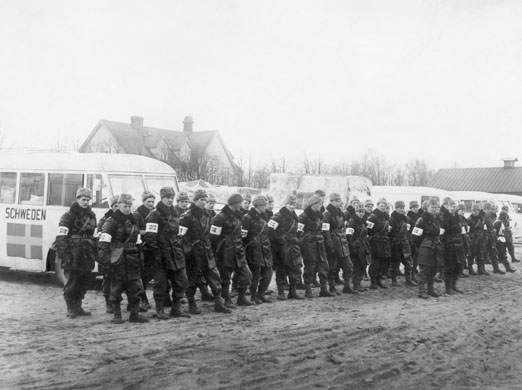
Photo credit: courtesy of the Swedish Red Cross
During World War II, Adolph Hitler, eager as current European leaders for war with Russia, plainly aimed to eliminate the Jews in Europe. He wanted to create “Grossedeutchland,” – “Greater Germany.” The SS had turned into an immense bureaucracy under Himmler’s control, systematically enacting Hitler’s hideous “final solution.” Amid chaotic and extremely dangerous conditions Bernadotte and his team steadily negotiated liberation and transport of prisoners.
Sune Persson records, in Escape from the Third Reich: Folke Bernadotte and the White Buses, the minutes from the May 13, 1945, gathering of the Jewish Stockholm Community. The chairperson thanked the Swedish Red Cross and Count Bernadotte:
“When the assembly now gathers here today, it is with a strong sense of entering a new epoch. These recent times, darker than humanity has ever known them, have reached a climax, so desperately coveted, and we stand –yearning, inquiring, hopeful – on the threshold of a new world…We would like to think at this moment of the admirable rescue operation undertaken by the Swedish Red Cross, bringing thousands of people – among them a considerable number of Jews – here to our country, to liberation from the horrors of the concentration camps and a terrible demise.”
But Bernadotte’s work on behalf of refugees and mediation wasn’t finished. After World War II, the United Nations Security Council unanimously chose Bernadotte to be the UN Security Council mediator in the Arab–Israeli conflict of 1947–1948.
Count Folke Bernadotte’s first report to the Secretary General outlined the desperate plight of Palestinian refugees, nearly a quarter of whom, he wrote, “are simply camped out and living under trees. In most places there was absolutely no sanitary accommodation, and since water was drawn from surface collections, and typhoid was endemic, grave possibilities in this regard at this season of the year were likely.”
He surveyed destroyed Palestinian villages and witnessed long lines of people waiting for food, scarce medical aid, and an ongoing humanitarian disaster. He and U.S. diplomat Ralph Bunche wrote a proposal to meet short-term and long-term needs of refugees. Their plan would allow for fixed boundaries between the Israelis and the Palestinians, with an economic union between the states and assurance that Palestinian refugees could return.
“It would be an offence against the principles of elemental justice,” Bernadotte wrote, “if these innocent victims of the conflict were denied the right to return to their homes, while Jewish immigrants flow into Palestine.”
Boldly and truthfully, Bernadotte drew links between meeting humanitarian needs and creating an environment in which peace could take hold. He insisted the UN must respect the refugees’ “unconditional right to make a free choice.”
Bernadotte’s and Ralph Bunche’s report was submitted to the UN on September 18, 1948, but Bernadotte did not live to present it in person. On September 17, terrorists from an extremist Zionist group, the Stern Gang, ambushed Bernadotte’s motorcade. They fired six bullets into Bernadotte’s body. His colleague, the French Colonel André Sérot was killed by seventeen bullets.
Count Bernadotte’s principled humanitarian work may have cost him his life, but we can choose to continue his legacy.
It’s encouraging to know that the 2026 Stockholm Forum for Peace and Development has recognized a fundamental reality: “many modern security risks, from climate shocks to pandemics and cyber threats, do not have hard security solutions and do not stop at borders. They are, however, further exacerbated when geopolitical rivalries undermine cooperative solutions.”
I hope Count Bernadotte’s inspiring life and Isak Hernández’s compassionate insistence: “I won’t be silent,” will steer us as we reckon with what Dr. King called “the fierce urgency of now.”
_________________________________________
 Kathy Kelly is a member of the TRANSCEND Network for Peace Development Environment, board president of World BEYOND War, an American peace activist, pacifist and author, one of the founding members of Voices in the Wilderness, and currently a co-coordinator Voices for Creative Nonviolence. Three times since 2000, she has been nominated for the Nobel Peace Prize. As part of peace teamwork in several countries, she has traveled to Iraq twenty-six times, notably remaining in combat zones during the early days of both US-Iraq wars. Her recent travel has focused on Afghanistan and Gaza, along with domestic protests against U.S. drone policy. She has been arrested more than sixty times at home and abroad, and written of her experiences among targets of U.S. military bombardment and inmates of U.S. prisons. She lives in Chicago. kathy@vcnv.org – info@vcnv.org – kathy.vcnv@gmail.com
Tags: Anti-NATO, European Union, Gaza, Genocide, Israel, Nonviolence, Palestine, Peace, USA, Warfare, Zionism
This article originally appeared on Transcend Media Service (TMS) on 17 Aug 2026.
Anticopyright: Editorials and articles originated on TMS may be freely reprinted, disseminated, translated and used as background material, provided an acknowledgement and link to the source, TMS: Courage for Peace, Not for War, is included. Thank you.
If you enjoyed this article, please donate to TMS to join the growing list of TMS Supporters.

This work is licensed under a CC BY-NC 4.0 License.
2 Responses to “Courage for Peace, Not for War”
Join the discussion!
We welcome debate and dissent, but personal — ad hominem — attacks (on authors, other users or any individual), abuse and defamatory language will not be tolerated. Nor will we tolerate attempts to deliberately disrupt discussions. We aim to maintain an inviting space to focus on intelligent interactions and debates.
great article, raising stirring memories of peace processes that worked and of the heroes who built peace and who built the UN
great article, raising stirring memories of famous peace activities and the builders of the UN