
The New Israel and the New Palestine: A Value-Based Peace Proposal for the Middle East
CONFLICT RESOLUTION - MEDIATION, 18 May 2026
Prof W. Julian Korab-Karpowicz, Ph.D. - TRANSCEND Media Service
“The world is the totality of values, rather than the totality of facts.”
— Tractatus Politico-Philosophicus, 7.2021
Modern diplomacy consistently fails in the Middle East because it treats the Israeli-Palestinian conflict as a zero-sum collision of physical facts, borders, and raw power politics. This paper (Korab-Karpowicz 2026b) operationalizes the evolutionary axiology of the Tractatus Politico-Philosophicus to present a structural, value-based alternative.
By rejecting the Hobbesian trap of mechanically dividing the contested territory of the West Bank, I propose a grand geopolitical exchange: the complete integration of the West Bank into Israel to ensure its strategic and historical security, balanced by the creation of “The New Palestine”—a sovereign, world-class hyper-developed state encompassing the Gaza Strip and an expanded territory in the Sinai Peninsula, funded entirely by the international community.
I. Foundational Principles and Critique of Power Politics
-
The Fallacy of Perpetual War (Korab-Karpowicz 2017, 7.321, 7.6321): Obtaining peace by Israel through endless conflict and the destruction of potential enemies in the neighborhood is a mathematical and moral illusion. Violence triggers violence; no military hegemony lasts forever. Humanity requires peace as a prerequisite for the civilizing process and further human evolution.
-
The Axiom of Fairness (10.2): True peace cannot be built at the expense of others. Guided by the principle that “everyone should be happy, but not at the expense of others,” this proposal satisfies the profound, legitimate historical and security needs of the Jewish people without degrading the dignity and prosperity of the Palestinian people.
-
The Hobbesian Territorial Dilemma: If two distinct groups desire the exact same piece of land which they cannot mutually enjoy, they are structurally bound to destroy each other. Dividing the narrow geography of the West Bank is an obsolete approach that guarantees continuous friction.
II. The Architecture of the Two-State Solution
A. The New Israel and the Spiritual Capital of the World
-
Territorial Integrity: The entire West Bank (incorporating the historical lands of Judea and Samaria) along with the Golan Heights shall be recognized as sovereign Israeli territory, providing Israel with defensible, continuous borders.
-
The Status of Jerusalem: Tel Aviv shall remain the political and administrative capital of Israel. Jerusalem shall be elevated beyond provincial politics to become the Spiritual Capital of the World.
-
The Mission of Israel: In alignment with their historical legacy, the Jewish people shall act as the guardians of the sacred, rather than masters of war. Jerusalem will serve as an ecumenical “city on the hill” where Judaism, Christianity, and Islam meet to foster global spiritual unity (7.6312).
B. The New Palestine: The Next Global Center
-
Territory: The sovereign state of Palestine shall encompass the Gaza Strip linked to a newly designated, hyper-developed territory in the Sinai Peninsula—ideally one and a half times the size of the West Bank.
-
The Dubai-IMEC Model: New Palestine will be designed as a major commercial, trade, and transportation hub, matching the infrastructure of Dubai. It will feature world-class administrative buildings, schools, universities, hospitals, and luxury housing.
-
Citizenship Options: Palestinians currently residing in the West Bank will be offered a dual opportunity: either to remain in their homes and voluntarily acquire Israeli citizenship with full equal rights, or to relocate to the highly prosperous New Palestine with full international financial compensation and guaranteed liberties.
III. Operational Implementation and Global Security
-
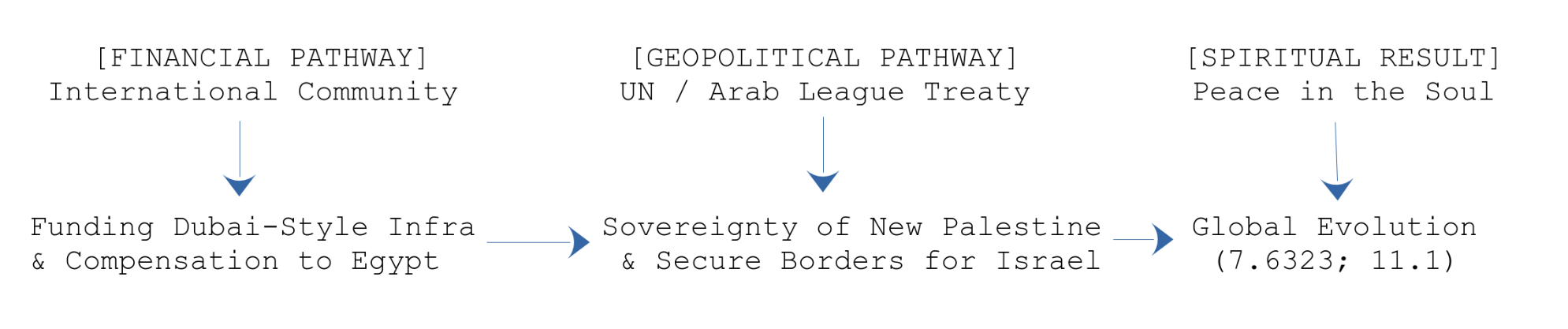
International Compensation for Egypt: While Egypt cedes a sparsely populated portion of the Sinai desert, it is an asset to their long-term stability. The international community, via a synchronized UN fund, will provide Egypt with a multi-billion dollar financial package to fully compensate its treasury and foster its own economic renewal.
-
Economic Feasibility: The cost of building New Palestine is significantly lower than the trillions of dollars currently lost by the global economy due to ongoing Middle Eastern instability, energy market volatility, and endless foreign military interventions.
-
Algorithmic Security and Demilitarization: To ensure absolute security for Israel, the New Palestine shall be fully demilitarized. Its borders and airspace will be monitored by a state-of-the-art, international AI-driven satellite network managed by a neutral coalition (e.g., UN and League of Arab States).
IV. A Value-Based Peace Proposal for the Middle East
Here are the key ethical and philosophical pillars:
1. The “New Palestine” Project as an Act of Justice and Reparation
• Geography and Sovereignty: The New Palestine encompasses the Gaza Strip and the adjacent Sinai area (one and a half times the size of the West Bank). This solution creates a coherent, secure, and sovereign Palestinian state.
• The Dubai/IMEC Model: You reject treating Palestinians as beneficiaries of humanitarian aid. You propose the creation of a “second Dubai”—a wealthy commercial and technological center. It is compensation and reward for decades of suffering (7.62 – culture as a response to human needs).
• Justification for Migration: Citing historical examples of mass migrations (Poland 1945, India/Pakistan 1947) demonstrate that relocation, though difficult for people, is sometimes the only rational way to permanently separate the warring parties and end the bloodshed.
2. The Mission of the “New Israel”: From Guardians of War to Guardians of Holiness
• Rejection of the Price of Blood: The message to Israel is that its historical and spiritual mission of bringing justice to humanity cannot be fulfilled through war (which is contrary to the essence of wisdom).
• Jerusalem as the Spiritual Capital of the World: Tel Aviv remains the political capital. Jerusalem is elevated above mundane politics, becoming an ecumenical “city on a hill” – a meeting place for Judaism, Christianity, and Islam (7.6312 – one timeless spirituality, many paths). Jews become trustees of the sacred, not masters of war.
V. Conclusion: The Appointed Time (7.9)
Humanity currently faces the threat of total annihilation driven by the misuse of technology and reductionist political models. The conflict in the Middle East acts as the primary catalyst for this global destabilization.
Peace on earth produces peace and silence in the soul, which leads to reflection, and reflection bestows liberation (7.6323–7.6325). Humanity needs peace for further evolution, for “ever-greater freedom, and moral and intellectual perfection” (11.1). “The importance of peace and human cooperation for humanity is that only in conditions of peace and cooperation can humans develop further and advance in the evolutionary process” (Korab-Karpowicz 2026a).
This proposal provides world leaders with a concrete path to move away from destructive tendencies. Every great change requires the right people and the right timing. The time to implement this value-based solution is now.
References
Korab-Karpowicz, W. J. (2017). Tractatus Politico-Philosophicus: New directions for the future development of humankind. Routledge.
Korab-Karpowicz, W. J. (2026a). Political Realism: An evolutionary theory of international relations. Routledge.
Korab-Karpowicz, W. J. (2026b). The New Israel and the New Palestine: A value-based peace proposal for the Middle East [Unpublished policy paper]. TPP-MENA-2026-01, Warsaw Academy of International Relations and American Studies (WSSMIA).
_________________________________________________________
 Prof W. Julian Korab-Karpowicz, Ph.D. is one of Poland’s most renowned philosophers and political theorists. He has received his doctorate in philosophy from the University of Oxford and has taught at many universities, including the University of Opole, the Anglo-American University of Prague and the Texas State University in San Marcos. In 2021-2022 he was a Lady Davis Visiting Professor at the Hebrew University of Jerusalem. He published several books, including Political Realism: An Evolutionary Theory of International Relations (Routledge 2026) and Tractatus Politico-Philosophicus: New Directions for the Future Development of Humankind (Routledge 2017). He is also the author of a well-known article on “Political Realism in International Relations” in the Stanford Encyclopaedia of Philosophy.
Tags: Conflict Analysis, Conflict Mediation, Conflict Transformation, Gaza, Genocide, Israel, Middle East, Palestine, Solutions, West Bank
This article originally appeared on Transcend Media Service (TMS) on 18 May 2026.
Anticopyright: Editorials and articles originated on TMS may be freely reprinted, disseminated, translated and used as background material, provided an acknowledgement and link to the source, TMS: The New Israel and the New Palestine: A Value-Based Peace Proposal for the Middle East, is included. Thank you.
If you enjoyed this article, please donate to TMS to join the growing list of TMS Supporters.

This work is licensed under a CC BY-NC 4.0 License.
Join the discussion!
We welcome debate and dissent, but personal — ad hominem — attacks (on authors, other users or any individual), abuse and defamatory language will not be tolerated. Nor will we tolerate attempts to deliberately disrupt discussions. We aim to maintain an inviting space to focus on intelligent interactions and debates.
Read more
Click here to go to the current weekly digest or pick another article:
CONFLICT RESOLUTION - MEDIATION: