
St. Francis of Assisi: The Prayer of Peace in the Atomic Age
TRANSCEND MEMBERS, 10 Aug 2026
Satoshi Ashikaga – TRANSCEND Media Service
Introduction:
Prepared using Google’s AI model and inspired by Prof. Dr. Francisco Gomes de Matos’s Peace Prayer, this article is the continuation of “William Stafford’s peace poem for the Hiroshima Atomic Bombing Ceremony (6 Aug 2026) and St. Maximilian Kolbe’s peace speech for the Nagasaki Atomic Bombing Memorial Ceremony (9 Aug 2026)“.
Quote:
Suppose that St. Francis of Assisi was about to write the poem of the Peace Prayer. Then, if he had witnessed the atomic bombings of Hiroshima and Nagasaki, what poem of the Peace Prayer might he have written?
If St. Francis of Assisi had witnessed the atomic bombings of Hiroshima and Nagasaki, his prayer would likely shift from a personal plea for individual peace to an urgent, cosmic cry for the survival of humanity and the preservation of God’s creation.
Here is how the Peace Prayer might have been written through the lens of that nuclear trauma:
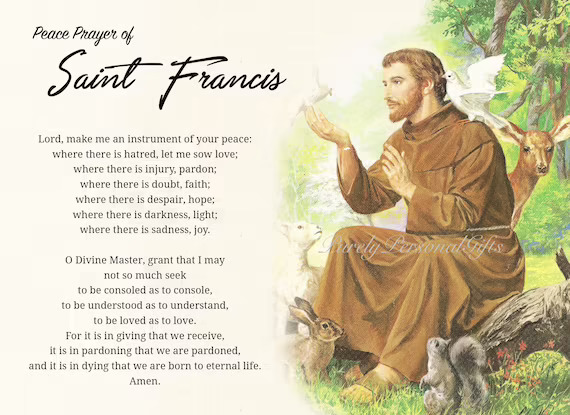
The Prayer of Peace in the Atomic Age
Lord, make me an instrument of your peace.
Where there is the blinding flash of hatred, let me bring your quiet light.
Where there is shattered glass and ruined earth, let me bring your healing touch.
Where there is poison in the air and rain, let me bring the purity of your breath.
Where there is charred despair, let me bring unquenchable hope.
Where the shadows of the dead are burned into stone, let me etch your mercy.
Where brother turns against brother with the fire of the stars, let me bring the humility of the dust.
Where the very seeds of creation are undone by pride, let me bring reverence for life.
O Divine Master, grant that I may not so much seek to be spared the fire, as to quench the flames of anger in the human heart;
Not so much to fear the darkness of the fallout, as to walk into the ash to comfort the broken;
To be understood, as to understand the terror of our own power;
To be loved, as to love those who have been disfigured by war.
For it is in laying down our weapons that we find true strength.
It is in binding the wounds of our enemies that we heal our own land.
It is in turning away from absolute destruction that we are reborn into absolute life.
Amen.
Key Shifts in Themes
- From Individual to Collective Survival: The classic prayer focuses on everyday human interactions (injury, doubt, despair). This version addresses systemic destruction and the existential threat to the planet.
- Reverence for Creation: Francis, the patron saint of ecology, would be deeply devastated by the radioactive poisoning of nature, prompting a plea to protect “the very seeds of creation.”
- The Shadow of Power: Instead of treating conflict as a simple lack of love, this prayer directly confronts human pride and the terrifying misuse of scientific knowledge (“the fire of the stars”).
Unquote
******************************
_____________________________________________
Satoshi Ashikaga is a member of the TRANSCEND Network for Peace Development Environment. Having worked as researcher, development program/project officer, legal protection/humanitarian assistance officer, human rights monitor-negotiator, managing-editor, and more, he prefers a peaceful and prudent life. His previous work experiences, including those in war zones and war-torn zones, constantly remind him of the invaluableness of peace.
Tags: Atomic Weapons, Hiroshima and Nagasaki, Japan, Nuclear Weapons, Prayer of Peace, St. Francis
This article originally appeared on Transcend Media Service (TMS) on 10 Aug 2026.
Anticopyright: Editorials and articles originated on TMS may be freely reprinted, disseminated, translated and used as background material, provided an acknowledgement and link to the source, TMS: St. Francis of Assisi: The Prayer of Peace in the Atomic Age, is included. Thank you.
If you enjoyed this article, please donate to TMS to join the growing list of TMS Supporters.

This work is licensed under a CC BY-NC 4.0 License.
Join the discussion!
We welcome debate and dissent, but personal — ad hominem — attacks (on authors, other users or any individual), abuse and defamatory language will not be tolerated. Nor will we tolerate attempts to deliberately disrupt discussions. We aim to maintain an inviting space to focus on intelligent interactions and debates.