
Xi Warned Trump of the ‘Thucydides Trap’–What Is It?
SPOTLIGHT, 18 May 2026
Leo Sands | The New York Times - TRANSCEND Media Service
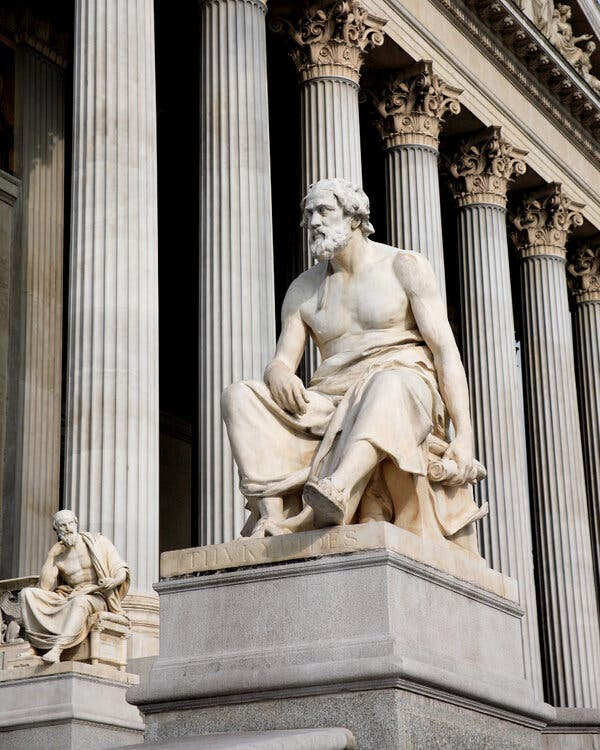
A statue of Thucydides, the Athenian general and historian, outside the parliament building in Vienna.
Credit…Eye Ubiquitous/Universal Images Group, via Getty Images
China’s leader reached for Greek history to warn the United States of what can happen when a rising power meets an incumbent one.
14 May 2026 – As the leaders of the United States and China met in Beijing today, Xi Jinping had a much older rivalry on his mind.
The Chinese president invoked a warning from the Classical world, when the Greek city-states of Athens and Sparta went to war, saying that the United States and China should beware the “Thucydides Trap” in their own relations.
Mr. Xi cited the concept, popularized in recent decades, as he warned that Beijing and Washington could enter an “extremely dangerous place” if President Trump sought to impede China as it asserted itself over Taiwan.
The trap referred to by Mr. Xi was named for Thucydides, the ancient Athenian general, whose account of the Second Peloponnesian War (431 B.C. to 404 B.C.) is considered one of the first written military histories.
In it, Thucydides argued that the war between Athens and Sparta was driven by the threat posed to an established power by one gaining strength. “The rise of Athens frightened Sparta and forced them into war,” wrote Thucydides. (The precise translation is contested among classicists).
For some scholars, the war — and the explanation offered for it in that ancient passage — presaged nearly every major conflict to follow. The international relations theorist Graham Allison dubbed it the “Thucydides Trap” in the early 2010s.
“The idea is that when an established, great power is met with a rising power, conflict between the two is certainly likely if not inevitable,” said Daniel Sutton, a classicist at the University of Cambridge who studies Thucydides, on Thursday.
In Mr. Xi’s version of the analogy, an emboldened China is the Athens to an American Sparta.
To demonstrate his theory, Professor Allison identified 16 times in history that a rising power threatened to displace a ruling one. According to his tally, which is subjective, 12 of the 16 rivalries ended in a conflict.
For more than a decade, Mr. Xi and top-ranking Chinese diplomats have invoked the concept, but presented it as a cautionary tale rather than an inevitability.
“There is no such thing as the so-called Thucydides Trap in the world,” said Mr. Xi in 2015, before an audience that included the former secretary of state Henry Kissinger.
It was on his mind again on Thursday. Speaking before Mr. Trump in the Great Hall of the People, Mr. Xi said the world had reached a new crossroads. “Can China and the United States overcome the ‘Thucydides Trap’ and establish a new paradigm for relations between great powers?” he asked.
Ryan Swan, a China-U.S. relations expert at the Bonn International Centre for Conflict Studies in Germany, saw Mr. Xi’s repeated use of the concept as part of a wider diplomatic effort by Beijing to cast itself as a “responsible great power” that can coexist peacefully with the United States.
Since taking office in 2012, Mr. Xi has pressed for the United States to treat China as an equal and not oppose Beijing in its backyard, a validation that Chinese officials believe would produce a more stable coexistence.
“China views the Thucydides Trap not as a predictive model, as it has occasionally been used in Western circles, but as a threat that can and should be avoided,” said Mr. Swan.
Tags: Anti-hegemony, Anti-imperialism, China, Conflict, Diplomacy, South China Sea, Taiwan, Thucydides Trap, Trump, USA, Xi Jinping
DISCLAIMER: The statements, views and opinions expressed in pieces republished here are solely those of the authors and do not necessarily represent those of TMS. In accordance with title 17 U.S.C. section 107, this material is distributed without profit to those who have expressed a prior interest in receiving the included information for research and educational purposes. TMS has no affiliation whatsoever with the originator of this article nor is TMS endorsed or sponsored by the originator. “GO TO ORIGINAL” links are provided as a convenience to our readers and allow for verification of authenticity. However, as originating pages are often updated by their originating host sites, the versions posted may not match the versions our readers view when clicking the “GO TO ORIGINAL” links. This site contains copyrighted material the use of which has not always been specifically authorized by the copyright owner. We are making such material available in our efforts to advance understanding of environmental, political, human rights, economic, democracy, scientific, and social justice issues, etc. We believe this constitutes a ‘fair use’ of any such copyrighted material as provided for in section 107 of the US Copyright Law. In accordance with Title 17 U.S.C. Section 107, the material on this site is distributed without profit to those who have expressed a prior interest in receiving the included information for research and educational purposes. For more information go to: http://www.law.cornell.edu/uscode/17/107.shtml. If you wish to use copyrighted material from this site for purposes of your own that go beyond ‘fair use’, you must obtain permission from the copyright owner.
Join the discussion!
We welcome debate and dissent, but personal — ad hominem — attacks (on authors, other users or any individual), abuse and defamatory language will not be tolerated. Nor will we tolerate attempts to deliberately disrupt discussions. We aim to maintain an inviting space to focus on intelligent interactions and debates.