
The US Mis-imagination of China
SPOTLIGHT, 18 May 2026
Amb. Chas W. Freeman, Jr. - TRANSCEND Media Service
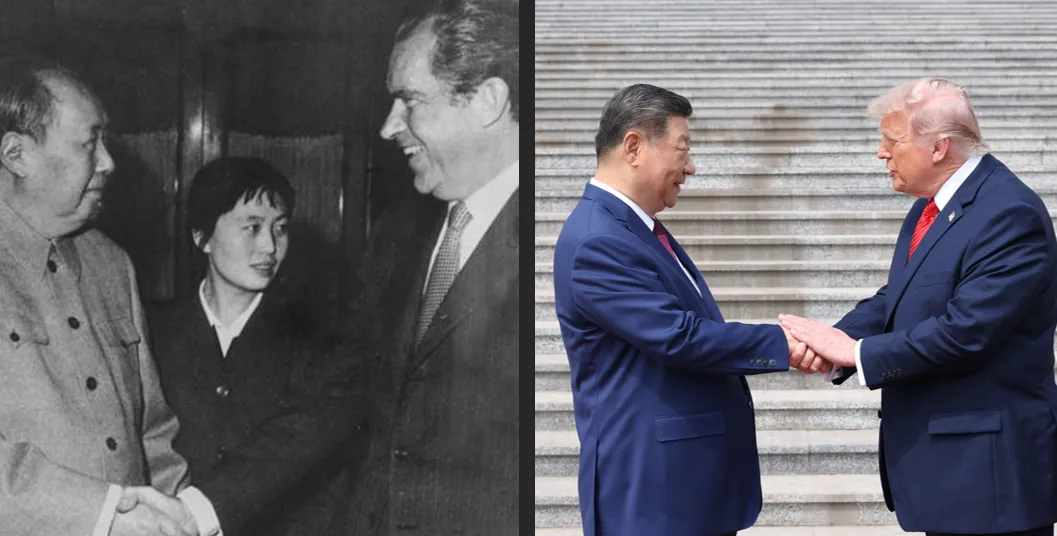
Left: Chairman of the Chinese Communist Party Mao Zedong, Mao’s private secretary Zhang Yufeng and President of the United States Richard Nixon.
White House Photo Office (1969 – 1974)
Right: Chinese President Xi Jinping holds a welcome ceremony for U.S. President Donald Trump on a state visit to China, outside the Great Hall of the People, 14 May 2026.
Credit: Huang Jingwen/Xinhua/Alamy Live News
14 May 2026 – Current US policies toward China combine protectionism, technological containment, the disruption of supply chains born of comparative advantage, economic warfare aimed at the exclusion or displacement of China in third-country markets, and the rejection of threat reduction through diplomacy in favor of deterrence by purely military means. These policies have:
- Stimulated industrial growth in countries open to Chinese investment and technology transfers, with little or no “reshoring” of the manufacturing to the United States they were supposed to promote.
- Done nothing to enable us to compete effectively with China in foreign markets.
- Not reduced our global trade deficit but increased it at the expense of American consumers.
- Boosted, not retarded, Chinese technological innovation.
- Encouraged U.S. scientists (not just those of Chinese origin) to depart the U.S. for the more favorable research and development ecosystem that now prevails in China.
- Deprived us of Chinese investment in our industries and agriculture or access to China’s increasingly innovative technological advances.
- Jeopardized the monopoly position of the U.S. dollar in trade settlement.
- Absented us from international organizations and groupings, enabling China and other countries to displace any American role in shaping the rules they make or influencing the decisions they take.
- Encouraged Pacific Asian countries to coordinate their trade and investment policies with China and with each other rather than us.
- Increased the danger that China will conclude that the Taiwan issue can only be resolved through the use of force, and
- Set off a nuclear arms race with China.
These policies are based on unrealistic views of China and the emerging multi-nodal world order. They do not serve our interests.
Nine weeks ago, Israel and the United States went to war with Iran for reasons that defy simple explanation. The disastrous results should remind us that there are a great many matters that the use of force cannot settle and may instead exacerbate. The return of China to wealth, power, and preeminence in its region is one such. China is once again able to defend itself against any enemy tempted to assault. This does not threaten the United States unless we choose war with China over peace with it.
China has an unfinished civil war, but it threatens none of its neighbors with conquest. It does not covet Lebensraum – territories beyond those internationally recognized as “Chinese.” It believes in market access through trade, not mercantilist colonial capture. It is as respectful of democracies as of all other political systems. It lacks any impulse to impose its ideology or political system on others. China has no aggressive military presence at our borders, though we maintain such a presence on its.
To treat China as a military rather than economic, scientific, and technological challenge says almost all you need to know about today’s America and nothing significant about contemporary China. We are making the same mistake that the Soviet Union made when it spent itself into oblivion in an effort to outdo us militarily. We are setting ourselves up for China to do the same to us.
The United States has misdiagnosed the politico-economic challenges of the 21st century, including its industrial challenges. China is out-competing us not with subsidies or low labor costs but through technological innovation and the integration of industrial software, factory deployment, and an increasingly well-educated workforce. China once struggled to overtake other countries. Today those countries strive to catch up to China. Tesla’s plant in Shanghai produces twice as many cars per worker as its plant in California. We should be asking ourselves what elements of the Chinese ecosystem enable it to do what it does, not how we can reduce Shanghai or Beijing to the condition of Tehran.
Deng Xiaoping’s abandonment of top-down direction and control of China’s economy in favor of market economics and political and financial incentives for entrepreneurship and job creation was inspired in part by Chinese study of our example. Deng knew what it would take to make China great again. He cut the budget for the Chinese military and downsized it to fund reforms and productive investment in education, agriculture, industry, and science and technology. He thereby laid the basis for a rejuvenated China. We are now doing the opposite. To compete with the increasingly wealthy and powerful China that Deng’s “reform and opening” created or with other rising or resurgent powers, we need to reexamine our priorities. Getting our own act together is far more important than trying to impair China’s.
John Hay was onto something when he saw an Open Door as the key to China’s modernization. This is not surprising. It was very American. The United States became the pre-eminent society on the planet in part through our unique openness to foreigners and foreign ideas. The reversal of this openness now taking place promises to debase and debilitate us. It is no accident that international respect for China’s leadership has now overtaken our own. China’s future role in world affairs will be determined not just by its interaction with us but by its interactions with others. Our role will be determined in no small measure by how we handle our relations with China.
Today’s world is very different from Hay’s. There is no Pax Britannica or Pax Americana. The West no longer dominates global politics or the world economy. Old alliances have died or are decaying. Global disorder contrasts with emerging regional orders. Countries that were once vassals of imperial powers are themselves emerging as great powers, not just in their own regions but globally.
Several geopolitical epochs have passed. World affairs are no longer bipolar. There is no “G-2.” We are in a new age of multi-nodality, in which middle-ranking powers can twist, turn, and adjust their political, economic, cultural, and military relationships to their advantage as they see it. The connections between great and lesser powers and in the networks they form are not just more diverse but more dynamic.
The emerging world order is one from which China cannot be excluded and from which the United States cannot afford to exclude itself. The current Sino-American relationship is marked by minimal aspirations – a search for modest strategic stability and the pursuit of minor tactical adjustments, rather than breakthroughs.
In Hay’s time, China needed the protection of a rising America to pull itself together. It was endangered not just by predatory foreign powers but by its own internal chaos and confusion. Today, in some ways, the tables are turned. We Americans need time and a peaceful international environment in which we can pull ourselves together. For this, we need a realistic and respectful relationship with a rising China.
For at least 120 years, both China and Sino-American relations have flipped and flopped in different directions with each passing decade. China need not be our Nemesis. It can yet be a partner in the rejuvenation of our republic. Another decade will soon be upon us. Let us do what we can to ensure that the changes that inevitably accompany it are positive for both Americans and Chinese!
______________________________________________
This is drawn from a talk given at Brown University on 2 May 2026 and is published with the kind permission of the author.
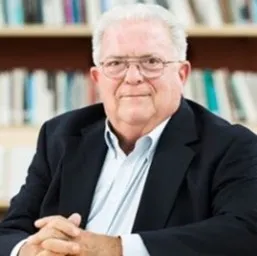 Amb. Chas W. Freeman, Jr. (USFS, Ret.) is a retired US diplomat and writer. He served in the US Foreign Service in many different capacities over the course of thirty years. Most notably, he worked as the main interpreter for Richard Nixon during his 1972 China visit; he was the U.S. Ambassador to Saudi Arabia from 1989 to 1992; and from 1993 to 1994 he was the Assistant Secretary of Defense for International Security Affairs. He is a co-chair of the U.S. China Policy Foundation and a Lifetime Director of the Atlantic Council, a Senior Fellow at the Watson Institute for International and Public Affairs, Brown University. He chairs Projects International, Inc., is an interpreter, recipient of numerous high honors and awards, a popular public speaker, and the author of five books.
Go to Original – ambassadorllp.substack.com
DISCLAIMER: The statements, views and opinions expressed in pieces republished here are solely those of the authors and do not necessarily represent those of TMS. In accordance with title 17 U.S.C. section 107, this material is distributed without profit to those who have expressed a prior interest in receiving the included information for research and educational purposes. TMS has no affiliation whatsoever with the originator of this article nor is TMS endorsed or sponsored by the originator. “GO TO ORIGINAL” links are provided as a convenience to our readers and allow for verification of authenticity. However, as originating pages are often updated by their originating host sites, the versions posted may not match the versions our readers view when clicking the “GO TO ORIGINAL” links. This site contains copyrighted material the use of which has not always been specifically authorized by the copyright owner. We are making such material available in our efforts to advance understanding of environmental, political, human rights, economic, democracy, scientific, and social justice issues, etc. We believe this constitutes a ‘fair use’ of any such copyrighted material as provided for in section 107 of the US Copyright Law. In accordance with Title 17 U.S.C. Section 107, the material on this site is distributed without profit to those who have expressed a prior interest in receiving the included information for research and educational purposes. For more information go to: http://www.law.cornell.edu/uscode/17/107.shtml. If you wish to use copyrighted material from this site for purposes of your own that go beyond ‘fair use’, you must obtain permission from the copyright owner.
Join the discussion!
We welcome debate and dissent, but personal — ad hominem — attacks (on authors, other users or any individual), abuse and defamatory language will not be tolerated. Nor will we tolerate attempts to deliberately disrupt discussions. We aim to maintain an inviting space to focus on intelligent interactions and debates.