
Gulf Limbo: Between War and a Hard Place
SPOTLIGHT, 6 Apr 2026
Pascal Lottaz | Neutrality Studies – TRANSCEND Media Service
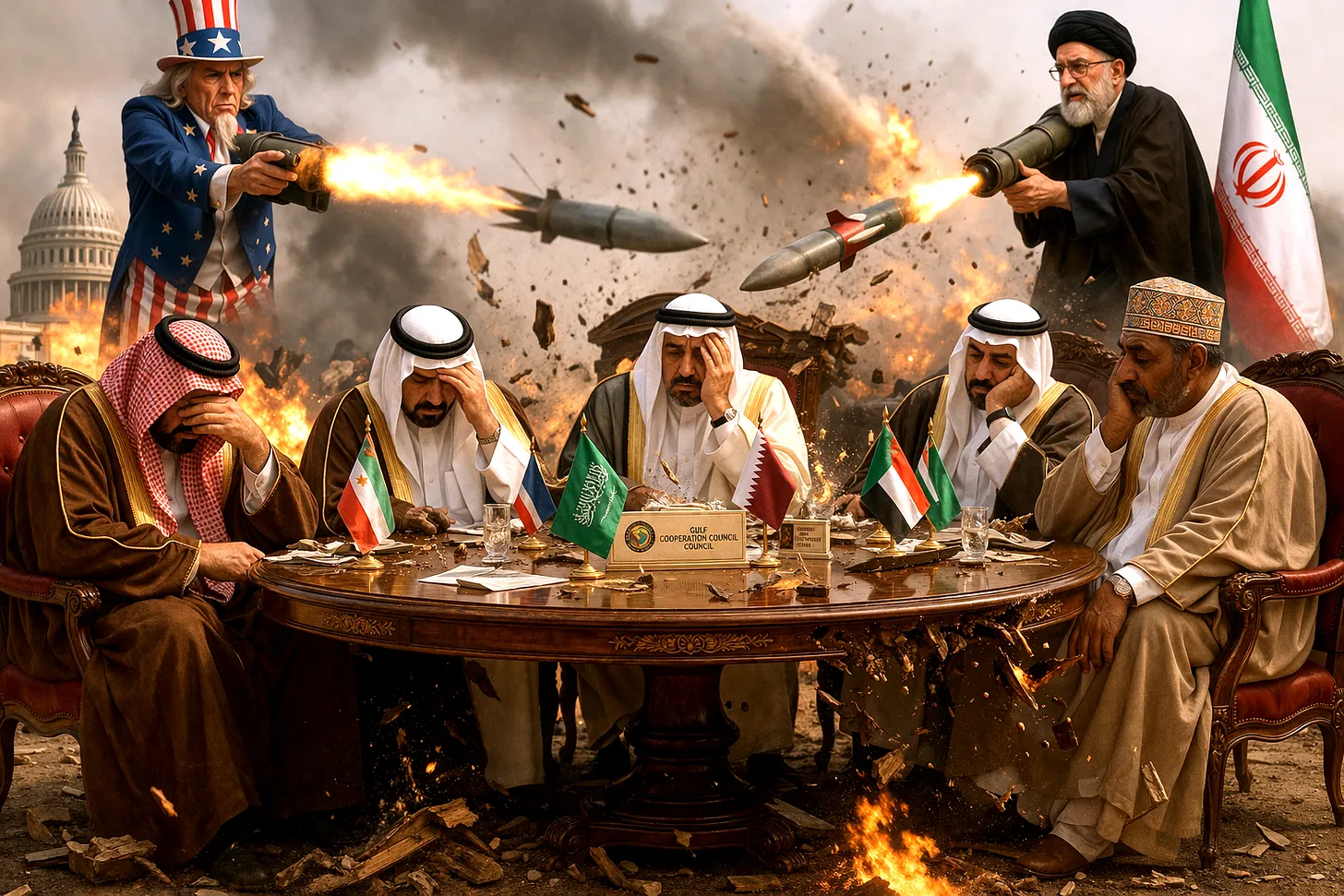
How the US ‘Allies’ in West Asia managed to maneuver themselves into the worst of both worlds.
3 Apr 2026 – On 28 February 2026, the United States and Israel jointly launched an illegal military campaign against Iran. Within hours, Iranian drones and missiles struck Manama, Abu Dhabi, Riyadh, and installations across Kuwait and Qatar—although the Gulf monarchies had not declared war on Iran. Several issued statements calling for restraint. But their capitals got hit anyhow, and the reason was not difficult to understand: these countries host the military bases from which American forces were (partially) prosecuting the illegal attacks on Iran.
This is the central issue: the Gulf monarchies wish to claim that they are not party to this war, but the legal architecture of neutrality—the only framework that could substantiate such a claim—makes it impossible for them to do so.
The law of neutrality, as it was codified in the Hague Conventions of 1907, rests on three pillars: the duty of abstention, the duty of prevention, and the duty of impartiality. A neutral state must not contribute to the hostilities; it must prevent belligerents from using its territory for military purposes; and whatever treatment it accords to one belligerent, it must accord equally to all.1 Article 1 of Convention V establishes that neutral territory is inviolable; Article 2 prohibits the movement of belligerent troops or convoys of war materials across neutral land.2 It is important to appreciate how absolute some of these obligations are. Even granting identical military facilities to both belligerents would constitute a violation, because the modern conception of neutrality—established already in the early twentieth century—requires abstention from any active or passive cooperation with belligerents in their military operations.3
Measured against these requirements, the Gulf monarchies are in comprehensive violation. Bahrain hosts the U.S. Fifth Fleet and Naval Forces Central Command. Qatar is home to Al Udeid Air Base—the largest American air installation in the Middle East, the hub from which sorties have been flown in virtually every U.S. operation in the region since 2001. Kuwait’s Camp Arifjan functions as a forward staging area for American ground forces.
The UAE and Saudi Arabia maintain extensive defense cooperation agreements, arms supply relationships, and basing arrangements that go well beyond anything a neutral state could countenance. In the language of international law, a military base on foreign territory constitutes a delimitated site for military operations of one state on the territory of another—and its legal title derives from international treaty.4 Contrasting this with Europe’s classic neutrals is quite interesting: Austria, Finland, Sweden, and Switzerland all understood that permanent neutrality required abstaining from military alliances and preventing the establishment of foreign bases on their soil, precisely because such entanglements would render neutrality incredible in time of war.5
The Gulf monarchies have pursued the exact opposite strategy. For decades, they have embedded themselves so deeply in the American security architecture that disentanglement at the moment of crisis was never a realistic option. When the strikes against Iran began, the bases were already there, the command structures were already integrated, and the logistical infrastructure was already running. Neutrality, as a legal status, was foreclosed long before anyone in Riyadh or Doha had to make a decision about the current war.
The question, then, is what status these states actually occupy? International law has encountered this problem before. The concept of non-belligerency entered the vocabulary in 1939, when Italy chose not to enter the Second World War immediately but provided substantial political and material support to Nazi Germany. Scholars have described this as a grey zone between neutrality and belligerency—variously labeled qualified neutrality, differentiated neutrality, or benevolent neutrality.6 The essential logic of non-belligerency is that the state picks a side, abandons its duties of impartiality and non-assistance, but refrains from direct participation in the fighting—hoping, in the process, to retain the legal protections that neutrality ordinarily confers.7 The United States occupied precisely this position between 1939 and 1941, supplying Britain with destroyers, occupying Greenland and Iceland, and eventually escorting Allied shipping across the Atlantic. (Remarkably, the State Department even rejected Argentina’s proposal for all American republics to formally abandon traditional neutrality—even though the United States was, by that point, neutral in name only).8
To be sure, non-belligerency has never enjoyed firm legal standing. The most thorough analyses of the traditional law of neutrality have concluded that while no formal prohibition prevented states from assisting a belligerent if they did not claim neutral status, the most important consequence was that they forfeited the protections neutrality would otherwise afford—above all, the right to territorial inviolability.9 Already by the mid-nineteenth century, qualified neutrality—a stance in which a state aids one belligerent on the basis of pre-existing treaty obligations—was controversial, and serious doubts persisted about whether it constituted neutrality at all.10
Actually, the Swedish experience during the Second World War illustrates the pattern well: non-belligerents claimed to enjoy neutral rights despite providing economic support, arms, and military facilities to a belligerent—conduct that lacked firm foundation in the law.11 The point has been made most forcefully in the legal literature on third-state support during armed conflicts: apart from two rare references in provisions of international humanitarian law, no treaty or soft-law instrument recognizes non-belligerency as a distinct legal category.12All of this suggests that non-belligerency is better understood as a political posture than as a status with legal consequences—a label states adopt when they want to have it both ways.
There is, however, the more unsettling possibility that the Gulf monarchies have crossed even the threshold of non-belligerency and entered the domain of co-belligerency. The case of Panama during the Second World War comes to mind.
Panama became a co-belligerent not merely because it declared war on the Axis powers but because it leased its territory to the United States for military operations, thereby effectively contributing to the Allied war effort. The voluntary leasing of territory for the conduct of military preparations and the transit of troops constituted a violation of the neutral duty of prevention that exposed the territory to belligerent action from the aggrieved party.13
The parallel to the Gulf states is quite obvious. By hosting bases from which the United States launches strikes against Iran, these monarchies have crossed what international law recognizes as a threshold into co-belligerency.14 The duty of impartiality encoded in Hague Convention XIII reinforces this logic: any concession granted to one belligerent—access to ports, airspace, or installations—must be extended on equal terms to all belligerents, something the Gulf states have manifestly not done.15
The Gulf monarchies thus inhabit a legal no-man’s-land that international law has never been willing to legitimize. They cannot invoke the law of neutrality because they have violated its foundational requirements—hosting belligerent forces, providing logistical infrastructure for combat operations, and maintaining military alliances incompatible with abstention, prevention, and impartiality. They do not wish to be recognized as belligerents, because such a designation would invite the full force of Iranian retaliation and strip them of any diplomatic leverage. What remains is the twilight zone of non-belligerency—a space where a state aids one side while insisting on the protections that come with standing apart. The historical record is quite clear about where this leads: states that adopted this posture before Pearl Harbor were simply violating the fundamental duties of neutrals in the most flagrant manner imaginable, running the risk that the adversary would treat them accordingly.16
Iran’s strikes on Gulf capitals on the first day of hostilities suggest that this risk has materialized. Through decades of strategic alignment with Washington, the Gulf monarchies have maneuvered themselves into a position where they are something more than neutral and something less than belligerent. The lesson from their most sorry predicament is that deep military entanglements with a great power can foreclose the option of neutrality long before the war that would test it actually begins. The Gulf monarchies never chose neutrality, and now that they need it, they cannot have it.
1. John Ross, Neutrality and International Sanctions: Sweden, Switzerland, and Collective Security (New York: Praeger, 1989), 15–16.
2. Yoram Dinstein, War, Aggression and Self-defence, 5th ed. (Cambridge: Cambridge University Press, 2012), 26.
3. Lassa F. L. Oppenheim, International Law: A Treatise—War and Neutrality (London: Longmans, Green, 1912), 382.
4. Rudolf Bernhardt, Encyclopedia of Public International Law: Use of Force—War and Neutrality Peace Treaties (A–M), vol. 3 (Amsterdam: North-Holland, 1982), 156.
5. Thomas Fischer, Juhana Aunesluoma, and Aryo Makko, “Introduction: Neutrality and Nonalignment in World Politics during the Cold War,” Journal of Cold War Studies 18 (2016): 7.
6. Luca Ferro and Nele Verlinden, “Neutrality During Armed Conflicts: A Coherent Approach to Third-State Support for Warring Parties,” Chinese Journal of International Law 17 (2018): 33.
7. Stephen C. Neff, The Rights and Duties of Neutrals: A General History (Manchester: Manchester University Press, 2000), 197–198.
8. Jürg Martin Gabriel, The American Conception of Neutrality after 1941 (New York: Palgrave Macmillan, 2002), 90.
9. Kentaro Wani, Neutrality in International Law: From the Sixteenth Century to 1945 (New York: Routledge, 2017), 191.
10. Elizabeth Chadwick, Traditional Neutrality Revisited: Law, Theory and Case Studies (The Hague: Brill, 2002), 80–81.
11. Mikael af Malmborg, Neutrality and State-building in Sweden (New York: Palgrave, 2001), 137.
12. Ferro and Verlinden, “Neutrality During Armed Conflicts,” 33–34.
13. Alonso E. Illueca, “International Coalitions and Non-Militarily Contributing Member States: A Perspective from Panama’s Practice and the Law of Neutrality,” Inter-American Law Review 49, no. 1 (2017): 30.
14. Illueca, “International Coalitions,” 36.
15. Brian F. Havel, “An International Law Institution in Crisis: Rethinking Permanent Neutrality,” Ohio State Law Journal 61 (2000): 179.
16. Neff, Rights and Duties of Neutrals, 198.
_________________________________________________
 Pascal Lottaz – I’m a (Swiss) academic in Japan, Associate Professor at Kyoto University, working on neutrality in IR. I also run the YouTube show “Neutrality Studies“, where I explore world politics with various guests.
Go to Original – pascallotaz.substack.com
Tags: Big Oil, Fossil fuels, Gulf Cooperation Council GCC, Houthi, International Trade, Iran, Iraq, Oman, Saudi Arabia, Strait of Hormuz, Syria, Trump, UAE, US empire, Warfare, Yemen
DISCLAIMER: The statements, views and opinions expressed in pieces republished here are solely those of the authors and do not necessarily represent those of TMS. In accordance with title 17 U.S.C. section 107, this material is distributed without profit to those who have expressed a prior interest in receiving the included information for research and educational purposes. TMS has no affiliation whatsoever with the originator of this article nor is TMS endorsed or sponsored by the originator. “GO TO ORIGINAL” links are provided as a convenience to our readers and allow for verification of authenticity. However, as originating pages are often updated by their originating host sites, the versions posted may not match the versions our readers view when clicking the “GO TO ORIGINAL” links. This site contains copyrighted material the use of which has not always been specifically authorized by the copyright owner. We are making such material available in our efforts to advance understanding of environmental, political, human rights, economic, democracy, scientific, and social justice issues, etc. We believe this constitutes a ‘fair use’ of any such copyrighted material as provided for in section 107 of the US Copyright Law. In accordance with Title 17 U.S.C. Section 107, the material on this site is distributed without profit to those who have expressed a prior interest in receiving the included information for research and educational purposes. For more information go to: http://www.law.cornell.edu/uscode/17/107.shtml. If you wish to use copyrighted material from this site for purposes of your own that go beyond ‘fair use’, you must obtain permission from the copyright owner.
Join the discussion!
We welcome debate and dissent, but personal — ad hominem — attacks (on authors, other users or any individual), abuse and defamatory language will not be tolerated. Nor will we tolerate attempts to deliberately disrupt discussions. We aim to maintain an inviting space to focus on intelligent interactions and debates.