
Endogenous Peace Principles Across Civilisations, from Maat in Antiquity to Biophotonic Coherence: A Humane, Scientific, and Sacred Science of Peace Part 1
TRANSCEND MEMBERS, 20 Apr 2026
Prof Hoosen Vawda – TRANSCEND Media Service
“A Comprehensive Narrative of Ethical, Mystical, Ecological, and Neuroharmonic Pathways to the attainment of Human Communal Peace” [1]
“[2]
This publication is suitable for general readership. Parental guidance is recommended for minors who may use this research paper as a resource material, for projects.
The author invites and welcomes any comments and discussions, by the readership.
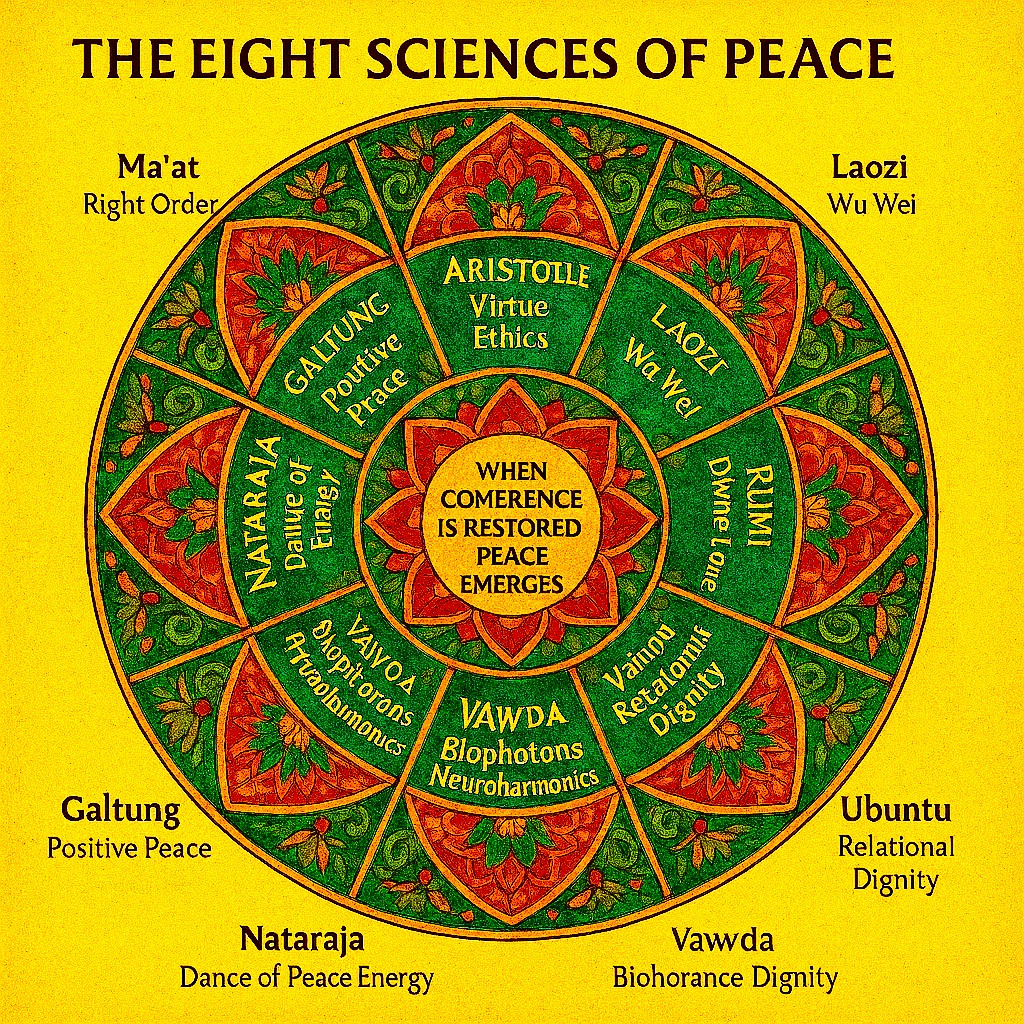
The Mandala Depicting the Eight Sciences of Peace, Through Eons.
The Peace Mandala composed from various traditions, as an Eternal Ornament to be constantly remembered.
Original Graphic Conceptualised by Mrs V. Vawda: April 2026
Mandala of the Eight Sciences of Endogenous Peace
16 Apr 2026 – This mandala‑style diagram presents a comparative and integrative model of peace across civilisations, visually synthesising eight historically distinct yet conceptually convergent peace traditions. Arranged in a circular, non‑hierarchical form, the mandala emphasises wholeness, balance, and systemic coherence, deliberately avoiding linear or scalar representations of precedence.
At the centre of the mandala is the core thesis of the work:“When coherence is restored, peace emerges.”
This central axiom represents peace as an endogenous phenomenon, an emergent property of internal order rather than an externally imposed condition.
Radiating outward, each segment of the mandala represents a distinct “science of peace,” equal in epistemic dignity and civilisational weight:
- Maat (Ancient Egypt), Right Order and Cosmic–Moral Balance
- Aristotle (Classical Greece), Rational Virtue Ethics and Justice
- Laozi (Taoism), Wu Wei: Non‑Forcing Alignment with Natural Order
- Rumi (Sufi Tradition), Transformative Peace through Love (‘Ishq)
- Ubuntu (African Philosophy), Relational Dignity and Communal Humanity
- Nataraja (Vedantic Cosmology), Dynamic Peace as Rhythmic Cosmic Coherence
- Johan Galtung (Modern Peace Studies), Positive Peace and Structural Justice
- Vawda (Contemporary Endogenous Peace Theory), Biophotonic Synchronicity and Neuroharmonic Coherence
The circular geometry signifies that peace traditions do not compete but converge, each articulating the same underlying insight through different symbolic, ethical, spiritual, ecological, or scientific languages. The absence of a dominant axis reflects a commitment to civilisational inclusivity and epistemic humility[3].
Conceptually, the mandala demonstrates that peace is sustained when coherence is achieved at multiple levels: moral, emotional, neurological, relational, systemic, and cosmic. Violence, conversely, is reframed as a manifestation of decoherence within and across systems.
This figure functions as a visual synthesis of the manuscript’s core argument, offering a unified framework in which ancient wisdom traditions and contemporary science together affirm peace as a state of regulated harmony rather than enforced stability.
Prologue
This paper, presents Part 1, in the series on the peace tenets, as espoused by socio-philosophical giants, over various epochs. Traditionally, conventional peace paradigms have largely focused on external mechanisms, treaties, deterrence, institutions, and enforcement, while persistently failing to address the recurrent roots of violence. Drawing on comparative civilisational wisdom and contemporary neurobiological insights, this paper advances a unifying framework of endogenous peace, positing peace as an emergent property of internal coherence rather than externally imposed order. By examining eight interrelated “sciences of peace”, from Maat in ancient Egypt, Aristotle’s ethical rationalism, Laozi’s Wu Wei, Rumi’s mysticism, Ubuntu’s relational humanism, the Indic cosmology of Nataraja’s dance, Johan Galtung’s structural peace theory, to Madam Vawda’s biophotonic and neuroharmonic peace paradigm, this work articulates a civilisationally inclusive, scientifically consonant, and deeply humane theory of peace. Violence is reframed not primarily as moral deviance or political failure, but as systemic decoherence within the human person and society. The paper concludes with strategic implications, a call for collective action, and a benediction for global and interstellar peace.
Human civilisation has never lacked instruments of order, laws, armies, treaties, or moral exhortations. Yet violence, domination, and structural injustice persist with remarkable regularity. This recurrence suggests a foundational misalignment: peace has been repeatedly sought as an external condition, rather than cultivated as an internal state.
Across ancient and modern civilisations alike, enduring peace traditions reveal a different orientation. From Egyptian cosmology to Taoist philosophy, from Sufi mysticism to contemporary neuroscience, a shared intuition emerges: peace originates within the human system and radiates outward only when inner coherence is sustained. This paper is offered as a bridge across epochs and epistemologies, unifying ancient wisdom with modern science into an integrated peace theory.
- Introduction
Mainstream peace discourse remains dominated by geopolitical negotiation, deterrence theory, and institutional frameworks. While necessary, these approaches largely treat violence as a failure of diplomacy or governance. This paper advances a complementary and foundational thesis:
Peace is an endogenous phenomenon, an emergent expression of coherence across moral, emotional, neurological, and biophysical systems.
By situating peace within the internal architecture of the human being, this framework does not negate structural analysis; rather, it deepens it. Civilisational peace traditions are revisited not as relics, but as early system‑level understandings now receiving empirical resonance through contemporary neuroscience and biophysics.
- The Eight Civilisational Sciences of Peace from Antiquity to the 21st Century
3.1 Maat (Ancient Pharoanic Egypt): Cosmic–Moral Order
Maat represents truth, justice, balance, and right order, the very fabric of existence. In the canonical Weighing of the Heart, moral integrity is assessed endogenously: the heart bears witness against itself. Peace is sustained when inner moral weight aligns with cosmic truth; chaos (Isfet) emerges from imbalance. This is arguably humanity’s earliest peace theory.
- Maat and the Feather
At the centre of the composition is the Feather of Maat, emblem of truth, justice, balance, and right order. The feather is not symbolic in a metaphorical sense alone; it is the ontological standard by which all existence is measured. Maat represents the condition of the universe when it is in harmony, socially, ethically, ecologically, and cosmically.
In Egyptian thought, Maat was not optional morality but the fabric of reality itself. To live “in Maat” was to live in alignment with the cosmic order established at creation.
- The Heart (Ib)
Opposite the feather lies the human heart (ib), regarded in ancient Egypt as:
- the seat of conscience,
- the locus of memory and intention,
- the centre of moral agency.
Unlike later traditions that privileged the intellect or soul, Egyptian anthropology held that the heart testified truthfully against its owner. No external advocate could override its testimony. This makes the judgement profoundly endogenous: one is measured only against one’s own inner order.
- The Scales
The balanced scales represent equilibrium rather than accusation. A heart equal in weight to the feather signifies a life lived in truth, restraint, and harmony. The image communicates a crucial principle: peace is weightless when integrity is preserved.
- Anubis
The jackal‑headed figure traditionally associated with the weighing ritual represents guidance, protection, and accurate transition. Anubis does not judge; he ensures that the process is conducted correctly, without distortion. His role underscores that justice must be procedurally pure to be cosmically valid.
- Thoth
The ibis‑headed scribe stands ready to record the outcome. Thoth embodies memory, language, measure, and order. The act of recording is significant: truth, once revealed, becomes part of eternal order. There is no appeal, because the judgement reflects the subject’s own coherence or lack thereof.
- The Absence of the Devourer
Notably, the artwork emphasises balance rather than punishment. In classical depictions, failure resulted in annihilation by the Devourer (Ammit). Here, the compositional restraint aligns with a pedagogical focus: order preserved is more important than chaos punished.
Was Maat a Female Deity?
Maat is unequivocally a female deity in ancient Egyptian religious tradition.
She is depicted as:
- a woman wearing an ostrich feather on her head,
- occasionally winged,
- often seated or standing in a posture of equilibrium.
However, it is essential to note that Maat transcends gender in function, even while being grammatically and iconographically feminine. She personifies:
- cosmic law,
- moral truth,
- natural balance,
- just governance.
Pharaohs were described not merely as worshippers of Maat, but as upholders and embodiments of Maat. To rule unjustly was to introduce Isfet (chaos), threatening not only society but the stability of the cosmos itself.
Alignment with the Endogenous Peace Framework
When read through the author’s endogenous peace lens, the Egyptian conception is strikingly prescient:
- The heart ↔ internal moral‑neurobiological coherence
- The feather ↔ optimal order / baseline harmony
- The scales ↔ dynamic regulation and balance
- Judgement ↔ emergent outcome, not imposed verdict
In modern terms, in the light of quantum physics, one might say that biophotonic and neuroharmonic coherence would metaphorically “lighten” the heart, while dysregulation, deception, and aggression would “weigh it down”.
Civilisational Insight (Timeless):
External peace cannot be sustained when internal order is lost;
cosmic harmony collapses when the heart becomes heavier than truth.
In this sense, Maat stands at the headwaters of all later peace philosophies, ethical, mystical, regulatory, and biological alike.
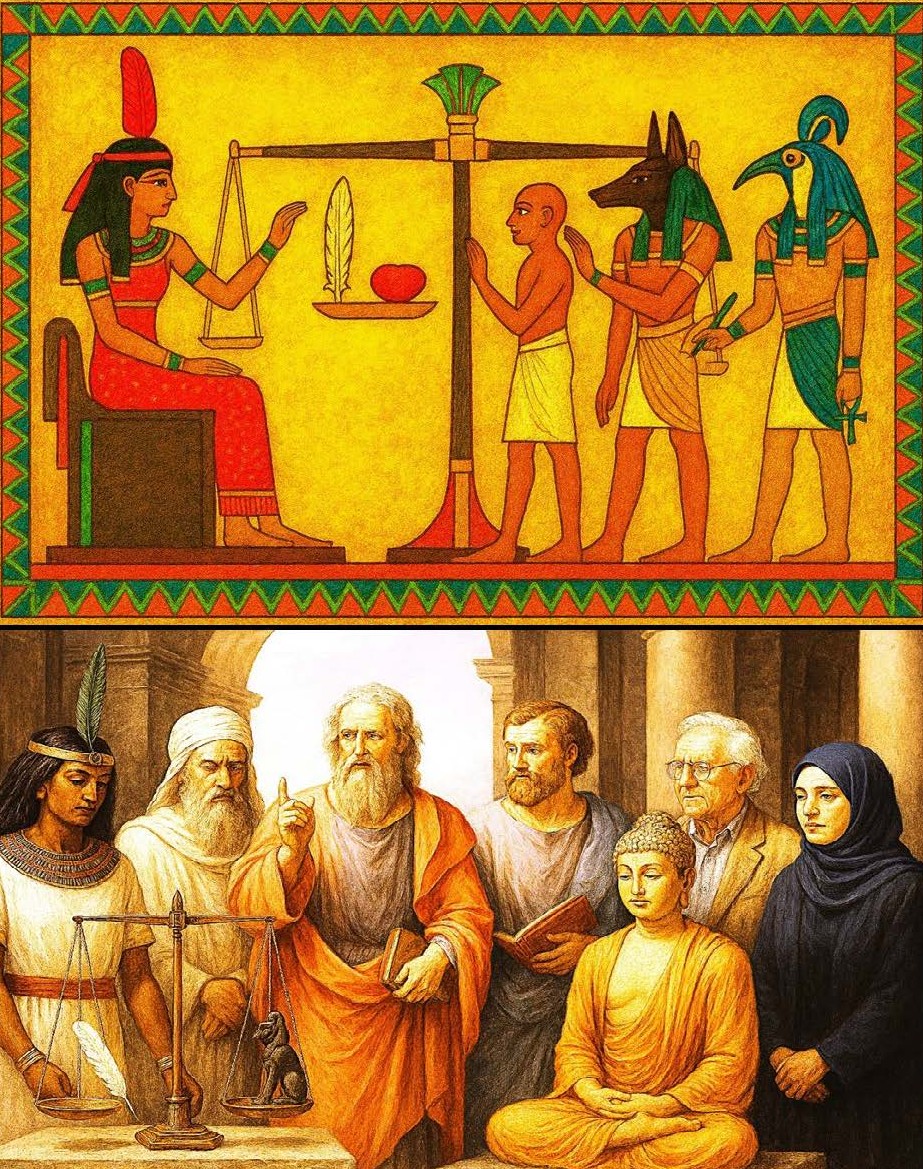
Photo Top: Maat and the Weighing of the Heart:
Cosmic Judgement, Moral Order, and Endogenous Peace in Ancient Egypt
This visual composition presents the canonical Judgement Scene (the “Weighing of the Heart”), a central motif in ancient Egyptian religious thought, most famously preserved in Chapter 125 of the Book of the Dead. The scene represents not a punitive tribunal, but a cosmic assessment of inner coherence, in which moral integrity determines harmony in both life and the afterlife.
Photo Bottom: The Lords of Peace through the different epochs, extending over millennia
A composite, photo‑realistic visual representation illustrating the civilizational continuum of peace thought from antiquity to modernity. The composition foregrounds the ancient Egyptian principle of Ma’at, symbolised through the weighing of the human heart against the feather of truth, justice, and balance, an early ethical metaphor for moral accountability and cosmic order. Surrounding this central moral axis are archetypal figures representing major philosophical and spiritual traditions of antiquity, including Persian ethical cosmology (Asha), Indic wisdom traditions (Dharma and Ahimsa), and Greek virtue philosophy, each contributing to early formulations of peace as restraint, justice, and harmony rather than mere absence of conflict. The visual progression culminates in contemporary peace propagators, symbolising the transmission, reinterpretation, and modern responsibility of these ancient peace epistemologies. The image serves as a conceptual overture to Part I of The Lords of Peace trilogy, situating modern peace theory within a deep historical and civilizational lineage.
Original Graphic Conceptualised by Mrs V. Vawda: April 2026
3.2 Aristotle in Classical Greece: Ethical, Rational Equilibrium
Aristotle situates peace as the telos of ethical life. Through reason (logos), virtue (aretē), and justice (dikaiosynē), the ordered soul gives rise to the ordered polis. Violence is not accidental but arises from ethical disarray. Peace, therefore, is cultivated through rational self‑governance. In the Aristotelian model of endogenous peace, peace is understood not as the mere absence of conflict, nor as an externally imposed political condition, but as an ethical equilibrium cultivated within the individual and sustained within the polis. Drawing from Aristotle’s Nicomachean Ethics and Politics, the composition foregrounds four interdependent moral and civic virtues, Justice, Friendship, Virtue, and Reason, as the intrinsic foundations of a peaceful society.
In Aristotle’s framework, Justice (dikaiosynē)[4] acts as the structural backbone of social harmony, ensuring proportionality, fairness, and moral accountability. Friendship (philia) functions as the affective and relational glue of the city-state, transforming coexistence into genuine civic cohesion. Virtue (aretē) represents the disciplined cultivation of moral excellence through habituation, aligning desire with ethical purpose. Reason (logos) governs the human capacity for deliberation, moderation, and self‑rule, without which neither virtue nor justice can endure.
The visual language, classical form rendered through contemporary realism and vivid chromatic symbolism, underscores Aristotle’s enduring insight that peace is not accidental nor coercive, but the natural outcome of ethical coherence within human character and communal life. In this sense, peace emerges endogenously when rational beings live virtuously in just and affectionate relation to one another, oriented toward the highest human good (eudaimonia).
“Peace is the end of war.” Aristotle, Politics, Book VII (1333a)
This succinct yet profound assertion situates peace as a telos, a moral and political end toward which all just action is ultimately directed. The artwork thus reclaims Aristotle not merely as a philosopher of ethics and politics, but as an early theorist of sustainable, virtue‑based peace, a vision of harmony that resonates deeply with contemporary discourses on inner coherence, social trust, and humane governance.
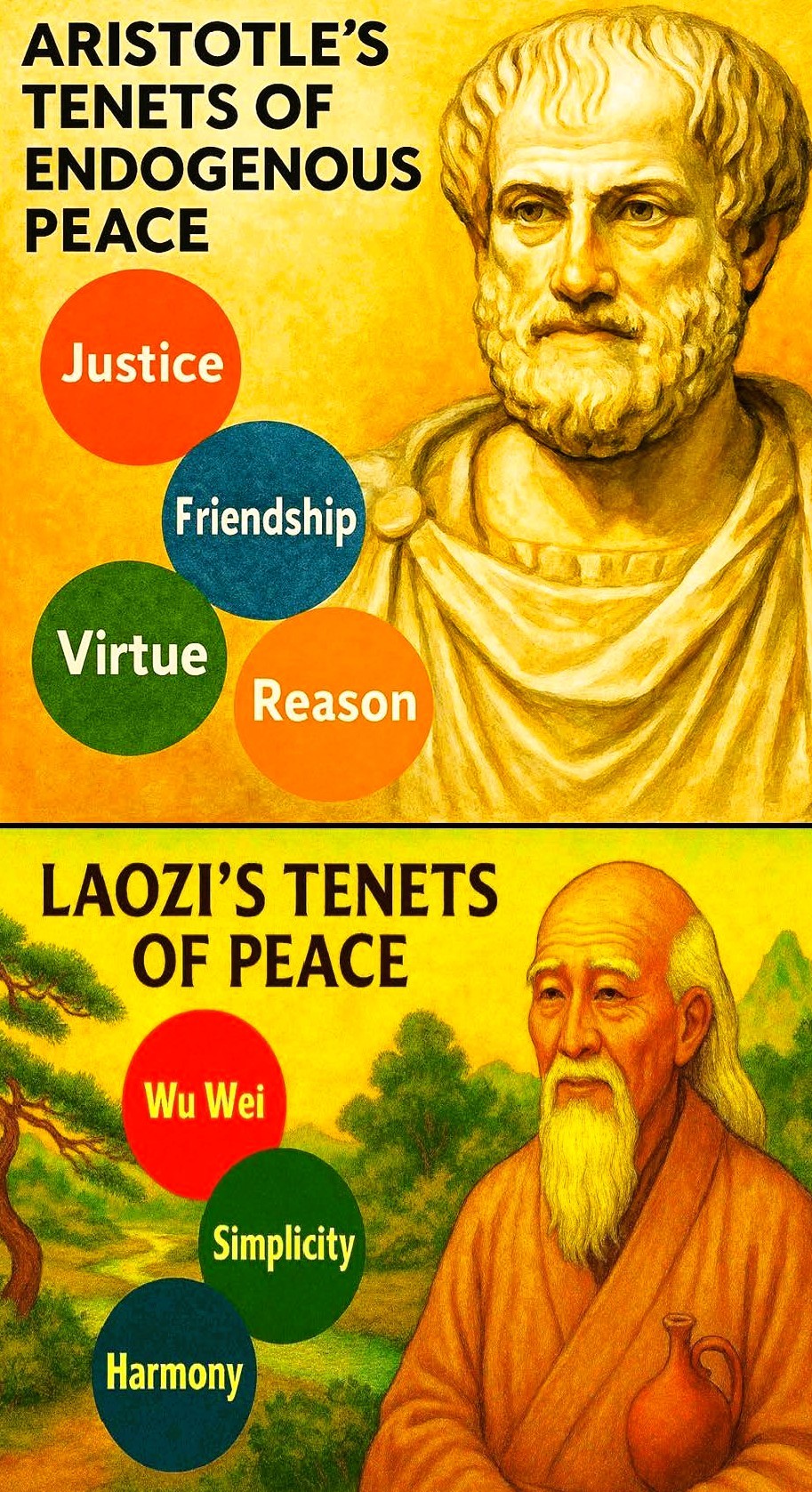
Photo Top: Aristotle in Classic Greece: Tenets of Endogenous Peace
Photo Bottom: Sage Laozi’s Taoism and Peace Tenets
Original Graphic Conceptualised by Mrs V. Vawda: April 2026
3.3 Laozi’s Taoism [5]: Wu Wei [6],[7] and Regulatory Peace [8],
Laozi’s Wu Wei, non‑forcing action, advocates alignment rather than control. Excessive intervention disrupts natural harmony. The Core of Taoist Life Philosophy for Inner Peace [9],[10]; At its heart, Taoism observes that the universe moves through a natural, effortless way, the Tao (the Way). Human suffering often begins when we resist this flow, when we grasp, control, force, or struggle against what is. Endogenous peace, therefore, is not something we manufacture but something we allow by aligning with the Tao.
The three great treasures of Taoism (compassion, frugality, and humility) all serve this inner alignment. But you have asked specifically about Wu Wei, the jewel in the crown of Taoist practice.
Peace emerges when systems self‑regulate in accordance with the Tao. This represents a profoundly ecological and neurological insight into regulation.
In this framework, peace is neither engineered through force nor secured through moral coercion, but emerges naturally when human conduct aligns with the Dao (道), the ineffable, generative principle that underlies all existence.
At the heart of this vision is Wu Wei (無為), often translated as “non‑action” or, more precisely, non‑forcing action[11]. Wu Wei does not advocate passivity or indifference; rather, it signifies action that is uncontrived, proportionate, and responsive, mirroring the effortless flow of nature. When individuals and rulers alike refrain from excessive interference, ambition, and control, social harmony arises spontaneously. Peace, in Taoism, is thus the by‑product of restraint and attentiveness, not domination.
The accompanying tenets, Simplicity and Harmony, further articulate this ethos. Simplicity (樸, pu), symbolised through humility and minimalism, reflects a rejection of excess desire, artificial complexity, and performative virtue. It is through simplicity that clarity returns, and with clarity, contentment. Harmony (和, he) denotes balance: between human beings, between society and governance, and between humanity and the natural world. Taoist peace is therefore ecological as well as ethical, grounded in the recognition that human flourishing is inseparable from cosmic balance.
The traditional landscape elements, mountains, rivers, mist, and open space, are not merely aesthetic but philosophical. In Taoist symbolism, mountains represent endurance and stillness, while water signifies adaptability, humility, and quiet strength, flowing around obstacles rather than confronting them. The human figure is rendered modestly and without ostentation, reflecting Laozi’s teaching that the sage leads best by withdrawing from conspicuous authority.
Laozi encapsulates this vision succinctly in the Dao De Jing:
“The Dao does nothing, yet nothing is left undone.”
, Dao De Jing, Chapter 37[12]
This Taoist conception of peace stands in subtle contrast, and profound complement, to rational‑ethical and mystical models of peace. Where Aristotle emphasises virtue through reason, and Rumi emphasises transformation through love, Laozi offers a third pathway: peace through alignment, achieved by allowing life, society, and governance to unfold in accordance with their intrinsic order.
In an age marked by over‑regulation, coercive power, and restless intervention, Laozi’s vision remains strikingly relevant, reminding us that the deepest peace is not constructed, but permitted.
3.4 Rumi (Sufism): Love and Transformative Peace
Rumi reframes peace as inner transformation through divine love (‘ishq). Ego dissolution gives rise to compassion, dissolving the internal conditions that generate violence. Peace becomes experiential, radiant, and contagious.
Rooted in Islamic mysticism (taṣawwuf), the image presents peace as a dynamic process of self‑emptying, divine love, and compassionate relationality, culminating in harmony within the human heart and radiating outward into society.
The foregrounded tenets, Love, Compassion, and Wisdom, represent core dimensions of Rumi’s spiritual anthropology. Love (‘Ishq) is not merely affective but ontological: the primal force animating creation and drawing the human soul toward the Divine. Compassion (Raḥma) constitutes the ethical expression of this love, manifesting as mercy, gentleness, and radical hospitality toward all beings, irrespective of creed or identity. Wisdom (Ma‘rifa), understood as experiential and inward knowing, emerges through humility, silence, and the dissolution of the ego (nafs), enabling alignment with divine truth.
The inclusion of the Mevlânâ Mausoleum in Konya situates Rumi historically and spiritually within the living tradition of Sufism, while symbolising the continuity between embodied life and transcendence. The pink roses, evoking classical Persian and Ottoman symbolism, signify divine beauty, spiritual longing, and the paradox of tenderness and pain inherent in the seeker’s path. Together, architecture and flora frame peace as both rooted and blossoming, anchored in sacred tradition yet eternally renewing.
Rumi’s vision complements rational‑ethical frameworks of peace by advancing a mystical epistemology: peace is realised not through control of the other, but through transformation of the self; not through domination of difference, but through love of it. In this sense, Rumi anticipates contemporary peace paradigms that emphasise inner coherence, empathy, and spiritual ecology as prerequisites for sustainable social harmony.
“Yesterday I was clever, so I wanted to change the world.
Today I am wise, so I am changing myself.”
Jalāl ad‑Dīn Rūmī
This visual composition offers a contemplative rendering of “The Garden of Love”, a central metaphor in the mystical poetry and philosophy of Jalāl ad‑Dīn Rūmī, through which peace is understood as an endogenous, self‑renewing state of being rather than a condition imposed by external order or authority. In Sufi thought, the garden symbolises the interior landscape of the human soul when it is harmonised with divine love (‘ishq), compassion (raḥma), and inward knowledge (ma‘rifa).
The richly blossoming roses, rendered in warm and varied hues, represent love in its many expressions: tender, painful, abundant, and inexhaustible. In classical Sufi symbolism, the rose embodies divine beauty and spiritual longing, while its fragrance signifies that love cannot be contained; it diffuses naturally, touching all who enter its presence. The fruit‑bearing trees speak to generativity and grace, suggesting that love, once rooted, nourishes others without depletion. The gently winding path at the centre of the garden evokes the sulūk, the inward journey of the seeker, non‑linear, patient, and guided by trust rather than force.
The absence of overt human figures is deliberate, reflecting Rumi’s teaching that the self must recede for love to flourish fully. Peace, in this vision, is not achieved through domination of the ego or the other, but through self‑transcendence, surrender, and attentive presence. Light suffuses the garden evenly, symbolising a state beyond dualities of joy and sorrow, success and failure, fear and control.
The image thus presents peace as a lived spiritual ecology, a state cultivated through love, humility, and remembrance, whose fruits are compassion, mercy, and quiet harmony. Far from escapist, this Sufi conception offers a profound ethical corrective to violence, alienation, and fragmentation: when the inner garden is tended, peace radiates outward naturally into human relationships and the wider world.
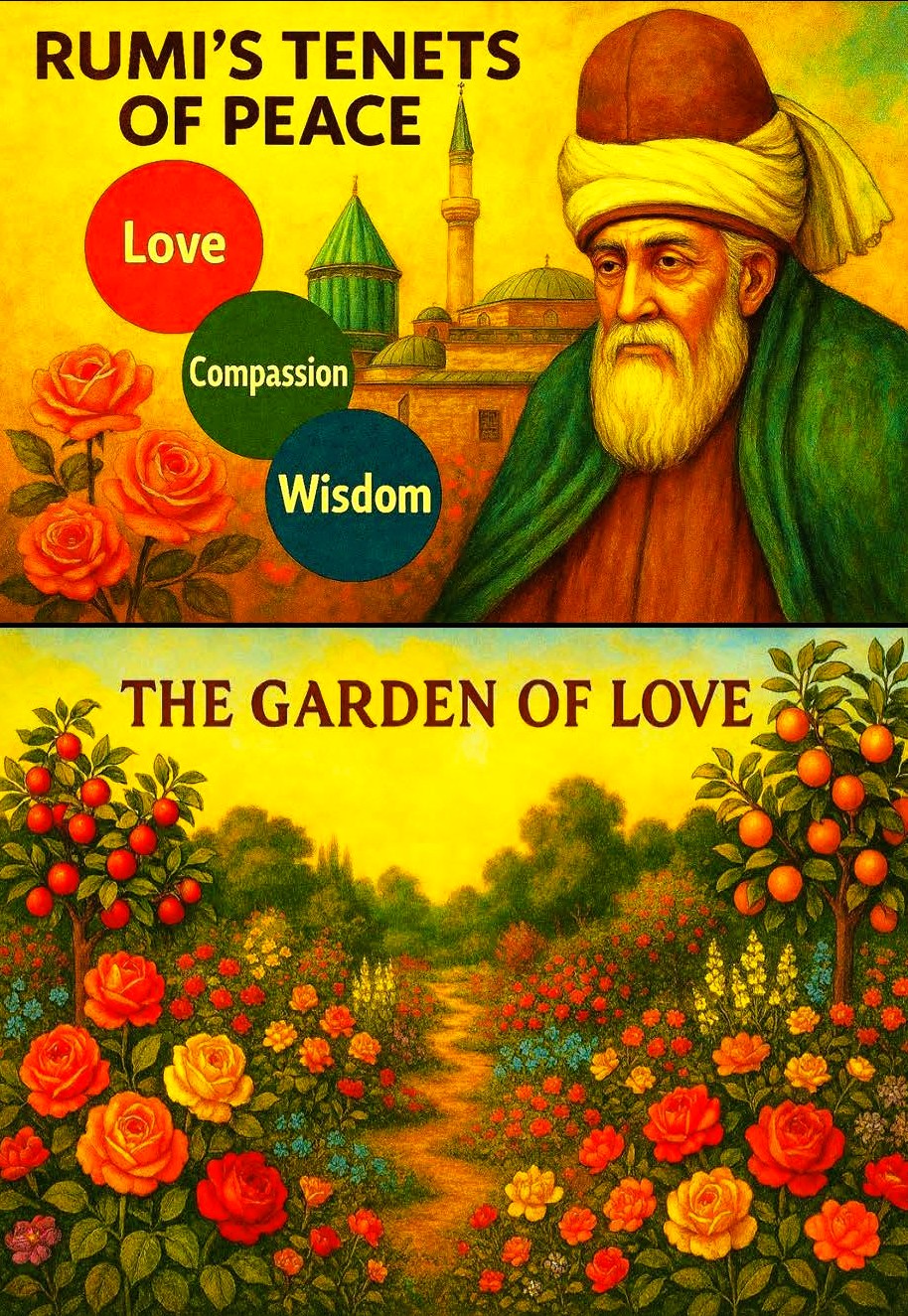
The Rumi’s Tenets of Peace: A Sufi Conception of Endogenous Harmony
Photo Top: This visual composition articulates Jalāl ad‑Dīn Rūmī’s Sufi conception of peace (salām) as an endogenous spiritual state, arising from the inward transformation of the self rather than from external regulation or coercive order. This artwork presents Rumi as a perennial philosopher of peace, one whose insights transcend time and geography, offering a profound counter‑narrative to violence, alienation, and fragmentation through the alchemy of love and inward awakening.
Photo Bottom: The Garden of Love: Distribute Respectful, Divine Love and the world will be full of lovely people, like flowers and fruits in Konya.
Original Graphic Conceptualised by Mrs V. Vawda: April 2026
Rumi articulates this paradisiacal interior condition with characteristic clarity:
“The garden of love is green without limit, and yields many fruits other than sorrow or joy.”
3.5 Ubuntu (Unique, South African Indigenous Philosophy): Relational Peace [13],[14],[15],[16],[17]
Ubuntu affirms relational personhood: “I am because we are.” Peace arises from dignity, reciprocity, and communal belonging. Harm is relational rupture; healing is restorative justice. Ubuntu introduces a social‑neurobiological dimension to peace.
3.6 Nataraja (Indic Philosophy): The Cosmic Dance of Peace Energy [18]
The cosmic dance of Shiva Nataraja symbolises dynamic balance, creation, preservation, dissolution, concealment, and grace. Peace is rhythmic coherence, not stasis. Human violence, in this tradition, reflects desynchronisation from cosmic order.
3.7 Johan Galtung (Modern Peace Studies): Structural Peace [19],[20],[21],[22],[23],[24]
Galtung distinguishes between negative peace (absence of violence) and positive peace (presence of justice). Structural violence, embedded inequality, must be addressed for peace to endure. His work bridges moral insight and systemic critique.
3.8 Madam Vawda’s Endogenous Peace Theory: Biophotonic and Neuroharmonic Coherence. [25]
This integrative framework articulates the biophysical substrate of peace. Cellular systems emit biophotons; neural systems oscillate rhythmically. When these systems are coherent, empathy, restraint, and ethical action emerge naturally. Violence is reconceptualised as biophotonic [26],[27],[28],[29],[30],[31],[32] and neuroharmonic decoherence [33],[34],[35][36] amplified by structural injustice.
- Epigraph
“Peace is not imposed upon the human being;it emerges when coherence is restored within.”
- Take‑Home Message
Across civilisations and sciences, peace is consistently understood as:
- inner coherence preceding outer order,
- alignment preceding enforcement,
- integration preceding intervention.
Ancient wisdom anticipated what modern science now affirms.
- Call for Collective Action
Humanity must re‑orient peacebuilding toward:
- education in emotional and neurological regulation,
- trauma‑informed governance,
- restorative rather than punitive justice,
- interfaith dialogue rooted in shared inner coherence.
Peace is a collective skill, not a slogan.
- Future Strategies
- Integrate peace neuroscience into education curricula.
- Embed Wu Wei principles into governance and leadership.
- Recognise trauma as a core peace and public health issue.
- Develop peace indices measuring wellbeing and coherence.
- Foster civilisational dialogue beyond doctrinal boundaries.
- The Last Word of a Peace Propagator
Peace is not weakness.
It is energetic efficiency, systemic intelligence, and moral courage.
Those who maintain inner coherence become stabilising nodes within turbulent systems. History remembers them as sages, healers, and peacemakers. Today, we may call them peace propagators.
- Benediction for Global and Interstellar Peace
May the hearts of humanity be lighter than truth.
May minds regain coherence.
May societies rediscover moderation.
May peace extend from neuron to nation,
from biosphere to noosphere,
from Earth to the silent harmonies of the cosmos.
And may future generations say of us:
They remembered what peace truly was, and chose to live it.
- A Manifesto for Endogenous Peace
For Humanity, for Earth, and for the Wider Cosmos
We Affirm
Peace is not merely the absence of violence. Peace is the presence of coherence, within the human heart, the human mind, human relationships, human institutions, and the living systems of the Earth.
Across civilisations and centuries, through Maat, Aristotle, Laozi, Rumi, Ubuntu, Nataraja, Galtung, and contemporary biophotonic and neuroharmonic science, humanity has known this truth in many languages:
When inner order is restored, peace emerges naturally.
We Recognise
- That violence is not humanity’s essence, but a symptom of internal and systemic decoherence.
- That injustice persists where balance, dignity, and relational harmony have been disrupted.
- That coercion without coherence cannot sustain peace.
- That external solutions fail when inner regulation is ignored.
Peace treaties collapse when hearts remain heavy. Institutions fracture when minds are dysregulated. Societies decay when systems lose rhythm.
We Declare
- Peace begins within
In the alignment of conscience, emotion, and reason; in the restoration of moral, emotional, and neurological coherence. - Peace extends relationally
Through Ubuntu, recognising that one’s humanity is realised through the dignity and wellbeing of others. - Peace requires restraint
As taught by Wu Wei: non‑forcing, non‑coercive action aligned with natural and social rhythms. - Peace is dynamic, not static
Like the cosmic dance of Nataraja, balance is sustained through movement, not rigidity. - Peace must be just
As Galtung reminds us, structural violence must be transformed, not normalised. - Peace is biologically intelligible
Coherent neural oscillations and synchronised cellular communication nurture empathy, restraint, and compassion; dysregulation breeds fear and aggression.
We Commit
- To educate for emotional, ethical, and neurological regulation.
- To govern with humility, proportionality, and care.
- To heal trauma as a peace imperative.
- To honour all civilisations as equal contributors to humanity’s moral inheritance.
- To cultivate coherence in ourselves before demanding peace from others.
We Envision
A world where:
- Hearts are lighter than truth,
- Minds are coherent rather than reactive,
- Institutions serve life rather than dominate it,
- Difference is held with dignity,
- And peace becomes self‑sustaining.
Our Bottom Line
Peace is not imposed.
Peace is revealed.
Peace is what emerges when coherence is restored.
TheAuthor’s Benediction for the readers
May peace arise from neuron to nation,
From family to civilisation,
From Earth to the wider cosmic field.
May humanity remember, not invent, peace.
And may we live it, together.
- The Bottom Line
Across epochs, geographies, disciplines, and belief systems, humanity has returned, again and again, to a single, persistent truth: peace cannot be sustainably imposed from the outside when it is absent within. Civilisations have differed in metaphors, rituals, cosmologies, and vocabularies, yet their deepest peace wisdom converges on the same principle, order precedes harmony, coherence precedes justice, and alignment precedes peace.
From Maat in ancient Egypt, where the heart was weighed against the feather of cosmic truth; to Aristotle’s insistence that the just polis must reflect the ordered soul; to Laozi’s doctrine of Wu Wei, wherein peace arises through non‑forcing alignment with natural order; to Rumi’s ecstatic declaration that love dissolves the inner conditions of violence; to Ubuntu’s affirmation that one’s humanity is realised only through the humanity of others; to the Indic image of Nataraja’s cosmic dance, a rhythm of creation and dissolution, peace has never been conceived as static, transactional, or merely political. It has been understood as dynamic equilibrium.
Johan Galtung’s modern articulation of positive peace [37][38]extends this insight into the structural domain, exposing the violence embedded in unjust systems. Yet even here, structures ultimately express the internal moral and cognitive states of those who design, inhabit, and enforce them. Structures do not decay in isolation; they decay when coherence collapses at the human level.
It is precisely at this juncture that the endogenous peace framework, articulated through biophotonic synchronicity and neuroharmonic coherence, finds its indispensable place. What antiquity intuited symbolically; modern science now begins to illuminate mechanistically. Living systems, including the human nervous system, tend naturally toward harmony when regulation is restored. Coherent neural oscillations, balanced autonomic tone, and synchronised cellular communication correlate with empathy, ethical restraint, and compassion. Conversely, dysregulation, trauma, and chronic stress produce noise, fragmentation, and aggression, at personal, social, and geopolitical scales.
The bottom line, therefore, is neither mystical abstraction nor reductive materialism. It is a unifying civilisational insight:
Peace is an emergent property of coherent systems, biological, psychological, moral, social, and cosmic.
Violence is not humanity’s destiny; it is the signature of decoherence. Justice is not merely legislated fairness; it is restored alignment. Love is not sentimentality; it is a regulatory force. Governance is not control; it is stewardship of balance. And peace is not passivity; it is the most energetically and ethically efficient state a system can achieve.
This tome ultimately asserts that the future of peace will not be secured by stronger weapons, louder rhetoric, or more complex institutions alone. It will be secured when humanity learns, once more and at scale, to cultivate inner coherence, to honour relational dignity, to exercise restraint, and to align action with wisdom. Only then will outer structures stabilise naturally.
In short:
- When hearts are ordered, societies settle.
- When minds are coherent, violence diminishes.
- When systems align with their own rhythms, peace becomes self‑sustaining.
That is the Bottom Line, ancient in origin, modern in validation, and urgent in its invitation, for humanity, which is listening, and not only wants to be, but absolutely needs to be humane.
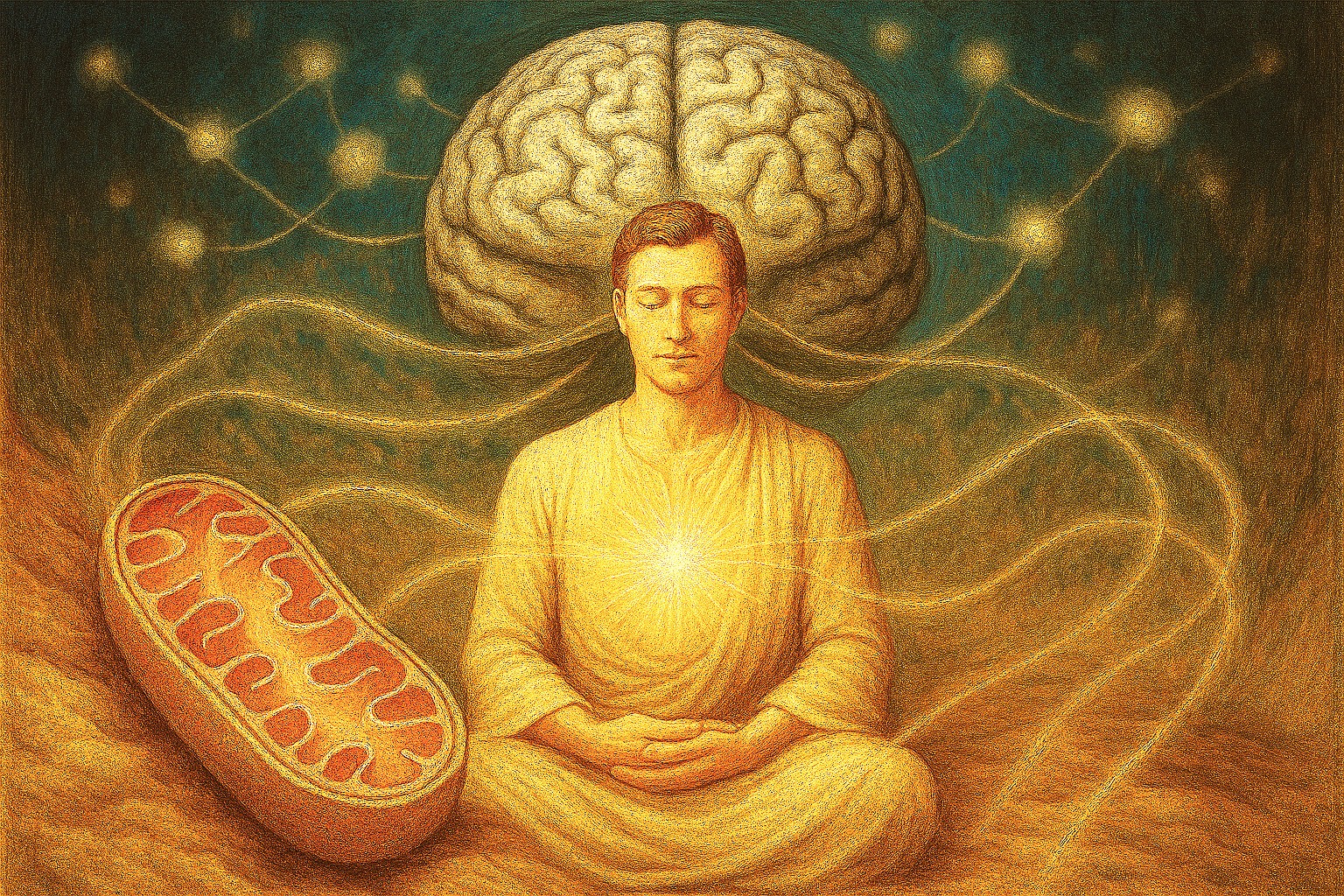
The Lords of Peace and Endogenous phenomenon, linking up with synchronised biophotons and coherent neuroharmonics, from the mitochondrial level to the cosmic expansion resulting in Exogenous, Universal Peace
Original Graphic Conceptualised by Mrs V. Vawda: April 2026
References:
[1] Personal Quote by author, January 2026
[2] Personal Quote by author, January 2026
[3] https://www.bing.com/ck/a?!&&p=a0a405d7c32c96201ce015e4747d37dfc6ffa27d3fbf947cb60324bceaa691efJmltdHM9MTc3NjM4NDAwMA&ptn=3&ver=2&hsh=4&fclid=2b35ea2c-b8d0-63b3-2370-fd36b95362a4&psq=epistemic+humility+definition&u=a1aHR0cHM6Ly9lbi53aWtpcGVkaWEub3JnL3dpa2kvRXBpc3RlbWljX2h1bWlsaXR5
[4] https://www.bing.com/ck/a?!&&p=52e43d5eac9c561b3782f082087b517576492767778e7802175911eb79bfa2a6JmltdHM9MTc3NjM4NDAwMA&ptn=3&ver=2&hsh=4&fclid=2b35ea2c-b8d0-63b3-2370-fd36b95362a4&psq=dikaiosyn%c4%93)&u=a1aHR0cHM6Ly93d3cuYmx1ZWxldHRlcmJpYmxlLm9yZy9sZXhpY29uL2cxMzQzL2tqdi90ci8wLTEv
[5] https://www.bing.com/ck/a?!&&p=9b57653caf9f9ef2d798f2787364f1c275516fc8821861fcf89d681649f9859eJmltdHM9MTc3NjM4NDAwMA&ptn=3&ver=2&hsh=4&fclid=2b35ea2c-b8d0-63b3-2370-fd36b95362a4&psq=Laozi+(Taoism)%3a+Wu+Wei+and+Regulatory+Peace&u=a1aHR0cHM6Ly93d3cubWRwaS5jb20vMjA3Ny0xNDQ0LzE2LzMvMzky
[6] https://www.bing.com/ck/a?!&&p=bfd69a56efebca25abda2f77e9271eb0c469dc2c6bee44a643cc6939c84230e2JmltdHM9MTc3NjM4NDAwMA&ptn=3&ver=2&hsh=4&fclid=2b35ea2c-b8d0-63b3-2370-fd36b95362a4&psq=Laozi+(Taoism)%3a+Wu+Wei+and+Regulatory+Peace&u=a1aHR0cHM6Ly9lbmVyZ3lzcGlyaXR1YWwuY29tL3RoZS1wYXRoLW9mLWZsb3ctdW5kZXJzdGFuZGluZy10YW9pc20taW4tdGhlLW1vZGVybi13b3JsZC8
[7] https://www.bing.com/ck/a?!&&p=89d163f7a48dc042a9cdbac7b4f4718a6eb47414edbc0bf864794abd959bc50fJmltdHM9MTc3NjM4NDAwMA&ptn=3&ver=2&hsh=4&fclid=2b35ea2c-b8d0-63b3-2370-fd36b95362a4&psq=wu+wei+meaning&u=a1aHR0cHM6Ly9lbi53aWtpcGVkaWEub3JnL3dpa2kvV3Vfd2Vp
[8] https://www.bing.com/ck/a?!&&p=fa06695fe75c4abe41954d305d8af8ea69e08cb288b034ee0449f3a44228a819JmltdHM9MTc3NjM4NDAwMA&ptn=3&ver=2&hsh=4&fclid=2b35ea2c-b8d0-63b3-2370-fd36b95362a4&psq=Laozi+(Taoism)%3a+Wu+Wei+and+Regulatory+Peace&u=a1aHR0cHM6Ly93d3cuYW5jaWVudC1vcmlnaW5zLm5ldC9zYWdlLXN0b3BwZWQtZm9yY2luZy1saWZlLWhvdy1sYW8tdHp1LXMtd3Utd2VpLWNhbi1icmluZy15b3UtYmFjay1mbG93LTAwMTAyNjk3
[9] https://www.bing.com/ck/a?!&&p=11d753d80c8c12870933c59a1d8679ff4dcbd2d3fc40b7ba9ab1a1f743533843JmltdHM9MTc3NjM4NDAwMA&ptn=3&ver=2&hsh=4&fclid=2b35ea2c-b8d0-63b3-2370-fd36b95362a4&psq=The+Core+of+Taoist+Life+Philosophy+for+Inner+Peace&u=a1aHR0cHM6Ly9yZWFsaXR5cGF0aGluZy5jb20vdGhlLXRhb2lzdC1wYXRoLXRvLWlubmVyLXBlYWNlLWFuZC1jb250ZW50bWVudC8
[10] https://www.bing.com/ck/a?!&&p=51e11dfec65d49d762e98c990cf61d4f89e8835d3929cf92c926be5c027499a6JmltdHM9MTc3NjM4NDAwMA&ptn=3&ver=2&hsh=4&fclid=2b35ea2c-b8d0-63b3-2370-fd36b95362a4&psq=The+Core+of+Taoist+Life+Philosophy+for+Inner+Peace&u=a1aHR0cHM6Ly9zcGlyaXR1YWxtZWFuaW5nc2d1aWRlLmNvbS90aGUtcm9sZS1vZi10YW8taW4tYWNoaWV2aW5nLWlubmVyLXBlYWNlLWFuZC1jbGFyaXR5Lw
[11] https://www.bing.com/ck/a?!&&p=89d163f7a48dc042a9cdbac7b4f4718a6eb47414edbc0bf864794abd959bc50fJmltdHM9MTc3NjM4NDAwMA&ptn=3&ver=2&hsh=4&fclid=2b35ea2c-b8d0-63b3-2370-fd36b95362a4&psq=wu+wei+meaning&u=a1aHR0cHM6Ly9lbi53aWtpcGVkaWEub3JnL3dpa2kvV3Vfd2Vp
[12] https://www.bing.com/ck/a?!&&p=6cb595c113db1cd3cb355b3ce016153266c465201569c209d202c33d2023dccbJmltdHM9MTc3NjM4NDAwMA&ptn=3&ver=2&hsh=4&fclid=2b35ea2c-b8d0-63b3-2370-fd36b95362a4&psq=Dao+De+Jing%2c+Chapter+37&u=a1aHR0cHM6Ly93d3cuZWdyZWVud2F5LmNvbS90YW9pc20vdHRjbHozNy5odG0
[13] https://www.transcend.org/tms/2026/01/ubuntu-rising-a-peace-force-against-global-belligerism/
[14] https://www.transcend.org/tms/2025/11/the-johannesburg-g20-summit-gambit-ubuntus-challenge-to-a-fragmenting-world-order/
[15] https://www.transcend.org/tms/2026/02/from-diagnosis-to-design-from-violence-to-value-ubuntu-and-the-transformative-peace-triangles-of-21st-century-part-2/
[16] https://www.transcend.org/tms/2026/04/peace-in-the-shadow-and-shade-of-colonial-imperialism-a-protagonists-call-to-decolonize-the-diasporic-mind-part-1/
[17] https://www.transcend.org/tms/2026/03/the-foundations-of-communal-peace-sustaining-threatened-languages-as-peace-infrastructure-part-1/
[18] https://www.transcend.org/tms/2025/09/the-lord-of-the-dances-a-sanctuary-of-motion/
[19] https://www.transcend.org/tms/2024/02/prof-johan-galtung-left-us/
[20] https://www.transcend.org/tms/2023/12/the-forgotten-part-6-the-pillars-of-peace-propagators-from-yajnavalkya-in-antiquity-to-johan-galtung-today/
[21] https://www.transcend.org/tms/2026/04/the-escalating-belligerence-in-the-middle-east-a-peace-propagators-academic-analysis-of-the-iran-war-of-choice/
[22] https://www.transcend.org/tms/2024/02/global-evils-today-part-2-misinformation-disinformation-and-media-propaganda-demystified/
[23] https://www.transcend.org/tms/2025/08/the-attainment-of-peace-a-multidimensional-perspective/
[24] https://www.transcend.org/tms/2023/07/stoicism-unveiling-the-elusive-path-to-peace-part-2/
[25] https://www.transcend.org/tms/2026/02/from-diagnosis-to-design-from-violence-to-value-ubuntu-and-the-transformative-peace-triangles-of-21st-century-part-2/
[26] https://www.transcend.org/tms/2025/08/light-of-life-the-synchronised-biophotons-and-photobionts-a-novel-hypothesis-part-2/
[27] https://www.transcend.org/tms/2025/08/biophotons-and-the-peace-crusade-a-21st-century-manifesto-written-in-light-part-1/
[28] https://www.transcend.org/tms/2026/04/the-escalating-belligerence-in-the-middle-east-a-peace-propagators-academic-analysis-of-the-iran-war-of-choice/
[29] https://www.transcend.org/tms/2026/03/sustained-indigenous-languages-and-peace-the-mandela-ubuntu-language-interactivity-part-2/
[30] https://www.transcend.org/tms/2026/03/the-global-geometry-of-peace-from-triangles-to-trinity-to-transcendence-a-peace-convergence-when-science-spirit-and-story-become-one-part-3/
[31] https://www.transcend.org/tms/2026/02/from-possession-to-presence-from-posture-to-pilgrimage-a-trans-tradition-framework-for-endogenous-and-exogenous-peace-part-1/
[32] https://www.transcend.org/tms/2025/11/valmiki-the-silent-seer-of-resonant-endogenous-and-global-peace/
[33] https://www.transcend.org/tms/2025/09/a-peace-odyssey-the-duality-of-the-human-brain-from-reptilian-instincts-to-humane-consciousness/
[34] https://www.transcend.org/tms/2025/09/the-lord-of-the-dances-a-sanctuary-of-motion/
[35] https://www.transcend.org/tms/2025/12/peace-of-the-festive-season-and-the-birth-of-christ-an-interfaith-reflection/
[36] https://www.transcend.org/tms/2025/09/from-swords-to-solutions-a-comparative-analysis-of-vegetius-military-doctrine-and-modern-peace-theories/
[37] https://www.bing.com/ck/a?!&&p=0e56505bcca990b483a3dfe75f3b10613704145c75a9ce712e4b5783f1b886ccJmltdHM9MTc3NjM4NDAwMA&ptn=3&ver=2&hsh=4&fclid=2b35ea2c-b8d0-63b3-2370-fd36b95362a4&psq=Johan+Galtung%e2%80%99s+modern+articulation+of+positive+peace+by+vawda&u=a1aHR0cHM6Ly93d3cudHJhbnNjZW5kLm9yZy90bXMvMjAyNi8wMi9mcm9tLWRpYWdub3Npcy10by1kZXNpZ24tZnJvbS12aW9sZW5jZS10by12YWx1ZS11YnVudHUtYW5kLXRoZS10cmFuc2Zvcm1hdGl2ZS1wZWFjZS10cmlhbmdsZXMtb2YtMjFzdC1jZW50dXJ5LXBhcnQtMi8
[38] https://www.bing.com/ck/a?!&&p=4d7f02d086d01389f75cd331e9e6825d4fd1e578408a116238bd8905c0077df0JmltdHM9MTc3NjM4NDAwMA&ptn=3&ver=2&hsh=4&fclid=2b35ea2c-b8d0-63b3-2370-fd36b95362a4&psq=Johan+Galtung%e2%80%99s+modern+articulation+of+positive+peace+by+vawda&u=a1aHR0cHM6Ly93d3cudHJhbnNjZW5kLm9yZy90bXMvMjAyNS8wOC90aGUtYXR0YWlubWVudC1vZi1wZWFjZS1hLW11bHRpZGltZW5zaW9uYWwtcGVyc3BlY3RpdmUv
______________________________________________
Professor G. Hoosen M. Vawda (Bsc; MBChB; PhD.Wits) is a member of the TRANSCEND Network for Peace Development Environment.
Director: Glastonbury Medical Research Centre; Community Health and Indigent Programme Services; Body Donor Foundation SA.
Principal Investigator: Multinational Clinical Trials
Consultant: Medical and General Research Ethics; Internal Medicine and Clinical Psychiatry:UKZN, Nelson R. Mandela School of Medicine
Executive Member: Inter Religious Council KZN SA
Public Liaison: Medical Misadventures
Activism: Justice for All
Email: vawda@ukzn.ac.za
Tags: Johan Galtung, Peace Mandala
This article originally appeared on Transcend Media Service (TMS) on 20 Apr 2026.
Anticopyright: Editorials and articles originated on TMS may be freely reprinted, disseminated, translated and used as background material, provided an acknowledgement and link to the source, TMS: Endogenous Peace Principles Across Civilisations, from Maat in Antiquity to Biophotonic Coherence: A Humane, Scientific, and Sacred Science of Peace Part 1, is included. Thank you.
If you enjoyed this article, please donate to TMS to join the growing list of TMS Supporters.

This work is licensed under a CC BY-NC 4.0 License.
Join the discussion!
We welcome debate and dissent, but personal — ad hominem — attacks (on authors, other users or any individual), abuse and defamatory language will not be tolerated. Nor will we tolerate attempts to deliberately disrupt discussions. We aim to maintain an inviting space to focus on intelligent interactions and debates.